Electrolyte Hydration Beverages Market Size, Share, Revenue Report 2026 to 2035
What is Electrolyte Hydration Beverages Market?
Electrolyte Hydration Beverages Market is estimated to grow at a 7.8% CAGR during the forecast period for 2026 to 2035.
Electrolyte Hydration Beverages Market Size, Share & Trends Analysis Distribution by Product Type (Sports Drinks, Electrolyte Drinks & Hydration Mixes, Oral Rehydration Solutions (ORS)), By Format (Ready-to-Drink (RTD), Powders & Drink Mixes, Effervescent & Dissolvable Tablets, Liquid Concentrates, Drops & Other Formats), By Sugar Content (Sugar-Containing, Zero / Low-Sugar), By Distribution Channel (Supermarkets, Hypermarkets & Mass Merchandisers, Convenience & Forecourt Stores, Pharmacies & Drugstores, Online Retail & Direct-to-Consumer, Institutional, Foodservice & Other Channels) and Segment Forecasts, 2026 to 2035
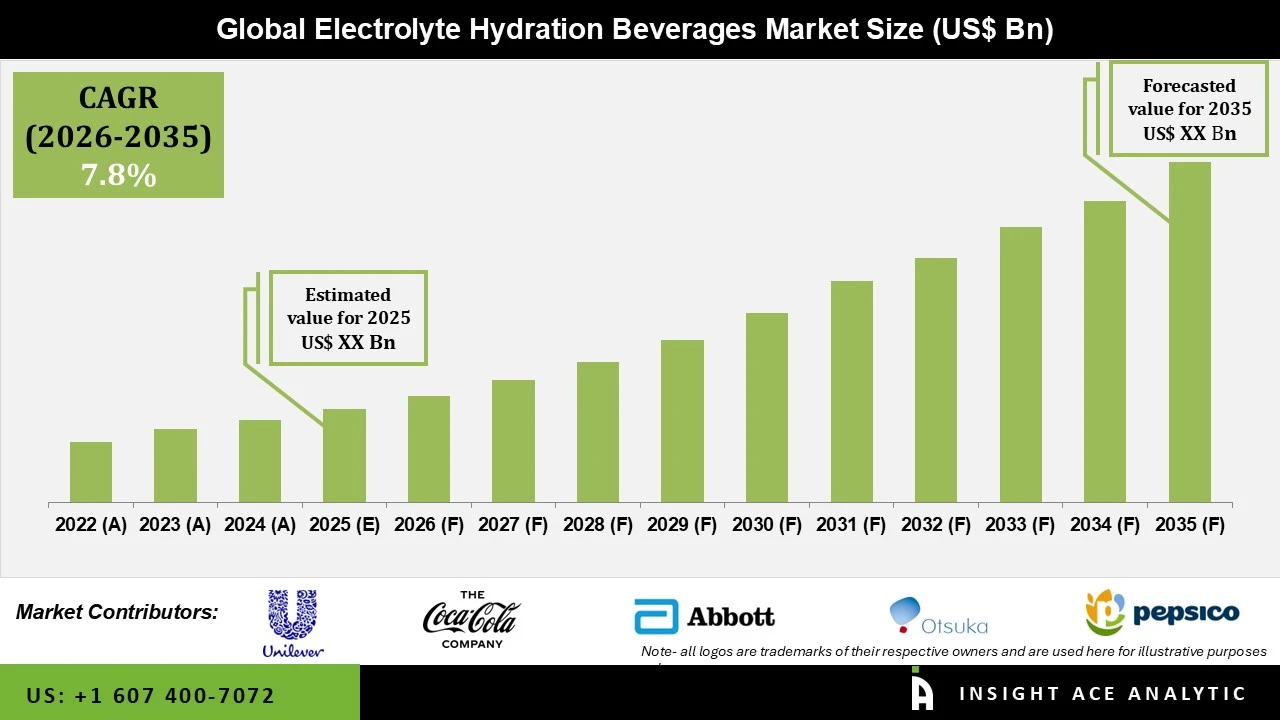
Electrolyte hydration drinks are designed to replace the fluids and essential electrolytes such as sodium, potassium, magnesium, and chloride which are lost via sweating, physical activity, illness, or dehydration. The category includes a wide variety of products, such as sports drinks, beverages with added electrolytes, hydration mixes, ready-to-drink solutions, powders, effervescent tablets, liquid concentrates, and oral rehydration solutions (ORS). These products are used in a number of different situations, including ordinary hydration and exercise recovery as well as in clinical and therapeutic rehydration.
The market for electrolyte hydration beverages involves the production and sale of drinks and hydration products intended to help with the replacement of fluids and electrolytes in a variety of areas such as consumer use, sports nutrition, and healthcare. It covers sports drinks, electrolyte drinks and hydration mixes as well as ORS, with products available in ready-to-drink beverages, powders and drink mixes, effervescent tablets, and liquid concentrates. Distribution of the market takes place via supermarkets and large retailers, convenience stores, pharmacies, online and direct-to-consumer channels, and also through institutional and foodservice outlets. The market includes both well-known beverage and healthcare companies as well as specialized hydration brands that operate in regional markets.
Competitive Landscape
Which are the Leading Players in the Electrolyte Hydration Beverages Market?
• PepsiCo, Inc.
• The Coca-Cola Company
• Abbott Laboratories
• Otsuka Holdings Co., Ltd.
• Unilever PLC
• Suntory Beverage & Food Limited
• Grupo PiSA
• Congo Brands
• The Vita Coco Company, Inc.
• Prestige Consumer Healthcare Inc.
• Drink LMNT, Inc.
• Science in Sport Limited
• BioSteel Sports Nutrition Inc.
• DripDrop Hydration, PBC
• The Hydration Pharmaceuticals Company Limited
• Skratch Labs LLC
• Precision Fuel & Hydration Ltd
• Ultima Health Products, Inc.
• Tailwind Nutrition
• FDC Limited
Market Dynamics
Driver
Rising Demand for Hydration and Electrolyte Replenishment
The strong interest on the part of consumers in hydration, physical well-being, and replacing electrolytes is a key factor in driving this market. Nowadays, people are looking more than ever for drinks that offer greater functional benefits than ordinary water, especially in relation to replenishing the electrolytes lost through exercise, outdoor activities, travel, heat exposure, and ordinary physical activity. As there is greater involvement in sports, fitness, and active lifestyles, demand for drinks that contain electrolytes also rises, and the availability of ready-to-drink options as well as portable powders and mixes makes it easier to include electrolyte supplementation into one's daily routine.
Restrain/Challenge
Product Differentiation and Market Saturation
The electrolyte hydration beverages market faces a significant challenge in the form of intense competition and the need for product differentiation. In this market one finds multinational beverage companies, pharmaceutical and healthcare companies, sports nutrition brands, and newer direct-to-consumer hydration companies which are all providing products that have increasingly similar electrolyte, hydration, low-sugar, and functional claims. As a result the product range is highly crowded and it becomes difficult for brands to achieve real differentiation except through flavour, electrolyte composition, formulation, packaging, pricing, and brand positioning. It is necessary for companies to keep on innovating while at the same time ensuring that their products remain effective, that consumer trust is maintained, and that competitive pricing is preserved, especially since consumers have a wide variety of hydration products to select from.
Electrolyte Drinks & Hydration Mixes Segment is Expected to Drive the Electrolyte Hydration Beverages Market
Electrolyte drinks & hydration mixes are expected to emerge as the growth-leading product type in the electrolyte hydration beverages market, supported by their broad applicability across everyday hydration, sports and fitness, wellness, travel, and active lifestyles. The segment is benefiting from the increasing variety of convenient forms such as ready-to-drink beverages, powders, sachets, tablets and concentrated mixes, enabling consumers to choose products according to their hydration requirements and the situations in which they plan to consume them.
Moreover, ongoing product innovation involving low-sugar, sugar-free, functional and customised electrolyte formulations is extending the segment past traditional sports nutrition and drawing in a broader consumer group.
Powders & Drink Mixes Segment is Growing at the Highest Rate in the Electrolyte Hydration Beverages Market
Powders & drink mixes are expected to register the highest growth rate in the Electrolyte Hydration Beverages Market, supported by their portability, convenience, extended shelf life, and ease of preparation. People are increasingly choosing single-serve sachets and powdered forms for use in sports, fitness, travel, and for everyday hydration, and product innovation involving low-sugar, sugar-free, and special electrolyte formulations is helping to increase consumer interest in these products. The lightweight packaging, efficient transport, and compatibility with e-commerce as well as direct-to-consumer distribution also contribute to the segment's growth.
Why North America Led the Electrolyte Hydration Beverages Market?
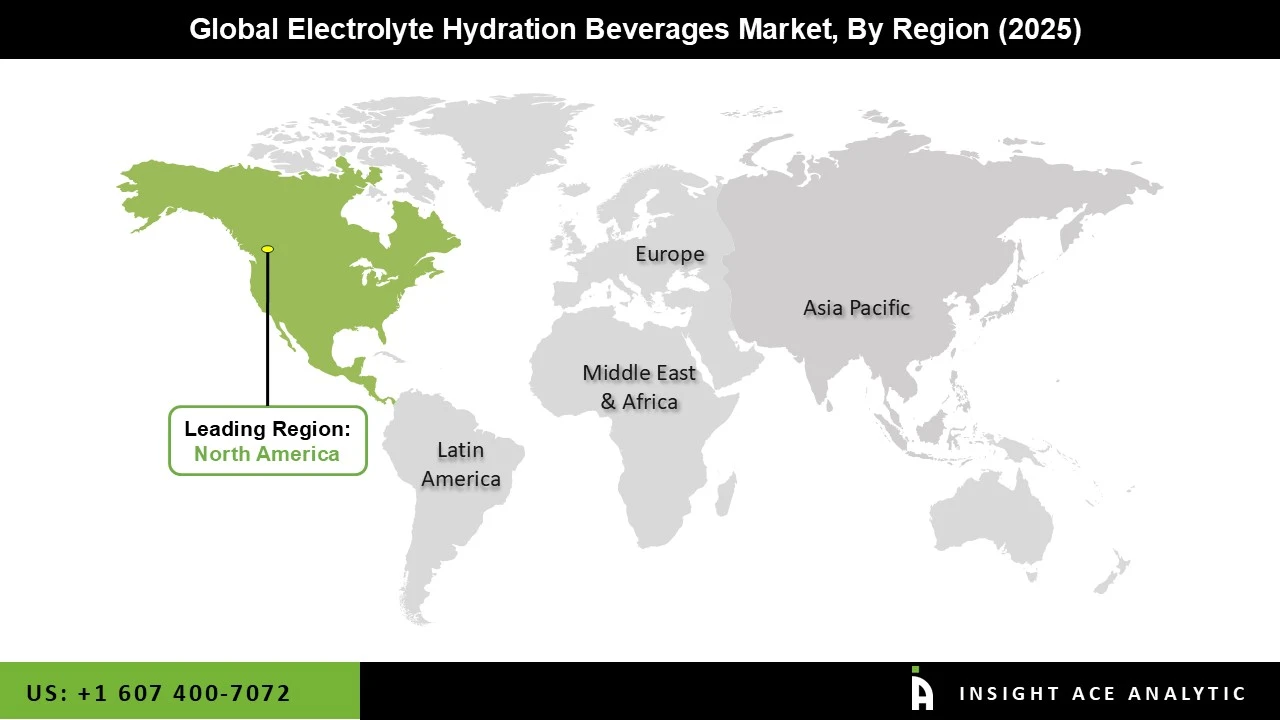
North America is projected to be the leader of the electrolyte hydration beverages market owing to the established sports and fitness beverages industry in the region, along with the awareness regarding hydration and electrolyte replacement among consumers in the region, and the availability of sports beverages, electrolyte mixers, and ready to drink hydration beverages. Moreover, the presence of key players like PepsiCo, The Coca-Cola Company, Abbott, and hydration brands will add value to the regional market. In addition, active engagement in fitness and sports activities, and rising preference for functional and low sugar beverages drives the market growth.
Key Development
March 2026: Gatorade launched Gatorade Lower Sugar, featuring 75% less sugar than Gatorade Thirst Quencher and Gatorade’s proven electrolyte blend, expanding its low-sugar hydration portfolio.
February 2026: Otsuka opened its second POCARI SWEAT manufacturing facility in Tianjin, China, increasing production capacity by approximately 2.5 times to meet growing demand for hydration and electrolyte replenishment products.
Electrolyte Hydration Beverages Market Report Scope:
| Report Attribute | Specifications |
| Growth Rate CAGR | CAGR of 7.8% from 2026 to 2035 |
| Quantitative Units | Representation of revenue in US$ Bn and CAGR from 2026 to 2035 |
| Historic Year | 2022 to 2025 |
| Forecast Year | 2026-2035 |
| Report Coverage | The forecast of revenue, the position of the company, the competitive market structure, growth prospects, and trends |
| Segments Covered | Product Type, Format, Sugar Content, Distribution Channel and By Region |
| Regional Scope | North America; Europe; Asia Pacific; Latin America; Middle East & Africa |
| Country Scope | U.S.; Canada; U.K.; Germany; China; India; Japan; Brazil; Mexico; France; Italy; Spain; South Korea; Southeast Asia |
| Competitive Landscape | PepsiCo, Inc., The Coca-Cola Company , Abbott Laboratories, Otsuka Holdings Co., Ltd., Unilever PLC, Suntory Beverage & Food Limited, Grupo PiSA, Congo Brands, The Vita Coco Company, Inc., Prestige Consumer Healthcare Inc., Drink LMNT, Inc. |
| Customization Scope | Free customization report with the procurement of the report, Modifications to the regional and segment scope. Geographic competitive landscape. |
| Pricing and Available Payment Methods | Explore pricing alternatives that are customized to your particular study requirements. |
Market Segmentation:
Electrolyte Hydration Beverages Market by Product Type -
• Sports Drinks
• Electrolyte Drinks & Hydration Mixes
• Oral Rehydration Solutions (ORS)
o Pharmaceutical ORS
o Consumer Rehydration Solutions
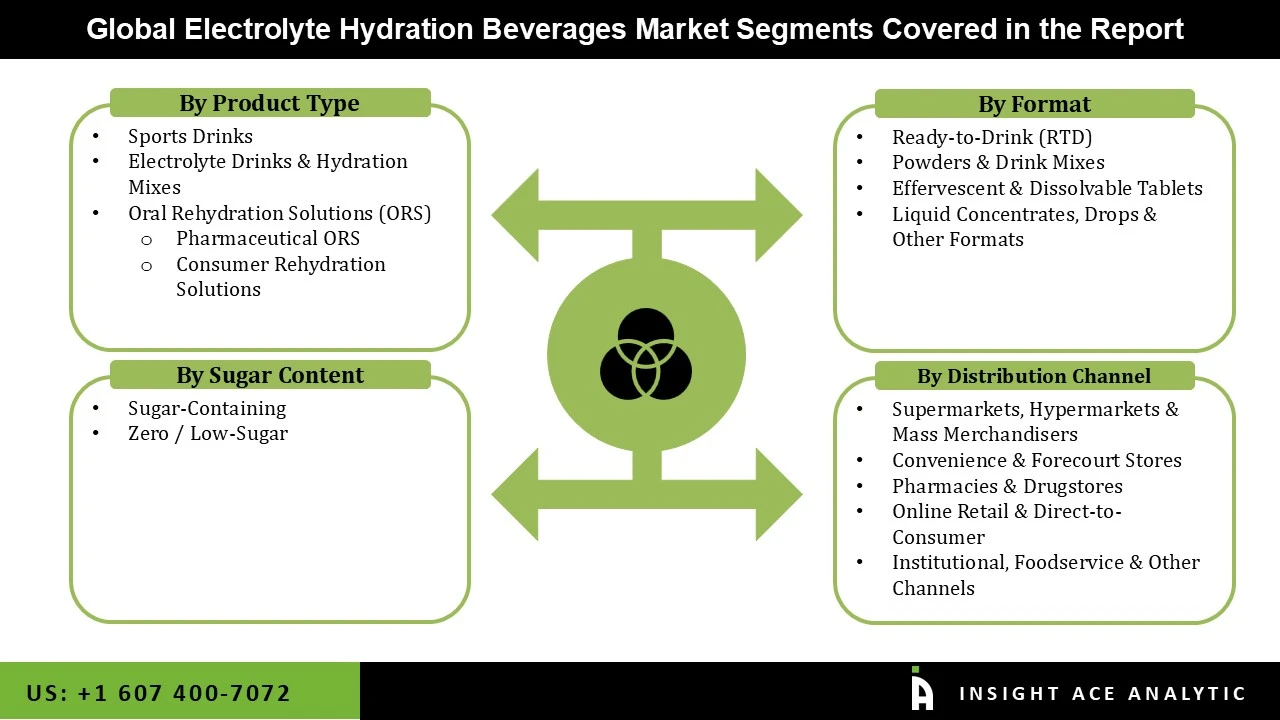
Electrolyte Hydration Beverages Market by Format -
• Ready-to-Drink (RTD)
• Powders & Drink Mixes
• Effervescent & Dissolvable Tablets
• Liquid Concentrates, Drops & Other Formats
Electrolyte Hydration Beverages Market by Sugar Content -
• Sugar-Containing
• Zero / Low-Sugar
Electrolyte Hydration Beverages Market by Distribution Channel -
• Supermarkets, Hypermarkets & Mass Merchandisers
• Convenience & Forecourt Stores
• Pharmacies & Drugstores
• Online Retail & Direct-to-Consumer
• Institutional, Foodservice & Other Channels
Electrolyte Hydration Beverages Market by Region-
North America-
• The US
• Canada
• Mexico
Europe-
• Germany
• The UK
• France
• Italy
• Spain
• Rest of Europe
Asia-Pacific-
• China
• Japan
• India
• South Korea
• South East Asia
• Rest of Asia Pacific
Latin America-
• Brazil
• Argentina
• Rest of Latin America
Middle East & Africa-
• GCC Countries
• South Africa
• Rest of Middle East and Africa
Research Design and Approach
This study employed a multi-step, mixed-method research approach that integrates:
- Secondary research
- Primary research
- Data triangulation
- Hybrid top-down and bottom-up modelling
- Forecasting and scenario analysis
This approach ensures a balanced and validated understanding of both macro- and micro-level market factors influencing the market.
Secondary Research
Secondary research for this study involved the collection, review, and analysis of publicly available and paid data sources to build the initial fact base, understand historical market behaviour, identify data gaps, and refine the hypotheses for primary research.
Sources Consulted
Secondary data for the market study was gathered from multiple credible sources, including:
- Government databases, regulatory bodies, and public institutions
- International organizations (WHO, OECD, IMF, World Bank, etc.)
- Commercial and paid databases
- Industry associations, trade publications, and technical journals
- Company annual reports, investor presentations, press releases, and SEC filings
- Academic research papers, patents, and scientific literature
- Previous market research publications and syndicated reports
These sources were used to compile historical data, market volumes/prices, industry trends, technological developments, and competitive insights.
Primary Research
Primary research was conducted to validate secondary data, understand real-time market dynamics, capture price points and adoption trends, and verify the assumptions used in the market modelling.
Stakeholders Interviewed
Primary interviews for this study involved:
- Manufacturers and suppliers in the market value chain
- Distributors, channel partners, and integrators
- End-users / customers (e.g., hospitals, labs, enterprises, consumers, etc., depending on the market)
- Industry experts, technology specialists, consultants, and regulatory professionals
- Senior executives (CEOs, CTOs, VPs, Directors) and product managers
Interview Process
Interviews were conducted via:
- Structured and semi-structured questionnaires
- Telephonic and video interactions
- Email correspondences
- Expert consultation sessions
Primary insights were incorporated into demand modelling, pricing analysis, technology evaluation, and market share estimation.
Data Processing, Normalization, and Validation
All collected data were processed and normalized to ensure consistency and comparability across regions and time frames.
The data validation process included:
- Standardization of units (currency conversions, volume units, inflation adjustments)
- Cross-verification of data points across multiple secondary sources
- Normalization of inconsistent datasets
- Identification and resolution of data gaps
- Outlier detection and removal through algorithmic and manual checks
- Plausibility and coherence checks across segments and geographies
This ensured that the dataset used for modelling was clean, robust, and reliable.
Market Size Estimation and Data Triangulation
Bottom-Up Approach
The bottom-up approach involved aggregating segment-level data, such as:
- Company revenues
- Product-level sales
- Installed base/usage volumes
- Adoption and penetration rates
- Pricing analysis
This method was primarily used when detailed micro-level market data were available.
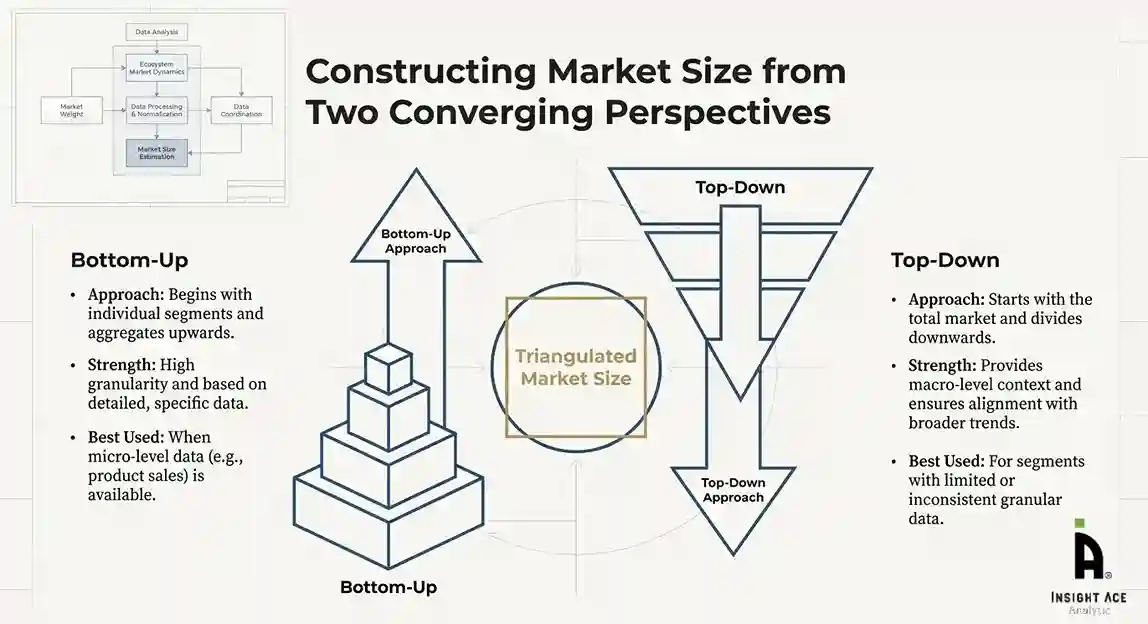
Top-Down Approach
The top-down approach used macro-level indicators:
- Parent market benchmarks
- Global/regional industry trends
- Economic indicators (GDP, demographics, spending patterns)
- Penetration and usage ratios
This approach was used for segments where granular data were limited or inconsistent.
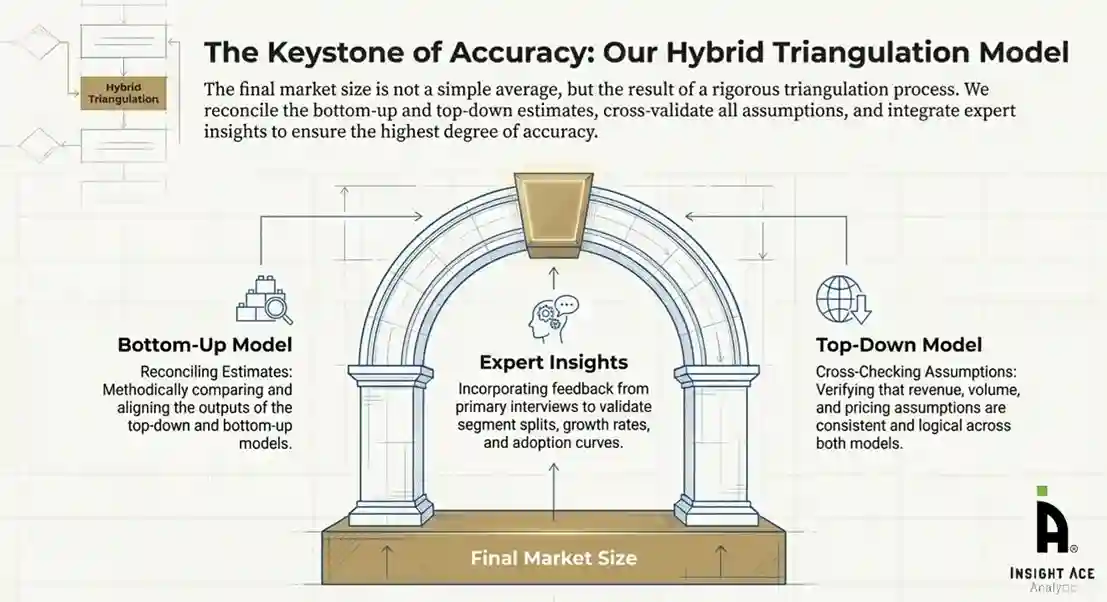
Hybrid Triangulation Approach
To ensure accuracy, a triangulated hybrid model was used. This included:
- Reconciling top-down and bottom-up estimates
- Cross-checking revenues, volumes, and pricing assumptions
- Incorporating expert insights to validate segment splits and adoption rates
This multi-angle validation yielded the final market size.
Forecasting Framework and Scenario Modelling
Market forecasts were developed using a combination of time-series modelling, adoption curve analysis, and driver-based forecasting tools.
Forecasting Methods
- Time-series modelling
- S-curve and diffusion models (for emerging technologies)
- Driver-based forecasting (GDP, disposable income, adoption rates, regulatory changes)
- Price elasticity models
- Market maturity and lifecycle-based projections
Scenario Analysis
Given inherent uncertainties, three scenarios were constructed:
- Base-Case Scenario: Expected trajectory under current conditions
- Optimistic Scenario: High adoption, favourable regulation, strong economic tailwinds
- Conservative Scenario: Slow adoption, regulatory delays, economic constraints
Sensitivity testing was conducted on key variables, including pricing, demand elasticity, and regional adoption.
Request Customization
Add countries, segments, company profiles, or extend forecast — free 10% customization with purchase.
Customize This Report →Enquire Before Buying
Speak with our analyst team about scope, methodology, pricing, or deliverable formats.
Enquire Now →Frequently Asked Questions
Electrolyte Hydration Beverages Market is estimated to grow at a 7.8% CAGR during the forecast period for 2026 to 2035.
PepsiCo, Inc., The Coca-Cola Company , Abbott Laboratories, Otsuka Holdings Co., Ltd., Unilever PLC, Suntory Beverage & Food Limited, Grupo PiSA, Congo Brands, The Vita Coco Company, Inc., Prestige Consumer Healthcare Inc., Drink LMNT, Inc.
Electrolyte Hydration Beverages Market is segmented into Product Type, Format, Sugar Content, Distribution Channel and By Region.
North America region is leading the Electrolyte Hydration Beverages Market