Protein Supplement Formats Market Size, Trend, Forecast Report 2026 to 2035
What is Protein Supplement Formats Market Size?
Protein Supplement Formats Market Size is valued at USD 24.60 Bn in 2025 and is predicted to reach USD 55.25 Bn by the year 2035 at a 8.8% CAGR during the forecast period for 2026 to 2035.
Protein Supplement Formats Market Size, Share & Trends Analysis Distribution by Product Form (Protein Powder, Ready-to-Drink (RTD) Protein Beverages, Protein Bars, Other Formats (Capsules, Gels, Mixes & Functional Formats)), by Source & Protein Type (Animal-Based Protein, Whey (Concentrate, Isolate, Hydrolysate), Casein & Milk Protein, Egg & Other Animal Proteins, Plant-Based Protein, Soy Protein, Pea Protein, Rice, Hemp & Other Plant Proteins, Blended Protein, Animal-Plant Blends, Multi-Plant Blends), by Application / Positioning (Sports & Performance Nutrition, Weight Management, General Wellness & Active Lifestyle, Meal Replacement & Functional Nutrition, Clinical / Medical & Healthy-Aging Nutrition), by Consumer Group / End User, by Distribution Channel and Segment Forecasts, 2026 to 2035
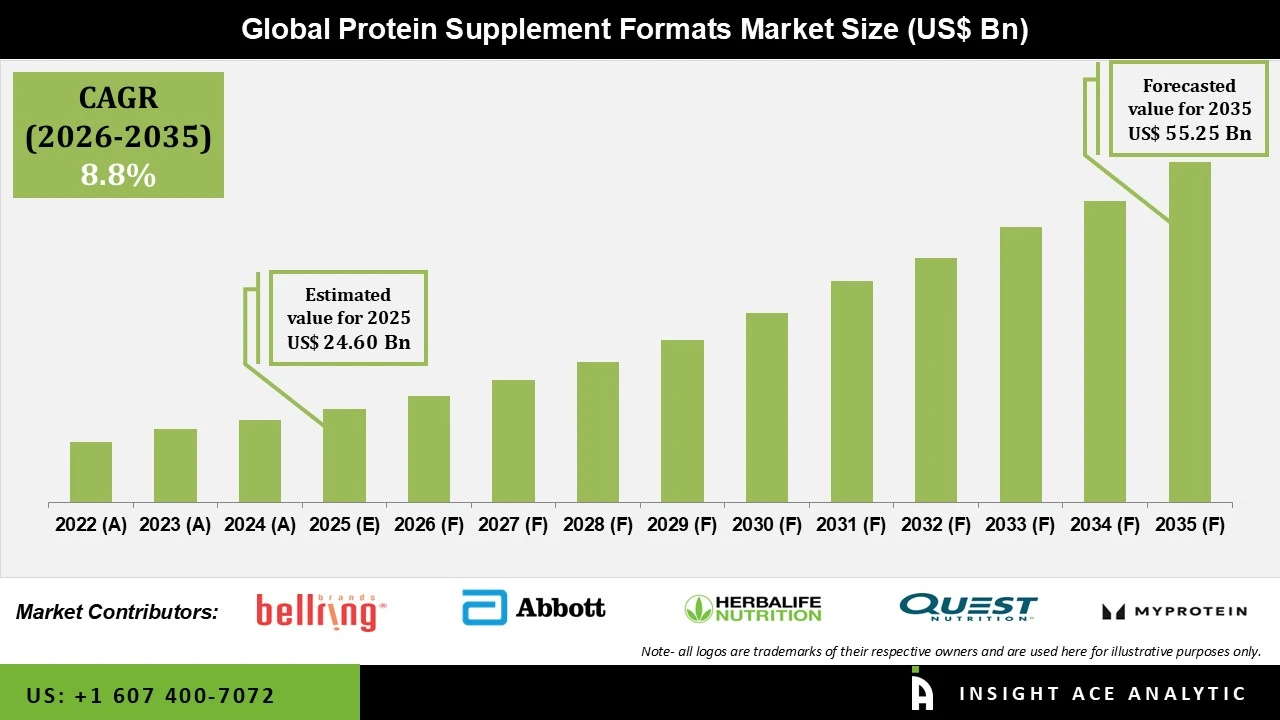
Protein supplements are becoming an increasingly common part of modern nutrition as consumers pay greater attention to protein intake, fitness, healthy ageing, weight management, and overall wellness. These products are available in a wide range of formats, including protein powders, ready-to-drink (RTD) beverages, protein bars, capsules, gels, and other functional products. This variety allows consumers to choose products based on their lifestyle, nutritional needs, convenience, and personal preferences. Athletes and bodybuilders widely use protein supplements, but demand is also expanding among active-lifestyle consumers, working professionals, older adults, and people looking for convenient ways to increase daily protein intake. The market for protein supplement formats is growing as more people look for convenient, nutritious products that fit their busy lives. Protein powders are still popular because they offer flexible serving sizes, flavors, and protein sources. Ready-to-drink protein drinks and bars are also becoming more common since they offer quick nutrition with no prep needed. Interest in weight control, meal replacements, sports performance, and general wellness is bringing in a wider range of customers. More people also understand how protein helps with muscle maintenance, recovery, feeling full, and healthy aging, which supports market growth.
One major factor supporting market growth is the growing popularity of sports and performance nutrition. More consumers are participating in fitness activities, strength training, running, recreational sports, and other forms of exercise, increasing demand for products that support muscle recovery and performance. However, the market is no longer limited to professional athletes or bodybuilders. Protein supplements are increasingly being positioned as everyday wellness products for consumers seeking convenient sources of nutrition. This shift is helping brands reach mainstream consumers and expand beyond traditional sports nutrition. Another trend is the rising demand for plant-based and alternative protein sources. While whey and other dairy proteins are still popular, more people are choosing soy, pea, rice, hemp, and other plant proteins. This shift is pushing manufacturers to create products with different protein sources, flavors, nutrition profiles, and dietary options. Blended products that mix several plant proteins or combine animal and plant proteins are also opening up new possibilities. Companies are working to improve taste, texture, digestibility, and nutrition to make these products more appealing to more people.
Convenience is also playing an important role in shaping the market. Busy lifestyles and growing demand for on-the-go nutrition are supporting the adoption of RTD beverages, protein bars, single-serve powders, and other easy-to-consume formats. E-commerce and direct-to-consumer channels are further supporting market expansion by giving consumers access to a wider selection of products and specialised formulations. Supermarkets, health and nutrition stores, pharmacies, gyms, and fitness centres continue to play an important role in product distribution, while online platforms are becoming increasingly important for product discovery and repeat purchases. There is also more innovation in functional and specialized protein products. Manufacturers are making products for specific needs like weight control, meal replacement, healthy aging, clinical nutrition, and active lifestyles. Some products include extra ingredients like vitamins, minerals, fiber, electrolytes, or other helpful components to offer more than just protein. Features like clean labels, less sugar, better nutrition, and easy-to-use formats are also becoming more important in new products.
Despite strong growth opportunities, the protein supplement formats market faces several challenges. Product pricing can be affected by fluctuations in the cost and availability of raw materials such as whey, milk proteins, plant proteins, and other ingredients. Competition is also intense, with established nutrition companies, sports-nutrition brands, private-label manufacturers, and new direct-to-consumer brands competing for consumer attention. Differences in taste, texture, product quality, and nutritional claims can influence purchasing decisions. In addition, manufacturers need to meet food safety, labelling, quality, and regulatory requirements across different markets. Overall, the future looks good for the protein supplement market as more people link protein with sports, weight control, daily wellness, and healthy aging. Ongoing product innovation, more interest in plant-based and blended proteins, growing online sales, and new convenient formats are expected to bring new opportunities. As people keep looking for practical and healthy options that fit their routines, protein powders, ready-to-drink drinks, bars, and other supplements will likely stay important in the nutrition and wellness market.
Competitive Landscape
Which are the Leading Players in the Protein Supplement Formats Market?
• Glanbia plc
• BellRing Brands
• Abbott Laboratories
• Herbalife Ltd.
• PepsiCo
• Quest Nutrition
• THG plc / Myprotein
• Iovate / MuscleTech
• NOW Foods
• RSP Nutrition
• MusclePharm
• Orgain
• Vega (Danone)
• Garden of Life
• Huel
• Ritual
• Sunwarrior
• Fonterra
• Arla Foods Ingredients
• Hilmar
• Saputo
• Milk Specialties
• Roquette
• ADM
• PURIS
• Ingredion
Market Dynamics
Driver
Growing Consumer Focus on Protein Intake and Healthy Lifestyles
The protein supplement formats market is being driven by growing consumer awareness of the importance of protein for muscle development, recovery, weight management, and overall health. Protein supplements were traditionally associated with athletes and bodybuilders, but their use has expanded to include active-lifestyle consumers, working professionals, older adults, and people looking for convenient nutrition options. This broader consumer base is creating demand across different product formats, including protein powders, ready-to-drink beverages, protein bars, and other functional products. As more people take part in fitness, strength training, sports, and wellness programs, the demand for protein supplements keeps growing.
Many consumers want products that help with muscle recovery and provide daily protein without a lot of meal preparation. Protein powders are still popular because they are flexible, while ready-to-drink drinks and protein bars are becoming more popular for their convenience at work, during travel, workouts, and in daily life. Interest in weight management and healthy aging is also helping the market grow. More people see protein as key for feeling full, keeping muscle, and staying strong. Because of this, companies are making products aimed at weight control, meal replacement, wellness, and healthy aging. At the same time, more people want plant-based options, which is boosting demand for soy, pea, rice, hemp, and blended plant proteins. E-commerce and direct-to-consumer sales are making it easier for people to buy protein products. Shoppers can compare brands, protein types, flavors, formulas, and prices online. This greater access is helping both big and new companies find more customers and grow their market share.
Restrain/Challenge
Raw Material Costs, Product Competition and Quality Expectations May Limit Market Expansion
A major challenge for the protein supplement formats market is the fluctuating cost and availability of key raw materials. Ingredients such as whey, milk proteins, plant proteins, flavours, sweeteners, and other functional ingredients can see price changes due to supply conditions, agricultural production, transportation costs, and global market conditions. These fluctuations can increase manufacturing costs and put pressure on product prices and company margins. The market is also highly competitive, with established sports nutrition companies, food and beverage manufacturers, private-label brands, and direct-to-consumer companies competing for consumer attention.
Consumers have access to many products with similar protein claims, making brand differentiation increasingly important. Companies need to compete on factors such as taste, texture, nutritional value, ingredient quality, convenience, price, and product positioning. Another challenge is that more people want clean-label and transparent products. Shoppers are looking for items with less sugar, fewer artificial ingredients, familiar ingredients, and clear nutrition labels. This means companies must keep improving their recipes while making sure products still taste good and stay affordable. Rules about food safety, nutrition labels, health claims, ingredient lists, and product quality can raise the cost of making and selling these products. Companies that sell in more than one country often have to follow different rules, which makes launching new products and growing in new markets harder. As competition grows, companies must balance quality, new ideas, price, and following the rules to keep growing over time.
Protein Powder Segment is Expected to Drive the Protein Supplement Formats Market
The Protein Powder segment is expected to remain a major contributor to the protein supplement formats market because of its flexibility, convenience, and wide range of available formulations. Protein powders can be consumed as shakes or added to smoothies, milk, yoghurt, and other foods, making them suitable for different consumer preferences and dietary routines. Whey protein is still popular with sports and fitness fans because it is well-known for helping with muscle recovery and performance. At the same time, more people are trying plant-based protein powders made from soy, pea, rice, hemp, and other sources. Companies are also making blended protein products to offer a mix of benefits. Having many flavors, serving sizes, protein levels, and special formulas is helping this segment grow. Products for muscle recovery, weight control, meal replacement, wellness, and healthy aging are bringing protein powders to more people, not just athletes. The growth of e-commerce and direct-to-consumer channels is also benefiting protein powder sales, as these products are relatively easy to store, ship, and purchase online. With continued interest in fitness, daily protein intake, and convenient nutrition, the protein powder segment is expected to remain a key growth area within the market.
Ready-to-Drink Protein Beverages Segment is Expected to Drive the Protein Supplement Formats Market
The Ready-to-Drink (RTD) Protein Beverages segment is gaining momentum as consumers increasingly prefer convenient, ready-to-consume nutrition products. Unlike traditional protein powders, RTD beverages require no mixing or preparation, making them suitable for busy consumers, office workers, travellers, athletes, and recreational fitness users. Growing participation in fitness and sports activities is increasing demand for beverages that can be consumed before or after workouts. At the same time, RTD protein products are increasingly being positioned as everyday wellness and meal-support products rather than products exclusively targeted at athletes. Companies are offering more choices in flavors, protein types, serving sizes, and nutrition. Lower-sugar options, plant-based RTD drinks, and added functional ingredients are opening up new possibilities. Better packaging, easy-to-carry products, and wider availability in stores, gyms, and online are also helping these drinks become more popular. As people keep looking for convenience without giving up nutrition, RTD protein drinks are expected to stay one of the fastest-growing types of protein supplements.
Why North America Led the Protein Supplement Formats Market?
North America remains a leading market for protein supplement formats due to strong consumer awareness of sports nutrition, fitness, weight management, and healthy lifestyles. The region has a well-established sports nutrition industry and a large base of consumers who regularly purchase protein powders, RTD beverages, protein bars, and other functional nutrition products. The United States stands out because it has many sports nutrition, food, and wellness brands. More people are adding protein products to their daily lives, so demand is growing beyond just athletes and bodybuilders. Interest in weight control, meal replacement, healthy aging, and wellness is bringing in even more customers. The region also benefits from well-developed retail and e-commerce infrastructure.
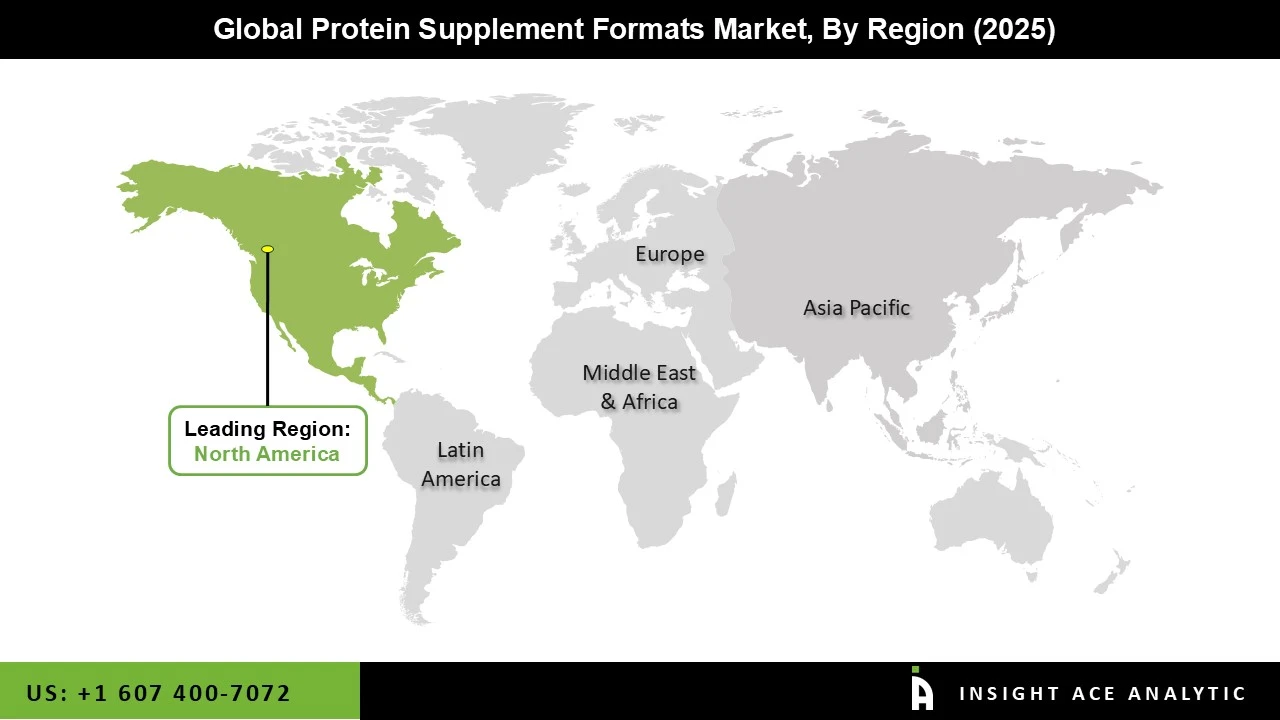
Protein supplements are widely available through supermarkets, mass retailers, speciality nutrition stores, pharmacies, gyms, brand websites, and online marketplaces. Direct-to-consumer channels are allowing brands to build stronger relationships with customers and introduce specialised products more quickly. Product innovation is another important factor supporting the regional market. Manufacturers are developing new flavours, plant-based formulations, lower-sugar products, RTD beverages, protein bars, and functional nutrition products to meet changing consumer preferences. Overall, strong fitness culture, high consumer awareness, established brands, broad distribution networks, and continuous product innovation are expected to keep North America an important market for Protein Supplement Formats.
Key Developments
• In March 2026, Glanbia plc continued strengthening its sports nutrition portfolio through its major brands, including Optimum Nutrition, BSN, and Isopure, with a focus on protein powders, RTD products, and convenient nutrition formats to meet growing demand from fitness and active-lifestyle consumers.
• In April 2026, Abbott Laboratories continued developing its nutrition portfolio, including Ensure and other protein-enriched products, with a strong focus on healthy ageing, weight management, and specialised nutrition.
Protein Supplement Formats Market Report Scope:
| Report Attribute | Specifications |
| Market size value in 2025 | USD 24.60 Bn |
| Revenue forecast in 2035 | USD 55.25 Bn |
| Growth Rate CAGR | CAGR of 8.8% from 2026 to 2035 |
| Quantitative Units | Representation of revenue in US$ Bn and CAGR from 2026 to 2035 |
| Historic Year | 2022 to 2025 |
| Forecast Year | 2026-2035 |
| Report Coverage | The forecast of revenue, the position of the company, the competitive market structure, growth prospects, and trends |
| Segments Covered | Product Form, Source & Protein Type, Application / Positioning, Consumer Group / End User, Distribution Channel and By Region |
| Regional Scope | North America; Europe; Asia Pacific; Latin America; Middle East & Africa |
| Country Scope | U.S.; Canada; U.K.; Germany; China; India; Japan; Brazil; Mexico; The UK; France; Italy; Spain; China; Japan; India; South Korea; Southeast Asia; South Korea; Southeast Asia |
| Competitive Landscape | Glanbia plc, BellRing Brands, Abbott Laboratories, Herbalife Ltd., PepsiCo, Quest Nutrition, THG plc / Myprotein, Iovate / MuscleTech, NOW Foods, RSP Nutrition, MusclePharm, Orgain, Vega (Danone), Garden of Life, Huel, Ritual, Sunwarrior, Fonterra, Arla Foods Ingredients, Hilmar, Saputo, Milk Specialties, Roquette, ADM, PURIS, Ingredion. |
| Customization Scope | Free customisation report with the procurement of the report, Modifications to the regional and segment scope. Geographic competitive landscape. |
| Pricing and Available Payment Methods | Explore pricing alternatives that are customised to your particular study requirements. |
Protein Supplement Formats Market Segmentation:
Protein Supplement Formats Market by Product Form -
• Protein Powder
• Ready-to-Drink (RTD) Protein Beverages
• Protein Bars
• Other Formats (Capsules, Gels, Mixes & Functional)
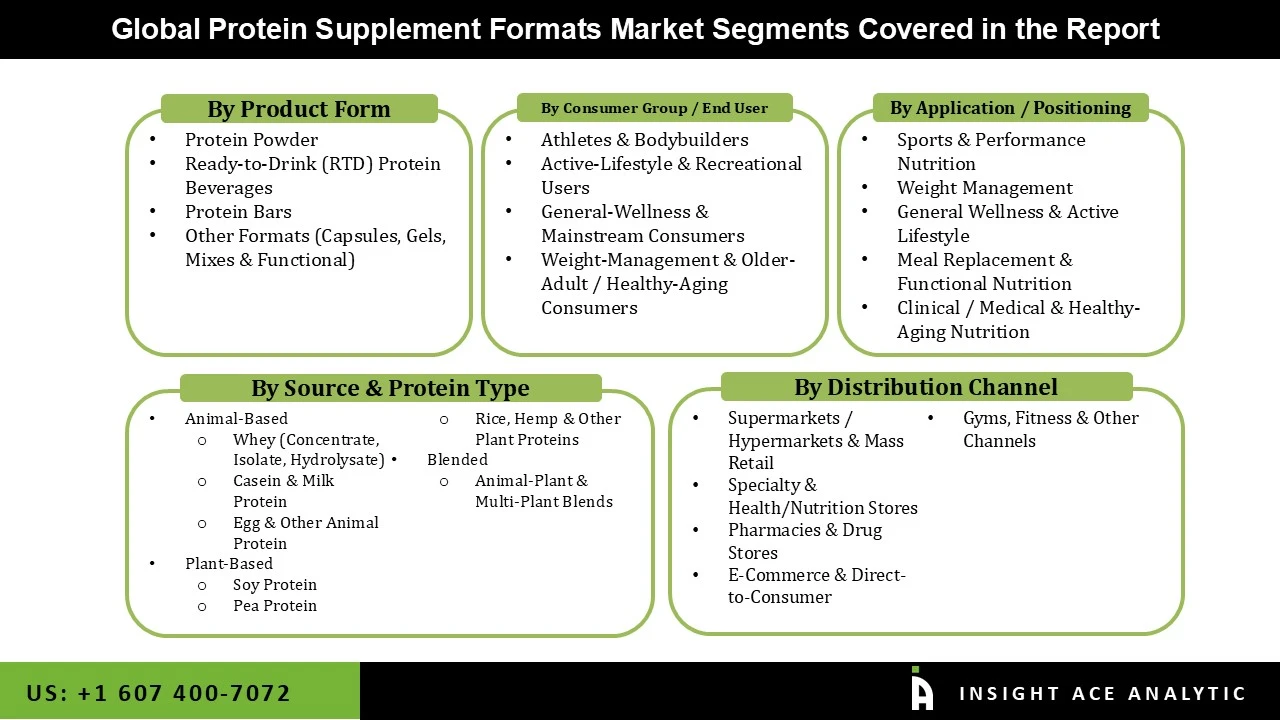
Protein Supplement Formats Market by Source & Protein Type -
• Animal-Based
o Whey (Concentrate, Isolate, Hydrolysate)
o Casein & Milk Protein
o Egg & Other Animal Protein
• Plant-Based
o Soy Protein
o Pea Protein
o Rice, Hemp & Other Plant Proteins
• Blended
o Animal-Plant & Multi-Plant Blends
Protein Supplement Formats Market by Application / Positioning -
• Sports & Performance Nutrition
• Weight Management
• General Wellness & Active Lifestyle
• Meal Replacement & Functional Nutrition
• Clinical / Medical & Healthy-Aging Nutrition
Protein Supplement Formats Market by Consumer Group / End User -
• Athletes & Bodybuilders
• Active-Lifestyle & Recreational Users
• General-Wellness & Mainstream Consumers
• Weight-Management & Older-Adult / Healthy-Aging Consumers
Protein Supplement Formats Market by Distribution Channel-
• Supermarkets / Hypermarkets & Mass Retail
• Specialty & Health/Nutrition Stores
• Pharmacies & Drug Stores
• E-Commerce & Direct-to-Consumer
• Gyms, Fitness & Other Channels
Protein Supplement Formats Market by Region-
North America-
• The US
• Canada
• Mexico
• Rest of North America
Europe-
• Austria
• Belgium
• Denmark
• France
• Germany
• Ireland
• Italy
• Netherlands
• Norway
• Russia
• Spain
• Sweden
• Switzerland
• UK
• Rest of Europe
Asia-Pacific-
• Australia
• China
• India
• Japan
• New-Zealand
• Singapore
• South Korea
• Rest of Asia-Pacific
Middle East and North Africa (MENA)-
• Egypt
• Iran
• Iraq
• Israel
• Kuwait
• Saudi Arabia
• UAE
• Rest of MENA
Latin America-
• Brazil
• Chile
• Colombia
• Venezuela
• Rest of Latin America
• Rest of the World
Research Design and Approach
This study employed a multi-step, mixed-method research approach that integrates:
- Secondary research
- Primary research
- Data triangulation
- Hybrid top-down and bottom-up modelling
- Forecasting and scenario analysis
This approach ensures a balanced and validated understanding of both macro- and micro-level market factors influencing the market.
Secondary Research
Secondary research for this study involved the collection, review, and analysis of publicly available and paid data sources to build the initial fact base, understand historical market behaviour, identify data gaps, and refine the hypotheses for primary research.
Sources Consulted
Secondary data for the market study was gathered from multiple credible sources, including:
- Government databases, regulatory bodies, and public institutions
- International organizations (WHO, OECD, IMF, World Bank, etc.)
- Commercial and paid databases
- Industry associations, trade publications, and technical journals
- Company annual reports, investor presentations, press releases, and SEC filings
- Academic research papers, patents, and scientific literature
- Previous market research publications and syndicated reports
These sources were used to compile historical data, market volumes/prices, industry trends, technological developments, and competitive insights.

Primary Research
Primary research was conducted to validate secondary data, understand real-time market dynamics, capture price points and adoption trends, and verify the assumptions used in the market modelling.
Stakeholders Interviewed
Primary interviews for this study involved:
- Manufacturers and suppliers in the market value chain
- Distributors, channel partners, and integrators
- End-users / customers (e.g., hospitals, labs, enterprises, consumers, etc., depending on the market)
- Industry experts, technology specialists, consultants, and regulatory professionals
- Senior executives (CEOs, CTOs, VPs, Directors) and product managers
Interview Process
Interviews were conducted via:
- Structured and semi-structured questionnaires
- Telephonic and video interactions
- Email correspondences
- Expert consultation sessions
Primary insights were incorporated into demand modelling, pricing analysis, technology evaluation, and market share estimation.
Data Processing, Normalization, and Validation
All collected data were processed and normalized to ensure consistency and comparability across regions and time frames.
The data validation process included:
- Standardization of units (currency conversions, volume units, inflation adjustments)
- Cross-verification of data points across multiple secondary sources
- Normalization of inconsistent datasets
- Identification and resolution of data gaps
- Outlier detection and removal through algorithmic and manual checks
- Plausibility and coherence checks across segments and geographies
This ensured that the dataset used for modelling was clean, robust, and reliable.
Market Size Estimation and Data Triangulation
Bottom-Up Approach
The bottom-up approach involved aggregating segment-level data, such as:
- Company revenues
- Product-level sales
- Installed base/usage volumes
- Adoption and penetration rates
- Pricing analysis
This method was primarily used when detailed micro-level market data were available.

Top-Down Approach
The top-down approach used macro-level indicators:
- Parent market benchmarks
- Global/regional industry trends
- Economic indicators (GDP, demographics, spending patterns)
- Penetration and usage ratios
This approach was used for segments where granular data were limited or inconsistent.
Hybrid Triangulation Approach
To ensure accuracy, a triangulated hybrid model was used. This included:
- Reconciling top-down and bottom-up estimates
- Cross-checking revenues, volumes, and pricing assumptions
- Incorporating expert insights to validate segment splits and adoption rates
This multi-angle validation yielded the final market size.
Forecasting Framework and Scenario Modelling
Market forecasts were developed using a combination of time-series modelling, adoption curve analysis, and driver-based forecasting tools.
Forecasting Methods
- Time-series modelling
- S-curve and diffusion models (for emerging technologies)
- Driver-based forecasting (GDP, disposable income, adoption rates, regulatory changes)
- Price elasticity models
- Market maturity and lifecycle-based projections
Scenario Analysis
Given inherent uncertainties, three scenarios were constructed:
- Base-Case Scenario: Expected trajectory under current conditions
- Optimistic Scenario: High adoption, favourable regulation, strong economic tailwinds
- Conservative Scenario: Slow adoption, regulatory delays, economic constraints
Sensitivity testing was conducted on key variables, including pricing, demand elasticity, and regional adoption.
Request Customization
Add countries, segments, company profiles, or extend forecast — free 10% customization with purchase.
Customize This Report →Enquire Before Buying
Speak with our analyst team about scope, methodology, pricing, or deliverable formats.
Enquire Now →Frequently Asked Questions
Protein Supplement Formats Market Size is valued at USD 24.60 Bn in 2025 and is predicted to reach USD 55.25 Bn by the year 2035
Protein Supplement Formats Market is expected to grow at a 8.8% CAGR during the forecast period for 2026 to 2035.
Glanbia plc, BellRing Brands, Abbott Laboratories, Herbalife Ltd., PepsiCo, Quest Nutrition, THG plc / Myprotein, Iovate / MuscleTech, NOW Foods, RSP Nutrition, MusclePharm, Orgain, Vega (Danone), Garden of Life, Huel, Ritual, Sunwarrior, Fonterra, Arla Foods Ingredients, Hilmar, Saputo, Milk Specialties, Roquette, ADM, PURIS, Ingredion.
Protein Supplement Formats Market is segmented into Product Form, Source & Protein Type, Application / Positioning, Consumer Group / End User, Distribution Channel and By Region
North America region is leading the Protein Supplement Formats Market.