Sodium-Ion Battery Market Size, Share, Trend, Scope Report 2026 to 2035
What is Sodium-Ion Battery Market Size?
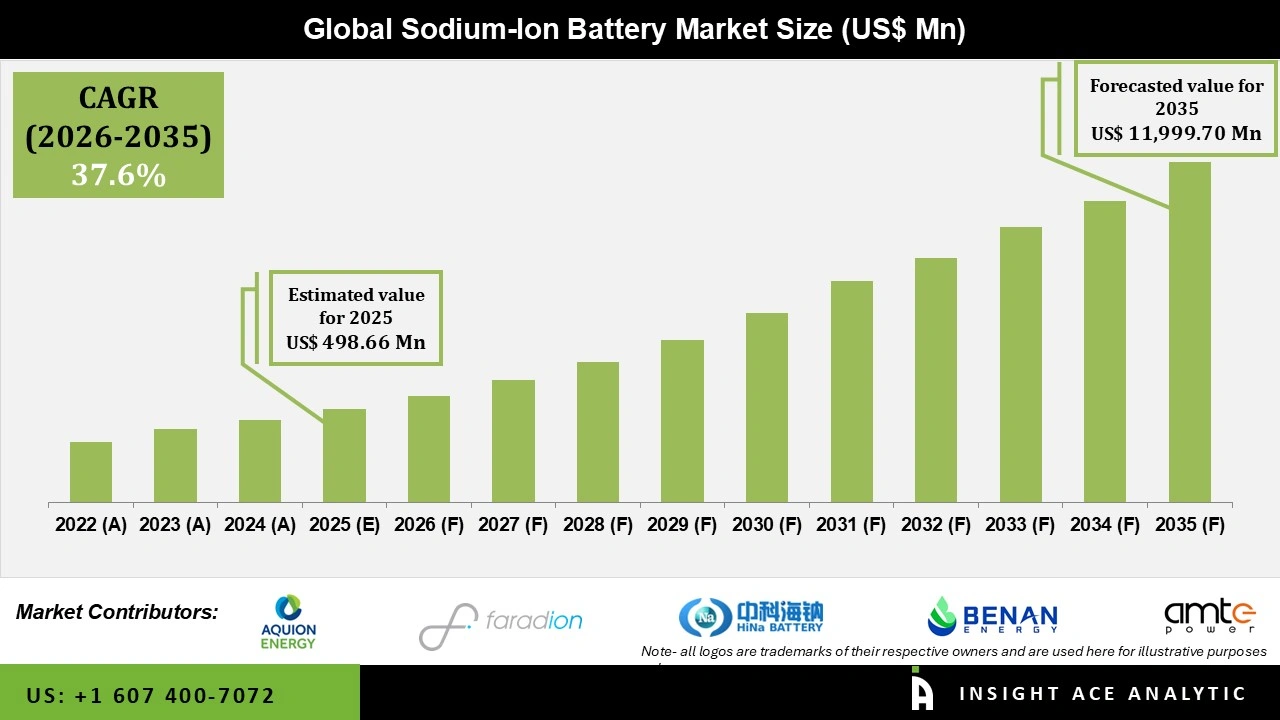
Global Sodium-Ion Battery Market Size is valued at USD 498.66 Mn in 2025 and is predicted to reach USD 11,999.70 Mn by the year 2035 at a 37.6% CAGR during the forecast period for 2026 to 2035.
Sodium-Ion Battery Market Size, Share & Trends Analysis Distribution by Application (Automotive, Electronics, Large Scale Stationary Energy Storage, Industrial, Others), By Product Type (Non-Aqueous Sodium-Ion Batteries, Aqueous Sodium-Ion Batteries, Solid State Sodium-Ion Batteries), By Form Factor (Prismatic, Cylindrical, Pouch) By System/Pack-Level Voltage (Low Voltage System (12V-60V), Medium Voltage System (60V-300V), High Voltage System (>300V)) and Segment Forecasts, 2026 to 2035.
Sodium-ion batteries represent a new class of energy storage systems in which sodium ions act as the primary charge carriers during electrochemical reactions. These batteries are increasingly being explored as a cost-effective and resource-secure alternative to conventional Lithium-ion battery technology. One of the key advantages of sodium-ion systems lies in their reliance on widely available raw materials such as sodium, which is abundant in seawater and the Earth’s crust. This reduces dependency on critical and geographically concentrated minerals like lithium, cobalt, and nickel. Additionally, sodium-ion batteries exhibit promising thermal stability and safety characteristics, making them less prone to overheating and thermal runaway, thereby enhancing their suitability for large-scale deployment.
Sodium-ion batteries have gained significant traction as industries increasingly prioritize sustainable, resilient, and cost-efficient energy storage solutions. Their compatibility with existing battery manufacturing infrastructure further accelerates commercialization potential. These batteries are particularly well-suited for stationary energy storage applications, including grid-scale storage, renewable energy integration (such as solar and wind), and backup power systems for industrial and commercial use. In the mobility sector, sodium-ion batteries are emerging as a viable solution for cost-sensitive segments such as electric two-wheelers, three-wheelers, and entry-level electric vehicles, where energy density requirements are moderate but affordability is critical.
Competitive Landscape
Which are the Leading Players in the Sodium-Ion Battery Market?
- Aquion Energy (Juline-Titans LLC)
- Faradion (Reliance Industries Ltd)
- HiNa Battery Technology Co., Ltd
- BENAN Energy Technology (Shanghai) Co., Ltd
- AMTE Power plc (AGM Batteries Limited)
- Natron Energy, Inc
- TIAMAT
- Jiangsu Zhongna Energy Technology Co., Ltd.
- Contemporary Amperex Technology Co. Limited (CATL)
- Bluetti Power
- Li-FUN Technology Corporation Limited
- Indi Energy
- Altris AB
- Farasis Energy
- BYD Company Ltd
Market Dynamics
Driver
Abundant Raw Materials and Cost Advantage
Sodium Ion batteries have the edge on their counterparts due to one main reason; the widespread availability and low cost of sodium compared to critical resources that are involved in Lithium-ion battery production like lithium, cobalt, and nickel. Sodium is available in plenty from sources in nature such as sea salt. It is therefore a more secure resource that has less volatility in terms of cost and is easily accessible. The benefits brought about by sodium being cheap, coupled with low costs of supply chain and ease of manufacture using current infrastructure, are what are fueling its rapid growth. This is seen especially when looking at large scale energy storage solutions like grid storage.
Restrain/Challenge
Lower Energy Density Compared to Lithium-Ion Technologies
One of the most significant problems faced by the Sodium-ion battery market is its relatively low energy density when compared to that of lithium-ion batteries, making it less appropriate for use in cases where energy density needs to be high despite having a small footprint, such as electric vehicles and consumer electronics. Although sodium-ion batteries present a number of cost and material benefits over lithium-ion batteries, they fall short when compared against their rivals in terms of energy efficiency, cycle optimization, and maturity of the entire system.
Large Scale Stationary Energy Storage Segment is Expected to Drive the Sodium-Ion Battery Market
Large Scale Stationary Energy Storage is propelling the growth in sodium-ion batteries, since it can make best use of advantages offered by the sodium-ion battery technology over the Lithium-ion battery technology in terms of cost-effectiveness, safety, and resource availability. Sodium-ion batteries can be used very efficiently for energy storage for grid balancing, renewable energy storage, and back-up purposes in which higher energy density becomes less significant than cost-effectiveness, scaleability, and duration of energy storage. The ability of sodium-ion batteries to use easily accessible natural resources contributes greatly to their suitability in utility-scale applications.
Solid-State Sodium-Ion Batteries Segment is Growing at the Highest Rate in the Sodium-Ion Battery Market
The Solid-State Sodium-Ion Batteries segment is expected to grow at the highest rate in the sodium-ion battery market. This is driven by its next-generation architecture, which replaces liquid electrolytes with solid electrolytes, offering improved safety, higher energy density potential, and better thermal stability compared to conventional non-aqueous and aqueous systems. While still at an early development stage relative to Lithium-ion battery technologies, solid-state sodium-ion batteries are attracting strong R&D and investment interest due to their potential for enhanced performance and longer lifecycle. These advantages position the segment for rapid expansion as commercialization advances and technology maturity improves.
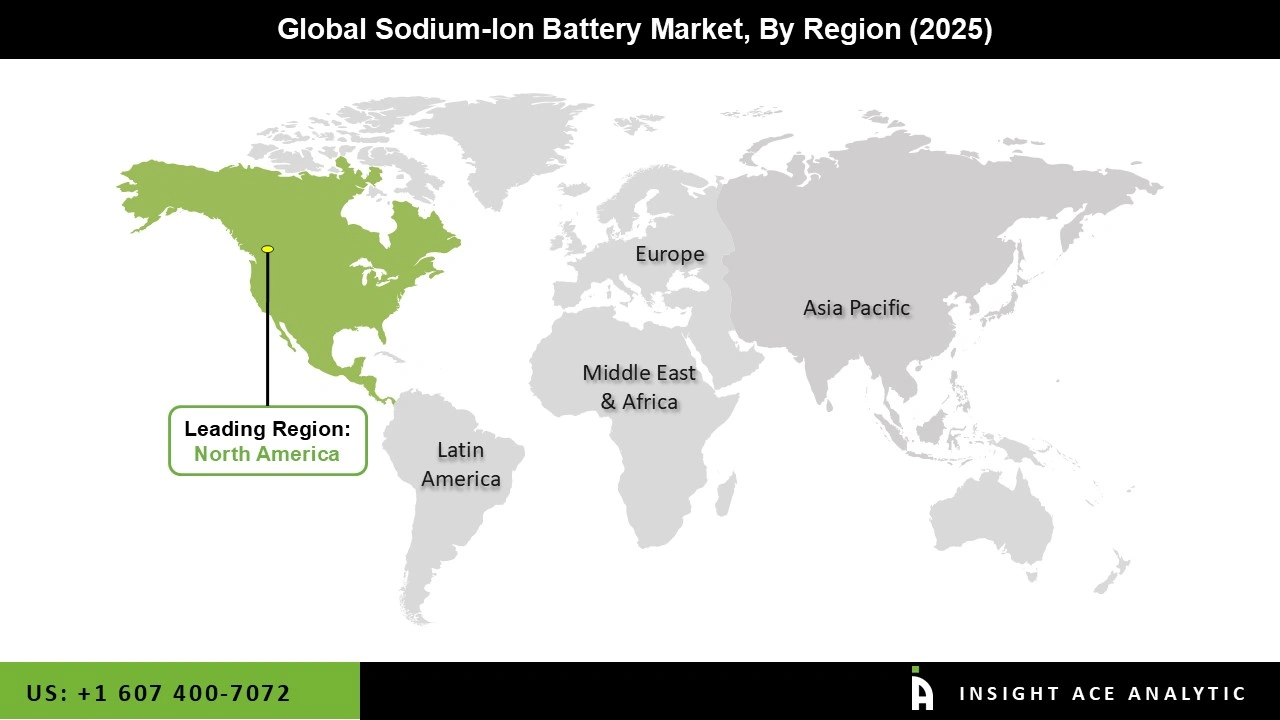
Why North America Led the Sodium-Ion Battery Market?
North America is a dominant player in the sodium-ion battery market owing to high investments made by the region in the next generation of energy storage technologies and development of infrastructure related to renewable energy sources.
There is significant progress being made in the development of energy storage technologies that do not depend on Lithium-ion battery technology owing to cost-efficiency, high safety levels, and scalability of such batteries. Increasing installations of renewable power technologies have also led to the growing demand for energy storage technologies with high efficiency and longevity.
Sodium-Ion Battery Market Report Scope :
| Report Attribute | Specifications |
| Market size value in 2025 | USD 498.66 Mn |
| Revenue forecast in 2035 | USD 11,999.70 Mn |
| Growth Rate CAGR | CAGR of 37.6% from 2026 to 2035 |
| Quantitative Units | Representation of revenue in US$ Bn and CAGR from 2026 to 2035 |
| Historic Year | 2022 to 2025 |
| Forecast Year | 2026-2035 |
| Report Coverage | The forecast of revenue, the position of the company, the competitive market structure, growth prospects, and trends |
| Segments Covered | Application, Product Type, Form Factor, System/Pack-Level Voltage and By Region |
| Regional Scope | North America; Europe; Asia Pacific; Latin America; Middle East & Africa |
| Country Scope | U.S.; Canada; U.K.; Germany; China; India; Japan; Brazil; Mexico; The UK; France; Italy; Spain; China; Japan; India; South Korea; Southeast Asia; South Korea; Southeast Asia |
| Competitive Landscape | Aquion Energy (Juline-Titans LLC), Faradion (Reliance Industries Ltd), HiNa Battery Technology Co., Ltd, BENAN Energy Technology (Shanghai) Co., Ltd (BENAN ENERGY), AMTE Power plc (AGM Batteries Limited), Natron Energy, Inc, TIAMAT,Jiangsu Zhongna Energy Technology Co., Ltd., Contemporary Amperex Technology Co. Limited (CATL), Bluetti Power, Li-FUN Technology Corporation Limited, Indi Energy, Altris AB, Farasis Energy, BYD Company Ltd |
| Customization Scope | Free customization report with the procurement of the report, Modifications to the regional and segment scope. Geographic competitive landscape. |
| Pricing and Available Payment Methods | Explore pricing alternatives that are customized to your particular study requirements. |
Segmentations of Sodium-Ion Battery Market:
Sodium-Ion Battery Market, by Application -
- Automotive
- Electronics
- Large Scale Stationary Energy Storage
- Industrial
- Others
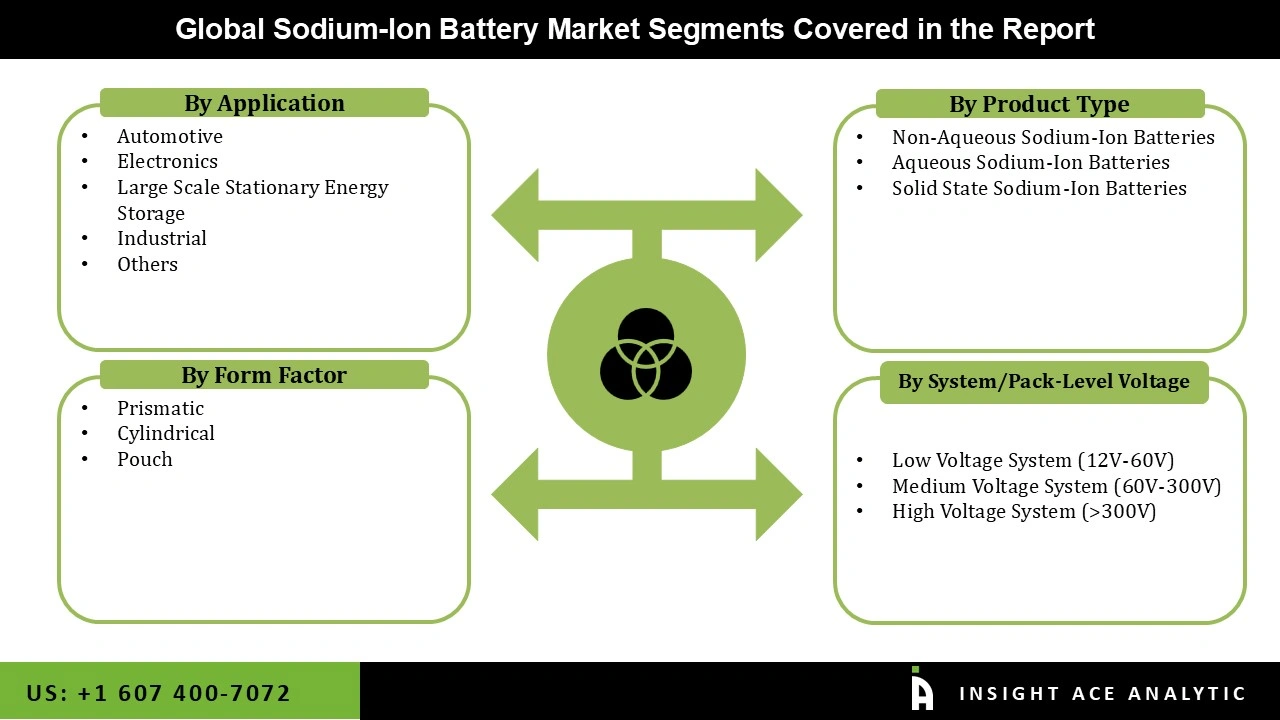
Sodium-Ion Battery Market, by Product Type -
- Non-Aqueous Sodium-Ion Batteries
- Aqueous Sodium-Ion Batteries
- Solid State Sodium-Ion Batteries
Sodium-Ion Battery Market, by Form Factor -
- Prismatic
- Cylindrical
- Pouch
Sodium-Ion Battery Market, by System/Pack-Level Voltage-
- Low Voltage System (12V-60V)
- Medium Voltage System (60V-300V)
- High Voltage System (>300V)
Sodium-Ion Battery Market, by Region-
- North America-
- The US
- Canada
- Europe-
- Germany
- The UK
- France
- Italy
- Spain
- Rest of Europe
- Asia-Pacific-
- China
- Japan
- India
- South Korea
- South East Asia
- Rest of Asia Pacific
- Latin America-
- Brazil
- Argentina
- Mexico
- Rest of Latin America
- Middle East and Africa-
- GCC Countries
- South Africa
- Rest of Middle East and Africa
Research Design and Approach
This study employed a multi-step, mixed-method research approach that integrates:
- Secondary research
- Primary research
- Data triangulation
- Hybrid top-down and bottom-up modelling
- Forecasting and scenario analysis
This approach ensures a balanced and validated understanding of both macro- and micro-level market factors influencing the market.
Secondary Research
Secondary research for this study involved the collection, review, and analysis of publicly available and paid data sources to build the initial fact base, understand historical market behaviour, identify data gaps, and refine the hypotheses for primary research.
Sources Consulted
Secondary data for the market study was gathered from multiple credible sources, including:
- Government databases, regulatory bodies, and public institutions
- International organizations (WHO, OECD, IMF, World Bank, etc.)
- Commercial and paid databases
- Industry associations, trade publications, and technical journals
- Company annual reports, investor presentations, press releases, and SEC filings
- Academic research papers, patents, and scientific literature
- Previous market research publications and syndicated reports
These sources were used to compile historical data, market volumes/prices, industry trends, technological developments, and competitive insights.

Primary Research
Primary research was conducted to validate secondary data, understand real-time market dynamics, capture price points and adoption trends, and verify the assumptions used in the market modelling.
Stakeholders Interviewed
Primary interviews for this study involved:
- Manufacturers and suppliers in the market value chain
- Distributors, channel partners, and integrators
- End-users / customers (e.g., hospitals, labs, enterprises, consumers, etc., depending on the market)
- Industry experts, technology specialists, consultants, and regulatory professionals
- Senior executives (CEOs, CTOs, VPs, Directors) and product managers
Interview Process
Interviews were conducted via:
- Structured and semi-structured questionnaires
- Telephonic and video interactions
- Email correspondences
- Expert consultation sessions
Primary insights were incorporated into demand modelling, pricing analysis, technology evaluation, and market share estimation.
Data Processing, Normalization, and Validation
All collected data were processed and normalized to ensure consistency and comparability across regions and time frames.
The data validation process included:
- Standardization of units (currency conversions, volume units, inflation adjustments)
- Cross-verification of data points across multiple secondary sources
- Normalization of inconsistent datasets
- Identification and resolution of data gaps
- Outlier detection and removal through algorithmic and manual checks
- Plausibility and coherence checks across segments and geographies
This ensured that the dataset used for modelling was clean, robust, and reliable.
Market Size Estimation and Data Triangulation
Bottom-Up Approach
The bottom-up approach involved aggregating segment-level data, such as:
- Company revenues
- Product-level sales
- Installed base/usage volumes
- Adoption and penetration rates
- Pricing analysis
This method was primarily used when detailed micro-level market data were available.

Top-Down Approach
The top-down approach used macro-level indicators:
- Parent market benchmarks
- Global/regional industry trends
- Economic indicators (GDP, demographics, spending patterns)
- Penetration and usage ratios
This approach was used for segments where granular data were limited or inconsistent.
Hybrid Triangulation Approach
To ensure accuracy, a triangulated hybrid model was used. This included:
- Reconciling top-down and bottom-up estimates
- Cross-checking revenues, volumes, and pricing assumptions
- Incorporating expert insights to validate segment splits and adoption rates
This multi-angle validation yielded the final market size.
Forecasting Framework and Scenario Modelling
Market forecasts were developed using a combination of time-series modelling, adoption curve analysis, and driver-based forecasting tools.
Forecasting Methods
- Time-series modelling
- S-curve and diffusion models (for emerging technologies)
- Driver-based forecasting (GDP, disposable income, adoption rates, regulatory changes)
- Price elasticity models
- Market maturity and lifecycle-based projections
Scenario Analysis
Given inherent uncertainties, three scenarios were constructed:
- Base-Case Scenario: Expected trajectory under current conditions
- Optimistic Scenario: High adoption, favourable regulation, strong economic tailwinds
- Conservative Scenario: Slow adoption, regulatory delays, economic constraints
Sensitivity testing was conducted on key variables, including pricing, demand elasticity, and regional adoption.
Request Customization
Add countries, segments, company profiles, or extend forecast — free 10% customization with purchase.
Customize This Report →Enquire Before Buying
Speak with our analyst team about scope, methodology, pricing, or deliverable formats.
Enquire Now →Frequently Asked Questions
Sodium-Ion Battery Market Size is valued at USD 498.66 Mn in 2025 and is predicted to reach USD 11,999.70 Mn by the year 2035
The Sodium-Ion Battery Market is expected to grow at a 37.6% CAGR during the forecast period for 2026 to 2035
Aquion Energy (Juline-Titans LLC), Faradion (Reliance Industries Ltd), HiNa Battery Technology Co., Ltd, BENAN Energy Technology (Shanghai) Co., Ltd (BENAN ENERGY), AMTE Power plc (AGM Batteries Limited), Natron Energy, Inc, TIAMAT,Jiangsu Zhongna Energy Technology Co., Ltd., Contemporary Amperex Technology Co. Limited (CATL), Bluetti Power, Li-FUN Technology Corporation Limited, Indi Energy, Altris AB, Farasis Energy, BYD Company Ltd and Others.
Sodium-Ion Battery Market is segmented into Application, Product Type, Form Factor, System/Pack-Level Voltage and Other.
North America region is leading the Sodium-Ion Battery Market.