Postbiotic Ingredients Market Size, Share, Trend, Scope Report 2026 to 2035
What is Postbiotic Ingredients Market Size?
Postbiotic Ingredients Market is estimated to grow at a 10.8% CAGR during the forecast period for 2026 to 2035.
Postbiotic Ingredients Market Size, Share & Trends Analysis Distribution by Source Microorganism (Lactic Acid Bacteria, Bifidobacteria, Akkermansia & Other Bacteria, Yeasts & Fungi), By Preparation Type (Inactivated Whole-Cell Preparations, Inactivated Cells with Fermentation Matrix (Whole Fermentates)), By Health Benefit Area, Immune Health, Digestive & Gastric Health, Bowel Function, Digestive Comfort & IBS, Gastric Health (H. pylori Management), Metabolic Health & Weight Management, Stress, Mood & Sleep (Gut–Brain Axis), Skin Health (Beauty-from-Within), By Application (Dietary Supplements, Functional Foods & Beverage), and Segment Forecasts, 2026 to 2035
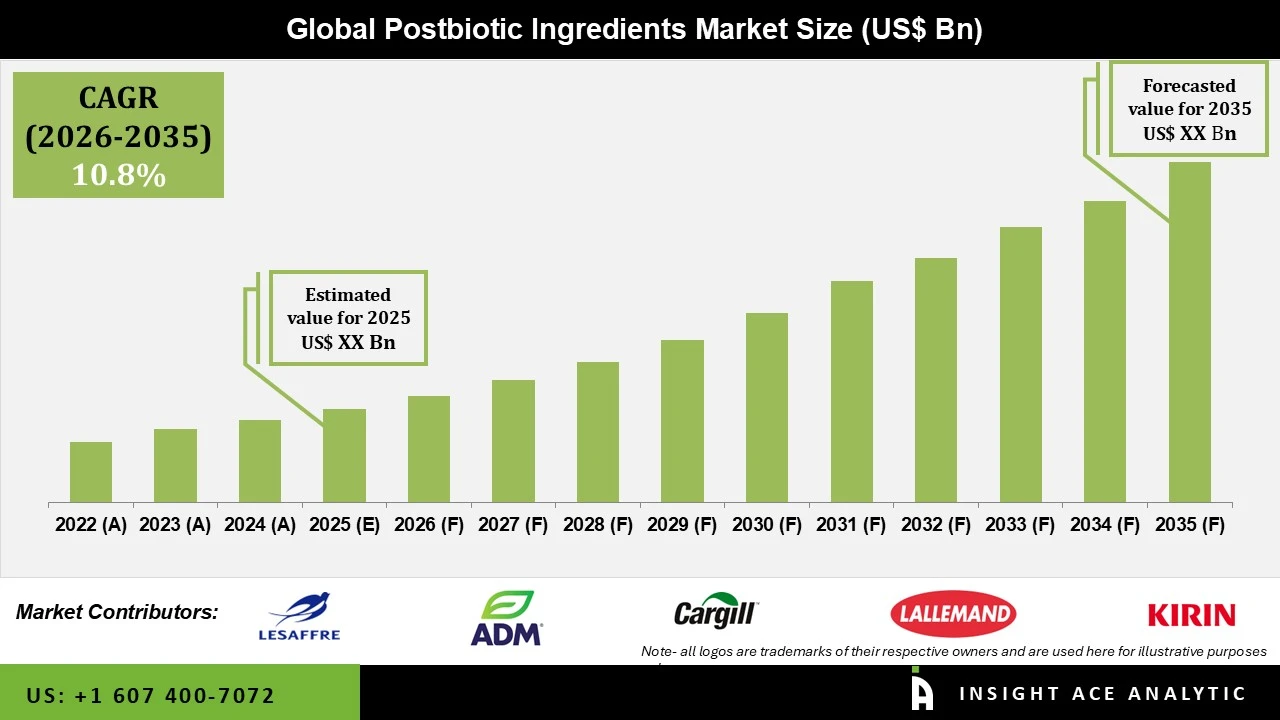
Postbiotic ingredients are formulations which include inactive microorganisms and/or their components and which have a beneficial effect on the host. Unlike probiotics, which contain live microorganisms, postbiotics are obtained by carrying out controlled fermentation, inactivation, and processing of microbial cultures. They may consist of non-viable microbial cells, cell components, metabolites, enzymes, peptides, organic acids, and other bioactive substances that are produced during microbial growth. Postbiotic ingredients are derived from microorganisms such as Lactobacillus, Bifidobacterium, Bacillus, Akkermansia, and yeast, and so on. According to their composition and the purpose for which they are to be used, these ingredients can be added to functional foods, beverages, dietary supplements, infant nutrition, animal nutrition, and other products aimed at promoting health.
The market for postbiotic ingredients on a global scale involves the development, manufacturing, commercialisation, and use of standardised postbiotic ingredients in the food, beverage, nutraceutical, and health sectors. It consists of a variety of ingredient forms which are obtained from microbial biomass, fermentation products, cell components, and particular microbial metabolites. Postbiotic ingredients are currently being developed for uses concerning digestive health, immune support, metabolic health, healthy ageing, and general well-being. Manufacturers are at the same time extending their postbiotic formulations in order to enhance their stability, functionality, shelf life, and compatibility with various product types. The market is moving from a focus on research towards wider commercial applications as ingredient manufacturers, food and beverage companies, and nutrition brands launch postbiotic-based products in different consumer segments.
Competitive Landscape
Which are the Leading Players in the Postbiotic Ingredients Market?
• Cargill, Incorporated
• Archer-Daniels-Midland Company
• Lesaffre et Compagnie
• Lallemand Inc.
• Kirin Holdings Company, Limited
• Kerry Group plc
• dsm-firmenich AG
• Morinaga Milk Industry Co., Ltd.
• Kameda Seika Co., Ltd.
• Danone S.A.
• SYNBIO TECH INC.
• HealthBiome Inc.
• Amazentis SA
• Novonesis A/S
Market Dynamics
Driver
Growing Consumer Focus on Gut Health and Digestive Wellness
The growing awareness of the connection between the gut microbiome and general health is leading to greater demand for products which support digestive and gastrointestinal well-being. Nowadays, consumers are more likely than not to seek out functional foods, drinks, and dietary supplements that offer advantages going beyond simple nutrition, and this is opening up possibilities for the use of microbiome-related ingredients such as postbiotics. Interest in postbiotics is rising since they contain inactivated microorganisms, microbial components, or metabolites that can produce specific biological effects without needing the microorganisms to stay alive. As a result, ingredient manufacturers and companies in the food and nutrition sector are developing products based on postbiotics for use in digestive health and in other areas relating to well-being. The wider availability of research on the microbiome together with rising consumer interest in solutions for gut health are thus helping to promote the use of postbiotic ingredients in functional nutrition products.
Restrain/Challenge
Lack of Standardization and Regulatory Clarity
The absence of uniform standards and clear regulation presents a big problem for the market in postbiotic ingredients. These ingredients can vary greatly in the microorganisms they are derived from, in their composition, in the method of processing, in their biological activity, and in the health benefits they are intended to provide. Manufacturers therefore find it difficult to set up consistent specifications regarding identity, purity, composition, potency, and efficacy. Moreover, regulatory systems concerning postbiotics are still being developed in various markets, which results in different ways of defining, assessing, approving and marketing these ingredients. The lack of harmonized requirements can lead to greater complexity in product development and in complying with regulations and may delay the commercialization of new postbiotic ingredients—especially when companies want to extend their products into several geographic markets.
Lactic Acid Bacteria Segment is Expected to Drive the Postbiotic Ingredients Market
Lactic acid bacteria expected to drive the market due to their extensive research base, established use in fermented foods and probiotics, and growing commercialization of LAB-derived postbiotic ingredients. Microorganisms such as Lactobacillus and other related species have been extensively researched regarding their metabolites, cell components, and various bioactive compounds, enabling applications in digestive health, immune support, and general well-being. Since Lactic Acid Bacteria have long been used in functional foods, dairy products, dietary supplements, and beverages, manufacturers already have the necessary production and formulation skills in place, which in turn promotes wider acceptance of postbiotic ingredients derived from LAB.
Fermentates Segment is Growing at the Highest Rate in the Postbiotic Ingredients Market
Fermentates (Inactivated Whole Fermentation Products) are expected to grow at the highest rate in the Postbiotic Ingredients Market, supported by their broad applicability in functional foods, beverages, and dietary supplements. Since fermentates include a complex mix of microbial metabolites, cellular components, and bioactive compounds produced during fermentation, manufacturers are able to create ingredients that have a number of functional properties. The fact that they are compatible with food and nutrition formulations, along with the increasing interest in health ingredients derived from fermentation, should lead to their quick acceptance when compared to inactivated whole-cell preparations and lysates & cell fractions.
Why North America Led the Postbiotic Ingredients Market?
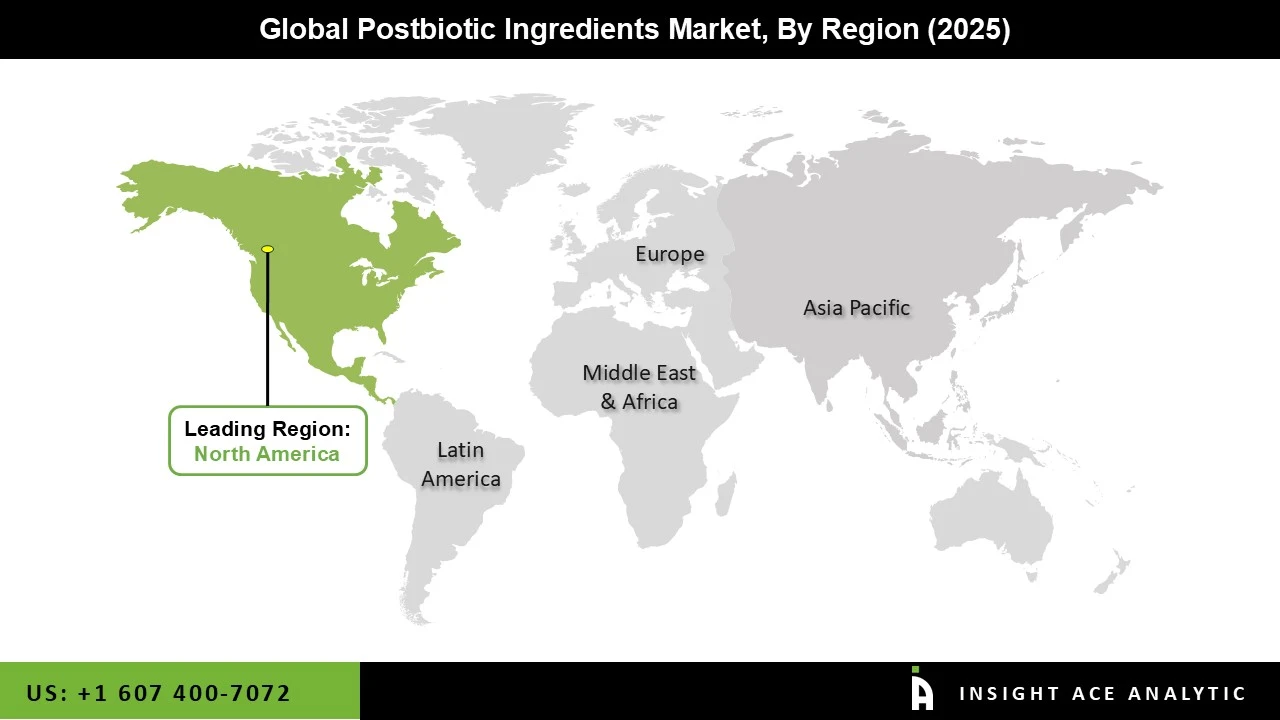
North America is expected to take the lead in the postbiotic ingredients market because of the region's well-established functional food and dietary supplement industry, the high level of consumer awareness regarding gut and microbiome health, and the strong involvement of companies that are developing and bringing postbiotic ingredients to market. The area also benefits from a well-developed nutraceutical ecosystem and substantial investment in microbiome research, which in turn supports the creation of postbiotic formulations based on scientific evidence. Furthermore, the rising demand for convenient health and wellness products and the increasing use of postbiotics in supplements, functional foods, and beverages are likely to contribute to North America's position as a market leader.
Key Development:
August 2026: Cargill reported research showing that its EpiCor® postbiotic produced measurable changes in immune-related biomarkers within three hours of a single 500 mg dose, supporting its potential for rapid immune health effects.
Postbiotic Ingredients Market Report Scope:
| Growth Rate CAGR | CAGR of 10.8% from 2026 to 2035 |
| Quantitative Units | Representation of revenue in US$ Bn and CAGR from 2026 to 2035 |
| Historic Year | 2022 to 2025 |
| Forecast Year | 2026-2035 |
| Report Coverage | The forecast of revenue, the position of the company, the competitive market structure, growth prospects, and trends |
| Segments Covered | Source Microorganism, Preparation Type, Application and By Region |
| Regional Scope | North America; Europe; Asia Pacific; Latin America; Middle East & Africa |
| Country Scope | U.S.; Canada; U.K.; Germany; China; India; Japan; Brazil; Mexico; France; Italy; Spain; South Korea; Southeast Asia |
| Competitive Landscape | Cargill, Incorporated, Archer-Daniels-Midland Company, Lesaffre et Compagnie, Lallemand Inc., Kirin Holdings Company, Limited, Kerry Group plc, dsm-firmenich AG, Morinaga Milk Industry Co., Ltd., Kameda Seika Co., Ltd., Danone S.A., SYNBIO TECH INC., HealthBiome Inc., Amazentis SA, Novonesis A/S |
| Customization Scope | Free customization report with the procurement of the report, Modifications to the regional and segment scope. Geographic competitive landscape. |
| Pricing and Available Payment Methods | Explore pricing alternatives that are customized to your particular study requirements. |
Market Segmentation:
Postbiotic Ingredients Market by Source Microorganism -
• Lactic Acid Bacteria
o Lactobacilli (Lactobacillus and Reclassified Genera)
o Lactococci, Enterococci & Other Lactic Acid Bacteria
• Bifidobacteria
• Akkermansia & Other Bacteria
• Yeasts & Fungi
o Saccharomyces cerevisiae
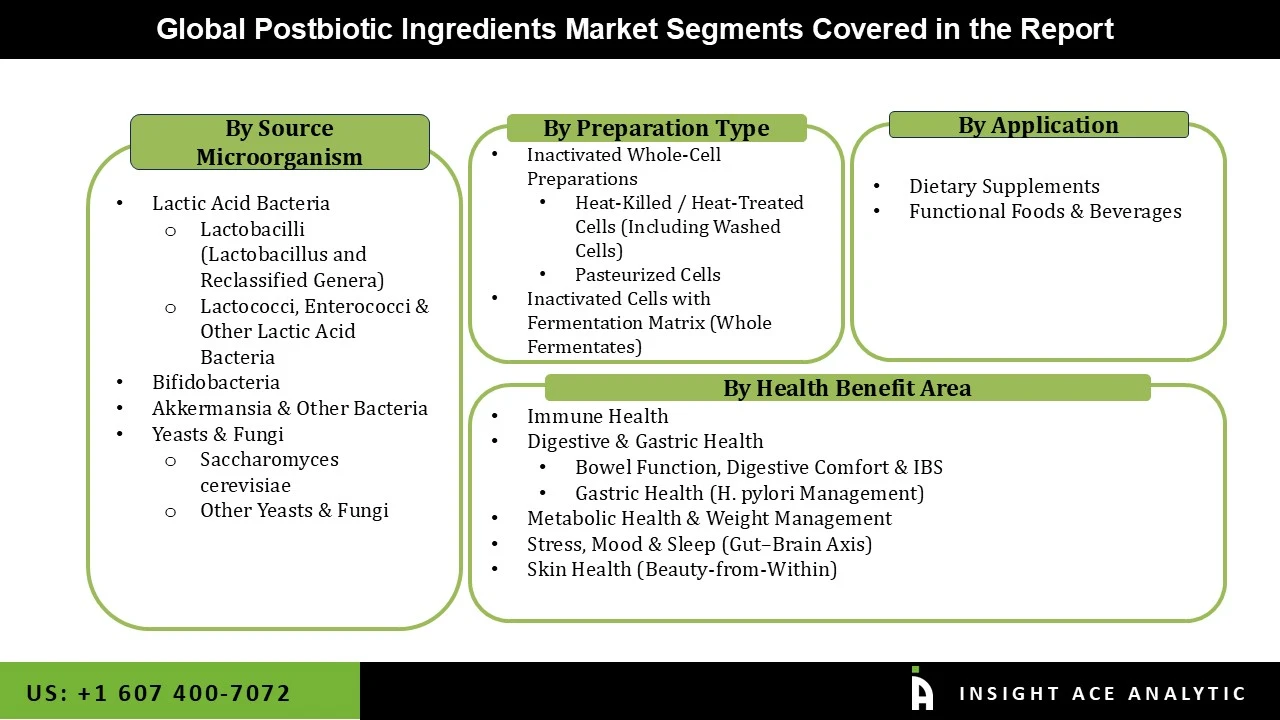
Postbiotic Ingredients Market by Preparation Type -
• Inactivated Whole-Cell Preparations
o Heat-Killed / Heat-Treated Cells (Including Washed Cells)
o Pasteurized Cells
• Inactivated Cells with Fermentation Matrix (Whole Fermentates)
By Health Benefit Area -
• Immune Health
• Digestive & Gastric Health
o Bowel Function, Digestive Comfort & IBS
o Gastric Health (H. pylori Management)
• Metabolic Health & Weight Management
• Stress, Mood & Sleep (Gut–Brain Axis)
• Skin Health (Beauty-from-Within)
Postbiotic Ingredients Market by Application -
• Dietary Supplements
• Functional Foods & Beverages
Postbiotic Ingredients Market by Region-
North America-
• The US
• Canada
• Mexico
Europe-
• Germany
• The UK
• France
• Italy
• Spain
• Rest of Europe
Asia-Pacific-
• China
• Japan
• India
• South Korea
• South East Asia
• Rest of Asia Pacific
Latin America-
• Brazil
• Argentina
• Rest of Latin America
Middle East & Africa-
• GCC Countries
• South Africa
• Rest of Middle East and Africa
Research Design and Approach
This study employed a multi-step, mixed-method research approach that integrates:
- Secondary research
- Primary research
- Data triangulation
- Hybrid top-down and bottom-up modelling
- Forecasting and scenario analysis
This approach ensures a balanced and validated understanding of both macro- and micro-level market factors influencing the market.
Secondary Research
Secondary research for this study involved the collection, review, and analysis of publicly available and paid data sources to build the initial fact base, understand historical market behaviour, identify data gaps, and refine the hypotheses for primary research.
Sources Consulted
Secondary data for the market study was gathered from multiple credible sources, including:
- Government databases, regulatory bodies, and public institutions
- International organizations (WHO, OECD, IMF, World Bank, etc.)
- Commercial and paid databases
- Industry associations, trade publications, and technical journals
- Company annual reports, investor presentations, press releases, and SEC filings
- Academic research papers, patents, and scientific literature
- Previous market research publications and syndicated reports
These sources were used to compile historical data, market volumes/prices, industry trends, technological developments, and competitive insights.

Primary Research
Primary research was conducted to validate secondary data, understand real-time market dynamics, capture price points and adoption trends, and verify the assumptions used in the market modelling.
Stakeholders Interviewed
Primary interviews for this study involved:
- Manufacturers and suppliers in the market value chain
- Distributors, channel partners, and integrators
- End-users / customers (e.g., hospitals, labs, enterprises, consumers, etc., depending on the market)
- Industry experts, technology specialists, consultants, and regulatory professionals
- Senior executives (CEOs, CTOs, VPs, Directors) and product managers
Interview Process
Interviews were conducted via:
- Structured and semi-structured questionnaires
- Telephonic and video interactions
- Email correspondences
- Expert consultation sessions
Primary insights were incorporated into demand modelling, pricing analysis, technology evaluation, and market share estimation.
Data Processing, Normalization, and Validation
All collected data were processed and normalized to ensure consistency and comparability across regions and time frames.
The data validation process included:
- Standardization of units (currency conversions, volume units, inflation adjustments)
- Cross-verification of data points across multiple secondary sources
- Normalization of inconsistent datasets
- Identification and resolution of data gaps
- Outlier detection and removal through algorithmic and manual checks
- Plausibility and coherence checks across segments and geographies
This ensured that the dataset used for modelling was clean, robust, and reliable.
Market Size Estimation and Data Triangulation
Bottom-Up Approach
The bottom-up approach involved aggregating segment-level data, such as:
- Company revenues
- Product-level sales
- Installed base/usage volumes
- Adoption and penetration rates
- Pricing analysis
This method was primarily used when detailed micro-level market data were available.

Top-Down Approach
The top-down approach used macro-level indicators:
- Parent market benchmarks
- Global/regional industry trends
- Economic indicators (GDP, demographics, spending patterns)
- Penetration and usage ratios
This approach was used for segments where granular data were limited or inconsistent.
Hybrid Triangulation Approach
To ensure accuracy, a triangulated hybrid model was used. This included:
- Reconciling top-down and bottom-up estimates
- Cross-checking revenues, volumes, and pricing assumptions
- Incorporating expert insights to validate segment splits and adoption rates
This multi-angle validation yielded the final market size.
Forecasting Framework and Scenario Modelling
Market forecasts were developed using a combination of time-series modelling, adoption curve analysis, and driver-based forecasting tools.
Forecasting Methods
- Time-series modelling
- S-curve and diffusion models (for emerging technologies)
- Driver-based forecasting (GDP, disposable income, adoption rates, regulatory changes)
- Price elasticity models
- Market maturity and lifecycle-based projections
Scenario Analysis
Given inherent uncertainties, three scenarios were constructed:
- Base-Case Scenario: Expected trajectory under current conditions
- Optimistic Scenario: High adoption, favourable regulation, strong economic tailwinds
- Conservative Scenario: Slow adoption, regulatory delays, economic constraints
Sensitivity testing was conducted on key variables, including pricing, demand elasticity, and regional adoption.
Request Customization
Add countries, segments, company profiles, or extend forecast — free 10% customization with purchase.
Customize This Report →Enquire Before Buying
Speak with our analyst team about scope, methodology, pricing, or deliverable formats.
Enquire Now →Frequently Asked Questions
Postbiotic Ingredients Market is estimated to grow at a 10.8% CAGR during the forecast period for 2026 to 2035.
Cargill, Incorporated, Archer-Daniels-Midland Company, Lesaffre et Compagnie, Lallemand Inc., Kirin Holdings Company, Limited, Kerry Group plc, dsm-firmenich AG, Morinaga Milk Industry Co., Ltd., Kameda Seika Co., Ltd., Danone S.A., SYNBIO TECH INC., HealthBiome Inc., Amazentis SA, Novonesis A/S
Postbiotic Ingredients Market is segmented into Source Microorganism, Preparation Type, Application and By Region.
North America region is leading the Postbiotic Ingredients Market.