Herbs and Spices Market Size, Share, Forecast Report 2026 to 2035
What is Herbs and Spices Market Size?
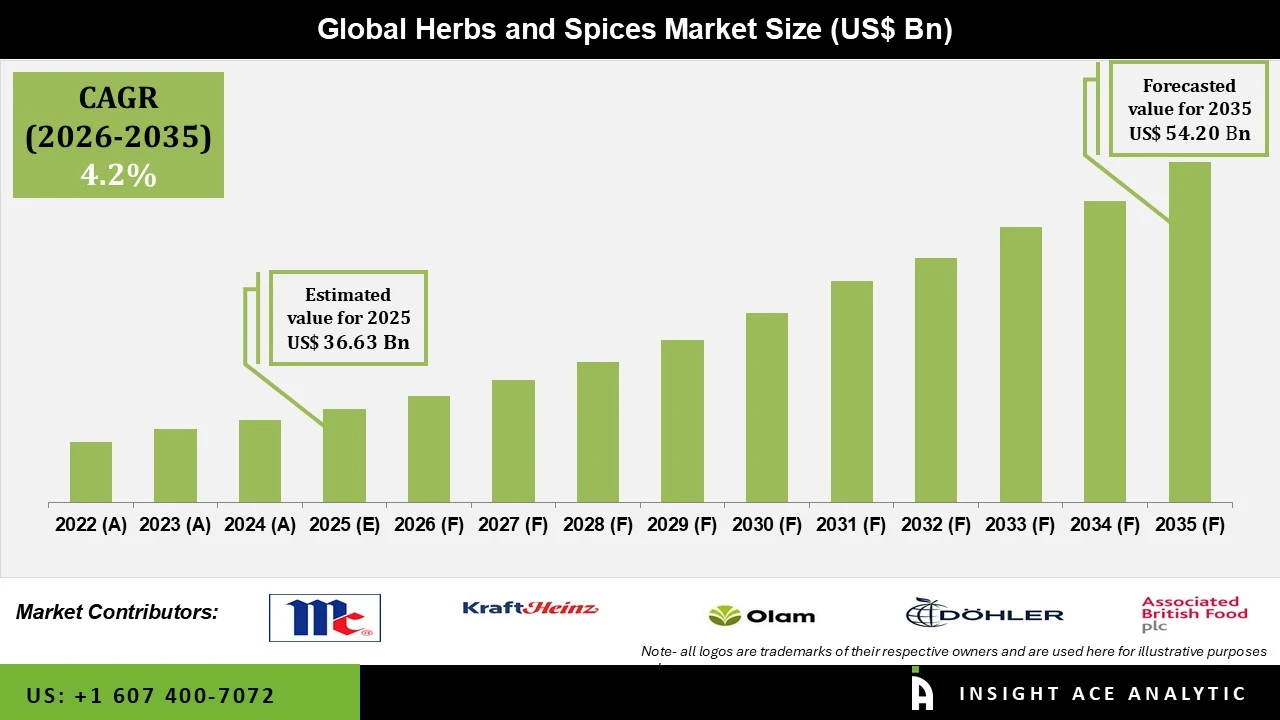
Herbs and Spices Market Size is valued at USD 36.63 Bn in 2025 and is predicted to reach USD 54.20 Bn by the year 2035 at an 4.2 CAGR during the forecast period for 2026 to 2035.
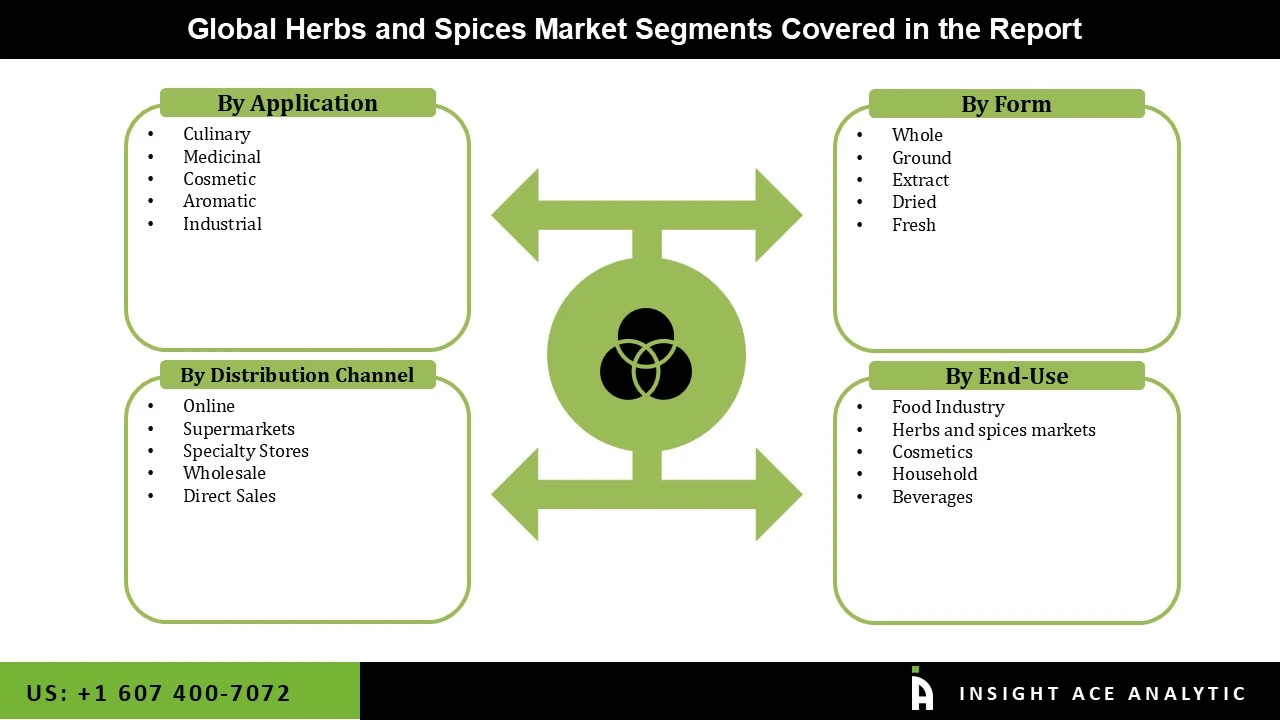
Herbs and Spices Market Size, Share & Trends Analysis Distribution by Application (Culinary, Medicinal, Cosmetic, Aromatic, Industrial), by Form (Whole, Ground, Extract, Dried, Fresh), by Distribution Channel (Online, Supermarkets, Specialty Stores, Wholesale, Direct Sales), by End Use (Food Industry, Herbs and Spices Markets, Cosmetics, Household, Beverages) and Segment Forecasts, 2026 to 2035
The herbs and spices market is expanding as more consumers and businesses look for natural ingredients that enhance flavour, aroma, colour, and offer functional benefits in many products. Herbs and spices are commonly used in foods, drinks, traditional medicine, cosmetics, personal care, and other industries. Interest in natural ingredients, changing diets, demand for global cuisines, and growth in processed food and beverage sectors are all helping the market grow in different regions. The food industry remains one of the largest contributors to demand for herbs and spices. Spices such as pepper, turmeric, cinnamon, ginger, cardamom, cumin, and chilli are commonly used to enhance the flavour, aroma, and appearance of food products.
The growing popularity of ready-to-eat meals, sauces, seasonings, snacks, and convenience foods is creating additional demand for processed and blended spices. Restaurants, foodservice providers, and packaged food manufacturers are also using a wider variety of herbs and spices to meet changing consumer tastes and growing interest in global cuisines. The market is also growing because more people are interested in the health benefits of herbs and spices. Ingredients like turmeric, ginger, garlic, cinnamon, and peppermint are linked to traditional wellness and are now used more in dietary products, herbal mixes, functional foods, and drinks. As people learn more about natural and plant-based ingredients, manufacturers are adding herbs and spices to new products for their benefits. Still, companies need to pay attention to quality, dosage, sourcing, and regulations in this area.
Cosmetics and personal care are also using more herbs and spices. These ingredients and their extracts are found in skincare, haircare, fragrances, soaps, and other products for their natural scents, colours, and benefits. As more people want plant-based and natural cosmetics, manufacturers are adding botanical extracts and essential oils to their products. Ingredients like rosemary, lavender, peppermint, turmeric, and ginger are being used in more personal care items. New technology is also shaping the herbs and spices market.
Manufacturers are using better cleaning, drying, grinding, sterilizing, extracting, and packaging methods to boost product quality, shelf life, and consistency. The market is changing as new product forms and ways to buy them appear. Whole and dried herbs and spices are still popular, but ground spices, extracts, blends, and fresh products are becoming more common for certain uses. Online shopping is giving people more choices, including speciality, organic, and international products. Supermarkets, speciality stores, wholesalers, and direct sales are still key for reaching both home and business buyers.
The global supply chain is crucial for the Herbs and Spices Market since most production happens in certain farming regions, while buyers are spread around the world. Weather, crop yields, transport costs, labor, and farming methods can all affect how much is available and how much it costs. Disruptions in the supply chain can impact both makers and sellers. Because of this, companies are working on having more suppliers, making long-term deals, tracking products, and managing inventory better.
The industry also deals with challenges like quality, food safety, adulteration, and following regulations. Without good controls, herbs and spices can have problems like contamination, pesticides, heavy metals, or foreign materials. Because of this, governments and food safety groups are focusing more on testing, tracking, processing standards, and labeling. Manufacturers are putting money into quality control and better testing to meet these rules and keep consumers’ trust. Sustainability is now a key issue for the market. Companies are working on responsible sourcing, using water and energy efficiently, sustainable farming, cutting packaging waste, and making supply chains more transparent. More consumers want organic, natural, and responsibly made ingredients. These trends are pushing suppliers and manufacturers to improve how they source products while keeping prices fair and quality steady.
Competitive Landscape
Which are the Leading Players in the Herbs and Spices Market ?
• McCormick & Company
• Kraft Heinz Company
• Olam International
• Döhler Group
• Associated British Foods
• Spice World
• Badia Spices
• Frontier Co-op
• Penzeys Spices
Driver
Growing Demand for Natural Flavours, Functional Ingredients, and Convenient Foods is Driving the Herbs and Spices Market
The global herbs and spices market is expanding as more consumers want natural ingredients that enhance the taste, smell, color, and health benefits of food and drinks. Common herbs and spices like pepper, turmeric, ginger, garlic, cumin, cinnamon, cardamom, and chili are used in home cooking, processed foods, sauces, snacks, ready meals, and beverages. As ethnic and international cuisines become more popular, food makers and restaurants are using a wider variety of herbs and spice blends. There is also more demand from the wellness and functional food sectors, where ingredients like turmeric, ginger, cinnamon, and peppermint are valued for their traditional uses and health benefits. The clean-label trend is pushing manufacturers to use natural flavors and colors instead of artificial ones. As food and beverage companies launch more products with natural ingredients and unique flavors, the need for herbs and spices is likely to stay high.
Restraint/Challenge
Quality Concerns, Price Volatility, and Supply Chain Risks Can Limit Market Expansion
The herbs and spices market faces challenges with raw material quality, changing prices, contamination, and supply issues. Production depends a lot on weather, crop yields, farming methods, and where the crops are grown. Problems like drought, too much rain, pests, and other climate issues can lower crop output and raise prices. Quality and food safety are also key concerns. Herbs and spices can be contaminated by microbes, pesticides, heavy metals, foreign objects, or adulteration if proper controls are not in place. To keep products safe and consistent, manufacturers need strong testing, processing, traceability, and quality control systems. Supply chain problems, higher transport costs, changing farm conditions, and reliance on certain regions can also impact supply and prices. To handle these issues, companies are working with more suppliers, improving sourcing, investing in quality testing, and making supply chains more transparent and traceable.
Food and Beverage Segment is Expected to Witness Strong Growth in the Herbs and Spices Market
The food and beverage segment is expected to account for a significant share of the global Herbs and Spices Market due to the widespread use of herbs and spices in cooking and food processing. Products such as black pepper, chilli, turmeric, cumin, oregano, basil, rosemary, ginger, and garlic are commonly used in sauces, seasonings, snacks, soups, processed meats, bakery products, ready-to-eat meals, and beverages. As more people want convenient foods, there are new chances for spice blends, seasoning mixes, dried herbs, and ready-to-use ingredients. Consumers are also more interested in global cuisines, premium flavors, and clean-label products. In response, food makers are creating new products with natural herbs, spices, extracts, and custom blends to boost taste and stand out in the market. The growth of restaurants, foodservice, packaged food companies, and ready-to-eat products is expected to keep demand for herbs and spices strong. As manufacturers keep launching new flavors and natural recipes, the food and beverage sector should stay a key part of market growth.
Medicinal, Wellness, and Functional Applications Segment is Expected to Witness Strong Growth in the Herbs and Spices Market
The medicinal, wellness, and functional uses of herbs and spices are getting more attention as people look for natural ingredients and traditional wellness methods. Herbs and spices like turmeric, ginger, garlic, cinnamon, peppermint, and rosemary are now used more often in herbal products, functional foods, drinks, supplements, and wellness formulas. Turmeric and ginger are especially well known for their traditional uses and are now added to functional drinks, wellness products, herbal mixes, and foods. As more people want plant-based and natural ingredients, manufacturers are looking into extracts, essential oils, and concentrated forms of herbs and spices. The growth of functional foods and drinks is giving manufacturers chances to make products that mix good taste with wellness benefits. As people keep looking for natural and plant-based choices, demand from wellness and functional uses should bring more growth to the herbs and spices market.
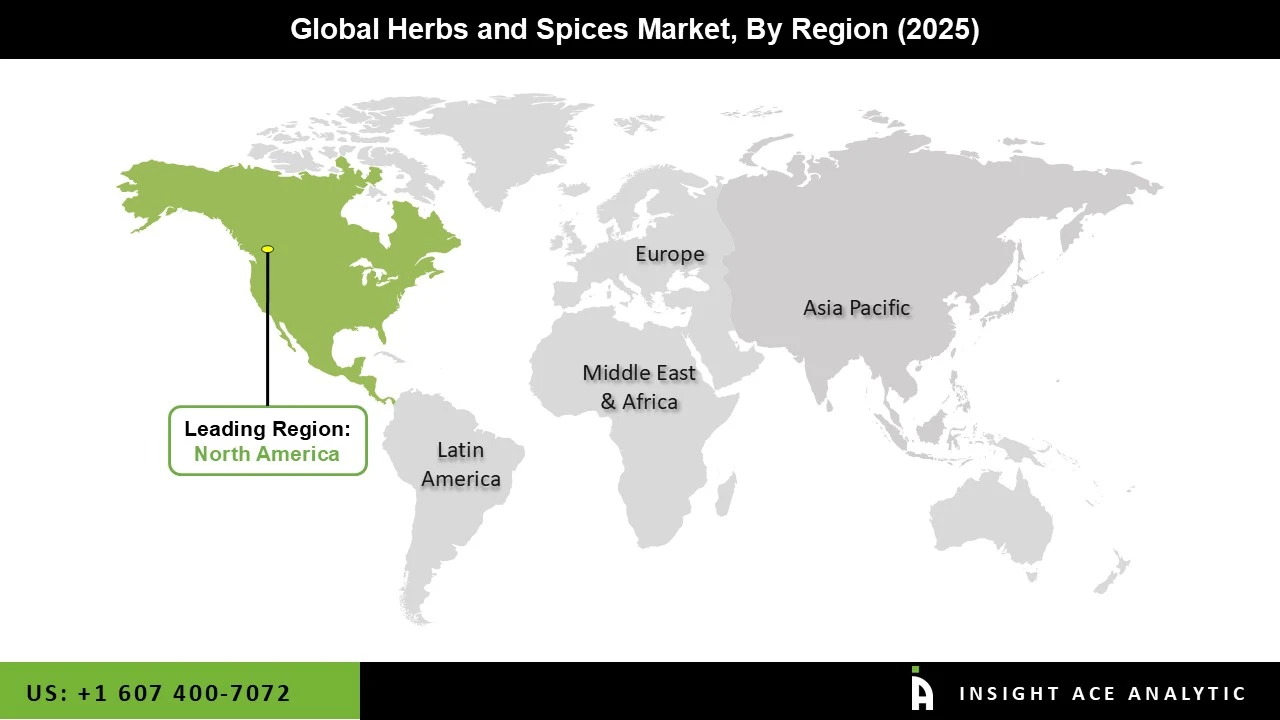
Why North America Led the Herbs and Spices Market?
North America is a leading region in the global herbs and spices market, supported by strong consumer demand for natural ingredients, growing interest in healthy and clean-label foods, a well-developed food and beverage industry, and established spice and seasoning brands. The U.S. accounts for a major share of regional demand, driven by widespread use of herbs and spices across household cooking, processed foods, restaurants, foodservice, and packaged food products. There is also more demand in the region for premium spice blends, organic herbs, natural seasonings, and functional ingredients. People are more interested in international cuisines and different flavors, so food makers and restaurants are launching new products with herbs, spices, and custom blends.
The rise of ready meals, snacks, sauces, drinks, and convenience foods is also boosting demand for processed and blended herbs and spices. The region’s strong retail network, with supermarkets, specialty stores, online shops, and direct sales, gives manufacturers many ways to reach customers. North America’s strong food processing industry, high buying power, growing interest in natural and clean-label ingredients, and steady product innovation keep it ahead in the global herbs and spices market. Continued demand for premium, organic, functional, and convenient products should bring more opportunities in the region.
Herbs and Spices Market Report Scope:
| Report Attribute | Specifications |
| Market size value in 2025 | USD 36.63 Bn |
| Revenue forecast in 2035 | USD 54.20 Bn |
| Growth Rate CAGR | CAGR of 4.2% from 2026 to 2035 |
| Quantitative Units | Representation of revenue in US$ Bn and CAGR from 2026 to 2035 |
| Historic Year | 2021 to 2025 |
| Forecast Year | 2026-2035 |
| Report Coverage | The forecast of revenue, the position of the company, the competitive market structure, growth prospects, and trends |
| Segments Covered | Application, Form, Distribution Channel, End User and By Region |
| Regional Scope | North America; Europe; Asia Pacific; Latin America; Middle East & Africa |
| Country Scope | U.S.; Canada; U.K.; Germany; China; India; Japan; Brazil; Mexico; The UK; France; Italy; Spain; China; Japan; India; South Korea; Southeast Asia; South Korea; Southeast Asia |
| Competitive Landscape | McCormick & Company, Kraft Heinz Company, Olam International, Döhler Group, Associated British Foods, Spice World, Badia Spices, Frontier Co-op, Penzeys Spices |
| Customization Scope | Free customisation report with the procurement of the report, Modifications to the regional and segment scope. Geographic competitive landscape. |
| Pricing and Available Payment Methods | Explore pricing alternatives that are customised to your particular study requirements. |
Market Segmentation:
Herbs and Spices Market by Production Process -
• Siemens (TCS-CVD)
• Fluidized Bed Reactor (Silane-FBR)
• Upgraded Metallurgical-Grade (UMG)
Herbs and Spices Market by End-User Industry -
• Solar Photovoltaics
• Electronics and Semiconductors
Herbs and Spices Market by Region-
North America-
• The US
• Canada
• Rest of North America
Europe-
• Germany
• United Kingdom
• France
• Italy
• Nordics
• Rest of Europe
Asia-Pacific-
• Japan
• China
• South Korea
• India
• Australia
• Rest of Asia-Pacific
Middle East and Africa-
• GCC & Saudi Arabia
• South Africa
• Rest of Middle East & Africa
Latin America-
• Brazil
• Rest of Latin America
Research Design and Approach
This study employed a multi-step, mixed-method research approach that integrates:
- Secondary research
- Primary research
- Data triangulation
- Hybrid top-down and bottom-up modelling
- Forecasting and scenario analysis
This approach ensures a balanced and validated understanding of both macro- and micro-level market factors influencing the market.
Secondary Research
Secondary research for this study involved the collection, review, and analysis of publicly available and paid data sources to build the initial fact base, understand historical market behaviour, identify data gaps, and refine the hypotheses for primary research.
Sources Consulted
Secondary data for the market study was gathered from multiple credible sources, including:
- Government databases, regulatory bodies, and public institutions
- International organizations (WHO, OECD, IMF, World Bank, etc.)
- Commercial and paid databases
- Industry associations, trade publications, and technical journals
- Company annual reports, investor presentations, press releases, and SEC filings
- Academic research papers, patents, and scientific literature
- Previous market research publications and syndicated reports
These sources were used to compile historical data, market volumes/prices, industry trends, technological developments, and competitive insights.

Primary Research
Primary research was conducted to validate secondary data, understand real-time market dynamics, capture price points and adoption trends, and verify the assumptions used in the market modelling.
Stakeholders Interviewed
Primary interviews for this study involved:
- Manufacturers and suppliers in the market value chain
- Distributors, channel partners, and integrators
- End-users / customers (e.g., hospitals, labs, enterprises, consumers, etc., depending on the market)
- Industry experts, technology specialists, consultants, and regulatory professionals
- Senior executives (CEOs, CTOs, VPs, Directors) and product managers
Interview Process
Interviews were conducted via:
- Structured and semi-structured questionnaires
- Telephonic and video interactions
- Email correspondences
- Expert consultation sessions
Primary insights were incorporated into demand modelling, pricing analysis, technology evaluation, and market share estimation.
Data Processing, Normalization, and Validation
All collected data were processed and normalized to ensure consistency and comparability across regions and time frames.
The data validation process included:
- Standardization of units (currency conversions, volume units, inflation adjustments)
- Cross-verification of data points across multiple secondary sources
- Normalization of inconsistent datasets
- Identification and resolution of data gaps
- Outlier detection and removal through algorithmic and manual checks
- Plausibility and coherence checks across segments and geographies
This ensured that the dataset used for modelling was clean, robust, and reliable.
Market Size Estimation and Data Triangulation
Bottom-Up Approach
The bottom-up approach involved aggregating segment-level data, such as:
- Company revenues
- Product-level sales
- Installed base/usage volumes
- Adoption and penetration rates
- Pricing analysis
This method was primarily used when detailed micro-level market data were available.

Top-Down Approach
The top-down approach used macro-level indicators:
- Parent market benchmarks
- Global/regional industry trends
- Economic indicators (GDP, demographics, spending patterns)
- Penetration and usage ratios
This approach was used for segments where granular data were limited or inconsistent.
Hybrid Triangulation Approach
To ensure accuracy, a triangulated hybrid model was used. This included:
- Reconciling top-down and bottom-up estimates
- Cross-checking revenues, volumes, and pricing assumptions
- Incorporating expert insights to validate segment splits and adoption rates
This multi-angle validation yielded the final market size.
Forecasting Framework and Scenario Modelling
Market forecasts were developed using a combination of time-series modelling, adoption curve analysis, and driver-based forecasting tools.
Forecasting Methods
- Time-series modelling
- S-curve and diffusion models (for emerging technologies)
- Driver-based forecasting (GDP, disposable income, adoption rates, regulatory changes)
- Price elasticity models
- Market maturity and lifecycle-based projections
Scenario Analysis
Given inherent uncertainties, three scenarios were constructed:
- Base-Case Scenario: Expected trajectory under current conditions
- Optimistic Scenario: High adoption, favourable regulation, strong economic tailwinds
- Conservative Scenario: Slow adoption, regulatory delays, economic constraints
Sensitivity testing was conducted on key variables, including pricing, demand elasticity, and regional adoption.
Request Customization
Add countries, segments, company profiles, or extend forecast — free 10% customization with purchase.
Customize This Report →Enquire Before Buying
Speak with our analyst team about scope, methodology, pricing, or deliverable formats.
Enquire Now →Frequently Asked Questions
Herbs and Spices Market Size is valued at USD 36.63 Bn in 2025 and is predicted to reach USD 54.20 Bn by the year 2035
Herbs and Spices Market is expected to grow at an 4.2 CAGR during the forecast period for 2026 to 2035.
McCormick & Company, Kraft Heinz Company, Olam International, Döhler Group, Associated British Foods, Spice World, Badia Spices, Frontier Co-op, Penzeys Spices
Herbs and Spices Market is segmented into Application, Form, Distribution Channel, End User and By Region
North America region is leading the Herbs and Spices Market.