Upcycled and Sustainable Food Ingredients Market Size, Trend, Forecast Report 2026 to 2035
What is Upcycled and Sustainable Food Ingredients Market Size?
Global Upcycled and Sustainable Food Ingredients Market Size is valued at USD 18.95 Bn in 2025 and is predicted to reach USD 41.74 Bn by the year 2035 at a 8.5% CAGR during the forecast period for 2026 to 2035.
Upcycled and Sustainable Food Ingredients Market Size, Share and Trends Analysis Distribution by Product Category (Upcycled Food Ingredients, Upcycled Certified® Ingredients, Non-Certified Verifiable Side-Stream Ingredients, Sustainable and Clean-Label Food Ingredients, Sustainably Sourced and Regenerative-Verified Plant Ingredients, Clean-Label and Natural Reformulation Ingredients), by Source / Feedstock (Brewery and Distillery Side-Streams, Brewer's Spent Grain (BSG) and Saved Barley, Spent Brewer's Yeast and Distilling Co-Products, Plant-Milk and Grain-Milling Side-Streams, Okara (Soymilk / Tofu Pulp), Oat-Milk Pulp and Oat Side-Streams, Corn, Wheat and Rice Milling Side-Streams, Fruit and Vegetable By-Products, Fruit Pomace, Peels, Trims and Surplus Produce, Fruit Kernels, Seeds and Stone-Fruit By-Products, Cacao-Fruit and Coffee By-Products, Other Side-Streams), by Ingredient Type, by Form, by Application, by End User and Segment Forecasts, 2026 to 2035
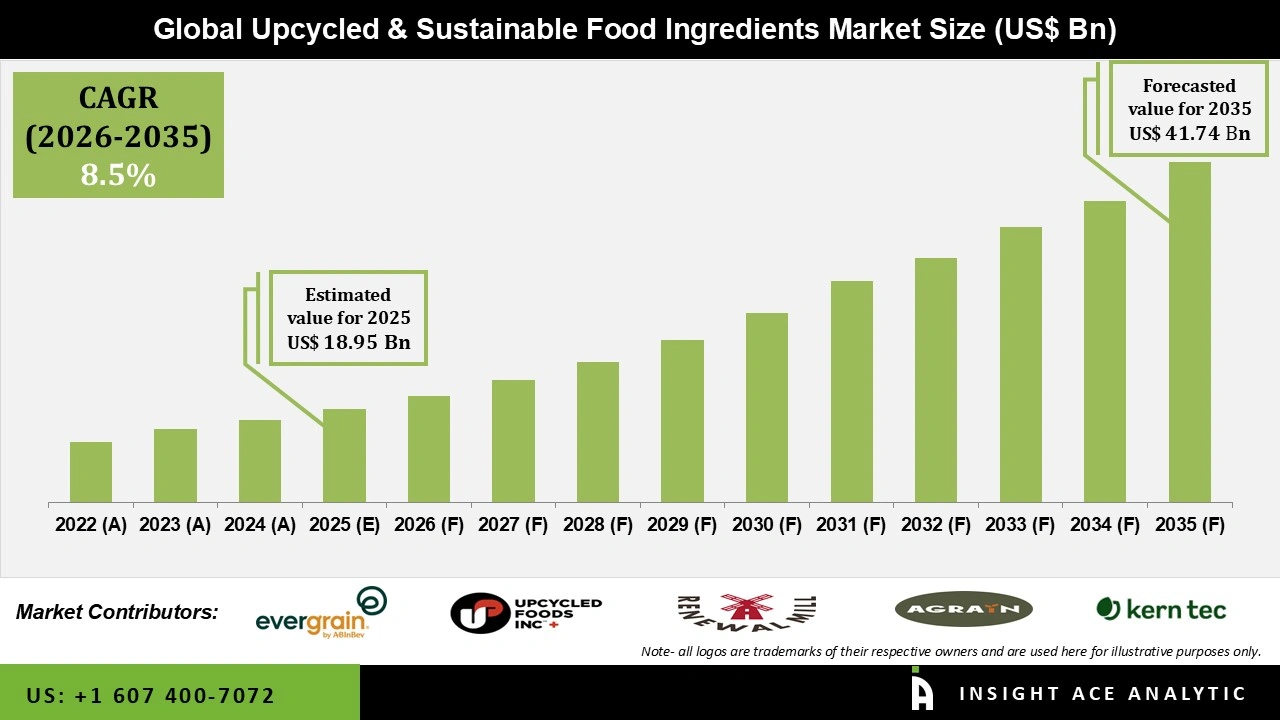
The Upcycled and Sustainable Food Ingredients Market is growing quickly as the global food industry moves toward more sustainable and waste-reducing practices. This market turns food processing by-products, agricultural leftovers, and surplus raw materials into valuable ingredients that are safe for use in food and drinks. Examples include upcycled flours, plant proteins, dietary fibers, fruit and vegetable powders, natural sweeteners, cocoa alternatives, oils, extracts, and clean-label functional ingredients. These are used in bakery items, beverages, snacks, dairy alternatives, plant-based foods, confectionery, and nutritional supplements to boost nutrition and cut down on food waste. More consumers are becoming aware of environmental sustainability, and there is a growing demand for clean-label, plant-based, and responsibly sourced ingredients. These trends are helping the market grow. Food manufacturers are looking for new ingredient solutions that help them meet their sustainability goals and respond to consumer preferences for healthier, more transparent products. Governments are also encouraging the use of upcycled ingredients by promoting food waste reduction, resource efficiency, and circular food systems. The market is further supported by increased investment in sustainable food innovation and partnerships among ingredient makers, food processors, retailers, and certification organizations.
Technology continues to play a major role in the development of the Upcycled and Sustainable Food Ingredients Market. Technology is a key driver of the Upcycled and Sustainable Food Ingredients Market's growth. New food processing, drying, fermentation, extraction, and ingredient recovery methods help manufacturers turn food by-products into safe, nutritious, and high-quality ingredients while keeping their useful properties. Digital traceability, AI-based quality checks, and sustainable sourcing tools help companies become more transparent, maintain consistent product quality, and make supply chains more efficient. Ongoing research into new uses for agricultural by-products and food processing leftovers is also creating more chances for innovation in many food categories. Standardisation of raw materials from different food side-streams can be complex, while maintaining consistent ingredient quality requires advanced processing capabilities and strict quality control. Consumer awareness of upcycled food ingredients is still developing in many regions, and regulatory requirements for food safety, labelling, and certification vary across countries.
In addition, scaling production while maintaining cost competitiveness remains a challenge for many emerging companies.
Still, the long-term outlook for the market is very positive. More investment in sustainable food systems, higher demand for clean-label and functional ingredients, supportive government policies, and stronger corporate commitments to sustainability are all expected to help the market grow steadily. As food makers focus more on using resources efficiently, cutting waste, and finding new sustainable solutions, upcycled and sustainable food ingredients will likely become a bigger part of the global food and beverage industry.
Competitive Landscape
Which are the Leading Players in the Upcycled and Sustainable Food Ingredients Market ?
- EverGrain Ingredients
- Upcycled Foods, Inc.
- Renewal Mill, Inc.
- Agrain ApS
- Kern Tec GmbH
- Green Spot Technologies
- Revyve B.V.
- Fiberstar, Inc.
- Comet Bio
- NETZRO, SBC
- BiaSol
- Outcast Foods Inc.
- Cabosse Naturals
- Koa Switzerland AG
- ofi (olam food ingredients)
- The Coffee Cherry Co.
- FruitSmart, Inc.
- Döhler GmbH
- AGRANA Beteiligungs-AG
- SunOpta Inc.
- Kerry Group plc
- Archer Daniels Midland Company (ADM)
- Cargill, Incorporated
- Ingredion Incorporated
- Tate and Lyle PLC
- Roquette Frères
- International Flavors and Fragrances Inc. (IFF)
- dsm-firmenich AG
- Givaudan SA
- BENEO GmbH
- Symrise AG
- Matriark Foods, Inc.
- Brewer's Foods
- Pectcof B.V.
- ÄIO
- The Supplant Company
- Planetarians
- Barilla G. e R. Fratelli – Società per Azioni
Market Dynamics
Driver
Rising Demand for Sustainable, Clean-Label, and Circular Food Ingredients
The market for upcycled and sustainable food ingredients is growing quickly. Food manufacturers are working to cut food waste and meet the rising demand for healthier, more eco-friendly products. More consumers now care about sustainability, clean-label foods, and plant-based nutrition, which is pushing companies to use upcycled ingredients in many types of food and drinks. Ingredients made from brewery by-products, fruit pomace, plant-milk leftovers, coffee by-products, and surplus produce help companies use resources more efficiently and support their ESG goals. Government efforts to reduce food waste, more investment in circular food systems, and a shift toward sustainable sourcing are also helping the market grow. As companies keep creating new products with natural and functional ingredients, the demand for upcycled and sustainable food ingredients is likely to keep rising.
Restraint / Challenge
Limited Raw Material Standardisation and Higher Processing Costs
Even with strong growth potential, the market faces some challenges. The supply and quality of food side-streams can change with the seasons, location, and processing methods, which makes it hard to keep ingredient quality consistent. Turning by-products from farming and food processing into safe, high-quality ingredients needs advanced technology, strict quality checks, and meeting regulations, all of which raise costs. In many areas, people are still learning about upcycled ingredients, and different food safety rules and abelling laws in each country can slow down market growth. It is also still difficult for many manufacturers to set up reliable systems for collecting, storing, and moving food side-streams.
Upcycled Food Ingredients Segment is Expected to Drive the Upcycled and Sustainable Food Ingredients Market
The upcycled food ingredients segment is expected to make up a large part of the market in the coming years. More food makers are using Upcycled Certified Ingredients and other approved side-stream ingredients to cut waste and create products with better nutrition. Demand from bakery, snack, beverage, and plant-based food companies, along with more consumers choosing sustainable foods, is likely to keep this segment growing. Support from certification groups and circular economy programs is also helping upcycled ingredients become more common in the global food industry.
Bakery and Breakfast Cereals Segment is Expected to Drive the Upcycled and Sustainable Food Ingredients Market
The bakery and breakfast cereals segment is set to lead the market as more companies use upcycled flours, fibers, fruit powders, and plant proteins in their products. Manufacturers are making baked goods and cereals that are more nutritious and reduce food waste, without losing quality or taste. More people want bakery products that are high in fiber, rich in protein, and have clean labels, which is driving the use of upcycled ingredients. Ongoing product innovation and wider retail availability are expected to help this segment grow in the next few years.
Why North America Leads the Upcycled and Sustainable Food Ingredients Market?
North America holds a leading position in the upcycled and sustainable food ingredients market due to strong consumer awareness of sustainability, widespread adoption of clean-label products, and a well-established food processing industry. The United States and Canada have witnessed significant investments in food waste reduction technologies, circular economy initiatives, and sustainable ingredient innovation. The presence of leading ingredient manufacturers, food technology companies, and organisations promoting upcycled food certification further strengthens the regional market. In addition, favourable government initiatives, increasing corporate sustainability commitments, and rising demand for functional and plant-based food products continue to support market growth.
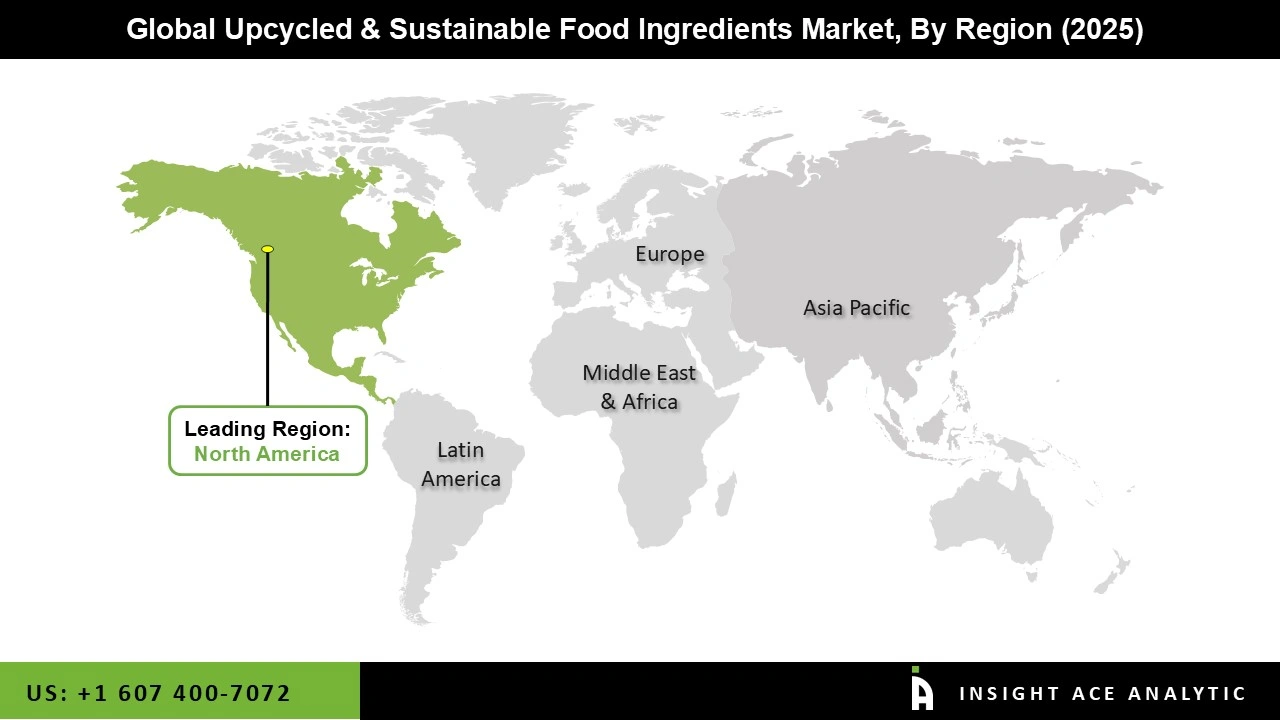
At the same time, the Asia Pacific region is expected to witness the fastest growth during the forecast period. Rapid expansion of the food processing industry, increasing urbanisation, growing consumer awareness of sustainable food consumption, and supportive government policies for reducing food waste are creating significant growth opportunities. Countries such as China, India, Japan, South Korea, and Australia are investing in sustainable food innovation, alternative proteins, and circular food systems, making Asia Pacific an important growth market for upcycled and sustainable food ingredients.
Key Developments-
• In April 2025, ofi (olam food ingredients) announced its largest-ever cocoa agroforestry partnership with Nestlé to support regenerative agriculture across Brazil, Côte d'Ivoire, and Nigeria. The initiative aims to train approximately 25,000 farmers, plant more than 2.8 million trees, and expand sustainable sourcing of cocoa ingredients, reinforcing the company's commitment to climate-smart and sustainable food ingredient supply chains.
• In August 2025, Renewal Mill, Inc. expanded its portfolio of upcycled bulk ingredients by introducing Upcycled Broken Oats, designed for applications in breakfast cereals, snack bars, cookies, and bakery products. The launch strengthens the company's ingredient offerings for food manufacturers seeking sustainable, clean-label, and high-value upcycled ingredient solutions.
Upcycled and Sustainable Food Ingredients Market Report Scope:
| Report Attribute | Specifications |
| Market size value in 2025 | USD 18.95 Bn |
| Revenue forecast in 2035 | USD 41.74 Bn |
| Growth Rate CAGR | CAGR of 8.5% from 2026 to 2035 |
| Quantitative Units | Representation of revenue in US$ Bn and CAGR from 2026 to 2035 |
| Historic Year | 2021 to 2025 |
| Forecast Year | 2026-2035 |
| Report Coverage | The forecast of revenue, the position of the company, the competitive market structure, growth prospects, and trends |
| Segments Covered | Product Category, Source / Feedstock, Ingredient Type, Form, Application, End User and By Region |
| Regional Scope | North America; Europe; Asia Pacific; Latin America; Middle East and Africa |
| Country Scope | U.S.; Canada; U.K.; Germany; China; India; Japan; Brazil; Mexico; The UK; France; Italy; Spain; China; Japan; India; South Korea; Southeast Asia; South Korea; Southeast Asia |
| Competitive Landscape | EverGrain Ingredients, Upcycled Foods, Inc., Renewal Mill, Inc., Agrain ApS, Kern Tec GmbH, Green Spot Technologies, Revyve B.V., Fiberstar, Inc., Comet Bio, NETZRO, SBC, BiaSol, Outcast Foods Inc., Cabosse Naturals, Koa Switzerland AG, ofi (olam food ingredients), The Coffee Cherry Co., FruitSmart, Inc., Döhler GmbH, AGRANA Beteiligungs-AG, SunOpta Inc., Kerry Group plc, Archer Daniels Midland Company (ADM), Cargill, Incorporated, Ingredion Incorporated, Tate and Lyle PLC, Roquette Frères, International Flavors and Fragrances Inc. (IFF), dsm-firmenich AG, Givaudan SA, BENEO GmbH, Symrise AG, Matriark Foods, Inc., Brewer's Foods, Pectcof B.V., ÄIO, The Supplant Company, Planetarians, Barilla G. e R. Fratelli – Società per Azioni |
| Customization Scope | Free customisation report with the procurement of the report, Modifications to the regional and segment scope. Geographic competitive landscape. |
| Pricing and Available Payment Methods | Explore pricing alternatives that are customized to your particular study requirements. |
Segmentations of Upcycled and Sustainable Food Ingredients Market :
Upcycled and Sustainable Food Ingredients Market by Product Category-
- Upcycled Food Ingredients
- Upcycled Certified® Ingredients
- Non-Certified Verifiable Side-Stream Ingredients
- Sustainable and Clean-Label Food Ingredients
- Sustainably Sourced and Regenerative-Verified Plant Ingredients
- Clean-Label and Natural Reformulation Ingredients
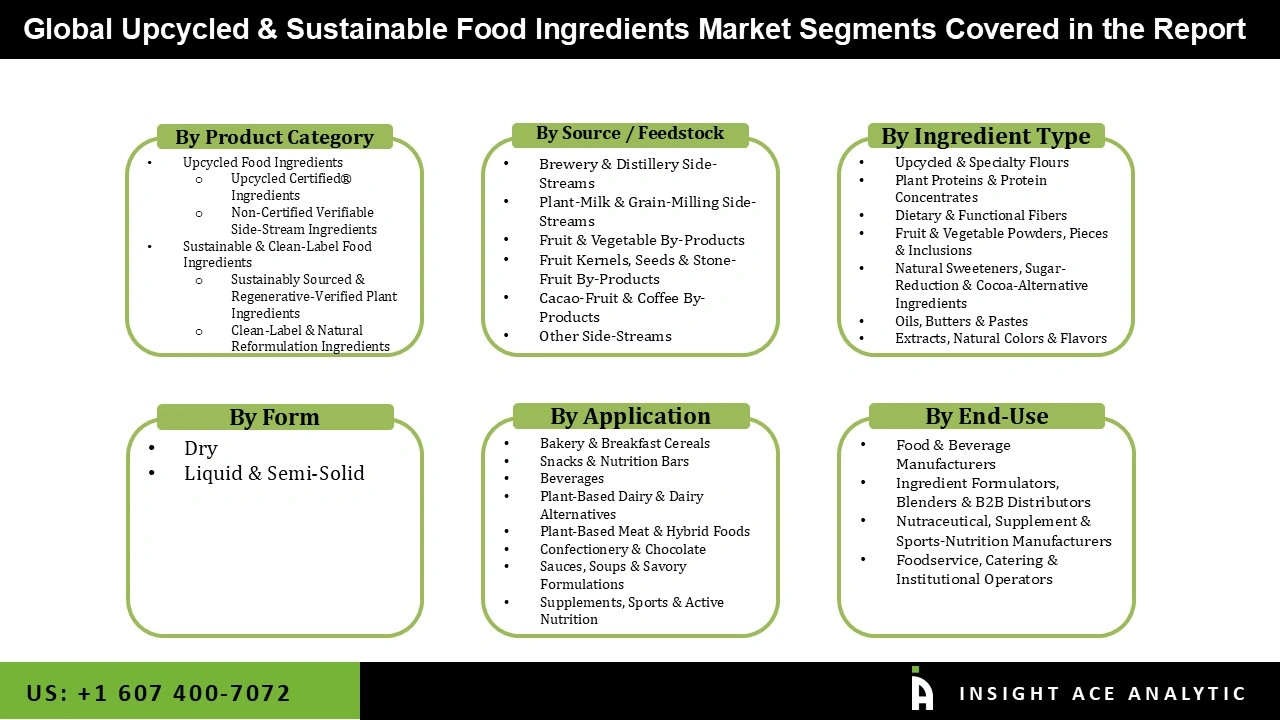
Upcycled and Sustainable Food Ingredients Market by Source / Feedstock-
- Brewery and Distillery Side-Streams
- Brewer’s Spent Grain (BSG) and Saved Barley
- Spent Brewer’s Yeast and Distilling Co-Products
- Plant-Milk and Grain-Milling Side-Streams
- Okara (Soymilk / Tofu Pulp)
- Oat-Milk Pulp and Oat Side-Streams
- Corn, Wheat and Rice Milling Side-Streams
- Fruit and Vegetable By-Products
- Fruit Pomace
- Peels, Trims and Surplus Produce
- Fruit Kernels, Seeds and Stone-Fruit By-Products
- Cacao-Fruit and Coffee By-Products
- Other Side-Streams
Upcycled and Sustainable Food Ingredients Market by Ingredient Type-
- Upcycled and Specialty Flours
- Plant Proteins and Protein Concentrates
- Dietary and Functional Fibers
- Fruit and Vegetable Powders, Pieces and Inclusions
- Natural Sweeteners, Sugar-Reduction and Cocoa-Alternative Ingredients
- Oils, Butters and Pastes
- Extracts, Natural Colors and Flavors
Upcycled and Sustainable Food Ingredients Market by Form-
- Dry
- Liquid and Semi-Solid
Upcycled and Sustainable Food Ingredients Market by Application-
- Bakery and Breakfast Cereals
- Snacks and Nutrition Bars
- Beverages
- Plant-Based Dairy and Dairy Alternatives
- Plant-Based Meat and Hybrid Foods
- Confectionery and Chocolate
- Sauces, Soups and Savory Formulations
- Supplements, Sports and Active Nutrition
Upcycled and Sustainable Food Ingredients Market by End User-
- Food and Beverage Manufacturers
- Ingredient Formulators, Blenders and B2B Distributors
- Nutraceutical, Supplement and Sports-Nutrition Manufacturers
- Foodservice, Catering and Institutional Operators
Upcycled and Sustainable Food Ingredients Market by Region-
- North America-
- The US
- Canada
- Europe-
- Germany
- The UK
- France
- Italy
- Spain
- Rest of Europe
- Asia-Pacific-
- China
- Japan
- India
- South Korea
- South East Asia
- Rest of Asia Pacific
- Latin America-
- Brazil
- Argentina
- Mexico
- Rest of Latin America
- Middle East and Africa-
- GCC Countries
- South Africa
- Rest of Middle East and Africa
Research Design and Approach
This study employed a multi-step, mixed-method research approach that integrates:
- Secondary research
- Primary research
- Data triangulation
- Hybrid top-down and bottom-up modelling
- Forecasting and scenario analysis
This approach ensures a balanced and validated understanding of both macro- and micro-level market factors influencing the market.
Secondary Research
Secondary research for this study involved the collection, review, and analysis of publicly available and paid data sources to build the initial fact base, understand historical market behaviour, identify data gaps, and refine the hypotheses for primary research.
Sources Consulted
Secondary data for the market study was gathered from multiple credible sources, including:
- Government databases, regulatory bodies, and public institutions
- International organizations (WHO, OECD, IMF, World Bank, etc.)
- Commercial and paid databases
- Industry associations, trade publications, and technical journals
- Company annual reports, investor presentations, press releases, and SEC filings
- Academic research papers, patents, and scientific literature
- Previous market research publications and syndicated reports
These sources were used to compile historical data, market volumes/prices, industry trends, technological developments, and competitive insights.

Primary Research
Primary research was conducted to validate secondary data, understand real-time market dynamics, capture price points and adoption trends, and verify the assumptions used in the market modelling.
Stakeholders Interviewed
Primary interviews for this study involved:
- Manufacturers and suppliers in the market value chain
- Distributors, channel partners, and integrators
- End-users / customers (e.g., hospitals, labs, enterprises, consumers, etc., depending on the market)
- Industry experts, technology specialists, consultants, and regulatory professionals
- Senior executives (CEOs, CTOs, VPs, Directors) and product managers
Interview Process
Interviews were conducted via:
- Structured and semi-structured questionnaires
- Telephonic and video interactions
- Email correspondences
- Expert consultation sessions
Primary insights were incorporated into demand modelling, pricing analysis, technology evaluation, and market share estimation.
Data Processing, Normalization, and Validation
All collected data were processed and normalized to ensure consistency and comparability across regions and time frames.
The data validation process included:
- Standardization of units (currency conversions, volume units, inflation adjustments)
- Cross-verification of data points across multiple secondary sources
- Normalization of inconsistent datasets
- Identification and resolution of data gaps
- Outlier detection and removal through algorithmic and manual checks
- Plausibility and coherence checks across segments and geographies
This ensured that the dataset used for modelling was clean, robust, and reliable.
Market Size Estimation and Data Triangulation
Bottom-Up Approach
The bottom-up approach involved aggregating segment-level data, such as:
- Company revenues
- Product-level sales
- Installed base/usage volumes
- Adoption and penetration rates
- Pricing analysis
This method was primarily used when detailed micro-level market data were available.

Top-Down Approach
The top-down approach used macro-level indicators:
- Parent market benchmarks
- Global/regional industry trends
- Economic indicators (GDP, demographics, spending patterns)
- Penetration and usage ratios
This approach was used for segments where granular data were limited or inconsistent.
Hybrid Triangulation Approach
To ensure accuracy, a triangulated hybrid model was used. This included:
- Reconciling top-down and bottom-up estimates
- Cross-checking revenues, volumes, and pricing assumptions
- Incorporating expert insights to validate segment splits and adoption rates
This multi-angle validation yielded the final market size.
Forecasting Framework and Scenario Modelling
Market forecasts were developed using a combination of time-series modelling, adoption curve analysis, and driver-based forecasting tools.
Forecasting Methods
- Time-series modelling
- S-curve and diffusion models (for emerging technologies)
- Driver-based forecasting (GDP, disposable income, adoption rates, regulatory changes)
- Price elasticity models
- Market maturity and lifecycle-based projections
Scenario Analysis
Given inherent uncertainties, three scenarios were constructed:
- Base-Case Scenario: Expected trajectory under current conditions
- Optimistic Scenario: High adoption, favourable regulation, strong economic tailwinds
- Conservative Scenario: Slow adoption, regulatory delays, economic constraints
Sensitivity testing was conducted on key variables, including pricing, demand elasticity, and regional adoption.
Request Customization
Add countries, segments, company profiles, or extend forecast — free 10% customization with purchase.
Customize This Report →Enquire Before Buying
Speak with our analyst team about scope, methodology, pricing, or deliverable formats.
Enquire Now →Frequently Asked Questions
Upcycled and Sustainable Food Ingredients Market Size is valued at USD 18.95 Bn in 2025 and is predicted to reach USD 41.74 Bn by the year 2035
The Upcycled and Sustainable Food Ingredients Market is expected to grow at a 8.5% CAGR during the forecast period for 2026 to 2035
EverGrain Ingredients, Upcycled Foods, Inc., Renewal Mill, Inc., Agrain ApS, Kern Tec GmbH, Green Spot Technologies, Revyve B.V., Fiberstar, Inc., Comet Bio, NETZRO, SBC, BiaSol, Outcast Foods Inc., Cabosse Naturals, Koa Switzerland AG, ofi (olam food ingredients), The Coffee Cherry Co., FruitSmart, Inc., Döhler GmbH, AGRANA Beteiligungs-AG, SunOpta Inc., Kerry Group plc, Archer Daniels Midland Company (ADM), Cargill, Incorporated, Ingredion Incorporated, Tate and Lyle PLC, Roquette Frères, International Flavors and Fragrances Inc. (IFF), dsm-firmenich AG, Givaudan SA, BENEO GmbH, Symrise AG, Matriark Foods, Inc., Brewer\'s Foods, Pectcof B.V., ÄIO, The Supplant Company, Planetarians, Barilla G. e R. Fratelli – Società per Azioni and Others.
Upcycled and Sustainable Food Ingredients Market is segmented into Product Category, Source / Feedstock, Ingredient Type, Form, Application, End User and Other.
North America region is leading the Upcycled and Sustainable Food Ingredients Market.