Sweet Proteins and Sugar Alternatives Market Size, Share, Trend Report 2026 to 2035
What is Sweet Proteins and Sugar Alternatives Market?
Sweet Proteins and Sugar Alternatives Market Size is predicted to grow at a 10.8% CAGR during the forecast period for 2026 to 2035.
Sweet Proteins & Sugar Alternatives Market Size, Share & Trends Analysis Distribution by Sweetener Category (Sweet Proteins, Rare Sugars, High-Intensity Natural Sweeteners (HINS), Sugar Alcohols (Polyols), Artificial High-Intensity Sweeteners, Novel Enzymatic & Taste Modulators), By Source & Production Technology (Precision Fermentation (microbial-host expression), Enzymatic Bioconversion (starch-to-rare-sugar, sucrose-to-fiber), Plant Extraction (katemfe fruit, stevia leaf, luo han guo), Plant Molecular Farming (tobacco-expressed thaumatin, maize-expressed brazzein), Chemical Synthesis (artificial HIS), Hybrid / Bioconversion-Enhanced Extraction (enzyme-enhanced stevia Reb M/D), AI-Enabled Discovery & Computational Protein Design (CPD)), By Form & Concentration (Crystalline / Powder, Liquid / Syrup, Pre-Formulated Blends (stevia+allulose, HINS+polyol, blended-system), Granulated / Tabletop Format, Encapsulated / Controlled-Release) By Application Category, By End-User Customer Tier, By By Functional Claim & Positioning and Segment Forecasts, 2026 to 2035
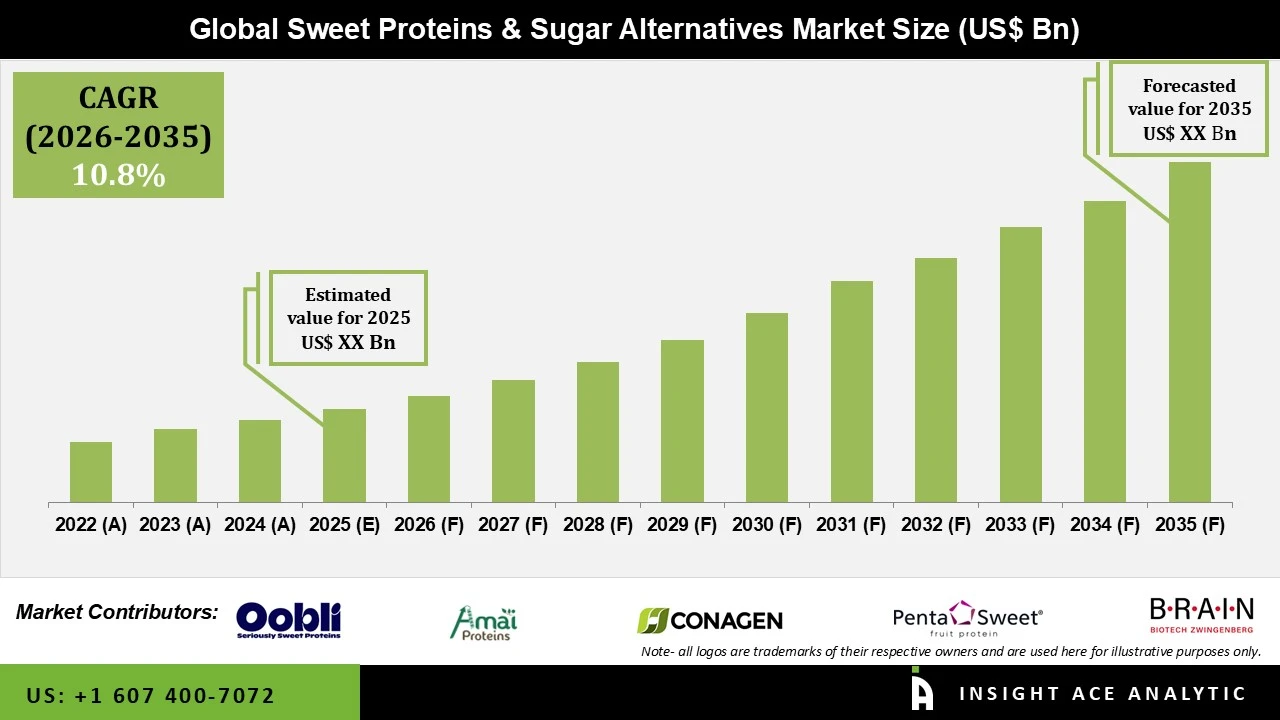
The market for sweet proteins & sugar alternatives is fast becoming a promising area of growth in the global food & nutrition space, owing to growing health consciousness among consumers coupled with rising incidences of lifestyle ailments like Type 2 Diabetes and obesity. As sugar consumption becomes more and more questioned with regard to its linkages with metabolic disorders, a trend towards low-calorie and low-glycemic sweetener options is evident. Sweet proteins are a new class of intensely sweet substances, which can be derived from natural sources such as thaumatin, brazzein, and monellin, among others, while sugar alternatives include everything ranging from natural sweeteners like stevia to artificial sweeteners like saccharin.
Such components find extensive applications in varied sectors, more importantly in the food and beverages industry, where they help reduce sugar content in soft drinks, dairy, bakery, and confectionery items while retaining their taste. In addition to food products, these molecules are extensively used in the pharmaceutical industry where they enhance the palatability of syrup medicines and chewable drugs. Moreover, they find application in the nutraceuticals industry via inclusion into health food bars, protein-based dietary supplements, and products for weight loss. With growing interest in healthy food choices, their use is increasing even in personal care products, mainly toothpaste, owing to their sweetness.
Competitive Landscape
Which are the Leading Players in the Global Sweet Proteins & Sugar Alternatives Market?
Sweet-Protein Platforms (Pure-Play & Precision-Fermentation)
• Oobli
• Amai Proteins
• Sweegen, Inc.
• Conagen, Inc.
• Pentasweet UAB
• BRAIN Biotech AG
• Nomad Bioscience GmbH
• MycoTechnology, Inc.
• Cweet, Inc.
• Shiru, Inc.
• Natur Research Ingredients, Inc.
• Magellan Life Sciences
• Novel Foods Group (UAE)
Rare-Sugar & Enzymatic Bioconversion Platforms
• Bonumose, Inc.
• Apura Ingredients, Inc.
• Anderson Global Group, LLC
• Matsutani Chemical Industry Co., Ltd.
• CJ CheilJedang Corporation
• Samyang Corporation
• Shandong Bailong Chuangyuan Bio-Tech Co., Ltd.
• Cosun Beet Company
• Better Juice, Ltd.
Diversified Ingredient Majors
• Tate & Lyle PLC
• Ingredion Incorporated
• Cargill, Incorporated
• Archer Daniels Midland Company (ADM)
• Roquette Frères
• Ajinomoto Co., Inc.
• Kerry Group plc
• International Flavors & Fragrances Inc. (IFF)
• DSM-Firmenich AG
• Givaudan SA
• Symrise AG
• Jungbunzlauer Suisse AG
• BENEO GmbH (Südzucker Group)
Stevia & Monk Fruit Specialists
• PureCircle by Ingredion
• Layn Natural Ingredients
• GLG Life Tech Corporation
• Saraya Co., Ltd. (Lakanto)
• BioVittoria Limited
• Manus Bio Inc.
• Morita Kagaku Kogyo Co., Ltd.
• Avansya (Cargill × DSM-Firmenich JV — EverSweet)
Taste-Modulation & Adjacent Solutions
• DouxMatok Ltd. (Incredo Sugar)
• HTBA — Healthy Taste of the Ancients
• Almendra
• Ayana Bio
• Oceanium
• Codexis, Inc.
Retail / Tabletop Sweetener Brands
• Heartland Food Products Group (Splenda)
• Whole Earth Brands, Inc.
• SweetLeaf Stevia (Wisdom Natural Brands)
• Swerve Sweetener
• Merisant Company (Equal)
• Cumberland Packing Corp. (Sweet'N Low)
Market Dynamics
Driver
Rising Prevalence of Lifestyle Diseases Driving Sugar Reduction
The main factor behind the sweet proteins & sugar alternatives market includes the rising occurrence of various life-threatening diseases such as Type 2 Diabetes and obesity throughout the world, which have made people worried about high sugar consumption and its associated adverse effects on health. The rising concern about high sugar consumption and its ill effects on health, coupled with increasing awareness among consumers about their consumption habits, is evident in efforts by food and beverage producers to reduce the amount of sugar in their products while maintaining sweetness.
Restrain/Challenge
Taste and Consumer Acceptance Challenges
The main obstacle in the market for sweet proteins and sugar alternatives lies in matching the taste experience with that of conventional sugar while gaining universal consumer acceptance. Most of the sugar alternatives, especially the high-intensity ones, tend to have an unpleasant taste experience, which may range from bitter and metallic to lacking the complete sensory experience provided by sugar, such as mouthfeel and temporal sweetness. Even the more sophisticated sweet proteins are not immune to the technical problems involved in reproducing sugar’s functional attributes across varied uses, such as baking and beverages.
High-Intensity Natural Sweeteners (HINS) Segment is Expected to Drive the Global Sweet Proteins & Sugar Alternatives Market
The high-intensity natural sweeteners (HINS) category represents the biggest driving force for the Sweet Proteins & Sugar Alternatives Market, owing to consumers' increasing inclination towards natural and reduced-calorie sugar substitutes. Such sweeteners, including stevia and monk fruit, offer high-intensity sweetness without any effects on blood sugar levels, which makes them perfect for people suffering from diabetes or similar conditions, as well as fitting into clean label and plant-based consumption trends. On the other hand, from the industrial perspective, these sweeteners have the advantage of being regulated, easily scalable, and applicable in a wide range of products including soft beverages, dairy items, and packaged foods, thus making this segment a leading market revenue contributor.
Precision Fermentation (microbial-host expression) Segment is Growing at the Highest Rate in the Global Sweet Proteins & Sugar Alternatives Market
The precision fermentation (microbial-host expression) segment is witnessing the highest growth in the Sweet Proteins & Sugar Alternatives Market due to its ability to efficiently produce next-generation sweeteners, particularly sweet proteins, at commercial scale with high purity and consistency. By leveraging engineered microorganisms such as yeast or bacteria, this technology overcomes the limitations of traditional plant extraction, including low yields and supply variability, while enabling cost-effective and sustainable production. Additionally, strong investments in biotechnology, increasing demand for clean-label and natural ingredients, and growing interest from food and beverage companies in scalable sugar reduction solutions are accelerating the adoption of precision fermentation, positioning it as the fastest-growing segment in the market.
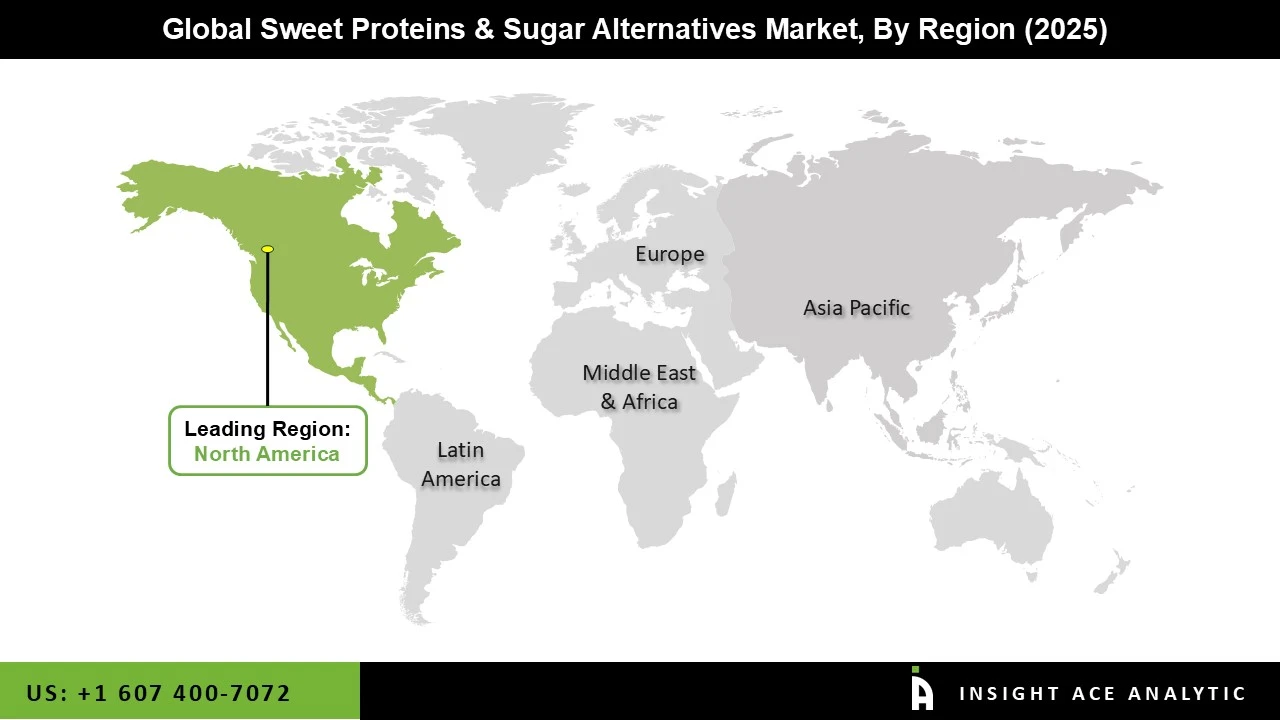
Why North America Led the Global Sweet Proteins & Sugar Alternatives Market?
North America dominates the sweet proteins and sugar alternatives market, due to a high level of consumer awareness regarding reducing sugar consumption, as well as robust demand for low-calorie and functional foods, especially with an increasing number of lifestyle diseases such as Type 2 Diabetes. North America's strength lies in having major food and beverages manufacturers who are engaged in re-formulation of products, coupled with a developed food technology ecosystem, favorable regulations, and an early adopter attitude towards innovation in the form of precision fermentation and plant-based sweetening ingredients.
Key Development
April 2026: Pentasweet is investing €65 million ($76 million) to build Europe’s first production facility for brazzein using precision fermentation. The plant will be developed in two phases, with initial operations expected by early 2027, marking a significant step toward scalable and cost-effective production of next-generation natural sweeteners.
Sweet Proteins & Sugar Alternatives Market Report Scope:
| Report Attribute | Specifications |
| Growth Rate CAGR | CAGR of 10.8% from 2026 to 2035 |
| Quantitative Units | Representation of revenue in US$ Bn and CAGR from 2026 to 2035 |
| Historic Year | 2021 to 2025 |
| Forecast Year | 2026-2035 |
| Report Coverage | The forecast of revenue, the position of the company, the competitive market structure, growth prospects, and trends |
| Segments Covered | Product Type, Application Distribution Channel, End-User and By Region |
| Regional Scope | North America; Europe; Asia Pacific; Latin America; Middle East & Africa |
| Country Scope | U.S.; Canada; U.K.; Germany; China; India; Japan; Brazil; Mexico; The UK; France; Italy; Spain; China; Japan; India; South Korea; Southeast Asia; South Korea; Southeast Asia |
| Competitive Landscape | Oobli, Amai Proteins, Sweegen, Inc., Conagen, Inc., Pentasweet UAB, BRAIN Biotech AG, Nomad Bioscience GmbH, MycoTechnology, Inc., Cweet, Inc., Shiru, Inc., Natur Research Ingredients, Inc., Magellan Life Sciences |
| Customization Scope | Free customization report with the procurement of the report, Modifications to the regional and segment scope. Geographic competitive landscape. |
| Pricing and Available Payment Methods | Explore pricing alternatives that are customized to your particular study requirements. |
Global Sweet Proteins & Sugar Alternatives Market Segmentation:
Global Sweet Proteins & Sugar Alternatives Market by Sweetener Category -
• Sweet Proteins
o Brazzein (including brazzein-53 and brazzein-54 isoforms)
o Thaumatin I & II
o Monellin
o Miraculin
o Designer / AI-Engineered Sweet Proteins (curculin, mabinlin, pentadin, de novo CPD variants)
• Rare Sugars
o Allulose (D-Psicose)
o Tagatose
o D-Allose and Other Rare Monosaccharides
• High-Intensity Natural Sweeteners (HINS)
o Stevia (Reb A, Reb M, Reb D)
o Monk Fruit (Mogroside V)
o Other HINS (Neohesperidin DC, Glycyrrhizin)
• Sugar Alcohols (Polyols)
o Erythritol
o Xylitol
o Sorbitol & Maltitol
o Other Polyols (Mannitol, Isomalt, Lactitol, Hydrogenated Starch Hydrolysates)
• Artificial High-Intensity Sweeteners
o Aspartame
o Sucralose
o Acesulfame-K
o Saccharin, Neotame, Advantame & Others
• Novel Enzymatic & Taste Modulators
o Enzymatic Sugar Conversion (sucrose-to-fiber systems)
o Sweetness Amplifiers & Modulators
o Bioactive Taste Modulators (citrus flavonoid, honey-truffle systems)
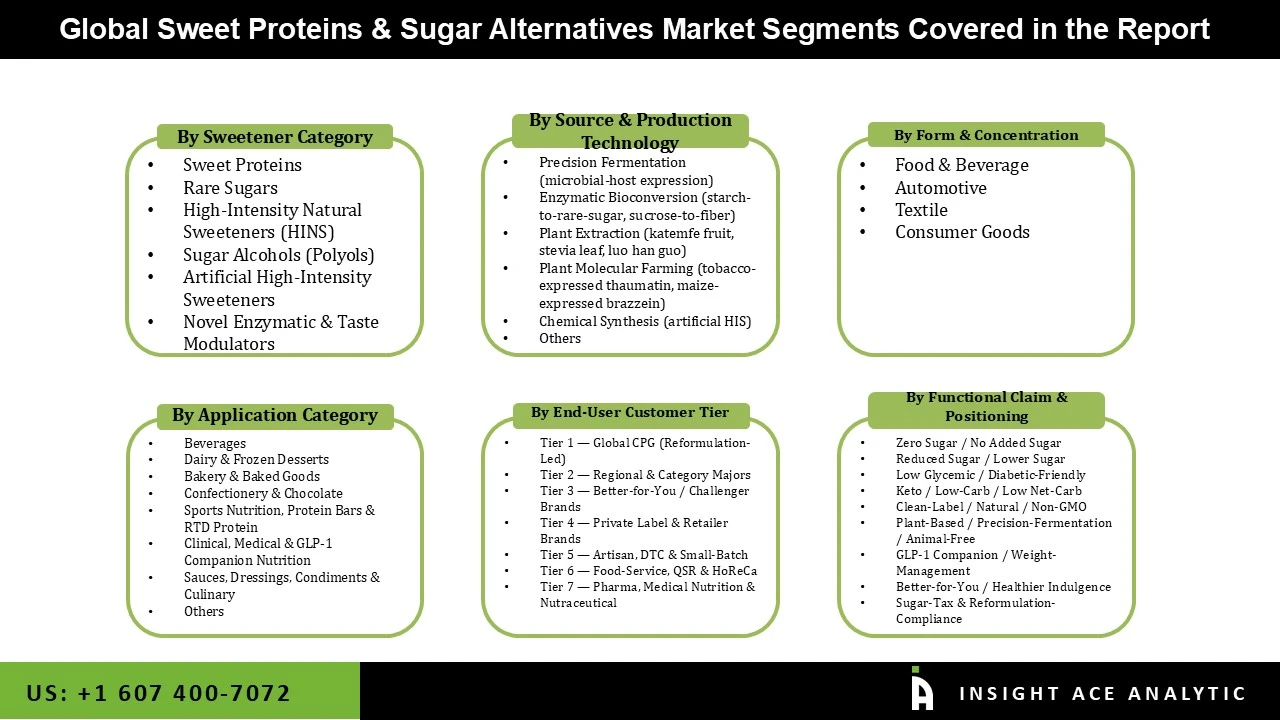
Global Sweet Proteins & Sugar Alternatives Market by Source & Production Technology -
• Precision Fermentation (microbial-host expression)
• Enzymatic Bioconversion (starch-to-rare-sugar, sucrose-to-fiber)
• Plant Extraction (katemfe fruit, stevia leaf, luo han guo)
• Plant Molecular Farming (tobacco-expressed thaumatin, maize-expressed brazzein)
• Chemical Synthesis (artificial HIS)
• Hybrid / Bioconversion-Enhanced Extraction (enzyme-enhanced stevia Reb M/D)
• AI-Enabled Discovery & Computational Protein Design (CPD)
Global Sweet Proteins & Sugar Alternatives Market by Form & Concentration -
• Crystalline / Powder
• Liquid / Syrup
• Pre-Formulated Blends (stevia+allulose, HINS+polyol, blended-system)
• Granulated / Tabletop Format
• Encapsulated / Controlled-Release
Global Sweet Proteins & Sugar Alternatives Market by Application Category -
• Beverages
o Carbonated Soft Drinks
o RTD Tea, Coffee & Functional Beverages
o Juice, Nectar & Enhanced Waters
o Sports, Energy & Hydration Drinks
• Dairy & Frozen Desserts
o Flavored Milk & Drinkable Yogurt
o Yogurt, Kefir & Cultured Dairy
o Ice Cream & Frozen Novelties
o Plant-Based Milk & Plant-Based Dairy
• Bakery & Baked Goods
o Breads, Rolls & Buns
o Cakes, Cookies & Pastries
o Breakfast Cereals, Granola S& Instant Oats
• Confectionery & Chocolate
o Chocolate Bars & Tablets
o Gummies, Hard Candy & Chewing Gum
• Sports Nutrition, Protein Bars & RTD Protein
• Clinical, Medical & GLP-1 Companion Nutrition
• Sauces, Dressings, Condiments & Culinary
• Tabletop & Retail-Packet Sweeteners
• Oral Care, Nutraceuticals & OTC Pharma
• Plant-Based Meat, Ready Meals & Savory
Global Sweet Proteins & Sugar Alternatives Market by End-User Customer Tier -
• Tier 1 — Global CPG (Reformulation-Led)
• Tier 2 — Regional & Category Majors
• Tier 3 — Better-for-You / Challenger Brands
• Tier 4 — Private Label & Retailer Brands
• Tier 5 — Artisan, DTC & Small-Batch
• Tier 6 — Food-Service, QSR & HoReCa
• Tier 7 — Pharma, Medical Nutrition & Nutraceutical
Global Sweet Proteins & Sugar Alternatives Market by Functional Claim & Positioning -
• Zero Sugar / No Added Sugar
• Reduced Sugar / Lower Sugar
• Low Glycemic / Diabetic-Friendly
• Keto / Low-Carb / Low Net-Carb
• Clean-Label / Natural / Non-GMO
• Plant-Based / Precision-Fermentation / Animal-Free
• GLP-1 Companion / Weight-Management
• Better-for-You / Healthier Indulgence
• Sugar-Tax & Reformulation-Compliance
Global Sweet Proteins & Sugar Alternatives Market by Region-
North America-
• The US
• Canada
Europe-
• Germany
• The UK
• France
• Italy
• Spain
• Rest of Europe
Asia-Pacific-
• China
• Japan
• India
• South Korea
• South East Asia
• Rest of Asia Pacific
Latin America-
• Brazil
• Argentina
• Mexico
• Rest of Latin America
Middle East & Africa-
• GCC Countries
• South Africa
• Rest of Middle East and Africa
Research Design and Approach
This study employed a multi-step, mixed-method research approach that integrates:
- Secondary research
- Primary research
- Data triangulation
- Hybrid top-down and bottom-up modelling
- Forecasting and scenario analysis
This approach ensures a balanced and validated understanding of both macro- and micro-level market factors influencing the market.
Secondary Research
Secondary research for this study involved the collection, review, and analysis of publicly available and paid data sources to build the initial fact base, understand historical market behaviour, identify data gaps, and refine the hypotheses for primary research.
Sources Consulted
Secondary data for the market study was gathered from multiple credible sources, including:
- Government databases, regulatory bodies, and public institutions
- International organizations (WHO, OECD, IMF, World Bank, etc.)
- Commercial and paid databases
- Industry associations, trade publications, and technical journals
- Company annual reports, investor presentations, press releases, and SEC filings
- Academic research papers, patents, and scientific literature
- Previous market research publications and syndicated reports
These sources were used to compile historical data, market volumes/prices, industry trends, technological developments, and competitive insights.

Primary Research
Primary research was conducted to validate secondary data, understand real-time market dynamics, capture price points and adoption trends, and verify the assumptions used in the market modelling.
Stakeholders Interviewed
Primary interviews for this study involved:
- Manufacturers and suppliers in the market value chain
- Distributors, channel partners, and integrators
- End-users / customers (e.g., hospitals, labs, enterprises, consumers, etc., depending on the market)
- Industry experts, technology specialists, consultants, and regulatory professionals
- Senior executives (CEOs, CTOs, VPs, Directors) and product managers
Interview Process
Interviews were conducted via:
- Structured and semi-structured questionnaires
- Telephonic and video interactions
- Email correspondences
- Expert consultation sessions
Primary insights were incorporated into demand modelling, pricing analysis, technology evaluation, and market share estimation.
Data Processing, Normalization, and Validation
All collected data were processed and normalized to ensure consistency and comparability across regions and time frames.
The data validation process included:
- Standardization of units (currency conversions, volume units, inflation adjustments)
- Cross-verification of data points across multiple secondary sources
- Normalization of inconsistent datasets
- Identification and resolution of data gaps
- Outlier detection and removal through algorithmic and manual checks
- Plausibility and coherence checks across segments and geographies
This ensured that the dataset used for modelling was clean, robust, and reliable.
Market Size Estimation and Data Triangulation
Bottom-Up Approach
The bottom-up approach involved aggregating segment-level data, such as:
- Company revenues
- Product-level sales
- Installed base/usage volumes
- Adoption and penetration rates
- Pricing analysis
This method was primarily used when detailed micro-level market data were available.

Top-Down Approach
The top-down approach used macro-level indicators:
- Parent market benchmarks
- Global/regional industry trends
- Economic indicators (GDP, demographics, spending patterns)
- Penetration and usage ratios
This approach was used for segments where granular data were limited or inconsistent.
Hybrid Triangulation Approach
To ensure accuracy, a triangulated hybrid model was used. This included:
- Reconciling top-down and bottom-up estimates
- Cross-checking revenues, volumes, and pricing assumptions
- Incorporating expert insights to validate segment splits and adoption rates
This multi-angle validation yielded the final market size.
Forecasting Framework and Scenario Modelling
Market forecasts were developed using a combination of time-series modelling, adoption curve analysis, and driver-based forecasting tools.
Forecasting Methods
- Time-series modelling
- S-curve and diffusion models (for emerging technologies)
- Driver-based forecasting (GDP, disposable income, adoption rates, regulatory changes)
- Price elasticity models
- Market maturity and lifecycle-based projections
Scenario Analysis
Given inherent uncertainties, three scenarios were constructed:
- Base-Case Scenario: Expected trajectory under current conditions
- Optimistic Scenario: High adoption, favourable regulation, strong economic tailwinds
- Conservative Scenario: Slow adoption, regulatory delays, economic constraints
Sensitivity testing was conducted on key variables, including pricing, demand elasticity, and regional adoption.
Request Customization
Add countries, segments, company profiles, or extend forecast — free 10% customization with purchase.
Customize This Report →Enquire Before Buying
Speak with our analyst team about scope, methodology, pricing, or deliverable formats.
Enquire Now →Frequently Asked Questions
Sweet Proteins and Sugar Alternatives Market Size is predicted to grow at a 10.8% CAGR during the forecast period for 2026 to 2035.
Oobli, Amai Proteins, Sweegen, Inc., Conagen, Inc., Pentasweet UAB, BRAIN Biotech AG, Nomad Bioscience GmbH, MycoTechnology, Inc., Cweet, Inc., Shiru, Inc., Natur Research Ingredients, Inc., Magellan Life Sciences
Sweet Proteins and Sugar Alternatives Market is segmented into Product Type, Application Distribution Channel, End-User and By Region.
North America region is leading the Sweet Proteins and Sugar Alternatives Market.