Silicon Carbide (SiC) Market Size, Share, Trend, Scope Report 2026 to 2035
What is Silicon Carbide (SiC) Market Size?
Global Silicon Carbide (SiC) Market Size is valued at USD 4.65 Bn in 2025 and is predicted to reach USD 52.05 Bn by the year 2035 at a 27.9% CAGR during the forecast period for 2026 to 2035.
Silicon Carbide (SiC) Market Size, Share & Trends Analysis Distribution by Voltage Range (Up to 1200 V, Low (200 V to 1700 V), Medium (1700 V to 3300 V), and High (>3300 V)), Device Type (SiC Discrete Devices and SiC Modules), End-user (Industrial, Automotive, Transportation, Energy & Power, Telecommunication, and Others), and Segment Forecasts, 2026 to 2035
-Market-Size.webp "Silicon Carbide (SiC) Market Size")
Silicon Carbide (SiC) Market Key Takeaways:
|
The substance known as silicon carbide (SiC) is composed of silicon and carbon atoms. It is used in many industrial applications because of its remarkable hardness, excellent thermal conductivity, and durability to extreme temperatures. In a process known as carbothermal reduction, silica (sand) and carbon sources such as petroleum coke or wood chips are heated in an electric furnace to generate SiC. Crystalline silicon carbide is produced as a result of this process, and it can then be processed into different sizes and forms for a variety of applications. The growing demand for energy-efficient power electronics, the development of the electric vehicle (EV) industry, and the growing uptake of renewable energy technologies are the main drivers of the silicon carbide (SiC) market expansion.
The growing need for SiC fibers in the aerospace sector is one significant trend propelling the silicon carbide (SiC) market's expansion. The industry vertical's automotive and electronics sectors will expand quickly since they provide more uses for silicon carbide. The demand for semiconductors is predicted to rise globally in a number of areas, including consumer electronics, automotive, IT, and telephony. Additionally, it is anticipated that the worldwide silicon carbide (SiC) market will expand due to the growing need for sustainable energy or solar energy. Furthermore, the silicon carbide (SiC) market is significantly driven by the oil and gas sector. In the oil and gas industry, silicon carbides (SiC) are widely utilized for dehydration procedures, impurity removal, and gas separation and purification. The demand for SiC is predicted to increase due to the growing need for energy worldwide and the development of unconventional oil and gas deposits.
In addition, the implementation of 5G networks necessitates the use of sophisticated RF devices that can function at high frequencies. Excellent RF performance, including high power handling capacity, low losses, and good thermal conductivity, is provided by silicon carbide. Silicon carbide-based RF devices will be in greater demand as 5G technology spreads throughout the world, creating growth prospects for the silicon carbide (SiC) market expansion. However, compared to conventional semiconductor materials such as silicon, silicon carbide has distinct material features and characteristics. It can be technically difficult to create effective devices and incorporate silicon carbide into current manufacturing methods. This may restrict the silicon carbide (SiC) market expansion and prevent silicon carbide from being used in a variety of industries and applications.
Competitive Landscape
Which are the Leading Players in Silicon Carbide (SiC) Market?
- Infineon Technologies AG
- Microchip Technology Inc.
- STMicroelectronics
- ROHM Co., Ltd.
- Semiconductor Components Industries, LLC
- Wolfspeed, Inc.
- Toshiba Electronic Devices & Storage Corporation
- Mitsubishi Electric Corporation
- Fuji Electric Co., Ltd.
- Robert Bosch GMBH
Market Dynamics
Driver
Growing Need for Energy-efficient and Clean Solutions
The silicon carbide (SiC) market is expanding due in large part to the growing need for energy-efficient and clean solutions in a variety of industries. As companies strive to reduce their carbon footprint and increase operational efficiency, semiconductors can play a significant role by enabling devices with high efficiency due to their numerous benefits over conventional silicon. Unlike conventional silicon-based semiconductors, SiC can withstand high temperatures and voltages while losing less energy, which makes it an ideal option for renewable energy systems like solar and wind. Additionally, government and organizational sustainability goals will continue to drive the need for energy-efficient technology, which will hasten the adoption of SiC in applications that lower energy consumption and greenhouse gas emissions. The demand for energy-efficient technology such as SiC-based solutions is being driven by the U.S. Department of Energy's "Better Buildings Challenge," which intends to increase commercial building energy efficiency by 20% over ten years. The adoption of SiC in power grids can cut energy losses by up to 10%, which helps minimize carbon emissions from the production and distribution of energy. The tendency will increase demand for SiC-based solutions in power electronics and energy systems, supported by incentives and regulatory frameworks that support green technologies.
Restrain/Challenge
High Production Costs and Intricate Manufacturing Procedures
The high production costs and complex manufacturing processes associated with SiC semiconductor devices limit the growth of the silicon carbide (SiC) market. High-purity silicon carbide wafers require sophisticated techniques, including precise crystal formation and high-temperature processing, which raises production costs. SiC wafers are more difficult to create than regular silicon wafers, which results in lower production yields and higher costs. The potential for silicon carbide power electronics to be adopted in cost-conscious industries is diminished by the higher production costs. Additionally, since they are essential to the silicon carbide (SiC) market, specialized machinery and highly qualified personnel increase manufacturing complexity. It is difficult for new rivals to enter this market since companies must spend a lot of money on research and development in order to improve manufacturing processes and reduce production costs. Large SiC wafers become difficult to get, which hinders industrial volume production and prevents widespread market adoption in emerging industries like renewable energy and electric vehicles.
SiC Modules Segment is Expected to Drive the Silicon Carbide (SiC) Market
The SiC Modules category held the largest share in the Silicon Carbide (SiC) market in 2025 because of its exceptional performance attributes. They are highly sought after for advanced applications due to their small system designs, reduced dependence on passive components, and capacity to handle quicker switching speeds. SiC modules' superior high-frequency performance, high blocking voltage, and ability to withstand high junction temperatures all contribute to their allure. These characteristics lead to a notable increase in power density and compactness, which fuels the demand for SiC modules in a variety of industries. For instance, Mitsubishi Electric unveiled six J3-Series SiC and Si power modules for electric vehicles in January 2024. Samples will be shipped starting on March 25, 2024, and they will be displayed at NEPCON Japan 2024 and other international exhibitions.
Automotive Segment is Growing at the Highest Rate in the Silicon Carbide (SiC) Market
In 2025, the automotive category dominated the silicon carbide (SiC) market because opto-semiconductor and high-performance power devices are becoming more and more in demand. This need is driven by the car industry's desire for high-performance and energy-efficient electronic systems. When compared to conventional silicon-based components, SiC-based devices provide better performance, including increased efficiency, quicker switching rates, and improved thermal conductivity. The increasing use of SiC-based power electronics in EVs for better energy efficiency, quicker charging, and longer range is especially driving this. Additionally, the advancement of advanced driver assistance systems (ADAS) and vehicle electrification supports the expansion of the silicon carbide (SiC) market in the automotive industry.
Why North America Led the Silicon Carbide (SiC) Market?
The silicon carbide (SiC) market was dominated by North America region in 2025 due to the ongoing increase in funding for 5G infrastructure and electric vehicle defense. By increasing their manufacturing of silicon carbide wafers, Wolfspeed and ON Semiconductor assume prominent positions in the advancement of American technology. With their most recent high-efficiency variants used in EVs and aerospace applications, silicon carbide MOSFETs are currently achieving unprecedented levels of efficiency performance.
-Market-Region.webp "Silicon Carbide (SiC) Market Leading Region")
Additionally, the government's encouragement of both local semiconductor manufacturing and renewable energy solutions contributes to the rise. Due to its rapid adoption of silicon carbide technology for high-frequency power electronics and renewable energy systems, the area is positioned as a major contributor to the silicon carbide (SiC) market expansion. Moreover, partnerships between businesses and academic institutions are promoting innovation in SiC applications in a variety of fields.
Key Development
• March 2025: EliteSiCTM SPM31 intelligent power modules, which incorporate 1,200 V SiC MOSFETs into a small three-phase inverter chassis, were introduced by Semiconductor Components Industries, LLC. The modules help energy-efficient systems and industrial motor control by providing increased efficiency and power density.
• February 2025: A new family of three 1200V SiC full-bridge modules, each combining two of the company's robust high-speed switching SiC MOSFETs with dependable body diodes, was unveiled by SemiQ, a designer and developer of silicon carbide (SiC) solutions. The modules are designed to make the development of energy storage, battery charging, solar inverters, and other high-frequency DC applications easier.
• December 2024: With the introduction of XSICM03, its next-generation XbloX platform, X-FAB Silicon Foundries SE advanced Silicon Carbide (SiC) process technology for power MOSFETs, resulting in a greatly lower cell pitch that allows for higher die per wafer and enhanced on-state resistance without sacrificing reliability.
• July 2024: EliteSiC M3e MOSFETs were introduced by the multinational company Onsemi to accelerate the silicon carbide technology platform worldwide. The business hopes to significantly reduce conduction and switching loss on the tried-and-true planar architecture using the new technology. Onsemi's EliteSiC M3e MOSFETs have among the industry's lowest specific on-resistance.
• November 2023: To improve energy efficiency and promote decarbonization, Mitsubishi Electric and Nexperia collaborated to develop silicon carbide (SiC) power semiconductors by fusing Mitsubishi's SiC MOSFET technology with Nexperia's knowledge of discrete devices.
Silicon Carbide (SiC) Market Report Scope:
| Report Attribute | Specifications |
| Market size value in 2025 | USD 4.65 Bn |
| Revenue forecast in 2035 | USD 52.05 Bn |
| Growth Rate CAGR | CAGR of 27.9% from 2026 to 2035 |
| Quantitative Units | Representation of revenue in US$ Bn and CAGR from 2026 to 2035 |
| Historic Year | 2022 to 2025 |
| Forecast Year | 2026 to 2035 |
| Report Coverage | The forecast of revenue, the position of the company, the competitive market structure, growth prospects, and trends |
| Segments Covered | Voltage Range, Device Type, End-user, and Region |
| Regional Scope | North America; Europe; Asia Pacific; Latin America; Middle East & Africa |
| Country Scope | U.S.; Canada; U.K.; Germany; China; India; Japan; Brazil; Mexico; The UK; France; Italy; Spain; China; Japan; India; South Korea; Southeast Asia; South Korea; Southeast Asia |
| Competitive Landscape | Infineon Technologies AG, Microchip Technology Inc., STMicroelectronics, ROHM Co., Ltd., Semiconductor Components Industries, LLC, Wolfspeed, Inc., Toshiba Electronic Devices & Storage Corporation, Mitsubishi Electric Corporation, Fuji Electric Co., Ltd., and Robert Bosch GMBH |
| Customization Scope | Free customization report with the procurement of the report, Modifications to the regional and segment scope. Geographic competitive landscape. |
| Pricing and Available Payment Methods | Explore pricing alternatives that are customized to your particular study requirements. |
Segmentation of Silicon Carbide (SiC) Market :
Silicon Carbide (SiC) Market by Voltage Range-
- Up to 1200 V
- Low (200 V to 1700 V)
- Medium (1700 V to 3300 V)
- High (>3300 V)
-Market-Seg.webp "Silicon Carbide (SiC) Market Segmentations")
Silicon Carbide (SiC) Market by Device Type-
- SiC Discrete Devices
- SiC Modules
Silicon Carbide (SiC) Market by End-user-
- Industrial
- Automotive
- Transportation
- Energy & Power
- Telecommunication
- Others
Silicon Carbide (SiC) Market By Region-
- North America-
- The US
- Canada
- Europe-
- Germany
- The UK
- France
- Italy
- Spain
- Rest of Europe
- Asia-Pacific-
- China
- Japan
- India
- South Korea
- South East Asia
- Rest of Asia Pacific
- Latin America-
- Brazil
- Argentina
- Mexico
- Rest of Latin America
- Middle East & Africa-
- GCC Countries
- South Africa
- Rest of Middle East and Africa
Research Design and Approach
This study employed a multi-step, mixed-method research approach that integrates:
- Secondary research
- Primary research
- Data triangulation
- Hybrid top-down and bottom-up modelling
- Forecasting and scenario analysis
This approach ensures a balanced and validated understanding of both macro- and micro-level market factors influencing the market.
Secondary Research
Secondary research for this study involved the collection, review, and analysis of publicly available and paid data sources to build the initial fact base, understand historical market behaviour, identify data gaps, and refine the hypotheses for primary research.
Sources Consulted
Secondary data for the market study was gathered from multiple credible sources, including:
- Government databases, regulatory bodies, and public institutions
- International organizations (WHO, OECD, IMF, World Bank, etc.)
- Commercial and paid databases
- Industry associations, trade publications, and technical journals
- Company annual reports, investor presentations, press releases, and SEC filings
- Academic research papers, patents, and scientific literature
- Previous market research publications and syndicated reports
These sources were used to compile historical data, market volumes/prices, industry trends, technological developments, and competitive insights.
Primary Research
Primary research was conducted to validate secondary data, understand real-time market dynamics, capture price points and adoption trends, and verify the assumptions used in the market modelling.
Stakeholders Interviewed
Primary interviews for this study involved:
- Manufacturers and suppliers in the market value chain
- Distributors, channel partners, and integrators
- End-users / customers (e.g., hospitals, labs, enterprises, consumers, etc., depending on the market)
- Industry experts, technology specialists, consultants, and regulatory professionals
- Senior executives (CEOs, CTOs, VPs, Directors) and product managers
Interview Process
Interviews were conducted via:
- Structured and semi-structured questionnaires
- Telephonic and video interactions
- Email correspondences
- Expert consultation sessions
Primary insights were incorporated into demand modelling, pricing analysis, technology evaluation, and market share estimation.
Data Processing, Normalization, and Validation
All collected data were processed and normalized to ensure consistency and comparability across regions and time frames.
The data validation process included:
- Standardization of units (currency conversions, volume units, inflation adjustments)
- Cross-verification of data points across multiple secondary sources
- Normalization of inconsistent datasets
- Identification and resolution of data gaps
- Outlier detection and removal through algorithmic and manual checks
- Plausibility and coherence checks across segments and geographies
This ensured that the dataset used for modelling was clean, robust, and reliable.
Market Size Estimation and Data Triangulation
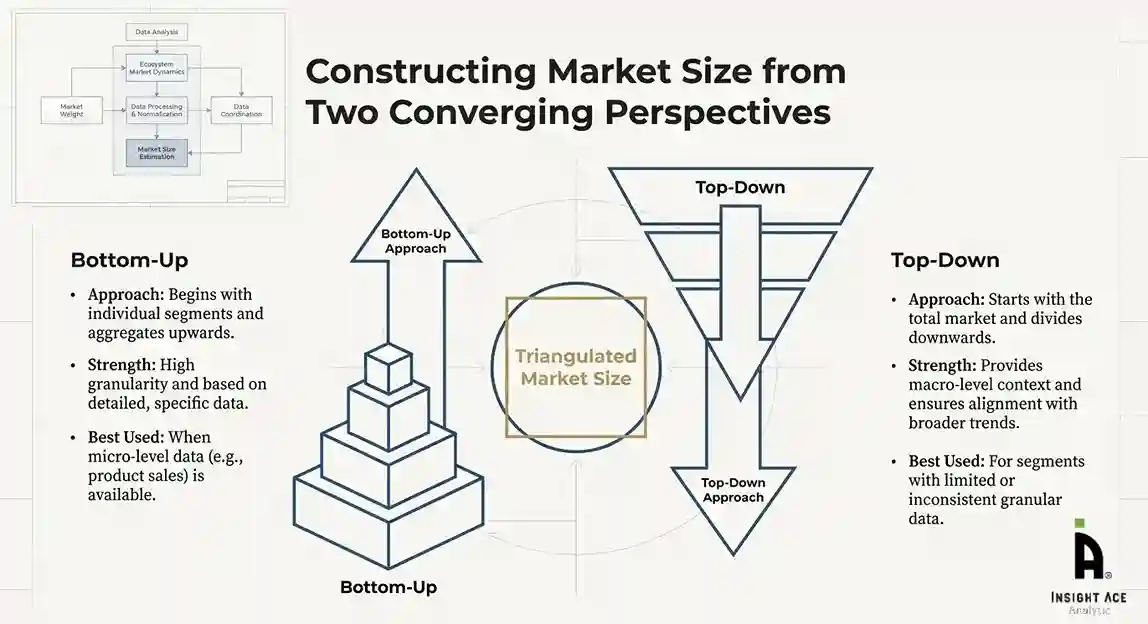
Bottom-Up Approach
The bottom-up approach involved aggregating segment-level data, such as:
- Company revenues
- Product-level sales
- Installed base/usage volumes
- Adoption and penetration rates
- Pricing analysis
This method was primarily used when detailed micro-level market data were available.
Top-Down Approach
The top-down approach used macro-level indicators:
- Parent market benchmarks
- Global/regional industry trends
- Economic indicators (GDP, demographics, spending patterns)
- Penetration and usage ratios
This approach was used for segments where granular data were limited or inconsistent.
Hybrid Triangulation Approach
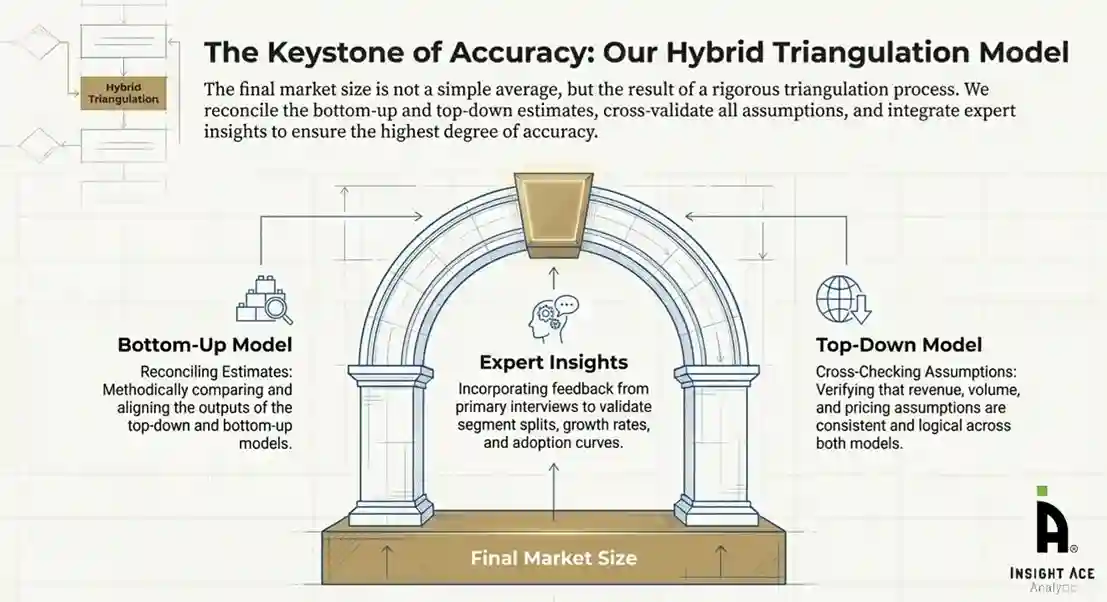
To ensure accuracy, a triangulated hybrid model was used. This included:
- Reconciling top-down and bottom-up estimates
- Cross-checking revenues, volumes, and pricing assumptions
- Incorporating expert insights to validate segment splits and adoption rates
This multi-angle validation yielded the final market size.
Forecasting Framework and Scenario Modelling
Market forecasts were developed using a combination of time-series modelling, adoption curve analysis, and driver-based forecasting tools.
Forecasting Methods
- Time-series modelling
- S-curve and diffusion models (for emerging technologies)
- Driver-based forecasting (GDP, disposable income, adoption rates, regulatory changes)
- Price elasticity models
- Market maturity and lifecycle-based projections
Scenario Analysis
Given inherent uncertainties, three scenarios were constructed:
- Base-Case Scenario: Expected trajectory under current conditions
- Optimistic Scenario: High adoption, favourable regulation, strong economic tailwinds
- Conservative Scenario: Slow adoption, regulatory delays, economic constraints
Sensitivity testing was conducted on key variables, including pricing, demand elasticity, and regional adoption.
Request Customization
Add countries, segments, company profiles, or extend forecast — free 10% customization with purchase.
Customize This Report →Enquire Before Buying
Speak with our analyst team about scope, methodology, pricing, or deliverable formats.
Enquire Now →Frequently Asked Questions
Silicon Carbide (SiC) Market Size is valued at USD 4.65 Bn in 2025 and is predicted to reach USD 52.05 Bn by the year 2035
The Silicon Carbide (SiC) Market is expected to grow at a 27.9% CAGR during the forecast period for 2026 to 2035
Infineon Technologies AG, Microchip Technology Inc., STMicroelectronics, ROHM Co., Ltd., Semiconductor Components Industries, LLC, Wolfspeed, Inc., Toshiba Electronic Devices & Storage Corporation, Mitsubishi Electric Corporation, Fuji Electric Co., Ltd., Robert Bosch GMBH and Others
Silicon Carbide (SiC) Market is segmented into Voltage Range, Device Type, End-user, Region and other.
Asia Pacific region is leading the Silicon Carbide (SiC) Market