Onboard Charger and DC Fast Charging Interoperability Test Equipment Market 2026 to 2035
What is Onboard Charger and DC Fast-Charging Interoperability Test Equipment Market Size?
Onboard Charger and DC Fast-Charging Interoperability Test Equipment Market Size is valued at USD 271.80 Mn in 2025 and is predicted to reach USD 959.63 Mn by the year 2035 at a 13.7% CAGR during the forecast period for 2026 to 2035.
Onboard Charger and DC Fast-Charging Interoperability Test Equipment Market Size, Share & Trends Analysis Distribution by Equipment Type (Charging Communication Conformance and Interoperability Testers, TTCN-3 Suites, PLC Systems, Protocol Emulators, and Fault-injection Systems), Standard Coverage (CCS Systems, CHAdeMO Systems, GB/T Systems, NACS Systems, and Multi-standard Platforms), Charging Scope (DC Fast-charging Testers, Plug & Charge Systems, AC DC Validation Systems, AC Charger Testers, and V2G Systems), Test Focus (Conformance Testing, Regression Testing, Communication Validation, Function Verification, Cybersecurity Validation, and Compatibility Testing), End-user (OEM Validation Teams, Tier 1 Suppliers, Charger Manufacturers, Test Labs, and Research Institutes), and Segment Forecasts, 2026 to 2035
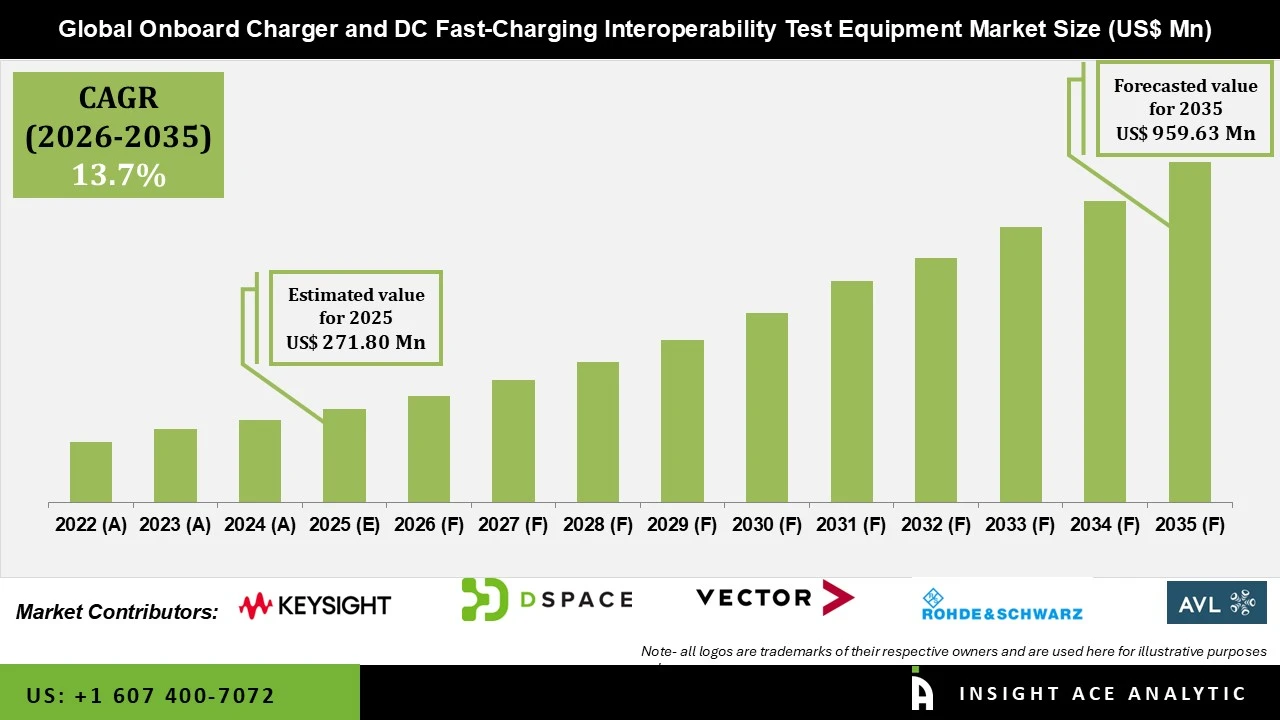
Specialized testing systems called onboard charger (OBC) and DC fast-charging interoperability test equipment are used to verify how electric vehicles (EVs) and charging infrastructure interact, function, and adhere to international charging standards. While DC fast charging avoids the onboard charger and provides high-power DC electricity directly to the battery, the onboard charger is the part of an EV that transforms AC power from regular charging stations into DC power to charge the battery. The growing popularity of electric vehicles (EVs) and the concurrent need for effective charging solutions that guarantee smooth compatibility across various platforms and technologies are driving the onboard charger & DC fast-charging interoperability test equipment market expansion.
The onboard charger & DC fast-charging interoperability test equipment market is being driven by the electric vehicle (EV) ecosystem's rapid growth, as automakers and charging infrastructure providers place a greater emphasis on seamless charging compatibility. The necessity to make sure that cars can connect and interact with various charging protocols, like CCS, CHAdeMO, and GB/T, is expanding due to the increasing use of EVs in both passenger and commercial markets. Additionally, the implementation of advanced testing systems is also being accelerated by government incentives, more stringent regulatory requirements, and international standardization initiatives. Manufacturers are being forced to use advanced interoperability testing techniques due to the growing complexity of power electronics, increased charging capabilities, and bidirectional charging technologies.
In addition, as EV charging technology and communication protocols continue to progress, the onboard charger & DC fast-charging interoperability test equipment market is anticipated to grow. Innovation in modeling and validation tools is being stimulated by the trend toward ultra-fast charging, smart grid integration, and vehicle-to-grid (V2G) capabilities. By enforcing compliance standards, regulatory authorities and certification agencies are also playing a critical role in increasing demand for dependable test equipment. Additionally, the manufacturers are putting more of an emphasis on scalable and modular testing systems that can accommodate various charging standards and upcoming technological advancements. This pattern indicates a shift toward highly specialized and automated testing solutions made to satisfy changing business requirements.
Competitive Landscape
Which are the Leading Players in Onboard Charger & DC Fast-Charging Interoperability Test Equipment Market?
• Keysight Technologies
• AVL
• Intertek / certification ecosystem
• Rohde & Schwarz
• Anritsu
• dSPACE
• Vector Informatik
Market Dynamics
Driver
Advances in Isotope Production and Supply Chain
One of the main factors driving the onboard charger & DC fast-charging interoperability test equipment market is the increasing global deployment of EV charging infrastructure. To encourage growing EV use, governments and corporate players are making significant investments in developing public and private charging networks. Ensuring smooth compatibility between EVs and chargers has become crucial as charging stations proliferate and vary in terms of power levels, communication methods, and connector standards. Additionally, the need for sophisticated interoperability testing tools that can verify communication, performance, and safety across many standards, including GB/T, CHAdeMO, and CCS, has greatly expanded as a result. Further propelling the onboard charger & DC fast-charging interoperability test equipment market expansion is the need for accurate and dependable testing systems due to the development of ultra-fast and smart charging technologies.
Restrain/Challenge
High Price and Technical Difficulty of Testing Devices
The high cost and technical complexity of onboard chargers and DC fast-charging interoperability test equipment are major barriers to the market. The advanced testing solutions are costly to design and implement because they need complex technology, simulation capabilities, and adherence to changing international standards. Budgetary restrictions may make it difficult for smaller producers and testing institutions to implement such technology. Additionally, the fast-evolving EV charging scenario necessitates ongoing modifications and technological know-how due to regular revisions in communication protocols and power requirements. This raises operating expenses and puts up a barrier for new competitors, which could delay the onboard charger & DC fast-charging interoperability test equipment market's broad adoption.
Charging Communication Conformance and Interoperability Testers Segment is Expected to Drive the Onboard Charger & DC Fast-Charging Interoperability Test Equipment Market
The Charging Communication Conformance and Interoperability Testers category held the largest share in the Onboard Charger & DC Fast-Charging Interoperability Test Equipment market in 2025, demonstrating the enormous amount of engineering work needed to debug digital handshakes. It takes thousands of costly developer hours to write custom validation scripts from scratch. Purchasing an EV charger protocol interoperability tester with specific EV charging tester suites that include hundreds of standardized test cases is how procurement teams address this issue. This method guarantees complete adherence to changing CharIN requirements without interfering with internal project schedules. Additionally, a lot of development teams find out too late that their specially designed simulators are unable to decipher more recent encryption layers. This continuing maintenance load is transferred back to the equipment vendor when commercial off-the-shelf compliance tools are purchased.
OEM Validation Teams Segment is Growing at the Highest Rate in the Onboard Charger & DC Fast-Charging Interoperability Test Equipment Market
In 2025, the OEM Validation Teams category dominated the Onboard Charger & DC Fast-Charging Interoperability Test Equipment market. To independently validate complete system behavior, they use advanced battery testing equipment in conjunction with an OEM EV charging validation bench. When charging sessions don't work, this tactic keeps providers from blaming one another. While the station manufacturer places the responsibility on the car software, an onboard charger supplier may place the blame on the station manufacturer. OEMs employ centralized interoperability testing to quantitatively pinpoint the precise cause of the communication breakdown. The right supplier is compelled by this conclusive evidence to provide software patches right away. Additionally, complete vehicle safety is ensured by using internal battery testing, inspection, and certification procedures in addition to communication tests.
Why North America Led the Onboard Charger & DC Fast-Charging Interoperability Test Equipment Market?
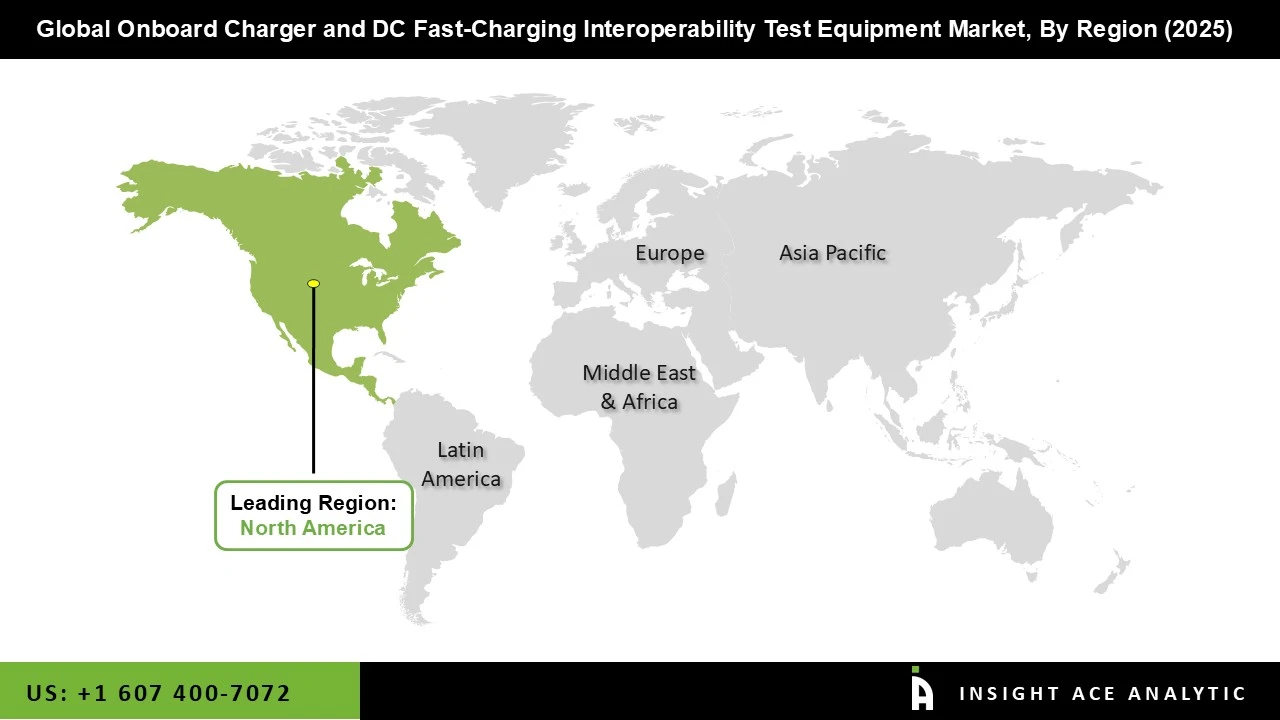
The Onboard Charger & DC Fast-Charging Interoperability Test Equipment market was dominated by North America region in 2025 propelled by substantial expenditures in research and development, robust regulatory frameworks, and early uptake of electric vehicles. With an emphasis on creating next-generation compliance test systems that enable new charging standards and smart grid integration, the US and Canada are at the forefront of technological innovation. Additionally, with continued government incentives and the growth of both public and commercial charging networks, it is anticipated that the North American onboard charger & DC fast-charging interoperability test equipment market will continue to grow steadily. Furthermore, before actual dispensers even reach highway rest areas, systems integration managers use sophisticated software tools to eliminate these digital handshake issues. These elements are expected to accelerate the onboard charger & DC fast-charging interoperability test equipment market expansion in this region.
Onboard Charger & DC Fast-Charging Interoperability Test Equipment Market Report Scope:
| Report Attribute | Specifications |
| Market size value in 2025 | USD 271.80 Mn |
| Revenue forecast in 2035 | USD 959.63 Mn |
| Growth Rate CAGR | CAGR of 13.7% from 2026 to 2035 |
| Quantitative Units | Representation of revenue in US$ Mn and CAGR from 2026 to 2035 |
| Historic Year | 2022 to 2025 |
| Forecast Year | 2026-2035 |
| Report Coverage | The forecast of revenue, the position of the company, the competitive market structure, growth prospects, and trends |
| Segments Covered | Equipment Type, Standard Coverage, Charging Scope, Test Focus, End-user, and By Region |
| Regional Scope | North America; Europe; Asia Pacific; Latin America; Middle East & Africa |
| Country Scope | U.S.; Canada; U.K.; Germany; China; India; Japan; Brazil; Mexico; The UK; France; Italy; Spain; China; Japan; India; South Korea; Southeast Asia; South Korea; Southeast Asia |
| Competitive Landscape | Keysight Technologies, AVL, Intertek / certification ecosystem, Rohde & Schwarz, Anritsu, dSPACE, and Vector Informatik. |
| Customization Scope | Free customization report with the procurement of the report, Modifications to the regional and segment scope. Geographic competitive landscape. |
| Pricing and Available Payment Methods | Explore pricing alternatives that are customized to your particular study requirements. |
Market Segmentation:
Onboard Charger & DC Fast-Charging Interoperability Test Equipment Market by Equipment Type-
• Charging Communication Conformance and Interoperability Testers
• TTCN-3 Suites
• PLC Systems
• Protocol Emulators
• Fault-injection Systems
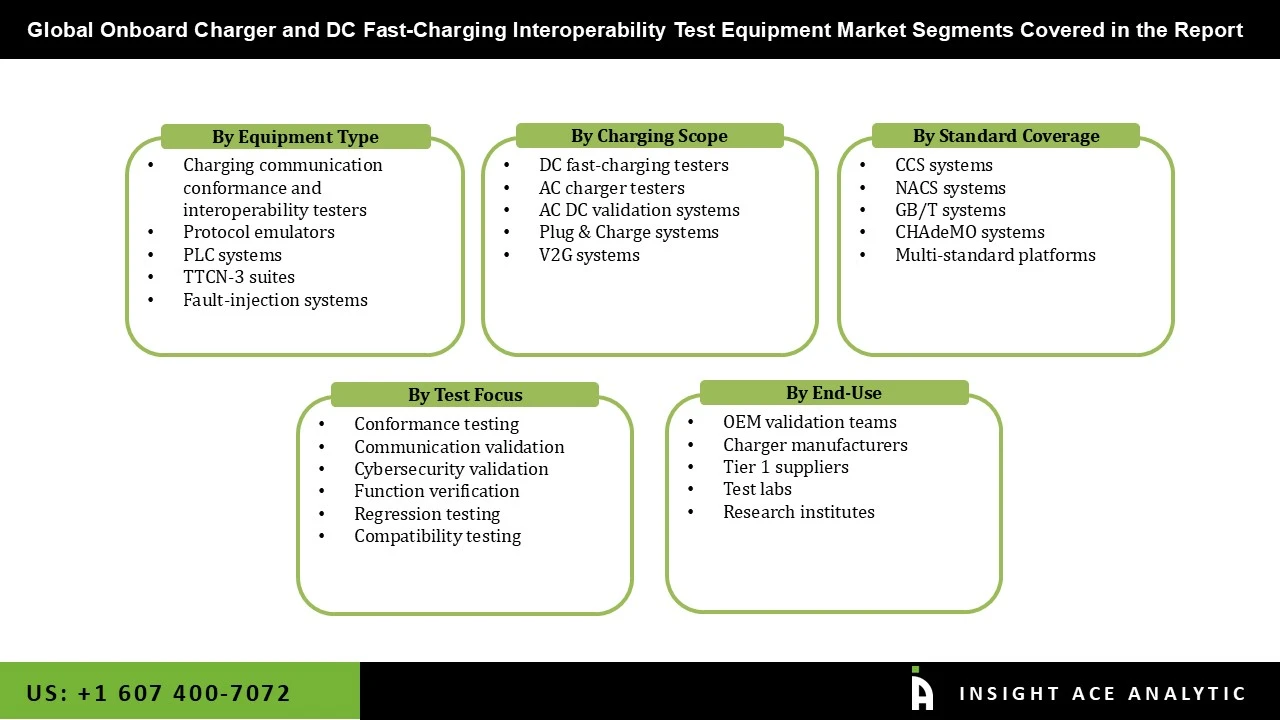
Onboard Charger & DC Fast-Charging Interoperability Test Equipment Market by Standard Coverage-
• CCS Systems
• CHAdeMO Systems
• GB/T Systems
• NACS Systems
• Multi-standard Platforms
Onboard Charger & DC Fast-Charging Interoperability Test Equipment Market by Charging Scope-
• DC Fast-charging Testers
• Plug & Charge Systems
• AC DC Validation Systems
• AC Charger Testers
• V2G Systems
Onboard Charger & DC Fast-Charging Interoperability Test Equipment Market by Test Focus-
• Conformance Testing
• Regression Testing
• Communication Validation
• Function Verification
• Cybersecurity Validation
• Compatibility Testing
Onboard Charger & DC Fast-Charging Interoperability Test Equipment Market by End-user-
• OEM Validation Teams
• Tier 1 Suppliers
• Charger Manufacturers
• Test Labs
• Research Institutes
By Region-
North America-
• The US
• Canada
Europe-
• Germany
• The UK
• France
• Italy
• Spain
• Rest of Europe
Asia-Pacific-
• China
• Japan
• India
• South Korea
• South East Asia
• Rest of Asia Pacific
Latin America-
• Brazil
• Argentina
• Mexico
• Rest of Latin America
Middle East & Africa-
• GCC Countries
• South Africa
• Rest of Middle East and Africa
Research Design and Approach
This study employed a multi-step, mixed-method research approach that integrates:
- Secondary research
- Primary research
- Data triangulation
- Hybrid top-down and bottom-up modelling
- Forecasting and scenario analysis
This approach ensures a balanced and validated understanding of both macro- and micro-level market factors influencing the market.
Secondary Research
Secondary research for this study involved the collection, review, and analysis of publicly available and paid data sources to build the initial fact base, understand historical market behaviour, identify data gaps, and refine the hypotheses for primary research.
Sources Consulted
Secondary data for the market study was gathered from multiple credible sources, including:
- Government databases, regulatory bodies, and public institutions
- International organizations (WHO, OECD, IMF, World Bank, etc.)
- Commercial and paid databases
- Industry associations, trade publications, and technical journals
- Company annual reports, investor presentations, press releases, and SEC filings
- Academic research papers, patents, and scientific literature
- Previous market research publications and syndicated reports
These sources were used to compile historical data, market volumes/prices, industry trends, technological developments, and competitive insights.

Primary Research
Primary research was conducted to validate secondary data, understand real-time market dynamics, capture price points and adoption trends, and verify the assumptions used in the market modelling.
Stakeholders Interviewed
Primary interviews for this study involved:
- Manufacturers and suppliers in the market value chain
- Distributors, channel partners, and integrators
- End-users / customers (e.g., hospitals, labs, enterprises, consumers, etc., depending on the market)
- Industry experts, technology specialists, consultants, and regulatory professionals
- Senior executives (CEOs, CTOs, VPs, Directors) and product managers
Interview Process
Interviews were conducted via:
- Structured and semi-structured questionnaires
- Telephonic and video interactions
- Email correspondences
- Expert consultation sessions
Primary insights were incorporated into demand modelling, pricing analysis, technology evaluation, and market share estimation.
Data Processing, Normalization, and Validation
All collected data were processed and normalized to ensure consistency and comparability across regions and time frames.
The data validation process included:
- Standardization of units (currency conversions, volume units, inflation adjustments)
- Cross-verification of data points across multiple secondary sources
- Normalization of inconsistent datasets
- Identification and resolution of data gaps
- Outlier detection and removal through algorithmic and manual checks
- Plausibility and coherence checks across segments and geographies
This ensured that the dataset used for modelling was clean, robust, and reliable.
Market Size Estimation and Data Triangulation
Bottom-Up Approach
The bottom-up approach involved aggregating segment-level data, such as:
- Company revenues
- Product-level sales
- Installed base/usage volumes
- Adoption and penetration rates
- Pricing analysis
This method was primarily used when detailed micro-level market data were available.

Top-Down Approach
The top-down approach used macro-level indicators:
- Parent market benchmarks
- Global/regional industry trends
- Economic indicators (GDP, demographics, spending patterns)
- Penetration and usage ratios
This approach was used for segments where granular data were limited or inconsistent.
Hybrid Triangulation Approach
To ensure accuracy, a triangulated hybrid model was used. This included:
- Reconciling top-down and bottom-up estimates
- Cross-checking revenues, volumes, and pricing assumptions
- Incorporating expert insights to validate segment splits and adoption rates
This multi-angle validation yielded the final market size.
Forecasting Framework and Scenario Modelling
Market forecasts were developed using a combination of time-series modelling, adoption curve analysis, and driver-based forecasting tools.
Forecasting Methods
- Time-series modelling
- S-curve and diffusion models (for emerging technologies)
- Driver-based forecasting (GDP, disposable income, adoption rates, regulatory changes)
- Price elasticity models
- Market maturity and lifecycle-based projections
Scenario Analysis
Given inherent uncertainties, three scenarios were constructed:
- Base-Case Scenario: Expected trajectory under current conditions
- Optimistic Scenario: High adoption, favourable regulation, strong economic tailwinds
- Conservative Scenario: Slow adoption, regulatory delays, economic constraints
Sensitivity testing was conducted on key variables, including pricing, demand elasticity, and regional adoption.
Request Customization
Add countries, segments, company profiles, or extend forecast — free 10% customization with purchase.
Customize This Report →Enquire Before Buying
Speak with our analyst team about scope, methodology, pricing, or deliverable formats.
Enquire Now →Frequently Asked Questions
Onboard Charger and DC Fast-Charging Interoperability Test Equipment Market Size is valued at USD 271.80 Mn in 2025 and is predicted to reach USD 959.63 Mn by the year 2035
Onboard Charger and DC Fast-Charging Interoperability Test Equipment Market is expected to grow at a 13.7% CAGR during the forecast period for 2026 to 2035.
Keysight Technologies, AVL, Intertek / certification ecosystem, Rohde & Schwarz, Anritsu, dSPACE, and Vector Informatik.
Onboard Charger and DC Fast-Charging Interoperability Test Equipment Market is segmented into Equipment Type, Standard Coverage, Charging Scope, Test Focus, End-user, and By Region
North America region is leading the Onboard Charger and DC Fast-Charging Interoperability Test Equipment Market.