5G Non Terrestrial Networks Market Size, Share and Trends Analysis 2026 to 2035
What is 5G Non-Terrestrial Networks Market Size?
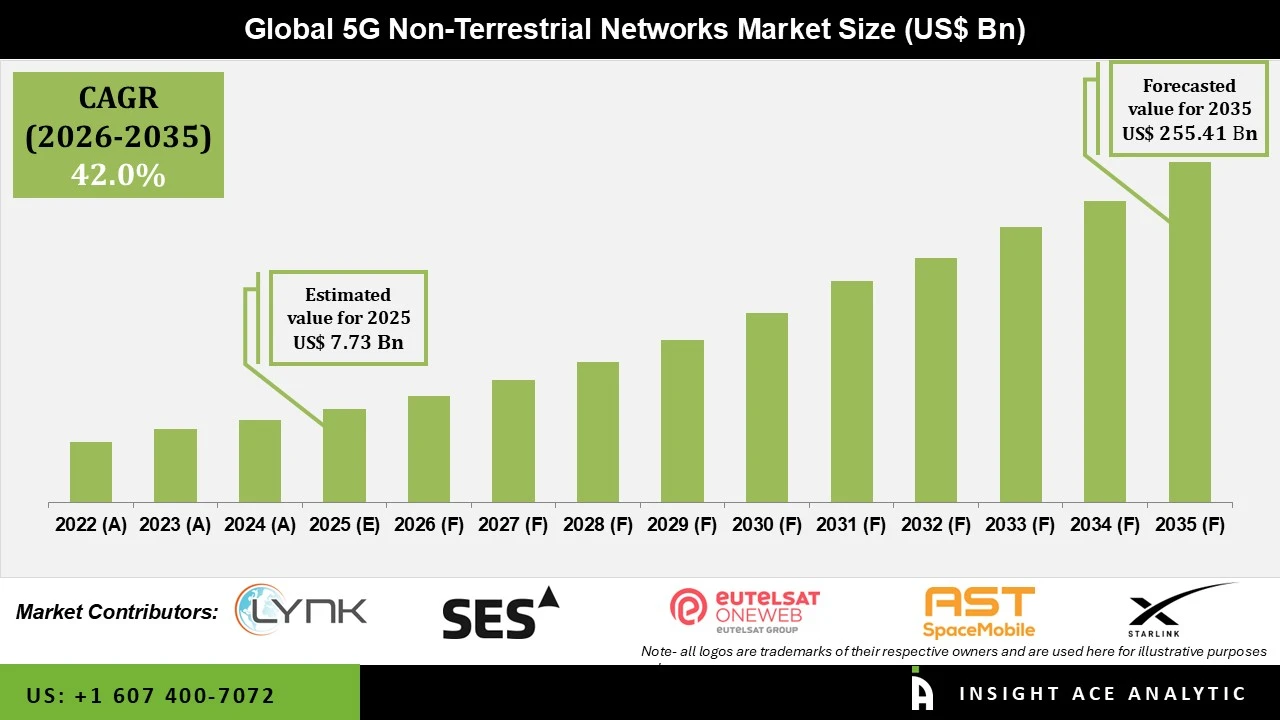
5G Non-Terrestrial Networks Market Size is valued at 7.73 billion in 2025 and is predicted to reach 255.41 billion by the year 2035 at a 42.0% CAGR during the forecast period for 2026 to 2035.
5G Non-Terrestrial Networks Market Size, Share & Trends Analysis Report By Platform (Unidentified Aerial System (UAS) Platform, Low-Earth Orbit (LEO) Satellite, Medium Earth Orbit (MEO) Satellite, Geosynchronous Equatorial Orbit (GEO) Satellite), By Application (Enhanced Mobile Broadband (EMBB), Ultra Reliable Low Latency Communications (URLLC), Massive Machine Type Communications (MMTC)), By Component Type, By Location, By End User, Region And Segment Forecasts, 2026 to 2035
5G Non-Terrestrial Networks Market Key Takeaways:
|
Key Industry Insights & Findings from the Report:
- Market growth can be accelerated through the use of a 5G non-terrestrial network through collaboration between government agencies and satellite providers, which can encourage innovation for the market's future growth.
- The increasing demand for constant and uninterrupted connectivity worldwide due to the spread of Internet of Things (IoT) devices and rising 5G non-terrestrial networks are anticipated to fuel substantial industry expansion in the years ahead.
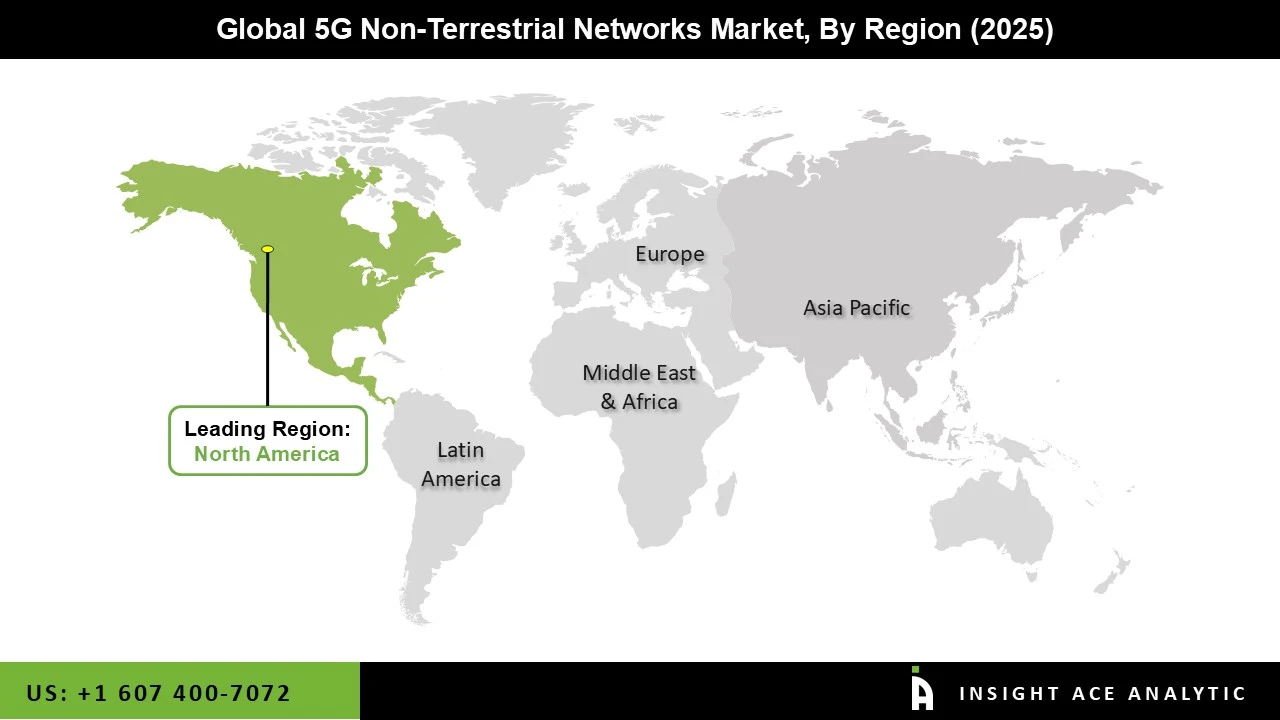
- North America dominated the market and accounted for a global revenue share in 2023.
- High costs associated with technology might slow this industry's growth and raise regulatory concerns.
In order to offer users 5G wireless access, 5G non-terrestrial networks (NTN) utilize satellites or high-altitude platforms like drones or balloons. The difficulties of delivering connectivity in remote or difficult-to-reach places, where conventional terrestrial networks are not practicable, are being addressed by the development of these networks. Many advantages are anticipated from 5G NTN, including more capacity and coverage, less latency, and enhanced dependability. Additionally, a broad range of applications, such as internet of things (IoT) gadgets, self-driving cars, and remote medical services, are anticipated to be supported.
The use of 5G Non-Terrestrial Networks (NTN) in mining activities is also conceivable. In the mining business, it might be challenging to access remote locations because typical terrestrial networks might not be stable or available. To enable real-time monitoring, control, and communication between employees, equipment, and operations, NTN can be utilised to deliver high-speed and dependable wireless connection to mining sites. Mining businesses are implementing the most-latest automation technologies to improve operations. For instance, Ericsson and the Swedish mine operator Boliden worked together to create an autonomous gold mine where Ericsson implemented the 5G network. As more vessels are needed to handle high data rates for applications like video and file transmission, there is an increasing demand for 5G NTN solutions.
Recent Developments:
- In February 2023, Samsung Electronics Co., Ltd., a leader in innovative semiconductor technology, acquired standardized 5G non-terrestrial networks (NTN) modem technology enabling direct connection between smartphones and satellites, particularly in remote areas. As part of its Exynos modem lineup, Samsung plans to integrate this technology, which will hasten the commercialization of 5G satellite communications and create the foundation for the Internet of Everything (IoE) future, which will be powered by 6G.
Competitive Landscape:
Some of the 5G Non-Terrestrial Networks market players are:
- SpaceX (Starlink)
- AST SpaceMobile
- Lynk Global
- Eutelsat OneWeb
- SES
- Viasat (Inmarsat)
- Intelsat
- Iridium
- Globalstar
- Omnispace
- Sateliot
- OQ Technology
- Amazon (Project Kuiper)
- Thales Alenia Space
- Airbus Defence and Space
- SoftBank / HAPS Mobile
- Nokia
- Ericsson
- Qualcomm
- MediaTek
Market Segmentation:
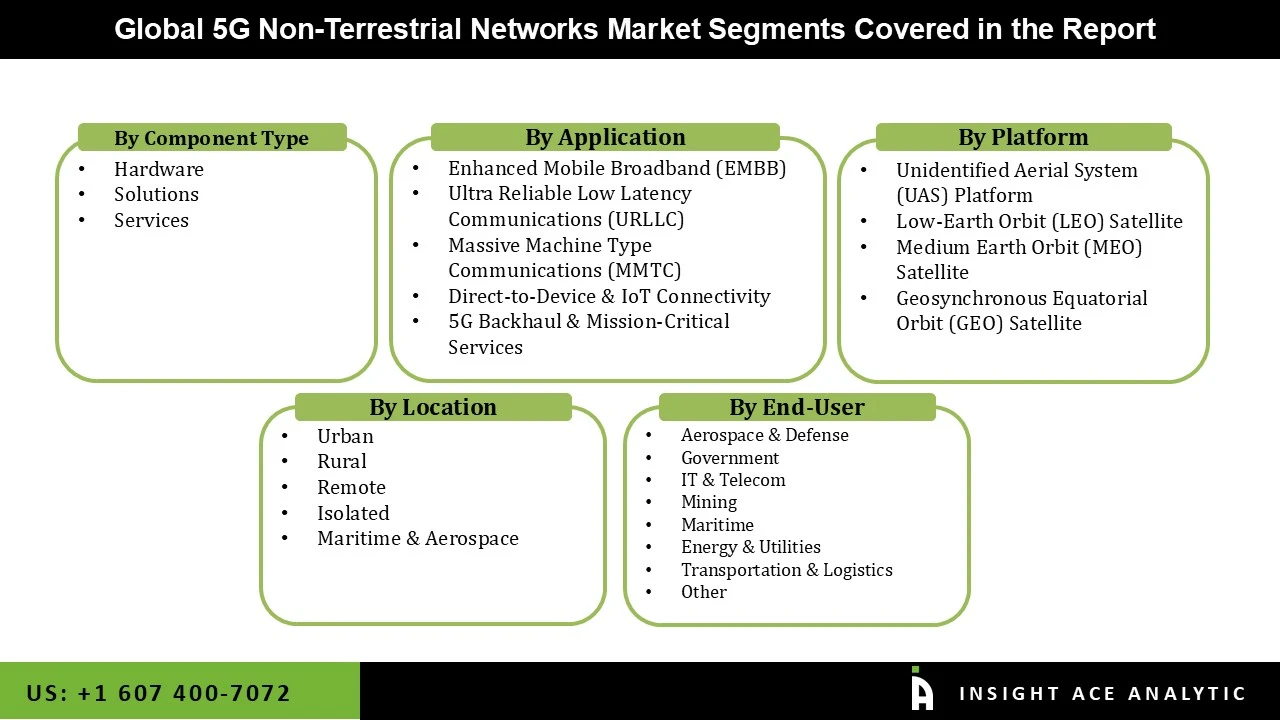
The 5G Non-Terrestrial Networks market is segmented on the basis of component type, platform, application, location, and end-user. Based on component type, the market is segmented as hardware, solutions, and services. The platform segment includes Unidentified Aerial System (UAS) Platform, Low-Earth Orbit (LEO) Satellite, Medium Earth Orbit (MEO) Satellite, and Geosynchronous Equatorial Orbit (GEO) Satellite. By application, the market is segmented into Enhanced Mobile Broadband (EMBB), Ultra Reliable Low Latency Communications (URLLC), and Massive Machine Type Communications (MMTC). The platform segment includes urban, rural, remote, and isolated. By end-user, the market is segmented as aerospace & defense, government, it & telecom, mining, maritime, and others.
Based On Components, The Solutions Segment Is Accounted As A Major Contributor In The 5G Non-Terrestrial Networks Market
Operators can use 5G NTN solutions to minimize operational costs while delivering a superior connectivity experience using 5G technologies. The 5G NTN solutions can offer high network coverage without bounds by merging with satellite communication. Before introducing the system into the market, several top firms offer 5G NTN test solutions to ensure its dependability, affordability, and effectiveness. Test solutions help resolve issues businesses have with the system's scalability, compatibility with long-distance coverage, mobility, satellite movement, speed, quality, and reliability in meeting demand, as well as its capacity for multi-layer communication.
The Remote Location Segment Witnessed Growth At A Rapid Rate
The NTN system will increase network coverage to a variety of locales without terrestrial coverage, guarantee connectivity in rural areas with little to no Internet access, and support remote businesses like mining and oil and gas development.
The usage of 5G solutions and services in remote education is rising to support remote working. Several businesses are concentrating on changing the laws and regulations to permit remote work and the transfer of employees from urban to rural areas. To provide network coverage in remote locations with cost-effectiveness and manageable technological complexity, they are deploying satellites in LEO, MEO, and GEO. The deployment of a highly spread network and network connectivity in an emergency and safety situation is the goal of 5G NTN in a distant location.
In The Region, The North America 5G Non-Terrestrial Networks Market Holds A Significant Revenue Share
The majority of the global 5G NTN market is anticipated to be in North America. In this area, 5G NTN technology has a high acceptance rate in the US. The growth of smart connected devices, the Industrial Internet of Everything (lloE), and the growing commercialization of 5G services are the drivers that are popularising the demand for 5G NTN solutions in this sector. The percentage of 5G connections in North America was 14% in 2022, according to the Global System for Mobile Communication (GSMA) study The Mobile Economy and is predicted to increase to 64% by the end of 2025.
5G Non-Terrestrial Networks Market Report Scope:
| Report Attribute | Specifications |
| Market Size Value In 2025 | USD 7.73 Bn |
| Revenue Forecast In 2035 | USD 255.41 Bn |
| Growth Rate CAGR | CAGR of 42.0% from 2026 to 2035 |
| Quantitative Units | Representation of revenue in US$ Mn, and CAGR from 2026 to 2035 |
| Historic Year | 2022 to 2025 |
| Forecast Year | 2026-2035 |
| Report Coverage | The forecast of revenue, the position of the company, the competitive market structure, growth prospects, and trends |
| Segments Covered | Component Type, Platform, Application, Location, And End-User |
| Regional Scope | North America; Europe; Asia Pacific; Latin America; Middle East & Africa |
| Country Scope | U.S.; Canada; U.K.; Germany; Japan; Brazil; Mexico; The UK; France; Italy; Spain; China; Japan; India; South Korea; Southeast Asia |
| Competitive Landscape | Qualcomm Technologies Inc., Thales Group, Softbank Group Corporation, Keysight Technologies Inc., MediaTek lnc., ZTE Corporation, Anritsu Corporation, Rohde & Schwarz GmbH & Co KG, Omnispace LLC, and EchoStar Corporation. |
| Customization Scope | Free customization report with the procurement of the report, Modifications to the regional and segment scope. Particular Geographic competitive landscape. |
| Pricing and Available Payment Methods | Explore pricing alternatives that are customized to your particular study requirements. |
Segmentation of 5G Non-Terrestrial Networks Market-
5G Non-Terrestrial Networks Market By Component Type-
- Hardware
- Solutions
- Services
5G Non-Terrestrial Networks Market By Platform-
- Unidentified Aerial System (UAS) Platform
- Low-Earth Orbit (LEO) Satellite
- Medium Earth Orbit (MEO) Satellite
- Geosynchronous Equatorial Orbit (GEO) Satellite
5G Non-Terrestrial Networks Market By Application-
- Enhanced Mobile Broadband (EMBB)
- Ultra Reliable Low Latency Communications (URLLC)
- Massive Machine Type Communications (MMTC)
- Direct-to-Device & IoT Connectivity
- 5G Backhaul & Mission-Critical Services
5G Non-Terrestrial Networks Market By Location-
- Urban
- Rural
- Remote
- Isolated
- Maritime & Aerospace
5G Non-Terrestrial Networks Market By End-User-
- Aerospace & Defense
- Government
- IT & Telecom
- Mining
- Maritime
- Energy & Utilities
- Transportation & Logistics
- Other
5G Non-Terrestrial Networks Market By Region-
North America-
- The US
- Canada
- Mexico
Europe-
- Germany
- The UK
- France
- Italy
- Spain
- Rest of Europe
Asia-Pacific-
- China
- Japan
- India
- South Korea
- Southeast Asia
- Rest of Asia Pacific
Latin America-
- Brazil
- Argentina
- Rest of Latin America
Middle East & Africa-
- GCC Countries
- South Africa
- Rest of the Middle East and Africa
Research Design and Approach
This study employed a multi-step, mixed-method research approach that integrates:
- Secondary research
- Primary research
- Data triangulation
- Hybrid top-down and bottom-up modelling
- Forecasting and scenario analysis
This approach ensures a balanced and validated understanding of both macro- and micro-level market factors influencing the market.
Secondary Research
Secondary research for this study involved the collection, review, and analysis of publicly available and paid data sources to build the initial fact base, understand historical market behaviour, identify data gaps, and refine the hypotheses for primary research.
Sources Consulted
Secondary data for the market study was gathered from multiple credible sources, including:
- Government databases, regulatory bodies, and public institutions
- International organizations (WHO, OECD, IMF, World Bank, etc.)
- Commercial and paid databases
- Industry associations, trade publications, and technical journals
- Company annual reports, investor presentations, press releases, and SEC filings
- Academic research papers, patents, and scientific literature
- Previous market research publications and syndicated reports
These sources were used to compile historical data, market volumes/prices, industry trends, technological developments, and competitive insights.

Primary Research
Primary research was conducted to validate secondary data, understand real-time market dynamics, capture price points and adoption trends, and verify the assumptions used in the market modelling.
Stakeholders Interviewed
Primary interviews for this study involved:
- Manufacturers and suppliers in the market value chain
- Distributors, channel partners, and integrators
- End-users / customers (e.g., hospitals, labs, enterprises, consumers, etc., depending on the market)
- Industry experts, technology specialists, consultants, and regulatory professionals
- Senior executives (CEOs, CTOs, VPs, Directors) and product managers
Interview Process
Interviews were conducted via:
- Structured and semi-structured questionnaires
- Telephonic and video interactions
- Email correspondences
- Expert consultation sessions
Primary insights were incorporated into demand modelling, pricing analysis, technology evaluation, and market share estimation.
Data Processing, Normalization, and Validation
All collected data were processed and normalized to ensure consistency and comparability across regions and time frames.
The data validation process included:
- Standardization of units (currency conversions, volume units, inflation adjustments)
- Cross-verification of data points across multiple secondary sources
- Normalization of inconsistent datasets
- Identification and resolution of data gaps
- Outlier detection and removal through algorithmic and manual checks
- Plausibility and coherence checks across segments and geographies
This ensured that the dataset used for modelling was clean, robust, and reliable.
Market Size Estimation and Data Triangulation
Bottom-Up Approach
The bottom-up approach involved aggregating segment-level data, such as:
- Company revenues
- Product-level sales
- Installed base/usage volumes
- Adoption and penetration rates
- Pricing analysis
This method was primarily used when detailed micro-level market data were available.

Top-Down Approach
The top-down approach used macro-level indicators:
- Parent market benchmarks
- Global/regional industry trends
- Economic indicators (GDP, demographics, spending patterns)
- Penetration and usage ratios
This approach was used for segments where granular data were limited or inconsistent.
Hybrid Triangulation Approach
To ensure accuracy, a triangulated hybrid model was used. This included:
- Reconciling top-down and bottom-up estimates
- Cross-checking revenues, volumes, and pricing assumptions
- Incorporating expert insights to validate segment splits and adoption rates
This multi-angle validation yielded the final market size.
Forecasting Framework and Scenario Modelling
Market forecasts were developed using a combination of time-series modelling, adoption curve analysis, and driver-based forecasting tools.
Forecasting Methods
- Time-series modelling
- S-curve and diffusion models (for emerging technologies)
- Driver-based forecasting (GDP, disposable income, adoption rates, regulatory changes)
- Price elasticity models
- Market maturity and lifecycle-based projections
Scenario Analysis
Given inherent uncertainties, three scenarios were constructed:
- Base-Case Scenario: Expected trajectory under current conditions
- Optimistic Scenario: High adoption, favourable regulation, strong economic tailwinds
- Conservative Scenario: Slow adoption, regulatory delays, economic constraints
Sensitivity testing was conducted on key variables, including pricing, demand elasticity, and regional adoption.
Request Customization
Add countries, segments, company profiles, or extend forecast — free 10% customization with purchase.
Customize This Report →Enquire Before Buying
Speak with our analyst team about scope, methodology, pricing, or deliverable formats.
Enquire Now →Frequently Asked Questions
5G Non-Terrestrial Networks Market Size is valued at 7.73 billion in 2025 and is predicted to reach 255.41 billion by the year 2035
5G Non-Terrestrial Networks Market is expected to grow at a 42.0% CAGR during the forecast period for 2026 to 2035.
Qualcomm Technologies Inc., Thales Group, Softbank Group Corporation, Keysight Technologies Inc., MediaTek lnc., ZTE Corporation, Anritsu Corporation,
5G Non-Terrestrial Networks market is segmented on the basis of component type, platform, application, location, and end-user.
North American region is leading the 5G Non-Terrestrial Networks market.