Formaldehyde Removal Air Purifier Market Size, Share, Trend, Scope Report 2026 to 2035
What is Formaldehyde Removal Air Purifier Market Size?
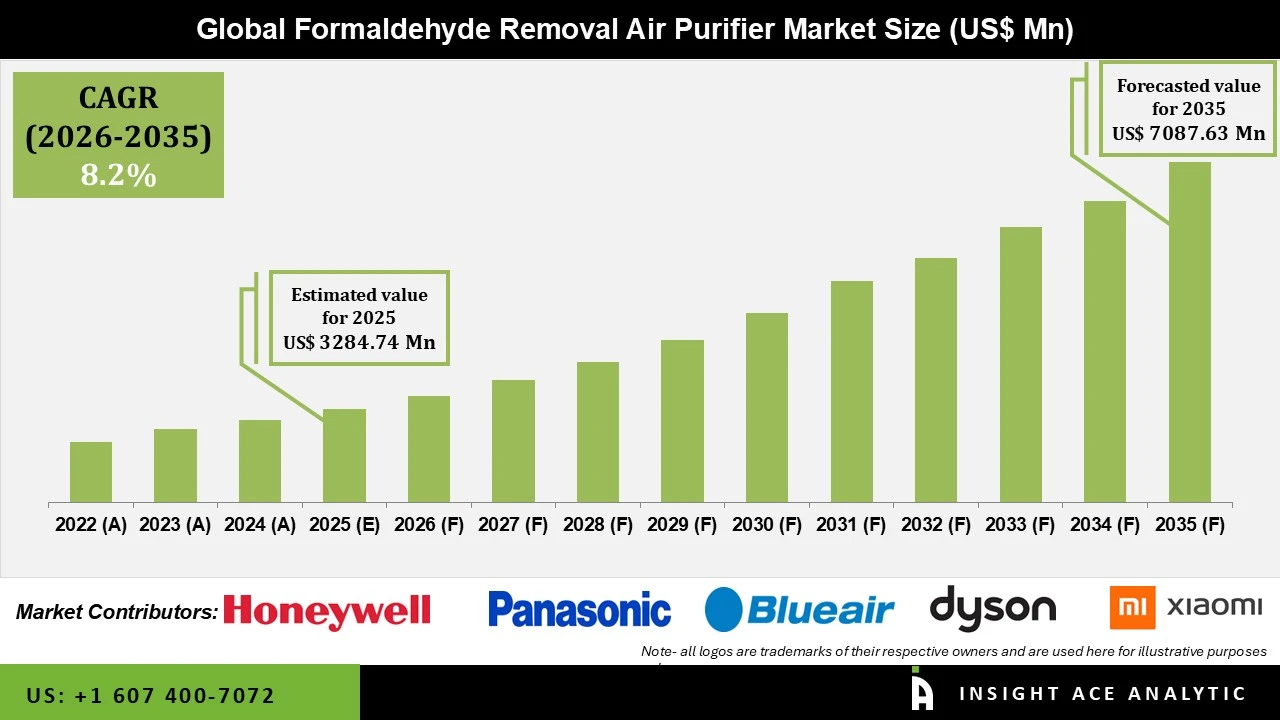
Formaldehyde Removal Air Purifier Market Size is valued at USD 3284.74 Mn in 2025 and is predicted to reach USD 7087.63 Mn by the year 2035 at a 8.2% CAGR during the forecast period for 2026 to 2035.
Formaldehyde Removal Air Purifier Market Size, Share & Trends Analysis Distribution by Type (Filter-type Air Purifier, Photocatalyst Air Purifier, Electrostatic Air Purifier, and Water-washable Air Purifier), Filtration Technology (HEPA Filtration, Activated Carbon Filtration, Hybrid Filtration Systems, and Photocatalytic Oxidation), Application (Household, Healthcare Facilities, Commercial, Educational Institutions, and Others), and Segment Forecasts, 2026 to 2035
Formaldehyde Removal Air Purifiers are specialized air cleaning devices designed to effectively capture and eliminate formaldehyde (HCHO) and other volatile organic compounds (VOCs) from indoor air. Formaldehyde is a common indoor pollutant emitted from furniture, building materials, paints, and textiles, known for causing irritation, respiratory issues, and long-term health risks. These purifiers typically combine high-efficiency activated carbon filters, photocatalytic oxidation (PCO) technology, and HEPA filtration to break down and remove formaldehyde at the molecular level. They are particularly useful in newly renovated homes, offices, and spaces with poor indoor air quality, providing a targeted and reliable solution for healthier breathing environments.
The need for efficient air purification solutions has increased due to formaldehyde's widespread use in a variety of consumer goods, such as building supplies, furniture, and household cleaners. Additionally, a number of factors, such as growing urbanization, strict government laws on air quality, and developments in air purification technology, are driving the formaldehyde removal air purifier market's revenue growth. The World Health Organization (WHO) states that indoor air pollution is a serious health risk that can lead to respiratory conditions and other health problems. The need for air purifiers has increased as a result, especially those made to eliminate dangerous chemicals such as formaldehyde. Furthermore, the government's efforts to improve the quality of the air are driving market expansion. Strict regulations for indoor air quality, especially in homes and businesses, have been put in place in a number of nations.
In addition, when buying air purifiers, consumers are increasingly taking sustainability into account. Many manufacturers are creating items that are energy-efficient and composed of sustainable materials by implementing eco-friendly methods in their production processes. This will boost the formaldehyde removal air purifier market growth over the forecast period. Additionally, the effectiveness of innovations like HEPA and activated carbon filters in absorbing airborne contaminants, particularly formaldehyde, is making them more and more popular. As consumers look for more effective formaldehyde removal options, the ongoing development of sophisticated filtration technologies is anticipated to propel market expansion. However, the consumer education regulations, competition from general air purification technology, and initial investment costs that impact adoption rates are some of the formaldehyde removal air purifier market's obstacles.
Competitive Landscape
Which are the Leading Players in Formaldehyde Removal Air Purifier Market?
• Panasonic Corporation
• Sharp Corporation
• Honeywell International Inc.
• Dyson
• Blueair AB
• Xiaomi Corporation
• Philips
• SoleusAir
• Coway Co., Ltd.
• IQAir
• ECOVAC
• Haier
• Daikin
• LG Electronics
• Others
Market Dynamics
Driver
Growing Knowledge of Health Risks and Indoor Air Pollution
The growing awareness of indoor air pollution and its detrimental health impacts is a major growth factor for the formaldehyde removal air purifier market. Furniture, plywood, flooring, paints, and adhesives frequently release formaldehyde, particularly in freshly built or remodeled buildings. The extended exposure to this chemical may result in allergies, respiratory issues, eye irritation, and possibly long-term health issues. Additionally, concerns over indoor air quality are developing as more people spend time indoors, whether at home or in offices. Customers are now actively investing in air purification products made especially to eliminate dangerous chemicals such as formaldehyde as a result of this change in consumer behavior. Moreover, consumer awareness is also being strengthened by government initiatives, public health campaigns, and increased media coverage of air quality issues.
Restrain/Challenge
High Maintenance and Cost Requirements
The comparatively high cost of sophisticated formaldehyde removal air purifiers and their continuous maintenance is one of the primary barriers to the market. Compared to basic air purifiers, devices with specialist filtration technologies such as multi-layer purification systems, catalytic filters, or activated carbon are usually more costly. Price-conscious consumers may be deterred by this increased upfront expense, especially in underdeveloped nations. Additionally, the long-term operating cost of these purifiers is increased by the need for routine maintenance, such as the replacement of filters or catalytic components regularly. Because of this, even with increased awareness, the adoption rate among customers on a tight budget might be low, which would limit the growth of the formaldehyde removal air purifier market.
Filter-type Air Purifier Segment is Expected to Drive the Formaldehyde Removal Air Purifier Market
The filter-type air purifier category held the largest share in the formaldehyde removal air purifier market in 2025. Filter-type systems are becoming more and more popular among consumers and air quality experts due to their better formaldehyde absorption qualities, defined performance requirements, and crucial usefulness in a variety of indoor applications across various building types. In addition, the users' needs for dependable formaldehyde elimination and ideal air quality precision in residential and commercial applications are immediately addressed by filter-type purifiers' demonstrated cost-effectiveness and performance features. Additionally, the filter-type air purifier segment serves as the basis for contemporary formaldehyde removal performance patterns since it is the technological category with the highest potential for filtering efficiency and proven compatibility with various air quality control systems.
Household Segment is Growing at the Highest Rate in the Formaldehyde Removal Air Purifier Market
In 2025, the household category dominated the formaldehyde removal air purifier market, since it is the main application for health-conscious customers looking for improved residential environment management credentials and greater indoor air quality benefits. The household applications are preferred by residential users and homeowners due to their demonstrated consumer demand, established health protection regulations, and capacity to maintain outstanding air quality while supporting adaptable room coverage during a variety of everyday activities. Household products are marketed as vital tools for health-conscious householders, giving benefits for family safety as well as superior wellness. Additionally, the industry is bolstered by ongoing advancements in home automation technology and the broad availability of standardized air quality standards that allow for premium positioning and health assurance at the consumer level.
Why Asia Pacific Led the Formaldehyde Removal Air Purifier Market?
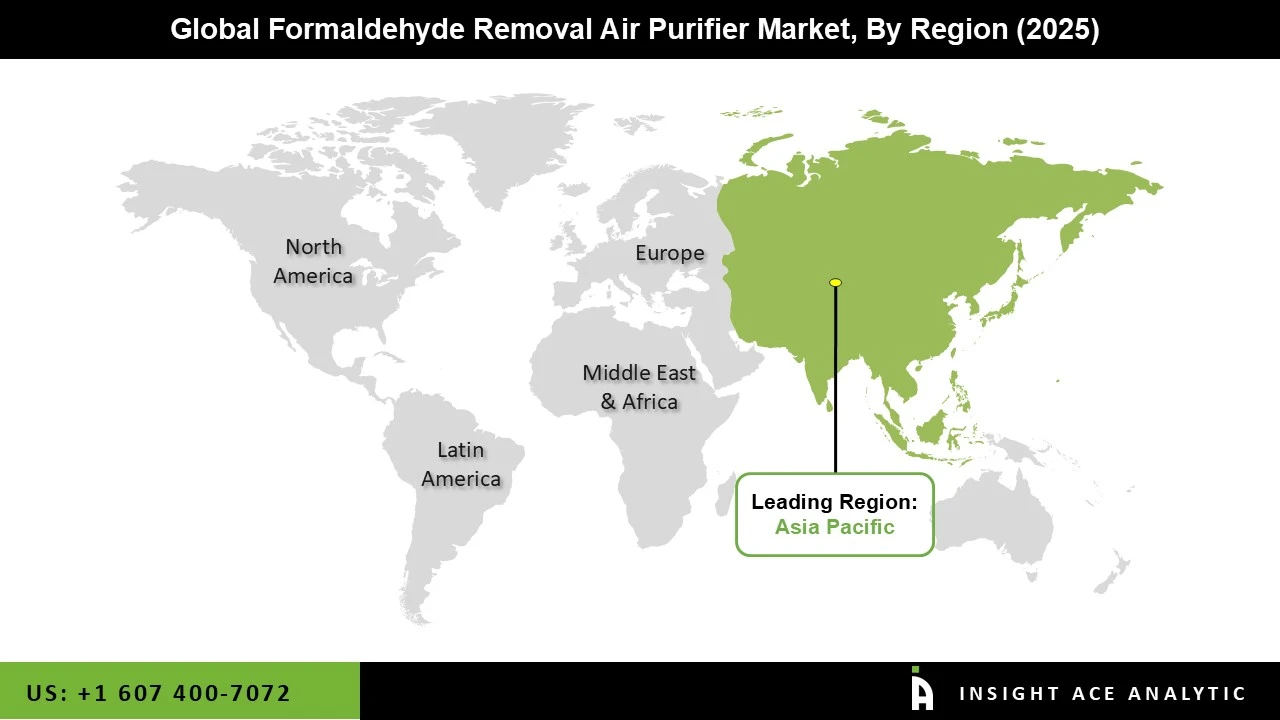
The formaldehyde removal air purifier market was dominated by Asia Pacific region in 2025. Leading manufacturers are well-represented in the area, and rising consumer awareness of indoor air quality is a major driver of the formaldehyde removal air purifier market expansion. The market is significantly influenced by the China, India, Japan in particular, where consumers are placing an increasing emphasis on wellness and health. Additionally, the goal of government programs will increase demand for air purifiers. As a result, it is anticipated that the Asia Pacific formaldehyde removal air purifier market will continue to grow, propelled by both growing consumer demand for efficient air purification products and regulatory backing.
Key Development
• August 2025: In China, Xiaomi unveiled the Mijia Smart Air Purifier 6. In addition to multi-stage HEPA filtration and formaldehyde removal, the gadget has improved sensors that track temperature, humidity, dust, PM2.5, and PM1. It combines smart connection with reasonably priced features, such as an OLED display with Google Home and Alexa support.
• January 2023: Honeywell introduced a new range of air purifiers with cutting-edge HEPA filters that are intended to remove formaldehyde and other dangerous contaminants. The goal of this product introduction is to increase the company's market share and meet the rising demand for efficient air purification products.
Formaldehyde Removal Air Purifier Market Report Scope:
| Report Attribute | Specifications |
| Market size value in 2025 | USD 3284.74 Mn |
| Revenue forecast in 2035 | USD 7087.63 Mn |
| Growth Rate CAGR | CAGR of 8.2% from 2026 to 2035 |
| Quantitative Units | Representation of revenue in US$ Bn and CAGR from 2026 to 2035 |
| Historic Year | 2022 to 2025 |
| Forecast Year | 2026-2035 |
| Report Coverage | The forecast of revenue, the position of the company, the competitive market structure, growth prospects, and trends |
| Segments Covered | Type, Filtration Technology, Application, and By Region |
| Regional Scope | North America; Europe; Asia Pacific; Latin America; Middle East & Africa |
| Country Scope | U.S.; Canada; U.K.; Germany; China; India; Japan; Brazil; Mexico; The UK; France; Italy; Spain; China; Japan; India; South Korea; Southeast Asia; South Korea; Southeast Asia |
| Competitive Landscape | Panasonic Corporation, Sharp Corporation, Honeywell International Inc., Dyson, Blueair AB, Xiaomi Corporation, Philips, SoleusAir, Coway Co., Ltd., IQAir, ECOVAC, Haier, Daikin, LG Electronics, and Others. |
| Customization Scope | Free customization report with the procurement of the report, Modifications to the regional and segment scope. Geographic competitive landscape. |
| Pricing and Available Payment Methods | Explore pricing alternatives that are customized to your particular study requirements. |
Market Segmentation:
Formaldehyde Removal Air Purifier Market by Type-
• Filter-type Air Purifier
• Photocatalyst Air Purifier
• Electrostatic Air Purifier
• Water-washable Air Purifier
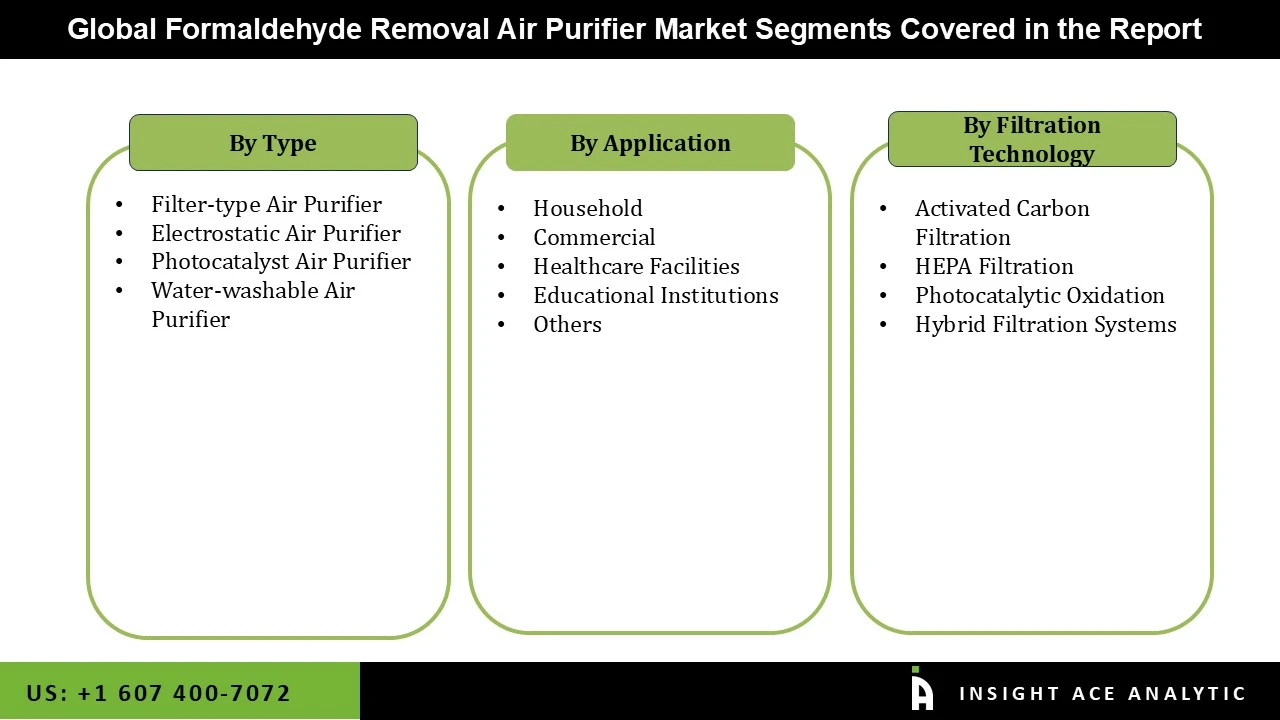
Formaldehyde Removal Air Purifier Market by Filtration Technology-
• HEPA Filtration
• Activated Carbon Filtration
• Hybrid Filtration Systems
• Photocatalytic Oxidation
Formaldehyde Removal Air Purifier Market by Application-
• Household
• Healthcare Facilities
• Commercial
• Educational Institutions
• Others
Formaldehyde Removal Air Purifier Market By Region-
North America-
• The US
• Canada
Europe-
• Germany
• The UK
• France
• Italy
• Spain
• Rest of Europe
Asia-Pacific-
• China
• Japan
• India
• South Korea
• South East Asia
• Rest of Asia Pacific
Latin America-
• Brazil
• Argentina
• Mexico
• Rest of Latin America
Middle East & Africa-
• GCC Countries
• South Africa
• Rest of Middle East and Africa
Research Design and Approach
This study employed a multi-step, mixed-method research approach that integrates:
- Secondary research
- Primary research
- Data triangulation
- Hybrid top-down and bottom-up modelling
- Forecasting and scenario analysis
This approach ensures a balanced and validated understanding of both macro- and micro-level market factors influencing the market.
Secondary Research
Secondary research for this study involved the collection, review, and analysis of publicly available and paid data sources to build the initial fact base, understand historical market behaviour, identify data gaps, and refine the hypotheses for primary research.
Sources Consulted
Secondary data for the market study was gathered from multiple credible sources, including:
- Government databases, regulatory bodies, and public institutions
- International organizations (WHO, OECD, IMF, World Bank, etc.)
- Commercial and paid databases
- Industry associations, trade publications, and technical journals
- Company annual reports, investor presentations, press releases, and SEC filings
- Academic research papers, patents, and scientific literature
- Previous market research publications and syndicated reports
These sources were used to compile historical data, market volumes/prices, industry trends, technological developments, and competitive insights.

Primary Research
Primary research was conducted to validate secondary data, understand real-time market dynamics, capture price points and adoption trends, and verify the assumptions used in the market modelling.
Stakeholders Interviewed
Primary interviews for this study involved:
- Manufacturers and suppliers in the market value chain
- Distributors, channel partners, and integrators
- End-users / customers (e.g., hospitals, labs, enterprises, consumers, etc., depending on the market)
- Industry experts, technology specialists, consultants, and regulatory professionals
- Senior executives (CEOs, CTOs, VPs, Directors) and product managers
Interview Process
Interviews were conducted via:
- Structured and semi-structured questionnaires
- Telephonic and video interactions
- Email correspondences
- Expert consultation sessions
Primary insights were incorporated into demand modelling, pricing analysis, technology evaluation, and market share estimation.
Data Processing, Normalization, and Validation
All collected data were processed and normalized to ensure consistency and comparability across regions and time frames.
The data validation process included:
- Standardization of units (currency conversions, volume units, inflation adjustments)
- Cross-verification of data points across multiple secondary sources
- Normalization of inconsistent datasets
- Identification and resolution of data gaps
- Outlier detection and removal through algorithmic and manual checks
- Plausibility and coherence checks across segments and geographies
This ensured that the dataset used for modelling was clean, robust, and reliable.
Market Size Estimation and Data Triangulation
Bottom-Up Approach
The bottom-up approach involved aggregating segment-level data, such as:
- Company revenues
- Product-level sales
- Installed base/usage volumes
- Adoption and penetration rates
- Pricing analysis
This method was primarily used when detailed micro-level market data were available.

Top-Down Approach
The top-down approach used macro-level indicators:
- Parent market benchmarks
- Global/regional industry trends
- Economic indicators (GDP, demographics, spending patterns)
- Penetration and usage ratios
This approach was used for segments where granular data were limited or inconsistent.
Hybrid Triangulation Approach
To ensure accuracy, a triangulated hybrid model was used. This included:
- Reconciling top-down and bottom-up estimates
- Cross-checking revenues, volumes, and pricing assumptions
- Incorporating expert insights to validate segment splits and adoption rates
This multi-angle validation yielded the final market size.
Forecasting Framework and Scenario Modelling
Market forecasts were developed using a combination of time-series modelling, adoption curve analysis, and driver-based forecasting tools.
Forecasting Methods
- Time-series modelling
- S-curve and diffusion models (for emerging technologies)
- Driver-based forecasting (GDP, disposable income, adoption rates, regulatory changes)
- Price elasticity models
- Market maturity and lifecycle-based projections
Scenario Analysis
Given inherent uncertainties, three scenarios were constructed:
- Base-Case Scenario: Expected trajectory under current conditions
- Optimistic Scenario: High adoption, favourable regulation, strong economic tailwinds
- Conservative Scenario: Slow adoption, regulatory delays, economic constraints
Sensitivity testing was conducted on key variables, including pricing, demand elasticity, and regional adoption.
Request Customization
Add countries, segments, company profiles, or extend forecast — free 10% customization with purchase.
Customize This Report →Enquire Before Buying
Speak with our analyst team about scope, methodology, pricing, or deliverable formats.
Enquire Now →Frequently Asked Questions
Formaldehyde Removal Air Purifier Market Size is valued at USD 3284.74 Mn in 2025 and is predicted to reach USD 7087.63 Mn by the year 2035
Formaldehyde Removal Air Purifier Market Size is predicted to grow at a 8.2% CAGR during the forecast period for 2026 to 2035.
Panasonic Corporation, Sharp Corporation, Honeywell International Inc., Dyson, Blueair AB, Xiaomi Corporation, Philips, SoleusAir, Coway Co., Ltd., IQAir, ECOVAC, Haier, Daikin, LG Electronics, and Others.
Formaldehyde Removal Air Purifier Market is segmented into Type, Filtration Technology, Application, and By Region
Asia Pacific region is leading the Formaldehyde Removal Air Purifier Market.