PCR in Consumer Electronics Market Size, Revenue, Forecast Report 2026 to 2035
What is PCR in Consumer Electronics Market Size?
PCR in Consumer Electronics Market Size is valued at USD 2.72 Bn in 2025 and is predicted to reach USD 8.96 Bn by the year 2035 at a 12.8% CAGR during the forecast period for 2026 to 2035.
In consumer electronics, PCR (Post-Consumer Recycled) refers to materials that have been recovered from previously used and discarded products by consumers, such as plastics from outdated laptops, smartphones, or household appliances, and then reprocessed into raw materials for the production of new electronic products. Manufacturers use PCR materials to lessen their influence on the environment, save natural resources, and cut carbon emissions rather than depending solely on virgin plastics or metals. PCR is frequently used in consumer electronics parts, including packaging, internal brackets, and device casings. The rising use of post-consumer recycled plastics in laptop, smartphone, wearable, and accessory housings, bezels, and internal components supports the PCR in consumer electronics market's growth.
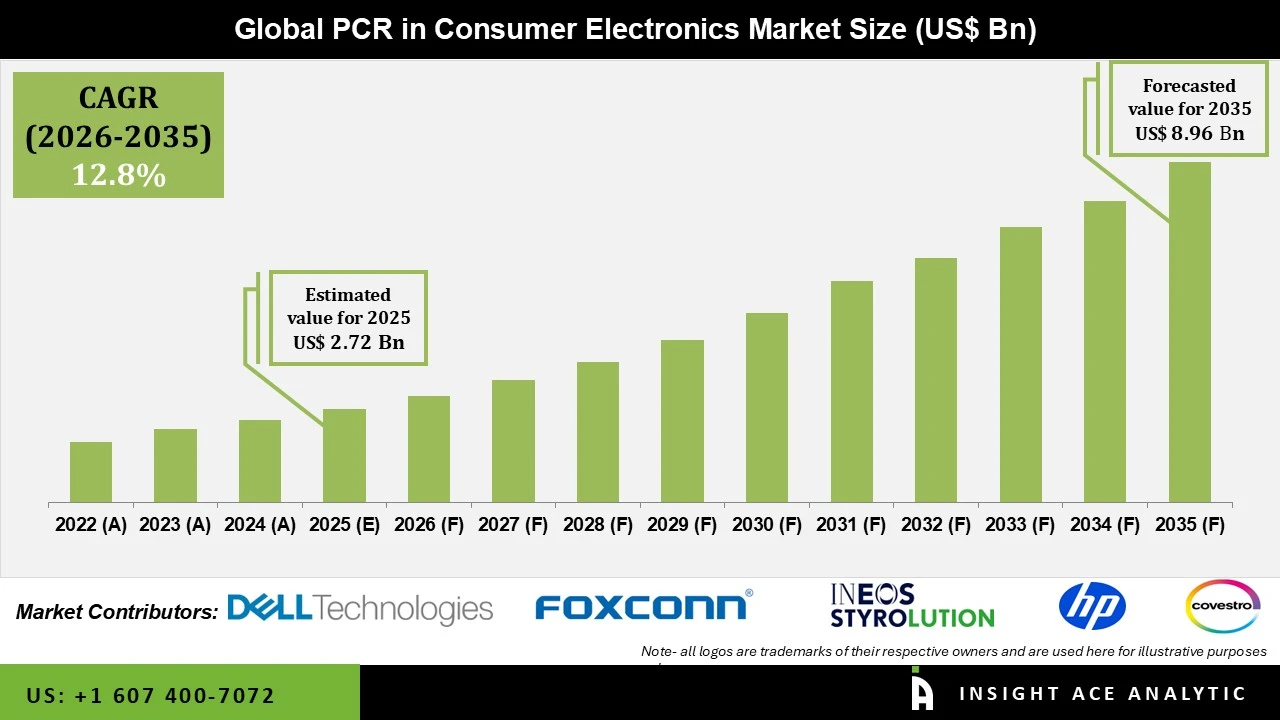
One of the main drivers in the PCR in consumer electronics market growth is the growing consumer awareness of the effects of plastic waste on the environment. Electronics items that use sustainable materials, such as post-consumer recycled plastics (PCR plastics), are becoming more and more popular as consumers become more ecologically concerned. Manufacturers are being forced to use PCR plastics to compete in the market due to this demand. Another important factor propelling the PCR in consumer electronics market expansion is the regulatory requirements. Particularly in sectors like consumer electronics that use a lot of plastic, governments and regulatory agencies throughout the world are enforcing strict regulations requiring firms to use recycled materials in their production processes. Thus, the PCR in consumer electronics market is expanding because of these regulations.
In addition, the growing consumer desire for sustainable electronics presents a potential opportunity for the PCR in consumer electronics market. Demand for eco-friendly products created from post-consumer recycled plastics is anticipated to increase as customers become more ecologically conscious. Additionally, there is a chance to grow the PCR in consumer electronics industry through the partnership between recycling businesses and electronics producers. The difficulties in getting materials can be addressed by collaborations that guarantee a consistent supply of high-quality recycled plastics. A favorable environment for businesses engaging in recycled plastics is created by government incentives and programs aimed at reducing plastic waste. The PCR in consumer electronics market is expected to grow more quickly as these incentives rise. However, the technological difficulty of PCR in consumer electronics appropriate for high-performance electronics poses a substantial market hurdle.
Competitive Landscape
Which are the Leading Players in PCR in Consumer Electronics Market?
• HP Inc.
• INEOS Styrolution Group GmbH
• Covestro AG
• MBA Polymers Inc.
• SABIC
• Dell Technologies
• Foxconn
• LAVERGNE, Inc.
• Lenovo Group Limited
• Sony Corporation
• Panasonic Corporation
• PolyVisions
• Others
Market Dynamics
Driver
Growing Emphasis on Sustainability
The growing emphasis on sustainability by businesses and governments is one of the main factors driving PCR in consumer electronics market. Manufacturers are being forced to use recycled materials in their goods by international environmental rules such as extended producer responsibility (EPR) programs and plastic waste reduction mandates. Major electronics companies are simultaneously establishing aggressive goals for the circular economy and carbon neutrality, which directly promote the usage of PCR metals and plastics. Additionally, consumers are driving businesses to reinvent items using recycled materials as they become more environmentally conscious and choose products with sustainable credentials. The integration of PCR materials in electrical products is being further accelerated by the combined push from regulators, business ESG goals, and customer demand.
Restrain/Challenge
Increasing Performance Limitations and Quality Consistency
The difficulty of preserving constant material quality and performance is a significant barrier in the PCR in consumer electronics market. PCR materials, in contrast to virgin materials, frequently originate from a variety of waste streams, resulting in variations in composition, strength, color, and durability. Electronic devices' structural integrity and aesthetic finish, which are crucial elements for both performance and brand perception, may be impacted by this irregularity. Furthermore, PCR in consumer electronics may find it difficult to reliably meet the stringent safety and thermal resistance requirements of high-performance electronics without significant processing and additions. The manufacturers may be reluctant to completely replace raw materials with PCR equivalents due to these extra processing needs, which can raise production costs and complexity in PCR in consumer electronics.
PCR-ABS Segment is Expected to Drive the PCR in Consumer Electronics Market
The PCR-ABS category held the largest share in the PCR in Consumer Electronics market in 2025. This combination is ideal for producing electronic housings for a variety of devices because of its enhanced processing, high heat resistance, flexibility, impact strength, and biocompatibility. Additionally, PCR-ABS is profiting from its status as a useful enclosure resin for injection-molded, thin-wall electronics components. A 2026 commercial display launch clearly compared the performance of recycled materials with petroleum-based PCR-ABS of the same weight while claiming reduced carbon emissions, and recent OEM releases show recycled plastic being specified in plastic components across devices. This is significant because it demonstrates that the blend is still essential to enclosure design, particularly in situations when manufacturers want impact strength, processability, and adherence to recycled-content goals.
Laptops, Peripherals, Accessories Segment is Growing at the Highest Rate in the PCR in Consumer Electronics Market
In 2025, the Laptops, Peripherals, Accessories category dominated the PCR in Consumer Electronics market because of its large production quantities and very flexible material specifications. In order to fulfill their promises to sustainability, well-known companies like Dell Technologies, HP Inc., and Lenovo are increasingly using PCR polymers in laptop chassis, keyboards, monitors, and accessories like docking stations and mouse. Manufacturers can employ recycled plastics in this category without sacrificing functionality because many external components don't need as high thermal or structural performance as interior electronic elements. Moreover, a circular supply chain is also supported by the regular product replacement cycles of computers and peripherals, which produce a constant flow of recyclable materials.
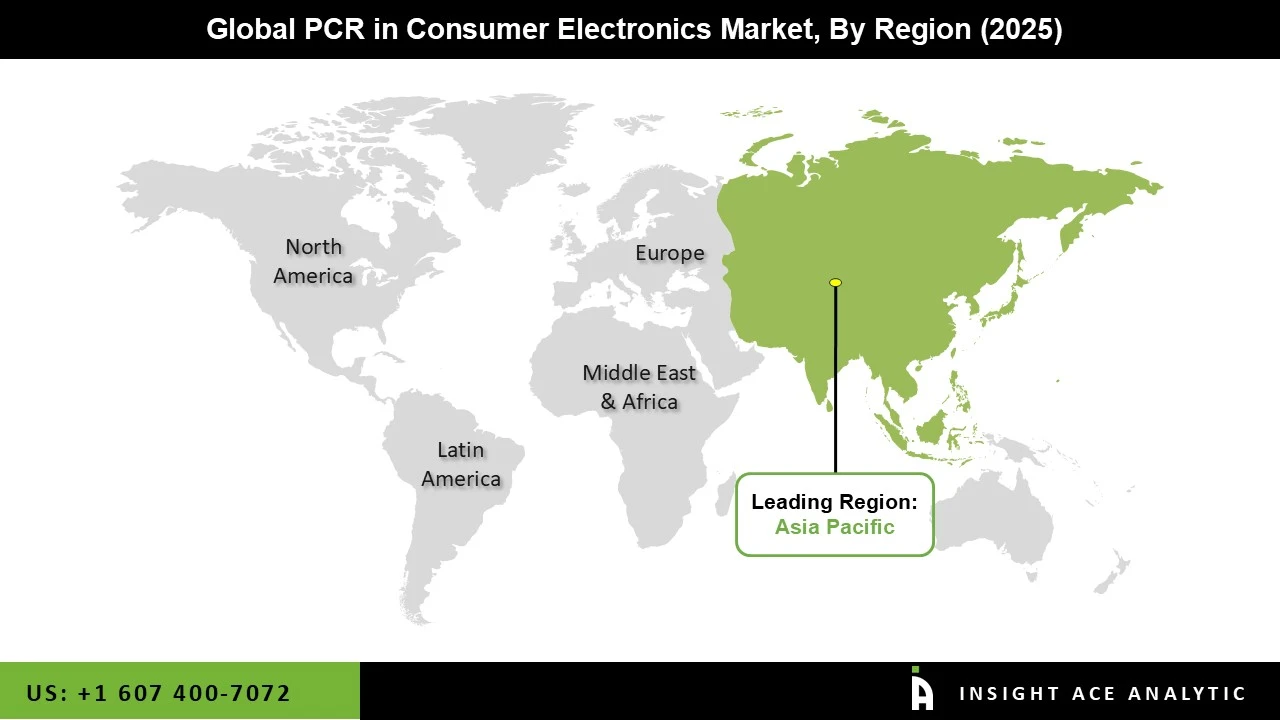
Why North America Led the PCR in Consumer Electronics Market?
The PCR in Consumer Electronics market was dominated by North America region in 2025 fueled by a robust regulatory framework that promotes the use of recycled materials. Electronics manufacturers are required to include post-consumer recycled plastics in their products as part of frameworks set up by the US and Canada to reduce plastic waste. Additionally, the demand for sustainable electronics is being driven not only by governmental pressure but also by North American customers' increased eco-consciousness. Many major manufacturers of consumer electronics are located in this area, and they are working hard to increase the amount of recycled materials in their products. Furthermore, the supply of recovered plastics is facilitated by the region's strong recycling infrastructure, guaranteeing that businesses have access to the resources they require. These factors are anticipated to boost the PCR in consumer electronics market growth in this region over the forecast period.
Key Development
January 2026: In order to reduce reliance on virgin plastics and manufacturing emissions, Samsung unveiled a 13-inch color e-paper display that uses 45% recycled plastic and bio-resin obtained from phytoplankton. This represents material innovation and the growth of recycled plastic applications.
July 2025: The use of recycled plastic in all of LG Electronics' products increased by 36% year over year. The company reiterated its objective to use a total of 600,000 tons of recycled plastics by the end of the decade and reported a 97.4% trash recycling rate at global production facilities in its annual sustainability report, exceeding its 2030 target ahead of time.
April 2024: Samsung Electronics revealed that a variety of recycled materials were included in their recently announced Galaxy S24 series, including a unique plastic made from leftover thermoplastic polyurethane used during the production of shoes. By the end of the year, the company hopes to recover up to 100 metric tons of recovered plastics using these flagship devices. This project demonstrated the feasibility of high-performance recycled materials in high-end consumer electronics by incorporating post-consumer recycled polymers into both external and internal components.
PCR in Consumer Electronics Market Report Scope:
| Report Attribute | Specifications |
| Market size value in 2025 | USD 2.72 Bn |
| Revenue forecast in 2035 | USD 8.96 Bn |
| Growth Rate CAGR | CAGR of 12.8% from 2026 to 2035 |
| Quantitative Units | Representation of revenue in US$ Bn and CAGR from 2026 to 2035 |
| Historic Year | 2022 to 2025 |
| Forecast Year | 2026-2035 |
| Report Coverage | The forecast of revenue, the position of the company, the competitive market structure, growth prospects, and trends |
| Segments Covered | Polymer Focus, Age Group, Treatment Duration, End-user, Distribution Channel, and By Region |
| Regional Scope | North America; Europe; Asia Pacific; Latin America; Middle East & Africa |
| Country Scope | U.S.; Canada; U.K.; Germany; China; India; Japan; Brazil; Mexico; The UK; France; Italy; Spain; China; Japan; India; South Korea; Southeast Asia; South Korea; Southeast Asia |
| Competitive Landscape | HP Inc., INEOS Styrolution Group GmbH, Covestro AG, MBA Polymers Inc., SABIC, Dell Technologies, Foxconn, LAVERGNE, Inc., Lenovo Group Limited, Sony Corporation, Panasonic Corporation, PolyVisions, and Others |
| Customization Scope | Free customization report with the procurement of the report, Modifications to the regional and segment scope. Geographic competitive landscape. |
| Pricing and Available Payment Methods | Explore pricing alternatives that are customized to your particular study requirements. |
Market Segmentation:
PCR in Consumer Electronics Market by Polymer Focus-
• PCR-ABS
• PCR-ABS / PCR-PC
• PCR-PC Blends
• PCR Engineering Plastics
• Others
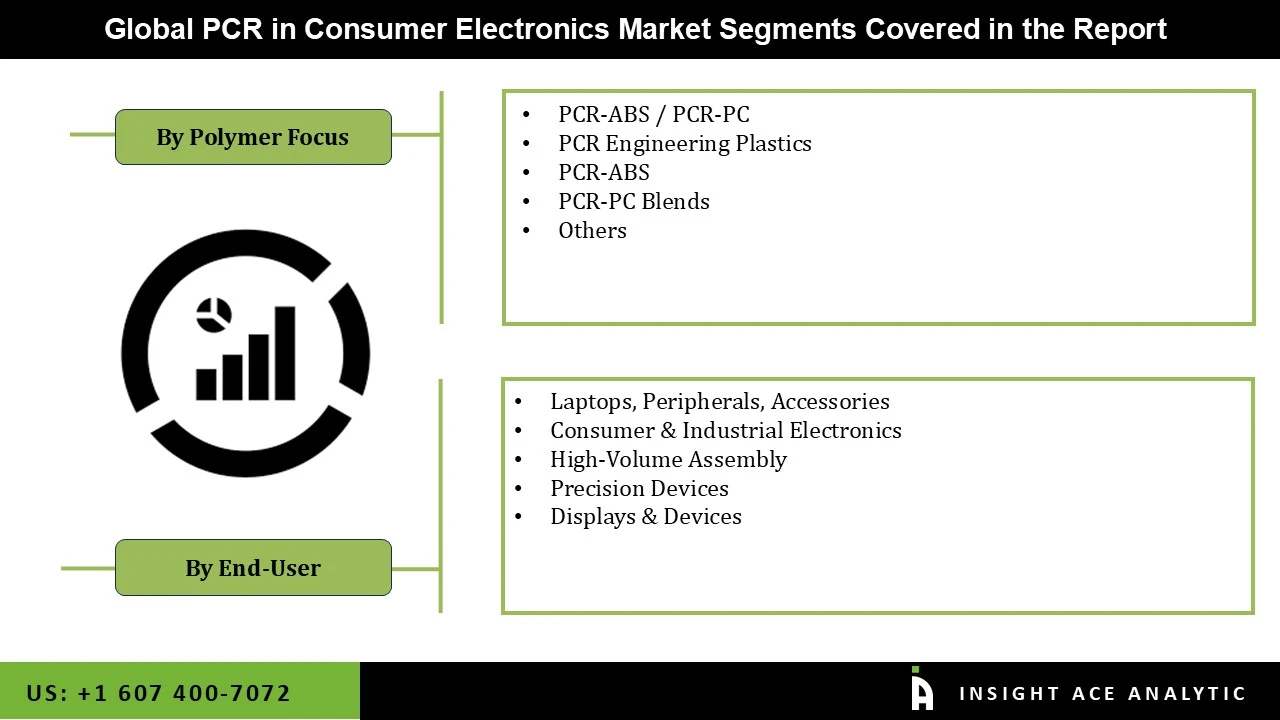
PCR in Consumer Electronics Market by End-user-
• Laptops, Peripherals, Accessories
• Precision Devices
• Consumer & Industrial Electronics
• Displays & Devices
• High-Volume Assembly
PCR in Consumer Electronics Market By Region-
North America-
• The US
• Canada
Europe-
• Germany
• The UK
• France
• Italy
• Spain
• Rest of Europe
Asia-Pacific-
• China
• Japan
• India
• South Korea
• South East Asia
• Rest of Asia Pacific
Latin America-
• Brazil
• Argentina
• Mexico
• Rest of Latin America
Middle East & Africa-
• GCC Countries
• South Africa
• Rest of Middle East and Africa
Research Design and Approach
This study employed a multi-step, mixed-method research approach that integrates:
- Secondary research
- Primary research
- Data triangulation
- Hybrid top-down and bottom-up modelling
- Forecasting and scenario analysis
This approach ensures a balanced and validated understanding of both macro- and micro-level market factors influencing the market.
Secondary Research
Secondary research for this study involved the collection, review, and analysis of publicly available and paid data sources to build the initial fact base, understand historical market behaviour, identify data gaps, and refine the hypotheses for primary research.
Sources Consulted
Secondary data for the market study was gathered from multiple credible sources, including:
- Government databases, regulatory bodies, and public institutions
- International organizations (WHO, OECD, IMF, World Bank, etc.)
- Commercial and paid databases
- Industry associations, trade publications, and technical journals
- Company annual reports, investor presentations, press releases, and SEC filings
- Academic research papers, patents, and scientific literature
- Previous market research publications and syndicated reports
These sources were used to compile historical data, market volumes/prices, industry trends, technological developments, and competitive insights.

Primary Research
Primary research was conducted to validate secondary data, understand real-time market dynamics, capture price points and adoption trends, and verify the assumptions used in the market modelling.
Stakeholders Interviewed
Primary interviews for this study involved:
- Manufacturers and suppliers in the market value chain
- Distributors, channel partners, and integrators
- End-users / customers (e.g., hospitals, labs, enterprises, consumers, etc., depending on the market)
- Industry experts, technology specialists, consultants, and regulatory professionals
- Senior executives (CEOs, CTOs, VPs, Directors) and product managers
Interview Process
Interviews were conducted via:
- Structured and semi-structured questionnaires
- Telephonic and video interactions
- Email correspondences
- Expert consultation sessions
Primary insights were incorporated into demand modelling, pricing analysis, technology evaluation, and market share estimation.
Data Processing, Normalization, and Validation
All collected data were processed and normalized to ensure consistency and comparability across regions and time frames.
The data validation process included:
- Standardization of units (currency conversions, volume units, inflation adjustments)
- Cross-verification of data points across multiple secondary sources
- Normalization of inconsistent datasets
- Identification and resolution of data gaps
- Outlier detection and removal through algorithmic and manual checks
- Plausibility and coherence checks across segments and geographies
This ensured that the dataset used for modelling was clean, robust, and reliable.
Market Size Estimation and Data Triangulation
Bottom-Up Approach
The bottom-up approach involved aggregating segment-level data, such as:
- Company revenues
- Product-level sales
- Installed base/usage volumes
- Adoption and penetration rates
- Pricing analysis
This method was primarily used when detailed micro-level market data were available.

Top-Down Approach
The top-down approach used macro-level indicators:
- Parent market benchmarks
- Global/regional industry trends
- Economic indicators (GDP, demographics, spending patterns)
- Penetration and usage ratios
This approach was used for segments where granular data were limited or inconsistent.
Hybrid Triangulation Approach
To ensure accuracy, a triangulated hybrid model was used. This included:
- Reconciling top-down and bottom-up estimates
- Cross-checking revenues, volumes, and pricing assumptions
- Incorporating expert insights to validate segment splits and adoption rates
This multi-angle validation yielded the final market size.
Forecasting Framework and Scenario Modelling
Market forecasts were developed using a combination of time-series modelling, adoption curve analysis, and driver-based forecasting tools.
Forecasting Methods
- Time-series modelling
- S-curve and diffusion models (for emerging technologies)
- Driver-based forecasting (GDP, disposable income, adoption rates, regulatory changes)
- Price elasticity models
- Market maturity and lifecycle-based projections
Scenario Analysis
Given inherent uncertainties, three scenarios were constructed:
- Base-Case Scenario: Expected trajectory under current conditions
- Optimistic Scenario: High adoption, favourable regulation, strong economic tailwinds
- Conservative Scenario: Slow adoption, regulatory delays, economic constraints
Sensitivity testing was conducted on key variables, including pricing, demand elasticity, and regional adoption.
Request Customization
Add countries, segments, company profiles, or extend forecast — free 10% customization with purchase.
Customize This Report →Enquire Before Buying
Speak with our analyst team about scope, methodology, pricing, or deliverable formats.
Enquire Now →Frequently Asked Questions
PCR in Consumer Electronics Market Size is valued at USD 2.72 Bn in 2025 and is predicted to reach USD 8.96 Bn by the year 2035
PCR in Consumer Electronics Market Growth is predicted to be at a 12.8% CAGR during the forecast period for 2026 to 2035.
HP Inc., INEOS Styrolution Group GmbH, Covestro AG, MBA Polymers Inc., SABIC, Dell Technologies, Foxconn, LAVERGNE, Inc., Lenovo Group Limited, Sony Corporation, Panasonic Corporation, PolyVisions, and Others
PCR in Consumer Electronics Market is segmented into Polymer Focus, Age Group, Treatment Duration, End-user, Distribution Channel, and By Region
Asia Pacific region is leading the PCR in Consumer Electronics Market.