Electric Vehicle Charging Infrastructure Market Size, Trend, Forecast Report 2026 to 2035
What is Electric Vehicle Charging Infrastructure Market Size?
Global Electric Vehicle Charging Infrastructure Market Size is valued at USD 40.86 Billion in 2025 and is predicted to reach USD 382.83 Billion by the year 2035 at a 25.2% CAGR during the forecast period for 2026 to 2035.
Electric Vehicle Charging Infrastructure Market Size, Share & Trends Analysis Report By Charging Point Type (AC, DC), Level of Charging (Level 1, Level 2, Level 3), Installation Type (Fixed, Portable), Vehicle Type, Charging Service, DC Fast Charging Type, Charging Infrastructure Type, End User, By Region, And Segment Forecasts, 2026 to 2035.
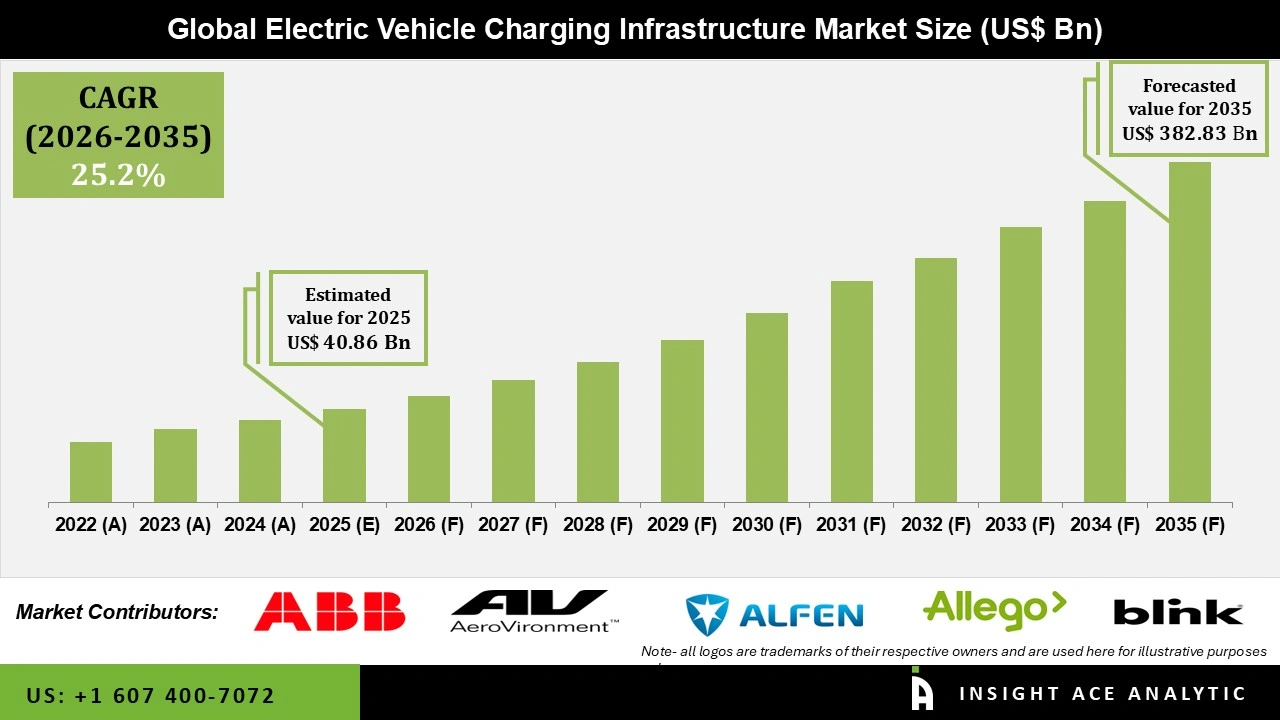
Electric Vehicle Charging Infrastructure Market Key Takeaways:
|
Key Industry Insights & Findings from the Report:
- Advancements in electric vehicle technology, along with the improvements in battery efficiency and extended ranges, are expected to boost the market growth in the coming years.
- Growing environmental awareness and stringent emissions regulations are expected to drive industry growth.
- Asia Pacific dominated the market and accounted for a revenue share of global revenue in 2025.
- One of the significant factor restraining industry growth is the High upfront costs.
The Internal Combustion Engine (ICE), which needs fuel and gases to produce power, is not used in Electric Vehicles (EVs), which run on electric motors. The facility utilised to supply the electric energy source to recharge electric vehicles is known as the electric vehicle charging infrastructure. Some vehicles can be set up overnight at a residence or place of employment.
However, it is always impractical and ineffective for the long run. The need for electric cars has arisen as a result of the increase in carbon emissions and other hazardous compounds produced by transportation. As a result, both commercial and residential environments require an infrastructure for electric vehicle (EV) charging.
Additionally, it is projected that growing industry alliances among automakers to provide subscription-based charging stations would promote business growth. Over the course of the projected period, rising demand for green energy is anticipated to further fuel EV charging infrastructure market development. Green energy is anticipated to significantly support the fast growing trend in both public and private electric charging stations. Government efforts to upgrade EV charging infrastructure are likely to increase, which will significantly boost EV charging infrastructure industry expansion.
The sales of electric vehicles have expanded exponentially in recent years, along with their improved performance, wider model availability, and longer range. The IEA's Global EV Outlook 2024 states that sales of electric vehicles approached 14 million in 2023, with the United States, China, and Europe accounting for 95% of these sales.
Additionally, during the projected period, the demand for commercial infrastructure and household charging stations for plug-in electric vehicles is expected to increase. But during the course of the forecast period, a number of issues, including the high setup costs of fast chargers and the lack of standardised plug types, are anticipated to restrain the EV charging infrastructure market revenue growth.
Competitive Landscape:
Some of the electric vehicle charging infrastructure market players are:
- ABB Ltd.
- AeroViroment, Inc.
- Alfen N.V.
- Allego
- Blink Charging Co.
- Chargemaster plc.
- ChargePoint, Inc.
- ClipperCreek
- Denso Corporation
- Efacec
- Elix Wireless
- Engie
- Evatran Group
- EVgo Services LLC.
- General Electric
- HellaKGaAHueck& Co.
- Infineon Technologies AG
- Leviton Manufacturing Co., Inc.
- Mojo Mobility, Inc.
- Qualcomm Technologies, Inc.
- Robert Bosch GmbH
- Scheinder Electric
- Siemens AG
- Tesla Inc.
- Toshiba Corporation
- Wi Tricity Corporation
Market Segmentation:
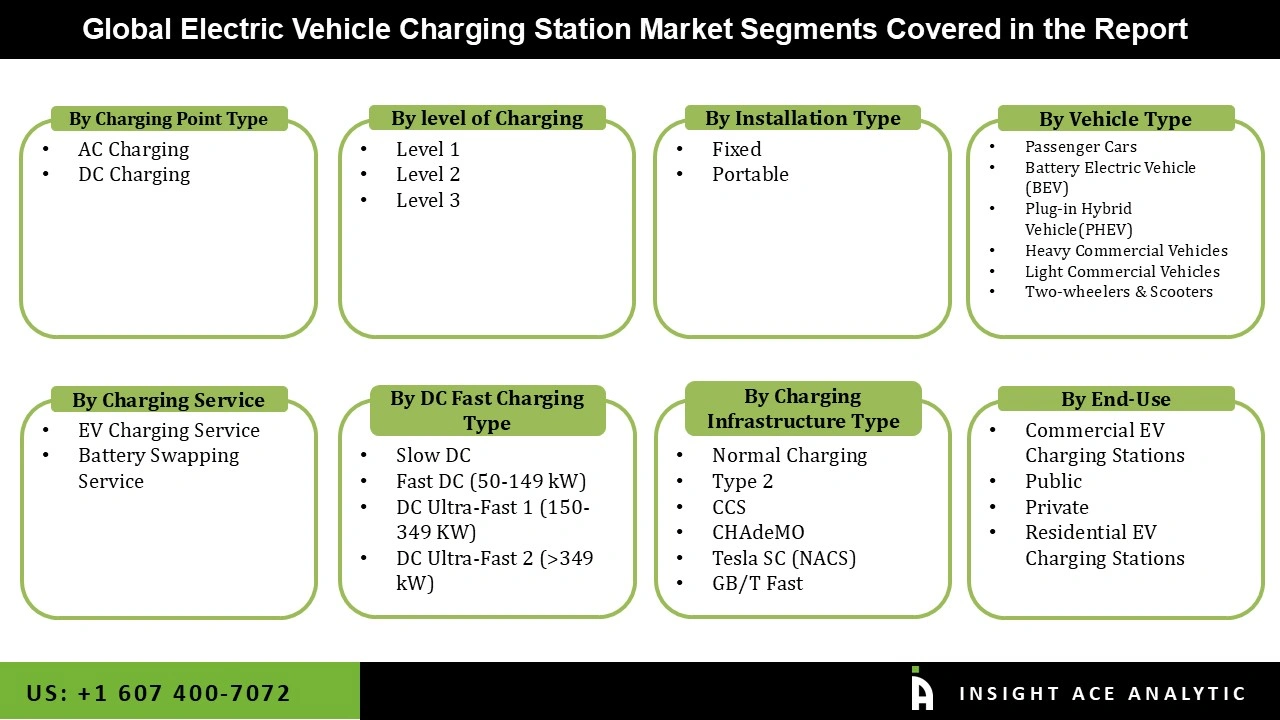
The electric vehicle charging infrastructure market is segregated based on charging point type, level of charging, installation type, vehicle type, charging service, dc fast charging type, charging infrastructure type, and end-user. Charging point type segment includes AC and DC charging, Level of charging segment includes Level 1, Level 2, and Level 3, Installation type segment includes fixed and portable. Vehicle type segment includes Passengers Cares, Battery electric vehicle, plug-in hybrid vehicle, heavy commercial vehicles, light commercial vehicles, and two wheelers & scooters. The charging service segment includes EV charging and battery swapping services. DC fast charging type segment includes Slow DC (349 kW). Charging infrastructure type segment includes Normal Charging, Type 2, CCS, CHAdeMO, Tesla SC (NACS), and GB/T Fast. End-user segment includes residential and commercial EV charging stations.
The DC Charging Segment Has Emerged As A Significant Contributor To The Electric Vehicle Charging Infrastructure Market, By The Type Of Charging Point.
The category of DC charging gained the largest revenue share, and it is expected that this trend will persist over the projected period. EV Fast charging, also referred to as Level 3 charging or DC charging, provides vehicles with significantly quicker charging durations in comparison to AC charging. The development of rapid DC adapters for rapid charging of electric vehicles is the primary factor propelling the expansion of the worldwide market. Rapid DC charging has enabled vehicle owners and drivers to recharge their devices while traveling or taking a brief break, as opposed to having to leave them connected overnight for several hours to fully charge. Range anxiety has been reduced by the expansion of public—and specifically rapid charging—infrastructure. An increasing preference among consumers to reduce the time required to recharge electric vehicle (EV) batteries has led to a surge in the need for DC rapid charging stations.
The Commercial Segment Witnessed Growth At A Rapid Rate
The commercial category is anticipated to grow at a significant rate over the forecast period. Public electric vehicle charging infrastructure is in greater demand as a result of the historic move to electric automobiles. The development of a charging infrastructure has not yet kept pace with the surge in sales of electric vehicles. The demand for public charging infrastructures would only grow as the price of electric vehicles fluctuated and dropped, entering new markets, notably for inhabitants of multi-unit buildings. The ideal candidates for hosting electric vehicle charging infrastructures would also be stores.
The Asia Pacific Electric Vehicle Charging Infrastructure Market Holds A Significant Revenue Share In The Region
The Asia Pacific electric vehicle charging infrastructure market is expected to report the highest market share in revenue in the near future. The Asia Pacific market is projected to be fueled by China's rapid expansion of EV charging infrastructure, rising consumer demand for reasonably priced EVs for daily usage, and government-led EV promotion. The IEA projects that China is leading the way in the worldwide electric vehicle market in its annual Global EV Outlook. 2023 year witnessed 8.1 million new electric car registrations in China, a 35% rise from year 2022. Robust sales of electric vehicles is the primary factor driving regional growth in the EV charging infrastructure market.
The nation's rapid economic growth will support the spread of cutting-edge technologies to enhance electrification in China during the predicted period. In addition, Europe is projected to grow at a rapid rate in the global electric vehicle charging infrastructure market due to the location of important market participants. Market expansion in this region is probably going to be fueled by consumer adoption of EVs, driverless vehicles, and shared mobility. The market in this region is anticipated to be driven by factors including the tightening government regulations on car emissions, the quick adoption of new technologies, and the significant investment in product innovation.
Recent Developments:
- In March 2024, Ford and Allego have announced their collaboration to deploy high-speed charging stations for Ford customers and the general public at numerous European dealerships of the U.S. carmaker. Allego will install charging stations with a capacity of up to 400 kilowatts, providing continuous charging options for electric vehicle (EV) drivers. The chargers would primarily target the automaker's core markets in the United Kingdom, Germany, Netherlands, France, Italy, and Spain, as well as smaller markets such as Norway.
- In Feb 2024, EV charging stations frequently necessitate intricate and costly enhancements to the current electrical infrastructure. Eaton, a corporation specializing in intelligent power management, addressed this difficulty by creating an automated and dynamic method to load management. This strategy effectively optimized the charging capacities of current electrical systems. The solution was created through a partnership with ChargeLab, a prominent North American company specializing in open software for managing EV chargers.
Electric Vehicle Charging Infrastructure Market Report Scope:
| Report Attribute | Specifications |
| Market size value in 2025 | USD 40.86 Billion |
| Revenue forecast in 2035 | USD 382.83 Billion |
| Growth rate CAGR | CAGR of 25.2% from 2026 to 2035 |
| Quantitative units | Representation of revenue in US$ Bn, Volume (Units), and CAGR from 2026 to 2035 |
| Historic Year | 2022 to 2025 |
| Forecast Year | 2026-2035 |
| Report coverage | The forecast of revenue, the position of the company, the competitive market statistics, growth prospects, and trends |
| Segments covered | charging point type, level of charging, installation type, vehicle type, charging service, dc fast charging type, charging infrastructure type, and end-user |
| Regional scope | North America; Europe; Asia Pacific; Latin America; Middle East & Africa |
| Country scope | U.S.; Canada; U.K.; Germany; China; India; Japan; Brazil; Mexico; The UK; France; Italy; Spain; China; Japan; India; South Korea; Southeast Asia; South Korea; Southeast Asia |
| Competitive Landscape | ABB Ltd., AeroViroment, Inc., Alfen N.V., Allego, Blink Charging Co., Chargemaster plc., ChargePoint, Inc., ClipperCreek, Denso Corporation, Efacec, Elix Wireless, Engie, Evatran Group, EVgo Services LLC., General Electric, HellaKGaAHueck& Co., Infineon Technologies AG, Leviton Manufacturing Co., Inc., Mojo Mobility, Inc., Qualcomm Technologies, Inc., Robert Bosch GmbH, Scheinder Electric, Siemens AG, Tesla Inc., Toshiba Corporation, Wi Tricity Corporation |
| Customization scope | Free customization report with the procurement of the report, Modifications to the regional and segment scope. Particular Geographic competitive landscape. |
| Pricing and available payment methods | Explore pricing alternatives that are customized to your particular study requirements. |
Segmentation of Electric Vehicle Charging Infrastructure Market :
Electric Vehicle Charging Infrastructure Market, By Charging Point Type-
- AC Charging
- DC Charging
Electric Vehicle Charging Infrastructure Market, By Level of Charging-
- Level 1
- Level 2
- Level 3
Electric Vehicle Charging Infrastructure Market, By Installation Type-
- Fixed
- Portable
Electric Vehicle Charging Infrastructure Marke, By Vehicle Type-
- Passenger Cars
- Battery Electric Vehicle (BEV)
- Plug-in Hybrid Vehicle(PHEV)
- Heavy Commercial Vehicles
- Light Commercial Vehicles
- Two-wheelers & Scooters
Electric Vehicle Charging Infrastructure Market, By Charging Service-
- EV Charging Service
- Battery Swapping Service
Electric Vehicle Charging Infrastructure Market, By DC Fast Charging Type-
- Slow DC (
- Fast DC (50-149 kW)
- DC Ultra-Fast 1 (150-349 KW)
- DC Ultra-Fast 2 (>349 kW)
Electric Vehicle Charging Infrastructure Market, By Charging Infrastructure Type-
- Normal Charging
- Type 2
- CCS
- CHAdeMO
- Tesla SC (NACS)
- GB/T Fast
Electric Vehicle Charging Infrastructure Market, By End User-
- Commercial EV Charging Stations
- Public
- Private
- Residential EV Charging Stations
Electric Vehicle Charging Infrastructure Market, By Region-
- North America-
- The US
- Canada
- Europe-
- Germany
- The UK
- France
- Italy
- Spain
- Rest of Europe
- Asia-Pacific-
- China
- Japan
- India
- South Korea
- South East Asia
- Rest of Asia Pacific
- Latin America-
- Brazil
- Argentina
- Mexico
- Rest of Latin America
- Middle East & Africa-
- GCC Countries
- South Africa
- Rest of Middle East and Africa
Research Design and Approach
This study employed a multi-step, mixed-method research approach that integrates:
- Secondary research
- Primary research
- Data triangulation
- Hybrid top-down and bottom-up modelling
- Forecasting and scenario analysis
This approach ensures a balanced and validated understanding of both macro- and micro-level market factors influencing the market.
Secondary Research
Secondary research for this study involved the collection, review, and analysis of publicly available and paid data sources to build the initial fact base, understand historical market behaviour, identify data gaps, and refine the hypotheses for primary research.
Sources Consulted
Secondary data for the market study was gathered from multiple credible sources, including:
- Government databases, regulatory bodies, and public institutions
- International organizations (WHO, OECD, IMF, World Bank, etc.)
- Commercial and paid databases
- Industry associations, trade publications, and technical journals
- Company annual reports, investor presentations, press releases, and SEC filings
- Academic research papers, patents, and scientific literature
- Previous market research publications and syndicated reports
These sources were used to compile historical data, market volumes/prices, industry trends, technological developments, and competitive insights.

Primary Research
Primary research was conducted to validate secondary data, understand real-time market dynamics, capture price points and adoption trends, and verify the assumptions used in the market modelling.
Stakeholders Interviewed
Primary interviews for this study involved:
- Manufacturers and suppliers in the market value chain
- Distributors, channel partners, and integrators
- End-users / customers (e.g., hospitals, labs, enterprises, consumers, etc., depending on the market)
- Industry experts, technology specialists, consultants, and regulatory professionals
- Senior executives (CEOs, CTOs, VPs, Directors) and product managers
Interview Process
Interviews were conducted via:
- Structured and semi-structured questionnaires
- Telephonic and video interactions
- Email correspondences
- Expert consultation sessions
Primary insights were incorporated into demand modelling, pricing analysis, technology evaluation, and market share estimation.
Data Processing, Normalization, and Validation
All collected data were processed and normalized to ensure consistency and comparability across regions and time frames.
The data validation process included:
- Standardization of units (currency conversions, volume units, inflation adjustments)
- Cross-verification of data points across multiple secondary sources
- Normalization of inconsistent datasets
- Identification and resolution of data gaps
- Outlier detection and removal through algorithmic and manual checks
- Plausibility and coherence checks across segments and geographies
This ensured that the dataset used for modelling was clean, robust, and reliable.
Market Size Estimation and Data Triangulation
Bottom-Up Approach
The bottom-up approach involved aggregating segment-level data, such as:
- Company revenues
- Product-level sales
- Installed base/usage volumes
- Adoption and penetration rates
- Pricing analysis
This method was primarily used when detailed micro-level market data were available.

Top-Down Approach
The top-down approach used macro-level indicators:
- Parent market benchmarks
- Global/regional industry trends
- Economic indicators (GDP, demographics, spending patterns)
- Penetration and usage ratios
This approach was used for segments where granular data were limited or inconsistent.
Hybrid Triangulation Approach
To ensure accuracy, a triangulated hybrid model was used. This included:
- Reconciling top-down and bottom-up estimates
- Cross-checking revenues, volumes, and pricing assumptions
- Incorporating expert insights to validate segment splits and adoption rates
This multi-angle validation yielded the final market size.
Forecasting Framework and Scenario Modelling
Market forecasts were developed using a combination of time-series modelling, adoption curve analysis, and driver-based forecasting tools.
Forecasting Methods
- Time-series modelling
- S-curve and diffusion models (for emerging technologies)
- Driver-based forecasting (GDP, disposable income, adoption rates, regulatory changes)
- Price elasticity models
- Market maturity and lifecycle-based projections
Scenario Analysis
Given inherent uncertainties, three scenarios were constructed:
- Base-Case Scenario: Expected trajectory under current conditions
- Optimistic Scenario: High adoption, favourable regulation, strong economic tailwinds
- Conservative Scenario: Slow adoption, regulatory delays, economic constraints
Sensitivity testing was conducted on key variables, including pricing, demand elasticity, and regional adoption.
Request Customization
Add countries, segments, company profiles, or extend forecast — free 10% customization with purchase.
Customize This Report →Enquire Before Buying
Speak with our analyst team about scope, methodology, pricing, or deliverable formats.
Enquire Now →Frequently Asked Questions
Electric Vehicle Charging Infrastructure Market Size is valued at USD 40.86 Billion in 2025 and is predicted to reach USD 382.83 Billion by the year 2035
Electric Vehicle Charging Infrastructure Market expected to grow at a 25.2% CAGR during the forecast period for 2026 to 2035
ABB Ltd., AeroViroment, Inc., Alfen N.V., Allego, Blink Charging Co., Chargemaster plc., ChargePoint, Inc., ClipperCreek, Denso Corporation, Efacec, Elix Wireless, Engie, Evatran Group, EVgo Services LLC., General Electric, HellaKGaAHueck& Co., Infineon Technologies AG, Leviton Manufacturing Co., Inc., Mojo Mobility, Inc., Qualcomm Technologies, Inc., Robert Bosch GmbH, Scheinder Electric, Siemens AG, Tesla Inc., Toshiba Corporation, Wi Tricity Corporation and Others.
Electric Vehicle Charging Infrastructure Market is segmented into Charging Point Type (AC, DC), Level of Charging (Level 1, Level 2, Level 3), Installation Type (Fixed, Portable), Vehicle Type, Charging Service, DC Fast Charging Type, Charging Infrastructure Type, End User and other.
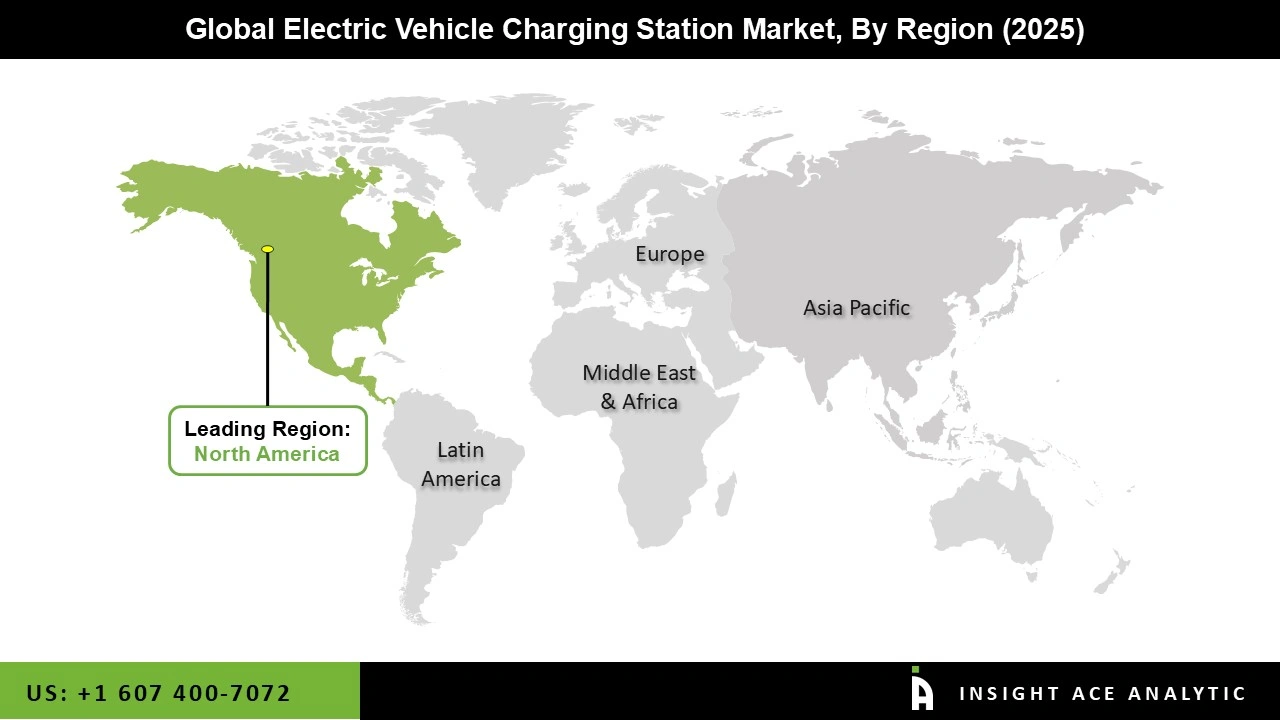
North America region is leading the Electric Vehicle Charging Infrastructure Market.