Recycled Cellulosic Fibers and Textile-to-Textile Circularity Market Size, Share and Forecast 2026 to 2035
What is Recycled Cellulosic Fibers and Textile-to-Textile Circularity Market Size?
Global Recycled Cellulosic Fibers and Textile-to-Textile Circularity Market Size is predicted to grow at a 22.4% CAGR during the forecast period for 2026 to 2035.
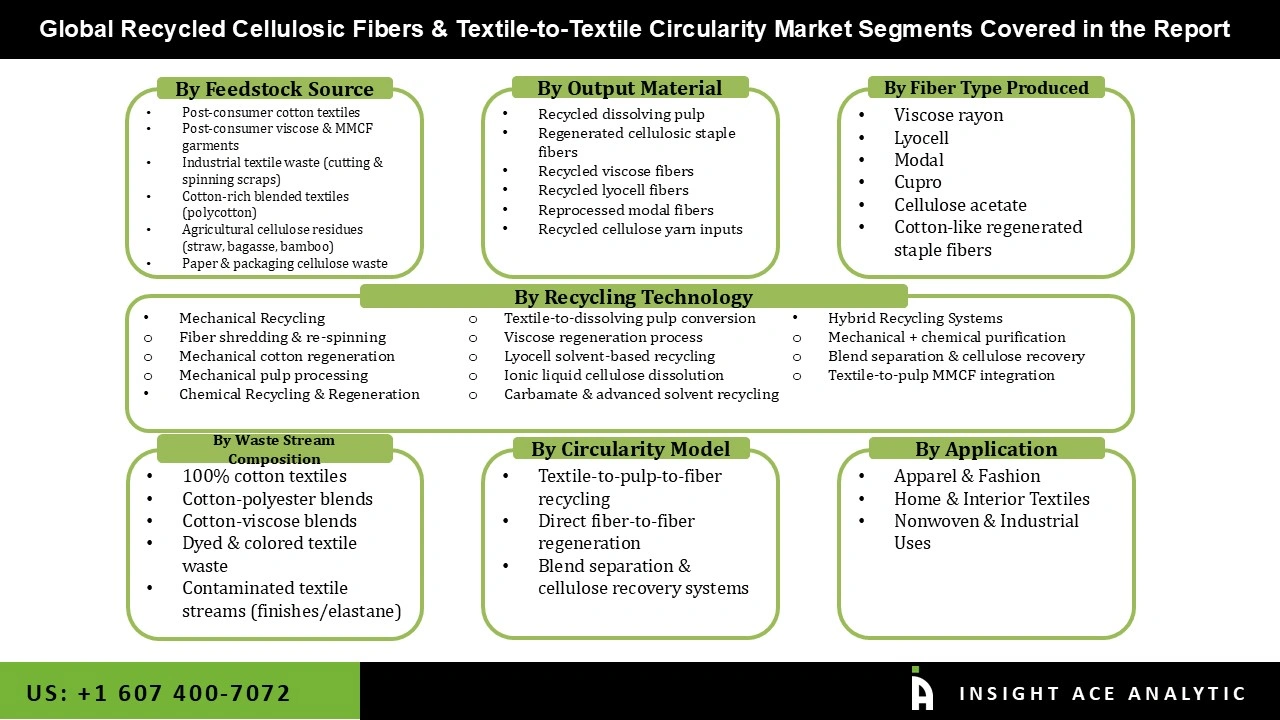
Recycled Cellulosic Fibers and Textile-to-Textile Circularity Market Size, Share & Trends Analysis Distribution by Feedstock Source (Post-Consumer Cotton Textiles, Post-Consumer Viscose & MMCF Garments, Industrial Textile Waste (Cutting & Spinning Scraps), Cotton-Rich Blended Textiles (Polycotton), Agricultural Cellulose Residues (Straw, Bagasse, Bamboo), Paper & Packaging Cellulose Waste), By Recycling Technology (Mechanical Recycling, Chemical Recycling & Regenera¬Tion, Hybrid Recycling Systems), By Output Material (Recycled Dissolving Pulp, Regene¬Rated Cellulosic Staple Fibers, Recycled Viscose Fibers, Recycled Lyocell Fibers, Reprocessed Modal Fibers, Recycled Cellulose Yarn Inputs), By Fiber Type Produced (Viscose Rayon, Lyocell, Modal, Cupro, Cellulose Acetate, Cotton-Like Regenerated Staple Fibers), By Waste Stream Composition, By Circularity Model, By Application, By Region and Segment Forecasts, 2026 to 2035.
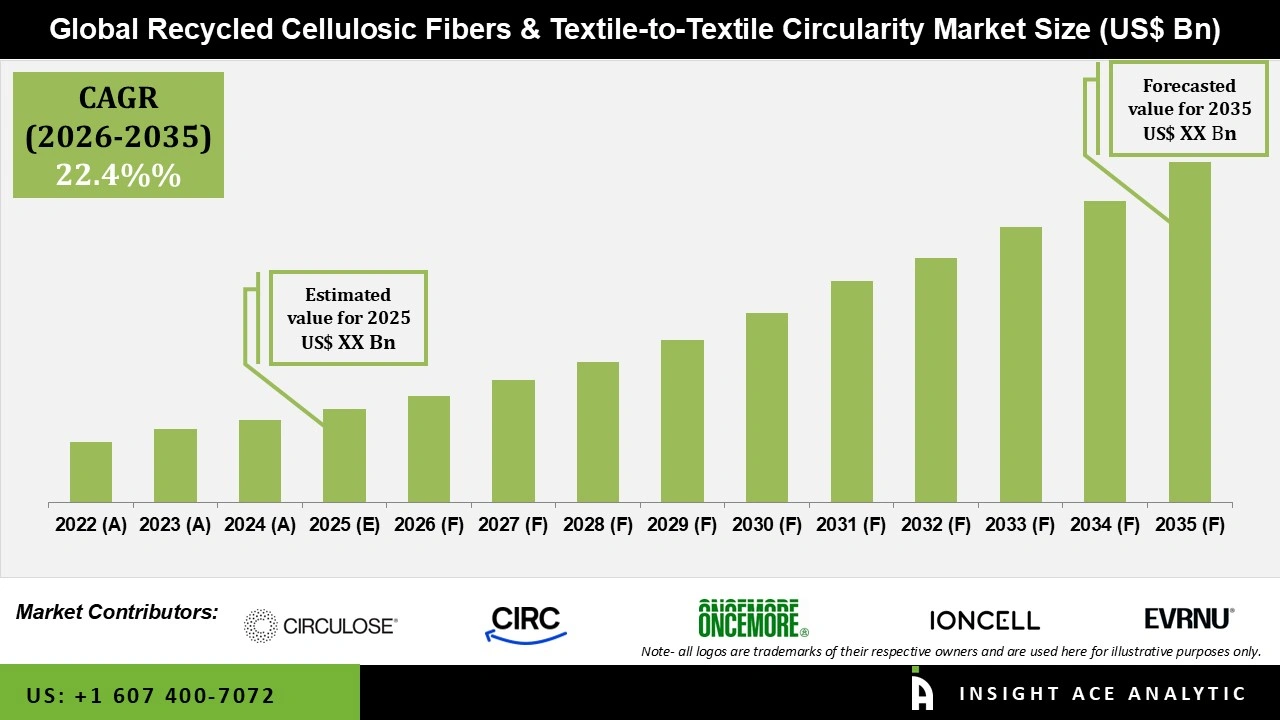
Recycled Cellulosic Fibers and Textile-to-Textile Circularity Market Key Takeaways:
|
The textile industry worldwide is presently experiencing a major shift owing to the pressing need for minimizing environmental effects and adopting sustainable resource management. At the forefront of this major shift is the recycled cellulosic fibers & textile-to-textile circularity market a relatively new and rapidly growing market that aims to revolutionize the way fibers and textiles are made, used, and recycled. Recycled cellulosic fibers are produced from waste-based cellulosic materials such as post-consumer clothing, textile scraps, agricultural litters, and wood pulp. Using processes such as mechanical recycling, chemical dissolution, and enzymatic processing, these materials are processed into regenerated fibers like recycled viscose, lyocell, and modal. Textile-to-textile circularity is a process where post-consumer textiles are collected, processed, and recycled into new textile materials, thus completing the production cycle and minimizing landfill dependence. These fibers retain fundamental characteristics like softness, breathability, and biodegradability while using water, carbon, and virgin resources to a minimal extent compared to traditional fibers like cotton and viscose.
The recycled cellulosic fibers find numerous applications in the areas of clothing and fashion, home textiles, technical textiles, and nonwoven specialty products such as medical applications. The use of these recycled cellulosic fibers is expected to increase as manufacturers respond to the rising consumer awareness and pressure for environmental accountability by adopting sustainable product lines and eco-certifications. The market for recycled cellulosic fibers is mainly driven by the growing awareness about sustainability among consumers and businesses, as well as the supporting regulatory policies that support recycling and sustainable production practices. However, The market is also constrained by factors such as the technical challenges involved in the recycling process and the lack of infrastructure for collecting and sorting textile waste.
Competitive Landscape
Which are the Leading Players in the Recycled Cellulosic Fibers and Textile-to-Textile Circularity Market?
- Circulose (formerly Renewcell)
- Circ
- Södra (OnceMore®)
- Ioncell (Aalto University consortium)
- Infinited Fiber Company
- Evrnu
- Spinnova
- TreeToTextile
- Tyton BioSciences
- Lenzing Group
- Birla Cellulose (Aditya Birla Group)
- Sateri
- Tangshan Sanyou Chemical Fiber
- Yibin Grace
- Worn Again Technologies
- Ambercycle
- Re&Up
- Reju
- Recover Textile Systems
- Procotex
- Hilaturas Ferre
- Filature du Parc
- TextileGenesis
- Pellenc ST
- Valvan Baling Systems
- Picvisa
- Other Prominent Players
Market Dynamics
Driver
Rising Sustainability Commitments and Circular Economy Regulations
The primary driver of the recycled cellulosic fibers & textile-to-textile circularity industry is the accelerating global push toward sustainability and circular economy adoption. The rising concerns about the environmental impact of textile waste, the water-intensive nature of cotton production, and carbon emissions are forcing companies, manufacturers, and governments to focus on sustainable materials and recycled materials. The major fashion brands are setting ESG goals, net-zero strategies, and recycled material requirements, which is a major driving force for the demand for recycled cellulosic fibers. On the other hand, the growing regulations on textile waste management, extended producer responsibility (EPR) policies, and circular economy strategies, especially in Europe and other developed countries, are forcing the market to create significant growth opportunities during the forecast period for textile-to-textile recycling solutions.
Restrain/Challenge
Limited Recycling Infrastructure and High Processing Costs
The key challenge in the recycled cellulosic fibers & textile-to-textile circularity market is the lack of efficient textile waste collection, sorting, and recycling infrastructure, as well as high processing costs. Textile-to-textile recycling requires sophisticated technology to separate mixed textiles and remove dyes or impurities while preserving the quality of the fibers. Such technologies are still in the development stages and tend to have higher capital costs than traditional fiber manufacturing. Moreover, the unavailability of a stable feedstock supply, owing to a lack of effective collection and sorting infrastructure, particularly in emerging markets, hinders commercialization on a larger scale. This, in turn, makes it difficult to achieve cost competitiveness with virgin fibers.
Post-consumer Cotton Textiles Segment is Expected to Drive the Recycled Cellulosic Fibers & Textile-to-Textile Circularity Market
The market for recycled cellulosic fibers & textile-to-textile circularity is expected to be led by post-consumer cotton textiles owing to their widespread availability, high cellulose content, and direct relevance to the objectives of circular fashion. As cotton is one of the most popular fibers used in the global fashion industry, the increasing amount of post-consumer cotton waste generated from discarded garments offers a scalable and steady supply for recycling. In terms of technology, the high purity of cellulose in cotton makes it very amenable to regeneration into new cellulosic fibers using chemical recycling technologies. Furthermore, the increasing industry pressure to manage textile waste, rising concerns about landfills, and strong brand commitments to use recycled materials are pushing the development of post-consumer cotton collection and recycling infrastructure, making this segment the key driver in the market.
Chemical Recycling & Regenera¬tion Segment is Growing at the Highest Rate in the Recycled Cellulosic Fibers & Textile-to-Textile Circularity Market
Among recycling technologies, chemical recycling & regeneration is expected to grow at the highest rate in the recycled cellulosic fibers & textile-to-textile circularity market. This market is gaining traction because of its capability to recycle post-consumer textiles, including cotton-rich blends and dyed textiles, while preserving the quality of the fibers. Unlike mechanical recycling, which reduces the length of the fibers and restricts their use to specific applications, chemical recycling breaks down cellulose and re-creates it into high-quality fibers like viscose, lyocell, and other MMCFs. With rising investments in advanced dissolution technologies, increasing demand for high-quality fibers, and strong brand commitments to closed-loop textile production, chemical recycling is expected to witness the highest growth rate during the forecast period.
Why Asia Pacific Led the Recycled Cellulosic Fibers & Textile-to-Textile Circularity Market?
The Asia Pacific represented the leading market for recycled cellulosic fibers & textile-to-textile circularity due to its preeminent position in the global textile production industry, coupled with its high capacity for the production of man-made cellulosic fibers. The Asia Pacific region also produces a high quantity of textile waste, while at the same time, it is driving a high demand for recycled materials, thus making it easy to integrate circular solutions into the existing supply chain.
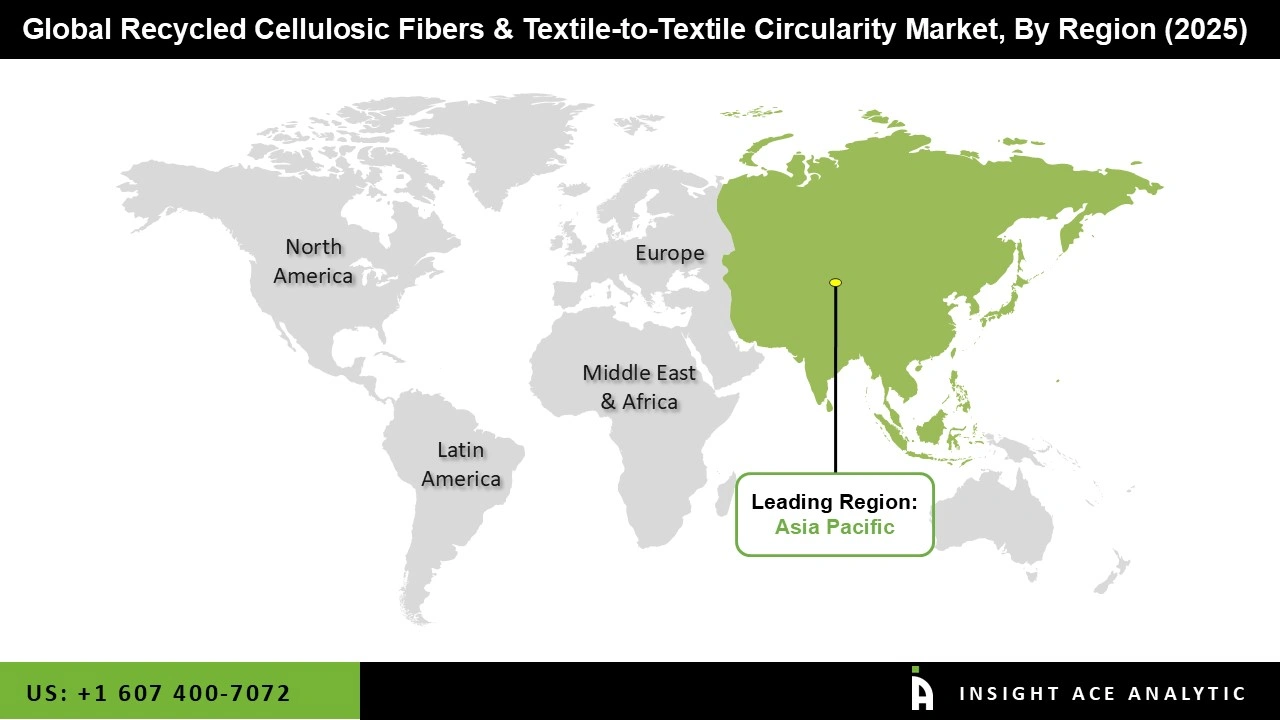
The region is home to major textile production countries such as China, India, Bangladesh, and Vietnam, which create favorable conditions for the production of recycled cellulosic fibers on a large scale.
Key Development :
December 2025: Circulose and Birla Cellulose signed a strategic partnership to accelerate textile recycling. Under the agreement, Circulose will supply pulp made from 100% recycled textile waste, and Birla Cellulose will convert it into viscose staple fiber using CIRCULOSE® pulp for distribution to Circulose’s brand partners, strengthening end-to-end circular solutions across the textile value chain.
Recycled Cellulosic Fibers and Textile-to-Textile Circularity Market Report Scope:
| Report Attribute | Specifications |
| Growth Rate CAGR | CAGR of 22.4%% from 2026 to 2035 |
| Quantitative Units | Representation of revenue in US$ Bn and CAGR from 2026 to 2035 |
| Historic Year | 2021 to 2025 |
| Forecast Year | 2026-2035 |
| Report Coverage | The forecast of revenue, the position of the company, the competitive market structure, growth prospects, and trends |
| Segments Covered | By Feedstock Source, Recycling Technology, Output Material, Fiber Type Produced, Waste Stream Composition, Circularity Model, Application, and By Region |
| Regional Scope | North America; Europe; Asia Pacific; Latin America; Middle East & Africa |
| Country Scope | U.S.; Canada; U.K.; Germany; China; India; Japan; Brazil; Mexico; The UK; France; Italy; Spain; China; Japan; India; South Korea; Southeast Asia; South Korea; Southeast Asia |
| Competitive Landscape | Circulose (formerly Renewcell), Circ, Södra (OnceMore®), Ioncell (Aalto University consortium), Infinited Fiber Company, Evrnu, Spinnova, TreeToTextile, Tyton BioSciences, Lenzing Group, Birla Cellulose (Aditya Birla Group), Sateri, Tangshan Sanyou Chemical Fiber, Yibin Grace, Worn Again Technologies, Ambercycle, Re&Up, Reju, Recover Textile Systems, Procotex, Hilaturas Ferre, Filature du Parc, TextileGenesis, Pellenc ST, Valvan Baling Systems, Picvisa |
| Customization Scope | Free customization report with the procurement of the report, Modifications to the regional and segment scope. Geographic competitive landscape. |
| Pricing and Available Payment Methods | Explore pricing alternatives that are customized to your particular study requirements. |
Segmentation of Recycled Cellulosic Fibers and Textile-to-Textile Circularity Market :
Recycled Cellulosic Fibers & Textile-to-Textile Circularity Market by Feedstock Source -
- Post-consumer cotton textiles
- Post-consumer viscose & MMCF garments
- Industrial textile waste (cutting & spinning scraps)
- Cotton-rich blended textiles (polycotton)
- Agricultural cellulose residues (straw, bagasse, bamboo)
- Paper & packaging cellulose waste
Recycled Cellulosic Fibers & Textile-to-Textile Circularity Market by Recycling Technology -
- Mechanical Recycling
- Fiber shredding & re-spinning
- Mechanical cotton regeneration
- Mechanical pulp processing
- Chemical Recycling & Regenera¬tion
- Textile-to-dissolving pulp conversion
- Viscose regeneration process
- Lyocell solvent-based recycling
- Ionic liquid cellulose dissolution
- Carbamate & advanced solvent recycling
- Hybrid Recycling Systems
- Mechanical + chemical purification
- Blend separation & cellulose recovery
- Textile-to-pulp MMCF integration
Recycled Cellulosic Fibers & Textile-to-Textile Circularity Market by Output Material -
- Recycled dissolving pulp
- Regene¬rated cellulosic staple fibers
- Recycled viscose fibers
- Recycled lyocell fibers
- Reprocessed modal fibers
- Recycled cellulose yarn inputs
Recycled Cellulosic Fibers & Textile-to-Textile Circularity Market by Fiber Type Produced-
- Viscose rayon
- Lyocell
- Modal
- Cupro
- Cellulose acetate
- Cotton-like regenerated staple fibers
Recycled Cellulosic Fibers & Textile-to-Textile Circularity Market by Waste Stream Composition -
- 100% cotton textiles
- Cotton-polyester blends
- Cotton-viscose blends
- Dyed & colored textile waste
- Contaminated textile streams (finishes/elastane)
Recycled Cellulosic Fibers & Textile-to-Textile Circularity Market by Circularity Model -
- Textile-to-pulp-to-fiber recycling
- Direct fiber-to-fiber regeneration
- Blend separation & cellulose recovery systems
Recycled Cellulosic Fibers & Textile-to-Textile Circularity Market by Application -
- Apparel & Fashion
- Everyday wear & basics
- Denim & cotton replacements
- Premium fashion textiles
- Performance & activewear
- Home & Interior Textiles
- Bedding & linens
- Upholstery fabrics
- Curtains & furnishings
- Nonwoven & Industrial Uses
- Hygiene & medical textiles
- Wipes & filtration materials
- Automotive & technical textiles
Recycled Cellulosic Fibers & Textile-to-Textile Circularity Market by Region-
- North America-
- The US
- Canada
- Europe-
- Germany
- The UK
- France
- Italy
- Spain
- Rest of Europe
- Asia-Pacific-
- China
- Japan
- India
- South Korea
- South East Asia
- Rest of Asia Pacific
- Latin America-
- Brazil
- Argentina
- Mexico
- Rest of Latin America
- Middle East & Africa-
- GCC Countries
- South Africa
- Rest of Middle East and Africa
Research Design and Approach
This study employed a multi-step, mixed-method research approach that integrates:
- Secondary research
- Primary research
- Data triangulation
- Hybrid top-down and bottom-up modelling
- Forecasting and scenario analysis
This approach ensures a balanced and validated understanding of both macro- and micro-level market factors influencing the market.
Secondary Research
Secondary research for this study involved the collection, review, and analysis of publicly available and paid data sources to build the initial fact base, understand historical market behaviour, identify data gaps, and refine the hypotheses for primary research.
Sources Consulted
Secondary data for the market study was gathered from multiple credible sources, including:
- Government databases, regulatory bodies, and public institutions
- International organizations (WHO, OECD, IMF, World Bank, etc.)
- Commercial and paid databases
- Industry associations, trade publications, and technical journals
- Company annual reports, investor presentations, press releases, and SEC filings
- Academic research papers, patents, and scientific literature
- Previous market research publications and syndicated reports
These sources were used to compile historical data, market volumes/prices, industry trends, technological developments, and competitive insights.

Primary Research
Primary research was conducted to validate secondary data, understand real-time market dynamics, capture price points and adoption trends, and verify the assumptions used in the market modelling.
Stakeholders Interviewed
Primary interviews for this study involved:
- Manufacturers and suppliers in the market value chain
- Distributors, channel partners, and integrators
- End-users / customers (e.g., hospitals, labs, enterprises, consumers, etc., depending on the market)
- Industry experts, technology specialists, consultants, and regulatory professionals
- Senior executives (CEOs, CTOs, VPs, Directors) and product managers
Interview Process
Interviews were conducted via:
- Structured and semi-structured questionnaires
- Telephonic and video interactions
- Email correspondences
- Expert consultation sessions
Primary insights were incorporated into demand modelling, pricing analysis, technology evaluation, and market share estimation.
Data Processing, Normalization, and Validation
All collected data were processed and normalized to ensure consistency and comparability across regions and time frames.
The data validation process included:
- Standardization of units (currency conversions, volume units, inflation adjustments)
- Cross-verification of data points across multiple secondary sources
- Normalization of inconsistent datasets
- Identification and resolution of data gaps
- Outlier detection and removal through algorithmic and manual checks
- Plausibility and coherence checks across segments and geographies
This ensured that the dataset used for modelling was clean, robust, and reliable.
Market Size Estimation and Data Triangulation
Bottom-Up Approach
The bottom-up approach involved aggregating segment-level data, such as:
- Company revenues
- Product-level sales
- Installed base/usage volumes
- Adoption and penetration rates
- Pricing analysis
This method was primarily used when detailed micro-level market data were available.

Top-Down Approach
The top-down approach used macro-level indicators:
- Parent market benchmarks
- Global/regional industry trends
- Economic indicators (GDP, demographics, spending patterns)
- Penetration and usage ratios
This approach was used for segments where granular data were limited or inconsistent.
Hybrid Triangulation Approach
To ensure accuracy, a triangulated hybrid model was used. This included:
- Reconciling top-down and bottom-up estimates
- Cross-checking revenues, volumes, and pricing assumptions
- Incorporating expert insights to validate segment splits and adoption rates
This multi-angle validation yielded the final market size.
Forecasting Framework and Scenario Modelling
Market forecasts were developed using a combination of time-series modelling, adoption curve analysis, and driver-based forecasting tools.
Forecasting Methods
- Time-series modelling
- S-curve and diffusion models (for emerging technologies)
- Driver-based forecasting (GDP, disposable income, adoption rates, regulatory changes)
- Price elasticity models
- Market maturity and lifecycle-based projections
Scenario Analysis
Given inherent uncertainties, three scenarios were constructed:
- Base-Case Scenario: Expected trajectory under current conditions
- Optimistic Scenario: High adoption, favourable regulation, strong economic tailwinds
- Conservative Scenario: Slow adoption, regulatory delays, economic constraints
Sensitivity testing was conducted on key variables, including pricing, demand elasticity, and regional adoption.
Request Customization
Add countries, segments, company profiles, or extend forecast — free 10% customization with purchase.
Customize This Report →Enquire Before Buying
Speak with our analyst team about scope, methodology, pricing, or deliverable formats.
Enquire Now →Frequently Asked Questions
Recycled Cellulosic Fibers and Textile-to-Textile Circularity Market Size is predicted to grow at a 22.4% CAGR during the forecast period for 2026 to 2035.
irculose (formerly Renewcell), Circ, Södra (OnceMore®), Ioncell (Aalto University consortium), Infinited Fiber Company, Evrnu, Spinnova, TreeToTextile, Tyton BioSciences, Lenzing Group, Birla Cellulose (Aditya Birla Group), Sateri, Tangshan Sanyou Chemical Fiber, Yibin Grace, Worn Again Technologies, Ambercycle, Re&Up, Reju, Recover Textile Systems, Procotex, Hilaturas Ferre, Filature du Parc, TextileGenesis, Pellenc ST, Valvan Baling Systems, Picvisa and Others.
Recycled Cellulosic Fibers and Textile-to-Textile Circularity Market is segmented into by Feedstock Source (Post-Consumer Cotton Textiles, Post-Consumer Viscose & MMCF Garments, Industrial Textile Waste (Cutting & Spinning Scraps), Cotton-Rich Blended Textiles (Polycotton), Agricultural Cellulose Residues (Straw, Bagasse, Bamboo), Paper & Packaging Cellulose Waste), By Recycling Technology (Mechanical Recycling, Chemical Recycling & Regenera¬Tion, Hybrid Recycling Systems), By Output Material (Recycled Dissolving Pulp, Regene¬Rated Cellulosic Staple Fibers, Recycled Viscose Fibers, Recycled Lyocell Fibers, Reprocessed Modal Fibers, Recycled Cellulose Yarn Inputs), By Fiber Type Produced (Viscose Rayon, Lyocell, Modal, Cupro, Cellulose Acetate, Cotton-Like Regenerated Staple Fibers), By Waste Stream Composition, By Circularity Model, By Application, and Other.
Asia Pacific region is leading the Recycled Cellulosic Fibers & Textile-to-Textile Circularity Market.