Gym-as-Clinic / Fitness Healthcare Convergence Market Size, Share, Trend, Forecast Report 2026 to 2035
What is Gym-as-Clinic / Fitness Healthcare Convergence Market Size?
Global Gym-as-Clinic / Fitness Healthcare Convergence Market Size is predicted to witness a 9.5% CAGR during the forecast period for 2026 to 2035.
Gym-as-Clinic / Fitness Healthcare Convergence Market Size, Share & Trends Analysis Distribution By Offering Type (Clinical & Preventive Health Services, Fitness & Performance Programs , Diagnostics & Health Monitoring, Digital Health & AI Platforms, Recovery & Longevity Services, Nutrition & Metabolic Health Solutions),By Business Model (Fully Integrated Gym-as-Clinic, Hybrid/Partnership Model, Digital-First/Platform Model), Technology Type (AI & Machine Learning, Wearables & IoT Sensors, Computer Vision (movement analysis), Digital Twin & Bio-Age Modeling, Cloud-Based Health Platforms), End Users (Individual Consumers (wellness/longevity seekers), Corporate Wellness Programs, Insurance-Linked Members, Athletes & Performance Users, Chronic Disease Patients, Premium Fitness Clubs, Medical Fitness Centers, Boutique Wellness Studios, Rehabilitation & Sports Medicine Centers, Corporate Wellness Centers) and Segment Forecasts, 2026 to 2035
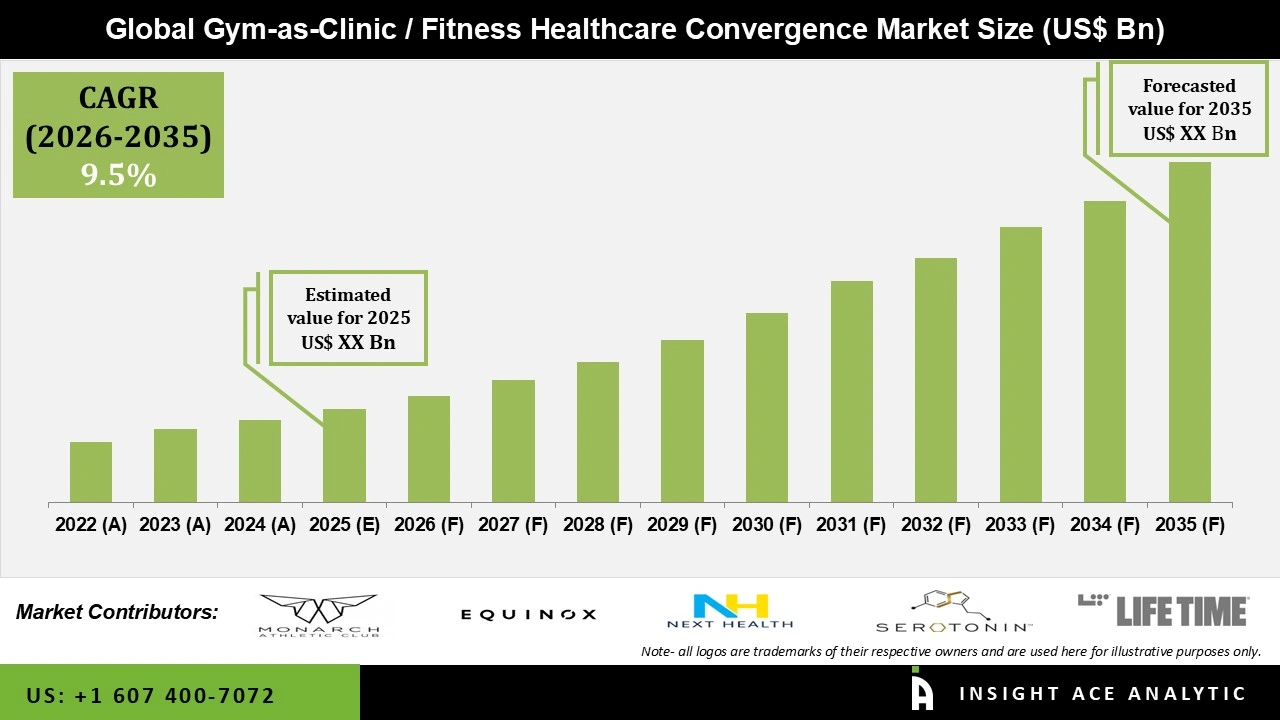
The gym-as-clinic / fitness healthcare convergence market is emerging as a transformative segment within the broader healthcare and wellness industry, as traditional fitness spaces evolve into integrated health hubs. This concept goes beyond workouts, combining medical care, preventive health services, diagnostics, and personalised fitness programs under one roof. It is gaining strong momentum as individuals increasingly prioritise proactive health management, longevity, and convenience. By bringing together healthcare professionals, trainers, and advanced technologies, these facilities offer a more holistic, continuous approach to well-being than conventional healthcare systems. One of the key advantages of this model is its ability to bridge the gap between prevention and treatment. Individuals can access services such as health assessments, chronic disease management, rehabilitation, and personalised training in a single setting. This not only improves patient engagement but also supports better long-term health outcomes. Additionally, integrating digital health tools, wearable devices, and AI-driven platforms enables real-time monitoring and data-driven decision-making, enhancing both efficiency and personalisation.
The market is witnessing growing adoption across diverse user groups, including health-conscious individuals, corporate wellness programs, athletes, and patients managing chronic conditions. Businesses are also exploring flexible models, ranging from fully integrated facilities to hybrid partnerships and digital-first platforms, making these solutions more accessible and scalable. Rising awareness of preventive healthcare, the increasing prevalence of lifestyle-related diseases, and the demand for personalised experiences are further supporting market growth. However, the market faces challenges, including the need for regulatory alignment, high initial investment, and the complexity of integrating medical and fitness services seamlessly. Despite these hurdles, continuous technological innovation, increased collaboration between healthcare and fitness providers, and a shift toward value-based care are expected to drive steady growth. Overall, the Gym-as-Clinic model is redefining how healthcare is delivered, offering a more convenient, preventive, and patient-centric approach to modern wellness.
Competitive Landscape
Which are the Leading Players in the Gym-as-Clinic / Fitness Healthcare Convergence Market?
- Purpose-Built Gym-as-Clinic Operators Company
- Love.Life
- Monarch Athletic Club
- Eternal
- Premium Fitness Operators with Healthcare Integration Company
- Life Time (NYSE: LTH)
- Equinox
- Integrated Clinical-Fitness Service Operators Company
- Next Health
- Serotonin Centers
Market Dynamics
Driver
Growing Demand for Preventive & Personalized Healthcare
The major driver of the gym-as-clinic / fitness healthcare convergence market is the increasing shift toward preventive and personalized healthcare. Today’s consumers are becoming more aware of the importance of maintaining long-term health rather than only seeking treatment after illness occurs. This has created strong demand for solutions that combine fitness, medical support, and wellness services in a single, convenient setting. Gym-as-Clinic models address this need by offering tailored programs that integrate exercise, nutrition, health monitoring, and clinical guidance. This not only enhances the user experience but also supports early detection and better management of health conditions. As a result, both individuals and organizations are actively adopting such integrated approaches to improve overall health outcomes and reduce long-term healthcare costs.
Restrain/Challenge
Integration & Regulatory Complexity
The key challenges in the gym-as-clinic/fitness healthcare convergence market lie in integrating medical services with traditional fitness operations while ensuring compliance with healthcare regulations. Bringing together clinical care, diagnostics, and fitness programs requires seamless coordination between healthcare professionals, trainers, and technology platforms. This often involves significant investment in infrastructure, staff training, and standardized processes to maintain quality and safety. Additionally, regulatory frameworks for such hybrid models are still evolving in many regions, creating uncertainty for operators and slowing expansion plans. As a result, while the concept is highly promising, successfully implementing and scaling these integrated solutions remains a complex task for market players.
Clinical & Preventive Health Services Segment is Expected to Drive the Gym-as-Clinic / Fitness Healthcare Convergence Market
The clinical and preventive health services segment is emerging as a major driver of the gym-as-clinic / fitness healthcare convergence market. As consumers increasingly shift toward proactive health management, demand is growing for services beyond traditional fitness offerings. This segment addresses that need by combining medical expertise with preventive care, including health assessments, chronic disease management, hormone therapy, and rehabilitation services. By offering these solutions within a gym environment, individuals can conveniently monitor and improve their health in a more continuous and personalized way. Additionally, early detection and management of conditions such as diabetes, obesity, and cardiovascular issues help reduce long-term healthcare costs and improve outcomes. The integration of medical and fitness services creates a more holistic approach to wellness, making this segment highly attractive for both consumers and providers.
Digital Health & AI Platforms Segment is Expected to Drive the Gym-as-Clinic / Fitness Healthcare Convergence Market
The digital health and AI platforms segment is playing a crucial role in accelerating the growth of the gym-as-clinic / fitness healthcare convergence market. With the increasing adoption of advanced technologies, fitness and healthcare services are becoming more data-driven, personalized, and accessible. AI-based training engines, wearable-integrated tracking, and predictive analytics enable real-time monitoring of health metrics and performance, allowing for more precise and effective interventions. In addition, telehealth and remote coaching solutions make it easier for users to access expert guidance regardless of geographic location. These platforms also help in integrating health data across systems, improving decision-making for both users and professionals. As consumers continue to embrace digital solutions for convenience and personalization, this segment is expected to see strong growth and remain a key contributor to market expansion.
Why North America Led the Gym-as-Clinic / Fitness Healthcare Convergence Market?
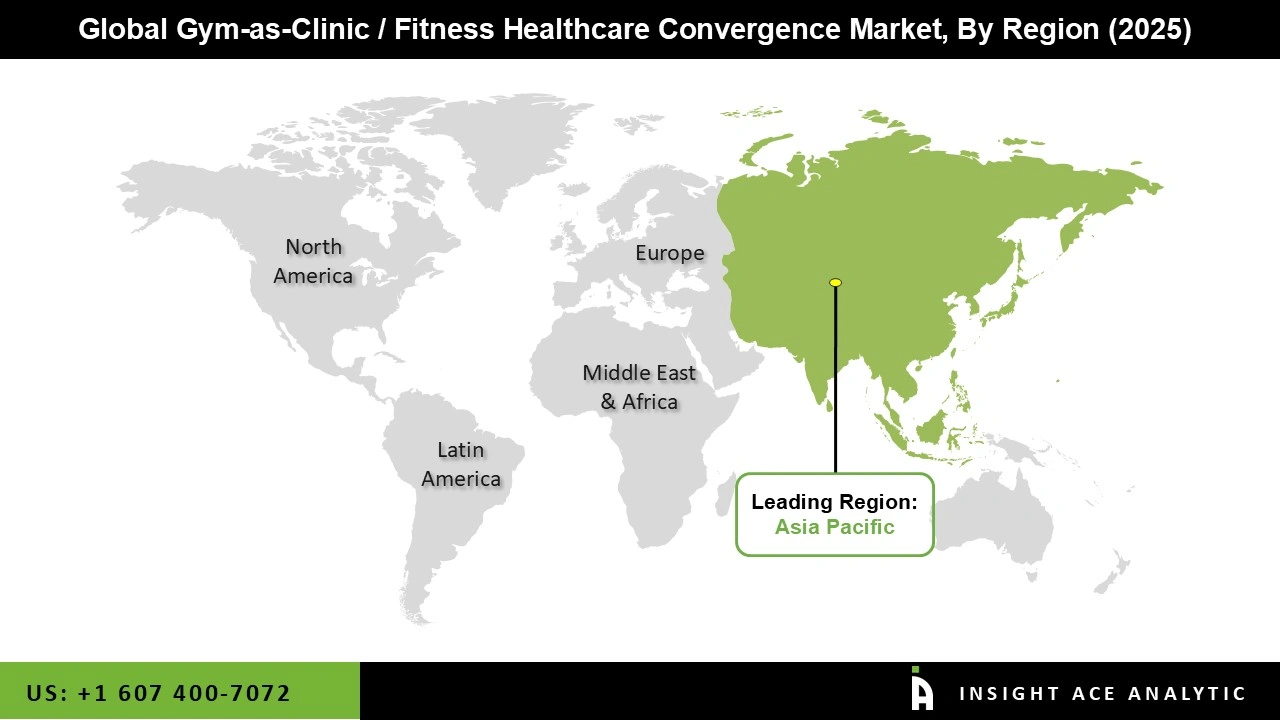
North America has emerged as a leading region in the gym-as-clinic / fitness healthcare convergence market, driven by its advanced healthcare ecosystem and strong focus on preventive care. The region, particularly the United States, has seen growing consumer awareness around fitness, longevity, and proactive health management. This has created strong demand for integrated solutions that combine medical care, diagnostics, and fitness services within a single platform. Consumers are increasingly willing to invest in personalized wellness programs that go beyond traditional gym memberships, supporting the growth of this model. Another key factor contributing to regional leadership is the presence of well-established healthcare infrastructure and a high level of digital health adoption. Technologies such as wearable devices, AI-driven health platforms, and remote monitoring tools are widely used, enabling seamless integration between fitness and clinical services. In addition, corporate wellness programs are well established in North America, with employers actively investing in employee health, further boosting the adoption of Gym-as-Clinic models.
The region also benefits from strong investment activity and innovation, with startups and established companies continuously exploring new ways to merge healthcare and fitness. Strategic partnerships between gyms, healthcare providers, and digital health companies are helping to expand service offerings and improve accessibility. While regulatory frameworks continue to evolve, the region’s openness to innovation and early adoption of new health models provides a favourable environment for growth. Overall, North America’s leadership is supported by a combination of consumer demand, technological advancement, strong industry collaboration, and a proactive approach to health and wellness, making it a key hub for the development and expansion of gym-as-clinic solutions.
Key Developments
• In June 2025, Love.Life expanded its integrated health model by introducing enhanced membership tiers and advanced diagnostics, including microbiome testing and personalized medical care. The company positioned itself as a one-stop destination combining functional medicine, fitness, recovery, and nutrition under one roof, while also outlining plans to scale its concept further.
Gym-as-Clinic / Fitness Healthcare Convergence Market Report Scope:
| Report Attribute | Specifications |
| Growth Rate CAGR | CAGR of 9.5% from 2026 to 2035 |
| Quantitative Units | Representation of revenue in US$ Bn and CAGR from 2026 to 2035 |
| Historic Year | 2022 to 2025 |
| Forecast Year | 2026-2035 |
| Report Coverage | The forecast of revenue, the position of the company, the competitive market structure, growth prospects, and trends |
| Segments Covered | By Offering, Business Model, Technology, Facility Type, End User, and By Region |
| Regional Scope | North America; Europe; Asia Pacific; Latin America; Middle East & Africa |
| Country Scope | U.S.; Canada; U.K.; Germany; China; India; Japan; Brazil; Mexico; The UK; France; Italy; Spain; China; Japan; India; South Korea; Southeast Asia; South Korea; Southeast Asia |
| Competitive Landscape | Love.Life, Monarch Athletic Club, Eternal, Life Time (NYSE: LTH), Equinox, Next Health, Serotonin Centers |
| Customization Scope | Free customization report with the procurement of the report, Modifications to the regional and segment scope. Geographic competitive landscape. |
| Pricing and Available Payment Methods | Explore pricing alternatives that are customized to your particular study requirements. |
Segmentations of Gym-as-Clinic / Fitness Healthcare Convergence Market :
Gym-as-Clinic / Fitness Healthcare Convergence Market by Offering -
- Clinical & Preventive Health Services
- Health Assessments (blood panels, VO2 max, metabolic testing)
- Chronic Disease Management (diabetes, obesity, cardiovascular)
- Hormone Therapy (HRT, testosterone optimization)
- GLP-1 Integrated Fitness Programs
- Physiotherapy & Rehabilitation (MSK, post-injury)
- Fitness & Performance Programs
- Personalized Training (AI-driven / trainer-led)
- Longevity-Focused Programs (strength, mobility, aging)
- Medical Fitness Programs (doctor-prescribed exercise)
- Group Therapy Fitness (mental + physical wellness)
- Diagnostics & Health Monitoring
- Body Composition Analysis
- Biomarker Tracking (glucose, HRV, inflammation)
- Wearable-Integrated Health Tracking
- Digital Twin / Bio-Age Scoring Systems
- Digital Health & AI Platforms
- AI-Based Training Engines
- Health Data Platforms (EHR-integrated fitness)
- Telehealth & Remote Coaching
- Predictive Analytics (risk scoring, prevention models)
- Recovery & Longevity Services
- Cryotherapy, Red Light Therapy
- IV Therapy, NAD+ Therapy
- Sleep Optimization Programs
- Stress & Mental Wellness Programs
- Nutrition & Metabolic Health Solutions
- Personalized Nutrition Planning
- Medical Nutrition Therapy
- Supplements & Functional Nutrition
- Weight Management Programs
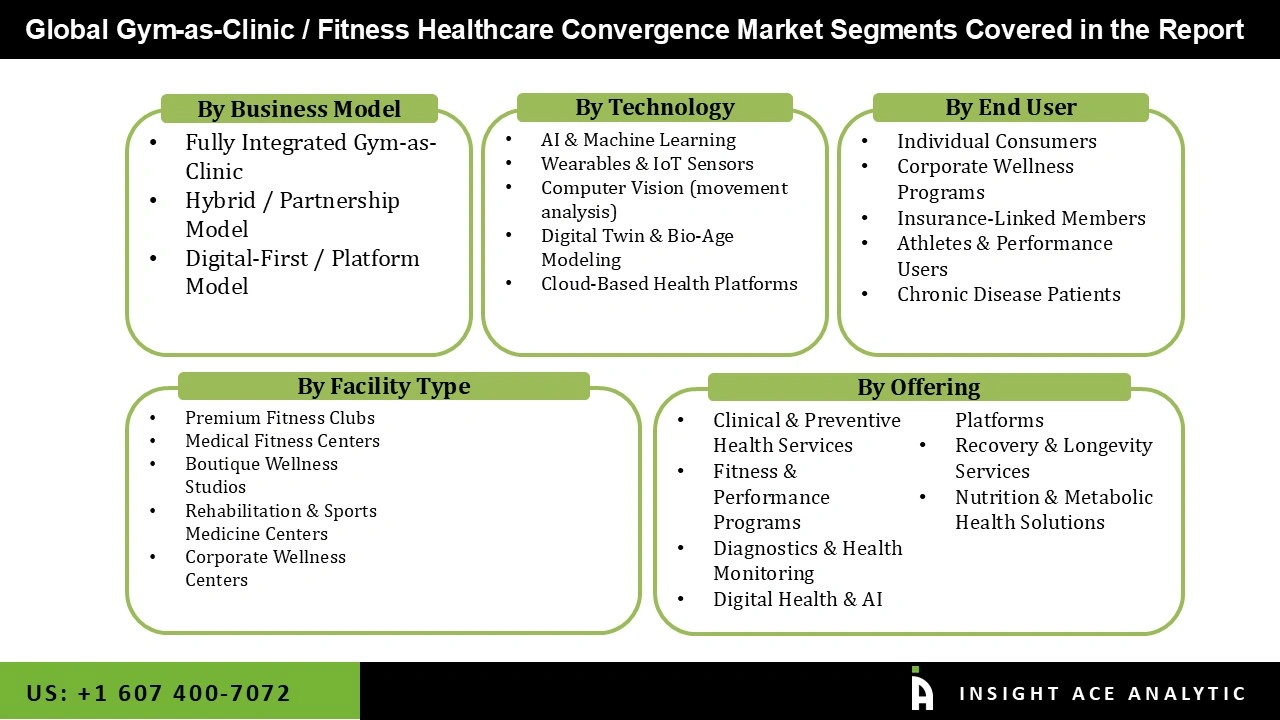
Gym-as-Clinic / Fitness Healthcare Convergence Market, by Business Model -
- Fully Integrated Gym-as-Clinic (in-house medical + fitness + diagnostics; concierge healthcare model)
- Hybrid / Partnership Model (gyms + telehealth providers; gyms + diagnostic labs; gyms + hormone clinics)
- Digital-First / Platform Model (app-based health + fitness ecosystem; remote diagnostics + coaching)
Gym-as-Clinic / Fitness Healthcare Convergence Market, by Technology -
- AI & Machine Learning
- Wearables & IoT Sensors
- Computer Vision (movement analysis)
- Digital Twin & Bio-Age Modeling
- Cloud-Based Health Platforms
Gym-as-Clinic / Fitness Healthcare Convergence Market, by End User -
- Individual Consumers (wellness/longevity seekers)
- Corporate Wellness Programs
- Insurance-Linked Members
- Athletes & Performance Users
- Chronic Disease Patients
Gym-as-Clinic / Fitness Healthcare Convergence Market, by Facility Type–
- Premium Fitness Clubs
- Medical Fitness Centers
- Boutique Wellness Studios
- Rehabilitation & Sports Medicine Centers
- Corporate Wellness Centers
Gym-as-Clinic / Fitness Healthcare Convergence Market, by Region-
- North America-
- The US
- Canada
- Europe-
- Germany
- The UK
- France
- Italy
- Spain
- Rest of Europe
- Asia-Pacific-
- China
- Japan
- India
- South Korea
- South East Asia
- Rest of Asia Pacific
- Latin America-
- Brazil
- Argentina
- Mexico
- Rest of Latin America
- Middle East and Africa-
- GCC Countries
- South Africa
- Rest of Middle East and Africa
Research Design and Approach
This study employed a multi-step, mixed-method research approach that integrates:
- Secondary research
- Primary research
- Data triangulation
- Hybrid top-down and bottom-up modelling
- Forecasting and scenario analysis
This approach ensures a balanced and validated understanding of both macro- and micro-level market factors influencing the market.
Secondary Research
Secondary research for this study involved the collection, review, and analysis of publicly available and paid data sources to build the initial fact base, understand historical market behaviour, identify data gaps, and refine the hypotheses for primary research.
Sources Consulted
Secondary data for the market study was gathered from multiple credible sources, including:
- Government databases, regulatory bodies, and public institutions
- International organizations (WHO, OECD, IMF, World Bank, etc.)
- Commercial and paid databases
- Industry associations, trade publications, and technical journals
- Company annual reports, investor presentations, press releases, and SEC filings
- Academic research papers, patents, and scientific literature
- Previous market research publications and syndicated reports
These sources were used to compile historical data, market volumes/prices, industry trends, technological developments, and competitive insights.

Primary Research
Primary research was conducted to validate secondary data, understand real-time market dynamics, capture price points and adoption trends, and verify the assumptions used in the market modelling.
Stakeholders Interviewed
Primary interviews for this study involved:
- Manufacturers and suppliers in the market value chain
- Distributors, channel partners, and integrators
- End-users / customers (e.g., hospitals, labs, enterprises, consumers, etc., depending on the market)
- Industry experts, technology specialists, consultants, and regulatory professionals
- Senior executives (CEOs, CTOs, VPs, Directors) and product managers
Interview Process
Interviews were conducted via:
- Structured and semi-structured questionnaires
- Telephonic and video interactions
- Email correspondences
- Expert consultation sessions
Primary insights were incorporated into demand modelling, pricing analysis, technology evaluation, and market share estimation.
Data Processing, Normalization, and Validation
All collected data were processed and normalized to ensure consistency and comparability across regions and time frames.
The data validation process included:
- Standardization of units (currency conversions, volume units, inflation adjustments)
- Cross-verification of data points across multiple secondary sources
- Normalization of inconsistent datasets
- Identification and resolution of data gaps
- Outlier detection and removal through algorithmic and manual checks
- Plausibility and coherence checks across segments and geographies
This ensured that the dataset used for modelling was clean, robust, and reliable.
Market Size Estimation and Data Triangulation
Bottom-Up Approach
The bottom-up approach involved aggregating segment-level data, such as:
- Company revenues
- Product-level sales
- Installed base/usage volumes
- Adoption and penetration rates
- Pricing analysis
This method was primarily used when detailed micro-level market data were available.

Top-Down Approach
The top-down approach used macro-level indicators:
- Parent market benchmarks
- Global/regional industry trends
- Economic indicators (GDP, demographics, spending patterns)
- Penetration and usage ratios
This approach was used for segments where granular data were limited or inconsistent.
Hybrid Triangulation Approach
To ensure accuracy, a triangulated hybrid model was used. This included:
- Reconciling top-down and bottom-up estimates
- Cross-checking revenues, volumes, and pricing assumptions
- Incorporating expert insights to validate segment splits and adoption rates
This multi-angle validation yielded the final market size.
Forecasting Framework and Scenario Modelling
Market forecasts were developed using a combination of time-series modelling, adoption curve analysis, and driver-based forecasting tools.
Forecasting Methods
- Time-series modelling
- S-curve and diffusion models (for emerging technologies)
- Driver-based forecasting (GDP, disposable income, adoption rates, regulatory changes)
- Price elasticity models
- Market maturity and lifecycle-based projections
Scenario Analysis
Given inherent uncertainties, three scenarios were constructed:
- Base-Case Scenario: Expected trajectory under current conditions
- Optimistic Scenario: High adoption, favourable regulation, strong economic tailwinds
- Conservative Scenario: Slow adoption, regulatory delays, economic constraints
Sensitivity testing was conducted on key variables, including pricing, demand elasticity, and regional adoption.
Request Customization
Add countries, segments, company profiles, or extend forecast — free 10% customization with purchase.
Customize This Report →Enquire Before Buying
Speak with our analyst team about scope, methodology, pricing, or deliverable formats.
Enquire Now →Frequently Asked Questions
Gym-as-Clinic / Fitness Healthcare Convergence Market Size is predicted to witness a 9.5% CAGR during the forecast period for 2026 to 2035.
Love.Life, Monarch Athletic Club, Eternal, Life Time (NYSE: LTH), Equinox, Next Health, Serotonin Centers and Others.
Gym-as-Clinic / Fitness Healthcare Convergence Market is segmented into Offering, Business Model, Technology, Facility Type, End User, and Other.
Asia Pacific region is leading the Gym-as-Clinic / Fitness Healthcare Convergence Market.