High Volume Low Price (HVLP) Fitness Clubs Market Size, Share, Revenue Report 2026 to 2035
What is High Volume Low-Price (HVLP) Fitness Clubs Market Size?
High Volume Low-Price (HVLP) Fitness Clubs Market Size is predicted to grow at a 6.8% CAGR during the forecast period for 2026 to 2035.
High Volume Low Price Fitness Clubs Market Size, Share & Trends Analysis Distribution by By Ownership Model (Franchised HVLP Clubs, Company-Owned / Corporate-Operated Clubs, Hybrid Models (Franchise + Company-Owned)), By Revenue Stream (Membership Dues (Base Tier), Premium/Upgraded Membership Fees (Black Card, Peak Results, etc.), Personal Training & Small Group Training, Ancillary Revenue (Vending, Tanning, HydroMassage, Recovery, Retail), Enrollment & Annual Maintenance Fees, Franchise Royalties & Equipment Sales (Franchisor Revenue)), By Membership Tier (Basic / Entry-Level, Mid-Tier / Multi-Club, Premium / Black Card and Segment Forecasts, 2026 to 2035
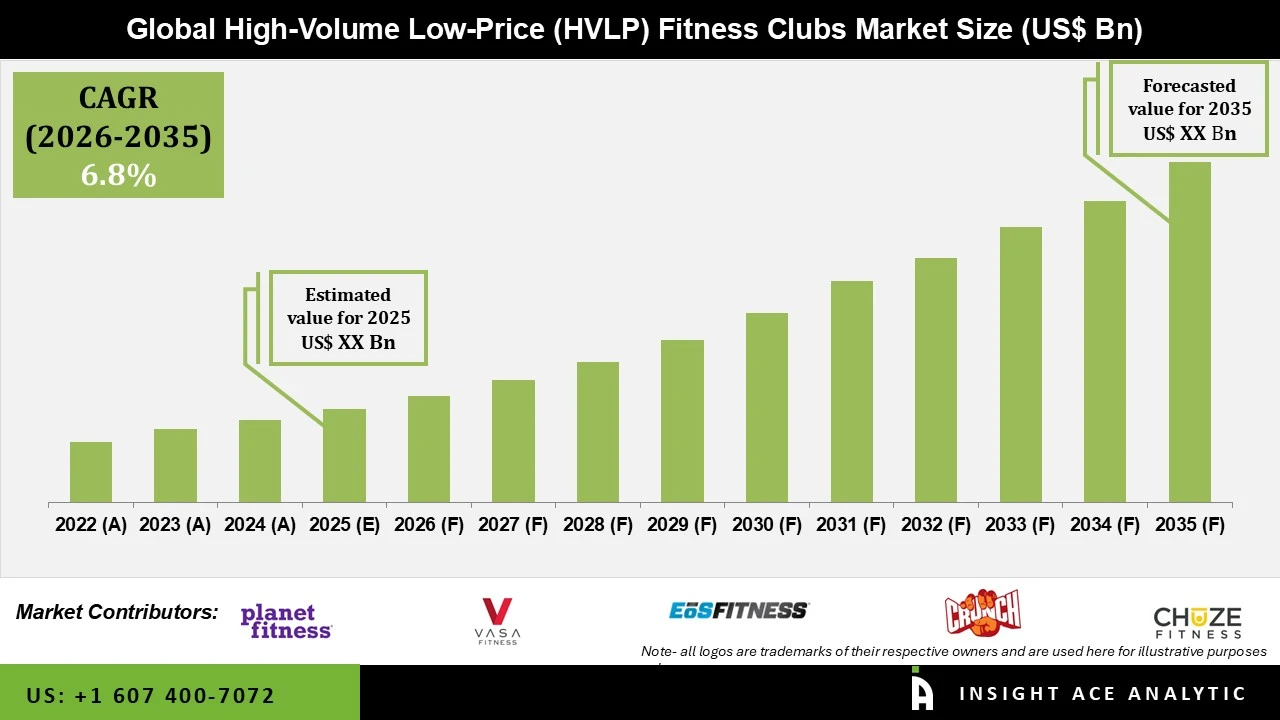
High-volume low-price (HVLP) fitness clubs have transformed the commercial fitness industry by making structured workout environments accessible to a broader consumer base. Built around a high-volume, affordability-focused business model, these clubs offer essential fitness equipment, group exercise facilities, and flexible memberships at substantially lower price points than traditional full-service gyms. Unlike premium fitness centers that emphasize luxury amenities and personalized services, HVLP operators prioritize operational efficiency, streamlined facilities, and scalable membership enrollment to maintain affordability while sustaining profitability.
The HVLP model has evolved from a niche concept into a globally recognized fitness segment with expanding presence across North America, Europe, Latin America, and emerging Asia-Pacific markets. Its growth has been supported by increasing participation in fitness activities, rising urban wellness awareness, and the expansion of organized gym networks into suburban and developing regions. The market is also becoming increasingly digitized, with operators integrating mobile applications, virtual fitness support, digital access systems, and flexible subscription structures to enhance member convenience and engagement.
The HVLP fitness clubs market represents a significant and resilient segment within the global fitness economy, positioned at the intersection of consumer wellness trends, scalable franchise expansion, and cost-efficient facility operations. As operators continue to refine pricing strategies, membership models, and geographic expansion plans, the market remains an important area of focus for investors, fitness brands, and industry stakeholders seeking to capitalize on the growing demand for accessible fitness solutions.
Competitive Landscape
Which are the Leading Players in the High-Volume Low-Price (HVLP) Fitness Clubs Market?
• Planet Fitness Inc. (PLNT)
• Crunch Fitness
• EōS Fitness
• VASA Fitness
• Chuze Fitness
• Workout Anytime
• Mountainside Fitness
• Basic-Fit N.V. (BFIT.AS)
• PureGym Ltd.
• SmartFit (SMFT3.SA)
• The Gym Group plc (GYM.L)
• McFIT / RSG Group
• Jetts Fitness
• Anytime Fitness (Self Esteem Brands)
• Blink Fitness (PureGym)
• Fitness Park
• Plus Fitness
Market Dynamics
Driver
Growing Demand for Affordable Fitness Memberships
One of the primary drivers of the high-volume low-price (HVLP) fitness clubs market is the increasing consumer preference for affordable fitness memberships. As health and wellness awareness continues to expand across different age groups, more individuals are seeking regular access to gyms and structured fitness environments without paying premium membership fees. HVLP fitness clubs meet this demand by offering low-cost memberships, flexible payment structures, and essential workout facilities, making fitness services accessible to a broader population base. This affordability-focused approach has enabled operators to attract first-time gym users, budget-conscious consumers, and younger demographics, supporting the rapid expansion of the market globally.
Restrain/Challenge
High Member Retention and Low Utilization Balance
One of the major challenges in the high-volume low-price (HVLP) fitness clubs market is maintaining profitability while balancing high membership volumes with member retention. The HVLP model relies heavily on enrolling a large number of members at low monthly fees, which requires operators to continuously attract and retain subscribers to sustain recurring revenue. However, intense competition, low switching costs, and changing consumer fitness preferences can make long-term retention difficult. At the same time, if facility usage increases beyond operational capacity, overcrowding can negatively affect customer experience, creating additional pressure on operators to manage utilization levels efficiently while preserving affordability.
Franchised HVLP Clubs Segment is Expected to Drive the High-Volume Low-Price (HVLP) Fitness Clubs Market
The franchised HVLP clubs segment is driving the high-volume low-price (HVLP) fitness clubs market due to its ability to support rapid geographic expansion with comparatively lower capital investment for parent companies. The franchise-based model enables fitness brands to scale efficiently by leveraging local franchise operators for facility development, operations, and market penetration while maintaining standardized branding and service structures. This approach has allowed major HVLP chains to establish widespread networks across urban and suburban regions, increasing market reach and membership accessibility. The scalability, operational flexibility, and recurring royalty-based revenue structure associated with franchised clubs continue to make this segment a dominant force within the market.
Premium/Upgraded Membership Fees Segment is Growing at the Highest Rate in the High-Volume Low-Price (HVLP) Fitness Clubs Market
The premium/upgraded membership Fees segment is witnessing the highest growth rate in the high-volume low-price (HVLP) fitness clubs market. While base-tier memberships remain central to the HVLP model, fitness operators are increasingly expanding premium membership offerings that include benefits such as multi-location access, guest privileges, recovery services, tanning, massage chairs, and digital fitness features. These upgraded plans allow companies to increase average revenue per member without significantly altering their low-price positioning. Growing consumer willingness to pay for added convenience, wellness-focused amenities, and flexible access options has accelerated the adoption of premium membership tiers across major HVLP fitness chains.
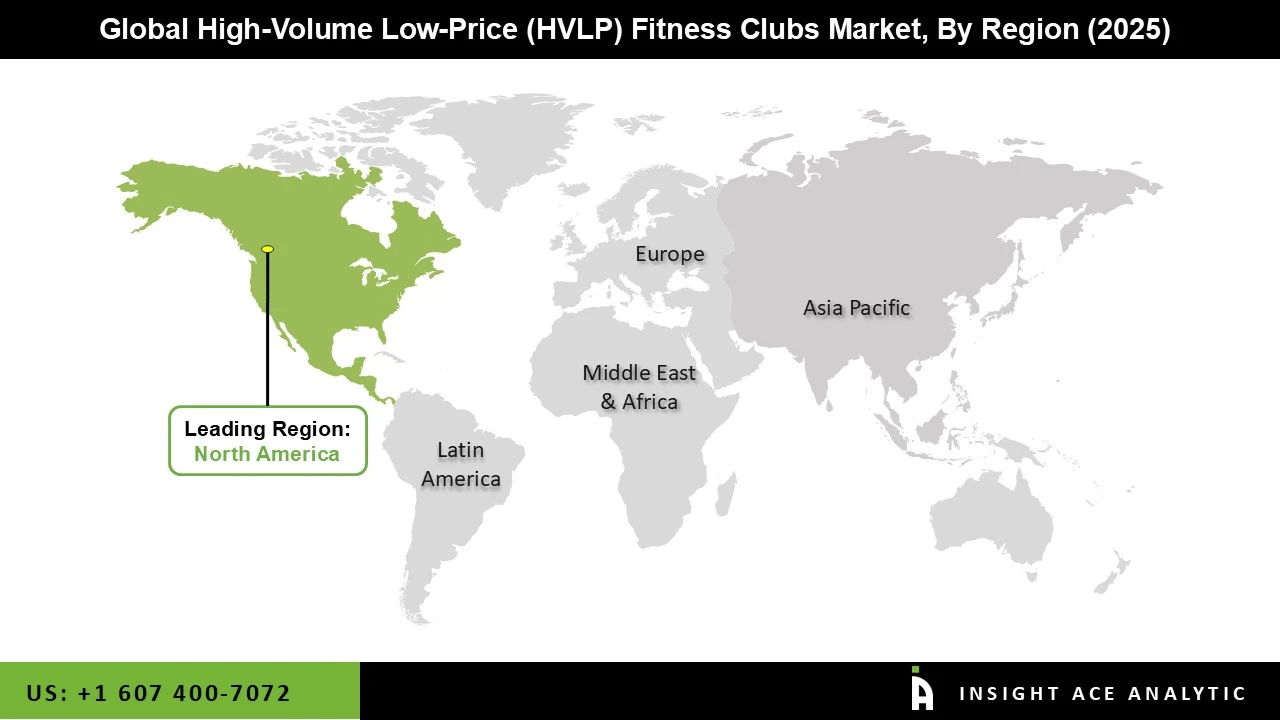
Why North America Led the High-Volume Low-Price (HVLP) Fitness Clubs Market?
North America, led by the United States, dominates the high-volume low-price (HVLP) fitness clubs market due to the early development and large-scale expansion of the HVLP business model across the region. The presence of established operators such as Planet Fitness, along with other rapidly expanding budget fitness chains, has strengthened market penetration through extensive franchise networks, suburban expansion strategies, and affordable membership offerings. The region benefits from a well-established fitness culture, high consumer awareness regarding health and wellness, and strong acceptance of low-cost gym memberships among a broad demographic base, including Millennials and Gen Z consumers. In addition, mature fitness infrastructure, access to franchise investment models, and increasing integration of digital fitness services continue to reinforce North America’s position as the largest and most developed HVLP fitness clubs market globally.
Key Development
• April 2025: Crunch Fitness announced a strategic investment from Leonard Green & Partners, under which LGP acquired a majority stake in the company from TPG and existing minority shareholders. Crunch Fitness has expanded into one of the fastest-growing HVLP fitness brands globally, supported by its “No Judgments” philosophy, franchise expansion strategy, and high-value low-price gym model.
High-Volume Low-Price (HVLP) Fitness Clubs Market Report Scope:
| Report Attribute | Specifications |
| Growth Rate CAGR | CAGR of 6.8% from 2026 to 2035 |
| Quantitative Units | Representation of revenue in US$ Bn and CAGR from 2026 to 2035 |
| Historic Year | 2022 to 2025 |
| Forecast Year | 2026-2035 |
| Report Coverage | The forecast of revenue, the position of the company, the competitive market structure, growth prospects, and trends |
| Segments Covered | Ownership Model, Revenue Stream, Membership Tier, Club Size & Format and By Region |
| Regional Scope | North America; Europe; Asia Pacific; Latin America; Middle East & Africa |
| Country Scope | U.S.; Canada; U.K.; Germany; China; India; Japan; Brazil; Mexico; The UK; France; Italy; Spain; China; Japan; India; South Korea; Southeast Asia; South Korea; Southeast Asia |
| Competitive Landscape | Planet Fitness Inc. (PLNT), Crunch Fitness, EōS Fitness, VASA Fitness, Chuze Fitness, Workout Anytime, Mountainside Fitness, Basic-Fit N.V. (BFIT.AS), PureGym Ltd., SmartFit (SMFT3.SA), The Gym Group plc (GYM.L), McFIT / RSG Group, Jetts Fitness, Anytime Fitness (Self Esteem Brands), Blink Fitness (PureGym) , Fitness Park, Plus Fitness |
| Customization Scope | Free customization report with the procurement of the report, Modifications to the regional and segment scope. Geographic competitive landscape. |
| Pricing and Available Payment Methods | Explore pricing alternatives that are customized to your particular study requirements. |
High-Volume Low-Price (HVLP) Fitness Clubs Market Segmentation:
High-Volume Low-Price (HVLP) Fitness Clubs Market by Ownership Model -
• Franchised HVLP Clubs
o Single-unit franchisees
o Multi-unit franchisees (5–50 units)
o Platform/mega-franchisees (50+ units)
• Company-Owned / Corporate-Operated Clubs
• Hybrid Models (Franchise + Company-Owned)
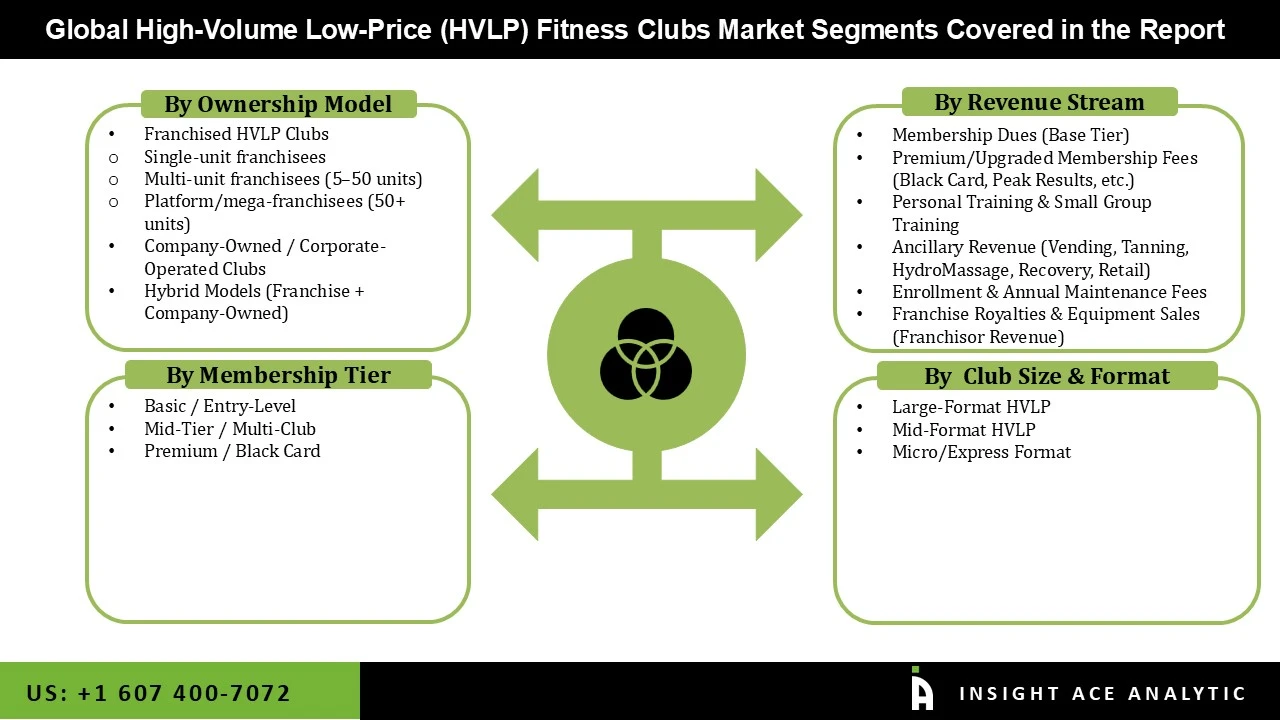
High-Volume Low-Price (HVLP) Fitness Clubs Market by Revenue Stream -
• Membership Dues (Base Tier)
• Premium/Upgraded Membership Fees (Black Card, Peak Results, etc.)
• Personal Training & Small Group Training
• Ancillary Revenue (Vending, Tanning, HydroMassage, Recovery, Retail)
• Enrollment & Annual Maintenance Fees
• Franchise Royalties & Equipment Sales (Franchisor Revenue)
High-Volume Low-Price (HVLP) Fitness Clubs Market by Membership Tier -
• Basic / Entry-Level
• Mid-Tier / Multi-Club
• Premium / Black Card
High-Volume Low-Price (HVLP) Fitness Clubs Market by Club Size & Format -
• Large-Format HVLP
• Mid-Format HVLP
• Micro/Express Format
High-Volume Low-Price (HVLP) Fitness Clubs Market by Region-
North America-
• The US
• Canada
• Mexico
Europe-
• Germany
• The UK
• France
• Italy
• Spain
• Rest of Europe
Asia-Pacific-
• China
• Japan
• India
• South Korea
• South East Asia
• Rest of Asia Pacific
Latin America-
• Brazil
• Argentina
• Rest of Latin America
Middle East & Africa-
• GCC Countries
• South Africa
• Rest of Middle East and Africa
Research Design and Approach
This study employed a multi-step, mixed-method research approach that integrates:
- Secondary research
- Primary research
- Data triangulation
- Hybrid top-down and bottom-up modelling
- Forecasting and scenario analysis
This approach ensures a balanced and validated understanding of both macro- and micro-level market factors influencing the market.
Secondary Research
Secondary research for this study involved the collection, review, and analysis of publicly available and paid data sources to build the initial fact base, understand historical market behaviour, identify data gaps, and refine the hypotheses for primary research.
Sources Consulted
Secondary data for the market study was gathered from multiple credible sources, including:
- Government databases, regulatory bodies, and public institutions
- International organizations (WHO, OECD, IMF, World Bank, etc.)
- Commercial and paid databases
- Industry associations, trade publications, and technical journals
- Company annual reports, investor presentations, press releases, and SEC filings
- Academic research papers, patents, and scientific literature
- Previous market research publications and syndicated reports
These sources were used to compile historical data, market volumes/prices, industry trends, technological developments, and competitive insights.

Primary Research
Primary research was conducted to validate secondary data, understand real-time market dynamics, capture price points and adoption trends, and verify the assumptions used in the market modelling.
Stakeholders Interviewed
Primary interviews for this study involved:
- Manufacturers and suppliers in the market value chain
- Distributors, channel partners, and integrators
- End-users / customers (e.g., hospitals, labs, enterprises, consumers, etc., depending on the market)
- Industry experts, technology specialists, consultants, and regulatory professionals
- Senior executives (CEOs, CTOs, VPs, Directors) and product managers
Interview Process
Interviews were conducted via:
- Structured and semi-structured questionnaires
- Telephonic and video interactions
- Email correspondences
- Expert consultation sessions
Primary insights were incorporated into demand modelling, pricing analysis, technology evaluation, and market share estimation.
Data Processing, Normalization, and Validation
All collected data were processed and normalized to ensure consistency and comparability across regions and time frames.
The data validation process included:
- Standardization of units (currency conversions, volume units, inflation adjustments)
- Cross-verification of data points across multiple secondary sources
- Normalization of inconsistent datasets
- Identification and resolution of data gaps
- Outlier detection and removal through algorithmic and manual checks
- Plausibility and coherence checks across segments and geographies
This ensured that the dataset used for modelling was clean, robust, and reliable.
Market Size Estimation and Data Triangulation
Bottom-Up Approach
The bottom-up approach involved aggregating segment-level data, such as:
- Company revenues
- Product-level sales
- Installed base/usage volumes
- Adoption and penetration rates
- Pricing analysis
This method was primarily used when detailed micro-level market data were available.

Top-Down Approach
The top-down approach used macro-level indicators:
- Parent market benchmarks
- Global/regional industry trends
- Economic indicators (GDP, demographics, spending patterns)
- Penetration and usage ratios
This approach was used for segments where granular data were limited or inconsistent.
Hybrid Triangulation Approach
To ensure accuracy, a triangulated hybrid model was used. This included:
- Reconciling top-down and bottom-up estimates
- Cross-checking revenues, volumes, and pricing assumptions
- Incorporating expert insights to validate segment splits and adoption rates
This multi-angle validation yielded the final market size.
Forecasting Framework and Scenario Modelling
Market forecasts were developed using a combination of time-series modelling, adoption curve analysis, and driver-based forecasting tools.
Forecasting Methods
- Time-series modelling
- S-curve and diffusion models (for emerging technologies)
- Driver-based forecasting (GDP, disposable income, adoption rates, regulatory changes)
- Price elasticity models
- Market maturity and lifecycle-based projections
Scenario Analysis
Given inherent uncertainties, three scenarios were constructed:
- Base-Case Scenario: Expected trajectory under current conditions
- Optimistic Scenario: High adoption, favourable regulation, strong economic tailwinds
- Conservative Scenario: Slow adoption, regulatory delays, economic constraints
Sensitivity testing was conducted on key variables, including pricing, demand elasticity, and regional adoption.
Request Customization
Add countries, segments, company profiles, or extend forecast — free 10% customization with purchase.
Customize This Report →Enquire Before Buying
Speak with our analyst team about scope, methodology, pricing, or deliverable formats.
Enquire Now →Frequently Asked Questions
High Volume Low-Price (HVLP) Fitness Clubs Market Size is predicted to grow at a 6.8% CAGR during the forecast period for 2026 to 2035.
Planet Fitness Inc. (PLNT), Crunch Fitness, EōS Fitness, VASA Fitness, Chuze Fitness, Workout Anytime, Mountainside Fitness, Basic-Fit N.V. (BFIT.AS), PureGym Ltd., SmartFit (SMFT3.SA), The Gym Group plc (GYM.L), McFIT / RSG Group, Jetts Fitness, Anytime Fitness (Self Esteem Brands), Blink Fitness (PureGym) , Fitness Park, Plus Fitness
High Volume Low-Price (HVLP) Fitness Clubs Market is segmented into Ownership Model, Revenue Stream, Membership Tier, Club Size & Format and By Region
North America region is leading the High Volume Low-Price (HVLP) Fitness Clubs Market.