Multi Vendor Support Services Market Size, Share, Scope Report 2026 to 2035
What is Multi Vendor Support Services Market Size?
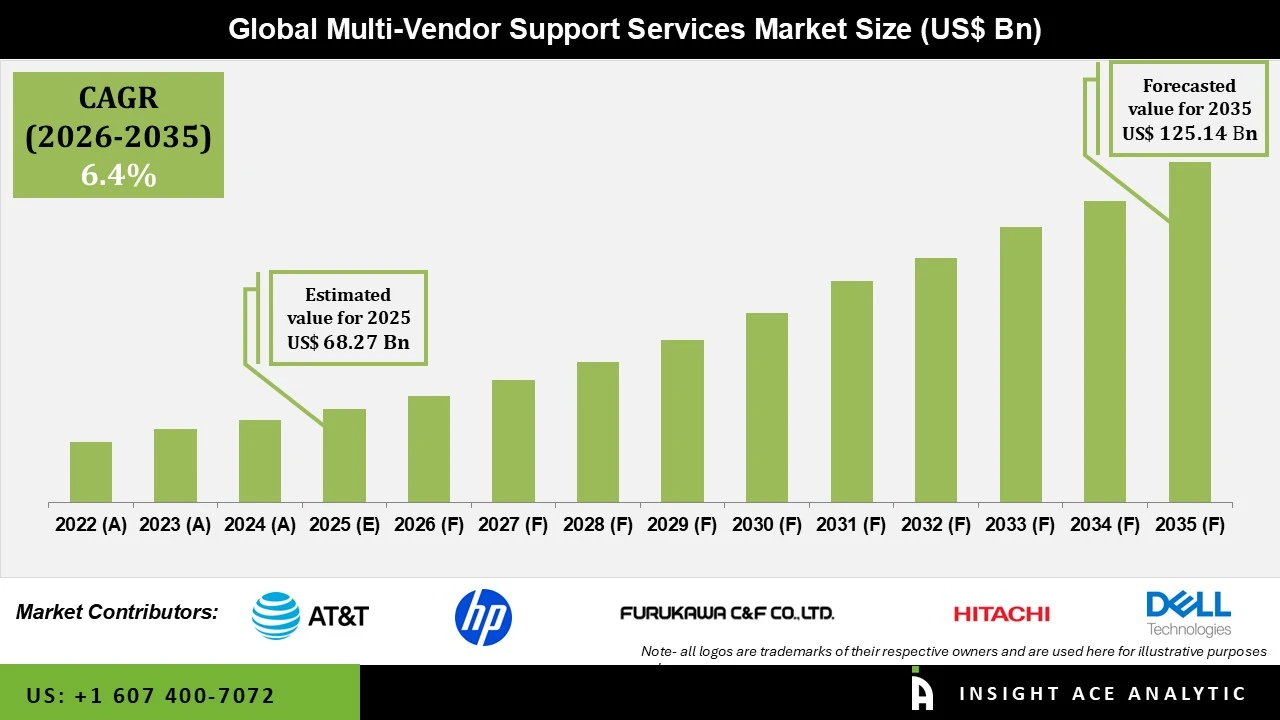
Multi Vendor Support Services Market Size is valued at USD 68.27 Bn in 2025 and is predicted to reach USD 125.14 Bn by the year 2035 at a 6.4% CAGR during the forecast period for 2026 to 2035.
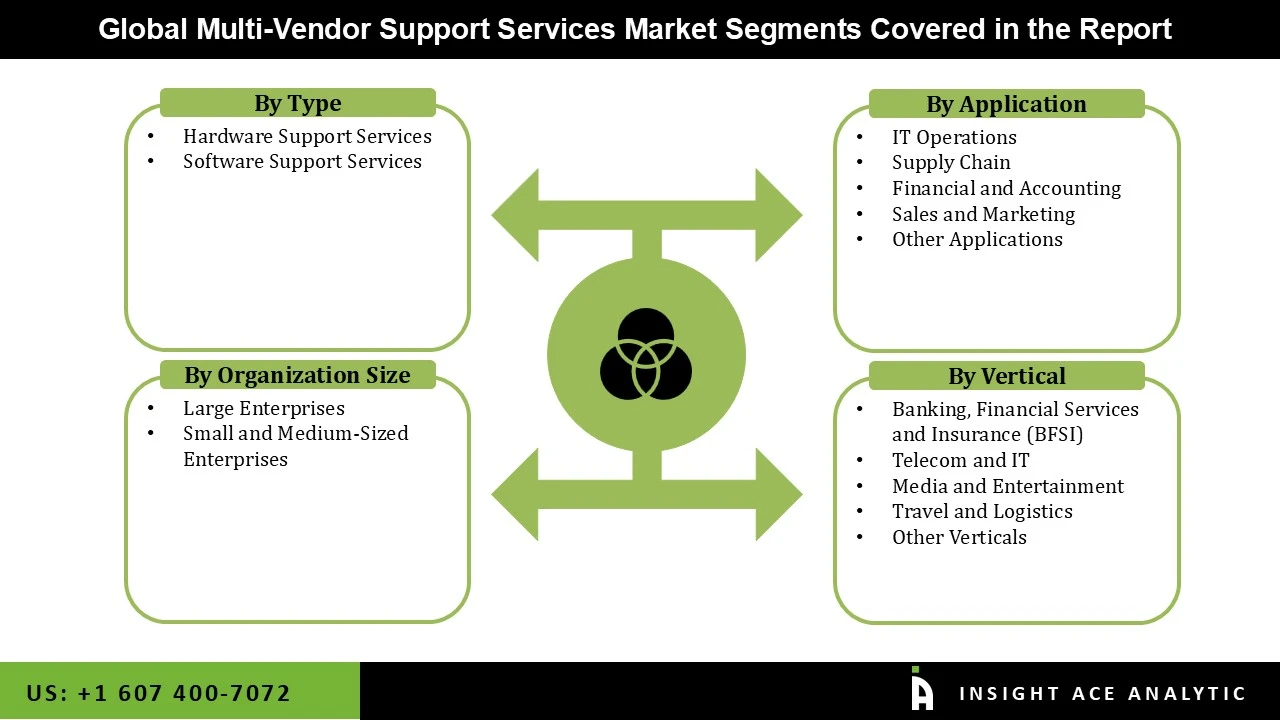
Multi Vendor Support Services Market Size, Share & Trends Analysis Distribution by Type (Hardware Support Services, Software Support Services), By Application (IT Operations, Supply Chain, Financial and Accounting, Sales and Marketing, Other Applications), By Organization Size (Large Enterprises, Small and Medium-Sized Enterprises), By Vertical (Banking, Financial Services and Insurance (BFSI), Telecom and IT, Media and Entertainment, Travel and Logistics, Other Verticals) and Segment Forecasts, 2026 to 2035
Multi-vendor support services refer to the management, maintenance, and technical support of IT infrastructure, hardware, software, networking equipment, and storage systems provided by multiple original equipment manufacturers (OEMs) through a single service provider. Instead of using separate support contracts for each vendor, organizations combine their support under one provider. This approach helps streamline service delivery, simplifies contract management, and ensures consistent maintenance across various IT environments. These services cover preventive maintenance, troubleshooting, software updates, hardware repair and replacement, system monitoring, and lifecycle management. This way, companies can maintain operational continuity while improving the performance of complex, multi-brand technology systems.
The multi-vendor support services market has become increasingly important as companies manage diverse IT infrastructures that include on-premises data centers, cloud platforms, edge computing, and hybrid architectures. Organizations in many industries are looking for support models that allow centralized management of different technology assets while improving service efficiency and reducing operational complexity. The market includes a wide range of hardware and software support solutions delivered through on-site, remote, and managed service models. It serves sectors like banking, financial services and insurance (BFSI), telecommunications, information technology, manufacturing, healthcare, retail, and government. Ongoing digital transformation, a growing reliance on interconnected systems, and the need for smooth IT operations have made multi-vendor support services a vital part of modern IT service management. Service providers are enhancing their offerings through automation, predictive maintenance, and AI-driven support platforms.
Competitive Landscape
Which are the Leading Players in the Multi-Vendor Support Services Market?
• AT&T Inc.
• Dell Technologies Inc.
• Furukawa Co., Ltd.
• Hitachi Ltd.
• HP Inc.
• International Business Machines Corporation (IBM)
• Microsoft Corporation
• Oracle Corporation
• NEC Corporation
• Toshiba Corporation
• Fujitsu Ltd.
• Lenovo Group Limited
• NetApp Inc.
• Clear Technologies Inc.
• Dynamic Systems Inc.
• Unisys Corporation
• NCR Corporation
• CompuCom Systems, Inc.
• Stefanini Inc.
• Wipro Limited
• HCL Technologies Limited
• Infosys Limited
• Tech Mahindra Limited
• Capgemini SE
• Atos SE
• Cognizant Technology Solutions Corporation
• DXC Technology Company
• Accenture plc
• Tata Consultancy Services Limited (TCS)
Market Dynamics
Driver
Increasing Complexity of Multi-Vendor IT Infrastructure Across Enterprises
Organizations are quickly adopting a variety of servers, storage systems, networking equipment, cloud platforms, and enterprise software from different vendors to take advantage of the best technologies. Managing separate maintenance contracts and support teams for each vendor raises operational complexity, costs, and downtime risks. Multi-vendor support services offer a single support model that centralizes maintenance, troubleshooting, and lifecycle management across various IT environments. This approach helps organizations improve operational efficiency, lower administrative burdens, and ensure better system availability.
Restrain/Challenge
Complexity in Delivering Consistent Support Across Diverse Vendor Ecosystems
Organizations depend on IT infrastructure made up of hardware, software, networking, and cloud solutions from various OEMs. Each has different technologies, service agreements, tools, and compatibility needs. Support providers that work with multiple vendors often struggle to maintain specialized knowledge. They also find it hard to access proprietary diagnostics, coordinate with original manufacturers, and ensure smooth operation across mixed environments. These challenges can lead to longer service resolution times, complicate troubleshooting, and impact the reliable delivery of service-level agreements (SLAs), especially for essential enterprise systems.
Hardware Support Services Segment is Expected to Drive the Multi-Vendor Support Services Market
The hardware support services segment is expected to lead the multi-vendor support services market. This growth is driven by the widespread use of servers, storage systems, networking equipment, data center infrastructure, PCs, and other hardware from various OEMs in enterprises. Organizations need ongoing maintenance, repairs, component replacements, and on-site support to ensure high system availability and smooth business operations. Many companies are also extending the lifespan of their current IT infrastructure to save on costs. This trend is increasing the demand for third-party and multi-vendor hardware maintenance. The high demand for hardware uptime in data centers, manufacturing, telecom, and BFSI sectors, along with the considerable value of hardware support contracts for field engineers, spare parts logistics, and on-site services, further boosts the segment's market leadership.
IT Operations Segment is Growing at the Highest Rate in the Multi-Vendor Support Services Market
The IT Operations segment is expected to grow the fastest because enterprise IT environments are becoming more complex. These environments include on-premises infrastructure, hybrid cloud, edge computing, and multi-cloud platforms. Organizations are using multi-vendor support services to manage servers, storage, networking equipment, operating systems, virtualization platforms, and enterprise applications from different vendors within one support framework. The rising demand for 24/7 system availability, quick incident resolution, proactive monitoring, predictive maintenance, and automated IT operations is also driving the need for multi-vendor support in IT operations. Moreover, the growth of digital transformation projects and mission-critical workloads has made managing IT infrastructure as a whole necessary. This development positions IT Operations as the fastest-growing application segment.
Why North America Led the Multi-Vendor Support Services Market?
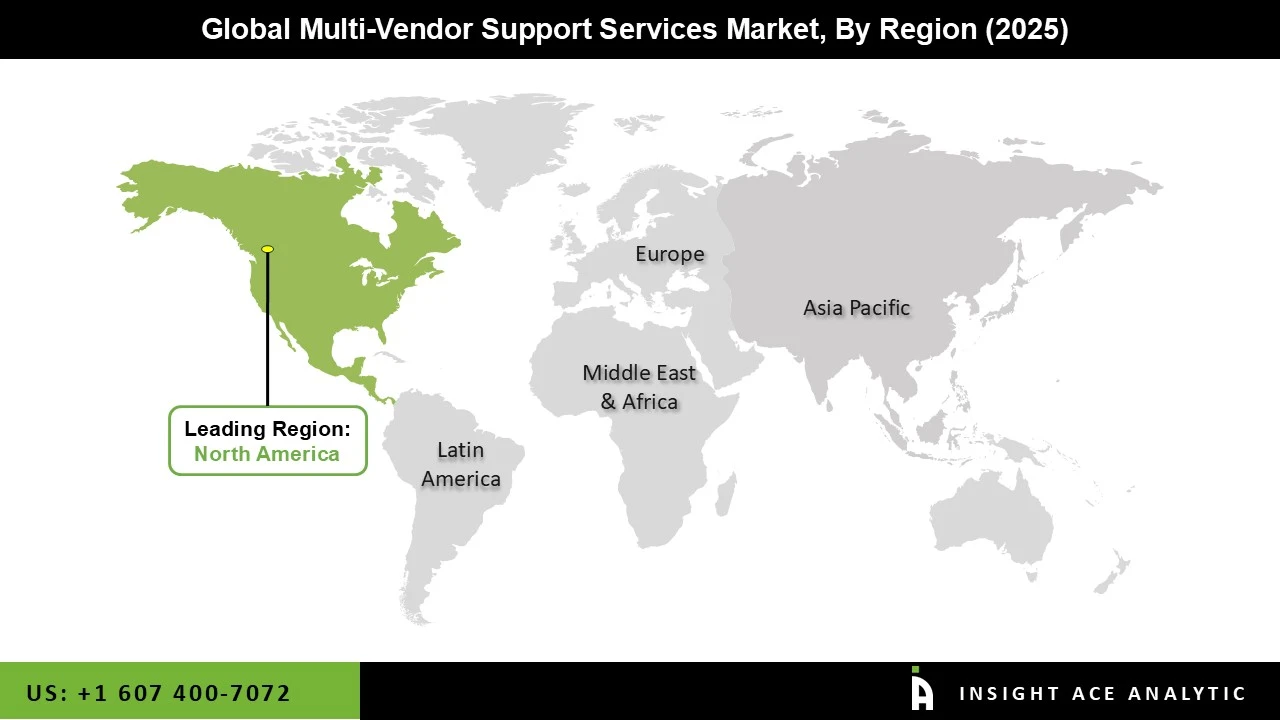
North America leads the multi-vendor support services market because of its well-established IT infrastructure, high use of hybrid and multi-cloud setups, and a large number of companies managing complex multi-vendor technology systems. Organizations in sectors like BFSI, healthcare, telecommunications, manufacturing, and government depend on various hardware, software, networking, and data center assets from multiple OEMs. This creates a strong demand for centralized support services. The region is also home to major IT service providers and technology vendors, making advanced multi-vendor support solutions widely available. Additionally, significant investments in digital transformation, data center upgrades, managed IT services, and AI-driven infrastructure management, along with the growing need to improve IT asset performance and maintain business continuity, solidify North America's top position in the market.
Key Development
April 2026: DXC Technology partnered with ServiceNow to deliver AI-driven enterprise transformation across multi-vendor IT environments, enhancing automation, operational efficiency, and service quality.
Multi-Vendor Support Services Market Report Scope:
| Report Attribute | Specifications |
| Market size value in 2025 | USD 68.27 Bn |
| Revenue forecast in 2035 | USD 125.14 Bn |
| Growth Rate CAGR | CAGR of 6.4% from 2026 to 2035 |
| Quantitative Units | Representation of revenue in US$ Bn and CAGR from 2026 to 2035 |
| Historic Year | 2022 to 2025 |
| Forecast Year | 2026-2035 |
| Report Coverage | The forecast of revenue, the position of the company, the competitive market structure, growth prospects, and trends |
| Segments Covered | Type, Application, Organization Size, Vertical and By Region |
| Regional Scope | North America; Europe; Asia Pacific; Latin America; Middle East & Africa |
| Country Scope | U.S.; Canada; U.K.; Germany; China; India; Japan; Brazil; Mexico; The UK; France; Italy; Spain; China; Japan; India; South Korea; Southeast Asia; South Korea; Southeast Asia |
| Competitive Landscape | AT&T Inc., Dell Technologies Inc., Furukawa Co., Ltd., Hitachi Ltd., HP Inc., International Business Machines Corporation (IBM), Microsoft Corporation, Oracle Corporation, NEC Corporation, Toshiba Corporation, Fujitsu Ltd. |
| Customization Scope | Free customization report with the procurement of the report, Modifications to the regional and segment scope. Geographic competitive landscape. |
| Pricing and Available Payment Methods | Explore pricing alternatives that are customized to your particular study requirements. |
Market Segmentation:
Multi-Vendor Support Services Market by Type -
• Hardware Support Services
o On-Site Support Services
o Remote Support Services
o Repair and Replacement Services
o Installation and Configuration Services
o Preventive Maintenance Services
• Software Support Services
o Technical Support Services
o Software Updates and Upgrades
o Application Maintenance Services
o Troubleshooting and Issue Resolution
o Customization and Integration Services
Multi-Vendor Support Services Market by Application -
• IT Operations
• Supply Chain
• Financial and Accounting
• Sales and Marketing
• Other Applications
Multi-Vendor Support Services Market by Organization Size -
• Large Enterprises
• Small and Medium-Sized Enterprises
Multi-Vendor Support Services Market by Vertical -
• Food & Beverage Manufacturers
• Nutraceutical Companies
• Dietary Supplement Brands
• Alternative Protein Companies
• Pharmaceutical & Clinical Nutrition Companies
• Foodservice Providers
Multi-Vendor Support Services Market by Region-
North America-
• The US
• Canada
• Mexico
Europe-
• Germany
• The UK
• France
• Italy
• Spain
• Rest of Europe
Asia-Pacific-
• China
• Japan
• India
• South Korea
• South East Asia
• Rest of Asia Pacific
Latin America-
• Brazil
• Argentina
• Rest of Latin America
Middle East & Africa-
• GCC Countries
• South Africa
• Rest of Middle East and Africa
Research Design and Approach
This study employed a multi-step, mixed-method research approach that integrates:
- Secondary research
- Primary research
- Data triangulation
- Hybrid top-down and bottom-up modelling
- Forecasting and scenario analysis
This approach ensures a balanced and validated understanding of both macro- and micro-level market factors influencing the market.
Secondary Research
Secondary research for this study involved the collection, review, and analysis of publicly available and paid data sources to build the initial fact base, understand historical market behaviour, identify data gaps, and refine the hypotheses for primary research.
Sources Consulted
Secondary data for the market study was gathered from multiple credible sources, including:
- Government databases, regulatory bodies, and public institutions
- International organizations (WHO, OECD, IMF, World Bank, etc.)
- Commercial and paid databases
- Industry associations, trade publications, and technical journals
- Company annual reports, investor presentations, press releases, and SEC filings
- Academic research papers, patents, and scientific literature
- Previous market research publications and syndicated reports
These sources were used to compile historical data, market volumes/prices, industry trends, technological developments, and competitive insights.

Primary Research
Primary research was conducted to validate secondary data, understand real-time market dynamics, capture price points and adoption trends, and verify the assumptions used in the market modelling.
Stakeholders Interviewed
Primary interviews for this study involved:
- Manufacturers and suppliers in the market value chain
- Distributors, channel partners, and integrators
- End-users / customers (e.g., hospitals, labs, enterprises, consumers, etc., depending on the market)
- Industry experts, technology specialists, consultants, and regulatory professionals
- Senior executives (CEOs, CTOs, VPs, Directors) and product managers
Interview Process
Interviews were conducted via:
- Structured and semi-structured questionnaires
- Telephonic and video interactions
- Email correspondences
- Expert consultation sessions
Primary insights were incorporated into demand modelling, pricing analysis, technology evaluation, and market share estimation.
Data Processing, Normalization, and Validation
All collected data were processed and normalized to ensure consistency and comparability across regions and time frames.
The data validation process included:
- Standardization of units (currency conversions, volume units, inflation adjustments)
- Cross-verification of data points across multiple secondary sources
- Normalization of inconsistent datasets
- Identification and resolution of data gaps
- Outlier detection and removal through algorithmic and manual checks
- Plausibility and coherence checks across segments and geographies
This ensured that the dataset used for modelling was clean, robust, and reliable.
Market Size Estimation and Data Triangulation
Bottom-Up Approach
The bottom-up approach involved aggregating segment-level data, such as:
- Company revenues
- Product-level sales
- Installed base/usage volumes
- Adoption and penetration rates
- Pricing analysis
This method was primarily used when detailed micro-level market data were available.

Top-Down Approach
The top-down approach used macro-level indicators:
- Parent market benchmarks
- Global/regional industry trends
- Economic indicators (GDP, demographics, spending patterns)
- Penetration and usage ratios
This approach was used for segments where granular data were limited or inconsistent.
Hybrid Triangulation Approach
To ensure accuracy, a triangulated hybrid model was used. This included:
- Reconciling top-down and bottom-up estimates
- Cross-checking revenues, volumes, and pricing assumptions
- Incorporating expert insights to validate segment splits and adoption rates
This multi-angle validation yielded the final market size.
Forecasting Framework and Scenario Modelling
Market forecasts were developed using a combination of time-series modelling, adoption curve analysis, and driver-based forecasting tools.
Forecasting Methods
- Time-series modelling
- S-curve and diffusion models (for emerging technologies)
- Driver-based forecasting (GDP, disposable income, adoption rates, regulatory changes)
- Price elasticity models
- Market maturity and lifecycle-based projections
Scenario Analysis
Given inherent uncertainties, three scenarios were constructed:
- Base-Case Scenario: Expected trajectory under current conditions
- Optimistic Scenario: High adoption, favourable regulation, strong economic tailwinds
- Conservative Scenario: Slow adoption, regulatory delays, economic constraints
Sensitivity testing was conducted on key variables, including pricing, demand elasticity, and regional adoption.
Request Customization
Add countries, segments, company profiles, or extend forecast — free 10% customization with purchase.
Customize This Report →Enquire Before Buying
Speak with our analyst team about scope, methodology, pricing, or deliverable formats.
Enquire Now →Frequently Asked Questions
Multi Vendor Support Services Market Size is valued at USD 68.27 Bn in 2025 and is predicted to reach USD 125.14 Bn by the year 2035
Multi Vendor Support Services Market is expected to grow at a 6.4% CAGR during the forecast period for 2026 to 2035.
Multi Vendor Support Services Market is segmented into Type, Application, Organization Size, Vertical and By Region
AT&T Inc., Dell Technologies Inc., Furukawa Co., Ltd., Hitachi Ltd., HP Inc., International Business Machines Corporation (IBM), Microsoft Corporation, Oracle Corporation, NEC Corporation, Toshiba Corporation, Fujitsu Ltd.
North America region is leading the Multi Vendor Support Services Market.