Beauty Contract Manufacturing Market Size, Share, Scope Report 2026 to 2035
What is Beauty Contract Manufacturing Market size?
Beauty Contract Manufacturing Market is estimated to grow with 7.8% CAGR during the forecast period for 2026 to 2035.
Beauty Contract Manufacturing Market Size, Share & Trends Analysis by Product Category (Skin Care, Facial Care, Body Care, Sun Care, Color Cosmetics, Face Make-up, Eye Make-up, Lip Products, Nail Products, Hair Care, Shampoos & Conditioners, Styling, Treatments & Colorants, Fragrances, Bath, Shower & Personal Care, Bath & Shower Products, Deodorants, Antiperspirants & Shaving Products), by Service Model (Full-Service ODM, OEM Manufacturing, Contract Filling & Packaging Only), by Customer Type (Multinational Beauty Companies, Independent & Regional Brand Owners, Retailer Private-Label Brands) and Segment Forecasts, 2026 to 2035
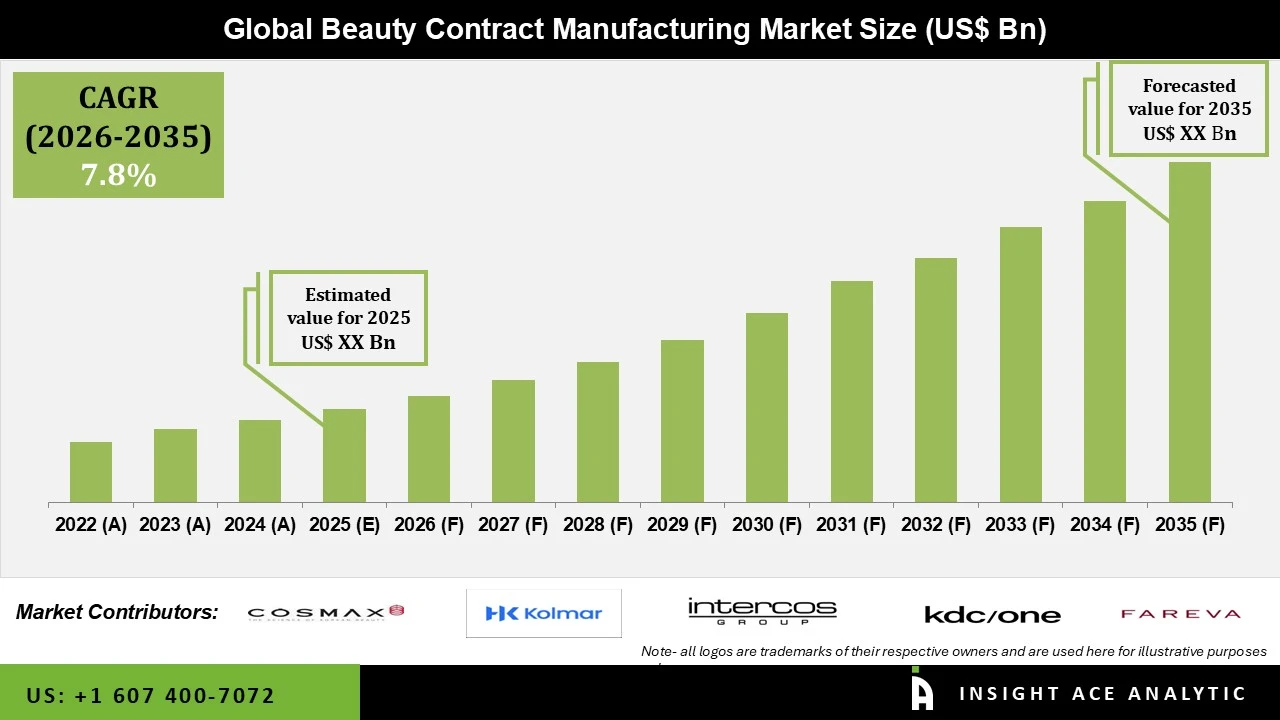
As consumer preferences evolve, beauty brands increasingly work with contract manufacturers to develop and produce a wide range of products without investing heavily in their own manufacturing facilities. The beauty contract manufacturing market is becoming an important part of the global beauty and personal care industry. Growing demand for skincare, colour cosmetics, hair care, fragrances, and personal care products is creating opportunities for manufacturers to serve established multinational companies, independent beauty brands, and retailer-owned private labels. The growing popularity of new beauty brands and rising demand for specialised formulations further support the need for flexible, reliable manufacturing partners.
A wide range of products is shaping the beauty contract manufacturing market. Skincare is still a major category, including facial care, body care, and sun care products for different needs. Colour cosmetics, such as face make-up, eye make-up, lip products, and nail products, offer more opportunities as brands launch new shades, textures, and formats. Hair care items such as shampoos, conditioners, styling products, treatments, and colourants also drive demand. Fragrances, along with bath, shower, and personal care products like deodorants, antiperspirants, and shaving products, further expand the range of products contract manufacturers produce.
Service models also influence market development. With full-service original design manufacturing (ODM), brands can work with manufacturers to develop, formulate, and produce products. Original equipment manufacturing (OEM) lets brands have products made to their specifications. Contract filling and packaging services help companies with existing formulas by handling the filling, finishing, and packaging. These service options let manufacturers work with businesses of all kinds, from large multinational companies to new brands and retailers creating private-label lines. By offering expertise in formulation, packaging choices, flexible production, and reliable delivery, manufacturers can build strong, long-term relationships with their customers. Innovation and product development are driving competition in the beauty contract manufacturing market.
Beauty brands look for manufacturing partners who can help them keep up with changing consumer preferences, create unique formulas, and launch products quickly. Manufacturers are putting resources into research and development, new production technologies, quality testing, and better manufacturing processes to meet these needs. Having expertise in formulation, product stability, safety, packaging compatibility, and regulatory compliance is especially important for skincare, colour cosmetics, hair care, and personal care products. Keeping product quality high and communicating well during development and production also helps manufacturers build stronger relationships with brand owners.
Despite these opportunities, the market faces several challenges. Manufacturers must manage raw material costs, packaging expenses, labour needs, production capacity, and supply chain issues while keeping prices competitive. Different quality standards and regulations across countries also complicate operations. Shorter product development times and changing consumer preferences mean manufacturers must stay flexible and respond quickly to new demands. Competition from both large contract manufacturers and smaller specialised producers makes it important for companies to stand out by offering technical expertise, strong production abilities, reliable service, and efficient operations.
In summary, the beauty contract manufacturing market is set to grow as more beauty and personal care brands expand, product choices increase, and outsourced manufacturing becomes more common. Demand for skincare, colour cosmetics, hair care, fragrances, and personal care products gives manufacturers new opportunities, especially those offering full-service ODM, OEM, and contract filling and packaging. Looking ahead, investing in research and development, efficient manufacturing, quality control, and flexible production will stay important. Companies that deliver reliable results, have strong formulation skills, and can adapt to changing client needs will be better able to compete as the market evolves.
Competitive Landscape
Which are the Leading Players in the Beauty Contract Manufacturing Market?
• Cosmax Inc.
• Kolmar Korea Co., Ltd.
• Intercos S.p.A.
• kdc/one
• Fareva SA
• TOA Inc.
• Cosmecca Korea Co., Ltd.
• Ancorotti Cosmetics S.p.A.
• Voyant Beauty
• Prime Matter Labs
• Mibelle Group
• Englewood Lab
• Cosmetic Essence Innovations
• Toyo Beauty Co., Ltd.
• Cosmo Beauty Co., Ltd.
• Picasso Beauty Chemical Research Institute Co., Ltd.
• Air Water Realize Co., Ltd.
• AFC-HD Amus Life Sciences Co., Ltd.
• UAB BIOK Laboratorija
Driver
Growing Demand for Outsourced Beauty Product Development and Manufacturing is Driving the Beauty Contract Manufacturing Market
Growing demand for beauty and personal care products is encouraging brands to work with contract manufacturers for product development and production. As consumer preferences evolve, companies are expanding their offerings across skincare, colour cosmetics, hair care, fragrances, and personal care. Outsourcing lets beauty brands access specialised formulation expertise, established production facilities, and quality-control capabilities without making major investments in their own manufacturing infrastructure. This is especially beneficial for independent and regional brands launching new products and for established companies managing diverse product portfolios. Full-service ODM providers support clients with formulation, product development, and manufacturing, while OEM manufacturers produce products according to brand specifications. Contract filling and packaging services also help businesses manage production requirements more efficiently. As brands focus on innovation, product differentiation, and faster market entry, demand for flexible and reliable contract manufacturing partners is expected to support market growth.
Restraint/Challenge
Rising Production Costs, Quality Requirements, and Intense Competition Can Challenge Beauty Contract Manufacturing Market Expansion
The beauty contract manufacturing market faces challenges related to production costs, changing client requirements, and competition among manufacturers. Companies must manage costs for raw materials, packaging, labour, energy, equipment, and transportation while keeping prices competitive. At the same time, beauty brands expect consistent product quality, reliable delivery, formulation flexibility, and compliance with applicable safety and regulatory requirements. Developing products with specific textures, fragrances, colours, and performance characteristics can also require additional testing, technical expertise, and production adjustments. Smaller manufacturers may struggle to invest in advanced equipment, research and development, and quality assurance systems. Established manufacturers also compete with specialised regional producers for contracts and long-term customer relationships. Companies can address these challenges by improving production efficiency, strengthening supplier networks, maintaining rigorous quality control, and offering services that meet clients' specific formulation and packaging needs.
Skin Care Segment is Expected to Account for a Significant Share of the Beauty Contract Manufacturing Market
The skin care segment is expected to stay a key part of the beauty contract manufacturing market, thanks to demand for facial care, body care, and sun care products. More consumers want products that target specific skin concerns and fit their routines, so brands are expanding their offerings. Contract manufacturers help by developing formulas, choosing ingredients, testing products, and handling large-scale production. Facial care items like moisturizers, cleansers, and serums create opportunities for manufacturers with strong research and development skills. Body care and sun care products also add to demand as brands make products for different preferences and climates. Manufacturers who deliver steady quality, support new ideas, and adjust to different order sizes are well placed to serve established companies, independent brands, and private-label clients.
Full-Service ODM is Expected to Remain an Important Service Model in the Beauty Contract Manufacturing Market
Full-service original design manufacturing (ODM) is important because it allows beauty brands to work with manufacturing partners at different stages of product development. Depending on the deal, ODM providers can help with formula design, ingredient selection, product testing, packaging, and production. This helps brands save time and resources while using specialized technical skills and existing manufacturing setups. The model is especially helpful for independent and regional brands without large in-house research teams. Established companies can also use ODM partners to grow their product lines or react to changing market trends. OEM manufacturing and contract filling and packaging are still good options for businesses with set formulas or specific production needs. As brands look for flexible ways to develop and grow their products, demand for full ODM services is likely to stay strong.
Why North America is Leading the Beauty Contract Manufacturing Market
North America leads the beauty contract manufacturing market, supported by its established beauty and personal care industry, strong brand presence, and demand for innovative product formulations. The United States drives regional activity, with multinational beauty companies, independent brands, and retailer-owned private labels seeking manufacturing partners to develop and produce a wide range of products. Outsourcing lets these businesses access specialised formulation expertise, advanced production facilities, and quality control capabilities without making major investments in their own manufacturing infrastructure.
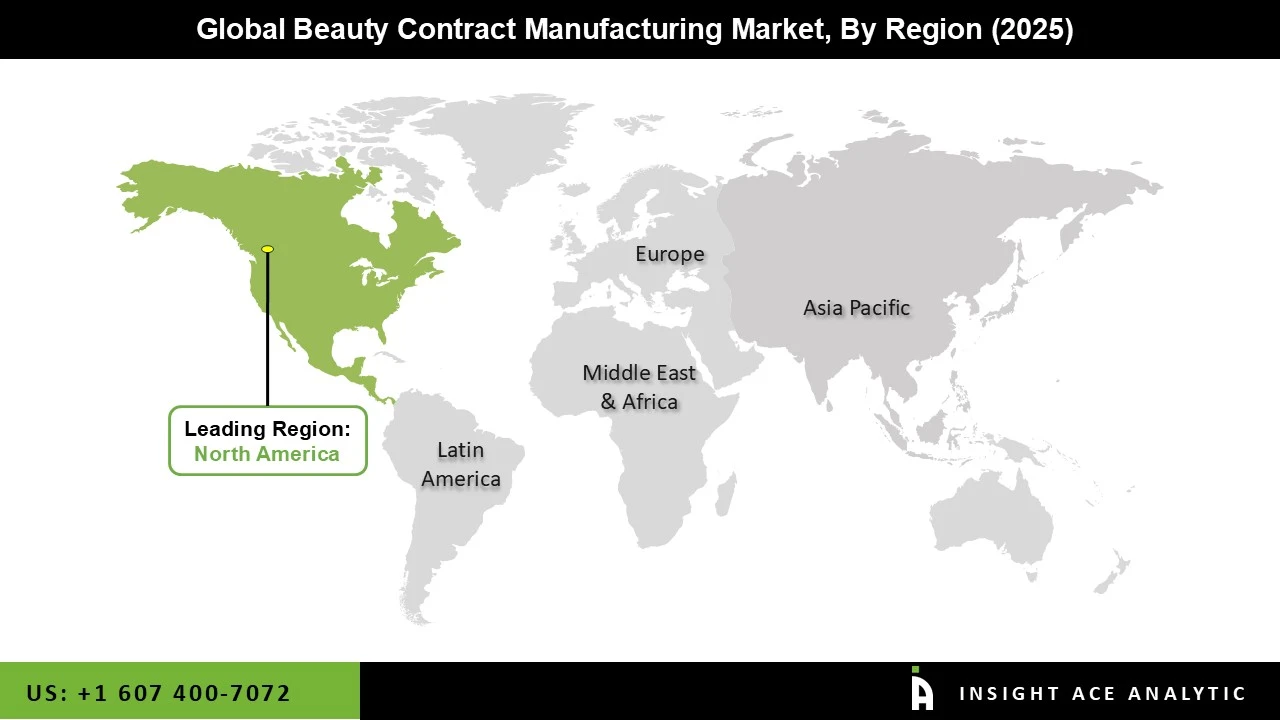
The region also benefits from demand for skincare, color cosmetics, hair care, fragrances, and personal care products that match changing consumer tastes. Beauty brands are looking for contract manufacturers who can help with new ideas, flexible production sizes, packaging, and faster product launches. Full-service ODM, OEM manufacturing, and contract filling and packaging give businesses options that fit their needs. Canada adds to the market with its beauty brands and private-label businesses, while Mexico offers more manufacturing and supply chain opportunities. Strong distribution networks, good supplier relationships, and technical know-how also help the region stay ahead. Even though manufacturers face challenges like production costs, regulations, and competition, ongoing investment in innovation, quality, and efficiency should keep North America strong in the global beauty contract manufacturing market.
Beauty Contract Manufacturing Market Report Scope:
| Report Attribute | Specifications |
| Growth Rate CAGR | CAGR of 7.8% from 2026 to 2035 |
| Quantitative Units | Representation of revenue in US$ Bn and CAGR from 2026 to 2035 |
| Historic Year | 2021 to 2025 |
| Forecast Year | 2026-2035 |
| Report Coverage | The forecast of revenue, the position of the company, the competitive market structure, growth prospects, and trends |
| Segments Covered | Product Category, Service Model, Customer Type, and By Region |
| Regional Scope | North America; Europe; Asia Pacific; Latin America; Middle East & Africa |
| Country Scope | U.S.; Canada; U.K.; Germany; China; India; Japan; Brazil; Mexico;France; Italy; Spain; South Korea; Southeast Asia; |
| Competitive Landscape | Cosmax Inc., Kolmar Korea Co., Ltd., Intercos S.p.A., kdc/one, Fareva SA, TOA Inc., Cosmecca Korea Co., Ltd., Ancorotti Cosmetics S.p.A., Voyant Beauty, Prime Matter Labs, Mibelle Group, Englewood Lab, Cosmetic Essence Innovations, Toyo Beauty Co., Ltd., Cosmo Beauty Co., Ltd., Picasso Beauty Chemical Research Institute Co., Ltd., Air Water Realize Co., Ltd., AFC-HD Amus Life Sciences Co., Ltd., UAB BIOK Laboratorija |
| Customization Scope | Free customisation report with the procurement of the report, Modifications to the regional and segment scope. Geographic competitive landscape. |
| Pricing and Available Payment Methods | Explore pricing alternatives that are customised to your particular study requirements. |
Market Segmentation:
Beauty Contract Manufacturing Market by Product Category-
• Skin Care
o Facial Care
o Body Care
o Sun Care
• Color Cosmetics
o Face Make-up
o Eye Make-up
o Lip Products
o Nail Products
• Hair Care
o Shampoos & Conditioners
o Styling, Treatments & Colorants
• Fragrances
• Bath, Shower & Personal Care
o Bath & Shower Products
o Deodorants, Antiperspirants & Shaving Products
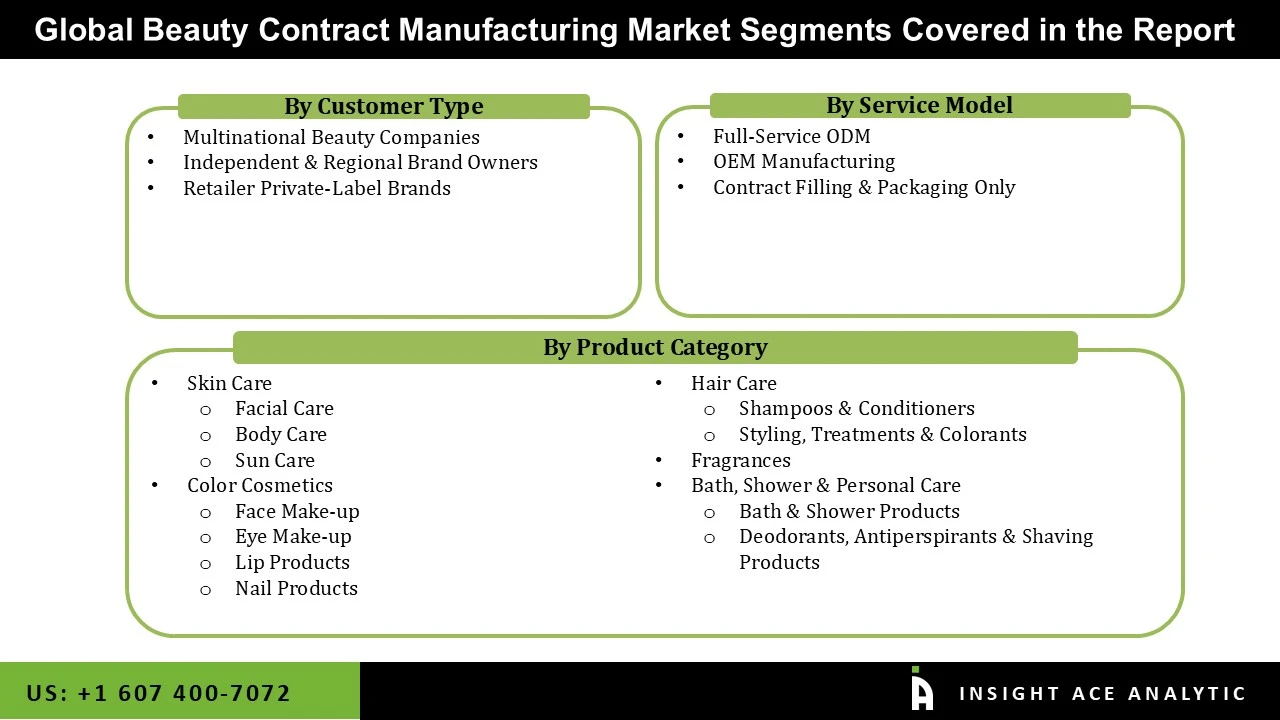
Beauty Contract Manufacturing Market by Service Model -
• Full-Service ODM
• OEM Manufacturing
• Contract Filling & Packaging Only
Beauty Contract Manufacturing Market by Customer Type -
• Multinational Beauty Companies
• Independent & Regional Brand Owners
• Retailer Private-Label Brands
Beauty Contract Manufacturing Market by Region-
North America-
• United States
• Canada
Europe-
• Germany
• United Kingdom
• France
• Russia
• Italy
• Spain
• Rest of Europe
Asia Pacific-
• China
• India
• Japan
• South Korea
• Malaysia
• Thailand
• Indonesia
• Rest of APAC
South America-
• Brazil
• Mexico
• Argentina
• Rest of South America
Middle East & Africa (MEA)-
• GCC Countries
• South Africa
• Rest of MEA
Research Design and Approach
This study employed a multi-step, mixed-method research approach that integrates:
- Secondary research
- Primary research
- Data triangulation
- Hybrid top-down and bottom-up modelling
- Forecasting and scenario analysis
This approach ensures a balanced and validated understanding of both macro- and micro-level market factors influencing the market.
Secondary Research
Secondary research for this study involved the collection, review, and analysis of publicly available and paid data sources to build the initial fact base, understand historical market behaviour, identify data gaps, and refine the hypotheses for primary research.
Sources Consulted
Secondary data for the market study was gathered from multiple credible sources, including:
- Government databases, regulatory bodies, and public institutions
- International organizations (WHO, OECD, IMF, World Bank, etc.)
- Commercial and paid databases
- Industry associations, trade publications, and technical journals
- Company annual reports, investor presentations, press releases, and SEC filings
- Academic research papers, patents, and scientific literature
- Previous market research publications and syndicated reports
These sources were used to compile historical data, market volumes/prices, industry trends, technological developments, and competitive insights.
Primary Research
Primary research was conducted to validate secondary data, understand real-time market dynamics, capture price points and adoption trends, and verify the assumptions used in the market modelling.
Stakeholders Interviewed
Primary interviews for this study involved:
- Manufacturers and suppliers in the market value chain
- Distributors, channel partners, and integrators
- End-users / customers (e.g., hospitals, labs, enterprises, consumers, etc., depending on the market)
- Industry experts, technology specialists, consultants, and regulatory professionals
- Senior executives (CEOs, CTOs, VPs, Directors) and product managers
Interview Process
Interviews were conducted via:
- Structured and semi-structured questionnaires
- Telephonic and video interactions
- Email correspondences
- Expert consultation sessions
Primary insights were incorporated into demand modelling, pricing analysis, technology evaluation, and market share estimation.
Data Processing, Normalization, and Validation
All collected data were processed and normalized to ensure consistency and comparability across regions and time frames.
The data validation process included:
- Standardization of units (currency conversions, volume units, inflation adjustments)
- Cross-verification of data points across multiple secondary sources
- Normalization of inconsistent datasets
- Identification and resolution of data gaps
- Outlier detection and removal through algorithmic and manual checks
- Plausibility and coherence checks across segments and geographies
This ensured that the dataset used for modelling was clean, robust, and reliable.
Market Size Estimation and Data Triangulation
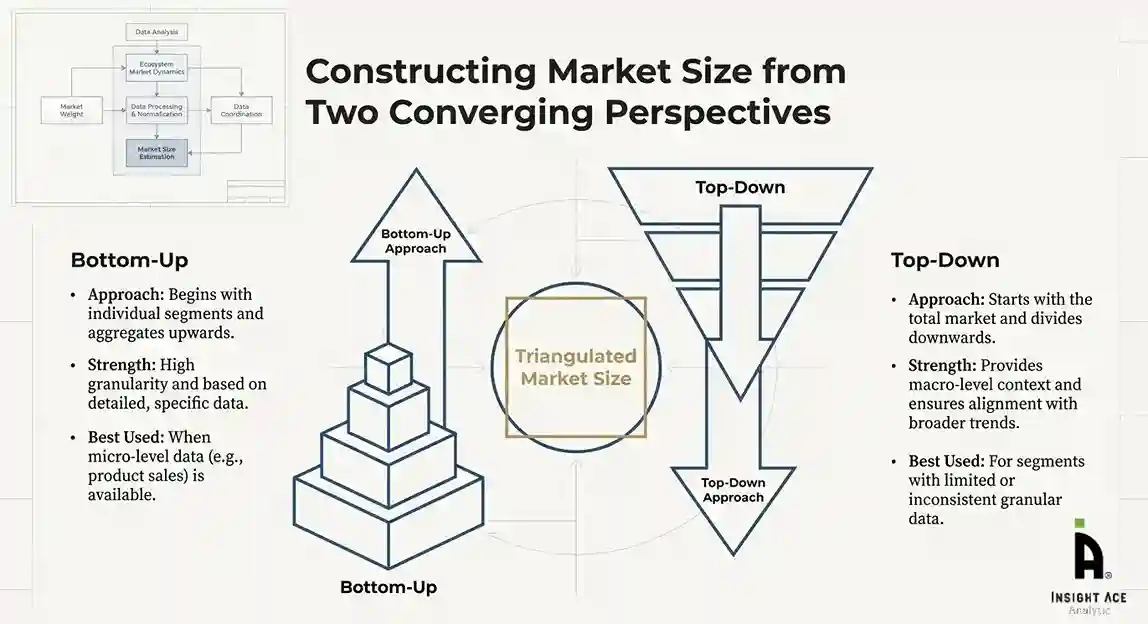
Bottom-Up Approach
The bottom-up approach involved aggregating segment-level data, such as:
- Company revenues
- Product-level sales
- Installed base/usage volumes
- Adoption and penetration rates
- Pricing analysis
This method was primarily used when detailed micro-level market data were available.
Top-Down Approach
The top-down approach used macro-level indicators:
- Parent market benchmarks
- Global/regional industry trends
- Economic indicators (GDP, demographics, spending patterns)
- Penetration and usage ratios
This approach was used for segments where granular data were limited or inconsistent.
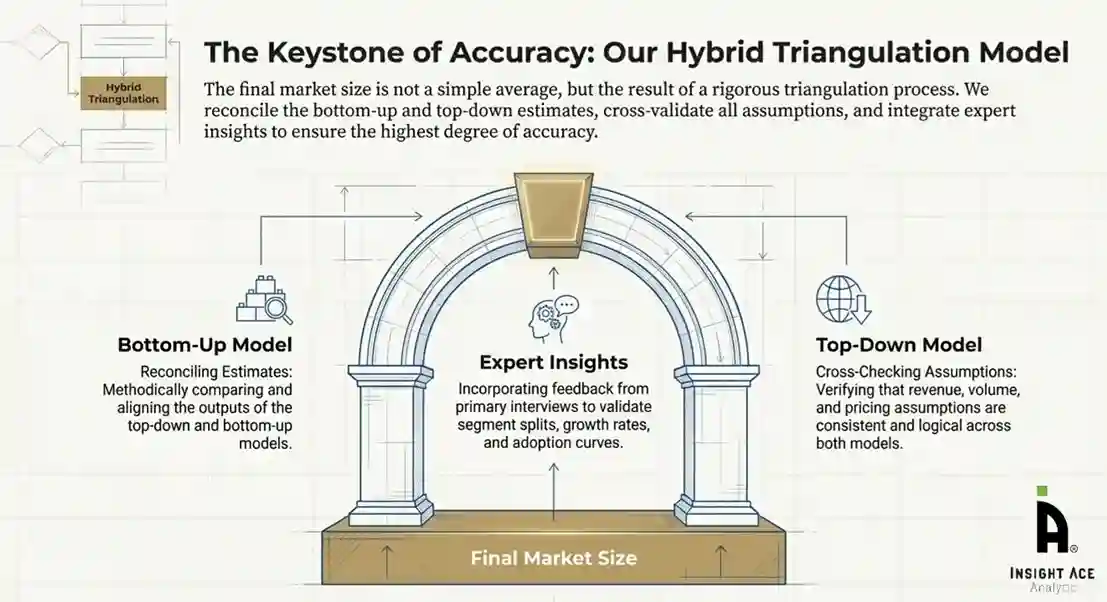
Hybrid Triangulation Approach
To ensure accuracy, a triangulated hybrid model was used. This included:
- Reconciling top-down and bottom-up estimates
- Cross-checking revenues, volumes, and pricing assumptions
- Incorporating expert insights to validate segment splits and adoption rates
This multi-angle validation yielded the final market size.
Forecasting Framework and Scenario Modelling
Market forecasts were developed using a combination of time-series modelling, adoption curve analysis, and driver-based forecasting tools.
Forecasting Methods
- Time-series modelling
- S-curve and diffusion models (for emerging technologies)
- Driver-based forecasting (GDP, disposable income, adoption rates, regulatory changes)
- Price elasticity models
- Market maturity and lifecycle-based projections
Scenario Analysis
Given inherent uncertainties, three scenarios were constructed:
- Base-Case Scenario: Expected trajectory under current conditions
- Optimistic Scenario: High adoption, favourable regulation, strong economic tailwinds
- Conservative Scenario: Slow adoption, regulatory delays, economic constraints
Sensitivity testing was conducted on key variables, including pricing, demand elasticity, and regional adoption.
Request Customization
Add countries, segments, company profiles, or extend forecast — free 10% customization with purchase.
Customize This Report →Enquire Before Buying
Speak with our analyst team about scope, methodology, pricing, or deliverable formats.
Enquire Now →Frequently Asked Questions
Beauty Contract Manufacturing Market is estimated to grow with 7.8% CAGR during the forecast period for 2026 to 2035.
Cosmax Inc., Kolmar Korea Co., Ltd., Intercos S.p.A., kdc/one, Fareva SA, TOA Inc., Cosmecca Korea Co., Ltd., Ancorotti Cosmetics S.p.A., Voyant Beauty, Prime Matter Labs, Mibelle Group, Englewood Lab, Cosmetic Essence Innovations, Toyo Beauty Co., Ltd., Cosmo Beauty Co., Ltd., Picasso Beauty Chemical Research Institute Co., Ltd., Air Water Realize Co., Ltd., AFC-HD Amus Life Sciences Co., Ltd., UAB BIOK Laboratorija
Beauty Contract Manufacturing Market is segmented into Product Category, Service Model, Customer Type, and By Region.
North America region is leading the Beauty Contract Manufacturing Market.