Loungewear Market Size, Share, Scope, Forecast Report 2026 to 2035
What is Loungewear Market Size?
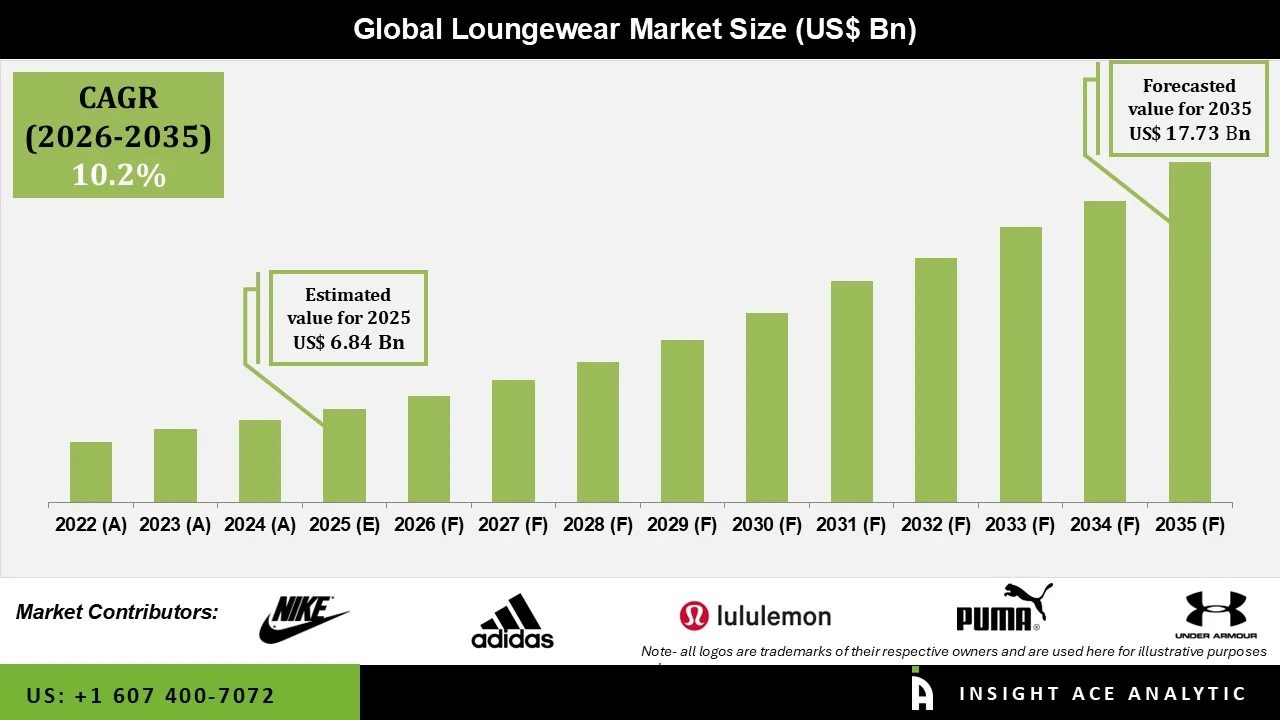
Global Loungewear Market Size is valued at USD 6.84 Bn in 2025 and is predicted to reach USD 17.73 Bn by the year 2035 at a 10.2% CAGR during the forecast period for 2026 to 2035.
Loungewear Market Size, Share & Trends Analysis Distribution by Material Type (Cotton, Wool, Silk, Others), By End User (Female, Male, Kids), By Distribution Channel (Store-Based, Non-Store-Based) and Segment Forecasts, 2026 to 2035.
Loungewear comprises garments designed to prioritise comfort, unrestricted movement, and a relaxed aesthetic for leisure and informal occasions. While traditionally associated with home attire such as pajama sets, robes, and loose-fitting tops and trousers, the category has evolved into a broader segment of lifestyle apparel. Contemporary loungewear incorporates design elements from casual wear, sleepwear, activewear, and athleisure. Typical offerings include coordinated lounge sets, joggers, hoodies, sweatshirts, leggings, and soft, loose-fitting tops and trousers. These products are distinguished by relaxed silhouettes, the use of soft, breathable, and stretchable fabrics, lightweight construction, and versatile styling suitable for domestic, travel, and informal social environments.
Materials commonly employed include cotton, polyester, modal, viscose, fleece, and blended textiles, enabling manufacturers to address varying requirements for softness, durability, thermal properties, and functional performance. The loungewear market involves the development, manufacturing, marketing, distribution, and sale of clothing designed for use during relaxation, in one's free time, for sleeping and for casual daily activities. It covers a variety of products for women, men, and children in different age groups and at various price levels, with items available ranging from simple everyday clothes to high-end and fashion-focused ranges. The range of products includes sleepwear and pajamas, lounge sets, sweatshirts and hoodies, sweatpants and joggers, robes, leggings, shorts, tops, and other loose-fitting clothing.
The market consists of global sportswear companies, fashion and apparel brands, producers of intimate apparel, lifestyle companies, and multi-brand retailers. Distribution is carried out via brand-owned retail stores, department stores, specialist apparel stores, supermarkets and hypermarkets, and through online channels. Because of the growing blend of comfortwear with everyday casual fashion, loungewear has become a more versatile type of clothing, with brands launching collections that combine practical comfort with modern styles, seasonal designs, and high-quality materials.
Competitive Landscape
Which are the Leading Players in the Loungewear Market?
- Nike
- Adidas
- Lululemon
- Puma
- Under Armour
- H&M
- Gap
- Zara
- American Eagle Outfitters
- L Brands Inc.
- Triumph International Holding GmbH
- Urban Outfitters
- Hanesbrands Inc.
- Jockey International Inc.
- Marks & Spencer Group PLC
- PVH Corporation
- Other Market Player
Market Dynamics
Driver
Growing Consumer Preference for Comfortable and Versatile Apparel
When people are choosing their everyday clothes, they are giving greater importance to comfort, flexibility, and ease of movement, which is leading to a rise in the use of loungewear outside of just home situations. Items such as lounge sets, joggers, sweatpants, hoodies, leggings, and loose-fitting tops combine comfortable fabrics and shapes with up-to-date styles so that consumers can wear them for relaxing, travelling, going out casually, running errands, and other informal social events. As a result of the increasing similarity between loungewear, casual wear, and athleisure, the number of different situations in which these products can be worn has increased. In response to this trend, clothing brands are launching versatile ranges that feature soft, stretchable, breathable, and lightweight materials as well as stylish designs. The move towards clothes that emphasize comfort and have multiple uses is expected to continue to be a major reason for the growth of the loungewear market.
Restrain/Challenge
Competition from Alternative Apparel Categories
A major challenge facing the loungewear market is the competition it receives from other closely related types of apparel, especially casualwear, activewear, sleepwear, and athleisure. Since various items—like joggers, leggings, hoodies, sweatshirts, pajama sets, and loose-fitting trousers—can be used in more than one way and are often marketed under different apparel categories rather than being specifically promoted as loungewear, it becomes difficult for brands to clearly distinguish their products and the competition for consumer money increases. Furthermore, well-established brands in the sportswear, fashion, intimate apparel, and lifestyle sectors also provide similar comfortable products, offering customers a broad selection of alternatives at different price levels and in various styles. Consequently, loungewear companies have to constantly differentiate their products through aspects such as design, fabric quality, functionality, brand positioning, and pricing, which in turn raises the level of competitive pressure and has an impact on market growth.
Cotton Segment is Expected to Drive the Loungewear Market
Cotton is expected to take the lead in the loungewear market, thanks to its softness, breathability, ability to absorb moisture, durability, and its suitability for long-term everyday use. This is because consumers usually place a high value on comfort, lightweight fabrics, and ease of movement when they are relaxing at home, on travel, or engaging in casual activities. The fact that cotton is widely available and not very expensive also allows clothing brands to provide cotton-based loungewear in both mass-market and premium lines. Furthermore, since cotton can be combined with a variety of fabric blends, finishes, and garment designs, manufacturers are able to create a wide assortment of lounge sets, T-shirts, sweatshirts, pajamas, joggers, and other types of comfortable clothing, which in turn supports its position as the leading material in this segment.
Non-Store-Based Segment is Growing at the Highest Rate in the Loungewear Market
The non-store-based segment is anticipated to show the fastest growth in the loungewear market over the forecast period, mainly due to the rapid expansion of e-commerce, rising consumer preference for the convenience of shopping online, greater product availability, and the increasing use of direct-to-consumer channels. Through online platforms, consumers are able to compare different brands, materials, designs, sizes, and prices without having to go to physical stores, and home delivery, simple return procedures, digital promotions, and the discovery of products via social media all help to promote online purchases. Market studies currently point to non-store-based channels as the fastest-growing distribution segment, even though store-based channels currently hold the larger market share.
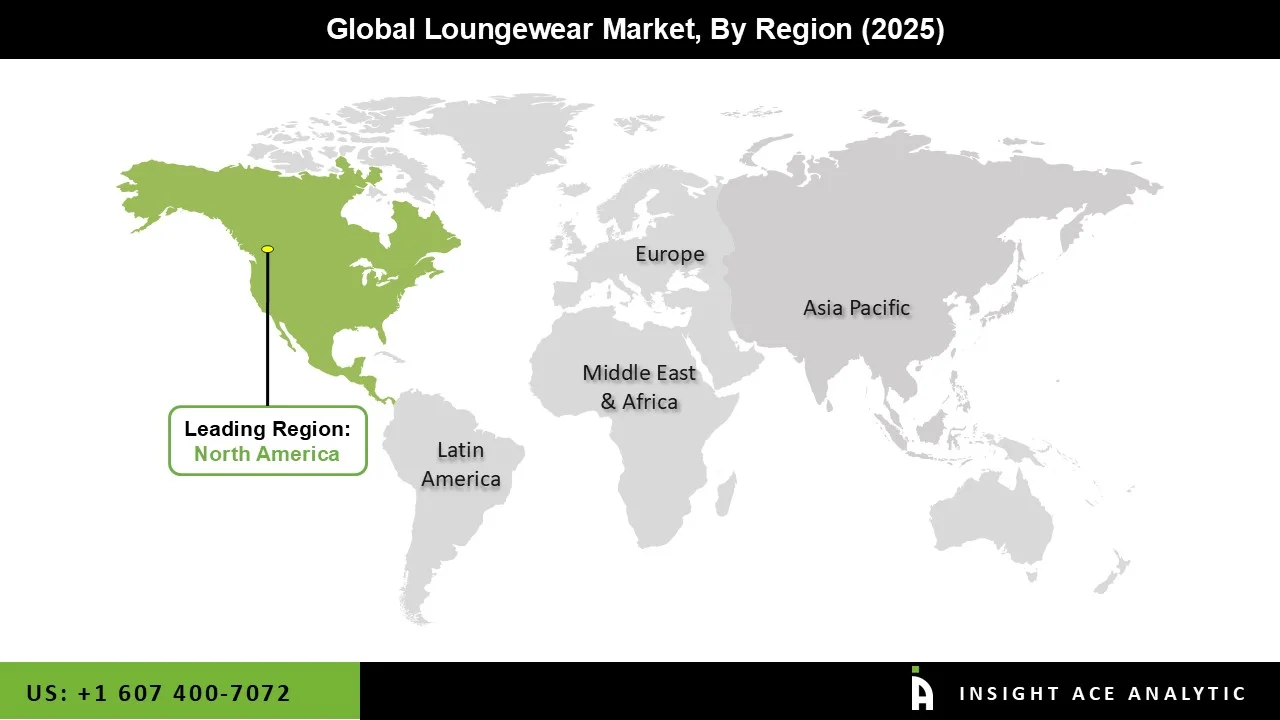
Why North America Led the Loungewear Market?
North America is expected to lead the Loungewear Market, supported by strong consumer preference for comfortable, versatile, and casual apparel, high disposable incomes, and the widespread adoption of athleisure and relaxed fashion. Loungewear is now being used more and more outside of traditional home settings, covering areas such as travel, leisure activities, casual events, and flexible work environments, which has made it more relevant to consumers.
The region also has the advantage of a strong presence of well-known apparel and sportswear brands, such as Nike, Lululemon, Gap, American Eagle, and other lifestyle brands that provide a variety of loungewear ranges. Moreover, the well-established retail infrastructure, the high level of e-commerce penetration, and the fact that consumers spend a lot on premium and fashion-focused apparel all contribute to the availability and uptake of loungewear products in the region.
Loungewear Market Report Scope:
| Report Attribute | Specifications |
| Market size value in 2025 | USD 6.84 Bn |
| Revenue forecast in 2035 | USD 17.73 Bn |
| Growth Rate CAGR | CAGR of 10.2% from 2026 to 2035 |
| Quantitative Units | Representation of revenue in US$ Bn and CAGR from 2026 to 2035 |
| Historic Year | 2022 to 2025 |
| Forecast Year | 2026-2035 |
| Report Coverage | The forecast of revenue, the position of the company, the competitive market structure, growth prospects, and trends |
| Segments Covered | Material Type, End User, Distribution Channel and By Region |
| Regional Scope | North America; Europe; Asia Pacific; Latin America; Middle East & Africa |
| Country Scope | U.S.; Canada; U.K.; Germany; China; India; Japan; Brazil; Mexico; France; Italy; Spain; South Korea; Southeast Asia |
| Competitive Landscape | Nike, Adidas, Lululemon, Puma, Under Armour, H&M, Gap, Zara, American Eagle Outfitters, L Brands Inc., Triumph International Holding GmbH |
| Customization Scope | Free customization report with the procurement of the report, Modifications to the regional and segment scope. Geographic competitive landscape. |
| Pricing and Available Payment Methods | Explore pricing alternatives that are customized to your particular study requirements. |
Segmentations Loungewear Market :
Loungewear Market by Material Type -
- Cotton
- Wool
- Silk
- Others
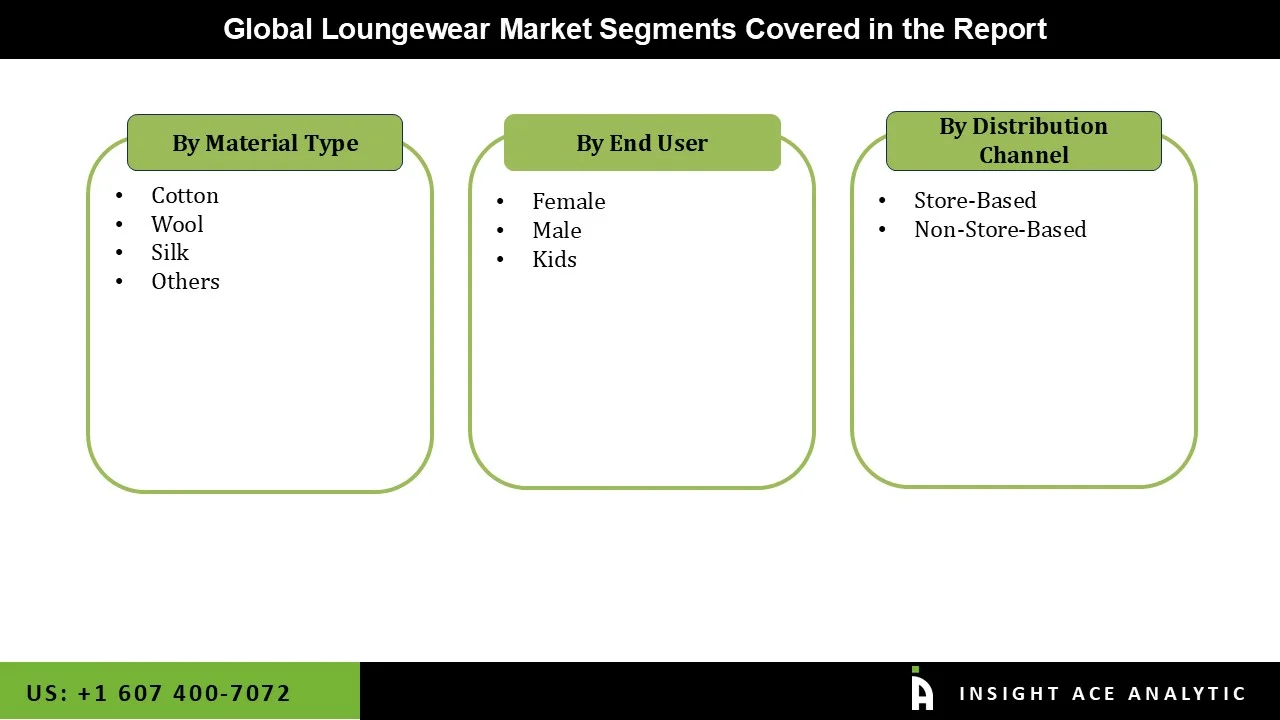
Loungewear Market by End User -
- Female
- Male
- Kids
Loungewear Market by Distribution Channel -
- Store-Based
- Non-Store-Based
Loungewear Market by Region-
- North America-
- The US
- Canada
- Europe-
- Germany
- The UK
- France
- Italy
- Spain
- Rest of Europe
- Asia-Pacific-
- China
- Japan
- India
- South Korea
- South East Asia
- Rest of Asia Pacific
- Latin America-
- Brazil
- Argentina
- Mexico
- Rest of Latin America
- Middle East and Africa-
- GCC Countries
- South Africa
- Rest of Middle East and Africa
Research Design and Approach
This study employed a multi-step, mixed-method research approach that integrates:
- Secondary research
- Primary research
- Data triangulation
- Hybrid top-down and bottom-up modelling
- Forecasting and scenario analysis
This approach ensures a balanced and validated understanding of both macro- and micro-level market factors influencing the market.
Secondary Research
Secondary research for this study involved the collection, review, and analysis of publicly available and paid data sources to build the initial fact base, understand historical market behaviour, identify data gaps, and refine the hypotheses for primary research.
Sources Consulted
Secondary data for the market study was gathered from multiple credible sources, including:
- Government databases, regulatory bodies, and public institutions
- International organizations (WHO, OECD, IMF, World Bank, etc.)
- Commercial and paid databases
- Industry associations, trade publications, and technical journals
- Company annual reports, investor presentations, press releases, and SEC filings
- Academic research papers, patents, and scientific literature
- Previous market research publications and syndicated reports
These sources were used to compile historical data, market volumes/prices, industry trends, technological developments, and competitive insights.

Primary Research
Primary research was conducted to validate secondary data, understand real-time market dynamics, capture price points and adoption trends, and verify the assumptions used in the market modelling.
Stakeholders Interviewed
Primary interviews for this study involved:
- Manufacturers and suppliers in the market value chain
- Distributors, channel partners, and integrators
- End-users / customers (e.g., hospitals, labs, enterprises, consumers, etc., depending on the market)
- Industry experts, technology specialists, consultants, and regulatory professionals
- Senior executives (CEOs, CTOs, VPs, Directors) and product managers
Interview Process
Interviews were conducted via:
- Structured and semi-structured questionnaires
- Telephonic and video interactions
- Email correspondences
- Expert consultation sessions
Primary insights were incorporated into demand modelling, pricing analysis, technology evaluation, and market share estimation.
Data Processing, Normalization, and Validation
All collected data were processed and normalized to ensure consistency and comparability across regions and time frames.
The data validation process included:
- Standardization of units (currency conversions, volume units, inflation adjustments)
- Cross-verification of data points across multiple secondary sources
- Normalization of inconsistent datasets
- Identification and resolution of data gaps
- Outlier detection and removal through algorithmic and manual checks
- Plausibility and coherence checks across segments and geographies
This ensured that the dataset used for modelling was clean, robust, and reliable.
Market Size Estimation and Data Triangulation
Bottom-Up Approach
The bottom-up approach involved aggregating segment-level data, such as:
- Company revenues
- Product-level sales
- Installed base/usage volumes
- Adoption and penetration rates
- Pricing analysis
This method was primarily used when detailed micro-level market data were available.
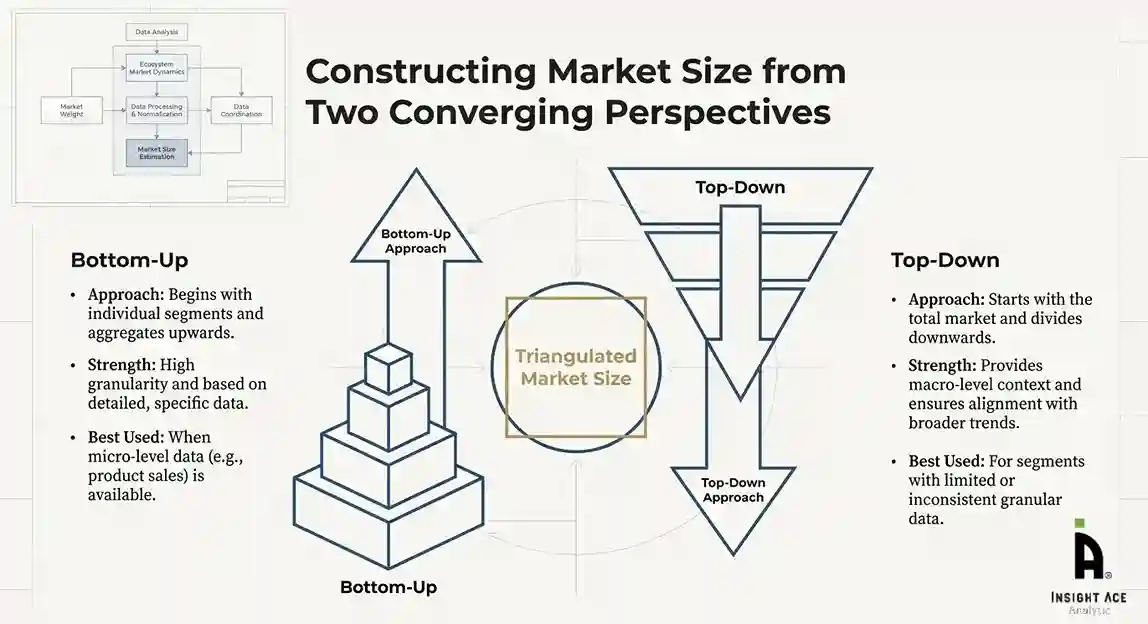
Top-Down Approach
The top-down approach used macro-level indicators:
- Parent market benchmarks
- Global/regional industry trends
- Economic indicators (GDP, demographics, spending patterns)
- Penetration and usage ratios
This approach was used for segments where granular data were limited or inconsistent.
Hybrid Triangulation Approach
To ensure accuracy, a triangulated hybrid model was used. This included:
- Reconciling top-down and bottom-up estimates
- Cross-checking revenues, volumes, and pricing assumptions
- Incorporating expert insights to validate segment splits and adoption rates
This multi-angle validation yielded the final market size.
Forecasting Framework and Scenario Modelling
Market forecasts were developed using a combination of time-series modelling, adoption curve analysis, and driver-based forecasting tools.
Forecasting Methods
- Time-series modelling
- S-curve and diffusion models (for emerging technologies)
- Driver-based forecasting (GDP, disposable income, adoption rates, regulatory changes)
- Price elasticity models
- Market maturity and lifecycle-based projections
Scenario Analysis
Given inherent uncertainties, three scenarios were constructed:
- Base-Case Scenario: Expected trajectory under current conditions
- Optimistic Scenario: High adoption, favourable regulation, strong economic tailwinds
- Conservative Scenario: Slow adoption, regulatory delays, economic constraints
Sensitivity testing was conducted on key variables, including pricing, demand elasticity, and regional adoption.
Request Customization
Add countries, segments, company profiles, or extend forecast — free 10% customization with purchase.
Customize This Report →Enquire Before Buying
Speak with our analyst team about scope, methodology, pricing, or deliverable formats.
Enquire Now →Frequently Asked Questions
Loungewear Market Size is valued at USD 6.84 Bn in 2025 and is predicted to reach USD 17.73 Bn by the year 2035
The Loungewear Market is expected to grow at a 10.2% CAGR during the forecast period for 2026 to 2035
Nike, Adidas, Lululemon, Puma, Under Armour, H&M, Gap, Zara, American Eagle Outfitters, L Brands Inc., Triumph International Holding GmbH and Others.
Loungewear Market is segmented into Material Type, End User, Distribution Channel and Other.
North America region is leading the Loungewear Market.