Lead-Acid Battery Scrap Market Size, Share, Forecast Report 2026 to 2035
What is Lead-Acid Battery Scrap Market Size?
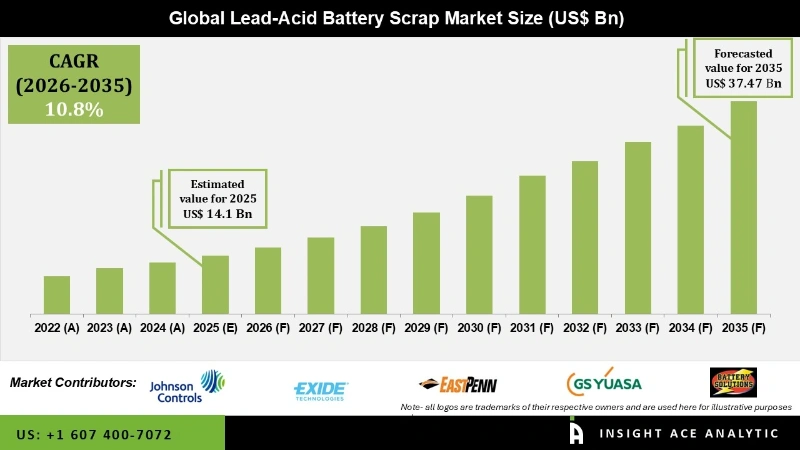
The Lead-Acid Battery Scrap Market Size is valued at USD 14.1 billion in 2025 and is predicted to reach USD 37.47 billion by the year 2035 at a 10.80% CAGR during the forecast period for 2026 to 2035.
Lead-Acid Battery Scrap Market Size, Share & Trends Analysis Report By Battery (Flooded, Sealed), By Product (Lead, Sulfuric acid), By Source (Motor Vehicles, UPS), By Region, And By Segment Forecasts, 2026 to 2035.
Lead-Acid Battery Scrap Market Key Takeaways:
|
Lead-acid battery scrap refers to batteries that have been used or discarded and yet contain precious lead, which can be able to be repurposed. The recycling process entails the segregation and purification of the lead, the neutralization of the acid, and the reuse of the plastic casing. Efficient recycling is crucial for minimizing environmental contamination and preserving resources, while also yielding economic benefits by reclaiming lead.
In automobiles, industrial settings, and electrical backup networks, lead-acid batteries are widely utilized. Both private and public sectors are investing in these systems to recycle lead-acid batteries more effectively. Facilities for recycling spent batteries remove important lead, guaranteeing appropriate disposal and reducing the ecological impact. Utilized in a variety of sectors, recycled lead promotes an economy with circularity that is environmentally friendly. Growing industry and consumer recognition of a demand for sustainable methods is driving the industry significantly.
However, the global lead-acid battery scrap industry is confronted with enormous challenges in terms of regulation and compatibility. The recycling technologies and procedures. Thus, it might be difficult to achieve integrated and defined norms. The absence of global standards frequently leads to incompatibilities, which impedes recycling facilities' ability to exchange information and interact efficiently. The absence of connectivity hampers the sector's capacity to achieve effective substance recoveries and improved efficiency. Irregular standards may result in errors, higher operating expenses, and less-than-ideal cleaning products. In the wake of the COVID-19 epidemic and subsequent lockdown, there was a decline in consumer demand for lead-acid batteries. Many different businesses were impacted by this, including those who make and recycle batteries.
Competitive Landscape
Some Major Key Players In The Lead-Acid Battery Scrap Market:
- Johnson Controls International PLC
- Exide Technologies S.A.S.
- East Penn Manufacturing Co., Inc.
- GS Yuasa International Ltd.
- Battery Solutions LLC
- Whitelake Organics Pvt Ltd.
- Gravita India Ltd.
- Aqua Metals Inc.
- Madenat Al Nokhba Recycling Services LLC
- Beeah Group
- EnviroServe
- EnerSys
- SYSTEMS SUNLIGHT S.A.
- AMIDT GROUP
- Duracell Inc.
- Engitec Technologies SpA
- ECOBAT Technologies Ltd
- Other Market Players
Market Segmentation:
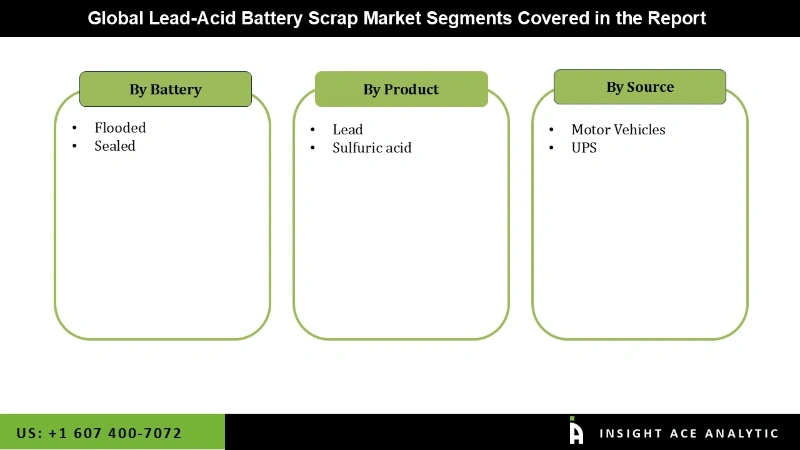
The lead-acid battery scrap market is segmented based on battery, product, and source. As per the battery, the market is segmented into flooded and sealed. By product, the market is segmented into lead and sulfuric acid. According to sources, the market is segmented into motor vehicles and U.P.S.
Based On The Battery, The Sealed Lead-Acid Battery Scrap Market Segment Is Accounted As A Major Contributor To The Lead-Acid Battery Scrap Market
The sealed lead-acid battery scrap is expected to hold a major global market share in 2023. Because these batteries are sealed, the electrolytes cannot leak or spill out, increasing their dependability and suitability for uses where comfort and security are crucial. Sealed lead-acid batteries are the most common type of battery in the scrap industry since they are used in many industries, including automobile connectivity, energy efficiency systems, and electrical power supplies.
Motor Vehicles Segment to Witness Growth at a Rapid Rate
Motor vehicles make up the bulk of lead-acid battery usage due to elements like the flourishing motoring sector, rising vehicle ownership rates, and the increasing need for battery-powered cars (E.V.s) with lithium-ion batteries in supporting technologies. Lead-acid battery recycling has increased proportionately as a result of the growth of electronic commerce and the logistics sector, as well as a surge in the number of automobiles on motorways, especially in countries like the US, Germany, the U.K., China, and India.
In The Region, The North American Lead-Acid Battery Scrap Market Holds A Significant Revenue Share.
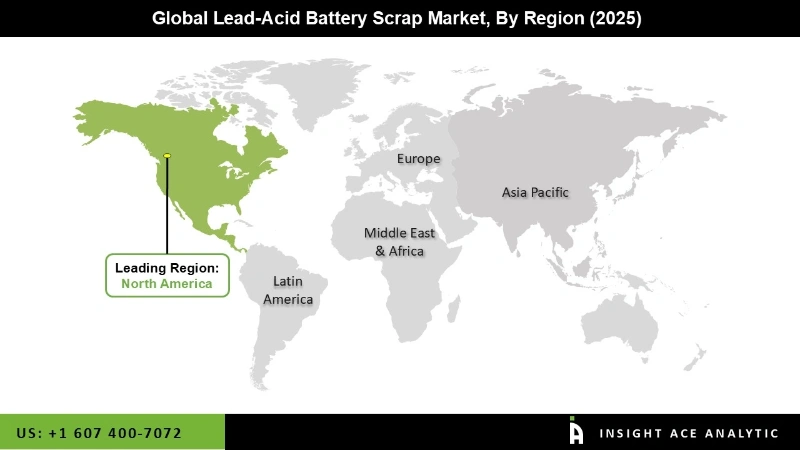
The North American lead-acid battery scrap market is expected to register the very big market share in revenue in the near future. This can be attributed to the fact that its people tend to be well-off and educated. Increasing lead-acid battery use in the region meets the rising need for batteries across various industries, including smart cards, packaging, and electric vehicles. In addition, Asia Pacific is estimated to grow rapidly in the global lead-acid battery market due to advancements in the renewable energy sector, an ever-increasing need for battery energy storage devices, and a massive consumer user base for consumer and portable electronics.
Recent Developments:
- In Jan 2024, The Ministry of Environment, Forest and Climate Change (MoEFCC) has issued the standard operating procedure (S.O.P.) for the recycling of lead scrap and used lead-acid batteries. The purpose of the S.O.P. is to establish guidelines for the importation, transportation, and recycling of garbage containing lead, with the goal of reducing environmental and health hazards.
- In Aug 2023, Chloride Metals, a subsidiary of Exide Industries, has recently commenced commercial operations at its fourth lead battery recycling facility in India. The facility was built on a previously undeveloped land spanning more than 15 acres within the Supa-Parner Industrial Park in Maharashtra. The initial capacity of the facility was 96,000 million tons per annum, and it was later expanded to 120,000 mtpa.
Lead-Acid Battery Scrap Market Report Scope
| Report Attribute | Specifications |
| Market Size Value In 2025 | USD 14.1 Bn |
| Revenue Forecast In 2035 | USD 37.47 Bn |
| Growth Rate CAGR | CAGR of 10.80% from 2026 to 2035 |
| Quantitative Units | Representation of revenue in US$ Bn and CAGR from 2026 to 2035 |
| Historic Year | 2022 to 2025 |
| Forecast Year | 2026-2035 |
| Report Coverage | The forecast of revenue, the position of the company, the competitive market structure, growth prospects, and trends |
| Segments Covered | By Battery, Product, And Source. |
| Regional Scope | North America; Europe; Asia Pacific; Latin America; Middle East & Africa |
| Country Scope | U.S.; Canada; U.K.; Germany; China; India; Japan; Brazil; Mexico; France; Italy; Spain; South East Asia; South Korea |
| Competitive Landscape | Johnson Controls International PLC, Exide Technologies S.A.S., East Penn Manufacturing Co., Inc., GS Yuasa International Ltd., Battery Solutions LLC, Whitelake Organics Pvt Ltd., Gravita India Ltd., Aqua Metals Inc., Madenat Al Nokhba Recycling Services LLC, Beeah Group. And other market players |
| Customization Scope | Free customization report with the procurement of the report and modifications to the regional and segment scope. Particular Geographic competitive landscape. |
| Pricing And Available Payment Methods | Explore pricing alternatives that are customized to your particular study requirements. |
Segmentation of the Lead-Acid Battery Scrap Market-
Lead-Acid Battery Scrap Market By Battery
- Flooded
- Sealed
Lead-Acid Battery Scrap Market By Product
- Lead
- Sulfuric acid
Lead-Acid Battery Scrap Market By Source
- Motor Vehicles
- UPS
Lead-Acid Battery Scrap Market By Region-
North America-
- The US
- Canada
- Mexico
Europe-
- Germany
- The UK
- France
- Italy
- Spain
- Rest of Europe
Asia-Pacific-
- China
- Japan
- India
- South Korea
- South East Asia
- Rest of Asia Pacific
Latin America-
- Brazil
- Argentina
- Rest of Latin America
Middle East & Africa-
- GCC Countries
- South Africa
- Rest of the Middle East and Africa
Research Design and Approach
This study employed a multi-step, mixed-method research approach that integrates:
- Secondary research
- Primary research
- Data triangulation
- Hybrid top-down and bottom-up modelling
- Forecasting and scenario analysis
This approach ensures a balanced and validated understanding of both macro- and micro-level market factors influencing the market.
Secondary Research
Secondary research for this study involved the collection, review, and analysis of publicly available and paid data sources to build the initial fact base, understand historical market behaviour, identify data gaps, and refine the hypotheses for primary research.
Sources Consulted
Secondary data for the market study was gathered from multiple credible sources, including:
- Government databases, regulatory bodies, and public institutions
- International organizations (WHO, OECD, IMF, World Bank, etc.)
- Commercial and paid databases
- Industry associations, trade publications, and technical journals
- Company annual reports, investor presentations, press releases, and SEC filings
- Academic research papers, patents, and scientific literature
- Previous market research publications and syndicated reports
These sources were used to compile historical data, market volumes/prices, industry trends, technological developments, and competitive insights.

Primary Research
Primary research was conducted to validate secondary data, understand real-time market dynamics, capture price points and adoption trends, and verify the assumptions used in the market modelling.
Stakeholders Interviewed
Primary interviews for this study involved:
- Manufacturers and suppliers in the market value chain
- Distributors, channel partners, and integrators
- End-users / customers (e.g., hospitals, labs, enterprises, consumers, etc., depending on the market)
- Industry experts, technology specialists, consultants, and regulatory professionals
- Senior executives (CEOs, CTOs, VPs, Directors) and product managers
Interview Process
Interviews were conducted via:
- Structured and semi-structured questionnaires
- Telephonic and video interactions
- Email correspondences
- Expert consultation sessions
Primary insights were incorporated into demand modelling, pricing analysis, technology evaluation, and market share estimation.
Data Processing, Normalization, and Validation
All collected data were processed and normalized to ensure consistency and comparability across regions and time frames.
The data validation process included:
- Standardization of units (currency conversions, volume units, inflation adjustments)
- Cross-verification of data points across multiple secondary sources
- Normalization of inconsistent datasets
- Identification and resolution of data gaps
- Outlier detection and removal through algorithmic and manual checks
- Plausibility and coherence checks across segments and geographies
This ensured that the dataset used for modelling was clean, robust, and reliable.
Market Size Estimation and Data Triangulation
Bottom-Up Approach
The bottom-up approach involved aggregating segment-level data, such as:
- Company revenues
- Product-level sales
- Installed base/usage volumes
- Adoption and penetration rates
- Pricing analysis
This method was primarily used when detailed micro-level market data were available.

Top-Down Approach
The top-down approach used macro-level indicators:
- Parent market benchmarks
- Global/regional industry trends
- Economic indicators (GDP, demographics, spending patterns)
- Penetration and usage ratios
This approach was used for segments where granular data were limited or inconsistent.
Hybrid Triangulation Approach
To ensure accuracy, a triangulated hybrid model was used. This included:
- Reconciling top-down and bottom-up estimates
- Cross-checking revenues, volumes, and pricing assumptions
- Incorporating expert insights to validate segment splits and adoption rates
This multi-angle validation yielded the final market size.
Forecasting Framework and Scenario Modelling
Market forecasts were developed using a combination of time-series modelling, adoption curve analysis, and driver-based forecasting tools.
Forecasting Methods
- Time-series modelling
- S-curve and diffusion models (for emerging technologies)
- Driver-based forecasting (GDP, disposable income, adoption rates, regulatory changes)
- Price elasticity models
- Market maturity and lifecycle-based projections
Scenario Analysis
Given inherent uncertainties, three scenarios were constructed:
- Base-Case Scenario: Expected trajectory under current conditions
- Optimistic Scenario: High adoption, favourable regulation, strong economic tailwinds
- Conservative Scenario: Slow adoption, regulatory delays, economic constraints
Sensitivity testing was conducted on key variables, including pricing, demand elasticity, and regional adoption.
Request Customization
Add countries, segments, company profiles, or extend forecast — free 10% customization with purchase.
Customize This Report →Enquire Before Buying
Speak with our analyst team about scope, methodology, pricing, or deliverable formats.
Enquire Now →Frequently Asked Questions
Lead-Acid Battery Scrap Market Size is valued at USD 14.1 billion in 2025 and is predicted to reach USD 37.47 billion by the year 2035.
The Lead-Acid Battery Scrap Market is expected to grow at a 10.80% CAGR during the forecast period for 2026-2035.
Johnson Controls International PLC, Exide Technologies S.A.S., East Penn Manufacturing Co., Inc., GS Yuasa International Ltd., Battery Solutions LLC,
Lead-acid battery scrap market is segmented based on battery, product, and source.
North American region is leading the Lead-acid battery scrap market.