Battery Fire and Explosion Containment Test Chambers Market Size, Share, Trend, Scope Report 2026 to 2035
What is Battery Fire and Explosion Containment Test Chambers Market Size?
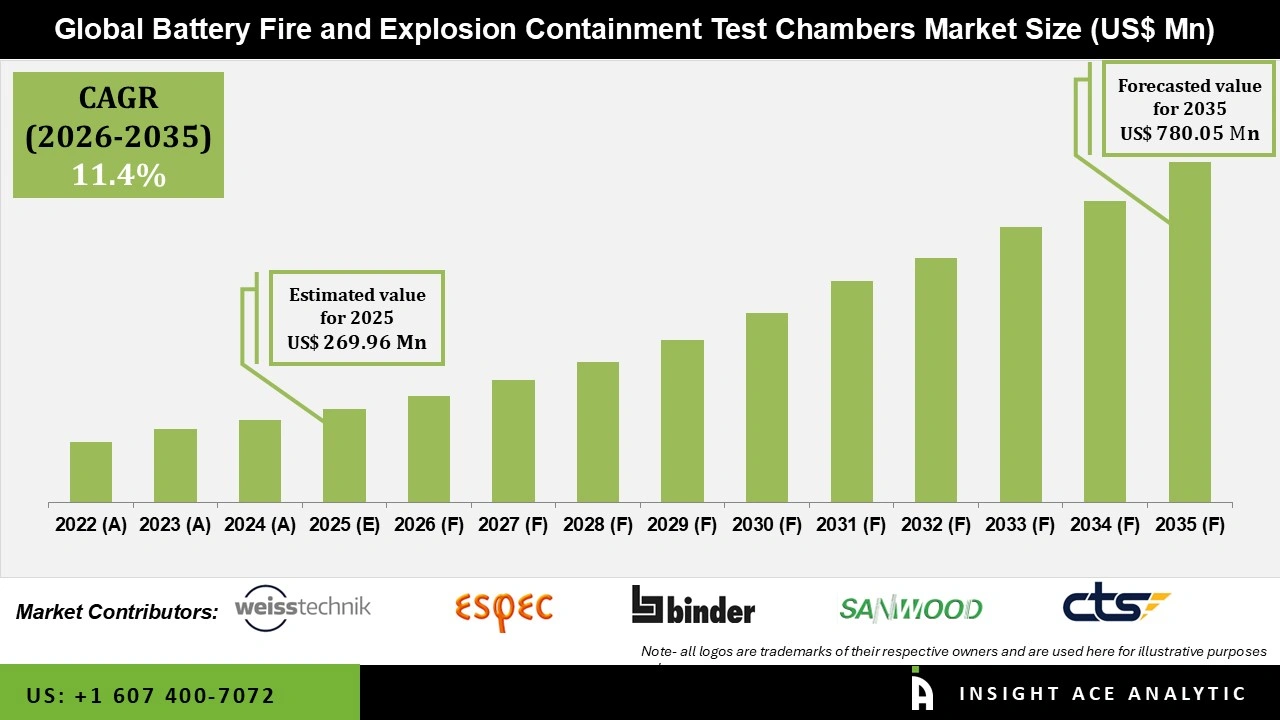
Global Battery Fire and Explosion Containment Test Chambers Market Size is valued at USD 269.96 Mn in 2025 and is predicted to reach USD 780.05 Mn by the year 2035 at a 11.4% CAGR during the forecast period for 2026 to 2035.
Battery Fire and Explosion Containment Test Chambers Market Size, Share & Trends Analysis Distribution by Chamber Type (Explosion-containment Environmental Chambers, Thermal Runaway and Abuse Test Chambers, Fire-containment and Propagation Chambers, Walk-in Battery Fire Test Chambers, Modular Replaceable-liner Abuse Chambers, Pack-level Abuse Bunkers and Reinforced Test Cells), Battery Test Application (EV Cell, Module, and Pack Abuse Testing, OEM Validation and Homologation Abuse Testing, BESS Thermal Runaway Propagation Testing, R&D Failure-mode and Root-cause Analysis Testing, Transport and UN 38.3 Related Safety Testing, Certification-lab Battery Fire and Explosion Testing), Safety Feature (Gas Detection and Extraction Systems, Blast-resistant Chamber Structures, Pressure-relief and Vent-gas Management Systems, Reinforced Doors, Locks, and Latches, Fire Suppression and Inerting Systems, Fragment Shield and Debris-containment Systems), Installation Type, End-user and Segment Forecasts, 2026 to 2035
Battery fire and explosion containment test chambers are specialized safety testing enclosures made to assess how batteries, especially lithium-ion and other high-energy storage systems, behave under extreme failure conditions such as physical damage, overheating, thermal runaway, or short circuits. These chambers are designed to properly confine high-pressure events, poisonous gas emissions, fires, and explosions that might happen during battery abuse testing. They provide both operator safety and environmental protection because they are built with fire suppression mechanisms, gas exhaust and filtration units, pressure relief systems, reinforced steel walls, and explosion-proof observation windows. The battery fire and explosion containment test chambers market is expected to grow significantly due to the growing demand for safer battery testing procedures across a number of industries, including consumer electronics, automotive, and aerospace.
The battery fire and explosion containment test chambers market is being driven by the growing need for battery safety testing solutions, mainly as a result of the quick development of consumer electronics, energy storage systems, and electric vehicles (EVs). The hazards of thermal runaway, fire, and explosion have increased due to these applications' heavy reliance on high-energy lithium-ion batteries, which have led manufacturers to implement sophisticated containment testing infrastructure. Additionally, businesses are being forced to perform thorough abuse and safety testing because of strict safety standards and certification requirements set by organizations such as the International Electrotechnical Commission and UL (Underwriters Laboratories). The adoption of battery fire and explosion containment test chambers is also accelerated by the increasing focus on environmental protection, worker safety, and product dependability.
Furthermore, the need for safe and controlled testing environments is growing across industries due to rising investments in battery innovation and the creation of next-generation chemistries. Continuous technological developments in battery testing equipment and containment solutions, such as enhanced fire suppression systems, gas filtering technologies, and automated monitoring features, are reshaping the battery fire and explosion containment test chambers market. The demand for more advanced testing conditions is also being driven by increased investments in research and development for next-generation batteries, such as solid-state and high-capacity chemistries. Moreover, companies are being encouraged to use high-performance containment chambers to reduce risks during testing due to increased awareness of environmental protection and workplace safety. Thus, these factors are anticipated to boost the battery fire and explosion containment test chambers market growth over the forecast period.
Competitive Landscape
Which are the Leading Players in Battery Fire and Explosion Containment Test Chambers Market?
- ESPEC
- Angelantoni Test Technologies / ACS
- BINDER
- Weiss Technik
- Thermotron Industries
- CTS
- Sanwood Technology
Market Dynamics
Driver
Growing Use of Energy Storage Systems and Electric Vehicles
One of the main factors propelling the battery fire and explosion containment test chambers market is the worldwide trend toward electric transportation and the integration of renewable energy sources. High-energy lithium-ion batteries, which have inherent safety problems such as thermal runaway and fire dangers, are becoming more and more important in electric vehicles (EVs), grid-scale energy storage systems, and portable gadgets. Manufacturers are under tremendous pressure to guarantee battery safety, performance, and regulatory compliance as production quantities increase. Additionally, the demand for sophisticated containment chambers is driven by standards established by organizations such as the International Electrotechnical Commission and UL (Underwriters Laboratories), which require stringent abuse testing. The necessity for these specialized testing solutions in the automotive and energy sectors is further supported by rising investments in battery innovation and safety validation infrastructure.
Restrain/Challenge
High Cost and Complicated Infrastructure Needs
The high expense of creating, setting up, and maintaining battery fire and explosion containment test chambers is one of the main barriers to this market. Strong building materials, explosion-proof parts, sophisticated ventilation and gas treatment systems, and integrated fire suppression mechanisms are all necessary for these systems, all of which greatly raise capital costs. Additionally, running these chambers requires knowledgeable staff, stringent safety procedures, and adherence to intricate legal frameworks, all of which raise operating expenses. It may be difficult for small and medium-sized businesses (SMEs) and new battery startups to invest in such costly equipment; therefore, they frequently choose to use third-party testing services. The widespread adoption may be hampered by this cost barrier, especially in developing nations where financial limitations and a lack of technological know-how impede the battery fire and explosion containment test chambers market expansion.
Explosion-containment Environmental Chambers Segment is Expected to Drive the Battery Fire and Explosion Containment Test Chambers Market
The Explosion-containment Environmental Chambers category held the largest share in the Battery Fire and Explosion Containment Test Chambers market in 2025 driven by the growing requirement to replicate extreme battery failure situations and real-world environmental conditions. These chambers are crucial for thorough battery safety certification because they are made to imitate different temperature, humidity, altitude, and pressure conditions, in addition to containing fire and explosions. Manufacturers are giving priority to multi-functional testing systems that can assess performance and safety under combined environmental and abuse conditions as battery applications grow in electric vehicles, airplanes, and renewable energy storage. Moreover, manufacturers and research institutes are being encouraged to implement such sophisticated systems by the increasing emphasis on product dependability, certification schedules, and failure analysis.
Fire Suppression and Inerting Systems Segment is Growing at the Highest Rate in the Battery Fire and Explosion Containment Test Chambers Market
In 2025, the Fire Suppression and Inerting Systems category dominated the Battery Fire and Explosion Containment Test Chambers market driven by the growing need to manage and reduce dangerous occurrences during battery testing, such as thermal runaway, fire spread, and gas explosions. Integrated fire suppression and inert gas systems are crucial parts of contemporary test chambers since the hazards of overheating and combustion increase with the energy density of lithium-ion batteries. These systems quickly put out flames and lower oxygen levels to avoid re-ignition by using technologies like water mist, inert gases like nitrogen or argon, and clean agent suppression. Furthermore, improvements in automation and suppression technologies are improving the efficiency and dependability of these systems, allowing for quicker reaction times and improved interaction with monitoring and control systems.
Why North America Led the Battery Fire and Explosion Containment Test Chambers Market?
The Battery Fire and Explosion Containment Test Chambers market was dominated by North America region in 2025 driven mostly by large-scale energy storage deployments, increased battery development, and the quick growth of electric vehicle production. The demand for sophisticated fire and explosion containment testing systems is rising, with the United States in particular being a major provider due to large expenditures in gigafactories and internal battery validation facilities.
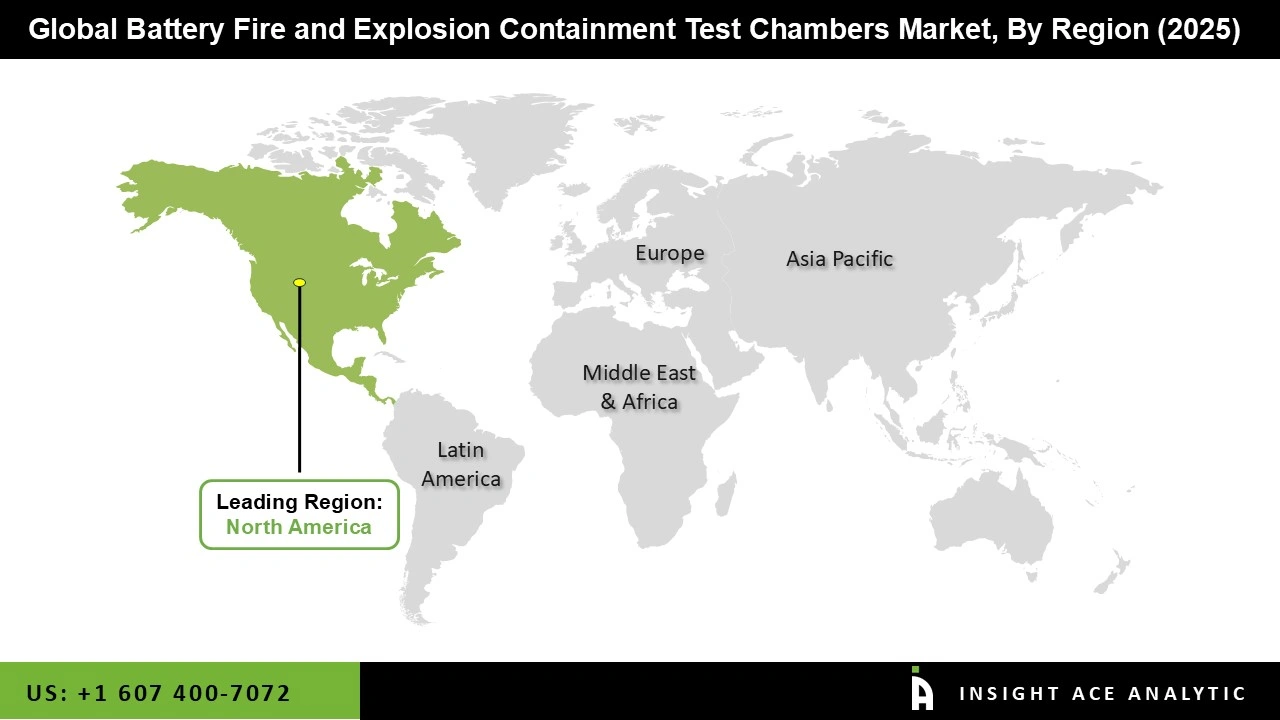
Additionally, automakers, battery manufacturers, and testing facilities are being forced to improve their infrastructure with high-performance containment chambers due to strict safety standards and compliance requirements throughout North America.
Battery Fire and Explosion Containment Test Chambers Market Report Scope:
| Report Attribute | Specifications |
| Market size value in 2025 | USD 269.96 Mn |
| Revenue forecast in 2035 | USD 780.05 Mn |
| Growth Rate CAGR | CAGR of 11.4% from 2026 to 2035 |
| Quantitative Units | Representation of revenue in US$ Mn and CAGR from 2026 to 2035 |
| Historic Year | 2022 to 2025 |
| Forecast Year | 2026-2035 |
| Report Coverage | The forecast of revenue, the position of the company, the competitive market structure, growth prospects, and trends |
| Segments Covered | Chamber Type, Battery Test Application, Safety Feature, Installation Type, End-user, and By Region |
| Regional Scope | North America; Europe; Asia Pacific; Latin America; Middle East & Africa |
| Country Scope | U.S.; Canada; U.K.; Germany; China; India; Japan; Brazil; Mexico; The UK; France; Italy; Spain; China; Japan; India; South Korea; Southeast Asia; South Korea; Southeast Asia |
| Competitive Landscape | ESPEC, Angelantoni Test Technologies / ACS, BINDER, Weiss Technik, Thermotron Industries, CTS, and Sanwood Technology. |
| Customization Scope | Free customization report with the procurement of the report, Modifications to the regional and segment scope. Geographic competitive landscape. |
| Pricing and Available Payment Methods | Explore pricing alternatives that are customized to your particular study requirements. |
Segmentations of Battery Fire and Explosion Containment Test Chambers Market:
Battery Fire and Explosion Containment Test Chambers Market, by Chamber Type-
- Explosion-containment Environmental Chambers
- Thermal Runaway and Abuse Test Chambers
- Fire-containment and Propagation Chambers
- Walk-in Battery Fire Test Chambers
- Modular Replaceable-liner Abuse Chambers
- Pack-level Abuse Bunkers and Reinforced Test Cells
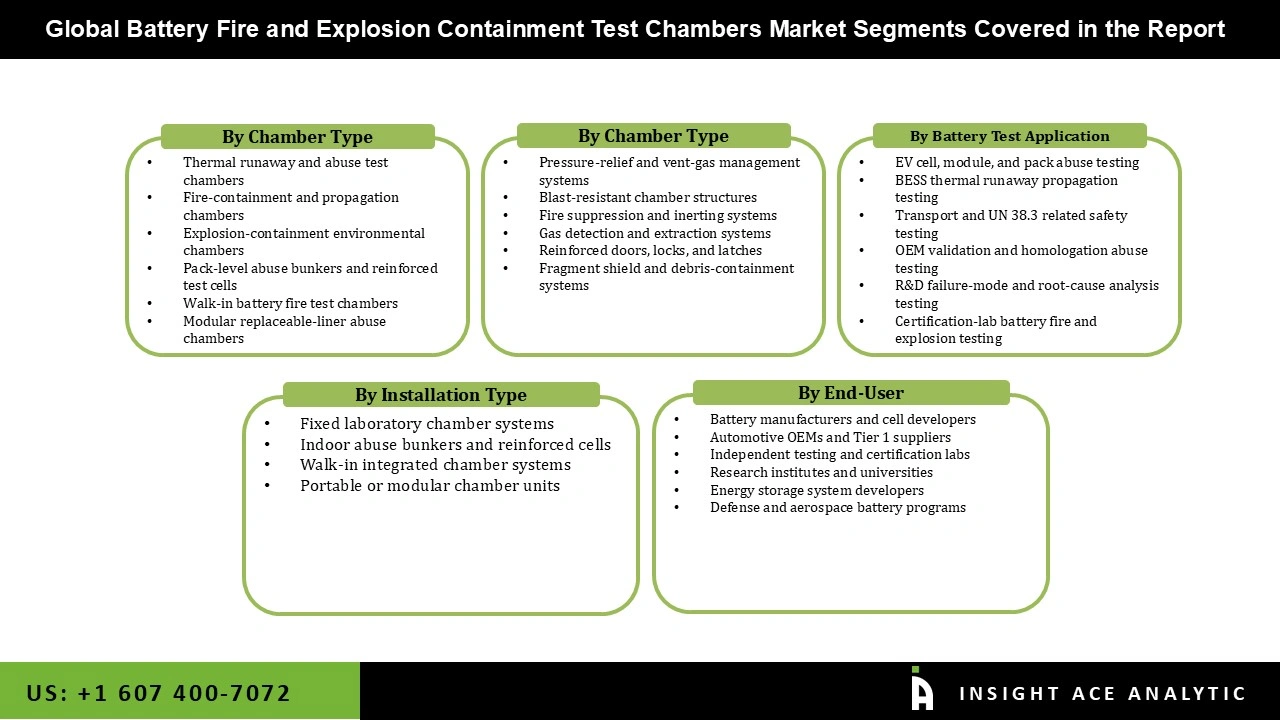
Battery Fire and Explosion Containment Test Chambers Market, by Battery Test Application-
- EV Cell, Module, and Pack Abuse Testing
- OEM Validation and Homologation Abuse Testing
- BESS Thermal Runaway Propagation Testing
- R&D Failure-mode and Root-cause Analysis Testing
- Transport and UN 38.3 Related Safety Testing
- Certification-lab Battery Fire and Explosion Testing
Battery Fire and Explosion Containment Test Chambers Market, by Safety Feature-
- Gas Detection and Extraction Systems
- Blast-resistant Chamber Structures
- Pressure-relief and Vent-gas Management Systems
- Reinforced Doors, Locks, and Latches
- Fire Suppression and Inerting Systems
- Fragment Shield and Debris-containment Systems
Battery Fire and Explosion Containment Test Chambers Market, by Installation Type-
- Indoor Abuse Bunkers and Reinforced Cells
- Fixed Laboratory Chamber Systems
- Portable or Modular Chamber Units
- Walk-in Integrated Chamber Systems
Battery Fire and Explosion Containment Test Chambers Market, by End-user-
- Automotive OEMs and Tier 1 Suppliers
- Battery Manufacturers and Cell Developers
- Energy Storage System Developers
- Independent Testing and Certification Labs
- Defense and Aerospace Battery Programs
- Research Institutes and Universities
Battery Fire and Explosion Containment Test Chambers Market ,by Region-
- North America-
- The US
- Canada
- Europe-
- Germany
- The UK
- France
- Italy
- Spain
- Rest of Europe
- Asia-Pacific-
- China
- Japan
- India
- South Korea
- South East Asia
- Rest of Asia Pacific
- Latin America-
- Brazil
- Argentina
- Mexico
- Rest of Latin America
- Middle East and Africa-
- GCC Countries
- South Africa
- Rest of Middle East and Africa
Research Design and Approach
This study employed a multi-step, mixed-method research approach that integrates:
- Secondary research
- Primary research
- Data triangulation
- Hybrid top-down and bottom-up modelling
- Forecasting and scenario analysis
This approach ensures a balanced and validated understanding of both macro- and micro-level market factors influencing the market.
Secondary Research
Secondary research for this study involved the collection, review, and analysis of publicly available and paid data sources to build the initial fact base, understand historical market behaviour, identify data gaps, and refine the hypotheses for primary research.
Sources Consulted
Secondary data for the market study was gathered from multiple credible sources, including:
- Government databases, regulatory bodies, and public institutions
- International organizations (WHO, OECD, IMF, World Bank, etc.)
- Commercial and paid databases
- Industry associations, trade publications, and technical journals
- Company annual reports, investor presentations, press releases, and SEC filings
- Academic research papers, patents, and scientific literature
- Previous market research publications and syndicated reports
These sources were used to compile historical data, market volumes/prices, industry trends, technological developments, and competitive insights.

Primary Research
Primary research was conducted to validate secondary data, understand real-time market dynamics, capture price points and adoption trends, and verify the assumptions used in the market modelling.
Stakeholders Interviewed
Primary interviews for this study involved:
- Manufacturers and suppliers in the market value chain
- Distributors, channel partners, and integrators
- End-users / customers (e.g., hospitals, labs, enterprises, consumers, etc., depending on the market)
- Industry experts, technology specialists, consultants, and regulatory professionals
- Senior executives (CEOs, CTOs, VPs, Directors) and product managers
Interview Process
Interviews were conducted via:
- Structured and semi-structured questionnaires
- Telephonic and video interactions
- Email correspondences
- Expert consultation sessions
Primary insights were incorporated into demand modelling, pricing analysis, technology evaluation, and market share estimation.
Data Processing, Normalization, and Validation
All collected data were processed and normalized to ensure consistency and comparability across regions and time frames.
The data validation process included:
- Standardization of units (currency conversions, volume units, inflation adjustments)
- Cross-verification of data points across multiple secondary sources
- Normalization of inconsistent datasets
- Identification and resolution of data gaps
- Outlier detection and removal through algorithmic and manual checks
- Plausibility and coherence checks across segments and geographies
This ensured that the dataset used for modelling was clean, robust, and reliable.
Market Size Estimation and Data Triangulation
Bottom-Up Approach
The bottom-up approach involved aggregating segment-level data, such as:
- Company revenues
- Product-level sales
- Installed base/usage volumes
- Adoption and penetration rates
- Pricing analysis
This method was primarily used when detailed micro-level market data were available.

Top-Down Approach
The top-down approach used macro-level indicators:
- Parent market benchmarks
- Global/regional industry trends
- Economic indicators (GDP, demographics, spending patterns)
- Penetration and usage ratios
This approach was used for segments where granular data were limited or inconsistent.
Hybrid Triangulation Approach
To ensure accuracy, a triangulated hybrid model was used. This included:
- Reconciling top-down and bottom-up estimates
- Cross-checking revenues, volumes, and pricing assumptions
- Incorporating expert insights to validate segment splits and adoption rates
This multi-angle validation yielded the final market size.
Forecasting Framework and Scenario Modelling
Market forecasts were developed using a combination of time-series modelling, adoption curve analysis, and driver-based forecasting tools.
Forecasting Methods
- Time-series modelling
- S-curve and diffusion models (for emerging technologies)
- Driver-based forecasting (GDP, disposable income, adoption rates, regulatory changes)
- Price elasticity models
- Market maturity and lifecycle-based projections
Scenario Analysis
Given inherent uncertainties, three scenarios were constructed:
- Base-Case Scenario: Expected trajectory under current conditions
- Optimistic Scenario: High adoption, favourable regulation, strong economic tailwinds
- Conservative Scenario: Slow adoption, regulatory delays, economic constraints
Sensitivity testing was conducted on key variables, including pricing, demand elasticity, and regional adoption.
Request Customization
Add countries, segments, company profiles, or extend forecast — free 10% customization with purchase.
Customize This Report →Enquire Before Buying
Speak with our analyst team about scope, methodology, pricing, or deliverable formats.
Enquire Now →Frequently Asked Questions
Battery Fire and Explosion Containment Test Chambers Market Size is valued at USD 269.96 Mn in 2025 and is predicted to reach USD 780.05 Mn by the year 2035
The Battery Fire and Explosion Containment Test Chambers Market is expected to grow at a 11.4% CAGR during the forecast period for 2026 to 2035
ESPEC, Angelantoni Test Technologies / ACS, BINDER, Weiss Technik, Thermotron Industries, CTS, Sanwood Technology and Others.
Battery Fire and Explosion Containment Test Chambers Market is segmented into Chamber Type, Battery Test Application, Safety Feature, Installation Type, End-user, and Other
North America region is leading the Battery Fire and Explosion Containment Test Chambers Market.