Voluntary Carbon Credit Market Size, Share, Revenue Report 2026 to 2035
What is Voluntary Carbon Credit Market Size?
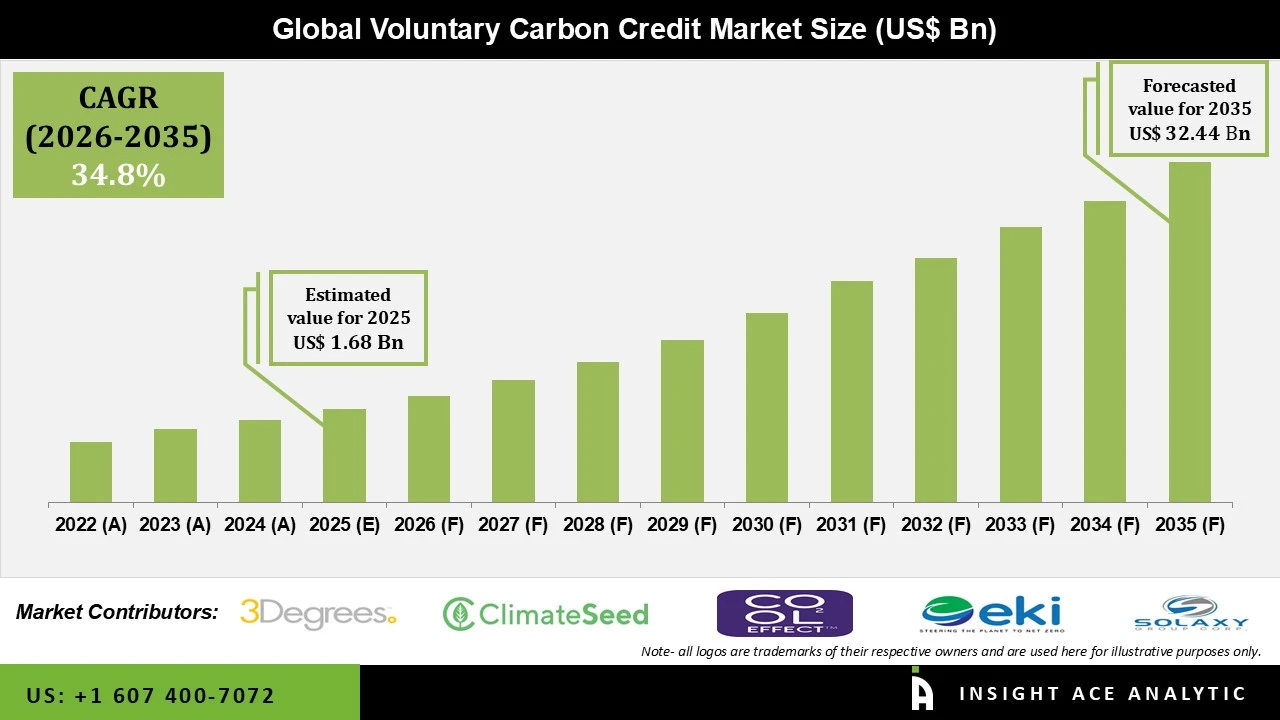
Voluntary Carbon Credit Market Size is valued at USD 1.68 Bn in 2025 and is predicted to reach USD 32.44 Bn by the year 2035 at a 34.8% CAGR during the forecast period for 2026 to 2035.
Voluntary Carbon Credit Market Size, Share & Trends Analysis Distribution by Type of Transaction (Carbon Reduction, Carbon Removal, and Mixed Transaction), Project (Renewable Energy Projects, Methane Capture and Destruction Projects, Forestry and Land Use Projects, Energy Efficiency Projects, and Others), Application (Agriculture Sector, Household Sector, Industrial Sector, Energy Sector, and Others), End-user (Government Agencies / Organizations, Private Companies, Non-Profit Organizations, and Individuals), and Segment Forecasts, 2026 to 2035
Voluntary Carbon Credit Market Key Takeaways:
|
A voluntary carbon credit is a type of environmental commodity that represents one metric ton of carbon dioxide (CO2) or its equivalent in other greenhouse gases removed from the ecosystem. These credits are usually generated by initiatives or tasks that contribute to carbon emission discounts above what is legally required by guidelines or treaties. Voluntary carbon credits are not the same as compliance credits, which are awarded to firms that meet specific legal requirements set by governments or international agreements. The voluntary carbon credit market is growing as companies across numerous industries commit to achieving net-zero targets and enhancing their environmental profiles.
The expansion of corporate social responsibility (CSR) initiatives has led businesses to invest in sustainability projects that satisfy stakeholders and enhance their brand image. The concept of carbon neutrality is driving investments in carbon offset projects worldwide and is increasingly becoming an important part of corporate strategy. This is anticipated to boost the voluntary carbon credit market expansion. Another factor driving the growth of the voluntary carbon market is the increasing importance of carbon credits in achieving sustainability goals as firms and governments recognize the need for dependable incentives for cutting emissions. It is expected that the industry will keep evolving, with a stronger focus on verifiability and credit quality.
In addition, various projects, such as forestry, renewable energy, and energy efficiency programs that support the creation of carbon credits, are driving the voluntary carbon credit market's growth. The market is likely to see advancements in credit tracking and verification as stakeholders become more involved, improving transparency and confidence between buyers and sellers. Additionally, the voluntary carbon credit market is being shaped by corporate sustainability objectives and legal frameworks. Furthermore, there is significant room for innovation in carbon capture and storage technology as international climate commitments grow. According to the International Energy Agency (IEA), scaling up carbon capture technologies will require significant investment in the coming decade, creating a range of opportunities for participants in the voluntary carbon credit market.
Competitive Landscape
Which are the Leading Players in Voluntary Carbon Credit Market?
• 3Degrees
• Earthly
• ClimateSeed
• First Climate
• Green Wedge
• Cool Effect
• Ecologi Impact Funds
• Climate Impact Partners
• EKI Energy Services
• Greenfleet
• The Carbon Collective Company
• natureOffice
• Solaxy Group
• South Pole
Market Dynamics
Driver
Growing Demand for Renewable Energy
The voluntary carbon credit market is anticipated to develop in the future due to the rising demand for renewable energy. Clean energy is in high demand because it protects the environment, improves public health, ensures energy security and independence, and is supported by policies and regulations. The growing need for clean energy encourages investment in renewable energy sources, which reduce emissions and produce carbon credits. These credits support the expansion of green energy and strengthen the carbon market by assisting companies in offsetting their carbon footprint. For instance, the American Clean Power Association, a US-based group, said in March 2024 that the clean power sector in the US had invested close to $80 billion in energy infrastructure and manufacturing. The developers added 49 gigawatts of new domestic capacity, which is 33% more than the 2023 record. Consequently, the voluntary carbon credit market is expanding due to the rising demand for clean energy.
Restrain/Challenge
Inconsistency and Concerns About the Reliability and Quality of Credit
The absence of standards and worries about credit quality and reliability are two significant barriers to the voluntary carbon credit market. The market currently uses a variety of standards, verification organizations, and techniques, which frequently result in inconsistent methods for the production, measurement, and verification of carbon credits. This fragmentation may raise questions about whether some initiatives actually reduce carbon emissions in a significant, long-lasting way. In several instances, purchasers and regulators have expressed doubts about credibility due to reports of overstated carbon savings, duplicate counting, or projects that would have happened even in the absence of carbon credit finance. Because of stakeholder scrutiny and reputational hazards, several businesses are reluctant to rely significantly on voluntary carbon credits for their climate goals.
Carbon Reduction Segment is Expected to Drive the Voluntary Carbon Credit Market
The carbon reduction category held the largest share in the Voluntary Carbon Credit market in 2025, as businesses spend more money on initiatives that directly lower or eliminate greenhouse gas emissions. Initiatives, including the use of renewable energy, energy efficiency enhancements, methane collection, and industrial emission reduction programs, produce carbon reduction credits. The need for premium carbon reduction credits to offset inevitable emissions has increased as businesses across industries adopt science-based targets and net-zero commitments. Because these projects produce quantifiable and provable reductions in emissions, purchasers frequently favor them, making them appealing for corporate sustainability programs. Investments in carbon reduction projects are also being accelerated by favorable international climate legislation, expanding ESG reporting regulations, and greater involvement from private businesses.
Forestry and Land Use Projects Segment is Growing at the Highest Rate in the Voluntary Carbon Credit Market
In 2025, the Forestry and Land Use Projects category dominated the Voluntary Carbon Credit market. The need for carbon offsetting has increased globally due to a significant increase in afforestation and reforestation operations. For instance, according to United Nations figures, almost 5 million hectares of trees were planted worldwide between 2015 and 2020. Reforestation initiatives will increase as environmental health regulations become more robust, which will boost company expansion. Additionally, programs that focus on afforestation, replanting, conservation of wooded areas, and sustainable wooded area management techniques produce forestry-based voluntary carbon credits. By photographing and storing atmospheric carbon dioxide in shrubs and woodland area ecosystems, these activities help to prevent climate change.
Why North America Led the Voluntary Carbon Credit Market?
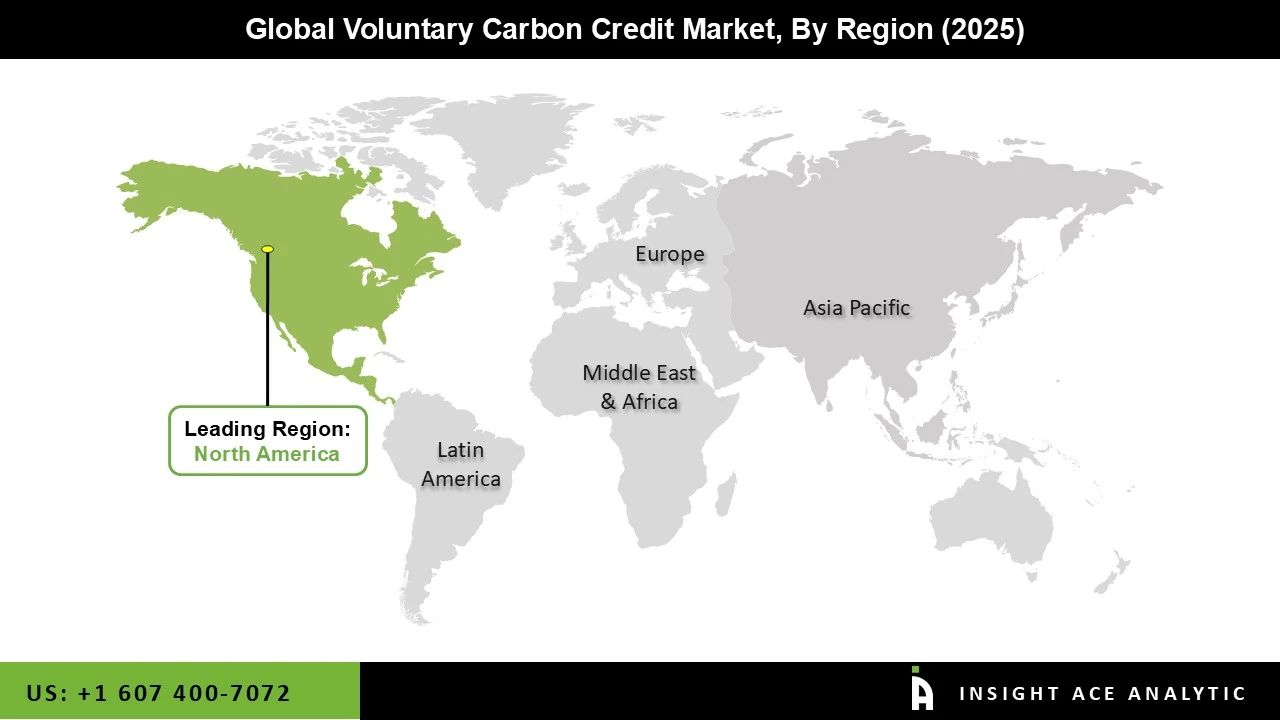
The Voluntary Carbon Credit market was dominated by North America region in 2025. Stricter environmental laws, business sustainability pledges, and rising consumer consciousness are the main drivers of the region's expansion. The main contributors are the United States and Canada, which have a strong framework that supports investments in renewable energy and carbon offset projects. Additionally, the key companies like Verra, Climate Action Reserve, and American Carbon Registry dominate the voluntary carbon credit market. These groups play a crucial role in creating certificates and standards for carbon credits. Furthermore, innovative startups and well-established businesses improve market dynamics, encouraging cooperation and funding for carbon offset projects. The region's dedication to combating climate change is further demonstrated by the numerous state-level programs that support carbon neutrality.
Key Development
July 2025: South Pole (CH) expanded its advice skills by acquiring a regional carbon consulting firm. Because it enables South Pole (CH) to provide a wider range of services, including project development and carbon credit certification, this acquisition is strategically significant. Increased client loyalty and a stronger competitive edge in the increasingly competitive market could result from such vertical integration.
April 2025: Microsoft and BTG Pactual TIG reached a significant agreement for 8 million carbon reduction credits, the biggest deal of its kind. Additionally, the corporation increased its efforts to reduce soil carbon by purchasing 40,000 verified credits from Indigo Ag. Both initiatives help Microsoft achieve its goal of becoming carbon negative by 2030.
September 2024: The ERM Carbon Credit Portal was introduced by the UK-based sustainability consultant ERM International Group Limited in order to make it easier for clients to enter the voluntary carbon market. By streamlining the carbon credit selection and purchase procedure, this effort hopes to help businesses effectively supplement their strategies for reducing greenhouse gas emissions. Transparency and confidence in the carbon credit purchase process are increased by the portal's pre-screened projects, which enable users to assess climate benefits and related risks.ERM's larger plan to assist corporate decarbonization initiatives includes this launch.
July 2024: Verra's initiatives to provide high-quality credits for reforestation and ecosystem restoration projects will make the ABACUS Label accessible. Since it is considerably simpler to account for emission reductions with this label, it is expected that the voluntary market will increase the credibility of carbon credits. Additionally, the reporting of carbon credits will benefit from this growth since it will promote cutting-edge technology to eliminate greenhouse gases, enhance quality, and stimulate verification.
November 2023: Trove Research was purchased by MSCI Inc., a US-based company that offers vital decision support tools and solutions to the international investment community, for an unknown sum. The purchase intends to improve MSCI's data and analytics capabilities in the voluntary carbon markets, giving customers all-inclusive tools to control carbon emissions and promote sustainability objectives across industries. Trove Research is a UK-based data, analysis, and advisory organization that specializes in voluntary carbon markets and corporate climate action.
Voluntary Carbon Credit Market Report Scope:
| Report Attribute | Specifications |
| Market size value in 2025 | USD 1.68 Bn |
| Revenue forecast in 2035 | USD 32.44 Bn |
| Growth Rate CAGR | CAGR of 34.8% from 2026 to 2035 |
| Quantitative Units | Representation of revenue in US$ Bn and CAGR from 2026 to 2035 |
| Historic Year | 2022 to 2025 |
| Forecast Year | 2026-2035 |
| Report Coverage | The forecast of revenue, the position of the company, the competitive market structure, growth prospects, and trends |
| Segments Covered | Type of Transaction, Project, Application, End-user, and By Region |
| Regional Scope | North America; Europe; Asia Pacific; Latin America; Middle East & Africa |
| Country Scope | U.S.; Canada; U.K.; Germany; China; India; Japan; Brazil; Mexico; The UK; France; Italy; Spain; China; Japan; India; South Korea; Southeast Asia; South Korea; Southeast Asia |
| Competitive Landscape | 3Degrees, Earthly, ClimateSeed, First Climate, Green Wedge, Cool Effect, Ecologi Impact Funds, Climate Impact Partners, EKI Energy Services, Greenfleet, The Carbon Collective Company, natureOffice, Solaxy Group, and South Pole |
| Customization Scope | Free customization report with the procurement of the report, Modifications to the regional and segment scope. Geographic competitive landscape. |
| Pricing and Available Payment Methods | Explore pricing alternatives that are customized to your particular study requirements. |
Voluntary Carbon Credit Market Segmentation:
Voluntary Carbon Credit Market by Type of Transaction-
- Carbon Reduction
- Carbon Removal
- Mixed Transaction
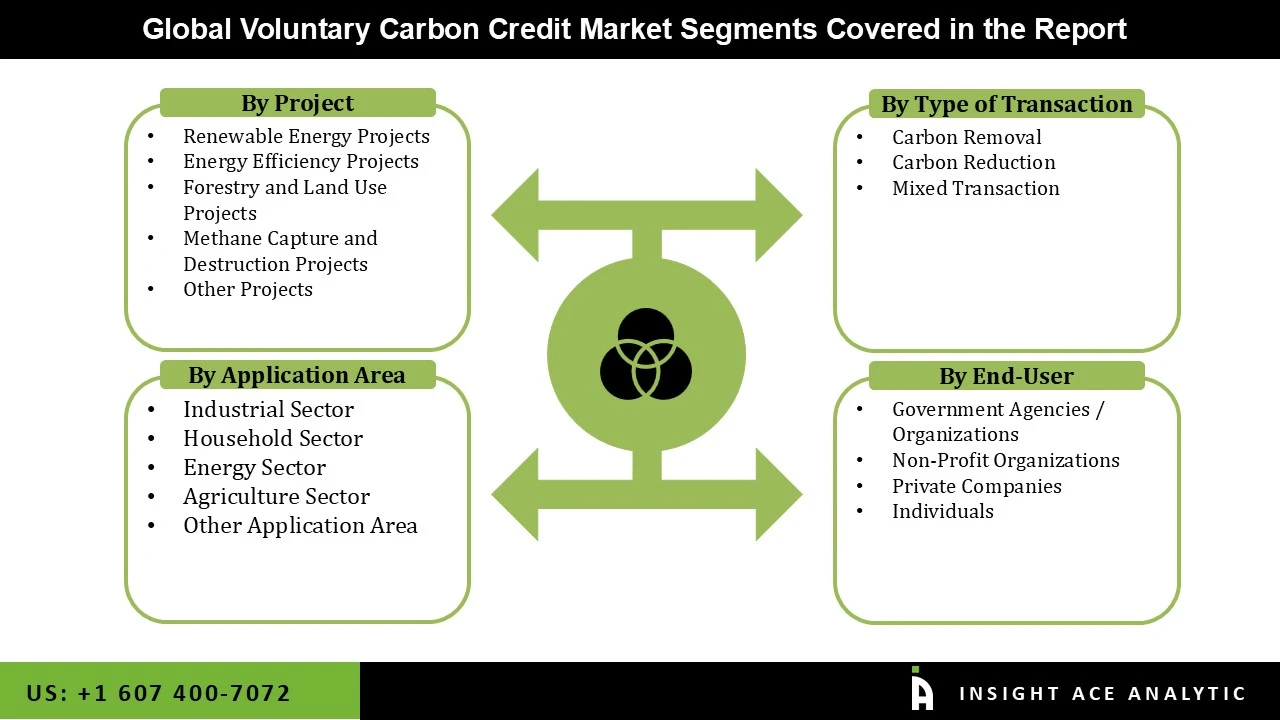
Voluntary Carbon Credit Market by Project-
- Renewable Energy Projects
- Methane Capture and Destruction Projects
- Forestry and Land Use Projects
- Energy Efficiency Projects
- Others
Voluntary Carbon Credit Market by Application-
- Agriculture Sector
- Household Sector
- Industrial Sector
- Energy Sector
- Others
Voluntary Carbon Credit Market by End-user-
- Government Agencies / Organizations
- Private Companies
- Non-Profit Organizations
- Individuals
Voluntary Carbon Credit Market, By Region-
- North America-
-
- The US
- Canada
- Europe-
-
- Germany
- France
- The UK
- Italy
- Spain
- Rest of Europe
- Asia-Pacific-
-
- China
- Japan
- India
- South Korea
- South East Asia
- Rest of Asia Pacific
- Latin America-
-
- Brazil
- Argentina
- Mexico
- Rest of Latin America
- Middle East & Africa-
-
- GCC Countries
- South Africa
- Rest of Middle East and Africa
Research Design and Approach
This study employed a multi-step, mixed-method research approach that integrates:
- Secondary research
- Primary research
- Data triangulation
- Hybrid top-down and bottom-up modelling
- Forecasting and scenario analysis
This approach ensures a balanced and validated understanding of both macro- and micro-level market factors influencing the market.
Secondary Research
Secondary research for this study involved the collection, review, and analysis of publicly available and paid data sources to build the initial fact base, understand historical market behaviour, identify data gaps, and refine the hypotheses for primary research.
Sources Consulted
Secondary data for the market study was gathered from multiple credible sources, including:
- Government databases, regulatory bodies, and public institutions
- International organizations (WHO, OECD, IMF, World Bank, etc.)
- Commercial and paid databases
- Industry associations, trade publications, and technical journals
- Company annual reports, investor presentations, press releases, and SEC filings
- Academic research papers, patents, and scientific literature
- Previous market research publications and syndicated reports
These sources were used to compile historical data, market volumes/prices, industry trends, technological developments, and competitive insights.

Primary Research
Primary research was conducted to validate secondary data, understand real-time market dynamics, capture price points and adoption trends, and verify the assumptions used in the market modelling.
Stakeholders Interviewed
Primary interviews for this study involved:
- Manufacturers and suppliers in the market value chain
- Distributors, channel partners, and integrators
- End-users / customers (e.g., hospitals, labs, enterprises, consumers, etc., depending on the market)
- Industry experts, technology specialists, consultants, and regulatory professionals
- Senior executives (CEOs, CTOs, VPs, Directors) and product managers
Interview Process
Interviews were conducted via:
- Structured and semi-structured questionnaires
- Telephonic and video interactions
- Email correspondences
- Expert consultation sessions
Primary insights were incorporated into demand modelling, pricing analysis, technology evaluation, and market share estimation.
Data Processing, Normalization, and Validation
All collected data were processed and normalized to ensure consistency and comparability across regions and time frames.
The data validation process included:
- Standardization of units (currency conversions, volume units, inflation adjustments)
- Cross-verification of data points across multiple secondary sources
- Normalization of inconsistent datasets
- Identification and resolution of data gaps
- Outlier detection and removal through algorithmic and manual checks
- Plausibility and coherence checks across segments and geographies
This ensured that the dataset used for modelling was clean, robust, and reliable.
Market Size Estimation and Data Triangulation
Bottom-Up Approach
The bottom-up approach involved aggregating segment-level data, such as:
- Company revenues
- Product-level sales
- Installed base/usage volumes
- Adoption and penetration rates
- Pricing analysis
This method was primarily used when detailed micro-level market data were available.

Top-Down Approach
The top-down approach used macro-level indicators:
- Parent market benchmarks
- Global/regional industry trends
- Economic indicators (GDP, demographics, spending patterns)
- Penetration and usage ratios
This approach was used for segments where granular data were limited or inconsistent.
Hybrid Triangulation Approach
To ensure accuracy, a triangulated hybrid model was used. This included:
- Reconciling top-down and bottom-up estimates
- Cross-checking revenues, volumes, and pricing assumptions
- Incorporating expert insights to validate segment splits and adoption rates
This multi-angle validation yielded the final market size.
Forecasting Framework and Scenario Modelling
Market forecasts were developed using a combination of time-series modelling, adoption curve analysis, and driver-based forecasting tools.
Forecasting Methods
- Time-series modelling
- S-curve and diffusion models (for emerging technologies)
- Driver-based forecasting (GDP, disposable income, adoption rates, regulatory changes)
- Price elasticity models
- Market maturity and lifecycle-based projections
Scenario Analysis
Given inherent uncertainties, three scenarios were constructed:
- Base-Case Scenario: Expected trajectory under current conditions
- Optimistic Scenario: High adoption, favourable regulation, strong economic tailwinds
- Conservative Scenario: Slow adoption, regulatory delays, economic constraints
Sensitivity testing was conducted on key variables, including pricing, demand elasticity, and regional adoption.
Request Customization
Add countries, segments, company profiles, or extend forecast — free 10% customization with purchase.
Customize This Report →Enquire Before Buying
Speak with our analyst team about scope, methodology, pricing, or deliverable formats.
Enquire Now →Frequently Asked Questions
Voluntary Carbon Credit Market Size is valued at USD 1.68 Bn in 2025 and is predicted to reach USD 32.44 Bn by the year 2035
Voluntary Carbon Credit Market is expected to grow at a 34.8% CAGR during the forecast period for 2026 to 2035.
3Degrees, Earthly, ClimateSeed, First Climate, Green Wedge, Cool Effect, Ecologi Impact Funds, Climate Impact Partners, EKI Energy Services, Greenfleet, The Carbon Collective Company, natureOffice, Solaxy Group, and South Pole
Voluntary Carbon Credit Market is segmented into Type of Transaction, Project, Application, End-user, and By Region
North America region is leading the Voluntary Carbon Credit Market