Smart Building Water Efficiency and Leak Detection Solutions Market Report 2026 to 2035
What is Smart Building Water Efficiency and Leak Detection Solutions Market Size?
Smart Building Water Efficiency and Leak Detection Solutions Market Size is predicted to develop at a 8.8% CAGR during the forecast period for 2026 to 2035.
Smart Building Water Efficiency & Leak Detection Solutions Market Size, Share & Trends Analysis Distribution by Product Type (Flow-Based Leak Detection & Monitoring Systems, Point Leak Detection Sensors, Smart Shutoff & Water Control Devices, Smart Water Submetering Systems, Water Efficiency & Optimization Software, Integrated Smart Building Water Management Platforms), By End User (Commercial Buildings, Multifamily Residential, Healthcare & Life Sciences Facilities, Data Centers & Mission-Critical Facilities, Industrial & Manufacturing Facilities, Educational & Institutional Buildings, Construction & Infrastructure Projects) and Segment Forecasts, 2026 to 2035
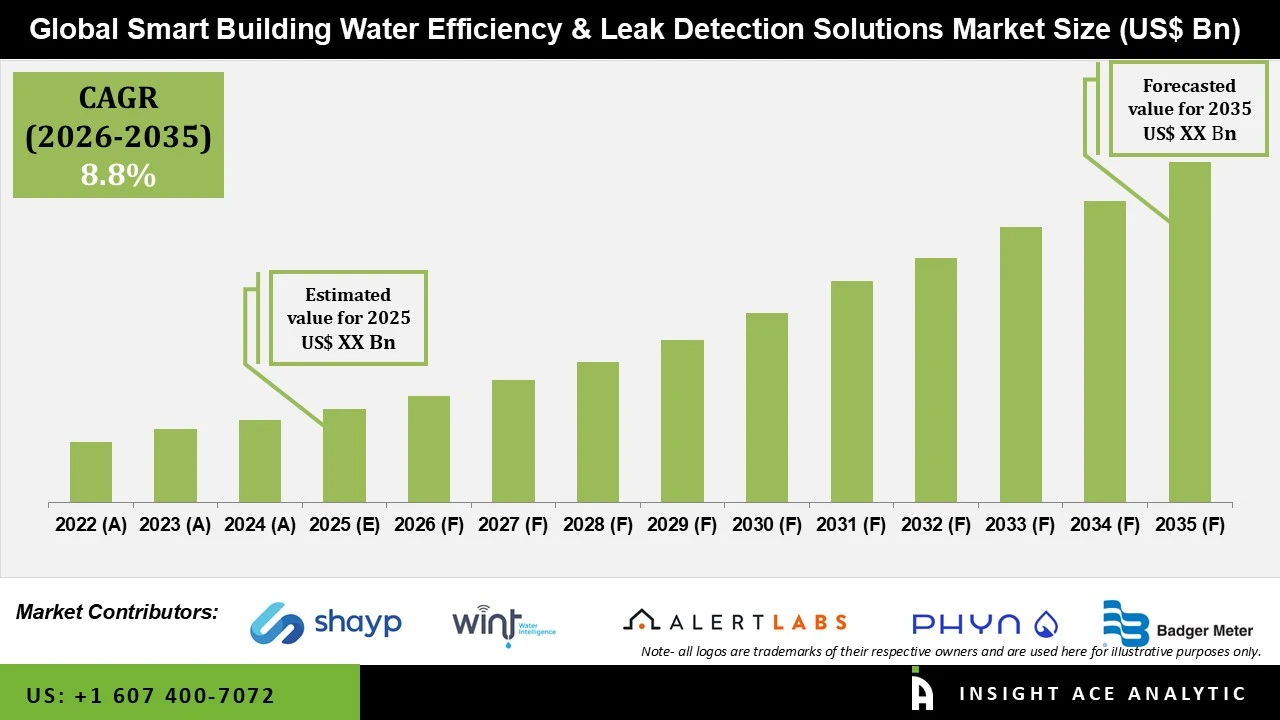
The smart building water efficiency and leak detection solutions market is emerging as a segment in the smart building space, driven by increasing water scarcity and the need for smart resource management. Smart building water-efficiency and leak-detection solutions include an array of IoT-enabled sensors, smart water meters, acoustic, ultrasonic, and other types of leak-detection systems, AI-based analysis solutions, cloud-based dashboards, and smart shut-off valves that monitor water consumption patterns in buildings. Smart building water efficiency and leak detection solutions can monitor water consumption patterns, detect anomalies such as water leaks, and alert management to take appropriate measures, which is not possible with traditional water management systems that rely on manual observations or bill analysis.
Such solutions are used in residential, commercial, healthcare, hospitality, industrial, and data center environments, where the efficient management of water and the protection of the water infrastructure are critical. In the residential and commercial sectors, the solutions help monitor and achieve sustainability goals, while in the healthcare and hospitality sectors, they support achieving higher levels of hygiene and cost savings, respectively. In the industrial sector, advanced leak detection systems are used to protect operations and equipment. The market's growth is driven by increasing water scarcity, the effects of climate change, and the implementation of sustainability regulations that promote the efficient use of water. However, the main challenges facing the market are the high costs associated with the initial setup of the necessary sensors, network, and software, which may act as a barrier to the adoption of the solutions, especially in the hands of small property owners, despite the benefits associated with the efficient management of water.
Competitive Landscape
Which are the Leading Players in the Smart Building Water Efficiency & Leak Detection Solutions Market?
AI Water Monitoring & Efficiency Platforms Companies
• Shayp
• WINT Water Intelligence
• APANA
• Banyan Water
• Droople
• Aquicore
• WaterSignal
Flow-Based Leak Detection & Monitoring Companies
• Alert Labs
• Phyn
• Kairos
• Badger Meter
Non-Intrusive Metering & Retrofit Monitoring Companies
• Smartvatten
• Metron
• LeakSense
Point Leak Detection & Sensor Networks Companies
• LAIIER
• The Detection Group
• Aqualeak
• RLE Technologies
Smart Shutoff & Water Control Systems Companies
• Flo by Moen
• LeakSmart
• Phyn
Integrated Smart Building & Water Intelligence Platforms Companies
• Schneider Electric
• Siemens
• Johnson Controls
• Honeywell
• Xylem
• Aquasight
Market Dynamics
Driver
Rising Demand for Sustainable and Nutrient-Dense Diets
Rising water scarcity, intensified by climate change, is a key driver of the smart building water efficiency and leak detection solutions market. In fact, currently, over 2 billion people across the world live in areas where there is already water scarcity, and this is expected to increase with rapid urbanization and changing rain patterns, thereby resulting in reduced freshwater availability. Buildings alone account for nearly 12% of global freshwater withdrawals, with up to 30% being wasted through undetected leaks and inefficient management, which is being addressed through tiered pricing, consumption limits, and penalties.
Restrain/Challenge
High Upfront Capital Investment
High upfront capital investment is a key restraint limiting the adoption of smart building water efficiency and leak detection solutions. Deployment requires substantial spending on hardware such as sensors, flow meters, leak detectors, and automated valves, along with network infrastructure, cloud-based monitoring platforms, and professional installation. Retrofitting older buildings and integrating systems with existing building management platforms can further increase costs. These financial barriers particularly affect small and medium property owners and operators in regions with lower water tariffs, while longer payback periods often discourage investment despite potential long-term savings.
Flow-Based Leak Detection & Monitoring Systems Segment is Expected to Drive the Smart Building Water Efficiency & Leak Detection Solutions Market
Flow-Based Leak Detection & Monitoring Systems are expected to hold a significant market share in the future, owing to their ability to monitor water flow across entire building pipeline infrastructures and detect abnormal usage patterns, thus preventing leakages. These systems are commonly used in residential, commercial, and industrial buildings, as they provide real-time information, leak detection, and valuable insights to minimize water consumption. Moreover, the increased use of IoT-enabled smart water meters and the need for predictive solutions are also driving the use of flow-based leak detection systems. These systems can monitor large water infrastructures, thus making them an essential part of smart water management solutions.
Data Centers & Mission-Critical Facilities Segment is Growing at the Highest Rate in the Smart Building Water Efficiency & Leak Detection Solutions Market
The data centers & mission-critical facilities segment is expected to experience the highest growth rate in the smart building water efficiency and leak detection solutions market. This is because these facilities make heavy usage of water-based cooling systems and house highly sensitive equipment, rendering the facilities extremely vulnerable to any kind of water leakages. The growth rate of data centers worldwide is increasing at a tremendous pace due to the ever-increasing need for cloud computing, artificial intelligence, and other forms of digital technologies. This is why the need for the adoption of smart leak detection sensors and real-time monitoring systems is also increasing at a tremendous rate in this segment.
Why North America Led the Smart Building Water Efficiency & Leak Detection Solutions Market?
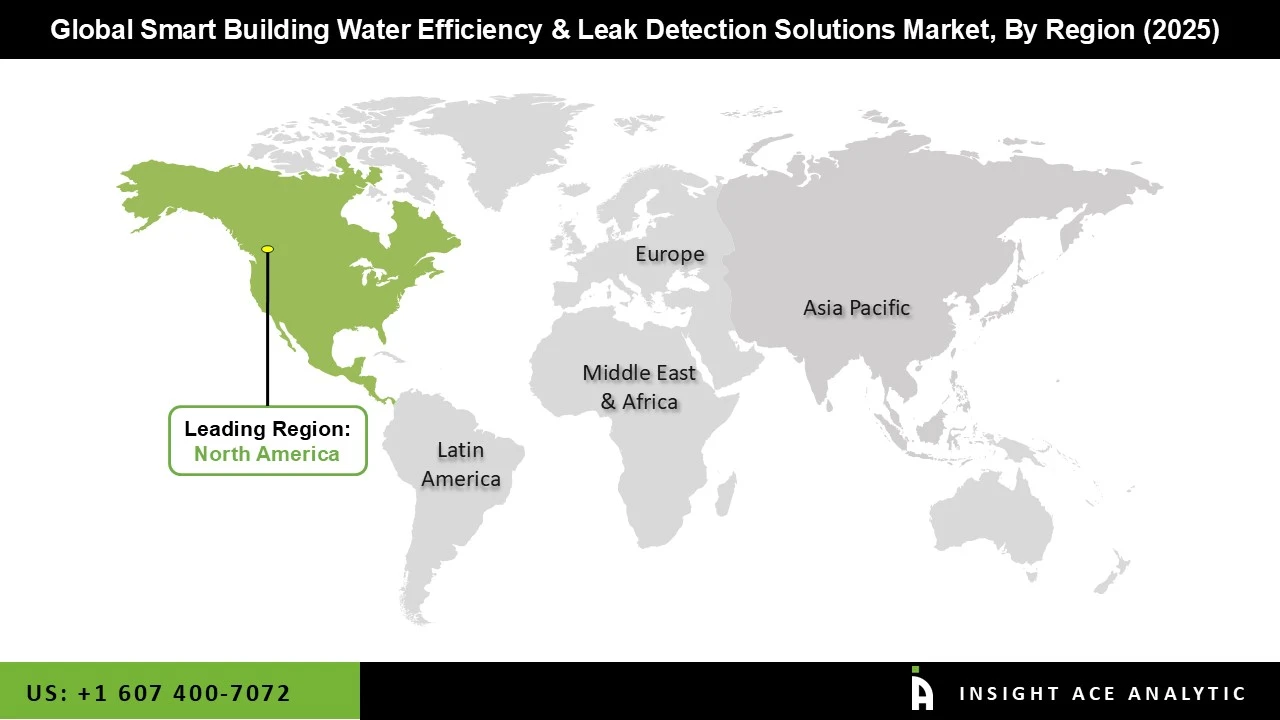
North America is currently leading the smart building water efficiency and leak detection solutions market, owing to the early adoption of smart building solutions, strong regulations, and high awareness of sustainability practices. North America has a large number of commercial buildings, data centers, and infrastructure, which are being increasingly equipped with IoT-based water usage monitoring solutions. Moreover, increasing water bills, stringent environmental regulations, and the presence of key technology providers and smart building solution companies are also driving the market in this region. These factors make North America the leading region in the Smart Building Water Efficiency and Leak Detection Solutions Market.
Key Development
• September 2025: Mexico City and Monterrey partnered with Xylem and Amazon to deploy the Xylem Vue analytics platform to improve water management and reduce water losses. The initiative aims to detect leaks and optimize water supply systems, helping save over 1.3 billion liters of water annually, including around 800 million liters in Mexico City and 560 million liters in Monterrey. The project is expected to strengthen water infrastructure resilience in these drought-affected and rapidly urbanizing cities.
Smart Building Water Efficiency & Leak Detection Solutions Market Report Scope:
| Report Attribute | Specifications |
| Growth Rate CAGR | CAGR of 8.8% from 2026 to 2035 |
| Quantitative Units | Representation of revenue in US$ Bn and CAGR from 2026 to 2035 |
| Historic Year | 2021 to 2025 |
| Forecast Year | 2026-2035 |
| Report Coverage | The forecast of revenue, the position of the company, the competitive market structure, growth prospects, and trends |
| Segments Covered | Product Type, End-User and By Region |
| Regional Scope | North America; Europe; Asia Pacific; Latin America; Middle East & Africa |
| Country Scope | U.S.; Canada; U.K.; Germany; China; India; Japan; Brazil; Mexico; The UK; France; Italy; Spain; China; Japan; India; South Korea; Southeast Asia; South Korea; Southeast Asia |
| Competitive Landscape | Shayp, WINT Water Intelligence, APANA, Banyan Water, Droople, Aquicore, WaterSignal, Alert Labs, Phyn, Kairos, Badger Meter, Smartvatten, Metron, LeakSense, Flo by Moen, LeakSmart, Phyn, Schneider Electric, Siemens, Johnson Controls, Honeywell, Xylem, Aquas, Schneider Electric, Siemens, Johnson Controls, Honeywell, Xylem, Aquasight |
| Customization Scope | Free customization report with the procurement of the report, Modifications to the regional and segment scope. Geographic competitive landscape. |
| Pricing and Available Payment Methods | Explore pricing alternatives that are customized to your particular study requirements. |
Smart Building Water Efficiency & Leak Detection Solutions Market Segmentation:
Smart Building Water Efficiency & Leak Detection Solutions Market by Product Type -
• Flow-Based Leak Detection & Monitoring Systems
o Inline flow monitoring devices
o AI anomaly detection platforms
o Pressure & flow monitoring units
• Point Leak Detection Sensors
o Moisture & spot leak sensors
o Rope/cable leak detection systems
o Condensate & humidity sensors
• Smart Shutoff & Water Control Devices
o Automatic shutoff valves
o Remote flow control systems
o Emergency isolation controllers
• Smart Water Submetering Systems
o Unit-level smart meters
o Zone-level monitoring meters
o Consumption tracking systems
• Water Efficiency & Optimization Software
o Water usage analytics platforms
o ESG & sustainability reporting tools
o Predictive maintenance & optimization software
• Integrated Smart Building Water Management Platforms
o BMS-integrated water monitoring
o Digital twin & building optimization systems
o Enterprise building intelligence platforms
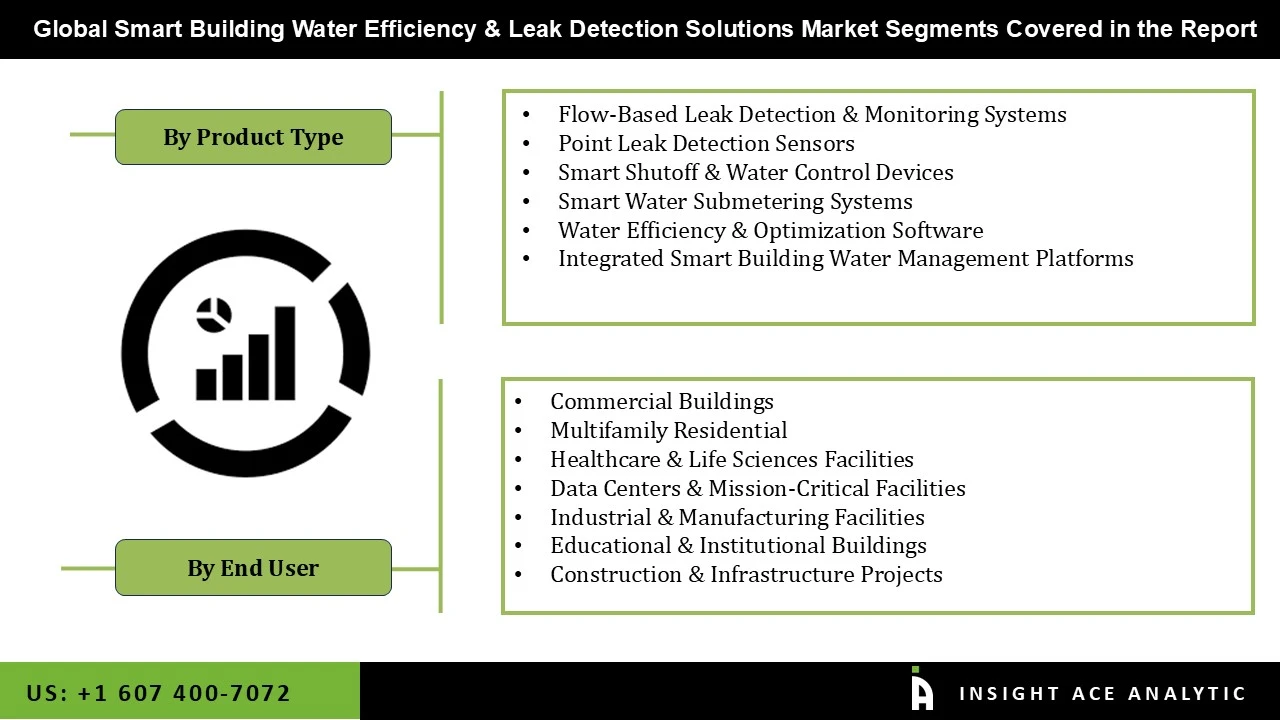
Smart Building Water Efficiency & Leak Detection Solutions Market by End User-
• Commercial Buildings
• Multifamily Residential
• Healthcare & Life Sciences Facilities
• Data Centers & Mission-Critical Facilities
• Industrial & Manufacturing Facilities
• Educational & Institutional Buildings
• Construction & Infrastructure Projects
Smart Building Water Efficiency & Leak Detection Solutions Market by Region-
North America-
• The US
• Canada
Europe-
• Germany
• The UK
• France
• Italy
• Spain
• Rest of Europe
Asia-Pacific-
• China
• Japan
• India
• South Korea
• South East Asia
• Rest of Asia Pacific
Latin America-
• Brazil
• Argentina
• Mexico
• Rest of Latin America
Middle East & Africa-
• GCC Countries
• South Africa
• Rest of Middle East and Africa
Research Design and Approach
This study employed a multi-step, mixed-method research approach that integrates:
- Secondary research
- Primary research
- Data triangulation
- Hybrid top-down and bottom-up modelling
- Forecasting and scenario analysis
This approach ensures a balanced and validated understanding of both macro- and micro-level market factors influencing the market.
Secondary Research
Secondary research for this study involved the collection, review, and analysis of publicly available and paid data sources to build the initial fact base, understand historical market behaviour, identify data gaps, and refine the hypotheses for primary research.
Sources Consulted
Secondary data for the market study was gathered from multiple credible sources, including:
- Government databases, regulatory bodies, and public institutions
- International organizations (WHO, OECD, IMF, World Bank, etc.)
- Commercial and paid databases
- Industry associations, trade publications, and technical journals
- Company annual reports, investor presentations, press releases, and SEC filings
- Academic research papers, patents, and scientific literature
- Previous market research publications and syndicated reports
These sources were used to compile historical data, market volumes/prices, industry trends, technological developments, and competitive insights.

Primary Research
Primary research was conducted to validate secondary data, understand real-time market dynamics, capture price points and adoption trends, and verify the assumptions used in the market modelling.
Stakeholders Interviewed
Primary interviews for this study involved:
- Manufacturers and suppliers in the market value chain
- Distributors, channel partners, and integrators
- End-users / customers (e.g., hospitals, labs, enterprises, consumers, etc., depending on the market)
- Industry experts, technology specialists, consultants, and regulatory professionals
- Senior executives (CEOs, CTOs, VPs, Directors) and product managers
Interview Process
Interviews were conducted via:
- Structured and semi-structured questionnaires
- Telephonic and video interactions
- Email correspondences
- Expert consultation sessions
Primary insights were incorporated into demand modelling, pricing analysis, technology evaluation, and market share estimation.
Data Processing, Normalization, and Validation
All collected data were processed and normalized to ensure consistency and comparability across regions and time frames.
The data validation process included:
- Standardization of units (currency conversions, volume units, inflation adjustments)
- Cross-verification of data points across multiple secondary sources
- Normalization of inconsistent datasets
- Identification and resolution of data gaps
- Outlier detection and removal through algorithmic and manual checks
- Plausibility and coherence checks across segments and geographies
This ensured that the dataset used for modelling was clean, robust, and reliable.
Market Size Estimation and Data Triangulation
Bottom-Up Approach
The bottom-up approach involved aggregating segment-level data, such as:
- Company revenues
- Product-level sales
- Installed base/usage volumes
- Adoption and penetration rates
- Pricing analysis
This method was primarily used when detailed micro-level market data were available.

Top-Down Approach
The top-down approach used macro-level indicators:
- Parent market benchmarks
- Global/regional industry trends
- Economic indicators (GDP, demographics, spending patterns)
- Penetration and usage ratios
This approach was used for segments where granular data were limited or inconsistent.
Hybrid Triangulation Approach
To ensure accuracy, a triangulated hybrid model was used. This included:
- Reconciling top-down and bottom-up estimates
- Cross-checking revenues, volumes, and pricing assumptions
- Incorporating expert insights to validate segment splits and adoption rates
This multi-angle validation yielded the final market size.
Forecasting Framework and Scenario Modelling
Market forecasts were developed using a combination of time-series modelling, adoption curve analysis, and driver-based forecasting tools.
Forecasting Methods
- Time-series modelling
- S-curve and diffusion models (for emerging technologies)
- Driver-based forecasting (GDP, disposable income, adoption rates, regulatory changes)
- Price elasticity models
- Market maturity and lifecycle-based projections
Scenario Analysis
Given inherent uncertainties, three scenarios were constructed:
- Base-Case Scenario: Expected trajectory under current conditions
- Optimistic Scenario: High adoption, favourable regulation, strong economic tailwinds
- Conservative Scenario: Slow adoption, regulatory delays, economic constraints
Sensitivity testing was conducted on key variables, including pricing, demand elasticity, and regional adoption.
Request Customization
Add countries, segments, company profiles, or extend forecast — free 10% customization with purchase.
Customize This Report →Enquire Before Buying
Speak with our analyst team about scope, methodology, pricing, or deliverable formats.
Enquire Now →Frequently Asked Questions
Smart Building Water Efficiency and Leak Detection Solutions Market Size is predicted to develop at a 8.8% CAGR during the forecast period for 2026 to 2035.
Shayp, WINT Water Intelligence, APANA, Banyan Water, Droople, Aquicore, WaterSignal, Alert Labs, Phyn, Kairos, Badger Meter, Smartvatten, Metron, LeakSense, Flo by Moen, LeakSmart, Phyn, Schneider Electric, Siemens, Johnson Controls, Honeywell, Xylem, Aquas, Schneider Electric, Siemens, Johnson Controls, Honeywell, Xylem, Aquasight
Smart Building Water Efficiency and Leak Detection Solutions Market is segmented into Product Type, End-User and By Region
North America region is leading the Smart Building Water Efficiency and Leak Detection Solutions Market.