Cobrowsing Market Size, Scope, Forecast Report 2026 to 2035
What is Cobrowsing Market Size?
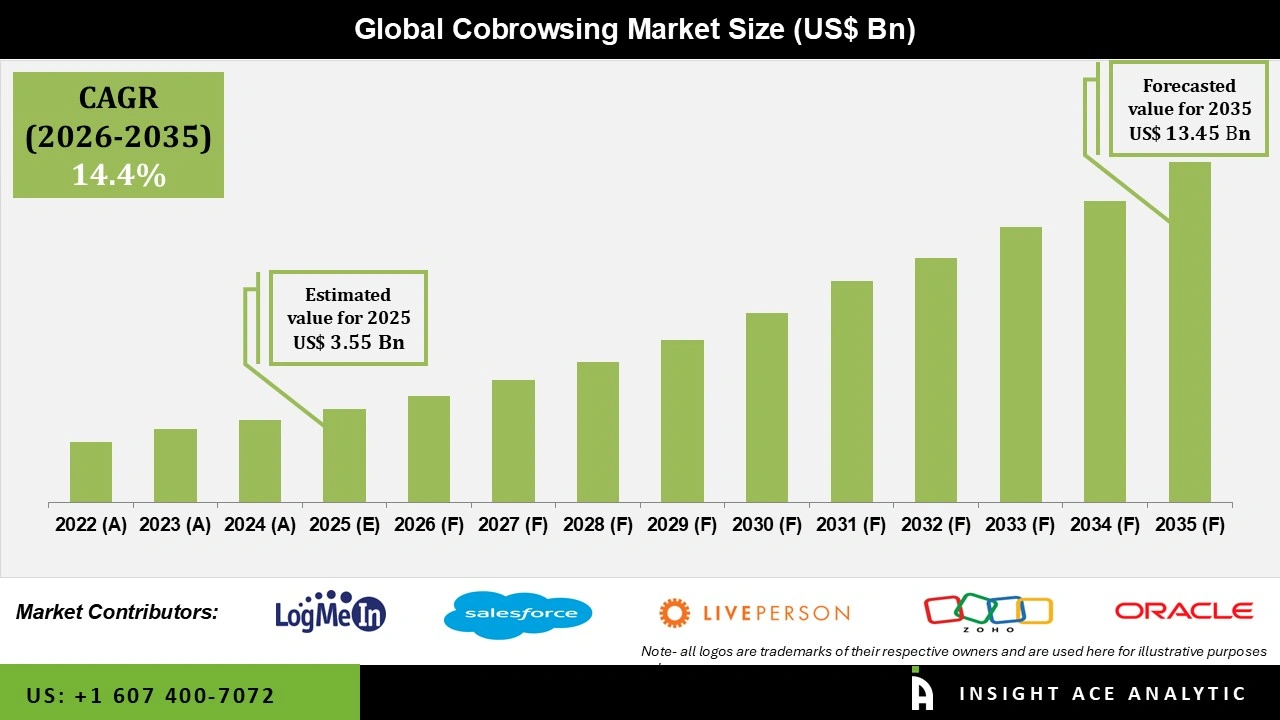
Global Cobrowsing Market Size is valued at USD 3.55 Bn in 2025 and is predicted to reach USD 13.45 Bn by the year 2035 at a 14.4 % CAGR during the forecast period for 2026 to 2035.
Cobrowsing Market Size, Share & Trends Analysis Distribution by Application (Customer Support, Sales Assistance, Remote Training, Technical Support), by Deployment Mode (Cloud-based, On-premises), by End Use Industry (E-commerce, Healthcare, Education, Financial Services, Telecommunications), by User Type (Individual Users, Small Business, Large Enterprises) and Segment Forecasts, 2026 to 2035.
Cobrowsing, also known as collaborative browsing, enables a customer and a support agent to view and interact with the same webpage or digital application in real time during a support session. Unlike traditional screen sharing, cobrowsing is designed to limit visibility to the relevant browser page or application interface, helping protect sensitive desktop content and improve privacy. It allows agents to guide customers through forms, digital onboarding, payments, account setup, troubleshooting, product selection, and other online journeys without requiring full device access.
The market is gaining momentum as businesses across banking, insurance, healthcare, retail, telecom, travel, technology, and government services focus on improving digital customer support. Customers increasingly expect fast, personalized, and frictionless assistance when using online services. Cobrowsing helps support teams resolve issues faster by allowing agents to visually guide customers, highlight page elements, assist with navigation, and reduce confusion during complex digital interactions.
The market is also supported by the growth of digital banking, e-commerce, telehealth, online insurance, remote technical support, and self-service portals. Businesses are integrating cobrowsing with live chat, voice, video, CRM systems, contact center platforms, and customer engagement tools to deliver more connected support experiences. Features such as data masking, permission-based access, session recording, co-annotation, analytics, mobile support, and secure cloud deployment are improving adoption across regulated and customer-facing industries.The rise of digital banking, telehealth, online shopping, remote support, and self-service tools is also boosting the cobrowsing market. More businesses are adding cobrowsing to their support systems to offer better, more interactive help while keeping security high. Software companies and tech providers are investing in new features that make teamwork easier, lower support costs, and build stronger customer relationships. As companies focus on smooth digital experiences, cobrowsing is likely to grow in both developed and emerging markets. Even with a positive outlook, the market has some challenges. Many companies need to make sure cobrowsing meets strict privacy, security, and legal rules, especially in banking and healthcare. Connecting cobrowsing to current support systems, CRM tools, and older software can take extra money and technical skill.
Competitive Landscape
Which are the Leading Players in the Cobrowsing Market?
- LogMeIn (US)
- Salesforce (US)
- TeamViewer (DE)
- LivePerson (US)
- Zoho (IN)
- Oracle (US)
- Cisco (US)
- HelpCrunch (UA)
- Bold360 (US)
Market Dynamics
Driver
Growing Demand for Real-Time Digital Customer Support and Personalised Assistance
One of the main factors driving the cobrowsing market is the increasing need for businesses to deliver faster, more personalised customer support across digital channels. As more services move online, customers expect quick and hassle-free assistance when completing tasks such as filling out forms, making payments, opening accounts, or resolving technical issues. Cobrowsing allows support agents to securely view and guide customers through a shared browser session in real time without taking control of the customer’s device. This helps reduce confusion, improve first-contact resolution, and create a smoother customer experience. Industries like banking, insurance, healthcare, retail, telecom, travel, and government are using cobrowsing to boost customer engagement while keeping privacy and security in mind. As digital banking, e-commerce, telehealth, and online customer service become more common, and as people expect faster support, the need for secure and interactive cobrowsing platforms keeps rising.
Restrain/Challenge
Privacy Concerns, Security Requirements, and Integration Complexity
Even though the cobrowsing market is growing, organisations face some challenges. Because co-browsing shares a customer’s browser session, businesses must protect sensitive information such as passwords, payment details, and personal data. To meet privacy laws and industry rules, companies need strong encryption, data masking, and secure session management, which can make implementation more expensive. It can also be difficult to connect cobrowsing tools with current customer service platforms, CRM systems, live chat, and contact centre software. Companies need to train support teams to use these tools effectively and maintain a smooth customer experience. For small and medium businesses, the cost and technical effort required to set up co-browsing can slow adoption.
Access Control Systems Segment is Expected to Drive the Data Center Physical Security Market
Cloud-based deployment is expected to hold a significant share of the cobrowsing market during the forecast period. Cloud solutions are easier to deploy, require lower upfront investment, and can scale quickly as customer service operations grow. They also allow businesses to support remote agents, manage multiple locations, and receive regular software updates without maintaining complex on-premises infrastructure. As organisations continue to adopt cloud-based customer engagement platforms and digital contact centres, demand for cloud-based co-browsing solutions is expected to grow steadily across industries.
Banking, Financial Services, and Insurance (BFSI) Segment is Expected to Drive the Cobrowsing Market
The BFSI sector is expected to remain one of the largest users of cobrowsing technology. Banks, insurance companies, and financial institutions increasingly rely on digital channels for customer onboarding, loan applications, account management, investment services, and claims processing. Cobrowsing enables customer service representatives to guide users through complex online processes while maintaining security and regulatory compliance. As digital banking continues to expand and financial institutions focus on improving customer experience, reducing support time, and increasing adoption of online services, demand for cobrowsing solutions in the BFSI sector is expected to remain strong.
Why North America Leads the Cobrowsing Market?
North America continues to lead the cobrowsing market due to its advanced digital infrastructure, high adoption of cloud technologies, and strong focus on delivering exceptional customer experiences. The region has numerous technology companies, financial institutions, healthcare providers, telecommunications firms, and e-commerce businesses that actively invest in digital customer engagement solutions. Businesses across the United States and Canada are increasingly adopting AI-powered customer support platforms, omnichannel communication tools, and cloud-based contact centres, creating strong demand for cobrowsing solutions.
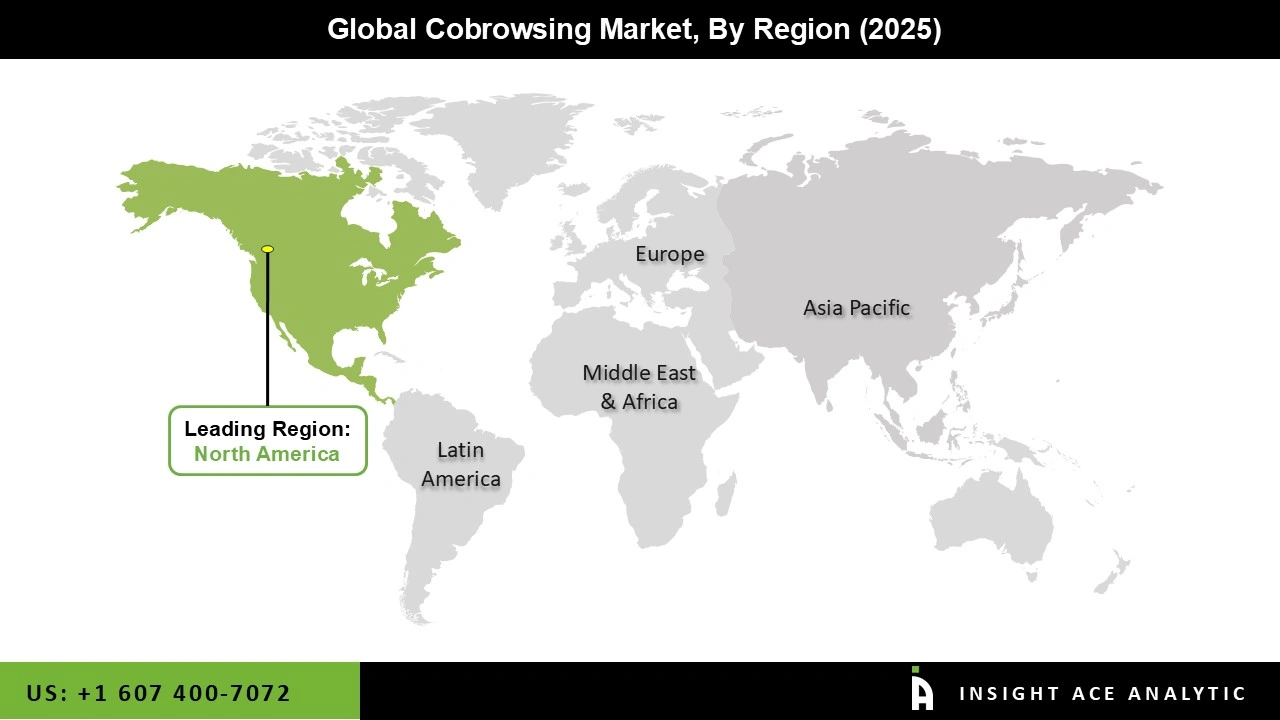
The region also benefits from the presence of leading software providers, continuous investment in customer experience technologies, and rapid digital transformation across industries. As organisations continue improving online customer interactions while maintaining high security and compliance standards, North America is expected to maintain its leading position in the global cobrowsing market throughout the forecast period.
Key Developments-
• In March 2025, LivePerson updated its CoBrowse support resources for messaging, live chat, and voice workflows, describing how agents and visitors can navigate a brand’s website collaboratively to support faster customer issue resolution.
Cobrowsing Market Report Scope:
| Report Attribute | Specifications |
| Market size value in 2025 | USD 3.55 Bn |
| Revenue forecast in 2035 | USD 13.45 Bn |
| Growth Rate CAGR | CAGR of 14.4% from 2026 to 2035 |
| Quantitative Units | Representation of revenue in US$ Bn and CAGR from 2026 to 2035 |
| Historic Year | 2021 to 2025 |
| Forecast Year | 2026-2035 |
| Report Coverage | The forecast of revenue, the position of the company, the competitive market structure, growth prospects, and trends |
| Segments Covered | By Application, Deployment Mode, End Use Industry, User Type and By Region |
| Regional Scope | North America; Europe; Asia Pacific; Latin America; Middle East & Africa |
| Country Scope | U.S.; Canada; U.K.; Germany; China; India; Japan; Brazil; Mexico; The UK; France; Italy; Spain; China; Japan; India; South Korea; Southeast Asia; South Korea; Southeast Asia |
| Competitive Landscape | LogMeIn (US), Salesforce (US), TeamViewer (DE), LivePerson (US), Zoho (IN), Oracle (US), Cisco (US), HelpCrunch (UA), Bold360 (US) |
| Customization Scope | Free customisation report with the procurement of the report, Modifications to the regional and segment scope. Geographic competitive landscape. |
| Pricing and Available Payment Methods | Explore pricing alternatives that are customized to your particular study requirements. |
Segmentations of Cobrowsing Market :
Cobrowsing Market by Application-
- Customer Support
- Sales Assistance
- Remote Training
- Technical Support
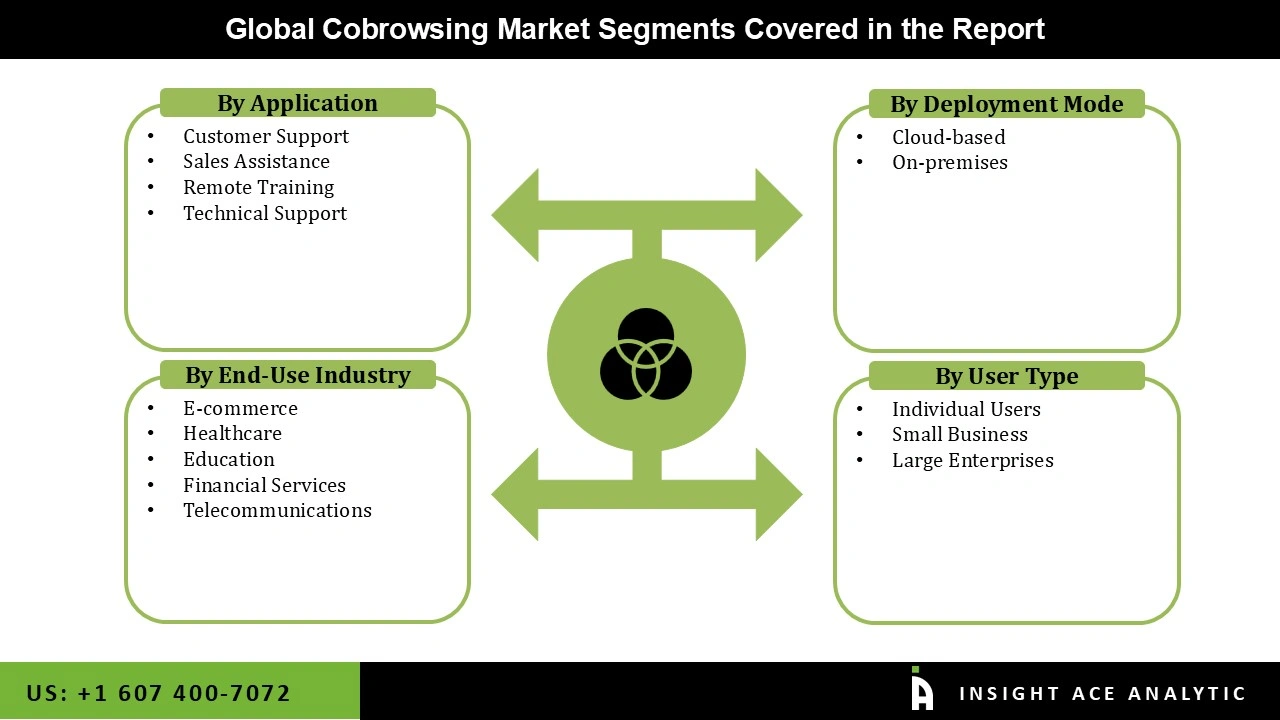
Cobrowsing Market by Deployment Mode-
- Cloud-based
- On-premises
Cobrowsing Market by End Use Industry-
- E-commerce
- Healthcare
- Education
- Financial Services
- Telecommunications
Cobrowsing Market by User Type-
- Individual Users
- Small Business
- Large Enterprises
Cobrowsing Market by Region-
- North America-
- The US
- Canada
- Europe-
- Germany
- The UK
- France
- Italy
- Spain
- Rest of Europe
- Asia-Pacific-
- China
- Japan
- India
- South Korea
- South East Asia
- Rest of Asia Pacific
- Latin America-
- Brazil
- Argentina
- Mexico
- Rest of Latin America
- Middle East and Africa-
- GCC Countries
- South Africa
- Rest of Middle East and Africa
Research Design and Approach
This study employed a multi-step, mixed-method research approach that integrates:
- Secondary research
- Primary research
- Data triangulation
- Hybrid top-down and bottom-up modelling
- Forecasting and scenario analysis
This approach ensures a balanced and validated understanding of both macro- and micro-level market factors influencing the market.
Secondary Research
Secondary research for this study involved the collection, review, and analysis of publicly available and paid data sources to build the initial fact base, understand historical market behaviour, identify data gaps, and refine the hypotheses for primary research.
Sources Consulted
Secondary data for the market study was gathered from multiple credible sources, including:
- Government databases, regulatory bodies, and public institutions
- International organizations (WHO, OECD, IMF, World Bank, etc.)
- Commercial and paid databases
- Industry associations, trade publications, and technical journals
- Company annual reports, investor presentations, press releases, and SEC filings
- Academic research papers, patents, and scientific literature
- Previous market research publications and syndicated reports
These sources were used to compile historical data, market volumes/prices, industry trends, technological developments, and competitive insights.

Primary Research
Primary research was conducted to validate secondary data, understand real-time market dynamics, capture price points and adoption trends, and verify the assumptions used in the market modelling.
Stakeholders Interviewed
Primary interviews for this study involved:
- Manufacturers and suppliers in the market value chain
- Distributors, channel partners, and integrators
- End-users / customers (e.g., hospitals, labs, enterprises, consumers, etc., depending on the market)
- Industry experts, technology specialists, consultants, and regulatory professionals
- Senior executives (CEOs, CTOs, VPs, Directors) and product managers
Interview Process
Interviews were conducted via:
- Structured and semi-structured questionnaires
- Telephonic and video interactions
- Email correspondences
- Expert consultation sessions
Primary insights were incorporated into demand modelling, pricing analysis, technology evaluation, and market share estimation.
Data Processing, Normalization, and Validation
All collected data were processed and normalized to ensure consistency and comparability across regions and time frames.
The data validation process included:
- Standardization of units (currency conversions, volume units, inflation adjustments)
- Cross-verification of data points across multiple secondary sources
- Normalization of inconsistent datasets
- Identification and resolution of data gaps
- Outlier detection and removal through algorithmic and manual checks
- Plausibility and coherence checks across segments and geographies
This ensured that the dataset used for modelling was clean, robust, and reliable.
Market Size Estimation and Data Triangulation
Bottom-Up Approach
The bottom-up approach involved aggregating segment-level data, such as:
- Company revenues
- Product-level sales
- Installed base/usage volumes
- Adoption and penetration rates
- Pricing analysis
This method was primarily used when detailed micro-level market data were available.

Top-Down Approach
The top-down approach used macro-level indicators:
- Parent market benchmarks
- Global/regional industry trends
- Economic indicators (GDP, demographics, spending patterns)
- Penetration and usage ratios
This approach was used for segments where granular data were limited or inconsistent.
Hybrid Triangulation Approach
To ensure accuracy, a triangulated hybrid model was used. This included:
- Reconciling top-down and bottom-up estimates
- Cross-checking revenues, volumes, and pricing assumptions
- Incorporating expert insights to validate segment splits and adoption rates
This multi-angle validation yielded the final market size.
Forecasting Framework and Scenario Modelling
Market forecasts were developed using a combination of time-series modelling, adoption curve analysis, and driver-based forecasting tools.
Forecasting Methods
- Time-series modelling
- S-curve and diffusion models (for emerging technologies)
- Driver-based forecasting (GDP, disposable income, adoption rates, regulatory changes)
- Price elasticity models
- Market maturity and lifecycle-based projections
Scenario Analysis
Given inherent uncertainties, three scenarios were constructed:
- Base-Case Scenario: Expected trajectory under current conditions
- Optimistic Scenario: High adoption, favourable regulation, strong economic tailwinds
- Conservative Scenario: Slow adoption, regulatory delays, economic constraints
Sensitivity testing was conducted on key variables, including pricing, demand elasticity, and regional adoption.
Request Customization
Add countries, segments, company profiles, or extend forecast — free 10% customization with purchase.
Customize This Report →Enquire Before Buying
Speak with our analyst team about scope, methodology, pricing, or deliverable formats.
Enquire Now →Frequently Asked Questions
Cobrowsing Market Size is valued at USD 3.55 Bn in 2025 and is predicted to reach USD 13.45 Bn by the year 2035
The Cobrowsing Market is expected to grow at a 14.4% CAGR during the forecast period for 2026 to 2035
LogMeIn (US), Salesforce (US), TeamViewer (DE), LivePerson (US), Zoho (IN), Oracle (US), Cisco (US), HelpCrunch (UA), Bold360 (US) and Others.
Cobrowsing Market is segmented into Application, Deployment Mode, End Use Industry, User Type and Other.
North America region is leading the Cobrowsing Market.