Retail Sourcing and Procurement Market Size, Share, Trend, Revenue Report 2026 to 2035
What is Retail Sourcing and Procurement Market Size?
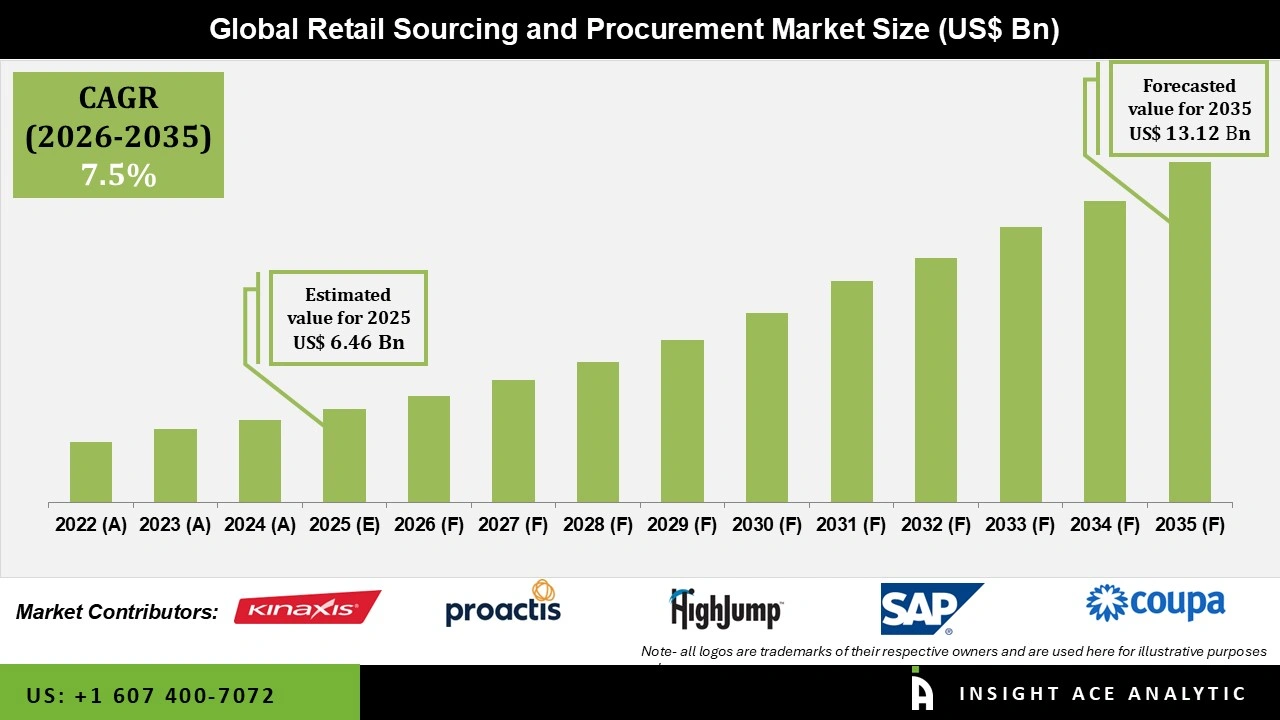
Global Retail Sourcing and Procurement Market Size is valued at USD 6.46 Bn in 2025 and is predicted to reach USD 13.12 Bn by the year 2035 at a 7.5% CAGR during the forecast period for 2026 to 2035.
Retail Sourcing and Procurement Market Size, Share & Trends Analysis Distribution by Application (Solution (Strategic Sourcing, Supplier Management, Contract Management, Procure-to-pay, Spend Analysis), Service (Implementation, Consulting, Training & Support)), By Deployment (On-Premise, Cloud-Based) and Segment Forecasts, 2026 to 2035.
Retail sourcing and procurement refers to the end-to-end process through which retailers identify, evaluate, select, and manage suppliers for the goods they sell, while ensuring optimal pricing, quality, and timely delivery. It involves activities such as supplier discovery, contract negotiation, purchase order management, inventory coordination, and compliance tracking. With the increasing adoption of digital tools like e-procurement platforms, analytics, and automation, retailers are transforming traditional procurement into a more strategic function that enhances supply chain efficiency, reduces costs, and improves supplier collaboration.
The retail sourcing and procurement market has evolved into a critical component of modern retail operations, driven by the growing complexity of global supply chains, rising consumer expectations, and the need for cost optimization. Retailers across segments—including grocery, apparel, electronics, and e-commerce—are increasingly investing in advanced procurement solutions to gain better visibility, improve demand forecasting, and mitigate supply risks. The market is witnessing strong growth supported by digital transformation, integration of AI-driven insights, and the expansion of omnichannel retailing, which collectively push organizations to adopt more agile and data-driven sourcing strategies.
Competitive Landscape
Which are the Leading Players in the Retail Sourcing and Procurement Market?
- Kinaxis
- Proactis Holdings Plc.
- Coupa Software
- HighJump Software
- Basware Corporation
- SAP SE
- Oracle Corporation
- IBM Corporation
- Epicor Software Corporation
- JDA Software Group, Inc.
- JAGGER, Inc.
- Infor Nexus
Market Dynamics
Driver
Rising Need for Cost Optimization and Operational Efficiency
A major driver for the retail sourcing and procurement market is the increasing need for cost optimization and operational efficiency amid intense price competition and fluctuating supply chain dynamics. Retailers are under constant pressure to maintain margins while offering competitive pricing, which has pushed them to adopt advanced sourcing and procurement solutions that enable better supplier negotiation, bulk purchasing advantages, and real-time cost visibility. Additionally, the growing complexity of global supply networks and demand volatility has accelerated the shift toward digital procurement platforms, helping retailers streamline processes, reduce manual errors, and make data-driven purchasing decisions.
Restrain/Challenge
Supply Chain Complexity and Limited Transparency
A key challenge in the retail sourcing and procurement market is the growing complexity and lack of transparency in global supply chains. Retailers often work with multiple suppliers across different regions, making it difficult to ensure consistent quality, regulatory compliance, and timely deliveries. Disruptions such as geopolitical tensions, fluctuating raw material costs, and logistics constraints further add uncertainty, limiting the effectiveness of procurement strategies. Additionally, integrating advanced digital procurement solutions with legacy systems can be costly and time-consuming, creating adoption barriers for many organizations.
Solution Segment is Expected to Drive the Retail Sourcing and Procurement Market
The retail sourcing and procurement industry is being driven by the solution category, with procure-to-pay and strategic sourcing leading the way. In order to expedite supplier selection, automate purchasing processes, and obtain real-time spending visibility—all of which have a direct impact on cost control and operational efficiency—retailers are giving these solutions more and more priority. Because they can integrate the whole procurement cycle, from request to payment, procure-to-pay systems are becoming increasingly popular, and strategic sourcing technologies help maximize supplier negotiations and long-term value generation. While services like advising and installation play a supporting role in facilitating adoption, capabilities like expenditure analysis and supplier management further boost decision-making, making the solution segment the main growth engine.
Cloud-Based Segment is Growing at the Highest Rate in the Retail Sourcing and Procurement Market
The cloud-based segment is growing at the highest rate in the retail sourcing and procurement market. This growth is driven by increasing demand for scalable, flexible, and cost-effective solutions that can be deployed quickly without heavy upfront infrastructure investments. Cloud-based platforms enable real-time data access, seamless integration across supply chain functions, and support for remote operations—making them particularly attractive for modern, omnichannel retail environments. Additionally, continuous updates, enhanced security features, and the integration of advanced technologies like AI and analytics are further accelerating the adoption of cloud-based procurement solutions over traditional on-premise systems.
Why North America Led the Retail Sourcing and Procurement Market?
Due to the early adoption of cutting-edge digital procurement solutions, a robust presence of top technology providers, and a well-established retail ecosystem, North America is leading the retail sourcing and procurement market. Cloud-based platforms, AI-driven analytics, and automation technologies are being used by retailers around the area to better supplier management, increase sourcing efficiency, and obtain real-time expenditure visibility.
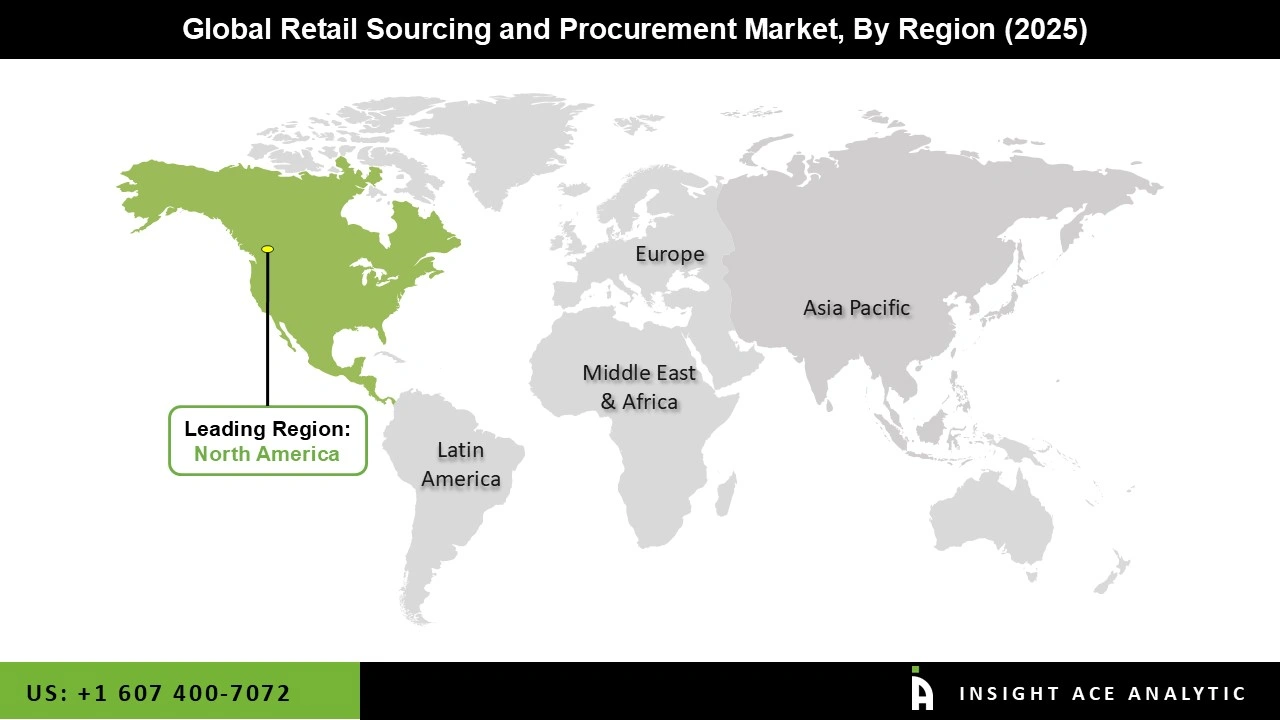
The region's leading position in the industry is further reinforced by the existence of major retail chains and e-commerce companies, as well as a significant emphasis on supply chain resilience and cost optimization.
Key Development
August 2024: GEP announced that Costa Coffee has gone live on its GEP SOFTWARE™ platform to digitize and automate global procurement operations. As part of its transformation strategy, Costa Coffee—operating in 50 countries—adopted the platform in 2023 to streamline both direct and indirect spend management across its business.
Retail Sourcing and Procurement Market Report Scope:
| Report Attribute | Specifications |
| Market size value in 2025 | USD 6.46 Bn |
| Revenue forecast in 2035 | USD 13.12 Bn |
| Growth Rate CAGR | CAGR of 7.5% from 2026 to 2035 |
| Quantitative Units | Representation of revenue in US$ Bn and CAGR from 2026 to 2035 |
| Historic Year | 2022 to 2025 |
| Forecast Year | 2026-2035 |
| Report Coverage | The forecast of revenue, the position of the company, the competitive market structure, growth prospects, and trends |
| Segments Covered | Application, Deployment and By Region |
| Regional Scope | North America; Europe; Asia Pacific; Latin America; Middle East & Africa |
| Country Scope | U.S.; Canada; U.K.; Germany; China; India; Japan; Brazil; Mexico; The UK; France; Italy; Spain; China; Japan; India; South Korea; Southeast Asia; South Korea; Southeast Asia |
| Competitive Landscape | Kinaxis, Proactis Holdings Plc., Coupa Software, HighJump Software, Basware Corporation, SAP SE, Oracle Corporation, IBM Corporation, Epicor Software Corporation, JDA Software Group, Inc., JAGGER, Inc., Infor Nexus |
| Customization Scope | Free customization report with the procurement of the report, Modifications to the regional and segment scope. Geographic competitive landscape. |
| Pricing and Available Payment Methods | Explore pricing alternatives that are customized to your particular study requirements. |
Segmentations of Retail Sourcing and Procurement Market :
Retail Sourcing and Procurement Market, by Application -
- Solution
- Strategic Sourcing
- Supplier Management
- Contract Management
- Procure-to-pay
- Spend Analysis
- Service
- Implementation
- Consulting
- Training & Support
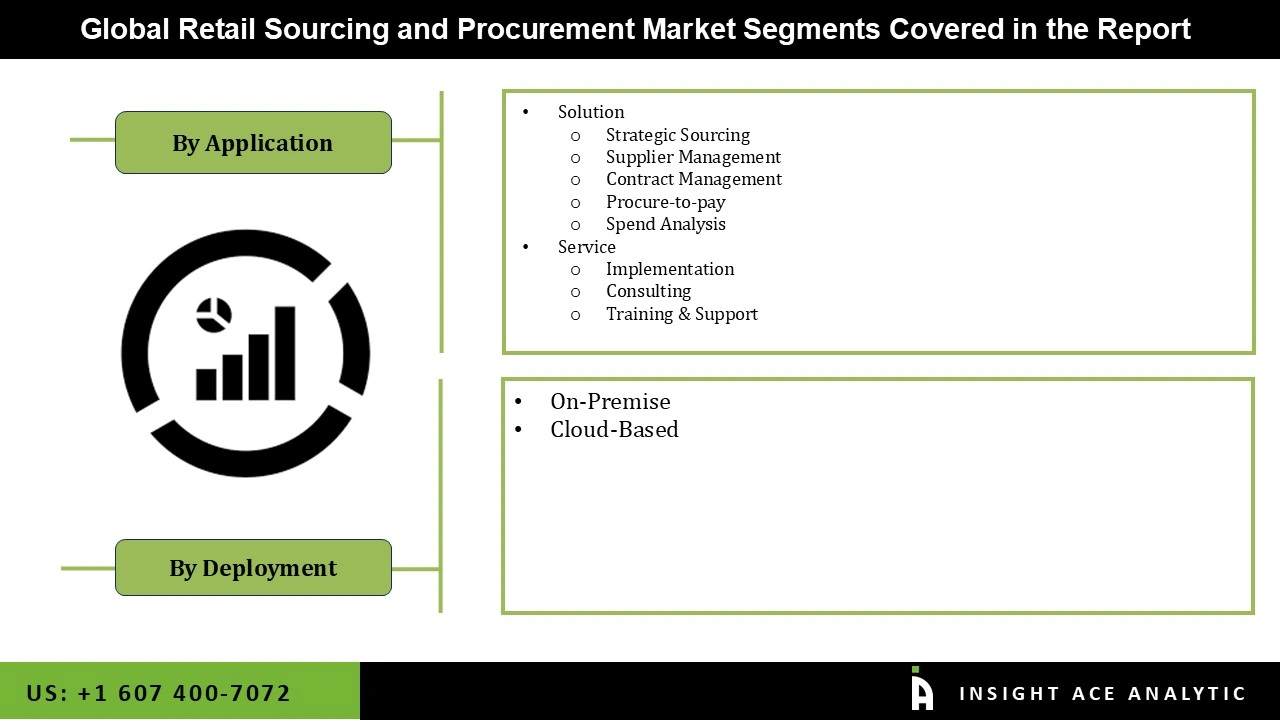
Retail Sourcing and Procurement Market, by Deployment -
- On-Premise
- Cloud-Based
Retail Sourcing and Procurement Market, by Region-
- North America-
- The US
- Canada
- Europe-
- Germany
- The UK
- France
- Italy
- Spain
- Rest of Europe
- Asia-Pacific-
- China
- Japan
- India
- South Korea
- South East Asia
- Rest of Asia Pacific
- Latin America-
- Brazil
- Argentina
- Mexico
- Rest of Latin America
- Middle East and Africa-
- GCC Countries
- South Africa
- Rest of Middle East and Africa
Research Design and Approach
This study employed a multi-step, mixed-method research approach that integrates:
- Secondary research
- Primary research
- Data triangulation
- Hybrid top-down and bottom-up modelling
- Forecasting and scenario analysis
This approach ensures a balanced and validated understanding of both macro- and micro-level market factors influencing the market.
Secondary Research
Secondary research for this study involved the collection, review, and analysis of publicly available and paid data sources to build the initial fact base, understand historical market behaviour, identify data gaps, and refine the hypotheses for primary research.
Sources Consulted
Secondary data for the market study was gathered from multiple credible sources, including:
- Government databases, regulatory bodies, and public institutions
- International organizations (WHO, OECD, IMF, World Bank, etc.)
- Commercial and paid databases
- Industry associations, trade publications, and technical journals
- Company annual reports, investor presentations, press releases, and SEC filings
- Academic research papers, patents, and scientific literature
- Previous market research publications and syndicated reports
These sources were used to compile historical data, market volumes/prices, industry trends, technological developments, and competitive insights.
Primary Research
Primary research was conducted to validate secondary data, understand real-time market dynamics, capture price points and adoption trends, and verify the assumptions used in the market modelling.
Stakeholders Interviewed
Primary interviews for this study involved:
- Manufacturers and suppliers in the market value chain
- Distributors, channel partners, and integrators
- End-users / customers (e.g., hospitals, labs, enterprises, consumers, etc., depending on the market)
- Industry experts, technology specialists, consultants, and regulatory professionals
- Senior executives (CEOs, CTOs, VPs, Directors) and product managers
Interview Process
Interviews were conducted via:
- Structured and semi-structured questionnaires
- Telephonic and video interactions
- Email correspondences
- Expert consultation sessions
Primary insights were incorporated into demand modelling, pricing analysis, technology evaluation, and market share estimation.
Data Processing, Normalization, and Validation
All collected data were processed and normalized to ensure consistency and comparability across regions and time frames.
The data validation process included:
- Standardization of units (currency conversions, volume units, inflation adjustments)
- Cross-verification of data points across multiple secondary sources
- Normalization of inconsistent datasets
- Identification and resolution of data gaps
- Outlier detection and removal through algorithmic and manual checks
- Plausibility and coherence checks across segments and geographies
This ensured that the dataset used for modelling was clean, robust, and reliable.
Market Size Estimation and Data Triangulation
Bottom-Up Approach
The bottom-up approach involved aggregating segment-level data, such as:
- Company revenues
- Product-level sales
- Installed base/usage volumes
- Adoption and penetration rates
- Pricing analysis
This method was primarily used when detailed micro-level market data were available.
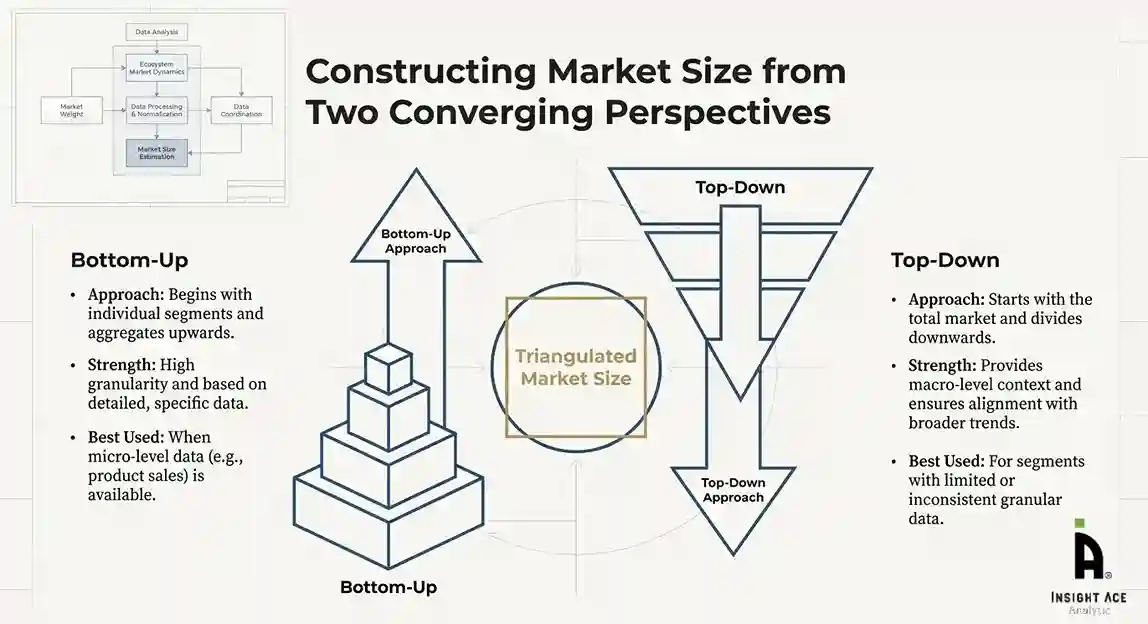
Top-Down Approach
The top-down approach used macro-level indicators:
- Parent market benchmarks
- Global/regional industry trends
- Economic indicators (GDP, demographics, spending patterns)
- Penetration and usage ratios
This approach was used for segments where granular data were limited or inconsistent.
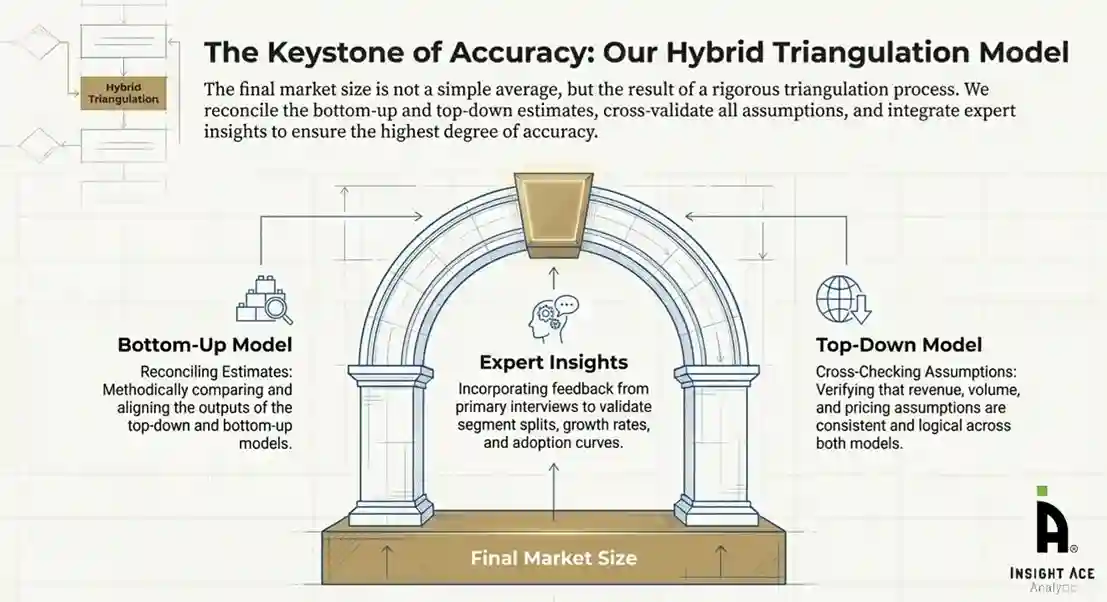
Hybrid Triangulation Approach
To ensure accuracy, a triangulated hybrid model was used. This included:
- Reconciling top-down and bottom-up estimates
- Cross-checking revenues, volumes, and pricing assumptions
- Incorporating expert insights to validate segment splits and adoption rates
This multi-angle validation yielded the final market size.
Forecasting Framework and Scenario Modelling
Market forecasts were developed using a combination of time-series modelling, adoption curve analysis, and driver-based forecasting tools.
Forecasting Methods
- Time-series modelling
- S-curve and diffusion models (for emerging technologies)
- Driver-based forecasting (GDP, disposable income, adoption rates, regulatory changes)
- Price elasticity models
- Market maturity and lifecycle-based projections
Scenario Analysis
Given inherent uncertainties, three scenarios were constructed:
- Base-Case Scenario: Expected trajectory under current conditions
- Optimistic Scenario: High adoption, favourable regulation, strong economic tailwinds
- Conservative Scenario: Slow adoption, regulatory delays, economic constraints
Sensitivity testing was conducted on key variables, including pricing, demand elasticity, and regional adoption.
Request Customization
Add countries, segments, company profiles, or extend forecast — free 10% customization with purchase.
Customize This Report →Enquire Before Buying
Speak with our analyst team about scope, methodology, pricing, or deliverable formats.
Enquire Now →Frequently Asked Questions
Retail Sourcing and Procurement Market Size is valued at USD 6.46 Bn in 2025 and is predicted to reach USD 13.12 Bn by the year 2035
Retail Sourcing and Procurement Market is expected to grow at a 7.5% CAGR during the forecast period for 2026 to 2035
Kinaxis, Proactis Holdings Plc., Coupa Software, HighJump Software, Basware Corporation, SAP SE, Oracle Corporation, IBM Corporation, Epicor Software Corporation, JDA Software Group, Inc., JAGGER, Inc., Infor Nexus and Others.
Retail Sourcing and Procurement Market is segmented into Application, Deployment and Other.
North America region is leading the Retail Sourcing and Procurement Market.