Motorcycle Connected Helmet Market Size, Trend, Revenue Report 2026 to 2035
What is Motorcycle Connected Helmet Market Size?
Global Motorcycle Connected Helmet Market Size is valued at USD 1.22 Bn in 2025 and is predicted to reach USD 6.14 Bn by the year 2035 at a 18.1% CAGR during the forecast period for 2026 to 2035.
Motorcycle Connected Helmet Market Size, Share & Trends Analysis Distribution by Type (Full-Face Helmets, Half-Face Helmets, Modular Helmets), by Connectivity Features (Bluetooth Connectivity, GPS Navigation, Music Streaming, SOS Emergency Alert), by Camera Features (Front-Facing Cameras, Rear-Facing Cameras, 360-Degree Cameras), by Sensor Technology (Accelerometers, Gyroscopes, Magnetometers, Barometers), and Segment Forecasts, 2026 to 2035.
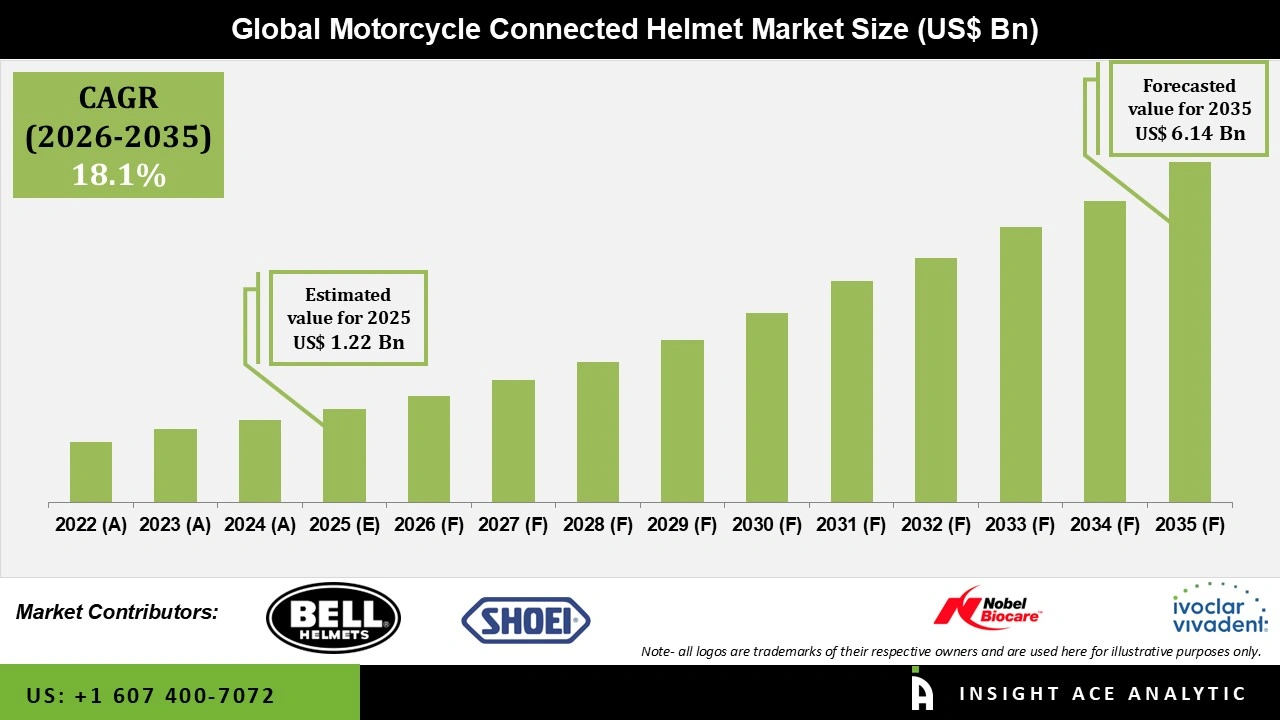
Connected motorcycle helmets are gaining popularity as riders seek safer and smarter ways to ride. Unlike regular helmets, these models add features like Bluetooth, GPS, voice assistants, cameras, sensors, and emergency alerts. With these technologies, riders can talk hands-free, use navigation, listen to music, record their trips, and get important updates without losing focus on the road. As safety becomes more important and smart mobility grows, more commuters and motorcycle fans are choosing connected helmets. A key reason for the market’s growth is the rising number of motorcycles, especially in developing countries where two-wheelers are common. Concerns about accidents and safety are also leading people to choose helmets that do more than just protect from impact. Features like emergency SOS alerts, crash detection, voice communication, and navigation help riders stay aware and safer in emergencies. Many governments are also making helmet safety rules stricter, which supports the use of advanced helmet technology.
New technology is also driving the market forward. Better Bluetooth, AI, sensors, cameras, voice recognition, and smartphone links have turned regular helmets into smart riding partners. Premium helmets now often include front and rear cameras, 360-degree recording, live traffic updates, helmet-to-helmet communication, and heads-up displays. Longer battery life, lighter materials, wireless connections, and helpful apps are making these helmets more practical and comfortable for daily use. Partnerships between helmet makers, tech companies, motorcycle brands, and communication providers are also helping the market grow. These teams are launching new products, making sure helmets work well with phones and bikes, and reaching more customers worldwide. As more people get interested in connected mobility, electric motorcycles, adventure touring, and smart transport, manufacturers have more chances to create helmets with better safety and convenience features.
Even with strong growth ahead, the market has some challenges. Connected helmets usually cost more than regular ones because of their advanced features, which can make them less appealing to people who are careful with spending. Makers also need to improve battery life, durability, software updates, and cyber security, and ensure helmets work with different systems. It’s also important to keep smart features simple so they don’t distract riders. Still, the future for connected motorcycle helmets looks very promising. More people are aware of rider safety, more motorcycles are on the road, and smart wearable technology is advancing quickly. As these helmets become more affordable and safety rules change, they are likely to play a bigger role in motorcycling by giving riders better protection, convenience, and a more connected experience.
Competitive Landscape
Which are the Leading Players in the Motorcycle Connected Helmet Market?
- Bell Helmets
- Shoei
- AGV
- HJC
- Scorpion
- Nolan
- LS2
- KBC
- Arai
- Others
Market Dynamics
Driver
Growing Focus on Rider Safety and Rising Adoption of Smart Helmet Technologies
The market for motorcycle-connected helmets is steadily growing as more riders look for helmets that combine safety with smart features. Unlike traditional helmets that primarily protect against impacts, connected helmets offer additional features such as Bluetooth, GPS, music streaming, voice communication, built-in cameras, and emergency SOS alerts. More people are becoming aware of road safety, motorcycle ownership is rising, and stricter helmet safety rules are encouraging riders to choose advanced helmets with smart features. The trend toward adventure touring, long-distance rides, and premium motorcycles is also helping the market grow. Improvements in wireless technology, sensors, artificial intelligence, and smartphone integration are making these helmets more reliable, easier to use, and more affordable. As people continue to value convenience, safety, and staying connected, demand for motorcycle connected helmets is likely to keep increasing.
Restraint/Challenge
High Product Costs and Technology Integration Challenges
Even though the market for connected motorcycle helmets has significant potential, it still faces challenges. These helmets usually cost more than regular ones because they include advanced electronics, communication systems, cameras, sensors, and batteries. The higher price can make it harder for some people to buy them, especially in markets where cost is a big concern. Manufacturers also need to address issues such as battery life, durability, software updates, waterproofing, cybersecurity, and compatibility with different smartphones and communication platforms. It's also important that the smart features are easy to use and do not distract riders. On top of that, incorporating advanced technology while still meeting safety certification standards complicates and increases the cost of product development and manufacturing.
Full-Face Helmet Segment is Expected to Drive the Motorcycle Connected Helmet Market
Full-face helmets are likely to make up the biggest part of the motorcycle-connected helmet market in the coming years. These helmets cover the entire head and face, offering the most protection, so they are popular with commuters, touring riders, and riders of high-performance motorcycles. Their closed design also makes it easier to add features such as Bluetooth, GPS, speakers, microphones, cameras, and emergency alerts without compromising comfort. As more people seek both safety and smart features, demand for connected full-face helmets should remain strong in both developed and emerging markets.
The Bluetooth Connectivity Segment is Expected to Drive the Motorcycle Connected Helmet Market
Bluetooth connectivity is expected to stay the most popular feature in motorcycle connected helmets. Riders like being able to make hands-free calls, talk to other riders, get navigation directions, listen to music, and connect to their smartphones without taking their eyes off the road. Bluetooth makes riding more convenient and safer by reducing the need to handle phones while riding. Ongoing improvements in wireless technology, voice assistants, and mobile apps are making Bluetooth helmets even more appealing. As smart mobility becomes more common, Bluetooth is likely to keep driving demand for connected helmets.
Why North America Leads the Motorcycle Connected Helmet Market?
North America currently holds a leading position in the motorcycle connected helmet market due to its strong motorcycle culture, high adoption of premium riding gear, and growing awareness of rider safety. The region has a large number of recreational riders, touring enthusiasts, and motorcycle clubs that increasingly prefer helmets equipped with advanced communication and safety features.
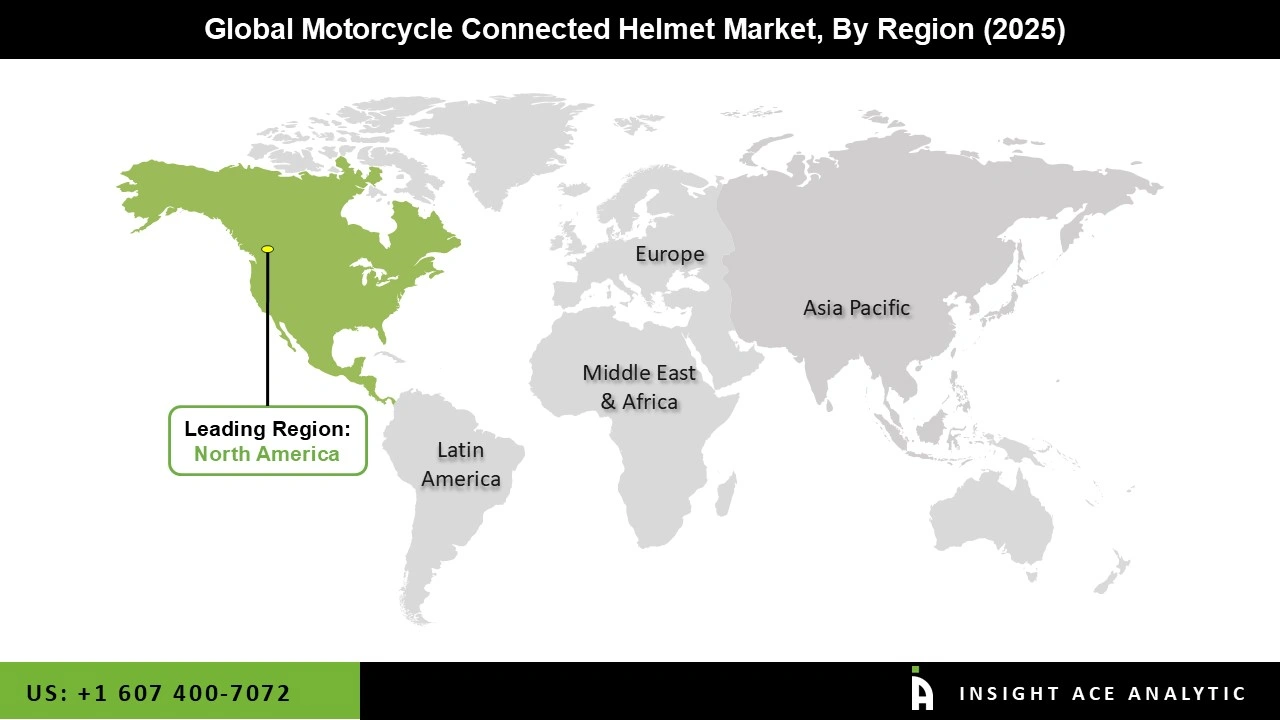
Rising demand for connected mobility solutions, increasing use of navigation and communication systems during long-distance riding, and greater consumer spending on premium motorcycle accessories are supporting market growth. North America also benefits from the presence of leading helmet manufacturers and technology companies, as well as continuous innovation in wearable electronics. As smart transportation technologies continue to evolve and rider safety remains a top priority, North America is expected to maintain its leadership position in the global motorcycle connected helmet market throughout the forecast period.
Key Developments-
• In March 2025, Bell Helmets continued expanding its smart helmet portfolio by enhancing Bluetooth-enabled communication features, rider connectivity, and integrated safety technologies designed to improve rider experience and on-road safety.
• In January 2025, Shoei strengthened its focus on premium motorcycle helmets by advancing smart helmet development, integrating improved communication systems, navigation compatibility, and enhanced rider comfort technologies.
Motorcycle Connected Helmet Market Report Scope :
| Report Attribute | Specifications |
| Market size value in 2025 | USD 1.22 Bn |
| Revenue forecast in 2035 | USD 6.14 Bn |
| Growth Rate CAGR | CAGR of 18.1% from 2026 to 2035 |
| Quantitative Units | Representation of revenue in US$ Bn and CAGR from 2026 to 2035 |
| Historic Year | 2022 to 2025 |
| Forecast Year | 2026-2035 |
| Report Coverage | The forecast of revenue, the position of the company, the competitive market structure, growth prospects, and trends |
| Segments Covered | By Type, Connectivity Features, Camera features, sensor technology and By Region |
| Regional Scope | North America; Europe; Asia Pacific; Latin America; Middle East & Africa |
| Country Scope | U.S.; Canada; U.K.; Germany; China; India; Japan; Brazil; Mexico; The UK; France; Italy; Spain; China; Japan; India; South Korea; Southeast Asia; South Korea; Southeast Asia |
| Competitive Landscape | Bell Helmets, Shoei, AGV, HJC, Scorpion, Nolan, LS2, KBC, Arai. |
| Customization Scope | Free customization report with the procurement of the report, Modifications to the regional and segment scope. Geographic competitive landscape. |
| Pricing and Available Payment Methods | Explore pricing alternatives that are customized to your particular study requirements. |
Segmentations Motorcycle Connected Helmet Market:
Motorcycle Connected Helmet Market by Type-
- Full-Face Helmets
- Half-Face Helmets
- Modular Helmets
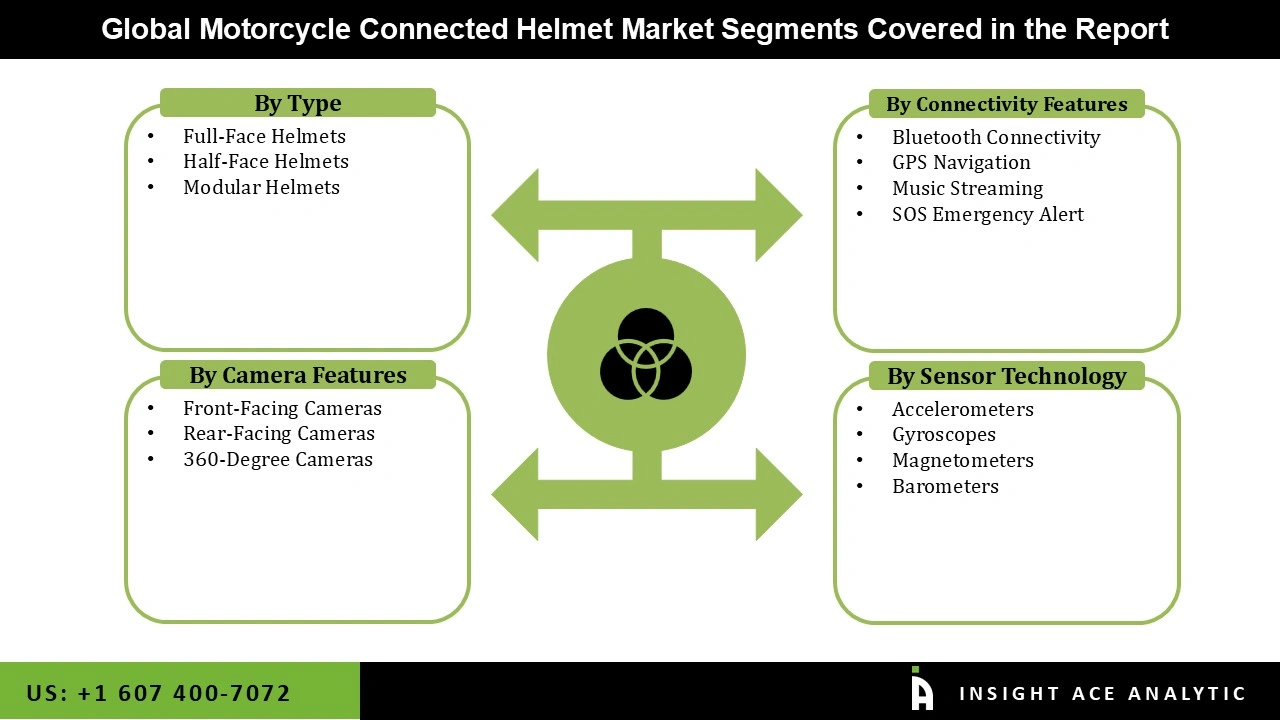
Motorcycle Connected Helmet Market by Connectivity Features-
- Bluetooth Connectivity
- GPS Navigation
- Music Streaming
- SOS Emergency Alert
Motorcycle Connected Helmet Market by Camera Features-
- Front-Facing Cameras
- Rear-Facing Cameras
- 360-Degree Cameras
Motorcycle Connected Helmet Market by Sensor Technology-
- Accelerometers
- Gyroscopes
- Magnetometers
- Barometers
Motorcycle Connected Helmet Market by Region-
- North America-
- The US
- Canada
- Europe-
- Germany
- The UK
- France
- Italy
- Spain
- Rest of Europe
- Asia-Pacific-
- China
- Japan
- India
- South Korea
- South East Asia
- Rest of Asia Pacific
- Latin America-
- Brazil
- Argentina
- Mexico
- Rest of Latin America
- Middle East and Africa-
- GCC Countries
- South Africa
- Rest of Middle East and Africa
Research Design and Approach
This study employed a multi-step, mixed-method research approach that integrates:
- Secondary research
- Primary research
- Data triangulation
- Hybrid top-down and bottom-up modelling
- Forecasting and scenario analysis
This approach ensures a balanced and validated understanding of both macro- and micro-level market factors influencing the market.
Secondary Research
Secondary research for this study involved the collection, review, and analysis of publicly available and paid data sources to build the initial fact base, understand historical market behaviour, identify data gaps, and refine the hypotheses for primary research.
Sources Consulted
Secondary data for the market study was gathered from multiple credible sources, including:
- Government databases, regulatory bodies, and public institutions
- International organizations (WHO, OECD, IMF, World Bank, etc.)
- Commercial and paid databases
- Industry associations, trade publications, and technical journals
- Company annual reports, investor presentations, press releases, and SEC filings
- Academic research papers, patents, and scientific literature
- Previous market research publications and syndicated reports
These sources were used to compile historical data, market volumes/prices, industry trends, technological developments, and competitive insights.

Primary Research
Primary research was conducted to validate secondary data, understand real-time market dynamics, capture price points and adoption trends, and verify the assumptions used in the market modelling.
Stakeholders Interviewed
Primary interviews for this study involved:
- Manufacturers and suppliers in the market value chain
- Distributors, channel partners, and integrators
- End-users / customers (e.g., hospitals, labs, enterprises, consumers, etc., depending on the market)
- Industry experts, technology specialists, consultants, and regulatory professionals
- Senior executives (CEOs, CTOs, VPs, Directors) and product managers
Interview Process
Interviews were conducted via:
- Structured and semi-structured questionnaires
- Telephonic and video interactions
- Email correspondences
- Expert consultation sessions
Primary insights were incorporated into demand modelling, pricing analysis, technology evaluation, and market share estimation.
Data Processing, Normalization, and Validation
All collected data were processed and normalized to ensure consistency and comparability across regions and time frames.
The data validation process included:
- Standardization of units (currency conversions, volume units, inflation adjustments)
- Cross-verification of data points across multiple secondary sources
- Normalization of inconsistent datasets
- Identification and resolution of data gaps
- Outlier detection and removal through algorithmic and manual checks
- Plausibility and coherence checks across segments and geographies
This ensured that the dataset used for modelling was clean, robust, and reliable.
Market Size Estimation and Data Triangulation
Bottom-Up Approach
The bottom-up approach involved aggregating segment-level data, such as:
- Company revenues
- Product-level sales
- Installed base/usage volumes
- Adoption and penetration rates
- Pricing analysis
This method was primarily used when detailed micro-level market data were available.

Top-Down Approach
The top-down approach used macro-level indicators:
- Parent market benchmarks
- Global/regional industry trends
- Economic indicators (GDP, demographics, spending patterns)
- Penetration and usage ratios
This approach was used for segments where granular data were limited or inconsistent.
Hybrid Triangulation Approach
To ensure accuracy, a triangulated hybrid model was used. This included:
- Reconciling top-down and bottom-up estimates
- Cross-checking revenues, volumes, and pricing assumptions
- Incorporating expert insights to validate segment splits and adoption rates
This multi-angle validation yielded the final market size.
Forecasting Framework and Scenario Modelling
Market forecasts were developed using a combination of time-series modelling, adoption curve analysis, and driver-based forecasting tools.
Forecasting Methods
- Time-series modelling
- S-curve and diffusion models (for emerging technologies)
- Driver-based forecasting (GDP, disposable income, adoption rates, regulatory changes)
- Price elasticity models
- Market maturity and lifecycle-based projections
Scenario Analysis
Given inherent uncertainties, three scenarios were constructed:
- Base-Case Scenario: Expected trajectory under current conditions
- Optimistic Scenario: High adoption, favourable regulation, strong economic tailwinds
- Conservative Scenario: Slow adoption, regulatory delays, economic constraints
Sensitivity testing was conducted on key variables, including pricing, demand elasticity, and regional adoption.
Request Customization
Add countries, segments, company profiles, or extend forecast — free 10% customization with purchase.
Customize This Report →Enquire Before Buying
Speak with our analyst team about scope, methodology, pricing, or deliverable formats.
Enquire Now →Frequently Asked Questions
Motorcycle Connected Helmet Market Size is valued at USD 1.22 Bn in 2025 and is predicted to reach USD 6.14 Bn by the year 2035
The Motorcycle Connected Helmet Market is expected to grow at a 18.1% CAGR during the forecast period for 2026 to 2035
Bell Helmets, Shoei, AGV, HJC, Scorpion, Nolan, LS2, KBC, Arai. and Others.
Motorcycle Connected Helmet Market is segmented into By Type, Connectivity Features, Camera features, sensor technology and Other.
North America region is leading the Motorcycle Connected Helmet Market.