800 VDC Power Distribution Market Size, Share, Trend, Forecast Report 2026 to 2035
What is 800 VDC Power Distribution Market Size?
Global 800 VDC Power Distribution Market is estimated to grow with a 42.0% CAGR during the forecast period for 2026 to 2035.
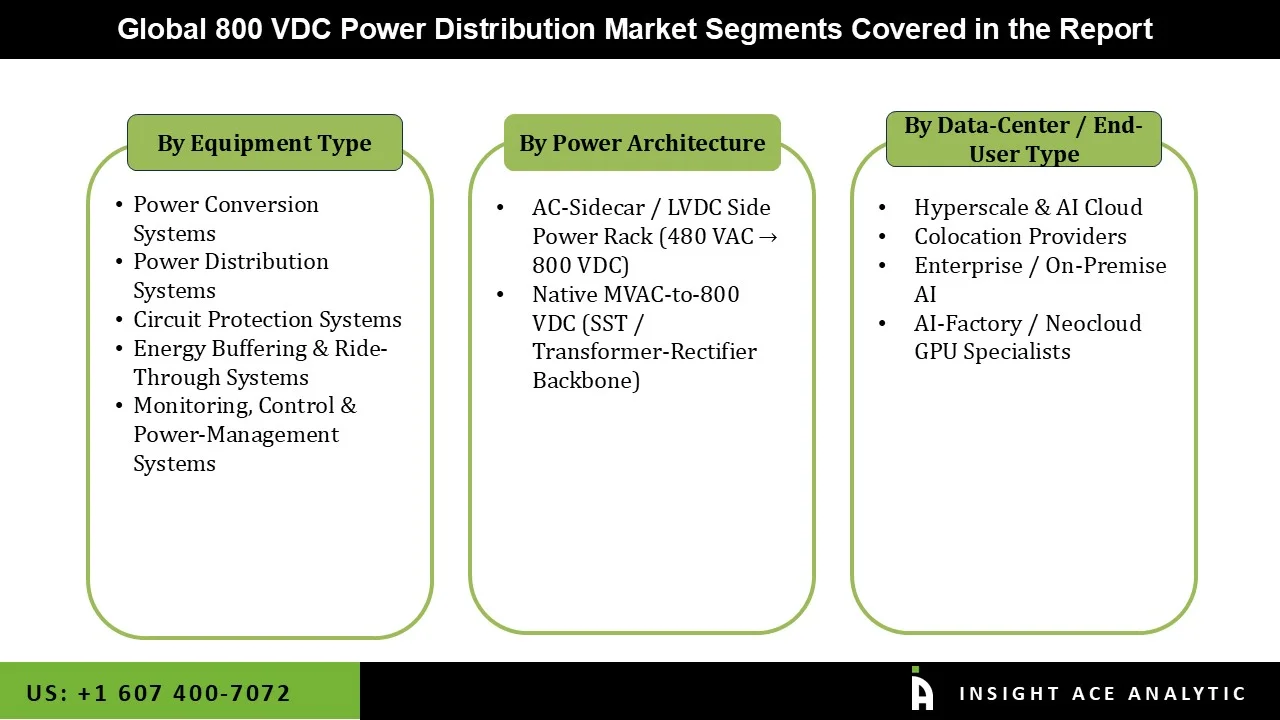
800 VDC Power Distribution Market Size, Share & Trends Analysis Distribution by Equipment Type (Power Conversion Systems, Power Distribution Systems, Circuit Protection Systems, Energy Buffering & Ride-Through Systems, Monitoring, Control & Power-Management Systems), By Power Architecture (AC-Sidecar / LVDC Side Power Rack (480 VAC → 800 VDC), Native MVAC-to-800 VDC (SST / Transformer-Rectifier Backbone)), By Data-Center / End-User Type (Hyperscale & AI Cloud, Colocation Providers, Enterprise / On-Premise AI, AI-Factory / Neocloud GPU Specialists) and Segment Forecasts, 2026 to 2035.
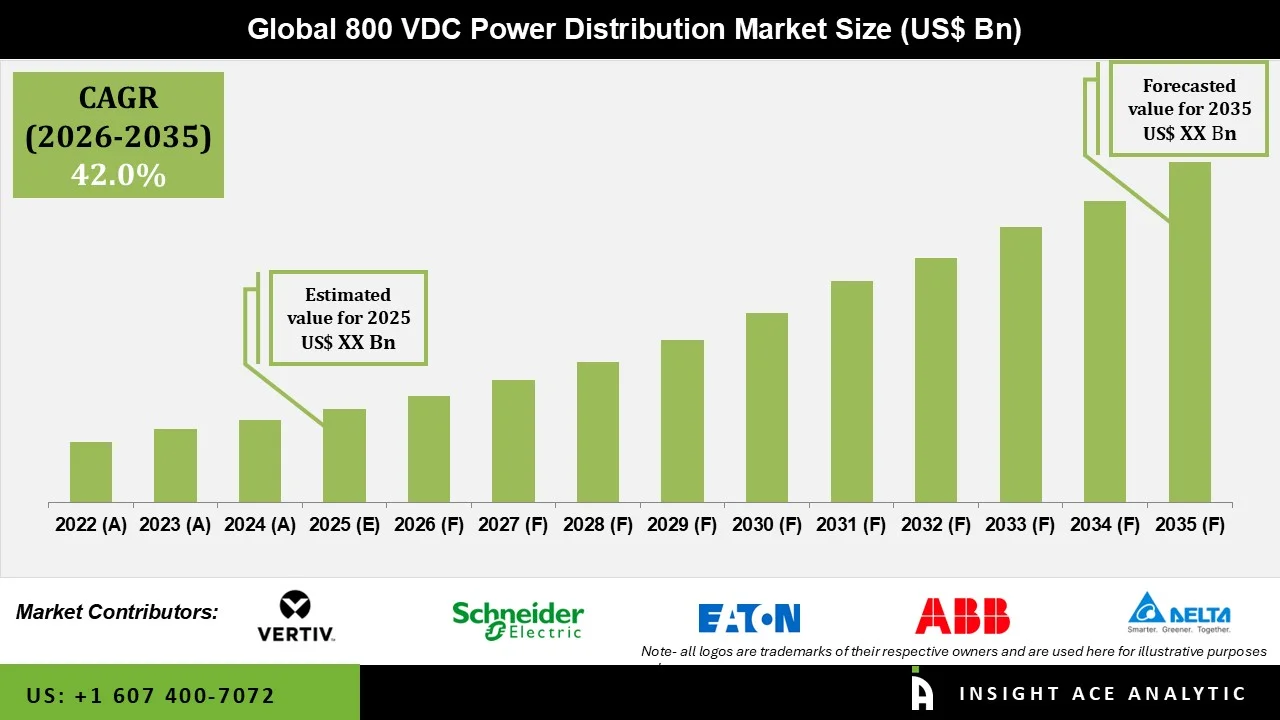
800 VDC power distribution is the delivery and management of power via an 800 volt DC architecture to the high power loads. It is an alternative to conventional AC distribution or lower voltage DC distribution and provides the ability to deliver more power at lower current for a given power requirement. This in turn results in reduced conductor losses and smaller power distribution components. The architecture consists of power conversion equipment, busbars, power shelves, circuit protection, monitoring and all the associated electrical components to safely and reliably deliver power to the high density computing environment.
The 800 VDC power distribution market is all about the development, manufacture and deployment of equipment and technologies for the distribution of high voltage DC power in data centres and other high power applications. It's becoming a very strategic market as the next generation of AI infrastructure will require vastly greater power capacity to support the next generation of processors, the next generation of high performance computing systems and the increasingly dense server racks. The market comprises electrical infrastructure providers, power conversion companies, semiconductor companies and power management technology companies all developing solutions for high efficiency power delivery. The 800vdc market is driving the evolution of the data centre electrical infrastructure with the equipment being designed and the power conversion technologies being developed to meet the demands of the next generation of computing systems.
Competitive Landscape
Which are the Leading Players in the 800 VDC Power Distribution Market?
Tier A — Core Companies
- Vertiv Holdings Co
- Schneider Electric SE
- Eaton Corporation plc
- ABB Ltd
- Delta Electronics, Inc.
- Flex Ltd.
- LITEON Technology Corporation
- Hitachi Energy Ltd
- DG Matrix, Inc.
- Siemens AG
Tier B — Strategic / Regional Companies
- GE Vernova Inc.
- Mitsubishi Electric Corporation
- Lead Wealth
- Shenzhen Megmeet Electrical Co. (Megmeet)
Tier C — Emerging / Watchlist Companies
- Navitas Semiconductor Corporation
- Infineon Technologies AG
- Monolithic Power Systems, Inc.
- Innoscience
Tier D — Adjacent / Context Only
- Texas Instruments Incorporated
- STMicroelectronics N.V.
- onsemi
- ROHM Co., Ltd.
- Renesas Electronics Corporation
- Analog Devices, Inc.
- NVIDIA Corporation
- Google LLC
- Microsoft Corporation
- Open Compute Project Foundation
Market Dynamics
Driver
Rising Power Demand from AI Data Centers and High-Density Computing Infrastructure
The primary driver of the 800vdc Power Distribution market is the increasing power demand of AI data centres and high density computing. The explosion in the use of generative AI, large language models and high performance computing is driving up the power requirements of the processors and server racks themselves. The traditional power distribution architectures are simply not able to deliver the power required at these higher densities. The 800vdc architecture allows for higher power delivery at lower current which in turn reduces distribution losses and conductor requirements and enables the required scalability of the next generation of AI data centres. As hyperscale data centre operators and the technology providers behind them look at higher voltage DC architectures the demand for advanced power conversion, distribution and protection will inevitably grow.
Restrain/Challenge
High Implementation Costs and Safety Complexities of 800 VDC Infrastructure
The big issue with the 800vdc power distribution market is the cost and complexity of the high voltage DC infrastructure. Getting to 800vdc involves a whole range of specialist power conversion gear, high voltage rated components, high levels of insulation, reliable protection and appropriate safety systems. You then have to deal with arc fault management, electrical isolation, thermal performance and personnel safety which all add to the complexity of the design and the maintenance of the system. There's also the issue of lack of standardisation and the requirement to integrate the new equipment with the existing data centre infrastructure which in turn can drive up the cost of deployment and slow the rate of adoption.
Power Distribution Systems Segment is Expected to Drive the 800 VDC Power Distribution Market
Power conversion systems are expected to drive the 800 VDC power distribution market, supported by their critical role in converting incoming AC power into 800 VDC and delivering power at the appropriate voltage levels to high-density AI servers and computing infrastructure. The increasing power demands of AI data centres are driving the need for higher capacity rectifiers, power shelf systems, solid state transformers and DC/DC converters. All of these are key enablers of efficient power delivery, minimising conversion losses and enabling the scale out of the next generation of data centre architectures.
Native MVAC-to-800 VDC Segment is Growing at the Highest Rate in the 800 VDC Power Distribution Market
Native MVAC to 800 VDC (SST / Transformer Rectifier Backbone) is projected to be the fastest growing technology in the 800 VDC power distribution market. As next gen AI data centres look at new architectures, the trend is to go direct from the medium voltage AC infrastructure to the 800 VDC distribution. This will reduce the number of conversion stages, simplify the power distribution path and improve space utilisation in the data centres that are hosting the very high density AI computing. The uptake of solid state transformers and integrated MV to DC conversion is expected to drive this adoption as data centre operators build out their next generation power infrastructure.
Why North America Led the 800 VDC Power Distribution Market?
North America is set to lead the 800 VDC power distribution market. This is due to the sheer scale of the hyperscale data centre footprint in the region, the level of investment in AI compute, and the presence of the major cloud providers and tech companies. There's a clear and growing demand for high density compute infrastructure to support generative AI, large language models and all the other forms of AI computing which is driving up the need for higher capacity, more efficient power distribution architectures.
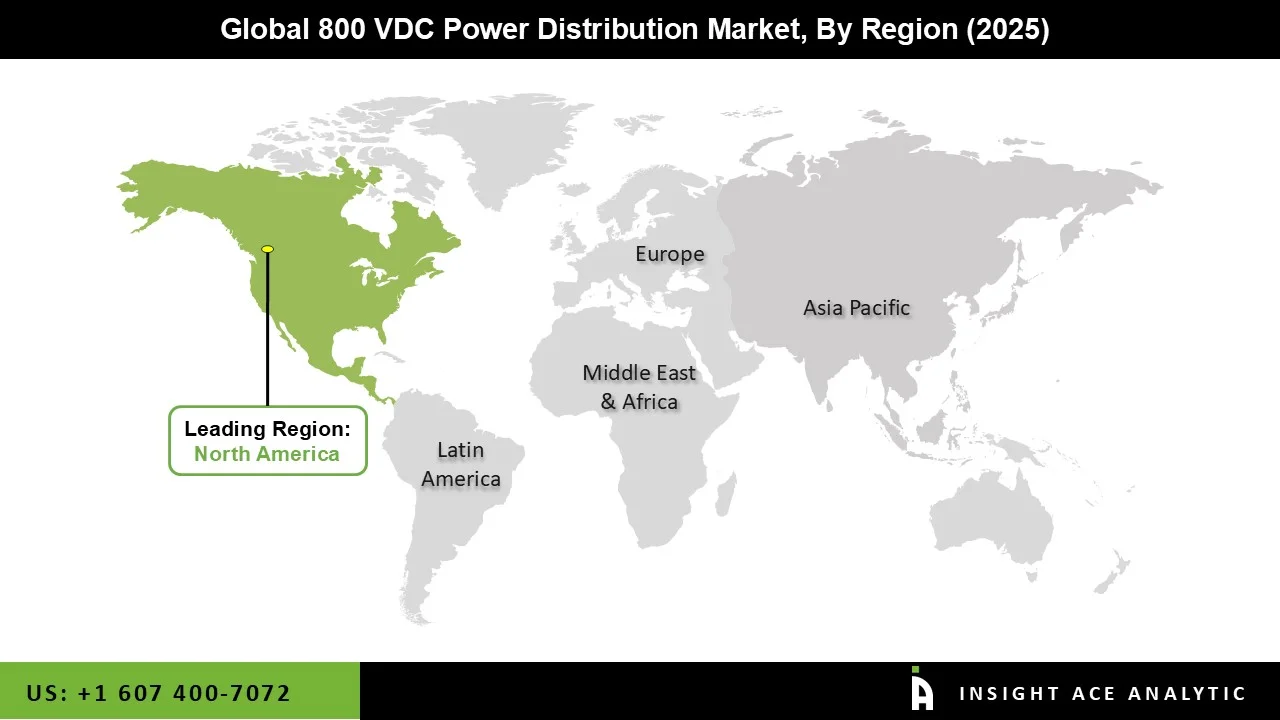
There's also a significant amount of collaboration happening between the data centre operators, the power management companies, the semiconductor companies and the various tech companies to drive the 800vdc solution forward. All of this makes North America the market leader in the move to next generation high voltage DC power distribution for AI data centres.
Key Development
- October 2025: Vertiv advanced its collaboration with NVIDIA on 800 VDC power architectures for next-generation AI factories, progressing from concept to engineering readiness. Its planned portfolio includes centralized rectifiers, high-efficiency DC busways, rack-level DC-DC converters, and integrated energy storage, with release targeted for the second half of 2026 to support NVIDIA Rubin Ultra platforms.
- July 2025: Eaton is collaborating with NVIDIA to advance high-voltage DC power infrastructure for AI data centers, including 800 VDC architectures designed to support 1 MW racks and beyond. The collaboration focuses on power-management solutions, design best practices, reference architectures, and integration with NVIDIA’s AI factory digital-twin platform.
800 VDC Power Distribution Market Report Scope:
| Report Attribute | Specifications |
| Growth Rate CAGR | CAGR of 42.0% from 2026 to 2035 |
| Quantitative Units | Representation of revenue in US$ Bn, Volume (MW (800 VDC-Served IT Power Capacity)) and CAGR from 2026 to 2035 |
| Historic Year | 2022 to 2025 |
| Forecast Year | 2026-2035 |
| Report Coverage | The forecast of revenue, the position of the company, the competitive market structure, growth prospects, and trends |
| Segments Covered | Equipment Type, Power Architecture, Data-Center / End-User Type and By Region |
| Regional Scope | North America; Europe; Asia Pacific; Latin America; Middle East & Africa |
| Country Scope | U.S.; Canada; U.K.; Germany; China; India; Japan; Brazil; Mexico; France; Italy; Spain; South Korea; Southeast Asia |
| Competitive Landscape | Vertiv Holdings Co, Schneider Electric SE, Eaton Corporation plc, ABB Ltd, Delta Electronics, Inc., Flex Ltd., LITEON Technology Corporation, Hitachi Energy Ltd, DG Matrix, Inc., Siemens AG |
| Customization Scope | Free customization report with the procurement of the report, Modifications to the regional and segment scope. Geographic competitive landscape. |
| Pricing and Available Payment Methods | Explore pricing alternatives that are customized to your particular study requirements. |
Segmentations 800 VDC Power Distribution Market:
800 VDC Power Distribution Market by Equipment Type -
- Power Conversion Systems
- AC-to-800 VDC Rectifier / Power-Shelf Systems
- MVAC-to-800 VDC Solid-State Transformers (SST)
- Transformer-Rectifier Units & Conversion Skids
- Rack-Level 800 VDC DC/DC Converters
- Power Distribution Systems
- 800 VDC Busway / Busbar Systems
- DC Switchgear
- 800 VDC Connectors & Cabling Assemblies
- Circuit Protection Systems
- DC Circuit Breakers
- Solid-State Circuit Breakers (SSCB)
- DC Disconnects & Protection Relays
- Energy Buffering & Ride-Through Systems
- 800 VDC Battery Backup Units (BBU / CBU)
- Supercapacitor & Capacitor-Bank Modules
- Monitoring, Control & Power-Management Systems
- DC Power Monitoring & Metering
- Embedded Power-Management & Controls
800 VDC Power Distribution Market by Power Architecture -
- AC-Sidecar / LVDC Side Power Rack (480 VAC → 800 VDC)
- Native MVAC-to-800 VDC (SST / Transformer-Rectifier Backbone)
800 VDC Power Distribution Market by Data-Center / End-User Type -
- Hyperscale & AI Cloud
- Colocation Providers
- Enterprise / On-Premise AI
- AI-Factory / Neocloud GPU Specialists
800 VDC Power Distribution Market by Region-
- North America-
- The US
- Canada
- Europe-
- Germany
- The UK
- France
- Italy
- Spain
- Rest of Europe
- Asia-Pacific-
- China
- Japan
- India
- South Korea
- South East Asia
- Rest of Asia Pacific
- Latin America-
- Brazil
- Argentina
- Mexico
- Rest of Latin America
- Middle East and Africa-
- GCC Countries
- South Africa
- Rest of Middle East and Africa
Research Design and Approach
This study employed a multi-step, mixed-method research approach that integrates:
- Secondary research
- Primary research
- Data triangulation
- Hybrid top-down and bottom-up modelling
- Forecasting and scenario analysis
This approach ensures a balanced and validated understanding of both macro- and micro-level market factors influencing the market.
Secondary Research
Secondary research for this study involved the collection, review, and analysis of publicly available and paid data sources to build the initial fact base, understand historical market behaviour, identify data gaps, and refine the hypotheses for primary research.
Sources Consulted
Secondary data for the market study was gathered from multiple credible sources, including:
- Government databases, regulatory bodies, and public institutions
- International organizations (WHO, OECD, IMF, World Bank, etc.)
- Commercial and paid databases
- Industry associations, trade publications, and technical journals
- Company annual reports, investor presentations, press releases, and SEC filings
- Academic research papers, patents, and scientific literature
- Previous market research publications and syndicated reports
These sources were used to compile historical data, market volumes/prices, industry trends, technological developments, and competitive insights.
Primary Research
Primary research was conducted to validate secondary data, understand real-time market dynamics, capture price points and adoption trends, and verify the assumptions used in the market modelling.
Stakeholders Interviewed
Primary interviews for this study involved:
- Manufacturers and suppliers in the market value chain
- Distributors, channel partners, and integrators
- End-users / customers (e.g., hospitals, labs, enterprises, consumers, etc., depending on the market)
- Industry experts, technology specialists, consultants, and regulatory professionals
- Senior executives (CEOs, CTOs, VPs, Directors) and product managers
Interview Process
Interviews were conducted via:
- Structured and semi-structured questionnaires
- Telephonic and video interactions
- Email correspondences
- Expert consultation sessions
Primary insights were incorporated into demand modelling, pricing analysis, technology evaluation, and market share estimation.
Data Processing, Normalization, and Validation
All collected data were processed and normalized to ensure consistency and comparability across regions and time frames.
The data validation process included:
- Standardization of units (currency conversions, volume units, inflation adjustments)
- Cross-verification of data points across multiple secondary sources
- Normalization of inconsistent datasets
- Identification and resolution of data gaps
- Outlier detection and removal through algorithmic and manual checks
- Plausibility and coherence checks across segments and geographies
This ensured that the dataset used for modelling was clean, robust, and reliable.
Market Size Estimation and Data Triangulation
Bottom-Up Approach
The bottom-up approach involved aggregating segment-level data, such as:
- Company revenues
- Product-level sales
- Installed base/usage volumes
- Adoption and penetration rates
- Pricing analysis
This method was primarily used when detailed micro-level market data were available.
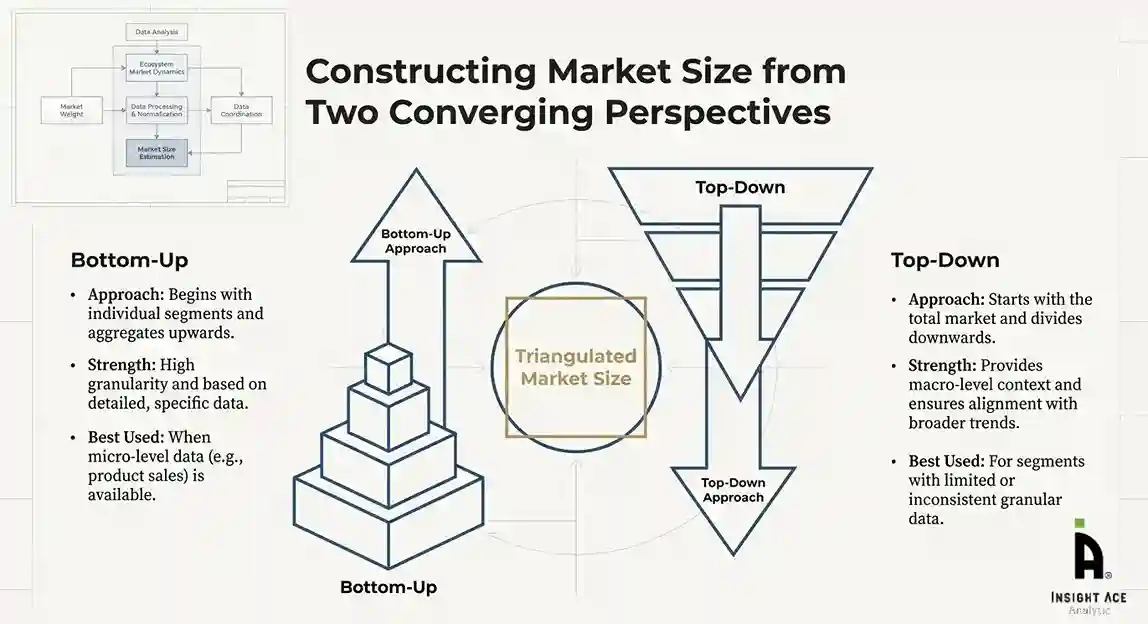
Top-Down Approach
The top-down approach used macro-level indicators:
- Parent market benchmarks
- Global/regional industry trends
- Economic indicators (GDP, demographics, spending patterns)
- Penetration and usage ratios
This approach was used for segments where granular data were limited or inconsistent.
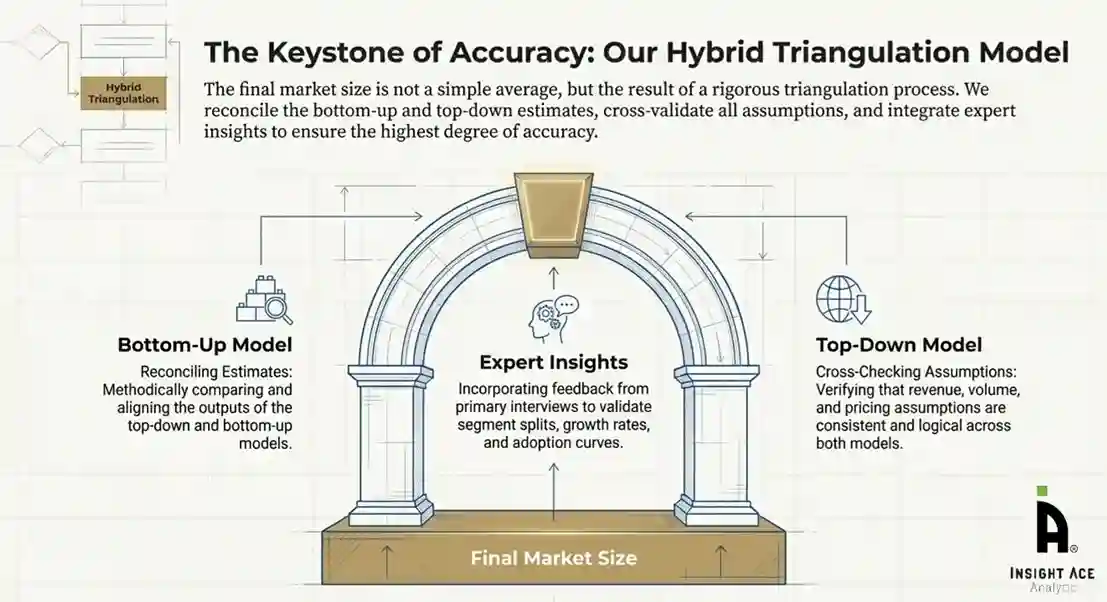
Hybrid Triangulation Approach
To ensure accuracy, a triangulated hybrid model was used. This included:
- Reconciling top-down and bottom-up estimates
- Cross-checking revenues, volumes, and pricing assumptions
- Incorporating expert insights to validate segment splits and adoption rates
This multi-angle validation yielded the final market size.
Forecasting Framework and Scenario Modelling
Market forecasts were developed using a combination of time-series modelling, adoption curve analysis, and driver-based forecasting tools.
Forecasting Methods
- Time-series modelling
- S-curve and diffusion models (for emerging technologies)
- Driver-based forecasting (GDP, disposable income, adoption rates, regulatory changes)
- Price elasticity models
- Market maturity and lifecycle-based projections
Scenario Analysis
Given inherent uncertainties, three scenarios were constructed:
- Base-Case Scenario: Expected trajectory under current conditions
- Optimistic Scenario: High adoption, favourable regulation, strong economic tailwinds
- Conservative Scenario: Slow adoption, regulatory delays, economic constraints
Sensitivity testing was conducted on key variables, including pricing, demand elasticity, and regional adoption.
Request Customization
Add countries, segments, company profiles, or extend forecast — free 10% customization with purchase.
Customize This Report →Enquire Before Buying
Speak with our analyst team about scope, methodology, pricing, or deliverable formats.
Enquire Now →Frequently Asked Questions
800 VDC Power Distribution Market is estimated to grow with a 42.0% CAGR during the forecast period for 2026 to 2035.
Vertiv Holdings Co, Schneider Electric SE, Eaton Corporation plc, ABB Ltd, Delta Electronics, Inc., Flex Ltd., LITEON Technology Corporation, Hitachi Energy Ltd, DG Matrix, Inc., Siemens AG and Others.
800 VDC Power Distribution Market is segmented into Equipment Type, Power Architecture, Data-Center / End-User Type and Other.
North America region is leading the 800 VDC Power Distribution Market.