Carbon Nanotubes For EV Battery and Electronics Market Size, Trend, Revenue Report 2026 to 2035
What is Carbon Nanotubes for EV Battery and Electronics Market Size?
Global Carbon Nanotubes for EV Battery and Electronics Market Size is valued at USD 9.01 Bn in 2025 and is predicted to reach USD 33.15 Bn by the year 2035 at a 14.0% CAGR during the forecast period for 2026 to 2035.
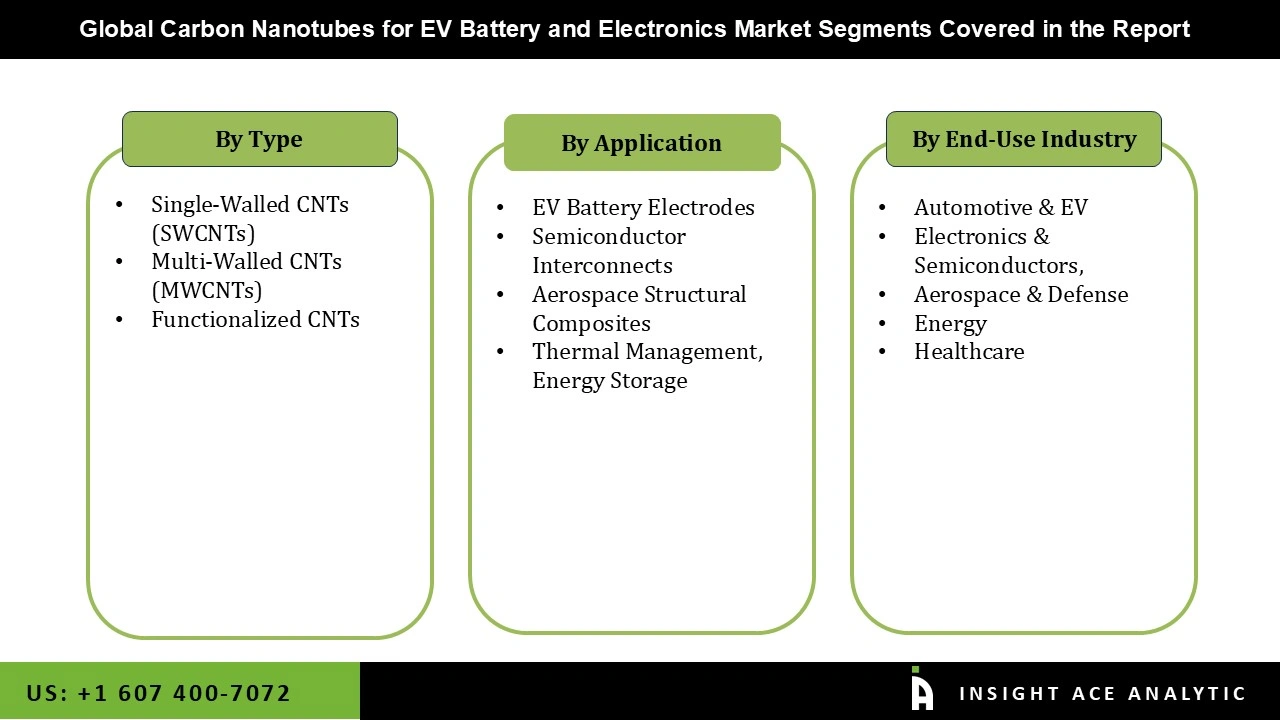
Carbon Nanotubes For EV Battery and Electronics Market Size, Share & Trends Analysis by Type (Single-Walled CNTs (SWCNTs), Multi-Walled CNTs (MWCNTs), Functionalized CNTs), by Application (EV Battery Electrodes, Semiconductor Interconnects, Aerospace Structural Composites, Thermal Management, Energy Storage), by End-Use Industry (Automotive & EV, Electronics & Semiconductors, Aerospace & Defense, Energy, Healthcare), and Segment Forecasts, 2026 to 2035.
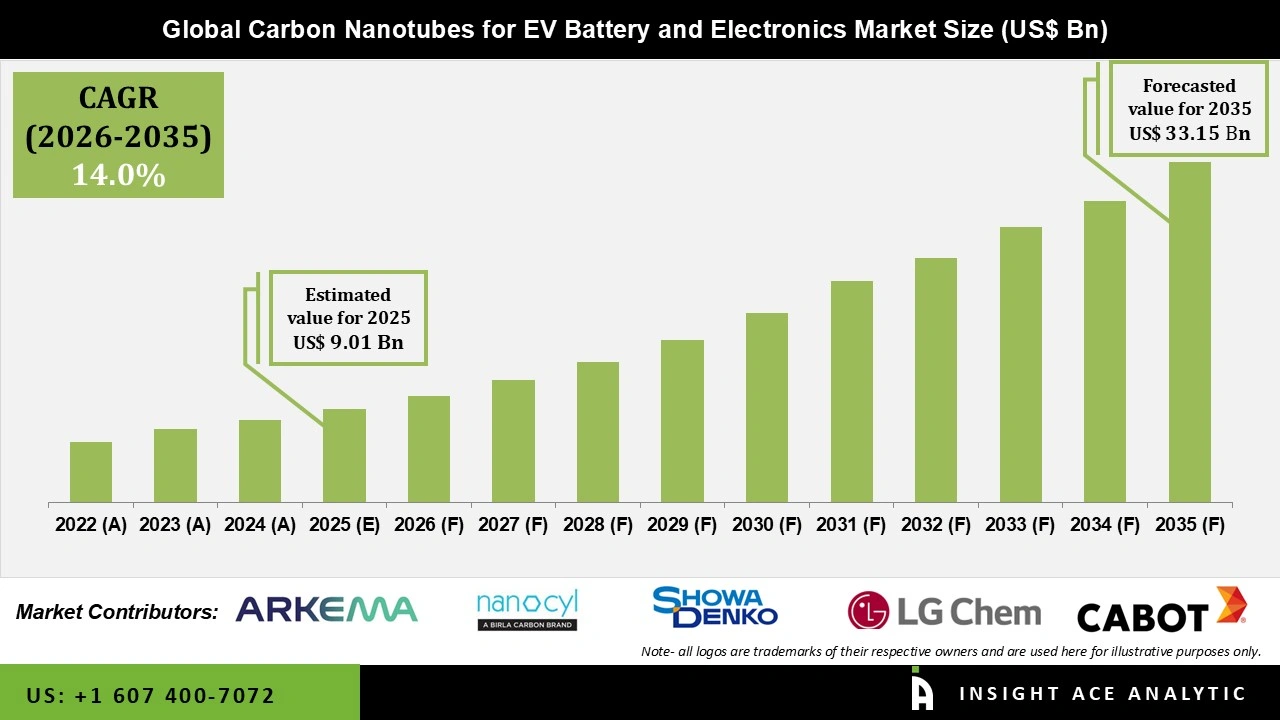
CNTs stand for cylindrical carbon nanostructures made up of carbon atoms in a hexagonal lattice structure. The high level of conductivity, mechanical strength, stability, and weightlessness are some of the factors that make the carbon nanotubes suitable for use in EV batteries and electronics. In lithium-ion batteries, CNTs are conductive additives that help in increasing the electrical conductivity of the battery and the capacity to store energy. They also enhance the performance of the battery by making it last longer and have fast charging capabilities. In electronics, they are used in semiconductors, conductive films, displays, and high-end electronic components.
The increased use of electric cars and the need for efficient energy storage devices is one of the main reasons for the high demand for carbon nanotubes. Battery makers are looking for conductive materials that will help improve battery performance and assist in adopting the future mobility technologies. In addition, the fast-growing consumer electronics and semiconductors industry will provide new avenues of application for the CNTs.
In addition, increasing research activities directed towards improving battery efficiency and cutting down charging times are driving the use of carbon nanotube-based materials. Companies are looking into developing efficient manufacturing processes that will reduce costs and ensure high-quality products. With the ongoing demand for light and strong materials having high conductivity, the market for carbon nanotubes in batteries and electronics for electric vehicles is poised to grow significantly during the forecast period.
Competitive Landscape
Which are the Leading Players in Carbon Nanotubes for EV Battery and Electronics Market?
- OCSiAl
- Arkema S.A.
- LG Chem Ltd.
- Cabot Corporation
- Birla Carbon / Nanocyl S.A.
- Kumho Petrochemical Co., Ltd.
- CHASM Advanced Materials, Inc.
- Jiangsu Cnano Technology Co., Ltd. / Cnano Technology
- Thomas Swan & Co. Ltd.
- Raymor Industries Inc.
- Hyperion Catalysis International
- Other Prominent Players
Market Dynamics
Driver
Rising Demand for High-Performance EV Batteries
One of the reasons behind the growth of the carbon nanotubes for EV batteries and electronics market is the rising use of electric vehicles across the globe. The EV producers are always looking out for new materials which will help increase the efficiency and capacity of batteries and prolong its life. Using carbon nanotubes increases the conductivity of the battery electrodes, making batteries more durable with higher energy densities. Industry trends have indicated that the production of global EVs is increasing at a rapid pace, creating high demand for advanced conductive materials like carbon nanotubes.
Restrain/Challenge
High Manufacturing Costs and Production Complexity
Some of the key obstacles that exist within the carbon nanotubes market include the high costs of production and purification of CNTs. Manufacturing pure and quality CNTs entails the use of specialized machinery and advanced technology. Industrial-level manufacturing of CNTs is relatively costly as compared to other existing conductive materials like carbon black. Furthermore, it is also difficult to ensure structural consistency and purity of the product throughout the production process. Environmental and occupational safety issues may also pose an obstacle.
Automotive Segment is Expected to Drive the Carbon Nanotubes for EV Battery and Electronics Market
Automotive industry formed the biggest part of the market during 2025. Increase in production of electric cars boosted the need for high quality batteries that can provide higher efficiency. Carbon nanotube are used more often in battery electrodes to increase energy density and conductivity of the battery. Major players in automotive industry and battery industry spend a lot on research and development of carbon nanotube applications to develop fast charging and long range batteries. As the rate of electrification of transport increases worldwide, automotive industry will be a key market growth driver.
Multi-Walled Carbon Nanotubes Segment is Growing at the Highest Rate in the Carbon Nanotubes for EV Battery and Electronics Market
Multi-Walled Carbon Nanotubes (MWCNTs) was the largest revenue generator in the market in 2025 owing to its economic efficiency, scalability, and good electrical conductivity. These nanotubes have been used extensively in lithium-ion batteries, conductive plastics, electronics, and industries owing to their high mechanical strength and easy production process. The rising investment in battery material and growing demand for conductive additives will boost the market for MWCNTs.
Why North America Led the Carbon Nanotubes for EV Battery and Electronics Market?
North America was a prominent player in the market in 2025 because of the existence of leading companies in advanced batteries, electric vehicles, and nanotechnology researches. Investments into clean energy technologies, semiconductors, and battery manufacturing help develop the industry in the region. Government programs that facilitate the development of domestic battery production and usage of electric vehicles are driving the demand for carbon nanotubes. Moreover, collaborations of universities, technology companies, and material science companies increase the demand.
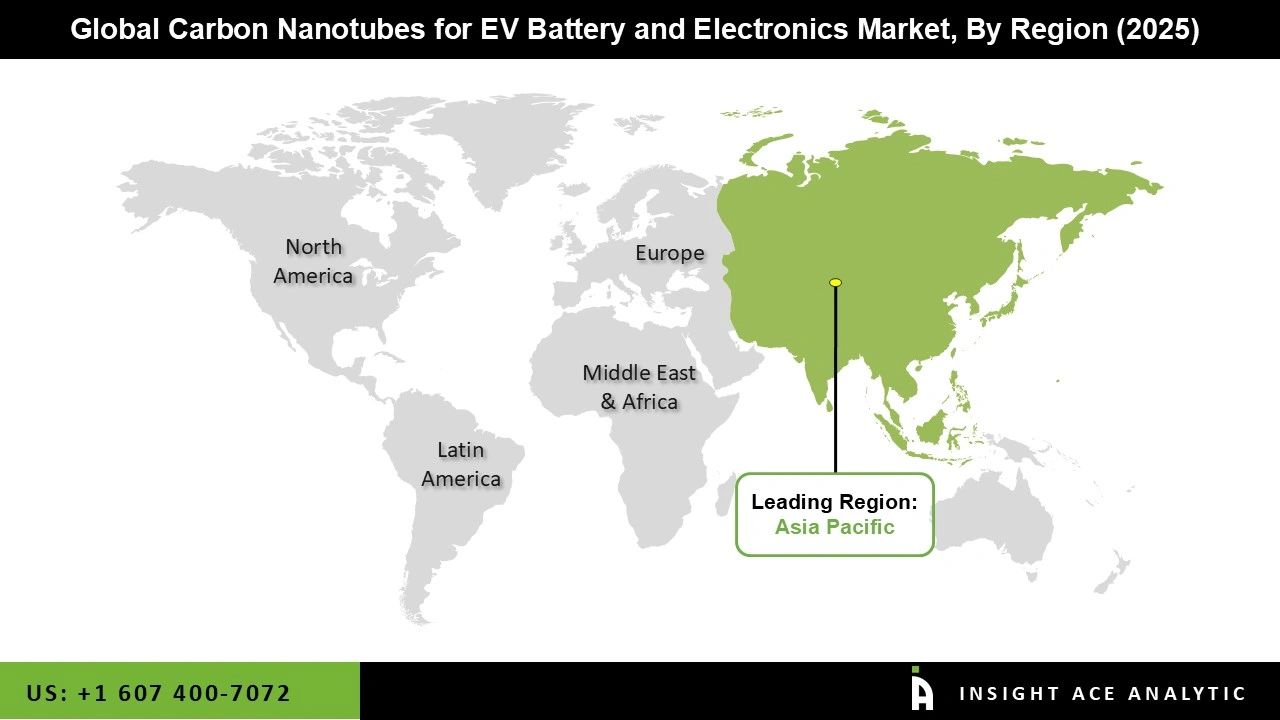
According to forecasts, the fastest growing region is predicted to be Asia Pacific. China, Japan, South Korea, and India will have fast-growing electric vehicles manufacturing capabilities and battery manufacturing capabilities. The region is home to leading battery manufacturing companies and electronics companies that start using CNTs in new batteries and electronics. Government programs facilitating EV adoption, investments into semiconductors manufacturing, and nanotechnology research are going to increase the market substantially.
Key Development
- May 2025: Graphene nanotubes manufacturer OCSiAl has announced an increase in its production capacity due to growing demand for graphene nanotubes by electric vehicle batteries manufacturers and energy storage producers.
- March 2025: French company Arkema S.A. has developed a line of advanced conductive carbon nanomaterials to be used in improving the properties of lithium-ion batteries used in electric vehicles.
- January 2025: LG Chem has stepped up its efforts in research and development of conductive carbon nanotube technologies for next-generation EV batteries.
- September 2024: Cabot Corporation has launched advanced conductive additives that will improve the properties of lithium-ion batteries.
June 2024: Jiangsu Cnano Technology has entered into new supplier contracts with battery manufacturers for more widespread application of carbon nanotubes as conductive agents in battery systems.
Carbon Nanotubes for EV Battery and Electronics Market Report Scope:
| Report Attribute | Specifications |
| Market size value in 2025 | USD 9.01 Bn |
| Revenue forecast in 2035 | USD 33.15 Bn |
| Growth Rate CAGR | CAGR of 14.0% from 2026 to 2035 |
| Quantitative Units | Representation of revenue in US$ Bn and CAGR from 2026 to 2035 |
| Historic Year | 2022 to 2025 |
| Forecast Year | 2026-2035 |
| Report Coverage | The forecast of revenue, the position of the company, the competitive market structure, growth prospects, and trends |
| Segments Covered | By Type, By Application, By End-user, and By Region |
| Regional Scope | North America; Europe; Asia Pacific; Latin America; Middle East & Africa |
| Country Scope | U.S.; Canada; U.K.; Germany; China; India; Japan; Brazil; Mexico; The UK; France; Italy; Spain; China; Japan; India; South Korea; Southeast Asia; South Korea; Southeast Asia |
| Competitive Landscape | OCSiAl, Arkema S.A., LG Chem Ltd., Cabot Corporation, Birla Carbon / Nanocyl S.A., Kumho Petrochemical Co., Ltd., CHASM Advanced Materials, Inc., Jiangsu Cnano Technology Co., Ltd. / Cnano Technology, Thomas Swan & Co. Ltd., Raymor Industries Inc., Hyperion Catalysis International, and other prominent players. |
| Customization Scope | Free customization report with the procurement of the report, Modifications to the regional and segment scope. Geographic competitive landscape. |
| Pricing and Available Payment Methods | Explore pricing alternatives that are customized to your particular study requirements. |
Segmentations of Carbon Nanotubes for EV Battery and Electronics Market:
Carbon Nanotubes for EV Battery and Electronics Market by Type-
- Single-Walled CNTs (SWCNTs)
- Multi-Walled CNTs (MWCNTs)
- Functionalized CNTs
Carbon Nanotubes for EV Battery and Electronics Market by Application-
- EV Battery Electrodes
- Semiconductor Interconnects
- Aerospace Structural Composites
- Thermal Management
- Energy Storage
Carbon Nanotubes for EV Battery and Electronics Market by End-user-
- Automotive & EV
- Electronics & Semiconductors
- Aerospace & Defense
- Energy
- Healthcare
Carbon Nanotubes for EV Battery and Electronics Market By Region-
- North America-
- The US
- Canada
- Europe-
- Germany
- The UK
- France
- Italy
- Spain
- Rest of Europe
- Asia-Pacific-
- China
- Japan
- India
- South Korea
- South East Asia
- Rest of Asia Pacific
- Latin America-
- Brazil
- Argentina
- Mexico
- Rest of Latin America
- Middle East and Africa-
- GCC Countries
- South Africa
- Rest of Middle East and Africa
Research Design and Approach
This study employed a multi-step, mixed-method research approach that integrates:
- Secondary research
- Primary research
- Data triangulation
- Hybrid top-down and bottom-up modelling
- Forecasting and scenario analysis
This approach ensures a balanced and validated understanding of both macro- and micro-level market factors influencing the market.
Secondary Research
Secondary research for this study involved the collection, review, and analysis of publicly available and paid data sources to build the initial fact base, understand historical market behaviour, identify data gaps, and refine the hypotheses for primary research.
Sources Consulted
Secondary data for the market study was gathered from multiple credible sources, including:
- Government databases, regulatory bodies, and public institutions
- International organizations (WHO, OECD, IMF, World Bank, etc.)
- Commercial and paid databases
- Industry associations, trade publications, and technical journals
- Company annual reports, investor presentations, press releases, and SEC filings
- Academic research papers, patents, and scientific literature
- Previous market research publications and syndicated reports
These sources were used to compile historical data, market volumes/prices, industry trends, technological developments, and competitive insights.

Primary Research
Primary research was conducted to validate secondary data, understand real-time market dynamics, capture price points and adoption trends, and verify the assumptions used in the market modelling.
Stakeholders Interviewed
Primary interviews for this study involved:
- Manufacturers and suppliers in the market value chain
- Distributors, channel partners, and integrators
- End-users / customers (e.g., hospitals, labs, enterprises, consumers, etc., depending on the market)
- Industry experts, technology specialists, consultants, and regulatory professionals
- Senior executives (CEOs, CTOs, VPs, Directors) and product managers
Interview Process
Interviews were conducted via:
- Structured and semi-structured questionnaires
- Telephonic and video interactions
- Email correspondences
- Expert consultation sessions
Primary insights were incorporated into demand modelling, pricing analysis, technology evaluation, and market share estimation.
Data Processing, Normalization, and Validation
All collected data were processed and normalized to ensure consistency and comparability across regions and time frames.
The data validation process included:
- Standardization of units (currency conversions, volume units, inflation adjustments)
- Cross-verification of data points across multiple secondary sources
- Normalization of inconsistent datasets
- Identification and resolution of data gaps
- Outlier detection and removal through algorithmic and manual checks
- Plausibility and coherence checks across segments and geographies
This ensured that the dataset used for modelling was clean, robust, and reliable.
Market Size Estimation and Data Triangulation
Bottom-Up Approach
The bottom-up approach involved aggregating segment-level data, such as:
- Company revenues
- Product-level sales
- Installed base/usage volumes
- Adoption and penetration rates
- Pricing analysis
This method was primarily used when detailed micro-level market data were available.

Top-Down Approach
The top-down approach used macro-level indicators:
- Parent market benchmarks
- Global/regional industry trends
- Economic indicators (GDP, demographics, spending patterns)
- Penetration and usage ratios
This approach was used for segments where granular data were limited or inconsistent.
Hybrid Triangulation Approach
To ensure accuracy, a triangulated hybrid model was used. This included:
- Reconciling top-down and bottom-up estimates
- Cross-checking revenues, volumes, and pricing assumptions
- Incorporating expert insights to validate segment splits and adoption rates
This multi-angle validation yielded the final market size.
Forecasting Framework and Scenario Modelling
Market forecasts were developed using a combination of time-series modelling, adoption curve analysis, and driver-based forecasting tools.
Forecasting Methods
- Time-series modelling
- S-curve and diffusion models (for emerging technologies)
- Driver-based forecasting (GDP, disposable income, adoption rates, regulatory changes)
- Price elasticity models
- Market maturity and lifecycle-based projections
Scenario Analysis
Given inherent uncertainties, three scenarios were constructed:
- Base-Case Scenario: Expected trajectory under current conditions
- Optimistic Scenario: High adoption, favourable regulation, strong economic tailwinds
- Conservative Scenario: Slow adoption, regulatory delays, economic constraints
Sensitivity testing was conducted on key variables, including pricing, demand elasticity, and regional adoption.
Request Customization
Add countries, segments, company profiles, or extend forecast — free 10% customization with purchase.
Customize This Report →Enquire Before Buying
Speak with our analyst team about scope, methodology, pricing, or deliverable formats.
Enquire Now →Frequently Asked Questions
Carbon Nanotubes for EV Battery and Electronics Market Size is valued at USD 9.01 Bn in 2025 and is predicted to reach USD 33.15 Bn by the year 2035
The Carbon Nanotubes For EV Battery and Electronics Market is expected to grow at a 14.0% CAGR during the forecast period for 2026 to 2035
OCSiAl, Arkema S.A., LG Chem Ltd., Cabot Corporation, Birla Carbon / Nanocyl S.A., Kumho Petrochemical Co., Ltd., CHASM Advanced Materials, Inc., Jiangsu Cnano Technology Co., Ltd. / Cnano Technology, Thomas Swan & Co. Ltd., Raymor Industries Inc., Hyperion Catalysis International, and other prominent players.
Carbon Nanotubes For EV Battery and Electronics Market is segmented into Type, Application, End-user, and Other.
Asia Pacific region is leading the Carbon Nanotubes For EV Battery and Electronics Market.