B20 Fuel Market Size, Share, Forecast Report 2026 to 2035
What is B20 Fuel Market Size?
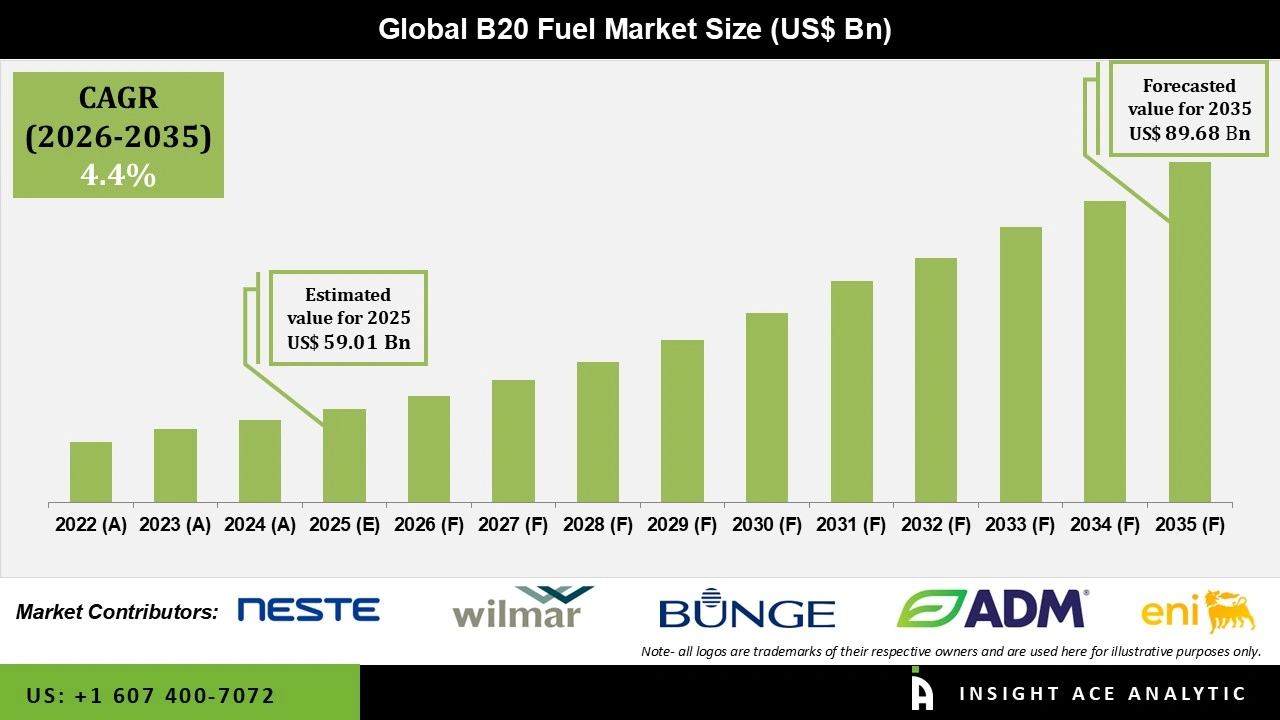
Global B20 Fuel Market Size is valued at US$ 59.01 Bn in 2025 and is predicted to reach US$ 89.68 Bn by the year 2035 at an 4.4% CAGR during the forecast period for 2026 to 2035.
B20 Fuel Market Size, Share & Trends Analysis Distribution by Distribution Channel (Direct and Wholesale), by Application (Transportation, Industrial, and Others), by Feedstock (Soybean Oil and Palm Oil), and Segment Forecasts, 2026 to 2035.
B20 fuel, a blend of 20% biodiesel and 80% petroleum diesel, is widely used in trucks, buses, construction machinery, agricultural equipment, municipal fleets, and selected naval engines. It provides a practical pathway toward cleaner transportation by enabling fleet operators to reduce emissions without replacing or significantly modifying their existing diesel engines. In addition to lowering particulate matter and soot emissions, B20 can improve fuel lubricity, support engine performance, and potentially reduce wear on diesel components. Municipal authorities are increasingly adopting the blend for public buses, waste-collection vehicles, and other service fleets.
The global B20 fuel market is expanding as governments and businesses face growing pressure to reduce transportation-related emissions while avoiding the high costs associated with transitioning to entirely new vehicle and engine technologies. Rising crude oil prices are also encouraging industries to explore biodiesel blends as an alternative to conventional diesel. Global biodiesel production reached nearly 50 billion litres in 2023, according to the World Bioenergy Association, indicating a strong and expanding supply base for blended fuels such as B20.
However, market growth may be constrained by the limited availability and price volatility of biodiesel feedstocks, including vegetable oils, used cooking oil, and animal fats. Nevertheless, ongoing technological advancements in feedstock processing, conversion efficiency, and biodiesel production are expected to reduce costs, improve fuel quality, and create significant growth opportunities for the B20 fuel market during the forecast period.
Competitive Landscape
Some of the Key Players in B20 Fuel Market:
- Chevron Corporation — Chevron Renewable Energy Group
- Wilmar International Limited
- Archer-Daniels-Midland Company — ADM
- Cargill, Incorporated
- Louis Dreyfus Company B.V.
- Verbio SE
- Bunge Global SA
- Be8 S.A. — ECB Group
- Trafigura Group Pte. Ltd. — Greenergy International Limited
- Argent Energy — Swire Group
- Aemetis, Inc. — Universal Biofuels Private Limited
- PT Sinar Mas Agro Resources and Technology Tbk — Sinar Mas Agribusiness and Food
- Musim Mas Group
- Münzer Bioindustrie GmbH
- Others
Market Segmentation:
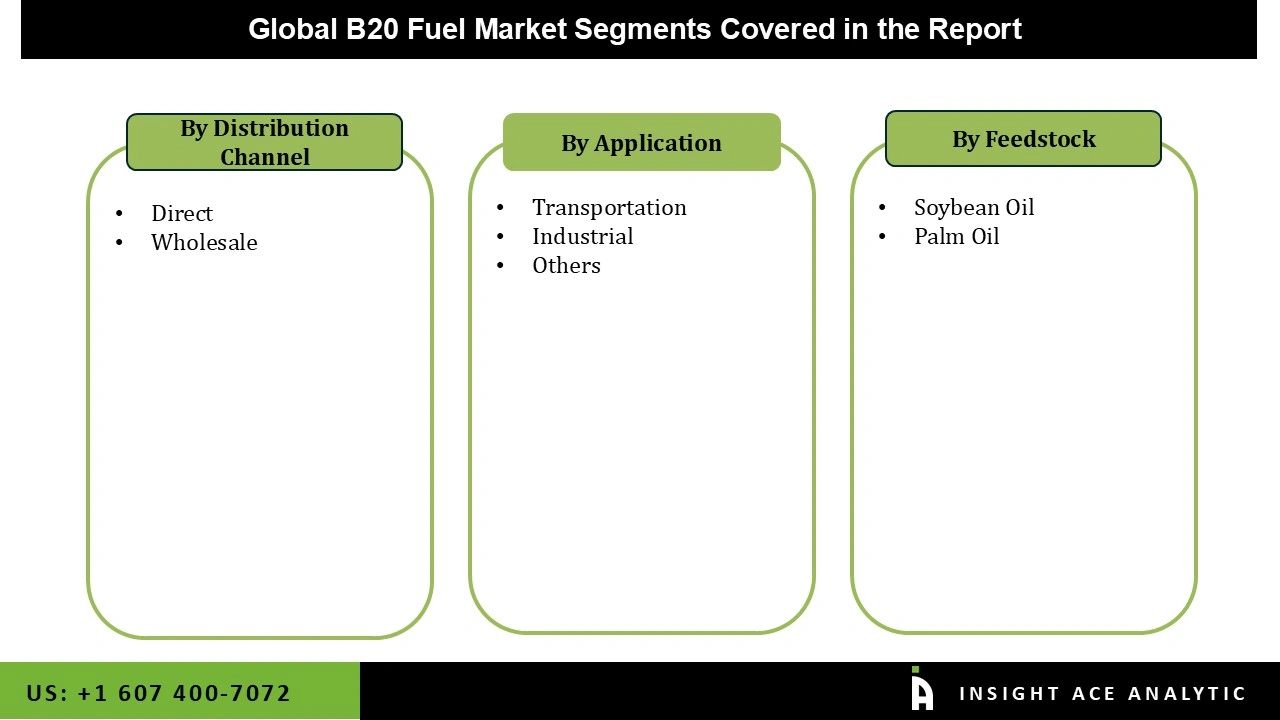
The B20 Fuel market is segmented by distribution channel, application, and feedstock. By distribution channel, the market is segmented into direct and wholesale. By application, the market is segmented into transportation, industrial, and others. By feedstock, the market is segmented into soybean oil and palm oil.
By Distribution Channel, the Direct Segment is Expected to Drive the B20 Fuel Market
the direct distribution channel is assessed to have dominated the global B20 fuel market in 2025 and should retain its leading position during the forecast period. Demand is supported by large-volume purchases from transportation fleets, municipal authorities, construction companies, agricultural operators, utilities, and defence organizations. These customers commonly procure B20 through long-term supply contracts or bulk deliveries, allowing them to secure consistent fuel quality, negotiate competitive prices, and maintain inventories. The U.S. Alternative Fuels Data Center notes that most B20 users purchase blends from fuel distributors or biodiesel marketers, while distributors can deliver B20 directly according to customer requirements. Direct procurement also provides control over blend specifications, delivery schedules, storage management, and regulatory documentation. In comparison, wholesale serves smaller fuel retailers and dispersed customers but involves additional intermediaries and margins. Fleet decarbonization targets and expanding bulk-fueling infrastructure should therefore reinforce the dominance of direct distribution.
Industrial Segment by Application is Growing at the Highest Rate in the B20 Fuel Market
The industrial segment represents the largest and fastest-growing application in the B20 fuel market, supported by increasing corporate sustainability commitments and stringent environmental regulations worldwide. Government policies, tax incentives, and emission-reduction programs promoting cleaner energy alternatives are further accelerating adoption. Industrial facilities are increasingly using B20 fuel in diesel generators, boilers, and other heavy-duty equipment to reduce greenhouse gas emissions and lower their dependence on conventional petroleum diesel. The segment is witnessing particularly strong growth in power generation, manufacturing, mining, and construction, where diesel-powered systems remain widely used. By adopting B20, industrial operators can reduce their carbon footprint and achieve emissions-reduction targets without making substantial investments in new equipment or infrastructure. Its compatibility with existing diesel engines and combustion systems makes B20 a practical and cost-effective transitional fuel, strengthening its adoption across energy-intensive industries.
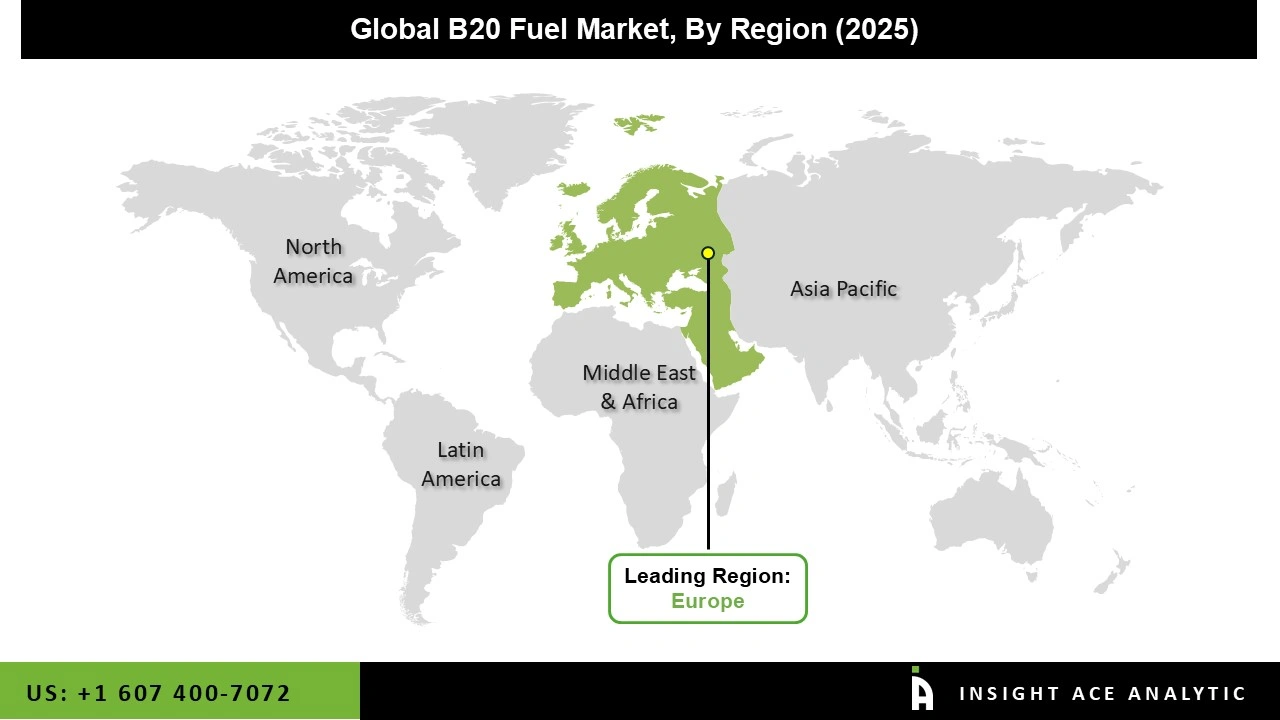
Regionally, Europe Led the B20 Fuel Market
Europe dominated the B20 Fuel market in 2025 due to strong legislative framework and unwavering commitment to decarbonization. Binding standards for renewable energy in the transportation industry are established by the European Union's Renewable Energy Directive, particularly RED II and its later updates. These targets include requirements for biofuel blending and progressively stricter greenhouse gas emission reduction thresholds. To ensure constant acceptance, these progressive government measures are frequently accompanied by rewards and sanctions for non-compliance.
Transportation and construction industries' rapid expansion is becoming more and more common in the Asia-Pacific area, the B20 Fuel market is expanding at the strongest and fastest rate in this region. Additionally, Because nations like Malaysia, Indonesia, and India are promoting strict biodiesel blending regulations to reduce reliance on imports and promote domestic agriculture, Asia Pacific is experiencing the fastest growth in the B20 fuel industry. Cleaner fuel sources that work with current diesel engines are in greater demand due to the transportation and construction industries' rapid expansion. Additionally, governments are investing in the capacity to produce biodiesel, which will increase the affordability and accessibility of B20.
B20 Fuel Market Report Scope :
| Report Attribute | Specifications |
| Market Size Value In 2025 | USD 59.01 Bn |
| Revenue Forecast In 2035 | USD 89.68 Bn |
| Growth Rate CAGR | CAGR of 4.4% from 2026 to 2035 |
| Quantitative Units | Representation of revenue in US$ Bn and CAGR from 2026 to 2035 |
| Historic Year | 2022 to 2025 |
| Forecast Year | 2026-2035 |
| Report Coverage | The forecast of revenue, the position of the company, the competitive market structure, growth prospects, and trends |
| Segments Covered | By Distribution Channel, By Application, By Feedstock, and By Region |
| Regional Scope | North America; Europe; Asia Pacific; Latin America; Middle East & Africa |
| Country Scope | U.S.; Canada; Germany; The UK; France; Italy; Spain; Rest of Europe; China; Japan; India; South Korea; Southeast Asia; Rest of Asia Pacific; Brazil; Argentina; Mexico; Rest of Latin America; GCC Countries; South Africa; Rest of the Middle East and Africa |
| Competitive Landscape | Chevron Corporation through Chevron Renewable Energy Group, Wilmar International Limited, Archer-Daniels-Midland Company under the ADM brand, Cargill, Incorporated, Louis Dreyfus Company B.V., VERBIO SE, Bunge Global SA, Be8 S.A., Trafigura Group Pte. Ltd. through Greenergy, and Argent Energy. |
| Customization Scope | Free customization report with the procurement of the report, Modifications to the regional and segment scope. Geographic competitive landscape. |
| Pricing and Available Payment Methods | Explore pricing alternatives that are customized to your particular study requirements. |
Segmentation of B20 Fuel Market -
B20 Fuel Market by Distribution Channel:
- Direct
- Wholesale
B20 Fuel Market by Application-
- Transportation
- Industrial
- Others
B20 Fuel Market by Feedstock-
- Soybean Oil
- Palm Oil
B20 Fuel Market by Region-
- North America-
- The US
- Canada
- Europe-
- Germany
- The UK
- France
- Italy
- Spain
- Rest of Europe
- Asia-Pacific-
- China
- Japan
- India
- South Korea
- South East Asia
- Rest of Asia Pacific
- Latin America-
- Brazil
- Argentina
- Mexico
- Rest of Latin America
- Middle East and Africa-
- GCC Countries
- South Africa
- Rest of Middle East and Africa
Research Design and Approach
This study employed a multi-step, mixed-method research approach that integrates:
- Secondary research
- Primary research
- Data triangulation
- Hybrid top-down and bottom-up modelling
- Forecasting and scenario analysis
This approach ensures a balanced and validated understanding of both macro- and micro-level market factors influencing the market.
Secondary Research
Secondary research for this study involved the collection, review, and analysis of publicly available and paid data sources to build the initial fact base, understand historical market behaviour, identify data gaps, and refine the hypotheses for primary research.
Sources Consulted
Secondary data for the market study was gathered from multiple credible sources, including:
- Government databases, regulatory bodies, and public institutions
- International organizations (WHO, OECD, IMF, World Bank, etc.)
- Commercial and paid databases
- Industry associations, trade publications, and technical journals
- Company annual reports, investor presentations, press releases, and SEC filings
- Academic research papers, patents, and scientific literature
- Previous market research publications and syndicated reports
These sources were used to compile historical data, market volumes/prices, industry trends, technological developments, and competitive insights.

Primary Research
Primary research was conducted to validate secondary data, understand real-time market dynamics, capture price points and adoption trends, and verify the assumptions used in the market modelling.
Stakeholders Interviewed
Primary interviews for this study involved:
- Manufacturers and suppliers in the market value chain
- Distributors, channel partners, and integrators
- End-users / customers (e.g., hospitals, labs, enterprises, consumers, etc., depending on the market)
- Industry experts, technology specialists, consultants, and regulatory professionals
- Senior executives (CEOs, CTOs, VPs, Directors) and product managers
Interview Process
Interviews were conducted via:
- Structured and semi-structured questionnaires
- Telephonic and video interactions
- Email correspondences
- Expert consultation sessions
Primary insights were incorporated into demand modelling, pricing analysis, technology evaluation, and market share estimation.
Data Processing, Normalization, and Validation
All collected data were processed and normalized to ensure consistency and comparability across regions and time frames.
The data validation process included:
- Standardization of units (currency conversions, volume units, inflation adjustments)
- Cross-verification of data points across multiple secondary sources
- Normalization of inconsistent datasets
- Identification and resolution of data gaps
- Outlier detection and removal through algorithmic and manual checks
- Plausibility and coherence checks across segments and geographies
This ensured that the dataset used for modelling was clean, robust, and reliable.
Market Size Estimation and Data Triangulation
Bottom-Up Approach
The bottom-up approach involved aggregating segment-level data, such as:
- Company revenues
- Product-level sales
- Installed base/usage volumes
- Adoption and penetration rates
- Pricing analysis
This method was primarily used when detailed micro-level market data were available.

Top-Down Approach
The top-down approach used macro-level indicators:
- Parent market benchmarks
- Global/regional industry trends
- Economic indicators (GDP, demographics, spending patterns)
- Penetration and usage ratios
This approach was used for segments where granular data were limited or inconsistent.
Hybrid Triangulation Approach
To ensure accuracy, a triangulated hybrid model was used. This included:
- Reconciling top-down and bottom-up estimates
- Cross-checking revenues, volumes, and pricing assumptions
- Incorporating expert insights to validate segment splits and adoption rates
This multi-angle validation yielded the final market size.
Forecasting Framework and Scenario Modelling
Market forecasts were developed using a combination of time-series modelling, adoption curve analysis, and driver-based forecasting tools.
Forecasting Methods
- Time-series modelling
- S-curve and diffusion models (for emerging technologies)
- Driver-based forecasting (GDP, disposable income, adoption rates, regulatory changes)
- Price elasticity models
- Market maturity and lifecycle-based projections
Scenario Analysis
Given inherent uncertainties, three scenarios were constructed:
- Base-Case Scenario: Expected trajectory under current conditions
- Optimistic Scenario: High adoption, favourable regulation, strong economic tailwinds
- Conservative Scenario: Slow adoption, regulatory delays, economic constraints
Sensitivity testing was conducted on key variables, including pricing, demand elasticity, and regional adoption.
Request Customization
Add countries, segments, company profiles, or extend forecast — free 10% customization with purchase.
Customize This Report →Enquire Before Buying
Speak with our analyst team about scope, methodology, pricing, or deliverable formats.
Enquire Now →Frequently Asked Questions
B20 Fuel Market Size is valued at US$ 59.01 Bn in 2025 and is predicted to reach US$ 89.68 Bn by the year 2035
The B20 Fuel Market is expected to grow at a 4.4% CAGR during the forecast period for 2026 to 2035
Chevron Corporation through Chevron Renewable Energy Group, Wilmar International Limited, Archer-Daniels-Midland Company under the ADM brand, Cargill, Incorporated, Louis Dreyfus Company B.V., VERBIO SE, Bunge Global SA, Be8 S.A., Trafigura Group Pte. Ltd. through Greenergy, Argent Energy and Others.
B20 Fuel Market is segmented into Distribution Channel, Application, Feedstock, and Other.
Europe region is leading the B20 Fuel Market.