Waste To Energy Technology Market Size, Share, Trend Report 2026 to 2035
What is Waste To Energy Technology Market Size?
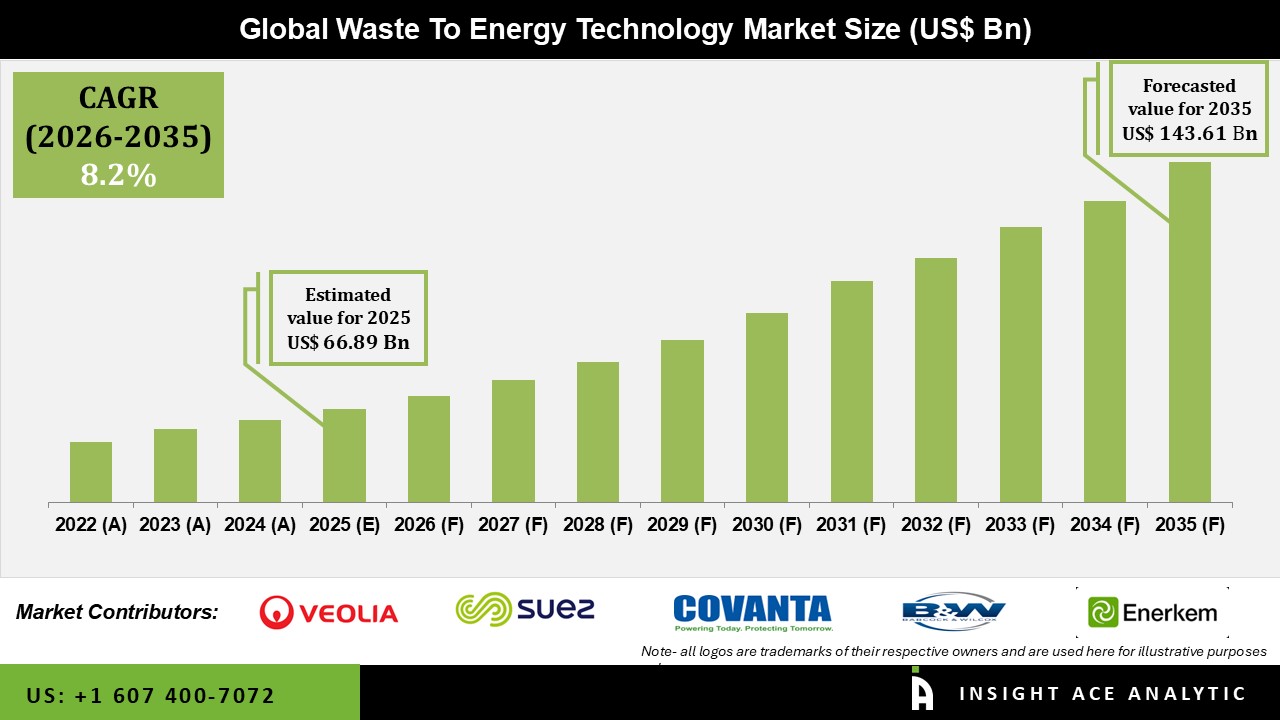
Global Waste To Energy Technology Market Size is valued at USD 66.89 Bn in 2025 and is predicted to reach USD 143.61 Bn by the year 2035 at a 8.2% CAGR during the forecast period for 2026 to 2035.
Waste To Energy Technology Market Size, Share & Trends Analysis Distribution by Feedstock (Municipal Solid Waste, Industrial Waste, Agricultural Waste, Construction and Demolition Waste, Medical Waste), by Technology Type (Incineration, Gasification, Pyrolysis, Plasma Gasification, Anaerobic Digestion), by End Product (Electricity, Heat, Steam, Biogas, Biofuel), by Capacity (Less than 10 MW, 10–50 MW, 50–100 MW, 100–200 MW, Over 200 MW), by Application (Power Generation, District Heating, Industrial Processes, Wastewater Treatment, Transportation Fuel), and Segment Forecasts, 2026 to 2035
Waste-to-Energy (WtE) technology is playing a larger role as governments, businesses, and cities seek sustainable ways to manage increasing waste and meet growing energy needs. Rather than sending waste to landfills, WtE technologies turn different types of waste into energy like electricity, heat, steam, biogas, and biofuels. With growing concerns about the environment, limited landfill space, greenhouse gas emissions, and energy security, more countries are turning to Waste-to-Energy solutions. A major reason for market growth is the fast rise in municipal solid waste around the world. More people, growing cities, more industry, and changing habits are all leading to more waste. Old methods like landfilling are less sustainable now because of environmental worries and limited space. Waste-to-Energy technologies offer a better option by cutting down waste and creating useful energy, helping communities manage waste and produce energy at the same time.
New technology is also helping the market grow. Today’s waste-to-energy plants use advanced methods like incineration, gasification, pyrolysis, plasma gasification, and anaerobic digestion to recover more energy and lower their impact on the environment. Ongoing improvements in emissions controls, automation, process efficiency, and energy conversion are making these plants more efficient, reliable, and better at meeting environmental rules. These changes help operators get the most energy while following stricter regulations. Government support and new policies are also helping the market grow. Many countries now offer incentives, set renewable energy goals, run carbon-reduction programs, and create policies to keep waste out of landfills, all of which encourage investment in Waste-to-Energy projects. Partnerships between public and private sectors, new infrastructure, and investments in the circular economy are making it easier for the market to expand. More interest in energy diversity and resource recovery is also leading industries and cities to consider Waste-to-Energy as part of their long-term plans.
Even with strong growth potential, the market has some challenges. waste-to-energy plants need a lot of upfront investment, take a long time to develop, and must go through complex approval processes. Concerns about emissions, public acceptance, getting enough waste to use, and high operating costs can also make projects harder to carry out. Developers and operators must also make sure they have a steady supply of waste and keep up with changing environmental standards. Still, the long-term outlook for the waste-to-energy technology market is very positive. More waste, a bigger focus on renewable energy, greater environmental awareness, supportive government policies, and ongoing innovation are all expected to keep the market growing. As countries look for cleaner energy and better waste management, Waste-to-Energy technologies will likely play an important part in sustainable development, cutting landfill use, and helping the global shift to new energy sources.
Competitive Landscape
Which are the Leading Players in the Waste To Energy Technology Market?
- Veolia Environnement S.A.
- SUEZ S.A.
- Reworld / Covanta
- Kanadevia Inova
- Babcock & Wilcox Enterprises, Inc.
- Enerkem Inc.
- Keppel Seghers
- Mitsubishi Heavy Industries Environmental & Chemical Engineering Co., Ltd.
- WIN Waste Innovations
- Viridor Limited
- MVV Energie AG / MVV Umwelt
- EEW Energy from Waste GmbH
- enfinium
- WM / Waste Management, Inc.
- Other Emerging Players
Market Dynamics
Driver
Growing Focus on Sustainable Waste Management and Renewable Energy Generation
The Waste-to-Energy (WtE) technology market is growing quickly as more governments, cities, and industries look for sustainable ways to handle increasing waste and produce clean energy. Urbanization, population growth, and industrial activity have led to much more municipal, industrial, agricultural, and commercial waste around the world. Traditional disposal methods like landfilling are less practical now because of environmental issues, limited space, and tighter rules. Waste-to-energy technologies provide a good alternative by turning waste into useful energy products such as electricity, heat, steam, biogas, and biofuels. More investment in renewable energy and circular economy projects is helping the market grow. Many governments are putting policies in place to keep waste out of landfills and support energy recovery from waste. Newer technologies like incineration, gasification, pyrolysis, plasma gasification, and anaerobic digestion are making operations more efficient and improving energy output and environmental results. As countries aim to cut carbon emissions and improve energy security, Waste-to-Energy technologies are becoming a key part of waste management and sustainable energy plans.
Restrain/Challenge
High Capital Investment Requirements and Environmental Concerns
A major challenge for the waste-to-energy technology market is the high cost of building and running modern facilities. Setting up waste-to-energy plants needs a lot of money for infrastructure, advanced processing equipment, emissions controls, and meeting regulations. Projects can also take a long time to develop because of permits, environmental reviews, and public input. There are also environmental concerns about emissions, sorting waste, ash disposal, and getting support from local communities. Operators have to follow stricter environmental rules while still running efficiently and making a profit. Changes in waste supply, higher operating costs, and the need for regular technology upgrades make things more complicated. These issues can slow down projects and make it harder for new companies to enter the market.
The Municipal Solid Waste Segment is Expected to Drive the Waste To Energy Technology Market
Municipal Solid Waste (MSW) is likely to make up a large part of the waste-to-energy technology market in the coming years. Fast urban growth and bigger populations are creating more household and commercial waste, which puts pressure on current waste management systems. Waste-to-energy plants help by cutting down on landfill use and turning everyday waste into useful energy. Municipal waste is easy to find and provides a steady supply for large energy recovery projects. Governments and local authorities are putting more money into advanced waste treatment to tackle environmental problems and reach sustainability goals. As cities grow and look for better waste management, municipal solid waste is expected to keep driving market growth.
The Power Generation Segment is Expected to Drive the Waste To Energy Technology Market
Power generation is expected to be the main use for waste to energy technology because there is more demand for reliable and sustainable electricity. Waste-to-energy plants turn different types of waste into electricity for homes, businesses, and industry. These plants help reduce waste and produce energy, making them a good choice for governments and utilities. Higher electricity demand, more renewable energy goals, and worries about relying on fossil fuels are leading to more investment in waste-based power generation. New facilities are getting better at turning waste into energy while still meeting strict environmental rules. As countries look for more energy sources and want to be more secure, power generation is likely to stay the main reason for using Waste-to-Energy technologies.
Why North America Leads the Waste To Energy Technology Market?
North America is currently ahead in the waste-to-energy technology market because it has strong waste management systems, strict environmental rules, and a bigger focus on renewable energy. The region has invested a lot in advanced waste processing and energy recovery, which helps cities and industries rely less on landfills and produce more energy. The United States and Canada have supportive government policies, good waste collection systems, and are using more sustainable waste management methods.
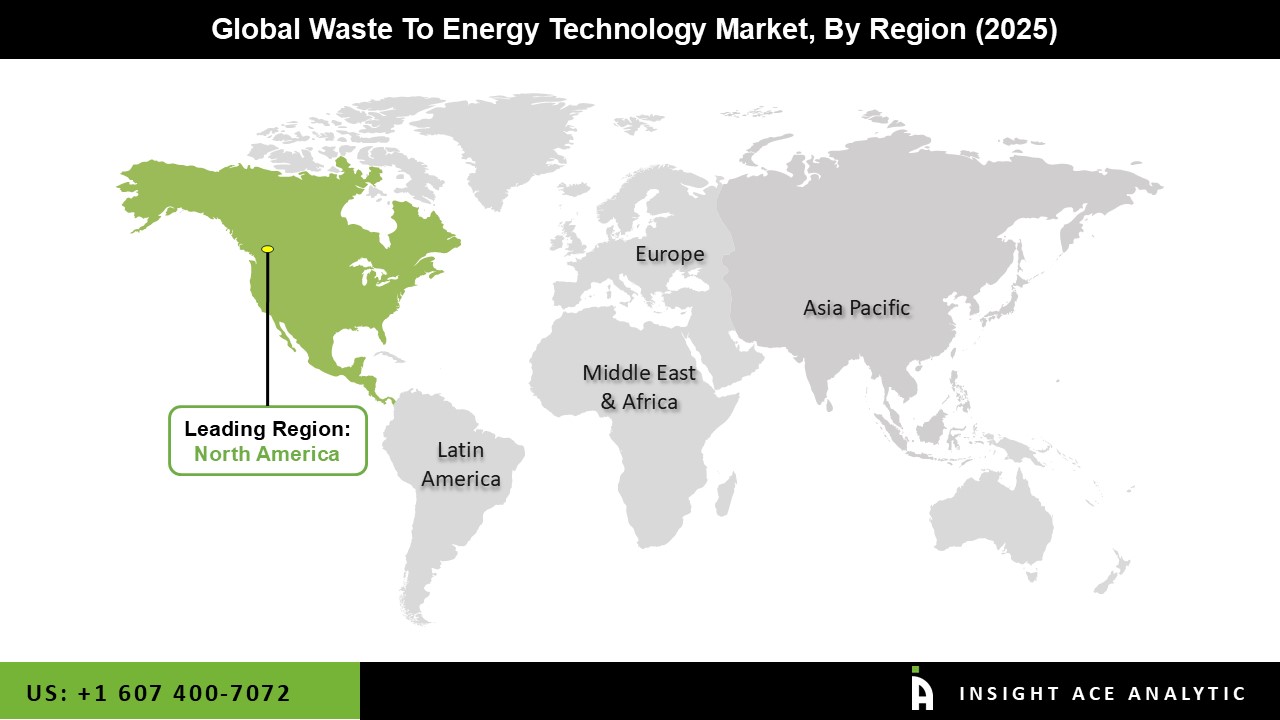
More people are aware of environmental issues, landfill costs are rising, and there is a bigger need for clean energy, all of which drive investment in waste-to-energy projects. Ongoing technology improvements and strong involvement from both public and private groups are also helping the market grow. With a steady focus on cutting carbon, recovering resources, and developing renewable energy, North America is likely to stay a leader in the global Waste-to-Energy Technology Market during the forecast period.
Key Developments-
• In Jan 2025, Enerkem announced that the Ecoplanta project in Spain received approval, marking a major step forward for Enerkem’s waste-to-methanol technology. The project is designed to convert non-recyclable waste and residual biomass into circular methanol.
Waste To Energy Technology Market Report Scope:
| Report Attribute | Specifications |
| Market size value in 2025 | USD 66.89 Bn |
| Revenue forecast in 2035 | USD 143.61 Bn |
| Growth Rate CAGR | CAGR of 8.2% from 2026 to 2035 |
| Quantitative Units | Representation of revenue in US$ Bn and CAGR from 2026 to 2035 |
| Historic Year | 2022 to 2025 |
| Forecast Year | 2026-2035 |
| Report Coverage | The forecast of revenue, the position of the company, the competitive market structure, growth prospects, and trends |
| Segments Covered | Application, Feedstock, Technology Type, Capacity, End User and By Region |
| Regional Scope | North America; Europe; Asia Pacific; Latin America; Middle East & Africa |
| Country Scope | U.S.; Canada; U.K.; Germany; China; India; Japan; Brazil; Mexico; The UK; France; Italy; Spain; China; Japan; India; South Korea; Southeast Asia; South Korea; Southeast Asia |
| Competitive Landscape | Veolia (France), SUEZ (France), Covanta (United States), Waste Management (United States), Babcock & Wilcox (United States), Enerkem (Canada), DONG Energy (Denmark), Hitachi Zosen Inova (Switzerland), Plasco Energy Group (Canada). |
| Customization Scope | Free customization report with the procurement of the report, Modifications to the regional and segment scope. Geographic competitive landscape. |
| Pricing and Available Payment Methods | Explore pricing alternatives that are customized to your particular study requirements. |
Segmentations of Waste To Energy Technology Market:
Waste To Energy Technology Market by Feedstock -
- Municipal Solid Waste
- Industrial Waste
- Agricultural Waste
- Construction and Demolition Waste
- Medical Waste
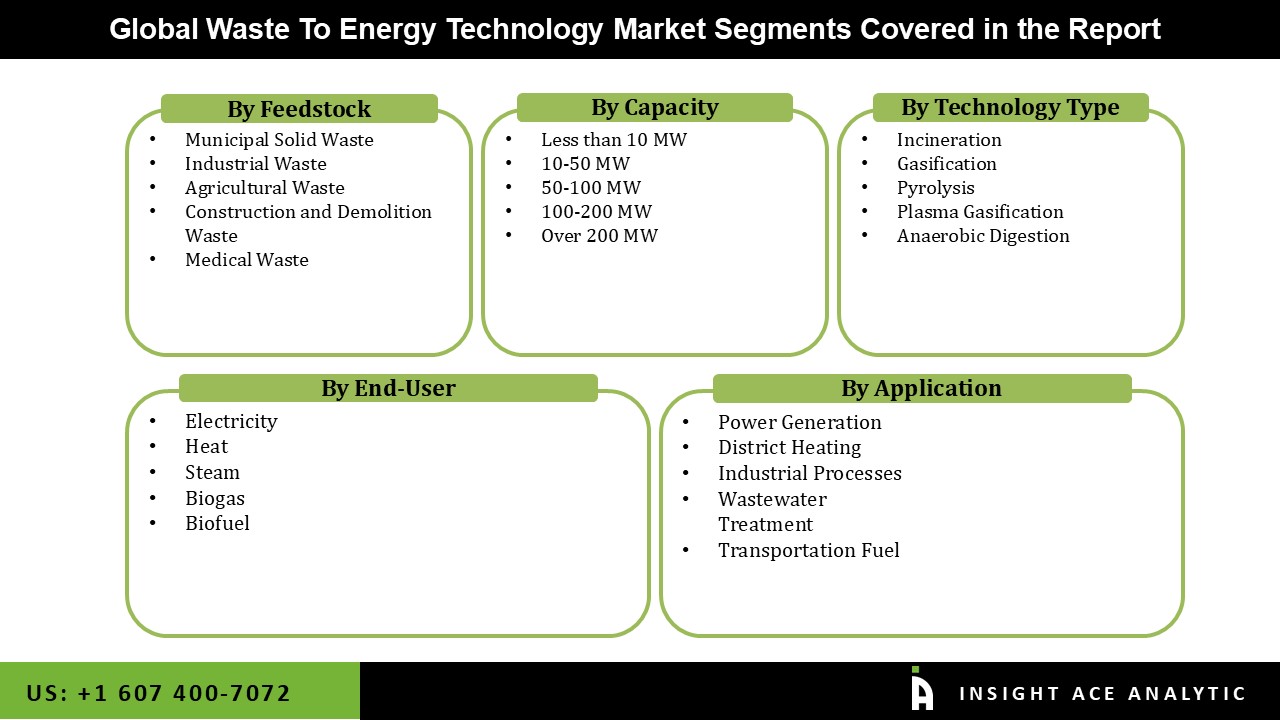
Waste To Energy Technology Market by End User-
- Electricity
- Heat
- Steam
- Biogas
- Biofuel
Waste To Energy Technology Market by Technology Type -
- Incineration
- Gasification
- Pyrolysis
- Plasma Gasification
- Anaerobic Digestion
Waste To Energy Technology Market by Capacity -
- Less than 10 MW
- 10-50 MW
- 50-100 MW
- 100-200 MW
- Over 200 MW
Waste To Energy Technology Market by Application -
- Power Generation
- District Heating
- Industrial Processes
- Wastewater Treatment
- Transportation Fuel
Waste To Energy Technology Market by Region-
- North America-
- The US
- Canada
- Europe-
- Germany
- The UK
- France
- Italy
- Spain
- Rest of Europe
- Asia-Pacific-
- China
- Japan
- India
- South Korea
- South East Asia
- Rest of Asia Pacific
- Latin America-
- Brazil
- Argentina
- Mexico
- Rest of Latin America
- Middle East and Africa-
- GCC Countries
- South Africa
- Rest of Middle East and Africa
Research Design and Approach
This study employed a multi-step, mixed-method research approach that integrates:
- Secondary research
- Primary research
- Data triangulation
- Hybrid top-down and bottom-up modelling
- Forecasting and scenario analysis
This approach ensures a balanced and validated understanding of both macro- and micro-level market factors influencing the market.
Secondary Research
Secondary research for this study involved the collection, review, and analysis of publicly available and paid data sources to build the initial fact base, understand historical market behaviour, identify data gaps, and refine the hypotheses for primary research.
Sources Consulted
Secondary data for the market study was gathered from multiple credible sources, including:
- Government databases, regulatory bodies, and public institutions
- International organizations (WHO, OECD, IMF, World Bank, etc.)
- Commercial and paid databases
- Industry associations, trade publications, and technical journals
- Company annual reports, investor presentations, press releases, and SEC filings
- Academic research papers, patents, and scientific literature
- Previous market research publications and syndicated reports
These sources were used to compile historical data, market volumes/prices, industry trends, technological developments, and competitive insights.

Primary Research
Primary research was conducted to validate secondary data, understand real-time market dynamics, capture price points and adoption trends, and verify the assumptions used in the market modelling.
Stakeholders Interviewed
Primary interviews for this study involved:
- Manufacturers and suppliers in the market value chain
- Distributors, channel partners, and integrators
- End-users / customers (e.g., hospitals, labs, enterprises, consumers, etc., depending on the market)
- Industry experts, technology specialists, consultants, and regulatory professionals
- Senior executives (CEOs, CTOs, VPs, Directors) and product managers
Interview Process
Interviews were conducted via:
- Structured and semi-structured questionnaires
- Telephonic and video interactions
- Email correspondences
- Expert consultation sessions
Primary insights were incorporated into demand modelling, pricing analysis, technology evaluation, and market share estimation.
Data Processing, Normalization, and Validation
All collected data were processed and normalized to ensure consistency and comparability across regions and time frames.
The data validation process included:
- Standardization of units (currency conversions, volume units, inflation adjustments)
- Cross-verification of data points across multiple secondary sources
- Normalization of inconsistent datasets
- Identification and resolution of data gaps
- Outlier detection and removal through algorithmic and manual checks
- Plausibility and coherence checks across segments and geographies
This ensured that the dataset used for modelling was clean, robust, and reliable.
Market Size Estimation and Data Triangulation
Bottom-Up Approach
The bottom-up approach involved aggregating segment-level data, such as:
- Company revenues
- Product-level sales
- Installed base/usage volumes
- Adoption and penetration rates
- Pricing analysis
This method was primarily used when detailed micro-level market data were available.

Top-Down Approach
The top-down approach used macro-level indicators:
- Parent market benchmarks
- Global/regional industry trends
- Economic indicators (GDP, demographics, spending patterns)
- Penetration and usage ratios
This approach was used for segments where granular data were limited or inconsistent.
Hybrid Triangulation Approach
To ensure accuracy, a triangulated hybrid model was used. This included:
- Reconciling top-down and bottom-up estimates
- Cross-checking revenues, volumes, and pricing assumptions
- Incorporating expert insights to validate segment splits and adoption rates
This multi-angle validation yielded the final market size.
Forecasting Framework and Scenario Modelling
Market forecasts were developed using a combination of time-series modelling, adoption curve analysis, and driver-based forecasting tools.
Forecasting Methods
- Time-series modelling
- S-curve and diffusion models (for emerging technologies)
- Driver-based forecasting (GDP, disposable income, adoption rates, regulatory changes)
- Price elasticity models
- Market maturity and lifecycle-based projections
Scenario Analysis
Given inherent uncertainties, three scenarios were constructed:
- Base-Case Scenario: Expected trajectory under current conditions
- Optimistic Scenario: High adoption, favourable regulation, strong economic tailwinds
- Conservative Scenario: Slow adoption, regulatory delays, economic constraints
Sensitivity testing was conducted on key variables, including pricing, demand elasticity, and regional adoption.
Request Customization
Add countries, segments, company profiles, or extend forecast — free 10% customization with purchase.
Customize This Report →Enquire Before Buying
Speak with our analyst team about scope, methodology, pricing, or deliverable formats.
Enquire Now →Frequently Asked Questions
Waste To Energy Technology Market Size is valued at USD 66.89 Bn in 2025 and is predicted to reach USD 143.61 Bn by the year 2035
The Waste To Energy Technology Market is expected to grow at a 8.2% CAGR during the forecast period for 2026 to 2035
Veolia (France), SUEZ (France), Covanta (United States), Waste Management (United States), Babcock & Wilcox (United States), Enerkem (Canada), DONG Energy (Denmark), Hitachi Zosen Inova (Switzerland), Plasco Energy Group (Canada) and Others.
Waste To Energy Technology Market is segmented into Application, Feedstock, Technology Type, Capacity, End User and Other.
North America region is leading the Waste To Energy Technology Market.