Long-Duration Energy Storage Systems Market Size, Share, Trend Report 2026 to 2035
What is Long-Duration Energy Storage Systems Market Size?
Global Long-Duration Energy Storage Systems Market is estimated to witness a growth of 10.5% CAGR during the forecast period for 2026 to 2035.
Long-Duration Energy Storage Systems Market Size, Share & Trends Analysis Distribution by Technology (Mechanical / Physical Storage: Pumped Hydro Storage, Compressed Air Energy Storage, Liquid Air Energy Storage, Gravity-Based Storage, Electrochemical Storage, Flow Batteries, Metal-Air Batteries, High-Temperature & Liquid-Metal Batteries, Sodium-Ion & Other Long-Duration-Configured Batteries, Thermal Storage, Sensible-Heat Storage, Latent-Heat / Phase-Change Storage, Pumped-Heat / Electrao-Thermal Energy Storage, Chemical Storage, Hydrogen-Based Power-to-Power Storage, Other Power-to-X Storage), by Storage Duration (Inter-Day, Multi-Day, Multi-Day to Seasonal), by Application / Use Case, by end user and Segment Forecasts, 2026 to 2035.
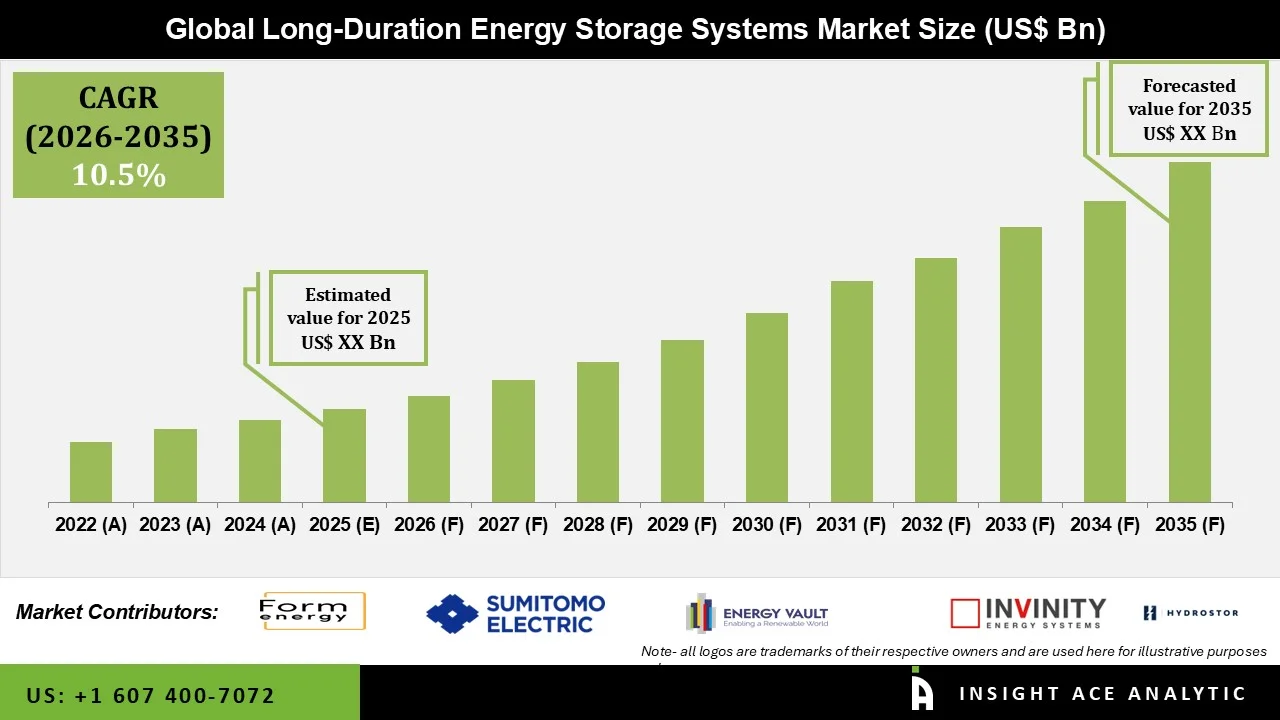
Long-duration energy storage systems (LDES) are energy storage technologies designed to retain electricity or energy for extended durations and discharge it when required to maintain a reliable balance between power generation and demand. Unlike conventional short-duration storage systems, LDES technologies can provide sustained energy delivery over several hours and, depending on the technology, for periods extending to multiple days or longer. These systems are increasingly important for integrating variable renewable energy sources, improving grid flexibility, reducing reliance on conventional peaking generation, and strengthening power system resilience.
The LDES technology landscape encompasses a diverse range of storage approaches, including mechanical and physical storage technologies such as pumped hydro, compressed air energy storage, liquid air energy storage, and gravity-based systems; electrochemical technologies such as flow batteries, metal-air batteries, and high-temperature or liquid-metal batteries; thermal energy storage; and chemical storage solutions including hydrogen-based power-to-power systems and other Power-to-X technologies. Each technology offers distinct characteristics in terms of storage duration, energy and power capacity, efficiency, response time, geographic requirements, and suitability for different grid and end-use applications.
The long-duration energy storage systems Market encompasses the development, manufacturing, system integration, deployment, and commercialization of technologies capable of providing extended-duration energy storage. These systems are utilized for renewable energy integration and firming, grid balancing, ancillary services, energy arbitrage, load shifting, peak demand management, backup power, microgrid resilience, off-grid electricity supply, and industrial decarbonization. Their ability to store surplus electricity and release it during periods of higher demand or reduced renewable generation makes LDES an important component of increasingly flexible and decentralized energy systems.
The market ecosystem includes technology developers, equipment and system manufacturers, engineering and infrastructure companies, project developers, utilities, independent power producers, grid operators, and energy service providers. LDES technologies range from established infrastructure-based solutions to emerging storage systems progressing through laboratory development, pilot projects, demonstration facilities, and large-scale commercial deployment. Continued advances in materials, system design, power conversion, thermal management, hydrogen technologies, and energy management systems are broadening the technological landscape and expanding the role of long-duration storage across modern power systems.
Competitive Landscape
Which are the Leading Players in the Long-Duration Energy Storage Systems Market?
- Form Energy, Inc.
- Sumitomo Electric Industries, Ltd.
- Energy Vault Holdings, Inc.
- Invinity Energy Systems plc
- Hydrostor Inc.
- Highview Power (Highview Enterprises Ltd.)
- Eos Energy Enterprises, Inc.
- Energy Dome S.p.A.
- GE Vernova Inc.
- Rondo Energy, Inc.
- ESS Tech, Inc.
- Antora Energy, Inc.
- Malta Inc.
- MAN Energy Solutions (Everllence)
- Siemens Energy AG
- CMBlu Energy AG
- Contemporary Amperex Technology Co., Ltd. (CATL)
- Voith Group (J.M. Voith SE & Co. KG)
- ANDRITZ AG (Andritz Hydro)
- Quidnet Energy, Inc.
- Fourth Power, Inc.
- Corre Energy B.V.
- Storelectric Ltd.
- RheEnergise Ltd.
- Kraftblock GmbH
- MGA Thermal Pty Ltd
- Primus Power Corporation
- VRB Energy Inc.
- Noon Energy, Inc.
- e-Zinc Inc.
Market Dynamics
Driver
Increasing Integration of Renewable Energy and Need for Grid Flexibility
As more renewable energy sources like solar and wind are added to the grid, there is a greater need for reliable energy storage to handle changes in electricity supply and demand. Long-duration energy storage systems help by saving extra electricity produced during high renewable output and providing it when generation is low or demand is high. These systems help keep the grid stable, make energy supplies more reliable, and reduce reliance on fossil fuels. With countries moving faster toward clean energy and building more renewable power, investments in long-duration storage technologies are rising for utilities, businesses, industry, and off-grid uses.
Restrain/Challenge
High Initial Investment and Long Project Development Timelines
One of the main challenges for long-duration energy storage is the high upfront cost needed for developing technology, buying equipment, building infrastructure, and starting projects. Systems like pumped hydro, compressed air, hydrogen-based, and liquid air storage need a lot of capital, special infrastructure, and the right locations. Long permitting processes, complex engineering, grid connection steps, and uncertain project economics can also slow down commercial use and large-scale rollout. Differences in how mature, efficient, or cost-effective each technology is make it hard for developers and users to find the best solutions for their needs.
Mechanical / Physical Storage Segment is Expected to Drive the Long-Duration Energy Storage Systems Market
Mechanical and physical storage is expected to make up a large part of the long-duration energy storage market. This is due to the wide use of pumped hydro storage and more interest in compressed air, liquid air, and gravity-based storage. These systems can hold a lot of energy for long periods and help with grid-scale needs like adding renewables, balancing the grid, and managing peak demand. Continued improvements in technology, more investment in infrastructure, and the growing need for long-term storage are encouraging utilities and grid operators to use these solutions.
Chemical Storage Segment is Expected to Grow at the Highest Rate in the Long-Duration Energy Storage Systems Market
The chemical storage segment is expected to grow at the highest rate, driven by increasing interest in hydrogen-based storage and other Power-to-X technologies. These solutions let extra renewable electricity be turned into energy carriers like hydrogen, which can be stored for a long time and changed back into electricity when needed. Their ability to store energy for several days or even seasons helps balance renewable output and meet long-term supply needs. More investment in hydrogen infrastructure, renewable hydrogen production, and efforts to cut industrial emissions are also speeding up the development and use of chemical energy storage.
Why North America Led the Long-Duration Energy Storage Systems Market?
North America is expected to lead the long-duration energy storage systems market, supported by increased investment in renewables, grid upgrades, and storage infrastructure. The region benefits from government funding, supportive clean energy policies, and more involvement from technology and project developers working on long-duration storage.
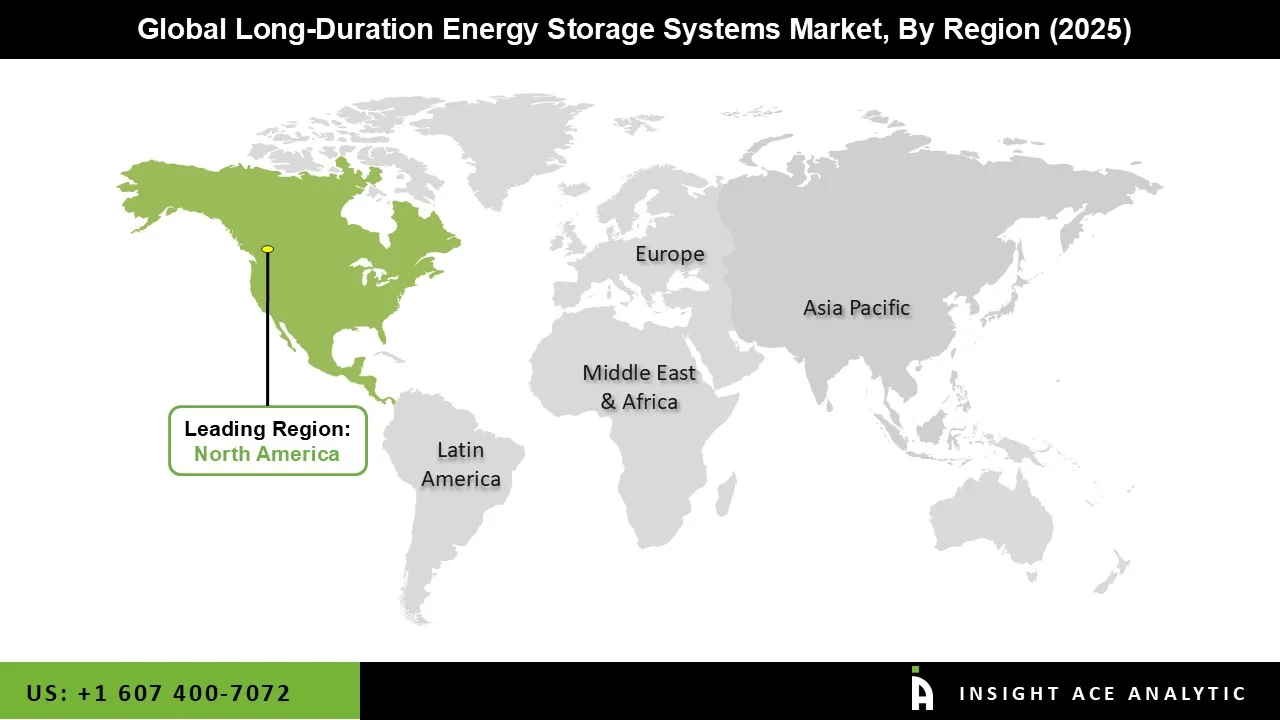
Established energy storage developers and ongoing advances in battery-based, compressed air, and gravity-based storage are strengthening the region's long-duration energy storage capabilities. Higher electricity demand, the need for a stronger grid, and more renewable projects are also increasing demand for long-duration storage among utilities, power producers, and businesses.
Long-Duration Energy Storage Systems Market Report Scope:
| Report Attribute | Specifications |
| Growth Rate CAGR | CAGR of 10.5% from 2026 to 2035 |
| Quantitative Units | Representation of revenue in US$ Bn and CAGR from 2026 to 2035 |
| Historic Year | 2022 to 2025 |
| Forecast Year | 2026-2035 |
| Report Coverage | The forecast of revenue, the position of the company, the competitive market structure, growth prospects, and trends |
| Segments Covered | By Technology, Storage Duration, Application / Use Case, End User and By Region |
| Regional Scope | North America; Europe; Asia Pacific; Latin America; Middle East & Africa |
| Country Scope | U.S.; Canada; U.K.; Germany; China; India; Japan; Brazil; Mexico; France; Italy; Spain; South Korea; Southeast Asia |
| Competitive Landscape | Form Energy, Inc., Sumitomo Electric Industries, Ltd., Energy Vault Holdings, Inc., Invinity Energy Systems plc, Hydrostor Inc., Highview Power (Highview Enterprises Ltd.), Eos Energy Enterprises, Inc., Energy Dome S.p.A., GE Vernova Inc., Rondo Energy, Inc., ESS Tech, Inc., Antora Energy, Inc., Malta Inc., MAN Energy Solutions (Everllence), Siemens Energy AG, CMBlu Energy AG, Contemporary Amperex Technology Co., Ltd. (CATL), Voith Group (J.M. Voith SE & Co. KG), ANDRITZ AG (Andritz Hydro), Quidnet Energy, Inc., Fourth Power, Inc., Corre Energy B.V., Storelectric Ltd., RheEnergise Ltd., Kraftblock GmbH, MGA Thermal Pty Ltd, Primus Power Corporation, VRB Energy Inc., Noon Energy, Inc., e-Zinc Inc. |
| Customization Scope | Free customization report with the procurement of the report, Modifications to the regional and segment scope. Geographic competitive landscape. |
| Pricing and Available Payment Methods | Explore pricing alternatives that are customized to your particular study requirements. |
Segmentations Long-Duration Energy Storage Systems Market:
Long-Duration Energy Storage Systems Market by Technology -
- Mechanical / Physical Storage
- Pumped Hydro Storage
- Compressed Air Energy Storage
- Liquid Air Energy Storage
- Gravity-Based Storage
- Electrochemical Storage
- Flow Batteries
- Metal-Air Batteries
- High-Temperature & Liquid-Metal Batteries
- Sodium-Ion & Other Long-Duration-Configured Batteries
- Thermal Storage
- Sensible-Heat Storage
- Latent-Heat / Phase-Change Storage
- Pumped-Heat / Electro-Thermal Energy Storage
- Chemical Storage
- Hydrogen-Based Power-to-Power Storage
- Other Power-to-X Storage
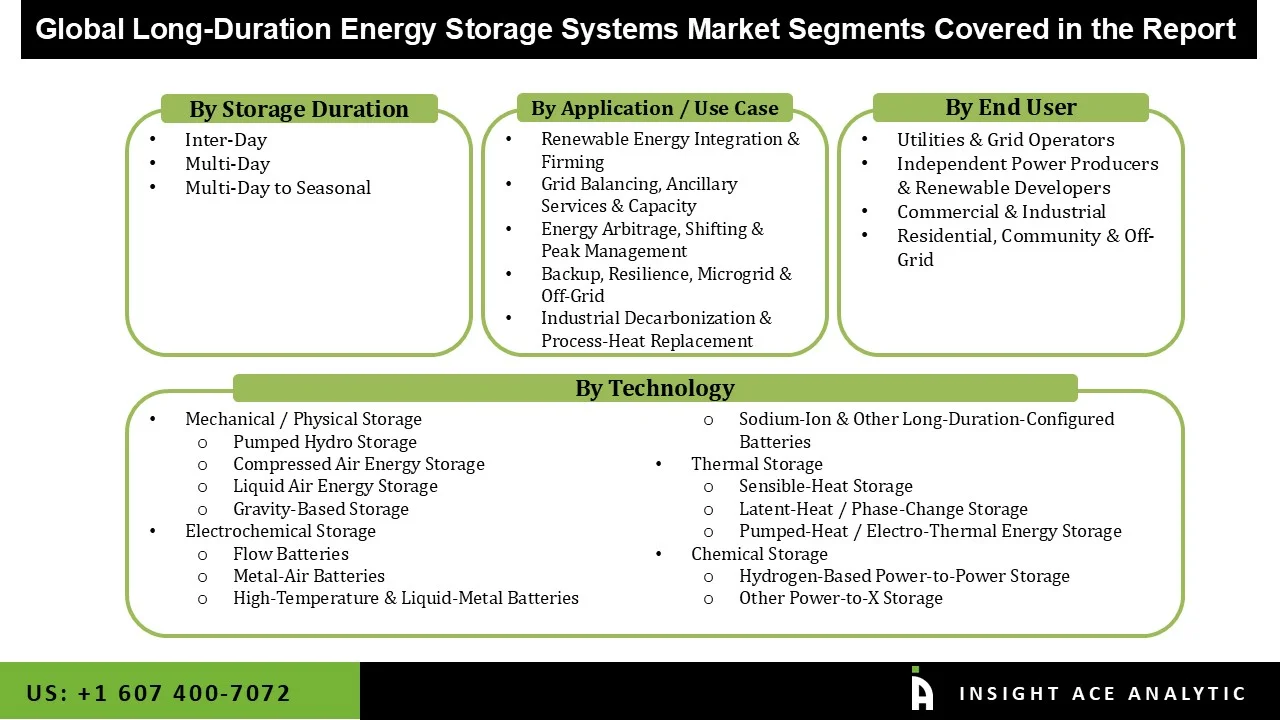
Long-Duration Energy Storage Systems Market by Storage Duration-
- Inter-Day
- Multi-Day
- Multi-Day to Seasonal
Long-Duration Energy Storage Systems Market by Application/ Use Case-
- Renewable Energy Integration & Firming
- Grid Balancing, Ancillary Services & Capacity
- Energy Arbitrage, Shifting & Peak Management
- Backup, Resilience, Microgrid & Off-Grid
- Industrial Decarbonization & Process-Heat Replacement
Long-Duration Energy Storage Systems Market by End User -
- Utilities & Grid Operators
- Independent Power Producers & Renewable Developers
- Commercial & Industrial
- Residential, Community & Off-Grid
Long-Duration Energy Storage Systems Market by Region-
- North America-
- The US
- Canada
- Europe-
- Germany
- The UK
- France
- Italy
- Spain
- Rest of Europe
- Asia-Pacific-
- China
- Japan
- India
- South Korea
- South East Asia
- Rest of Asia Pacific
- Latin America-
- Brazil
- Argentina
- Mexico
- Rest of Latin America
- Middle East and Africa-
- GCC Countries
- South Africa
- Rest of Middle East and Africa
Research Design and Approach
This study employed a multi-step, mixed-method research approach that integrates:
- Secondary research
- Primary research
- Data triangulation
- Hybrid top-down and bottom-up modelling
- Forecasting and scenario analysis
This approach ensures a balanced and validated understanding of both macro- and micro-level market factors influencing the market.
Secondary Research
Secondary research for this study involved the collection, review, and analysis of publicly available and paid data sources to build the initial fact base, understand historical market behaviour, identify data gaps, and refine the hypotheses for primary research.
Sources Consulted
Secondary data for the market study was gathered from multiple credible sources, including:
- Government databases, regulatory bodies, and public institutions
- International organizations (WHO, OECD, IMF, World Bank, etc.)
- Commercial and paid databases
- Industry associations, trade publications, and technical journals
- Company annual reports, investor presentations, press releases, and SEC filings
- Academic research papers, patents, and scientific literature
- Previous market research publications and syndicated reports
These sources were used to compile historical data, market volumes/prices, industry trends, technological developments, and competitive insights.
Primary Research
Primary research was conducted to validate secondary data, understand real-time market dynamics, capture price points and adoption trends, and verify the assumptions used in the market modelling.
Stakeholders Interviewed
Primary interviews for this study involved:
- Manufacturers and suppliers in the market value chain
- Distributors, channel partners, and integrators
- End-users / customers (e.g., hospitals, labs, enterprises, consumers, etc., depending on the market)
- Industry experts, technology specialists, consultants, and regulatory professionals
- Senior executives (CEOs, CTOs, VPs, Directors) and product managers
Interview Process
Interviews were conducted via:
- Structured and semi-structured questionnaires
- Telephonic and video interactions
- Email correspondences
- Expert consultation sessions
Primary insights were incorporated into demand modelling, pricing analysis, technology evaluation, and market share estimation.
Data Processing, Normalization, and Validation
All collected data were processed and normalized to ensure consistency and comparability across regions and time frames.
The data validation process included:
- Standardization of units (currency conversions, volume units, inflation adjustments)
- Cross-verification of data points across multiple secondary sources
- Normalization of inconsistent datasets
- Identification and resolution of data gaps
- Outlier detection and removal through algorithmic and manual checks
- Plausibility and coherence checks across segments and geographies
This ensured that the dataset used for modelling was clean, robust, and reliable.
Market Size Estimation and Data Triangulation
Bottom-Up Approach
The bottom-up approach involved aggregating segment-level data, such as:
- Company revenues
- Product-level sales
- Installed base/usage volumes
- Adoption and penetration rates
- Pricing analysis
This method was primarily used when detailed micro-level market data were available.
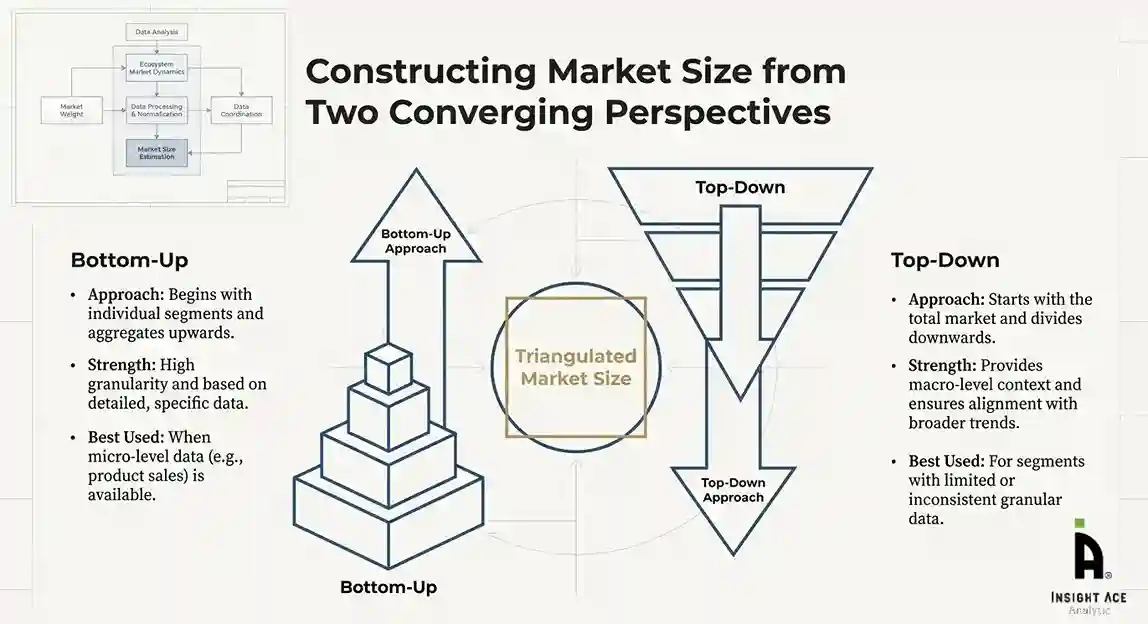
Top-Down Approach
The top-down approach used macro-level indicators:
- Parent market benchmarks
- Global/regional industry trends
- Economic indicators (GDP, demographics, spending patterns)
- Penetration and usage ratios
This approach was used for segments where granular data were limited or inconsistent.
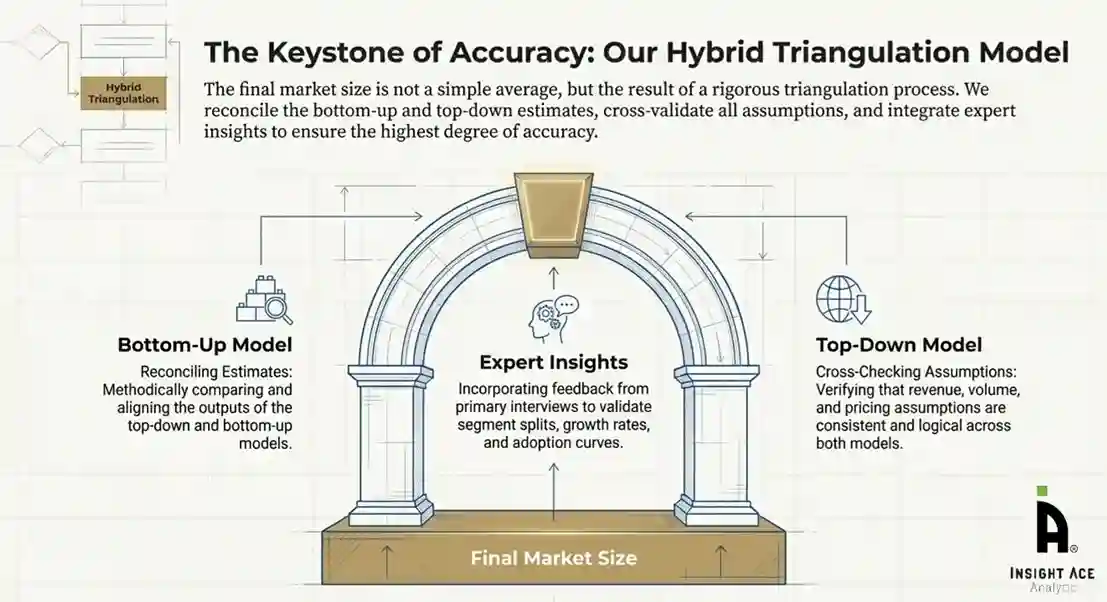
Hybrid Triangulation Approach
To ensure accuracy, a triangulated hybrid model was used. This included:
- Reconciling top-down and bottom-up estimates
- Cross-checking revenues, volumes, and pricing assumptions
- Incorporating expert insights to validate segment splits and adoption rates
This multi-angle validation yielded the final market size.
Forecasting Framework and Scenario Modelling
Market forecasts were developed using a combination of time-series modelling, adoption curve analysis, and driver-based forecasting tools.
Forecasting Methods
- Time-series modelling
- S-curve and diffusion models (for emerging technologies)
- Driver-based forecasting (GDP, disposable income, adoption rates, regulatory changes)
- Price elasticity models
- Market maturity and lifecycle-based projections
Scenario Analysis
Given inherent uncertainties, three scenarios were constructed:
- Base-Case Scenario: Expected trajectory under current conditions
- Optimistic Scenario: High adoption, favourable regulation, strong economic tailwinds
- Conservative Scenario: Slow adoption, regulatory delays, economic constraints
Sensitivity testing was conducted on key variables, including pricing, demand elasticity, and regional adoption.
Request Customization
Add countries, segments, company profiles, or extend forecast — free 10% customization with purchase.
Customize This Report →Enquire Before Buying
Speak with our analyst team about scope, methodology, pricing, or deliverable formats.
Enquire Now →Frequently Asked Questions
Long-Duration Energy Storage Systems Market is estimated to witness a growth of 10.5% CAGR during the forecast period for 2026 to 2035.
Form Energy, Inc., Sumitomo Electric Industries, Ltd., Energy Vault Holdings, Inc., Invinity Energy Systems plc, Hydrostor Inc., Highview Power (Highview Enterprises Ltd.), Eos Energy Enterprises, Inc., Energy Dome S.p.A., GE Vernova Inc., Rondo Energy, Inc., ESS Tech, Inc., Antora Energy, Inc., Malta Inc., MAN Energy Solutions (Everllence), Siemens Energy AG, CMBlu Energy AG, Contemporary Amperex Technology Co., Ltd. (CATL), Voith Group (J.M. Voith SE & Co. KG), ANDRITZ AG (Andritz Hydro), Quidnet Energy, Inc., Fourth Power, Inc., Corre Energy B.V., Storelectric Ltd., RheEnergise Ltd., Kraftblock GmbH, MGA Thermal Pty Ltd, Primus Power Corporation, VRB Energy Inc., Noon Energy, Inc., e-Zinc Inc. and Others.
Long-Duration Energy Storage Systems Market is segmented into Technology, Storage Duration, Application / Use Case, End User and Other.
North America region is leading the Long-Duration Energy Storage Systems Market.