Aeroderivative Gas Turbines for Data Centers Market Size, Share, Trend, Revenue Report 2026 to 2035
What is Aeroderivative Gas Turbines for Data Centers Market Size?
Global Aeroderivative Gas Turbines for Data Centers Market is estimated to grow with a 13.8 % CAGR during the forecast period for 2026 to 2035.
Aeroderivative Gas Turbines for Data Centers Market Size, Share & Trends Analysis Distribution by Power Rating (Below 20 MW, 20–40 MW, 40–60 MW, Above 60 MW), By Offering (Equipment, Aftermarket Services), By Deployment Configuration (Trailer-Mounted Mobile Units, Skid-Mounted Stationary Packages), By Power Application (Primary Off-Grid Power, Bridge Power Pending Grid Connection, Backup, Peaking & Grid-Support Power), By Data Center Capacity (Large Campuses (100 MW and Above), Mid-Size Facilities (20–100 MW), Small Facilities (Below 20 MW)) and Segment Forecasts, 2026 to 2035.
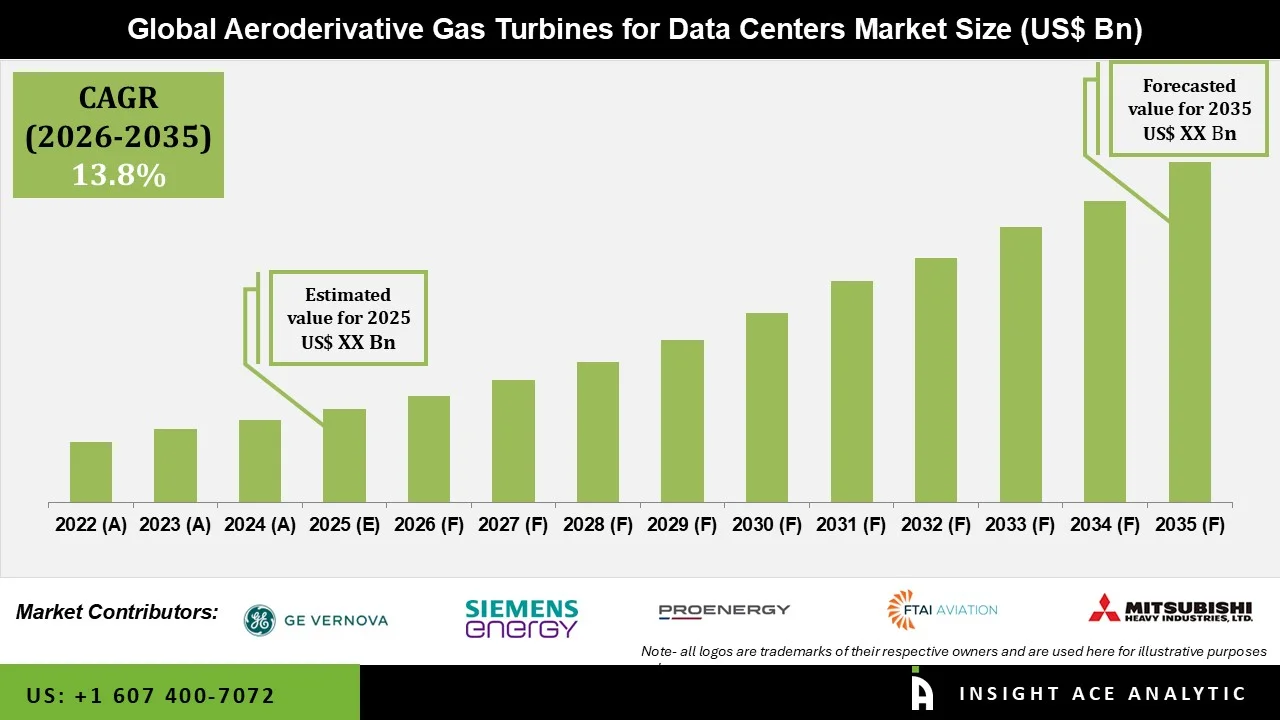
Aeroderivative gas turbines are gas turbines which have been taken from aircraft engine technology and adapted for stationary power generation. Their light weight, high power density, ability to start quickly and their operational flexibility make them ideal for use where you need reliable power in a relatively small footprint. They can be used for base load, for backup and for peak load, and their modular nature means that the power capacity can be easily scaled to meet the operational requirements. This is particularly relevant for sites with a high demand for electricity and a requirement for a very high level of power availability.
The aeroderivative gas turbines for data centres market is becoming increasingly important as data centre operators look for reliable on-site power solutions to underpin their growing digital infrastructure. The proliferation of AI, cloud computing, hyperscale facilities and high density computing is driving up power demand and putting pressure on the power supply. Aeroderivative gas turbines provide an alternative to being completely reliant on the grid by enabling on-site generation of power, providing power resilience and helping to overcome the constraints of grid capacity and grid connection times. Their ability to be deployed quickly, their flexible operation and their suitability for a modular power application make them a very relevant technology in meeting the power needs of today's data centres.
Competitive Landscape
Which are the Leading Players in the Aeroderivative Gas Turbines for Data Centers Market?
- GE Vernova Inc.
- PROENERGY Services, LLC
- Siemens Energy AG
- FTAI Aviation Ltd.
- Mitsubishi Heavy Industries, Ltd.
- APR Energy
Market Dynamics
Driver
Rising Data Center Electricity Demand and Grid Connection Delays
The explosion of AI, cloud computing and hyperscale data centres is driving up electricity demand and placing increasing pressure on the grid. With grid capacity constrained, grid connection times stretching to years and the imperative to maintain uninterrupted operations, there is a strong move by data centre operators to look at on-site generation. Aeroderivatives offer high power density, fast start-up and flexible operation and are ideally suited to the requirements of a data centre looking to meet its growing power needs and reduce its reliance on the grid. All of this is going to drive the demand for aeroderivative gas turbines.
Restrain/Challenge
High Initial Investment and Natural Gas Infrastructure Dependency
The very high capital outlay required for aeroderivative gas turbine systems (turbine equipment, installation, gas supply, power generation facilities etc) is a significant barrier to entry for the aeroderivative gas turbines for data centres market. They are also very much reliant on the availability of natural gas and the existence of a good pipeline network in the location of the data centre. Fluctuating natural gas prices, the requirement for permits, emissions regulation and the need for specialist maintenance are all factors which can add to the cost of operation and complicate the delivery of a project. All of these can have a bearing on the investment decision for a data centre operator looking for a cost effective and sustainable long term power solution.
20–40 MW segment Segment is Expected to Drive the Aeroderivative Gas Turbines for Data Centers Market
The 20–40 MW power rating segment is expected to be a major driver of the aeroderivative gas turbines for data centres market, underpinned by the increasing demand for modular, on-site power generation that can be deployed rapidly. These turbines are well suited to individual data centre sites and can be deployed in multiple units to provide power for larger hyperscale campuses. The LM2500XPRESS from GE Vernova and the SGT-A35 from Siemens Energy are both in the 20-40mw range and are therefore relevant to the data centre market where there is a need to address grid connection times and increasing electricity demand.
Small Business (Less than 100 Employees) Segment is Growing at the Highest Rate in the Aeroderivative Gas Turbines for Data Centers Market
The equipment segment is projected to grow at a high rate in the aeroderivative gas turbines for data centres market as a result of increased investment in on-site power generation to support the growth in AI infrastructure, hyperscale data centres and high density computing. Grid connection delays and the lack of electricity in certain areas are driving operators to buy new aeroderivative gas turbines in order to ensure a reliable power supply and to get their facilities up and running as quickly as possible. Demand for equipment is further underpinned by a rise in orders for aeroderivative turbines and capacity expansion by the manufacturers themselves.
Why North America Led the Aeroderivative Gas Turbines for Data Centers Market?
North America is currently the leader in the aeroderivative gas turbines for data centres market. This is due to the high concentration of hyperscale data centres, the rapid growth of AI infrastructure and the increasing demand for on-site power generation.
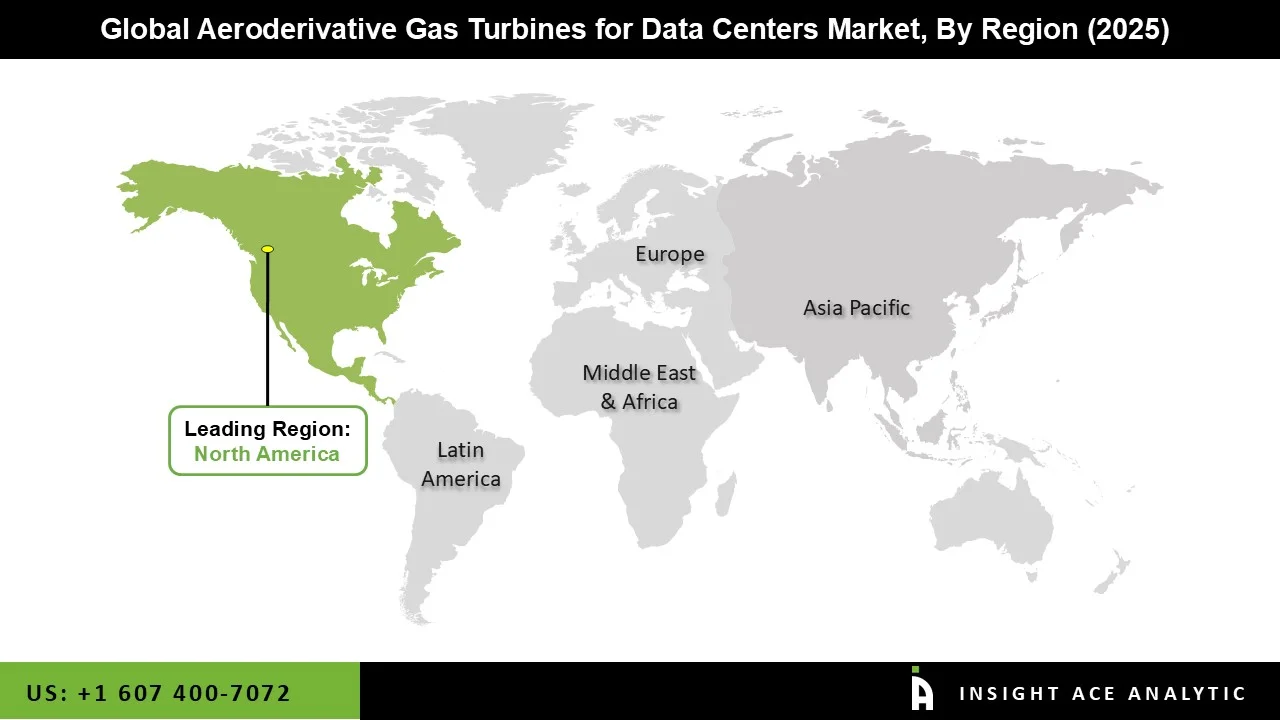
The US is a key contributor to this, with data centre operators increasingly looking to deploy aeroderivative gas turbines as a result of grid connection delays, limited availability of electricity and escalating power requirements. The region is also home to the major manufacturers (GE Vernova, Siemens Energy, PROENERGY) and is seeing significant investment in AI computing infrastructure which is in turn bolstering the market's position.
Key Development
- April 20256: PROENERGY announced a contract to supply Crusoe with 13 PE6000 aeroderivative gas turbine generator sets, each rated at 50 MW, to power upcoming hyperscale AI data center projects. The equipment will be tested and quality-checked at PROENERGY’s Sedalia manufacturing facility before delivery.
Aeroderivative Gas Turbines for Data Centers Market Report Scope:
| Report Attribute | Specifications |
| Growth Rate CAGR | CAGR of 13.8% from 2026 to 2035 |
| Quantitative Units | Representation of revenue in US$ Bn and CAGR from 2026 to 2035 |
| Historic Year | 2022 to 2025 |
| Forecast Year | 2026-2035 |
| Report Coverage | The forecast of revenue, the position of the company, the competitive market structure, growth prospects, and trends |
| Segments Covered | Power Rating, Offering, Deployment Configuration, Power Application, Data Center Capacity and By Region |
| Regional Scope | North America; Europe; Asia Pacific; Latin America; Middle East & Africa |
| Country Scope | U.S.; Canada; U.K.; Germany; China; India; Japan; Brazil; Mexico; France; Italy; Spain; South Korea; Southeast Asia |
| Competitive Landscape | GE Vernova Inc., PROENERGY Services, LLC, Siemens Energy AG, FTAI Aviation Ltd., Mitsubishi Heavy Industries, Ltd., APR Energy |
| Customization Scope | Free customization report with the procurement of the report, Modifications to the regional and segment scope. Geographic competitive landscape. |
| Pricing and Available Payment Methods | Explore pricing alternatives that are customized to your particular study requirements. |
Segmentations Aeroderivative Gas Turbines for Data Centers Market:
Aeroderivative Gas Turbines for Data Centers Market by Power Rating -
- Below 20 MW
- 20–40 MW
- 40–60 MW
- Above 60 MW
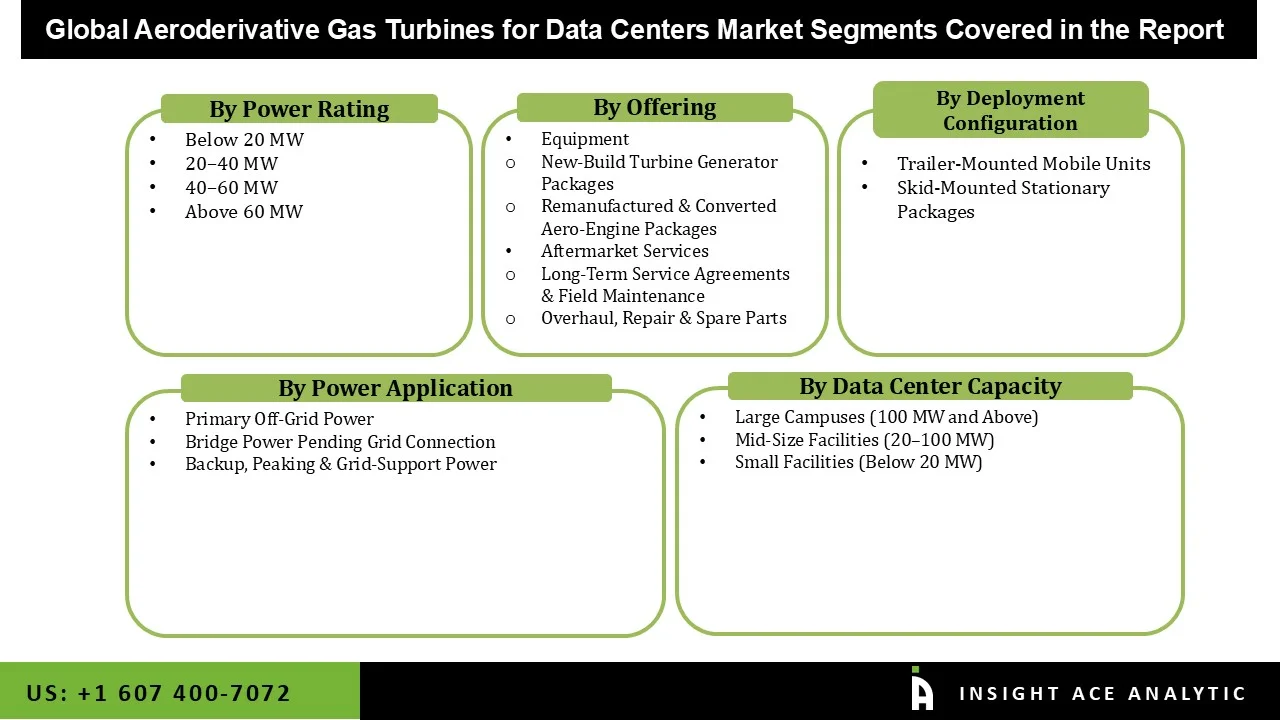
Aeroderivative Gas Turbines for Data Centers Market by Offering -
- Equipment
- New-Build Turbine Generator Packages
- Remanufactured & Converted Aero-Engine Packages
- Aftermarket Services
- Long-Term Service Agreements & Field Maintenance
- Overhaul, Repair & Spare Parts
Aeroderivative Gas Turbines for Data Centers Market by Deployment Configuration -
- Trailer-Mounted Mobile Units
- Skid-Mounted Stationary Packages
Aeroderivative Gas Turbines for Data Centers Market by Power Application -
- Primary Off-Grid Power
- Bridge Power Pending Grid Connection
- Backup, Peaking & Grid-Support Power
Aeroderivative Gas Turbines for Data Centers Market by Data Center Capacity -
- Large Campuses (100 MW and Above)
- Mid-Size Facilities (20–100 MW)
- Small Facilities (Below 20 MW)
Aeroderivative Gas Turbines for Data Centers Market by Region-
- North America-
- The US
- Canada
- Europe-
- Germany
- The UK
- France
- Italy
- Spain
- Rest of Europe
- Asia-Pacific-
- China
- Japan
- India
- South Korea
- South East Asia
- Rest of Asia Pacific
- Latin America-
- Brazil
- Argentina
- Mexico
- Rest of Latin America
- Middle East and Africa-
- GCC Countries
- South Africa
- Rest of Middle East and Africa
Research Design and Approach
This study employed a multi-step, mixed-method research approach that integrates:
- Secondary research
- Primary research
- Data triangulation
- Hybrid top-down and bottom-up modelling
- Forecasting and scenario analysis
This approach ensures a balanced and validated understanding of both macro- and micro-level market factors influencing the market.
Secondary Research
Secondary research for this study involved the collection, review, and analysis of publicly available and paid data sources to build the initial fact base, understand historical market behaviour, identify data gaps, and refine the hypotheses for primary research.
Sources Consulted
Secondary data for the market study was gathered from multiple credible sources, including:
- Government databases, regulatory bodies, and public institutions
- International organizations (WHO, OECD, IMF, World Bank, etc.)
- Commercial and paid databases
- Industry associations, trade publications, and technical journals
- Company annual reports, investor presentations, press releases, and SEC filings
- Academic research papers, patents, and scientific literature
- Previous market research publications and syndicated reports
These sources were used to compile historical data, market volumes/prices, industry trends, technological developments, and competitive insights.
Primary Research
Primary research was conducted to validate secondary data, understand real-time market dynamics, capture price points and adoption trends, and verify the assumptions used in the market modelling.
Stakeholders Interviewed
Primary interviews for this study involved:
- Manufacturers and suppliers in the market value chain
- Distributors, channel partners, and integrators
- End-users / customers (e.g., hospitals, labs, enterprises, consumers, etc., depending on the market)
- Industry experts, technology specialists, consultants, and regulatory professionals
- Senior executives (CEOs, CTOs, VPs, Directors) and product managers
Interview Process
Interviews were conducted via:
- Structured and semi-structured questionnaires
- Telephonic and video interactions
- Email correspondences
- Expert consultation sessions
Primary insights were incorporated into demand modelling, pricing analysis, technology evaluation, and market share estimation.
Data Processing, Normalization, and Validation
All collected data were processed and normalized to ensure consistency and comparability across regions and time frames.
The data validation process included:
- Standardization of units (currency conversions, volume units, inflation adjustments)
- Cross-verification of data points across multiple secondary sources
- Normalization of inconsistent datasets
- Identification and resolution of data gaps
- Outlier detection and removal through algorithmic and manual checks
- Plausibility and coherence checks across segments and geographies
This ensured that the dataset used for modelling was clean, robust, and reliable.
Market Size Estimation and Data Triangulation
Bottom-Up Approach
The bottom-up approach involved aggregating segment-level data, such as:
- Company revenues
- Product-level sales
- Installed base/usage volumes
- Adoption and penetration rates
- Pricing analysis
This method was primarily used when detailed micro-level market data were available.
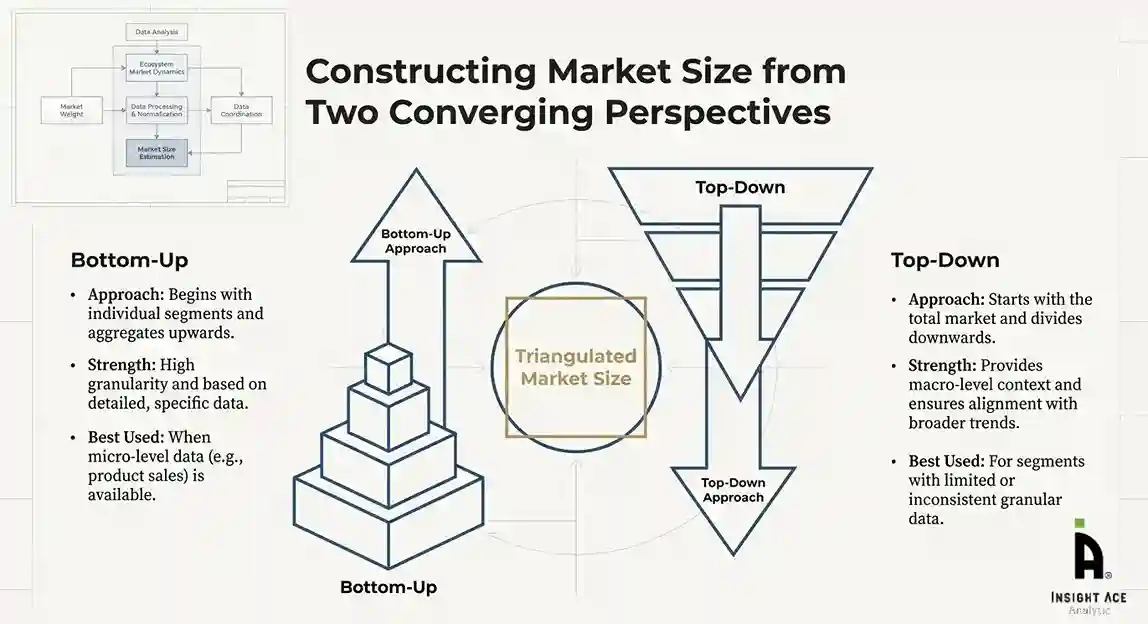
Top-Down Approach
The top-down approach used macro-level indicators:
- Parent market benchmarks
- Global/regional industry trends
- Economic indicators (GDP, demographics, spending patterns)
- Penetration and usage ratios
This approach was used for segments where granular data were limited or inconsistent.
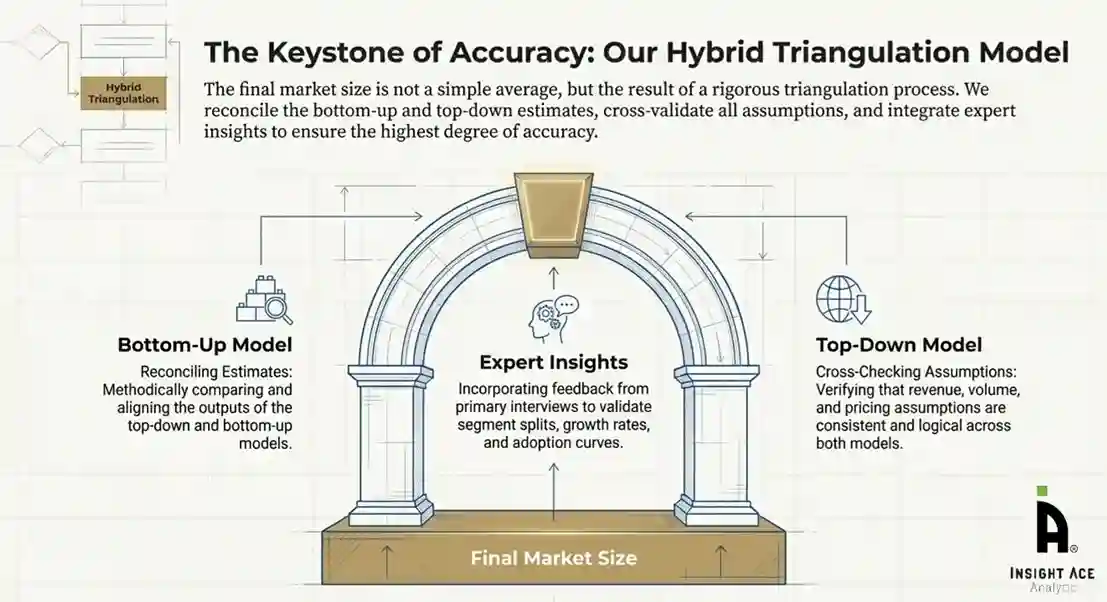
Hybrid Triangulation Approach
To ensure accuracy, a triangulated hybrid model was used. This included:
- Reconciling top-down and bottom-up estimates
- Cross-checking revenues, volumes, and pricing assumptions
- Incorporating expert insights to validate segment splits and adoption rates
This multi-angle validation yielded the final market size.
Forecasting Framework and Scenario Modelling
Market forecasts were developed using a combination of time-series modelling, adoption curve analysis, and driver-based forecasting tools.
Forecasting Methods
- Time-series modelling
- S-curve and diffusion models (for emerging technologies)
- Driver-based forecasting (GDP, disposable income, adoption rates, regulatory changes)
- Price elasticity models
- Market maturity and lifecycle-based projections
Scenario Analysis
Given inherent uncertainties, three scenarios were constructed:
- Base-Case Scenario: Expected trajectory under current conditions
- Optimistic Scenario: High adoption, favourable regulation, strong economic tailwinds
- Conservative Scenario: Slow adoption, regulatory delays, economic constraints
Sensitivity testing was conducted on key variables, including pricing, demand elasticity, and regional adoption.
Request Customization
Add countries, segments, company profiles, or extend forecast — free 10% customization with purchase.
Customize This Report →Enquire Before Buying
Speak with our analyst team about scope, methodology, pricing, or deliverable formats.
Enquire Now →Frequently Asked Questions
The Aeroderivative Gas Turbines for Data Centers Market is expected to grow at a 13.8% CAGR during the forecast period for 2026 to 2035
GE Vernova Inc., PROENERGY Services, LLC, Siemens Energy AG, FTAI Aviation Ltd., Mitsubishi Heavy Industries, Ltd., APR Energy and Others.
Aeroderivative Gas Turbines for Data Centers Market is segmented into Power Rating, Offering, Deployment Configuration, Power Application, Data Center Capacity and Other.
North America region is leading the Aeroderivative Gas Turbines for Data Centers Market.