Thermal Evaporation System Market Size, Scope, Forecast Report 2026 to 2035
What is Thermal Evaporation System Market Size?
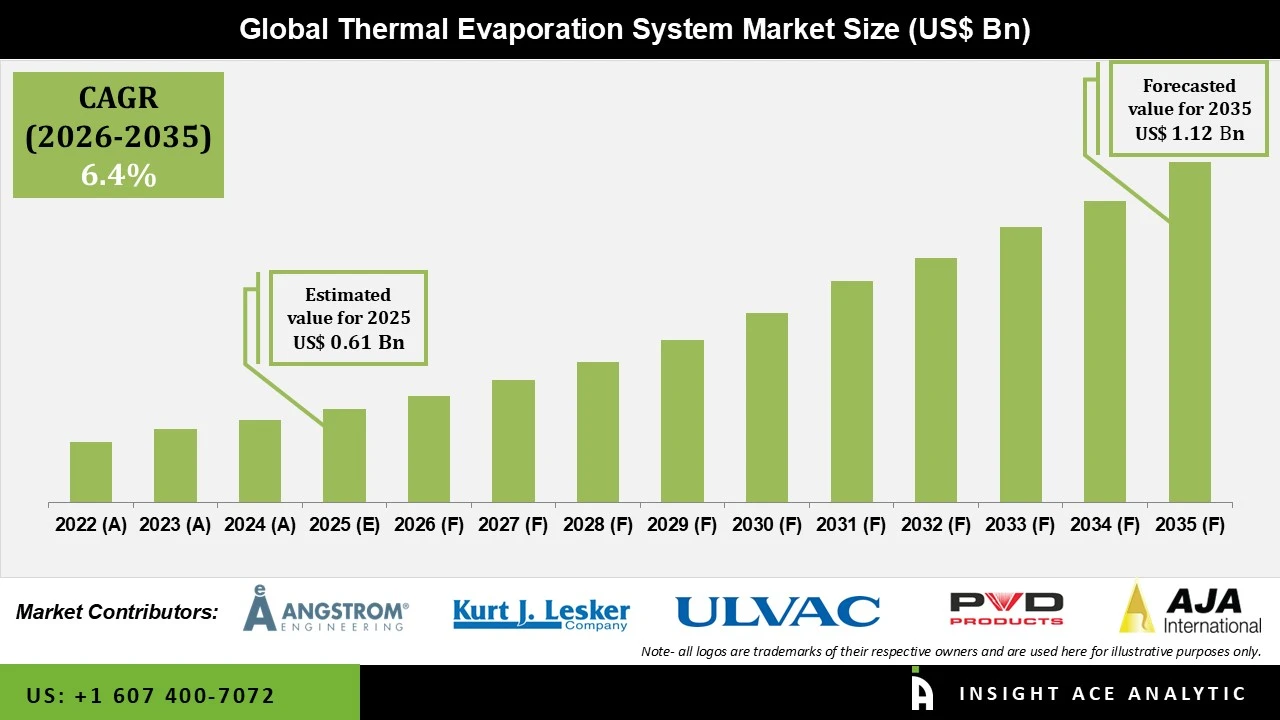
Thermal Evaporation System Market Size is valued at USD 0.61 Bn in 2025 and is predicted to reach USD 1.12 Bn by the year 2035 at a 6.4% CAGR during the forecast period for 2026 to 2035.
Thermal Evaporation System Market Size, Share & Trends Analysis By Product Type (Single Chamber Thermal Evaporation Systems, Multi-Chamber Thermal Evaporation Systems), By Application (Semiconductors, Optoelectronics, Solar Cells, Research & Development, Others), By End-User (Electronics, Aerospace & Defense, Healthcare, Energy, Others), and Segment Forecasts, 2026 to 2035
Thermal evaporation systems refer to physical vapor deposition (PVD) machines for thin film deposition where source material is heated until it is vaporized and deposited on substrate material. The usage of these systems is common in industries ranging from semiconductor production, electronics, optics to photovoltaic cells and advanced materials due to the ability to produce uniform, high-purity coatings that provide great adhesion. Thermal evaporation is among the most popular thin film deposition technologies due to simple process of deposition, fast deposition rate and wide variety of possible materials.
Increasing demand for advanced semiconductor devices, consumer electronics, optical products and other renewables is propelling the development of thermal evaporation systems market. With the constant improvements being made in process nodes and advanced packaging technologies in semiconductor industry, there will be increasing demand for thin film deposition devices which will help improve device performance and productivity of manufacturing processes.
Higher investments in manufacturing plants of semiconductors, display products, and photovoltaic products are further boosting the growth of this market. Governments from North America, Europe, and Asia Pacific regions are focusing on manufacturing semiconductors through their investment programs and industrial development plans in order to encourage manufacturers to adopt deposition techniques. Moreover, increased manufacturing of OLED display screens, MEMS products, optical coating, and flexible electronics is opening up new avenues for manufacturers of thermal evaporation equipment.
Moreover, manufacturers of thermal evaporation equipment are adopting automation, artificial intelligence aided control, online monitoring, and predictive maintenance of thermal evaporation equipment. These developments will further boost production efficiency. Sustained growth of this market is anticipated due to growing implementation of smart manufacturing and industry 4.0 concepts.
Competitive Landscape
Which are the Leading Players in Thermal Evaporation System Market ?
• Veeco Instruments Inc.
• Kurt J. Lesker Company
• Angstrom Engineering Inc.
• ULVAC Inc.
• Denton Vacuum LLC
• Ferrotec Holdings Corporation
• Oxford Instruments plc
• PVD Products Inc.
• Bühler Leybold Optics
• Applied Materials Inc.
• Canon Anelva Corporation
• Hitachi High-Tech Corporation
• Tokyo Electron Limited (TEL)
• Satisloh AG
• HHV Ltd.
• AJA International Inc.
• Moorfield Nanotechnology Ltd.
• Plassys Bestek
• VACOM Vakuum Komponenten & Messtechnik GmbH
• Semicore Equipment Inc.
• Scia Systems GmbH
• KLA Corporation
• ASM International
• EV Group (EVG)
• JEOL Ltd.
Market Dynamics
Driver
Growing Demand for Thin-Film Deposition in Semiconductor and Electronics Manufacturing
The rising production of semiconductor devices, OLED displays, photovoltaic cells, and optical components is creating high demand for thermal evaporation systems. The deposition of thin films is critical in the manufacturing of complex electronic components that require precise control of coating thickness and purity of the material used. Thermal evaporation systems assist manufacturers in boosting device performance, improving the efficiency of the production process, and minimizing manufacturing errors. The rising investments in semiconductor wafer fabrication and advanced display fabrication have increased market growth further. The growing applications of AI processors, electric vehicles, and communication technologies are driving the demand for thin-film deposition equipment.
Restrain/Challenge
High Capital Investment and Process Limitations
The high cost of advanced thermal evaporation equipment remains one of the key challenges for market growth. Modern deposition systems require sophisticated vacuum chambers, precision control systems, automated substrate handling, and advanced monitoring technologies, resulting in significant installation and maintenance costs. Additionally, thermal evaporation may not be suitable for depositing certain complex materials that require higher process control or reactive environments. Manufacturers often require additional deposition technologies for specialized applications, which may increase production costs and equipment complexity.
Semiconductor Manufacturing Segment is Expected to Drive the Thermal Evaporation System Market
The thermal evaporation system in the semiconductor manufacturing domain is predicted to have the maximum market share in the forecast period. Thermally evaporated thin film of metals as well as non-metals is necessary for fabricating conductive as well as insulating films used in integrated circuits, sensors, and advanced packaging. With the rising demand for AI chipsets, memory components, power semiconductors, and advanced logic processors, this application segment continues to fuel the growth of the thermal evaporation system market. Increasing investments in fabrication facilities and advanced manufacturing processes are anticipated to bolster the supremacy of the semiconductor segment.
Electron Beam Evaporation Systems Segment is Growing at the Highest Rate in the Thermal Evaporation System Market
The electron beam evaporation system type is predicted to experience the fastest growth rate throughout the forecast period on account of their ability to evaporate high melting point materials along with high level of control processes. They offer highly pure thin film formation, deposition rate control, and coating uniformity. Increasing application in electronics and semiconductor manufacturing will be responsible for their growth.
Why North America Led the Thermal Evaporation System Market ?
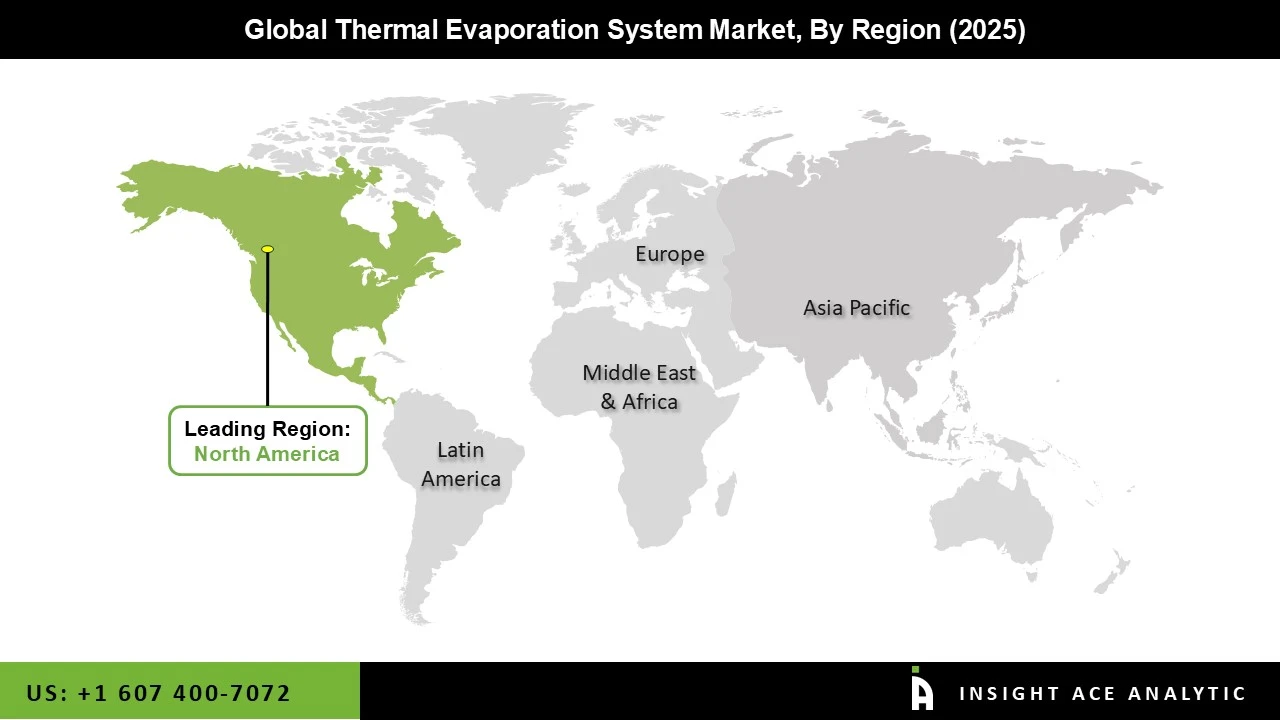
North America dominate the global market due to the presence of a highly efficient and advanced ecosystem of semiconductor manufacturing, extensive research infrastructure, and investment in technologies for thin-film deposition processes. Semiconductors manufacturing plants, research laboratories, and companies in the industry have led to the increased implementation of accurate deposition technologies in sectors like semiconductors, aerospace, defense, and optoelectronics.
Furthermore, governmental support through policies for the manufacture and domestic supply chains in the industry has facilitated investments in the production of advanced fabrication units. The demand from AI chipmakers, high performance computer, and advanced optical equipment manufacturers has boosted the growth of the market. Research on nanotechnology, MEMS, and quantum computing is another factor contributing to market growth.
Key Development
• May 2025: ULVAC Inc., an innovative company that manufactures equipment for deposition technologies, introduced next-generation thermal evaporation equipment featuring highly developed process automation and productivity.
• April 2025: Kurt J. Lesker Company added new platforms of thermal evaporation equipment featuring advanced thin film deposition technology with enhanced vacuum systems and digital controls.
• February 2025: Veeco Instruments Inc., which is engaged in development of equipment for thin-film deposition, enhanced its solutions by adding capabilities for process monitoring and predictive maintenance.
• October 2024: Oxford Instruments plc, a company producing physical vapor deposition (PVD) equipment, expanded its product line with thin-film deposition technologies suitable for semiconductor, photonics, and quantum applications.
• August 2024: Denton Vacuum LLC launched new generation of automated equipment for thermal evaporation with better process control and improved handling of substrates.
• June 2024: Applied Materials Inc. improved its product line for semiconductor manufacturing, namely thin film deposition equipment with enhanced automation technologies.
Thermal Evaporation System Market Report Scope:
| Report Attribute | Specifications |
| Market size value in 2025 | USD 0.61 Bn |
| Revenue forecast in 2035 | USD 1.12 Bn |
| Growth Rate CAGR | CAGR of 6.4% from 2026 to 2035 |
| Quantitative Units | Representation of revenue in US$ Bn and CAGR from 2026 to 2035 |
| Historic Year | 2022 to 2025 |
| Forecast Year | 2026-2035 |
| Report Coverage | The forecast of revenue, the position of the company, the competitive market structure, growth prospects, and trends |
| Segments Covered | Product Type, Application, End-user, and By Region |
| Regional Scope | North America; Europe; Asia Pacific; Latin America; Middle East & Africa |
| Country Scope | U.S.; Canada; U.K.; Germany; China; India; Japan; Brazil; Mexico; The UK; France; Italy; Spain; China; Japan; India; South Korea; Southeast Asia; South Korea; Southeast Asia |
| Competitive Landscape | Veeco Instruments Inc., Kurt J. Lesker Company, Angstrom Engineering Inc., ULVAC Inc., Denton Vacuum LLC, Ferrotec Holdings Corporation, Oxford Instruments plc, PVD Products Inc., Bühler Leybold Optics, Applied Materials Inc., Canon Anelva Corporation, Hitachi High-Tech Corporation, Tokyo Electron Limited, Satisloh AG, HHV Ltd., AJA International Inc., Moorfield Nanotechnology Ltd., Plassys Bestek, VACOM Vakuum Komponenten & Messtechnik GmbH, Semicore Equipment Inc., Scia Systems GmbH, KLA Corporation, ASM International, EV Group (EVG), and JEOL Ltd. |
| Customization Scope | Free customization report with the procurement of the report, Modifications to the regional and segment scope. Geographic competitive landscape. |
| Pricing and Available Payment Methods | Explore pricing alternatives that are customized to your particular study requirements. |
Thermal Evaporation System Market Segmentation:
Thermal Evaporation System Market by Product Type -
• Single Chamber Thermal Evaporation Systems
• Multi-Chamber Thermal Evaporation Systems
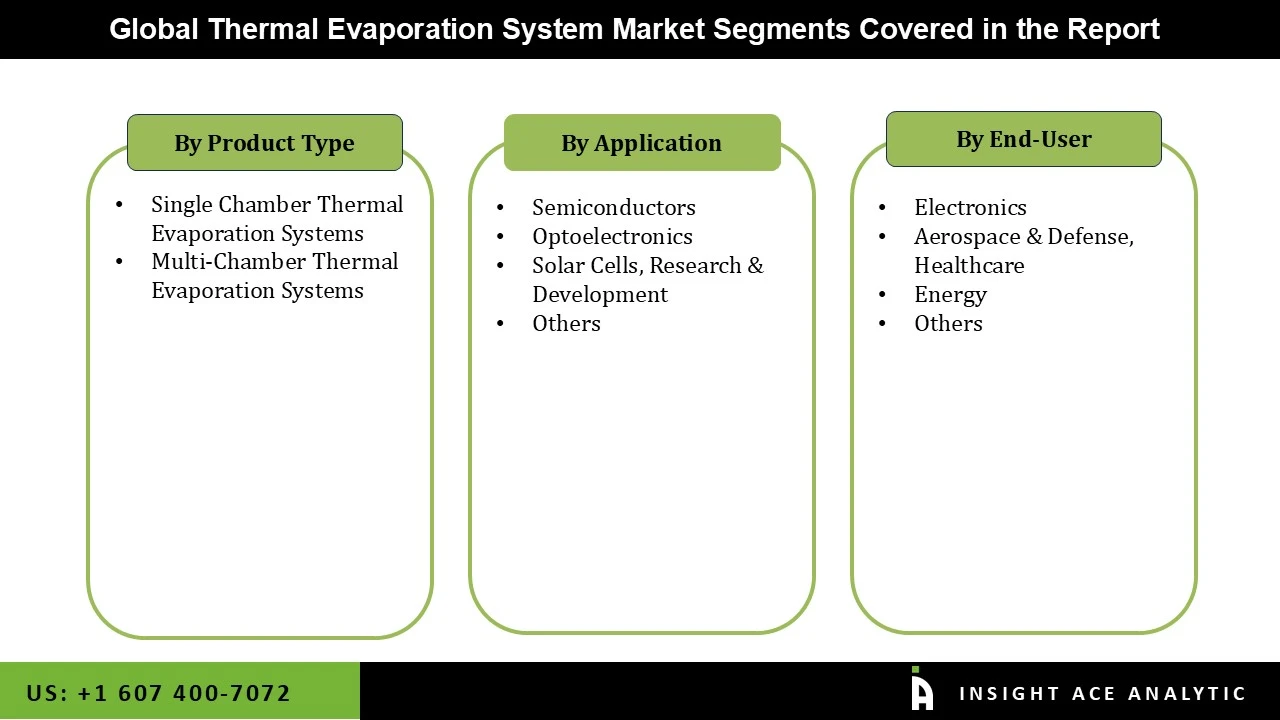
Thermal Evaporation System Market by Application
• Semiconductors
• Optoelectronics
• Solar Cells
• Research & Development
• Others
Thermal Evaporation System Market by End-user
• Electronics
• Aerospace & Defense
• Healthcare
• Energy
• Others
Thermal Evaporation System Market- By Region
North America-
• The US
• Canada
Europe-
• Germany
• The UK
• France
• Italy
• Spain
• Rest of Europe
Asia-Pacific-
• China
• Japan
• India
• South Korea
• South East Asia
• Rest of Asia Pacific
Latin America-
• Brazil
• Argentina
• Mexico
• Rest of Latin America
Middle East & Africa-
• GCC Countries
• South Africa
• Rest of Middle East and Africa
Research Design and Approach
This study employed a multi-step, mixed-method research approach that integrates:
- Secondary research
- Primary research
- Data triangulation
- Hybrid top-down and bottom-up modelling
- Forecasting and scenario analysis
This approach ensures a balanced and validated understanding of both macro- and micro-level market factors influencing the market.
Secondary Research
Secondary research for this study involved the collection, review, and analysis of publicly available and paid data sources to build the initial fact base, understand historical market behaviour, identify data gaps, and refine the hypotheses for primary research.
Sources Consulted
Secondary data for the market study was gathered from multiple credible sources, including:
- Government databases, regulatory bodies, and public institutions
- International organizations (WHO, OECD, IMF, World Bank, etc.)
- Commercial and paid databases
- Industry associations, trade publications, and technical journals
- Company annual reports, investor presentations, press releases, and SEC filings
- Academic research papers, patents, and scientific literature
- Previous market research publications and syndicated reports
These sources were used to compile historical data, market volumes/prices, industry trends, technological developments, and competitive insights.

Primary Research
Primary research was conducted to validate secondary data, understand real-time market dynamics, capture price points and adoption trends, and verify the assumptions used in the market modelling.
Stakeholders Interviewed
Primary interviews for this study involved:
- Manufacturers and suppliers in the market value chain
- Distributors, channel partners, and integrators
- End-users / customers (e.g., hospitals, labs, enterprises, consumers, etc., depending on the market)
- Industry experts, technology specialists, consultants, and regulatory professionals
- Senior executives (CEOs, CTOs, VPs, Directors) and product managers
Interview Process
Interviews were conducted via:
- Structured and semi-structured questionnaires
- Telephonic and video interactions
- Email correspondences
- Expert consultation sessions
Primary insights were incorporated into demand modelling, pricing analysis, technology evaluation, and market share estimation.
Data Processing, Normalization, and Validation
All collected data were processed and normalized to ensure consistency and comparability across regions and time frames.
The data validation process included:
- Standardization of units (currency conversions, volume units, inflation adjustments)
- Cross-verification of data points across multiple secondary sources
- Normalization of inconsistent datasets
- Identification and resolution of data gaps
- Outlier detection and removal through algorithmic and manual checks
- Plausibility and coherence checks across segments and geographies
This ensured that the dataset used for modelling was clean, robust, and reliable.
Market Size Estimation and Data Triangulation
Bottom-Up Approach
The bottom-up approach involved aggregating segment-level data, such as:
- Company revenues
- Product-level sales
- Installed base/usage volumes
- Adoption and penetration rates
- Pricing analysis
This method was primarily used when detailed micro-level market data were available.

Top-Down Approach
The top-down approach used macro-level indicators:
- Parent market benchmarks
- Global/regional industry trends
- Economic indicators (GDP, demographics, spending patterns)
- Penetration and usage ratios
This approach was used for segments where granular data were limited or inconsistent.
Hybrid Triangulation Approach
To ensure accuracy, a triangulated hybrid model was used. This included:
- Reconciling top-down and bottom-up estimates
- Cross-checking revenues, volumes, and pricing assumptions
- Incorporating expert insights to validate segment splits and adoption rates
This multi-angle validation yielded the final market size.
Forecasting Framework and Scenario Modelling
Market forecasts were developed using a combination of time-series modelling, adoption curve analysis, and driver-based forecasting tools.
Forecasting Methods
- Time-series modelling
- S-curve and diffusion models (for emerging technologies)
- Driver-based forecasting (GDP, disposable income, adoption rates, regulatory changes)
- Price elasticity models
- Market maturity and lifecycle-based projections
Scenario Analysis
Given inherent uncertainties, three scenarios were constructed:
- Base-Case Scenario: Expected trajectory under current conditions
- Optimistic Scenario: High adoption, favourable regulation, strong economic tailwinds
- Conservative Scenario: Slow adoption, regulatory delays, economic constraints
Sensitivity testing was conducted on key variables, including pricing, demand elasticity, and regional adoption.
Request Customization
Add countries, segments, company profiles, or extend forecast — free 10% customization with purchase.
Customize This Report →Enquire Before Buying
Speak with our analyst team about scope, methodology, pricing, or deliverable formats.
Enquire Now →Frequently Asked Questions
Thermal Evaporation System Market Size is valued at USD 0.61 Bn in 2025 and is predicted to reach USD 1.12 Bn by the year 2035
Thermal Evaporation System Market is expected to grow at a 6.4% CAGR during the forecast period for 2026 to 2035.
Veeco Instruments Inc., Kurt J. Lesker Company, Angstrom Engineering Inc., ULVAC Inc., Denton Vacuum LLC, Ferrotec Holdings Corporation, Oxford Instruments plc, PVD Products Inc., Bühler Leybold Optics, Applied Materials Inc., Canon Anelva Corporation, Hitachi High-Tech Corporation, Tokyo Electron Limited, Satisloh AG, HHV Ltd., AJA International Inc., Moorfield Nanotechnology Ltd., Plassys Bestek, VACOM Vakuum Komponenten & Messtechnik GmbH, Semicore Equipment Inc., Scia Systems GmbH, KLA Corporation, ASM International, EV Group (EVG), and JEOL Ltd.
Thermal Evaporation System Market is segmented into Product Type, Application, End-user, and By Region
North America region is leading the Thermal Evaporation System Market.