Rotary Power Tool Market Size, Trend, Forecast Report 2026 to 2035
What is Rotary Power Tool Market Size?
Global Rotary Power Tool Market Size is valued at USD 0.57 Bn in 2025 and is predicted to reach USD 1.12 Bn by the year 2035 at a 7.2% CAGR during the forecast period for 2026 to 2035.
Rotary Power Tool Market Size, Share & Trends Analysis Distribution by Type (Rotary Tools, Oscillating Multi-Tools), By Power Source (Corded, Cordless), By User Type (DIY, Professional), By Distribution Channel (Manufacturer Direct/Web Store, Wholesalers/Industrial Distributors, Specialist Trade Channels, DIY Superstores, Ecommerce) and Segment Forecasts, 2026 to 2035.
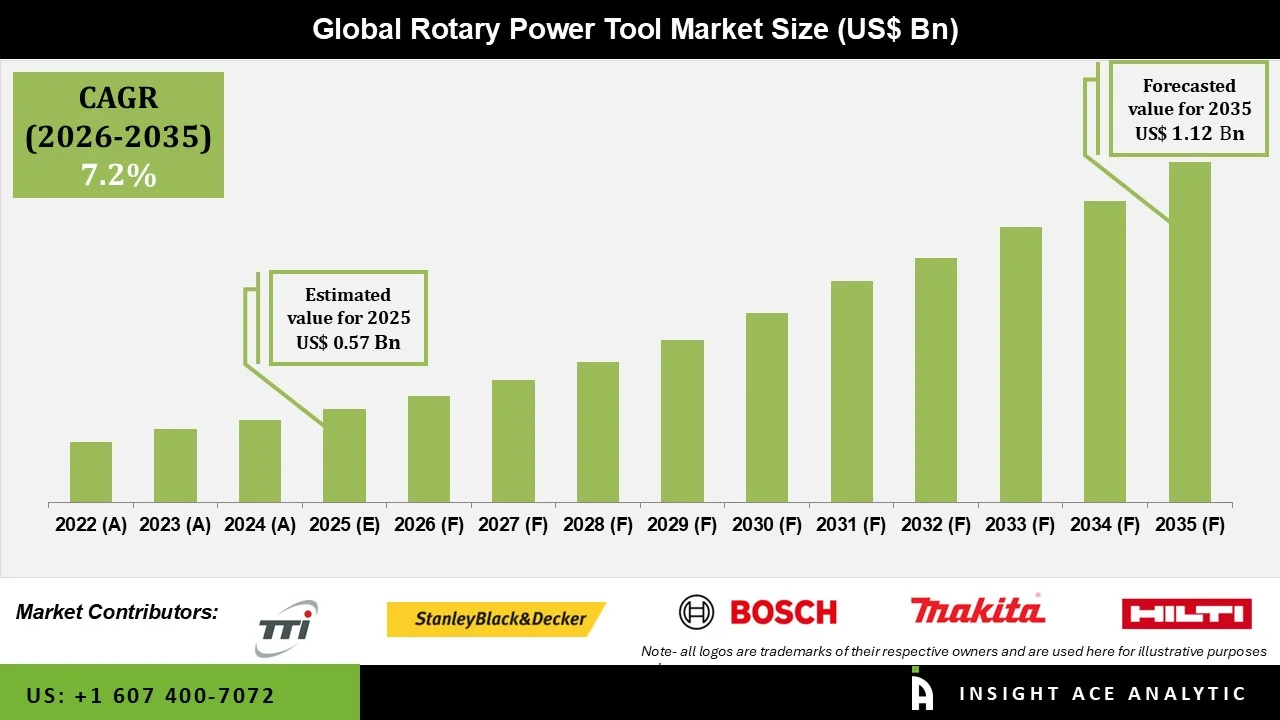
Rotary power tools are versatile handheld devices which use rotational or oscillating motion to carry out precise jobs such as cutting, grinding, sanding, polishing, engraving and surface finishing. Because of their compact design and the fact that they can be used with a variety of attachments, they are appropriate for a wide range of uses, whether those involve detailed do-it-yourself jobs and home improvements or more specialized work in professional woodworking, metalworking, automotive maintenance and industrial operations.
The market for rotary power tools involves the development, manufacturing, and sale of rotary tools and oscillating multi-tools using a variety of power sources, for different types of users and via various distribution channels. It covers both corded and cordless products that are designed for use by do-it-yourselfers and for professional purposes, with sales taking place through manufacturer web stores, industrial distributors, specialist trade channels, DIY superstores, and e-commerce websites. This market meets a wide range of end-use needs, the products offered differing in terms of performance, precision, functionality, and the purpose for which they are intended.
Competitive Landscape
Which are the Leading Players in the Rotary Power Tool Market?
- Bosch
- Stanley Black & Decker
- Techtronic Industries
- Makita Corporation
- Hilti
- Festool
- Einhell Germany AG
- Positec Group
- C. & E. Fein GmbH (FEIN)
- KOKI Holdings Co., Ltd.
Market Dynamics
Driver
Growing Demand for Multifunctional Tools Across DIY and Professional Applications
The growing preference for versatile tools which can carry out a number of operations is helping the rotary power tool market to expand. Since rotary tools and oscillating multi-tools have a variety of attachments for cutting, sanding, grinding, polishing and surface finishing, users are able to carry out different tasks using one device only. This flexibility means that they are appropriate for use in home improvement, woodworking, automotive maintenance and professional repair work. With DIY enthusiasts and professionals looking for flexible tools to meet their different project needs, demand for multifunctional rotary power tools is likely to rise.
Restrain/Challenge
High Competition from Low-Cost Alternatives and Product Substitutes
The market for rotary power tools is encountering difficulties due to fierce price competition and the presence of cheap alternatives, especially in the consumer and do-it-yourself areas. Since products which have the same fundamental functions are available at a wide variety of price levels, it has become hard for manufacturers to distinguish their products on the basis of function alone. In addition, professional-grade tools demand spending on durability, performance, safety features, and battery technology, leading to higher product costs. For this reason, manufacturers have to strike a balance between keeping prices low and ensuring product quality and reliability while remaining competitive in both the consumer and professional markets.
Cloud / SaaS segment Segment is Expected to Drive the Rotary Power Tool Market
The rotary tools sector is likely to be the main force in the rotary power tool market because of their versatility in a wide variety of applications such as cutting, grinding, sanding, polishing, engraving and carving. Thanks to the availability of interchangeable accessories, users can carry out precise work on materials like wood, metal, plastic and ceramics with just one tool. The use of these tools in do-it-yourself projects, home improvements, crafts and in professional repair work fuels demand from both consumers and professionals. This wide range of applications is expected to enhance the sector's contribution to the total market.
Cordless Segment is Growing at the Highest Rate in the Rotary Power Tool Market
The cordless section is anticipated to show the fastest rate of growth in the rotary power tool market as a result of its portability, ease of use, and versatility in a variety of working environments. Since battery-powered tools do not require constant access to electrical outlets, users can use them conveniently in narrow spaces, at outdoor locations, and on remote job sites. Further improvements in lithium-ion battery technology, together with better charging efficiency and longer runtime, are also boosting tool performance and usability. Because of these benefits, cordless rotary power tools are becoming more popular among DIY enthusiasts and professionals in the fields of construction, maintenance, woodworking, and repair.
Why North America Led the Rotary Power Tool Market?
North America is expected to retain its leading position in the rotary power tool market as a result of the ongoing levels of construction, renovation, maintenance, woodworking, and home improvement. The steady demand from professional contractors, repair specialists, and do-it-yourself users helps to promote the use of rotary tools and oscillating multi-tools in both residential, commercial, and industrial settings.
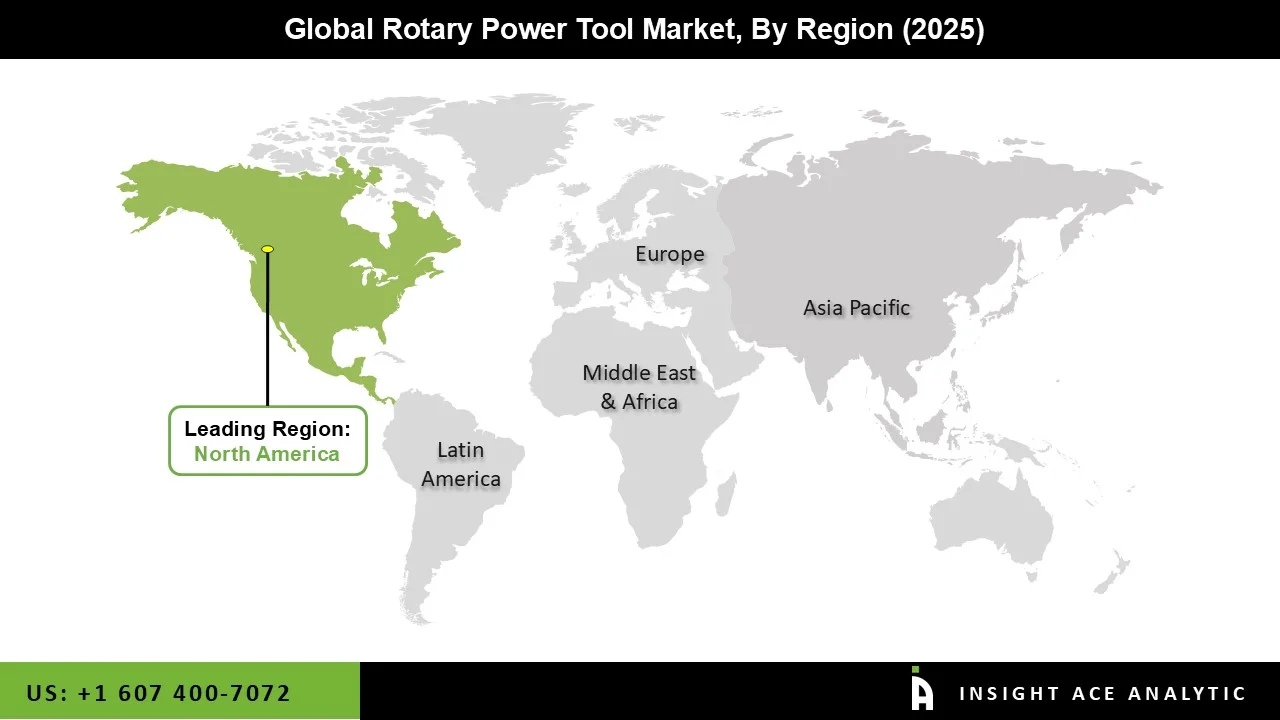
Moreover, the region has a well-developed distribution network consisting of specialist retailers, industrial distributors, do-it-yourself superstores, and e-commerce websites, which guarantees wide product availability. The existence of well-known power tool brands together with the ongoing expansion of cordless and multifunctional product ranges also contributes to North America's status as a market leader.
Key Development
• August 2026: DEWALT, a Stanley Black & Decker brand, expanded its cordless carpentry portfolio with new tools, including an oscillating multi-tool, random orbital sanders, a plunge track saw, and a finish nailer, targeting professional carpenters, remodelers, and woodworkers.
Rotary Power Tool Market Report Scope :
| Report Attribute | Specifications |
| Market size value in 2025 | USD 0.57 Bn |
| Revenue forecast in 2035 | USD 1.12 Bn |
| Growth Rate CAGR | CAGR of 7.2% from 2026 to 2035 |
| Quantitative Units | Representation of revenue in US$ Bn and CAGR from 2026 to 2035 |
| Historic Year | 2022 to 2025 |
| Forecast Year | 2026-2035 |
| Report Coverage | The forecast of revenue, the position of the company, the competitive market structure, growth prospects, and trends |
| Segments Covered | Type, Power Source, User Type, Distribution Channel and By Region |
| Regional Scope | North America; Europe; Asia Pacific; Latin America; Middle East & Africa |
| Country Scope | U.S.; Canada; U.K.; Germany; China; India; Japan; Brazil; Mexico; France; Italy; Spain; South Korea; Southeast Asia |
| Competitive Landscape | Bosch, Stanley Black & Decker, Techtronic Industries, Makita Corporation, Hilti, Festool, Einhell Germany AG, Positec Group, C. & E. Fein GmbH (FEIN), KOKI Holdings Co., Ltd. |
| Customization Scope | Free customization report with the procurement of the report, Modifications to the regional and segment scope. Geographic competitive landscape. |
| Pricing and Available Payment Methods | Explore pricing alternatives that are customized to your particular study requirements. |
Segmentations of Rotary Power Tool Market :
Rotary Power Tool Market by Type -
- Rotary Tools
- Oscillating Multi-Tools
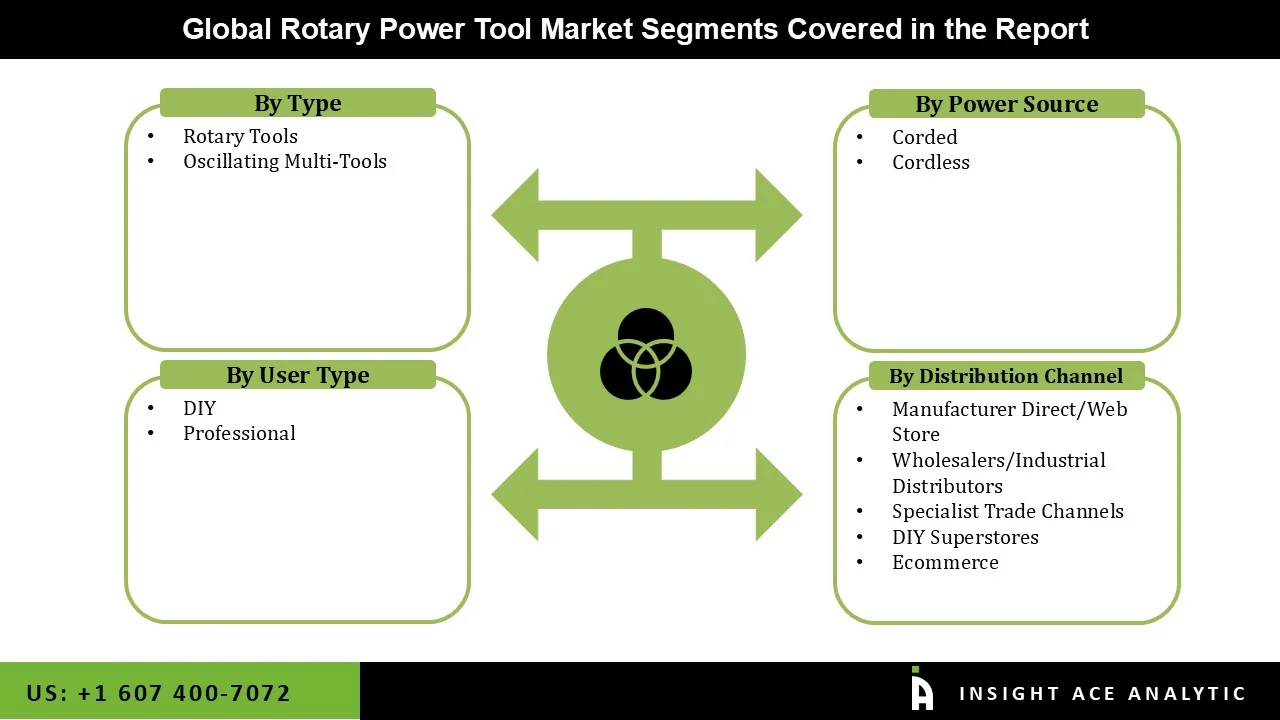
Rotary Power Tool Market by Power Source -
- Corded
- Cordless
Rotary Power Tool Market by User Type -
- DIY
- Professional
Rotary Power Tool Market by Distribution Channel -
- Manufacturer Direct/Web Store
- Wholesalers/Industrial Distributors
- Specialist Trade Channels
- DIY Superstores
- Ecommerce
Rotary Power Tool Market by Region-
- North America-
- The US
- Canada
- Europe-
- Germany
- The UK
- France
- Italy
- Spain
- Rest of Europe
- Asia-Pacific-
- China
- Japan
- India
- South Korea
- South East Asia
- Rest of Asia Pacific
- Latin America-
- Brazil
- Argentina
- Mexico
- Rest of Latin America
- Middle East and Africa-
- GCC Countries
- South Africa
- Rest of Middle East and Africa
Research Design and Approach
This study employed a multi-step, mixed-method research approach that integrates:
- Secondary research
- Primary research
- Data triangulation
- Hybrid top-down and bottom-up modelling
- Forecasting and scenario analysis
This approach ensures a balanced and validated understanding of both macro- and micro-level market factors influencing the market.
Secondary Research
Secondary research for this study involved the collection, review, and analysis of publicly available and paid data sources to build the initial fact base, understand historical market behaviour, identify data gaps, and refine the hypotheses for primary research.
Sources Consulted
Secondary data for the market study was gathered from multiple credible sources, including:
- Government databases, regulatory bodies, and public institutions
- International organizations (WHO, OECD, IMF, World Bank, etc.)
- Commercial and paid databases
- Industry associations, trade publications, and technical journals
- Company annual reports, investor presentations, press releases, and SEC filings
- Academic research papers, patents, and scientific literature
- Previous market research publications and syndicated reports
These sources were used to compile historical data, market volumes/prices, industry trends, technological developments, and competitive insights.

Primary Research
Primary research was conducted to validate secondary data, understand real-time market dynamics, capture price points and adoption trends, and verify the assumptions used in the market modelling.
Stakeholders Interviewed
Primary interviews for this study involved:
- Manufacturers and suppliers in the market value chain
- Distributors, channel partners, and integrators
- End-users / customers (e.g., hospitals, labs, enterprises, consumers, etc., depending on the market)
- Industry experts, technology specialists, consultants, and regulatory professionals
- Senior executives (CEOs, CTOs, VPs, Directors) and product managers
Interview Process
Interviews were conducted via:
- Structured and semi-structured questionnaires
- Telephonic and video interactions
- Email correspondences
- Expert consultation sessions
Primary insights were incorporated into demand modelling, pricing analysis, technology evaluation, and market share estimation.
Data Processing, Normalization, and Validation
All collected data were processed and normalized to ensure consistency and comparability across regions and time frames.
The data validation process included:
- Standardization of units (currency conversions, volume units, inflation adjustments)
- Cross-verification of data points across multiple secondary sources
- Normalization of inconsistent datasets
- Identification and resolution of data gaps
- Outlier detection and removal through algorithmic and manual checks
- Plausibility and coherence checks across segments and geographies
This ensured that the dataset used for modelling was clean, robust, and reliable.
Market Size Estimation and Data Triangulation
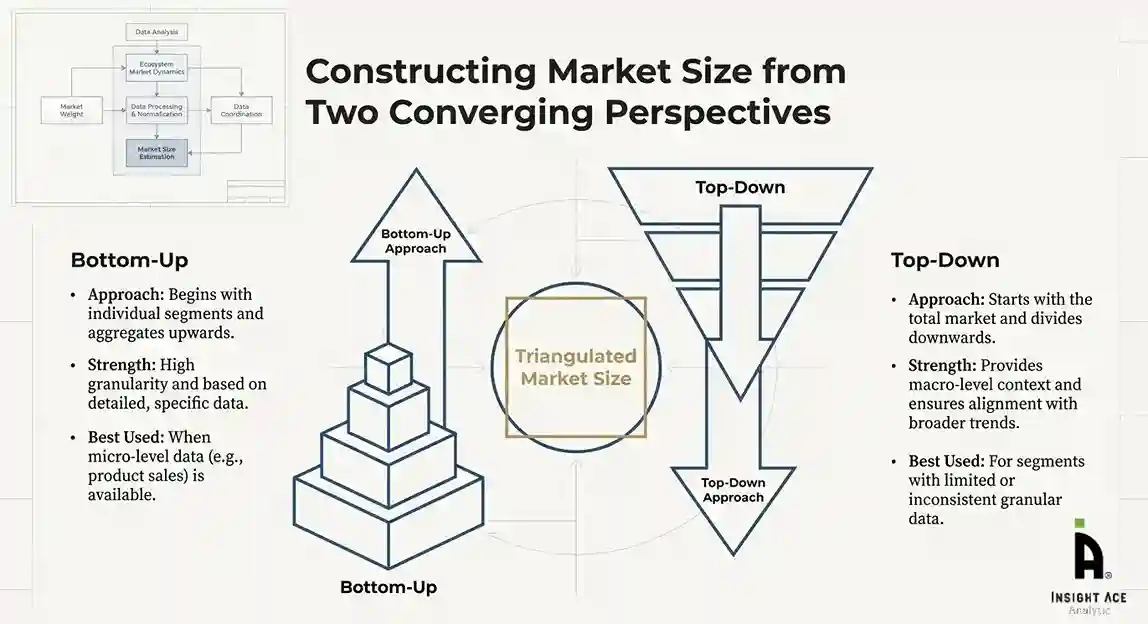
Bottom-Up Approach
The bottom-up approach involved aggregating segment-level data, such as:
- Company revenues
- Product-level sales
- Installed base/usage volumes
- Adoption and penetration rates
- Pricing analysis
This method was primarily used when detailed micro-level market data were available.
Top-Down Approach
The top-down approach used macro-level indicators:
- Parent market benchmarks
- Global/regional industry trends
- Economic indicators (GDP, demographics, spending patterns)
- Penetration and usage ratios
This approach was used for segments where granular data were limited or inconsistent.
Hybrid Triangulation Approach
To ensure accuracy, a triangulated hybrid model was used. This included:
- Reconciling top-down and bottom-up estimates
- Cross-checking revenues, volumes, and pricing assumptions
- Incorporating expert insights to validate segment splits and adoption rates
This multi-angle validation yielded the final market size.
Forecasting Framework and Scenario Modelling
Market forecasts were developed using a combination of time-series modelling, adoption curve analysis, and driver-based forecasting tools.
Forecasting Methods
- Time-series modelling
- S-curve and diffusion models (for emerging technologies)
- Driver-based forecasting (GDP, disposable income, adoption rates, regulatory changes)
- Price elasticity models
- Market maturity and lifecycle-based projections
Scenario Analysis
Given inherent uncertainties, three scenarios were constructed:
- Base-Case Scenario: Expected trajectory under current conditions
- Optimistic Scenario: High adoption, favourable regulation, strong economic tailwinds
- Conservative Scenario: Slow adoption, regulatory delays, economic constraints
Sensitivity testing was conducted on key variables, including pricing, demand elasticity, and regional adoption.
Request Customization
Add countries, segments, company profiles, or extend forecast — free 10% customization with purchase.
Customize This Report →Enquire Before Buying
Speak with our analyst team about scope, methodology, pricing, or deliverable formats.
Enquire Now →Frequently Asked Questions
Rotary Power Tool Market Size is valued at USD 0.57 Bn in 2025 and is predicted to reach USD 1.12 Bn by the year 2035
The Rotary Power Tool Market is expected to grow at a 7.2% CAGR during the forecast period for 2026 to 2035
Bosch, Stanley Black & Decker, Techtronic Industries, Makita Corporation, Hilti, Festool, Einhell Germany AG, Positec Group, C. & E. Fein GmbH (FEIN), KOKI Holdings Co., Ltd. and Others.
Rotary Power Tool Market is segmented into Type, Power Source, User Type, Distribution Channel and Other.
North America region is leading the Rotary Power Tool Market.