Data Center Air Handling Units Market Size, Share, Trend, Revenue Report 2026 to 2035
What Data Center Air Handling Units Market Size?
Global Data Center Air Handling Units Market Size is valued at USD 3.92 Bn in 2025 and is predicted to reach USD 9.43 Bn by the year 2035 at a 9.5% CAGR during the forecast period for 2026 to 2035.
Data Center Air Handling Units Market Size, Share & Trends Analysis Distribution by Type (Chilled Water (CHW) AHU, DX (Direct Expansion) AHU, Evaporative/Adiabatic AHU, Outside Air/Air Side Economizer AHU, Hybrid (Dual Medium Native) AHU), By Capacity (≤ 5,000 m³/h, 5,001–15,000 m³/h, 15,001–30,000 m³/h, 30,001–50,000 m³/h, ≥ 50,001 m³/h), By Data Center Type (Hyperscale, Colocation Providers, Enterprises) and Segment Forecasts, 2026 to 2035.
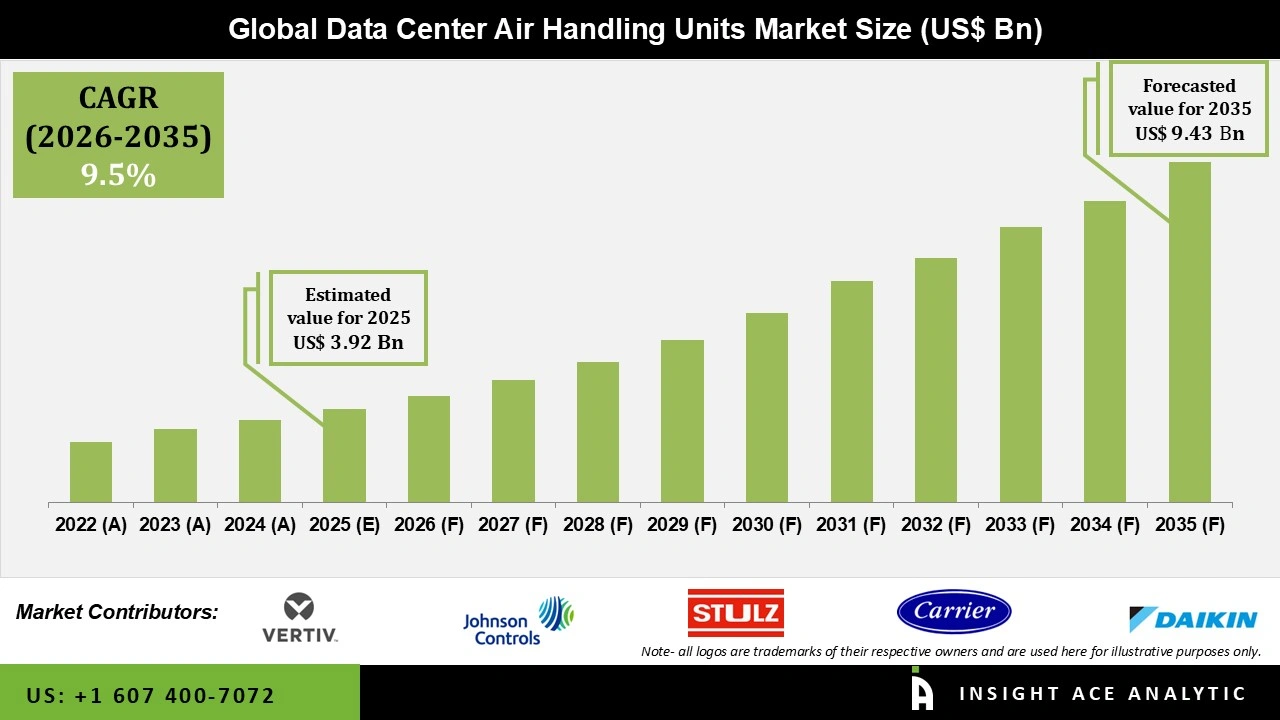
Air handling units (AHUs) are essential parts of the cooling system in data centres and are intended to condition, circulate, filter and manage the air in buildings that contain servers, networking equipment and other IT systems. The AHUs in data centres control temperature, humidity, airflow and air quality in order to ensure that the delicate computing equipment has stable operating conditions. The type of cooling method used by AHUs will depend on the cooling system's design and the environmental requirements, and may involve chilled water, direct expansion (DX), evaporative or adiabatic cooling, outside-air economization or hybrid cooling methods. The way in which AHUs are configured and the size of their capacity will vary according to factors such as the size of the data centre, the density of the racks, the cooling load, the climate and the design of the facility.
The market for AHUs in data centres includes the design, the manufacturing, the supply, the installation and the deployment of AHUs which have been specially engineered for use in data centre settings. It involves a variety of AHU types such as chilled water, DX, evaporative/adiabatic, outside air/air-side economizers and hybrid units, as well as different ranges of airflow capacity. Demand exists in hyperscale, colocation and enterprise data centres, with deployment increasing in both established and developing data centre markets around the world. The market is also influenced by the expansion of high-density computing infrastructure, the growing cooling requirements, the modernisation of existing facilities and the demand for efficient and reliable thermal management systems.
Competitive Landscape
Which are the Leading Players in the Data Center Air Handling Units Market?
- Vertiv Group Corp
- Johnson Controls, Inc.
- STULZ GMBH
- Carrier
- Daikin Industries Ltd.
- Samsung Electronics
- Systemair AB
- Swegon Group AB
- Munters Group AB
- Trane
- Mitsubishi Electric Corporation
- LG Electronics
- Trox SE
- Airedale International Air Conditioning Ltd. (Modine)
- AL-KO THERM GMBH
- AAON
- Zeco Aircon
- GD Midea Heating & Ventilating Equipment Co., Ltd.
Market Dynamics
Driver
Rising AI and High-Density Computing Deployments
The quick growth of artificial intelligence (AI), machine learning, and high-performance computing (HPC) is causing data centres to use more power and produce more heat, which means that the rack densities are now much higher than those found in traditional IT systems. Since AI workloads depend greatly on high-performance GPUs and accelerators, these components produce a large amount of heat and need constant, accurate cooling in order to ensure that the equipment functions properly and remains reliable. In response, data centre operators, especially those who operate hyperscale facilities and colocation services, are installing more powerful and more advanced air handling units (AHUs) so that they can handle the greater demand for airflow and cooling. With the global capacity for AI-ready data centres increasing, there is expected to be a growing requirement for reliable and scalable thermal management infrastructure to meet the demand for data centre AHUs.
Restrain/Challenge
Shift Toward Liquid Cooling for High-Density AI Data Centers
The greater the use of direct-to-chip and other liquid cooling technologies in connection with AI and high-performance computing tasks, the more significant the challenge becomes for the Data Center AHU Market. Since rack power densities are increasing, conventional air cooling becomes less effective at getting rid of the concentrated heat, whereas liquid cooling is able to transfer the heat more efficiently and can support racks with much higher densities. Current industry recommendations more and more regard liquid cooling as the best method for use in AI/HPC environments when traditional air cooling can no longer be relied upon practically. This change could decrease the need for conventional AHUs in high-density AI applications and might restrict their role to areas with lower densities or to part of a hybrid cooling system.
Chilled Water (CHW) AHU Segment is Expected to Drive the Data Center Air Handling Units Market
The chilled water (CHW) AHU segment is likely to stay the leading segment in the data center AHU market since it can offer high-capacity, reliable, and scalable cooling for large data centre environments. It is especially appropriate for hyperscale and colocation facilities, as the central cooling system can serve several IT rooms and handle varying thermal loads. The technology also meets the increasing demands of AI and high-performance computing, since current chilled-water systems are capable of providing conventional air cooling as well as integration with liquid-cooling systems. Moreover, the use of variable-flow chillers, higher chilled-water temperatures, and free-cooling options is enhancing system efficiency and lowering operating costs, which in turn increases the appeal of CHW-based cooling for large-scale data centre applications.
≤ 5,000 m³/h Segment is Growing at the Highest Rate in the Data Center Air Handling Units Market
The segment with a capacity of ≥50,001 m³/h is expected to be the fastest-growing and leading segment over the forecast period, owing to the expansion of hyperscale and large colocation data centres, especially those supporting AI, ML, and HPC workloads, since these require much higher airflow volumes in order to deal with the rising rack power densities and thermal loads. AHUs with high capacity are able to offer large-scale air distribution and cooling and can support technologies including chilled-water cooling, free cooling, variable-speed fans, and advanced controls.
Why North America Led the Data Center Air Handling Units Market?
North America is expected to take the lead in the data center AHU market over the course of the forecast period. This is due to the region's well-established data centre ecosystem, the large number of hyperscale and colocation facilities it contains, and the strong levels of investment in AI, cloud computing, and high-performance computing.
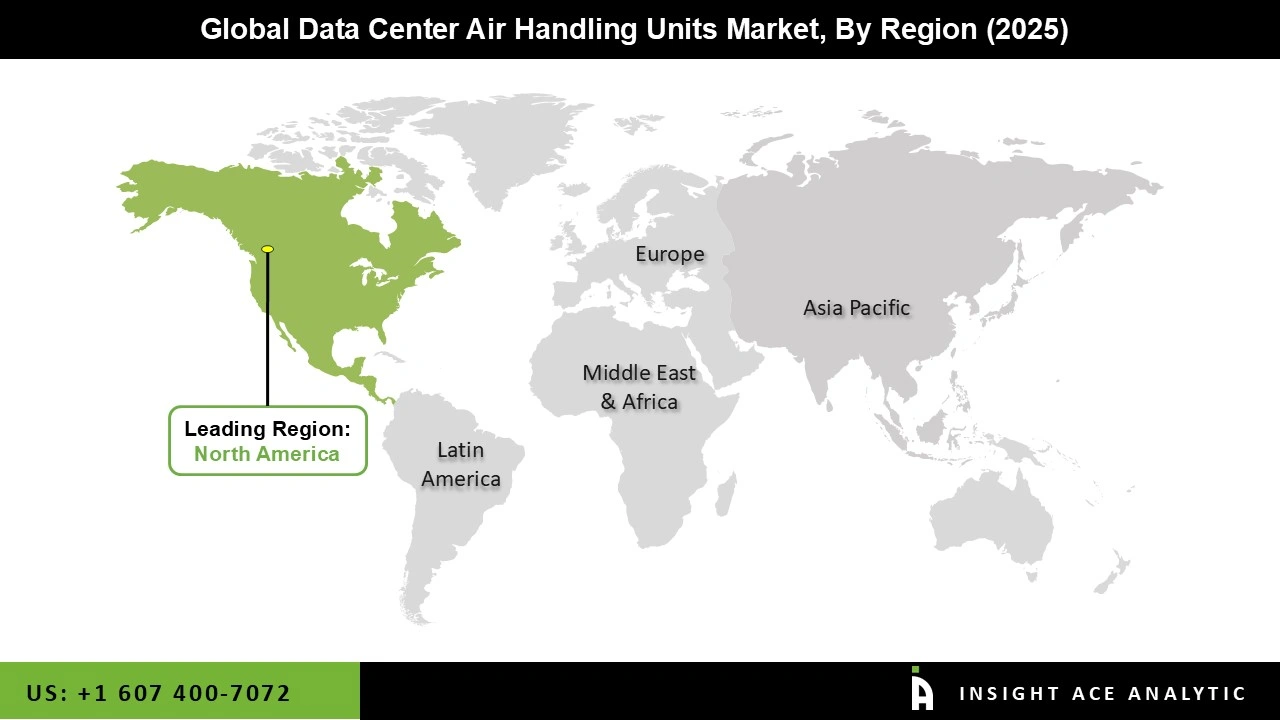
The United States makes up the largest share of the regional data centre capacity, with key locations such as Northern Virginia, Texas, Dallas-Fort Worth, and Phoenix experiencing major expansions. This fast-paced development is driving up the demand for high-capacity and energy-efficient thermal management systems, including AHUs. Furthermore, the increasing rack power densities resulting from AI workloads are leading to higher cooling demands, which in turn is promoting greater adoption of AHUs.
Key Development:
November 2025: Samsung Electronics completed the acquisition of FläktGroup, strengthening its position in the global HVAC and data center markets. The acquisition enables Samsung to leverage FläktGroup’s HVAC technologies, production and sales network, and subsidiaries, including Woods Air Movement, SEMCO, and SE-Elektronic. FläktGroup will continue operating as an independent subsidiary, while Samsung plans to integrate its expertise with AI platforms to develop advanced HVAC and data center cooling solutions.
Data Center Air Handling Units Market Report Scope:
| Report Attribute | Specifications |
| Market size value in 2025 | USD 3.92 Bn |
| Revenue forecast in 2035 | USD 9.43 Bn |
| Growth Rate CAGR | CAGR of 9.5% from 2026 to 2035 |
| Quantitative Units | Representation of revenue in US$ Bn and CAGR from 2026 to 2035 |
| Historic Year | 2022 to 2025 |
| Forecast Year | 2026-2035 |
| Report Coverage | The forecast of revenue, the position of the company, the competitive market structure, growth prospects, and trends |
| Segments Covered | Type, Capacity, Data Center Type and By Region |
| Regional Scope | North America; Europe; Asia Pacific; Latin America; Middle East & Africa |
| Country Scope | U.S.; Canada; U.K.; Germany; China; India; Japan; Brazil; Mexico; The UK; France; Italy; Spain; China; Japan; India; South Korea; Southeast Asia; South Korea; Southeast Asia |
| Competitive Landscape | Vertiv Group Corp, Johnson Controls, Inc., STULZ GMBH, Carrier, Daikin Industries Ltd., Samsung Electronics, Systemair AB, Swegon Group AB, Munters Group AB, Trane, Mitsubishi Electric Corporation |
| Customization Scope | Free customization report with the procurement of the report, Modifications to the regional and segment scope. Geographic competitive landscape. |
| Pricing and Available Payment Methods | Explore pricing alternatives that are customized to your particular study requirements. |
Segmentations Data Center Air Handling Units Market :
Data Center Air Handling Units Market by Type -
- Chilled Water (CHW) AHU
- DX (Direct Expansion) AHU
- Evaporative/Adiabatic AHU
- Outside Air/Air Side Economizer AHU
- Hybrid (Dual Medium Native) AHU
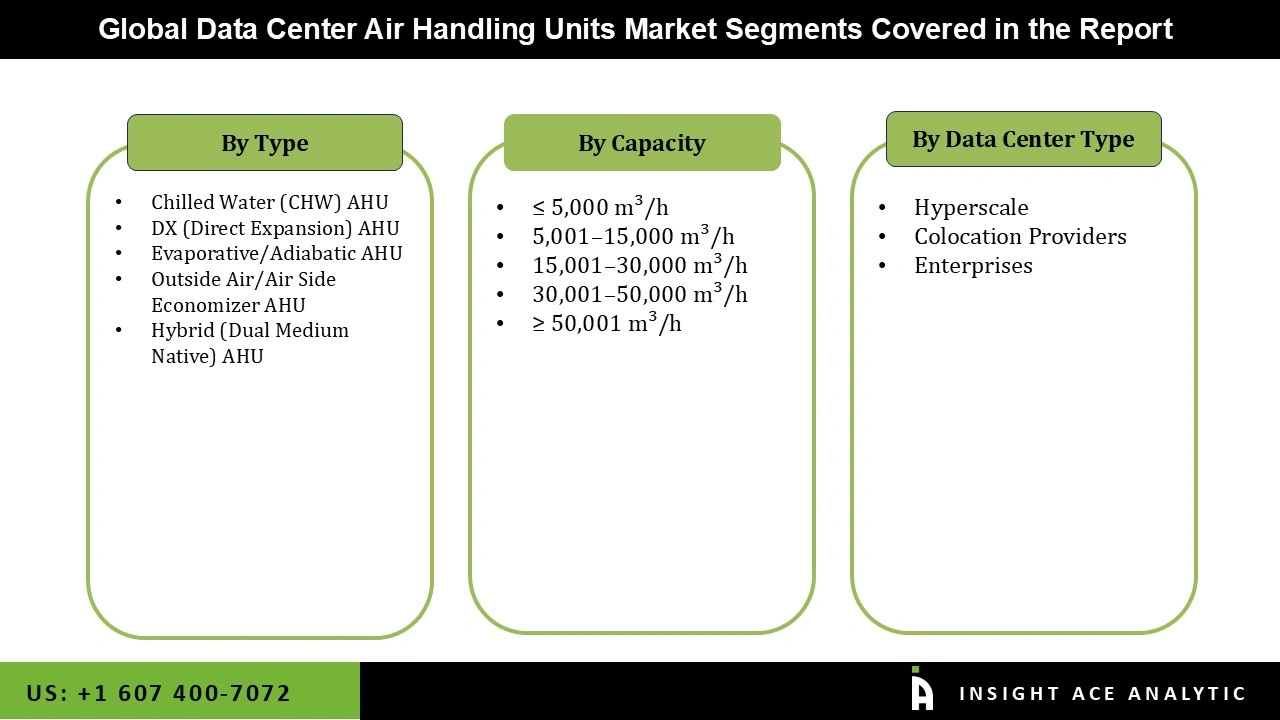
Data Center Air Handling Units Market by Capacity -
- ≤ 5,000 m³/h
- 5,001–15,000 m³/h
- 15,001–30,000 m³/h
- 30,001–50,000 m³/h
- ≥ 50,001 m³/h
Data Center Air Handling Units Market by Data Center Type -
- Hyperscale
- Colocation Providers
- Enterprises
Data Center Air Handling Units Market by Region-
- North America-
- The US
- Canada
- Europe-
- Germany
- The UK
- France
- Italy
- Spain
- Rest of Europe
- Asia-Pacific-
- China
- Japan
- India
- South Korea
- South East Asia
- Rest of Asia Pacific
- Latin America-
- Brazil
- Argentina
- Mexico
- Rest of Latin America
- Middle East and Africa-
- GCC Countries
- South Africa
- Rest of Middle East and Africa
Research Design and Approach
This study employed a multi-step, mixed-method research approach that integrates:
- Secondary research
- Primary research
- Data triangulation
- Hybrid top-down and bottom-up modelling
- Forecasting and scenario analysis
This approach ensures a balanced and validated understanding of both macro- and micro-level market factors influencing the market.
Secondary Research
Secondary research for this study involved the collection, review, and analysis of publicly available and paid data sources to build the initial fact base, understand historical market behaviour, identify data gaps, and refine the hypotheses for primary research.
Sources Consulted
Secondary data for the market study was gathered from multiple credible sources, including:
- Government databases, regulatory bodies, and public institutions
- International organizations (WHO, OECD, IMF, World Bank, etc.)
- Commercial and paid databases
- Industry associations, trade publications, and technical journals
- Company annual reports, investor presentations, press releases, and SEC filings
- Academic research papers, patents, and scientific literature
- Previous market research publications and syndicated reports
These sources were used to compile historical data, market volumes/prices, industry trends, technological developments, and competitive insights.

Primary Research
Primary research was conducted to validate secondary data, understand real-time market dynamics, capture price points and adoption trends, and verify the assumptions used in the market modelling.
Stakeholders Interviewed
Primary interviews for this study involved:
- Manufacturers and suppliers in the market value chain
- Distributors, channel partners, and integrators
- End-users / customers (e.g., hospitals, labs, enterprises, consumers, etc., depending on the market)
- Industry experts, technology specialists, consultants, and regulatory professionals
- Senior executives (CEOs, CTOs, VPs, Directors) and product managers
Interview Process
Interviews were conducted via:
- Structured and semi-structured questionnaires
- Telephonic and video interactions
- Email correspondences
- Expert consultation sessions
Primary insights were incorporated into demand modelling, pricing analysis, technology evaluation, and market share estimation.
Data Processing, Normalization, and Validation
All collected data were processed and normalized to ensure consistency and comparability across regions and time frames.
The data validation process included:
- Standardization of units (currency conversions, volume units, inflation adjustments)
- Cross-verification of data points across multiple secondary sources
- Normalization of inconsistent datasets
- Identification and resolution of data gaps
- Outlier detection and removal through algorithmic and manual checks
- Plausibility and coherence checks across segments and geographies
This ensured that the dataset used for modelling was clean, robust, and reliable.
Market Size Estimation and Data Triangulation
Bottom-Up Approach
The bottom-up approach involved aggregating segment-level data, such as:
- Company revenues
- Product-level sales
- Installed base/usage volumes
- Adoption and penetration rates
- Pricing analysis
This method was primarily used when detailed micro-level market data were available.

Top-Down Approach
The top-down approach used macro-level indicators:
- Parent market benchmarks
- Global/regional industry trends
- Economic indicators (GDP, demographics, spending patterns)
- Penetration and usage ratios
This approach was used for segments where granular data were limited or inconsistent.
Hybrid Triangulation Approach
To ensure accuracy, a triangulated hybrid model was used. This included:
- Reconciling top-down and bottom-up estimates
- Cross-checking revenues, volumes, and pricing assumptions
- Incorporating expert insights to validate segment splits and adoption rates
This multi-angle validation yielded the final market size.
Forecasting Framework and Scenario Modelling
Market forecasts were developed using a combination of time-series modelling, adoption curve analysis, and driver-based forecasting tools.
Forecasting Methods
- Time-series modelling
- S-curve and diffusion models (for emerging technologies)
- Driver-based forecasting (GDP, disposable income, adoption rates, regulatory changes)
- Price elasticity models
- Market maturity and lifecycle-based projections
Scenario Analysis
Given inherent uncertainties, three scenarios were constructed:
- Base-Case Scenario: Expected trajectory under current conditions
- Optimistic Scenario: High adoption, favourable regulation, strong economic tailwinds
- Conservative Scenario: Slow adoption, regulatory delays, economic constraints
Sensitivity testing was conducted on key variables, including pricing, demand elasticity, and regional adoption.
Request Customization
Add countries, segments, company profiles, or extend forecast — free 10% customization with purchase.
Customize This Report →Enquire Before Buying
Speak with our analyst team about scope, methodology, pricing, or deliverable formats.
Enquire Now →Frequently Asked Questions
Data Center Air Handling Units Market Size is valued at USD 3.92 Bn in 2025 and is predicted to reach USD 9.43 Bn by the year 2035
The Data Center Air Handling Units Market is expected to grow at a 9.5% CAGR during the forecast period for 2026 to 2035
Vertiv Group Corp, Johnson Controls, Inc., STULZ GMBH, Carrier, Daikin Industries Ltd., Samsung Electronics, Systemair AB, Swegon Group AB, Munters Group AB, Trane, Mitsubishi Electric Corporation and Others.
Data Center Air Handling Units Market is segmented into Type, Capacity, Data Center Type and Other.
North America region is leading the Data Center Air Handling Units Market.