Military Grade Microelectronics Market Size, Share, Scope Report 2026 to 2035
What is Military Grade Microelectronics Market Size?
Military Grade Microelectronics Market is estimated to grow with an 8.7% CAGR during the forecast period for 2026 to 2035.
Military Grade Microelectronics Market Size, Share & Trends Analysis By Component (Processors and Controllers, FPGAs and ASICs, Memory Devices, Analog and Mixed-Signal ICs (Data Converters, Amplifiers, Interface and Timing ICs), Power Management and Discrete Semiconductors, RF, Microwave and Millimetre-Wave Components, Sensors, MEMS and Optoelectronics, Multichip Modules, System-in-Package and Advanced Packaging, Military-Grade PCBs and Electronic Assemblies, Other Components), Material Type (Silicon, Gallium Nitride, Silicon Carbide, and Others), Application (Airborne, Land, and Naval System), and Segment Forecasts, 2026 to 2035
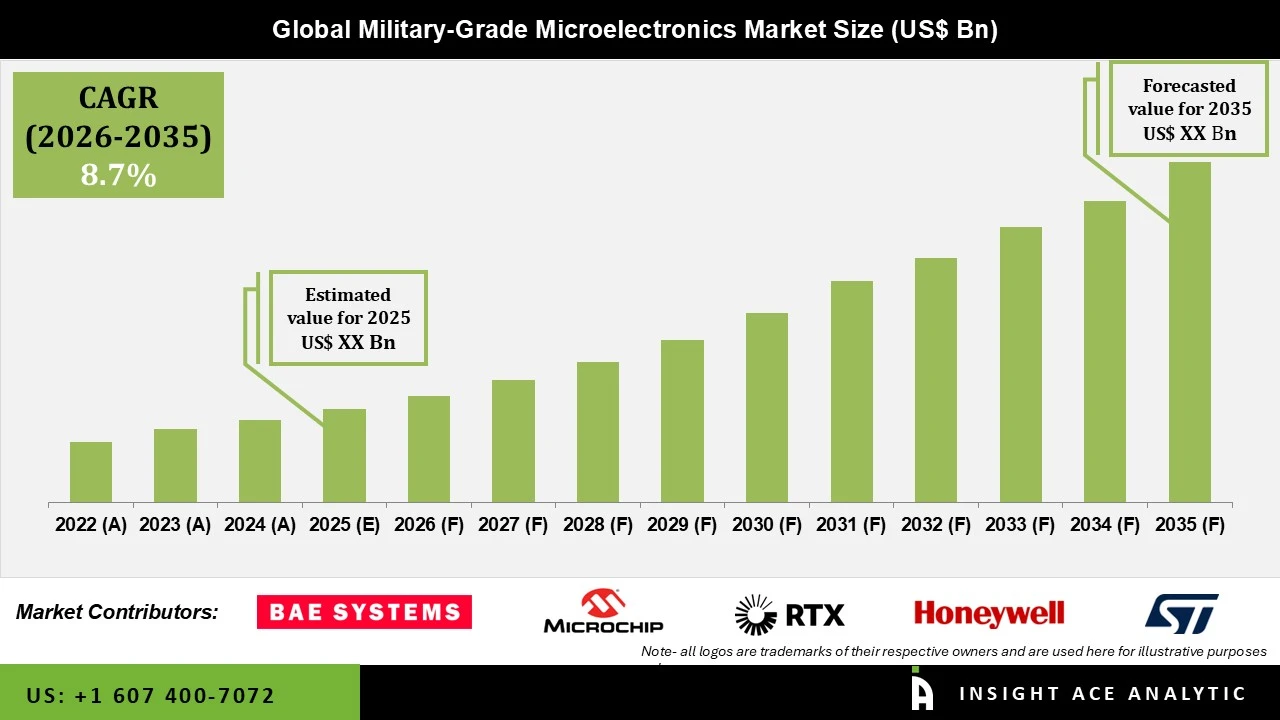
Military grade microelectronics are very reliable semiconductor devices that are made specifically for use in tough conditions like high temperature, radiation, vibrations, humidity, and electromagnetic interference. Such electronic devices are necessary for defense systems like fighter jets, warships, battle tanks, satellite communications, missile guidance, radar, and secure communication systems. In comparison to consumer electronic devices, military-grade microelectronic devices meet tough qualification criteria for their long-lasting reliability, security, and critical operations.
The modernization of defense infrastructures, heavy investments in advanced military technologies, and procurement of advanced military hardware are the key drivers of the Military-Grade Microelectronics market. There are huge investments being made by governments around the world in AI-enabled defense systems, electronic warfare systems, autonomous military vehicles, hypersonic missiles, and satellite defense systems that require robust semiconductor devices. Growing demand for radiation hardened electronics, high-performance processors, embedded system security, and advanced sensor technologies is further propelling the market growth.
Moreover, increased defense expenditure, and domestic investment in semiconductor manufacturing are some of the favorable factors that are making an impact on the market players. The constant advancement in technologies like miniaturization, heterogeneous integration, chiplets technology, and secure semiconductor packaging is leading to the creation of small-sized and energy-efficient military electronics. Also, there will be immense growth in the demand for military electronic components due to the inclusion of AI, edge computing, and secure communications into the defense system during the forecast period. However, complicated manufacturing process and expensive production cost pose as limitations to the market growth.
Competitive Landscape
Which are the Leading Players in Military-Grade Microelectronics Market?
• BAE Systems plc
• RTX Corporation
• Northrop Grumman Corporation
• Honeywell International Inc.
• Texas Instruments Incorporated
• Microchip Technology Incorporated
• Analog Devices, Inc.
• Infineon Technologies AG
• STMicroelectronics N.V.
• Renesas Electronics Corporation
• Teledyne Technologies Incorporated
• Mercury Systems, Inc.
• Advanced Micro Devices, Inc.
• SkyWater Technology, Inc.
• Frontgrade Technologies, Inc.
• Qorvo, Inc.
• Micross Components, Inc.
• NanoXplore S.A.
• Apogee Semiconductor, Inc.
• GlobalFoundries Inc.
Market Dynamics
Driver
Rising Defense Modernization Programs and Demand for Secure Electronics
Military-Grade Microelectronics Market is largely influenced by rising spending on defense modernization efforts in key economies. The government is enhancing their military power by integrating sophisticated communication devices, electronic warfare solutions, autonomous defense technology, and artificial intelligence-driven command and control systems, which need effective semiconductor components. Military-grade microelectronic devices offer better resilience, cybersecurity, and reliability of operation even during severe battlefield situations, thus become crucial for defense applications.
With the increased usage of UAVs, autonomous naval platforms, missile defense systems, and satellite-based surveillance technologies, the demand for radiation-resistant processors, trusted embedded controllers, and sensors is further being boosted. Moreover, increasing investment in domestic semiconductor manufacturing and security of supply chains is leading to the creation of defense electronics. Further innovation in system-on-chip, FPGA, ASIC, and radiation-resistant semiconductor technology will fuel market growth over the forecast period.
Restrain/Challenge
Complex Manufacturing Requirements and Supply Chain Constraints
One of the main problems that affect the military-grade microelectronics market is the fact that these products have a high degree of specialization due to the manufacturing process used. Unlike consumer electronics, military microelectronics must meet a high level of compliance with military standards, which concern reliability, radiation tolerance, temperature ranges, and long life cycles. This leads to an increase in complexity, time frames, and cost of manufacturing process.
Another problem associated with the semiconductor market is the vulnerability of the worldwide supply chain because of geopolitical disputes, export regulations, shortage of materials, and limited manufacturing capacities for trusted military semiconductor chips. In addition, lengthy certification procedures and security regulations of military procurement programs may lead to delays in commercialization of the product. Rapid progress in semiconductor technologies also demands a constant research and development process that does not provide small manufacturers with competitive advantage. These factors will limit market growth over the forecast period.
Airborne Systems Segment Is Expected to Hold the Largest Share of the Military-Grade Microelectronics Market
The airborne systems segment is expected to account for the largest share of the military-grade microelectronics market during the forecast period. Modern fighter aircraft, military helicopters, unmanned aerial vehicles, surveillance platforms, and airborne early-warning systems depend heavily on high-reliability microelectronic components for mission computing, radar, electronic warfare, secure communication, navigation, flight control, sensing, and weapons management. These platforms require processors, FPGAs, ASICs, memory devices, RF components, power semiconductors, and sensors capable of operating under extreme temperature, vibration, electromagnetic interference, and radiation conditions. Increasing investments in next-generation combat aircraft, autonomous aerial systems, radar modernization, and AI-enabled avionics are further increasing semiconductor content per platform.
Why North America Led the Military-Grade Microelectronics Market?
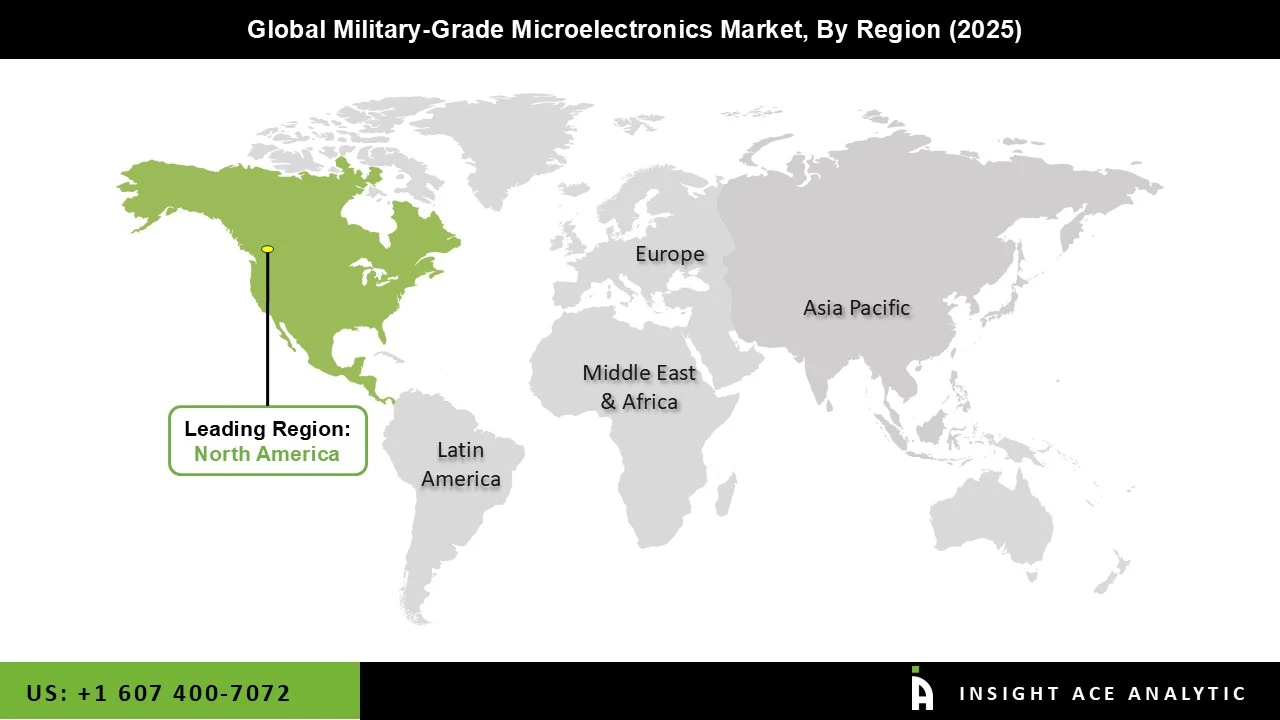
North America was the largest market for Military Grade Microelectronics in 2025 since it has high military expenditure, capability in semiconductor manufacture, and presence of major defense contractors. United States continues to have a high expenditure in the development of new military electronics, which include autonomous military electronics, hypersonic weapons, battle field electronics, cybersecurity equipment, and space defense technology. This region has major semiconductor manufacture companies and defense electronics suppliers that work in collaboration with the government to produce trusted microelectronic devices. In addition, programs targeting to boost local semiconductor manufacturing are propelling the growth of the market.
Asia Pacific is anticipated to experience the fastest growth over the forecasted period due to high defense modernization programs being undertaken by countries like China, India, Japan, South Korea, and Australia. Growing geopolitical tensions, rise in local defense production, and increased investments in military electronics are boosting the demand for microelectronics in this region.
Key Development
• In June 2026, BAE Systems announced that its Endura system-on-chip processor had demonstrated operation in natural-space and severe strategic-radiation environments. The processor is intended for high-performance onboard computing in demanding space and defense missions.
Military-Grade Microelectronics Market Report Scope:
| Report Attribute | Specifications |
| Growth Rate CAGR | CAGR of 8.7% from 2026 to 2035 |
| Quantitative Units | Representation of revenue in US$ Bn and CAGR from 2026 to 2035 |
| Historic Year | 2022 to 2025 |
| Forecast Year | 2026-2035 |
| Report Coverage | The forecast of revenue, the position of the company, the competitive market structure, growth prospects, and trends |
| Segments Covered | Component, Material Type, Application, and By Region |
| Regional Scope | North America; Europe; Asia Pacific; Latin America; Middle East & Africa |
| Country Scope | U.S.; Canada; U.K.; Germany; China; India; Japan; Brazil; Mexico; The UK; France; Italy; Spain; China; Japan; India; South Korea; Southeast Asia; South Korea; Southeast Asia |
| Competitive Landscape | BAE Systems plc, RTX Corporation, Northrop Grumman Corporation, Honeywell International Inc., Texas Instruments Incorporated, Microchip Technology Incorporated, Analog Devices, Inc., Infineon Technologies AG, STMicroelectronics N.V., Renesas Electronics Corporation, Teledyne Technologies Incorporated, Mercury Systems, Inc., Advanced Micro Devices, Inc., SkyWater Technology, Inc., Frontgrade Technologies, Inc., Qorvo, Inc., Micross Components, Inc., NanoXplore S.A., Apogee Semiconductor, Inc., GlobalFoundries Inc. |
| Customization Scope | Free customization report with the procurement of the report, Modifications to the regional and segment scope. Geographic competitive landscape. |
| Pricing and Available Payment Methods | Explore pricing alternatives that are customized to your particular study requirements. |
Market Segmentation:
Military-Grade Microelectronics Market by Component—
o Microprocessors
o Microcontrollers
o Digital Signal Processors
o Systems-on-Chip
• FPGAs and ASICs
• Memory Devices
o SRAM
o DRAM
o Flash and Non-Volatile Memory
o MRAM and Other Emerging Memory
• Analog and Mixed-Signal ICs
o Data Converters
o Amplifiers
o Interface and Timing ICs
• Power Management and Discrete Semiconductors
• RF, Microwave and Millimetre-Wave Components
• Sensors, MEMS and Optoelectronics
• Multichip Modules, System-in-Package and Advanced Packaging
• Military-Grade PCBs and Electronic Assemblies
• Other Components
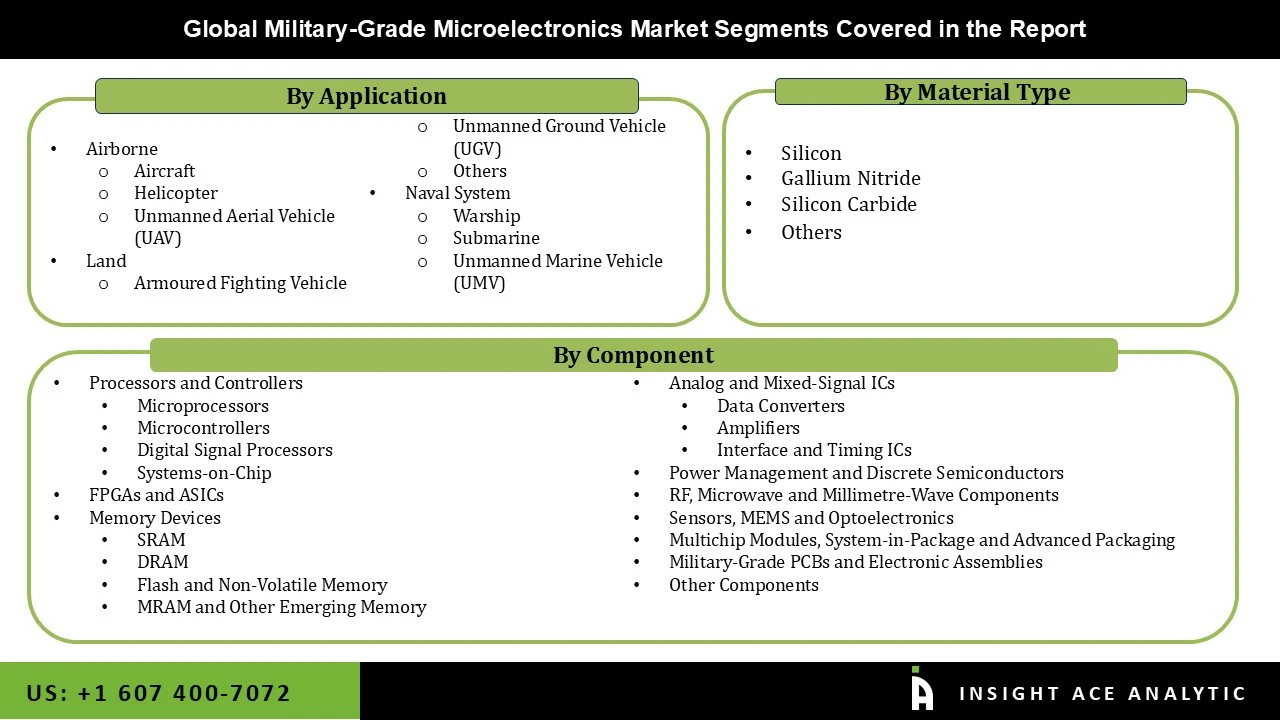
Military Grade Microelectronics Market by Material Type-
• Silicon
• Gallium Nitride
• Silicon Carbide
• Others
Military Grade Microelectronics Market by Application-
• Airborne
o Aircraft
o Helicopter
o Unmanned Aerial Vehicle (UAV)
• Land
o Armoured Fighting Vehicle
o Unmanned Ground Vehicle (UGV)
o Others
• Naval System
o Warship
o Submarine
o Unmanned Marine Vehicle (UMV)
Research Design and Approach
This study employed a multi-step, mixed-method research approach that integrates:
- Secondary research
- Primary research
- Data triangulation
- Hybrid top-down and bottom-up modelling
- Forecasting and scenario analysis
This approach ensures a balanced and validated understanding of both macro- and micro-level market factors influencing the market.
Secondary Research
Secondary research for this study involved the collection, review, and analysis of publicly available and paid data sources to build the initial fact base, understand historical market behaviour, identify data gaps, and refine the hypotheses for primary research.
Sources Consulted
Secondary data for the market study was gathered from multiple credible sources, including:
- Government databases, regulatory bodies, and public institutions
- International organizations (WHO, OECD, IMF, World Bank, etc.)
- Commercial and paid databases
- Industry associations, trade publications, and technical journals
- Company annual reports, investor presentations, press releases, and SEC filings
- Academic research papers, patents, and scientific literature
- Previous market research publications and syndicated reports
These sources were used to compile historical data, market volumes/prices, industry trends, technological developments, and competitive insights.

Primary Research
Primary research was conducted to validate secondary data, understand real-time market dynamics, capture price points and adoption trends, and verify the assumptions used in the market modelling.
Stakeholders Interviewed
Primary interviews for this study involved:
- Manufacturers and suppliers in the market value chain
- Distributors, channel partners, and integrators
- End-users / customers (e.g., hospitals, labs, enterprises, consumers, etc., depending on the market)
- Industry experts, technology specialists, consultants, and regulatory professionals
- Senior executives (CEOs, CTOs, VPs, Directors) and product managers
Interview Process
Interviews were conducted via:
- Structured and semi-structured questionnaires
- Telephonic and video interactions
- Email correspondences
- Expert consultation sessions
Primary insights were incorporated into demand modelling, pricing analysis, technology evaluation, and market share estimation.
Data Processing, Normalization, and Validation
All collected data were processed and normalized to ensure consistency and comparability across regions and time frames.
The data validation process included:
- Standardization of units (currency conversions, volume units, inflation adjustments)
- Cross-verification of data points across multiple secondary sources
- Normalization of inconsistent datasets
- Identification and resolution of data gaps
- Outlier detection and removal through algorithmic and manual checks
- Plausibility and coherence checks across segments and geographies
This ensured that the dataset used for modelling was clean, robust, and reliable.
Market Size Estimation and Data Triangulation
Bottom-Up Approach
The bottom-up approach involved aggregating segment-level data, such as:
- Company revenues
- Product-level sales
- Installed base/usage volumes
- Adoption and penetration rates
- Pricing analysis
This method was primarily used when detailed micro-level market data were available.

Top-Down Approach
The top-down approach used macro-level indicators:
- Parent market benchmarks
- Global/regional industry trends
- Economic indicators (GDP, demographics, spending patterns)
- Penetration and usage ratios
This approach was used for segments where granular data were limited or inconsistent.
Hybrid Triangulation Approach
To ensure accuracy, a triangulated hybrid model was used. This included:
- Reconciling top-down and bottom-up estimates
- Cross-checking revenues, volumes, and pricing assumptions
- Incorporating expert insights to validate segment splits and adoption rates
This multi-angle validation yielded the final market size.
Forecasting Framework and Scenario Modelling
Market forecasts were developed using a combination of time-series modelling, adoption curve analysis, and driver-based forecasting tools.
Forecasting Methods
- Time-series modelling
- S-curve and diffusion models (for emerging technologies)
- Driver-based forecasting (GDP, disposable income, adoption rates, regulatory changes)
- Price elasticity models
- Market maturity and lifecycle-based projections
Scenario Analysis
Given inherent uncertainties, three scenarios were constructed:
- Base-Case Scenario: Expected trajectory under current conditions
- Optimistic Scenario: High adoption, favourable regulation, strong economic tailwinds
- Conservative Scenario: Slow adoption, regulatory delays, economic constraints
Sensitivity testing was conducted on key variables, including pricing, demand elasticity, and regional adoption.
Request Customization
Add countries, segments, company profiles, or extend forecast — free 10% customization with purchase.
Customize This Report →Enquire Before Buying
Speak with our analyst team about scope, methodology, pricing, or deliverable formats.
Enquire Now →Frequently Asked Questions
Military Grade Microelectronics Market is estimated to grow with an 8.7% CAGR during the forecast period for 2026 to 2035.
Military Grade Microelectronics Market is segmented into Component, Material Type, Application, and By Region
BAE Systems plc, RTX Corporation, Northrop Grumman Corporation, Honeywell International Inc., Texas Instruments Incorporated, Microchip Technology Incorporated, Analog Devices, Inc., Infineon Technologies AG, STMicroelectronics N.V., Renesas Electronics Corporation, Teledyne Technologies Incorporated, Mercury Systems, Inc., Advanced Micro Devices, Inc., SkyWater Technology, Inc., Frontgrade Technologies, Inc., Qorvo, Inc., Micross Components, Inc., NanoXplore S.A., Apogee Semiconductor, Inc., GlobalFoundries Inc.
North America region is leading the Military Grade Microelectronics Market.