Lithium-ion Battery Market Size, Share, Scope Report 2026 to 2035
What is Lithium-ion Battery Market Size?
Global Lithium-ion Battery Market Size is valued at USD 63.00 Billion in 2025 and is predicted to reach USD 282.57 Billion by the year 2035 at a 16.60% CAGR during the forecast period for 2026 to 2035.
Lithium-ion Battery Market Size, Share & Trends Analysis Report By Component (Cathode (Lithium Nickel Manganese Cobalt Oxide, Lithium Iron Phosphate, Lithium Cobalt Oxide, Lithium Titanate Oxide, Lithium Manganese Oxide, Lithium Nickel Cobalt Aluminum Oxide), Anode, Electrolyte, Separator, and Others), By Product, By Battery Type, By capacity, By voltage, By End-User, By Region, And Segment Forecasts, 2026 to 2035.
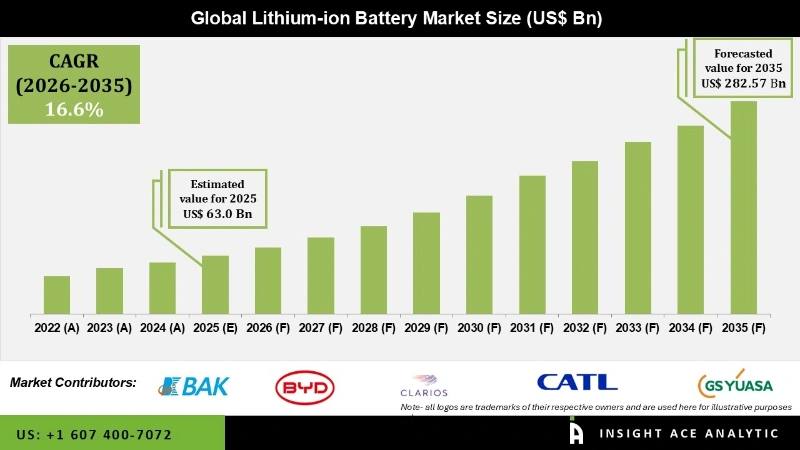
Lithium-ion Battery Market Key Takeaways:
|
Most laptops, cell phones, hybrid and electric vehicles, and other electronic devices use lithium-ion batteries. These have a high energy density to prolong battery life, are lightweight, and can be recharged. Therefore, their use is growing in a wide range of applications. These batteries power a variety of items, including cell phones, power equipment, electric cars, and aerospace components. Lithium-ion batteries (LIB) use intercalated lithium compounds as the electrode in contrast to disposable batteries, which use metallic lithium as the electrode.
The demand for these goods has risen quickly across industries, primarily in the manufacturing and automotive sectors. This is a result of the growing popularity of electric vehicles, falling Li-ion battery prices, booming government efforts, and increased technologies.
Future opportunities for India's lithium-ion battery market are likely to arise from the country's growing lithium-ion battery recycling activities, which are anticipated to secure the supply of raw materials like lithium and cobalt and decrease the reliance on removing and refining materials from mineral resources.
Hazardous compounds in used batteries include acids and heavy metals like mercury and lead. It is required to keep used batteries stored away from other combustible and flammable products in watertight containers. Although lithium-ion batteries can store a lot of energy in a short space, they tend to heat up quickly and could catch fire if something goes wrong. Lithium-ion battery overheating is caused by high-rate or unusually rapid discharge, such as from a short circuit.
Competitive Landscape:
Some of the lithium-ion battery market players are:
- Bak Powder Battery Co.Ltd.
- BYD Company LTD.
- Clarios
- Contemporary Amperex Technologies Co., Limited
- GS Yuasa International Ltd.
- Hitachi Ltd.
- LG CHEM
- Panasonic Holdings Corporation
- Samsung SDI Co.Ltd
- Toshiba Corporation
- Caleb
- Tesla, Inc
- Lithiumwerks
- Saft
- Varta AG
- Farasis Energy (Ganzhou) Co.Ltd.
- Sila Nanotechologies Inc.
- Amperex Technologies Limited
- Envision Aesc Group Ltd
- Guoxuan High Tech Co., Ltd
- Lithium Energy Japan
- Enerdel, Inc
- Kokam
- Ipower Batteries PVT LTD
- Nextera Energy, Inc
Market Segmentation:
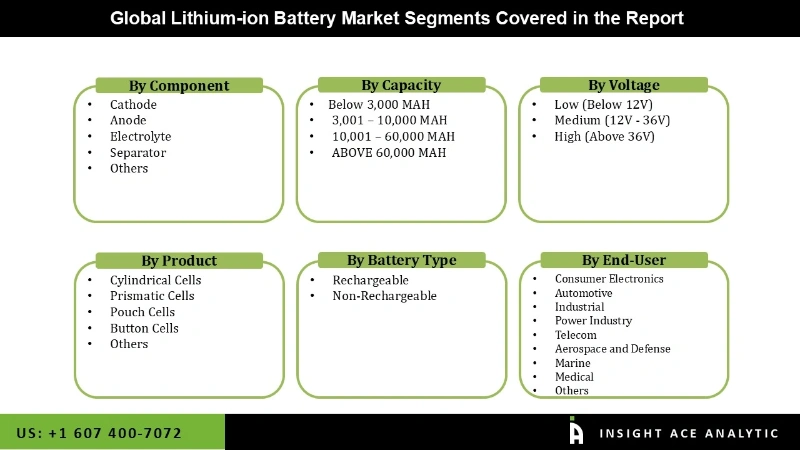
The lithium-ion battery market is categorized into Components, Products, battery Types, Capacity, voltage, and end users. As per the Component, the market consists Cathode (Lithium Nickel Manganese Cobalt Oxide, Lithium Iron Phosphate, Lithium Cobalt Oxide, Lithium Titanate Oxide, Lithium Manganese Oxide, Lithium Nickel Cobalt Aluminum Oxide), Anode, Electrolyte (Lithium Hexafluorophosphate (LiPF6), Lithium Hexafluoroarsenate (LiAsF6), Lithium Perchlorate (LiClO4), Lithium bis(trifluoromethanesulfonyl)imide (LiTFSI), Others), Separator, and Others. The Product segment consists of Cylindrical Cells, Prismatic Cells, Pouch Cells, Button Cells, and Others. The Battery Type segment is classified into rechargeable and non-rechargeable. Based on Capacity, the market is further divided into Below 3,000 mAh, 3,001 – 10,000 mAh, 10,001 – 60,000 mAh, and above 60,000 mAh. As per the voltage, the market is categorised into Low (Below 12V), Medium (12V - 36V), and High (Above 36V). According to the End-User segment, the market includes consumer electronics, automotive, industrial, power industry, telecom, aerospace and defence, marine, medical, and others.
Based on Capacity, the 3,000 mAh to 10,000 mAh Segment Is Accounted As A Significant Contributor To The Lithium-Ion Battery Market
The 3,000 mAh to 10,000 mAh is expected to hold a significant share of the global lithium-ion battery market. These batteries are appropriate for industrial and electric car applications because of their large Capacity. Higher-capacity batteries that can run devices for extended periods of time while offering the best possible experience in terms of huge screens and power backup services are becoming more and more necessary as the consumer electronics and smartphone markets expand. The use of portable electronics, including laptops, smartphones, and mobile phones, is growing quickly. Due to their small battery capacity, these devices need to be charged more frequently. These power banks' lithium-ion batteries provide dependability, safety, and low discharge rates.
The 36 V Voltage Segment Witnessed Growth At A Rapid Rate
The 36 V voltage segment is projected to increase in the global lithium-ion battery market. These batteries are used in high-current sectors like telecom, power, maritime, and the military, as well as electric cars. They have more power, a longer lifespan, and better safety features than lead-acid batteries. These batteries provide outstanding performance thanks to their large power capacity and deep-cycle capabilities. They also have sophisticated battery management systems that maximize cell cycle life, avoid overcharging and overheating, and guarantee optimal performance.
Based On End-User, The Consumer Electronics Segment Is A Major Contributor To The Lithium-Ion Battery Market
Consumer electronics is expected to hold a major share of the global lithium-ion battery market. Consumer electronics items and portable devices both need portable batteries. Mobile phones, laptops, desktops, tablets, torches or lanterns, LED lighting, vacuum cleaners, digital cameras, wristwatches, calculators, hearing aids, and other wearable gadgets are just a few things that can use portable batteries. Over the projection period, the market for electric and hybrid vehicles is expected to grow profitably. The expansion is anticipated to be aided by rising fossil fuel prices and increased consumer knowledge of the advantages of battery-powered vehicles, notably in North America, Europe, and Asia-Pacific.
The Lithium Iron Phosphate Segment Witnessed Growth At A Rapid Rate
The lithium-ion battery market dominated the lithium iron phosphate (LFP) category. The category is expanding due to factors such as the rising requirement for long-lasting and effective batteries and the spike in demand for lithium iron phosphate (LFP) batteries in portable devices. The benefits of lithium iron phosphate (LFP) batteries, such as their long shelf life and top safety rating, also promote the segment's expansion.
The Asia Pacific Lithium-Ion Battery Market Holds A Significant Revenue Share In The Region
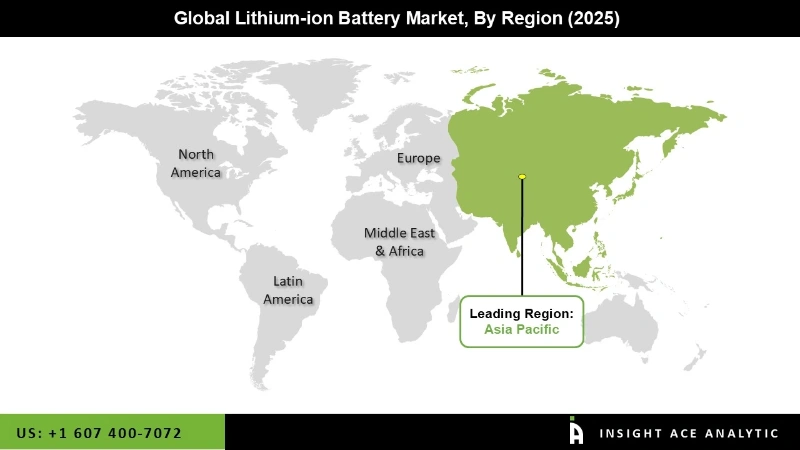
The Asia Pacific lithium-ion battery market is expected to register the highest market share in revenue shortly. Due to growing environmental concerns, China has banned traditional fossil fuel-powered scooters from all of its main cities to reduce pollution, increasing the country's e-scooter sales. The usage of tools powered by lithium-ion batteries has expanded due to Asia Pacific's ascent to prominence as a hub for global manufacturing. The region also has the most population in the entire world. As a result, consumer devices that rely on lithium-ion batteries for functioning, such as mobile phones and laptops, see strong sales in the Asia Pacific region.
One of the key elements driving up demand for lithium-ion batteries is the expanding market for electric vehicles in Asia Pacific nations like China and India. Due to the rising use of lithium-ion batteries in energy storage systems, electric vehicles, and consumer electronics, the market in Germany is anticipated to increase moderately throughout the projected period. Developing renewable energies and energy storage technologies are prominent industries in Germany. Additionally, North America is anticipated to dominate the market. Due to the widespread use of electric vehicles and consumer gadgets. Government measures that encourage the industry and strict targets for decreasing GHG emissions are mostly to blame for the nation's soaring sales of electric vehicles.
Recent Developments:
- In June 2021, Forsee Power, a French manufacturer of battery systems, began mass-producing lithium-ion batteries for electric two-wheelers (E2W) and electric three-wheelers (E3W) in Pune. (Chakan Industrial Area, 35 km from Pune Airport).
- In February 2021, A Memorandum of Understanding (MoU) for the development and production of Li-ion batteries in India and the North American region was signed by Hyderabad-based Roshan Energy Technologies and Barrel Energy, a U.S.-based manufacturer of Li-ion batteries.
Lithium-ion Battery Market Report Scope:
| Report Attribute | Specifications |
| Market size value in 2025 | USD 63.00 Billion |
| Revenue forecast in 2035 | USD 282.57 Billion |
| Growth rate CAGR | CAGR of 16.60% from 2026 to 2035 |
| Quantitative units | Representation of revenue in US$ Mn, and CAGR from 2026 to 2035 |
| Historic Year | 2022 to 2025 |
| Forecast Year | 2026-2035 |
| Report coverage | The forecast of revenue, the position of the company, the competitive market statistics, growth prospects, and trends |
| Segments covered | Material, Product Type, Type, Capacity, Voltage, And Industry |
| Regional scope | North America; Europe; Asia Pacific; Latin America; Middle East & Africa |
| Country scope | U.S.; Canada; U.K.; Germany; China; India; Japan; Brazil; Mexico; The UK; France; Italy; Spain; China; Japan; India; South Korea; Southeast Asia; South Korea; Southeast Asia |
| Competitive Landscape | Bak Powder Battery Co.Ltd., BYD Company LTD., Clarios, Contemporary Amperex Technologies Co., Limited, GS Yuasa International Ltd., Hitachi Ltd., LG CHEM, Panasonic Holdings Corporation, Samsung SDI Co.Ltd, Toshiba Corporation, Calb, Tesla, Inc, Lithiumwerks, Saft, Varta AG, Farasis Energy (Ganzhou) Co.Ltd., Sila Nanotechologies Inc., Amperex Technologies Limited, Envision Aesc Group Ltd, Guoxuan High Tech Co., Ltd, Lithium Energy Japan Enerdel, Inc, Kokam, Ipower Batteries PVT LTD and Nextera Energy, Inc. |
| Customization scope | Free customization report with the procurement of the report, Modifications to the regional and segment scope. Particular Geographic competitive landscape. |
| Pricing and available payment methods | Explore pricing alternatives that are customized to your particular study requirements. |
Segmentation of Lithium-ion Battery Market-
Lithium-ion Battery Market By Component-
- Cathode
- Lithium Nickel Manganese Cobalt Oxide
- Lithium Iron Phosphate
- Lithium Cobalt Oxide
- Lithium Titanate Oxide
- Lithium Manganese Oxide
- Lithium Nickel Cobalt Aluminum Oxide
- Anode
- Electrolyte
- Lithium Hexafluorophosphate (LiPF6)
- Lithium Hexafluoroarsenate (LiAsF6)
- Lithium Perchlorate (LiClO4)
- Lithium bis(trifluoromethanesulfonyl)imide (LiTFSI)
- Others
- Separator
- Others
Lithium-ion Battery Market By Capacity
- Below 3,000 MAH
- 3,001 – 10,000 MAH
- 10,001 – 60,000 MAH
- ABOVE 60,000 MAH
Lithium-ion Battery Market By Voltage:
- Low (Below 12V)
- Medium (12V - 36V)
- High (Above 36V)
Lithium-ion Battery Market By Product -
- Cylindrical Cells
- Prismatic Cells
- Pouch Cells
- Button Cells
- Others
Lithium-ion Battery Market By Battery Type
- Rechargeable
- Non-Rechargeable
Lithium-ion Battery Market By End-User
- Consumer Electronics
- Automotive
- Industrial
- Power Industry
- Telecom
- Aerospace and Defense
- Marine
- Medical
- Others
Lithium-ion Battery Market By Region-
Lithium-ion Battery Market North America-
- The US
- Canada
Europe-
- Germany
- The UK
- France
- Italy
- Spain
- Rest of Europe
Asia-Pacific-
- China
- Japan
- India
- South Korea
- South East Asia
- Rest of Asia Pacific
Latin America-
- Brazil
- Argentina
- Mexico
- Rest of Latin America
Middle East & Africa-
- GCC Countries
- South Africa
- Rest of the Middle East and Africa
Research Design and Approach
This study employed a multi-step, mixed-method research approach that integrates:
- Secondary research
- Primary research
- Data triangulation
- Hybrid top-down and bottom-up modelling
- Forecasting and scenario analysis
This approach ensures a balanced and validated understanding of both macro- and micro-level market factors influencing the market.
Secondary Research
Secondary research for this study involved the collection, review, and analysis of publicly available and paid data sources to build the initial fact base, understand historical market behaviour, identify data gaps, and refine the hypotheses for primary research.
Sources Consulted
Secondary data for the market study was gathered from multiple credible sources, including:
- Government databases, regulatory bodies, and public institutions
- International organizations (WHO, OECD, IMF, World Bank, etc.)
- Commercial and paid databases
- Industry associations, trade publications, and technical journals
- Company annual reports, investor presentations, press releases, and SEC filings
- Academic research papers, patents, and scientific literature
- Previous market research publications and syndicated reports
These sources were used to compile historical data, market volumes/prices, industry trends, technological developments, and competitive insights.

Primary Research
Primary research was conducted to validate secondary data, understand real-time market dynamics, capture price points and adoption trends, and verify the assumptions used in the market modelling.
Stakeholders Interviewed
Primary interviews for this study involved:
- Manufacturers and suppliers in the market value chain
- Distributors, channel partners, and integrators
- End-users / customers (e.g., hospitals, labs, enterprises, consumers, etc., depending on the market)
- Industry experts, technology specialists, consultants, and regulatory professionals
- Senior executives (CEOs, CTOs, VPs, Directors) and product managers
Interview Process
Interviews were conducted via:
- Structured and semi-structured questionnaires
- Telephonic and video interactions
- Email correspondences
- Expert consultation sessions
Primary insights were incorporated into demand modelling, pricing analysis, technology evaluation, and market share estimation.
Data Processing, Normalization, and Validation
All collected data were processed and normalized to ensure consistency and comparability across regions and time frames.
The data validation process included:
- Standardization of units (currency conversions, volume units, inflation adjustments)
- Cross-verification of data points across multiple secondary sources
- Normalization of inconsistent datasets
- Identification and resolution of data gaps
- Outlier detection and removal through algorithmic and manual checks
- Plausibility and coherence checks across segments and geographies
This ensured that the dataset used for modelling was clean, robust, and reliable.
Market Size Estimation and Data Triangulation
Bottom-Up Approach
The bottom-up approach involved aggregating segment-level data, such as:
- Company revenues
- Product-level sales
- Installed base/usage volumes
- Adoption and penetration rates
- Pricing analysis
This method was primarily used when detailed micro-level market data were available.

Top-Down Approach
The top-down approach used macro-level indicators:
- Parent market benchmarks
- Global/regional industry trends
- Economic indicators (GDP, demographics, spending patterns)
- Penetration and usage ratios
This approach was used for segments where granular data were limited or inconsistent.
Hybrid Triangulation Approach
To ensure accuracy, a triangulated hybrid model was used. This included:
- Reconciling top-down and bottom-up estimates
- Cross-checking revenues, volumes, and pricing assumptions
- Incorporating expert insights to validate segment splits and adoption rates
This multi-angle validation yielded the final market size.
Forecasting Framework and Scenario Modelling
Market forecasts were developed using a combination of time-series modelling, adoption curve analysis, and driver-based forecasting tools.
Forecasting Methods
- Time-series modelling
- S-curve and diffusion models (for emerging technologies)
- Driver-based forecasting (GDP, disposable income, adoption rates, regulatory changes)
- Price elasticity models
- Market maturity and lifecycle-based projections
Scenario Analysis
Given inherent uncertainties, three scenarios were constructed:
- Base-Case Scenario: Expected trajectory under current conditions
- Optimistic Scenario: High adoption, favourable regulation, strong economic tailwinds
- Conservative Scenario: Slow adoption, regulatory delays, economic constraints
Sensitivity testing was conducted on key variables, including pricing, demand elasticity, and regional adoption.
Request Customization
Add countries, segments, company profiles, or extend forecast — free 10% customization with purchase.
Customize This Report →Enquire Before Buying
Speak with our analyst team about scope, methodology, pricing, or deliverable formats.
Enquire Now →Frequently Asked Questions
Lithium-ion Battery Market Size is valued at USD 63.00 Billion in 2025 and is predicted to reach USD 282.57 Billion by the year 2035.
Lithium-ion Battery Market expected to grow at a 16.60% CAGR during the forecast period for 2026-2035.
Bak Powder Battery Co.Ltd., BYD Company LTD., Clarios, Contemporary Amperex Technologies Co., Limited, GS Yuasa International Ltd., Hitachi Ltd.
Lithium-ion Battery Market is categorized into Component, Product, Battery Type, capacity, voltage and End-User, Cathode (Lithium Nickel Manganese Cobalt Oxide, Lithium Iron Phosphate, Lithium Cobalt Oxide, Lithium Titanate Oxide, Lithium Manganese Oxide, Lithium Nickel Cobalt Aluminum Oxide),
Asia Pacific region is leading the Lithium-ion Battery Market.