Shared Middle-Mile Network-as-a-Service Market Report with Forecast 2026 to 2035
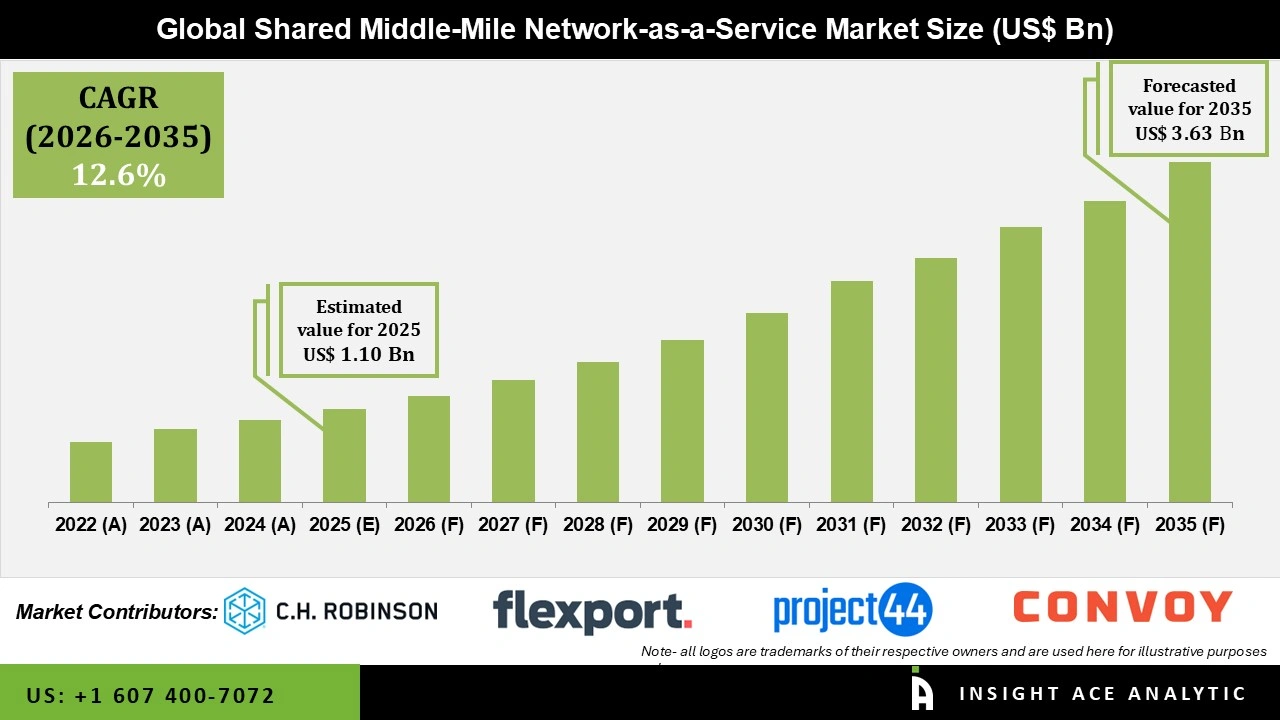
Global Shared Middle-Mile Network-as-a-Service Market Size is valued at USD 1.16 Bn in 2025 and is predicted to reach USD 3.63 Bn by the year 2035 at a 12.6% CAGR during the forecast period for 2026 to 2035.
Shared Middle-Mile Network-as-a-Service Market Size, Share & Trends Analysis Distribution by Service Type (Shared Fulfillment & Cross Docking Networks, Platform Enabled Middle Mile Collaboration, Managed Shared Carrier Networks, and Analytics & Optimization Services), End-user (Third Party Logistics (3PL), E Commerce & Retail, Manufacturing & Distribution, and Consumer Goods & FMCG), and Segment Forecasts, 2026 to 2035
Shared Middle-Mile Network-as-a-Service (MMNaaS) is a modern telecom model where a neutral provider builds, owns, and operates the middle-mile infrastructure — the high-capacity network segment that connects local access networks (last mile) to the main core or backbone networks. Instead of each telecom operator, enterprise, or government agency building its own separate middle-mile fiber, aggregation points, and transmission equipment, they all share the same infrastructure on-demand. Users pay only for the bandwidth or connectivity they actually use, through flexible, pay-as-you-go or subscription models. This shared approach reduces duplication, lowers overall costs, speeds up deployment, and makes high-quality broadband more accessible to multiple parties at the same time.
The global shared middle-mile network-as-a-service market is driven mainly by the rising demand for cheap, high-throughput connectivity capabilities as well as the rapid adoption of broadband and data-intensive services. The demand for scalable connect solutions in the middle-mile link, which can reduce the constraints imposed by infrastructure ownership, has risen because of the growing adoption of the internet, cloud services, the rollout of 5G, and increased data traffic. Another major factor influencing the shared middle-mile network-as-a-service market is the adoption of software-defined networking and network virtualization, which enables dynamic pricing and usage models to support shared, on-demand connect capacity in the middle mile. The adoption of shared middle-mile NaaS solutions among telecom operators, ISPs, and organizations has been spurred by these technological progressions.
In addition, there are immense growth opportunities available for the shared middle-mile network-as-a-service market with the increasing focus on overcoming the digital divide, particularly in disadvantaged and rural regions. As a result of public investment, public-private collaborations, and open access legislation to foster the utilization of the shared middle-mile network offered on a service basis, it has been noticed that public bodies and regulating agencies in many regions are encouraging broadband growth plans. Moreover, the growth of the shared middle-mile network-as-a-service market is further encouraged by the increase in the number of service operators that want to immediately enter the market without involving heavy investment on their part. However, the key challenge for the shared middle-mile network-as-a-service market is related to performance assurance, service integrity, and utilization by third-party outside network service providers.
Competitive Landscape
Which are the Leading Players in Shared Middle-Mile Network-as-a-Service Market?
- C.H. Robinson
- Shopify Fulfillment Network (SFN)
- Project44
- Flexport
- Convoy
Market Dynamics
Driver
Growth of Government-led Broadband Expansion Programs
The growth of government-led broadband expansion programs and legislative changes intended to support these solutions is a major factor driving the shared middle-mile network-as-a-service market. In order to provide broadband access to underserved and distant regions, governments in both developed and emerging countries are initiating ambitious programs, frequently utilizing public-private partnerships and frameworks. By drawing in private investments, these programs not only promote market expansion but also speed up the deployment of high-capacity networks. Additionally, the adoption of shared middle-mile network-as-a-service makes it possible to use resources more effectively, reduces infrastructure duplication, and quickens the pace of digital transformation in important industries like public administration, healthcare, and education.
Restrain/Challenge
High Initial Setup Cost
The high initial setup cost is one of the main barriers to the growth of the shared middle-mile network-as-a-service market. The establishment of a middle-mile network necessitates a significant initial financial outlay for the construction of aggregation points and network hubs, right-of-way acquisition, ducting, trenching, and civil works. To guarantee carrier-grade performance and dependability, providers also need to make investments in high-capacity transmission equipment, optical networking systems, power supplies, backup infrastructure, and network management tools. Furthermore, infrastructure developers face longer payback periods and greater financial risk as a result of these expenses, which are incurred long before significant income-generating starts.
Managed Shared Carrier Networks Segment is Expected to Drive the Shared Middle-Mile Network-as-a-Service Market
The Managed Shared Carrier Networks category held the largest share in the Shared Middle-Mile Network-as-a-Service market in 2025. These services enable companies to make use of shared transportation resources across several users, which lowers expenses and boosts middle-mile logistical efficiency. For companies looking for scalability and flexibility in their transportation operations without committing to specific assets, managed shared carrier networks are perfect. The businesses can lower operating costs and increase delivery speed by optimizing routes and using shared infrastructure. The managed shared carrier networks are especially in high demand from businesses trying to grow without drastically raising their logistics costs.
Third Party Logistics (3PL) Segment is Growing at the Highest Rate in the Shared Middle-Mile Network-as-a-Service Market.
In 2025, the Third Party Logistics (3PL) category dominated the Shared Middle-Mile Network-as-a-Service market due to the requirement for dependable, high-capacity connections throughout dispersed supply chains and the growing digitization of logistics operations. The 3PL providers need smooth data transmission between warehouses, distribution centers, ports, and last-mile partners since they oversee transportation, warehousing, and order fulfillment for several clients over large geographic areas. Additionally, the demand from 3PL players is further supported by the quick expansion of e-commerce, the use of IoT-enabled fleet management, and the growing dependence on analytics and AI for demand forecasting.
Why North America Led the Shared Middle-Mile Network-as-a-Service Market?
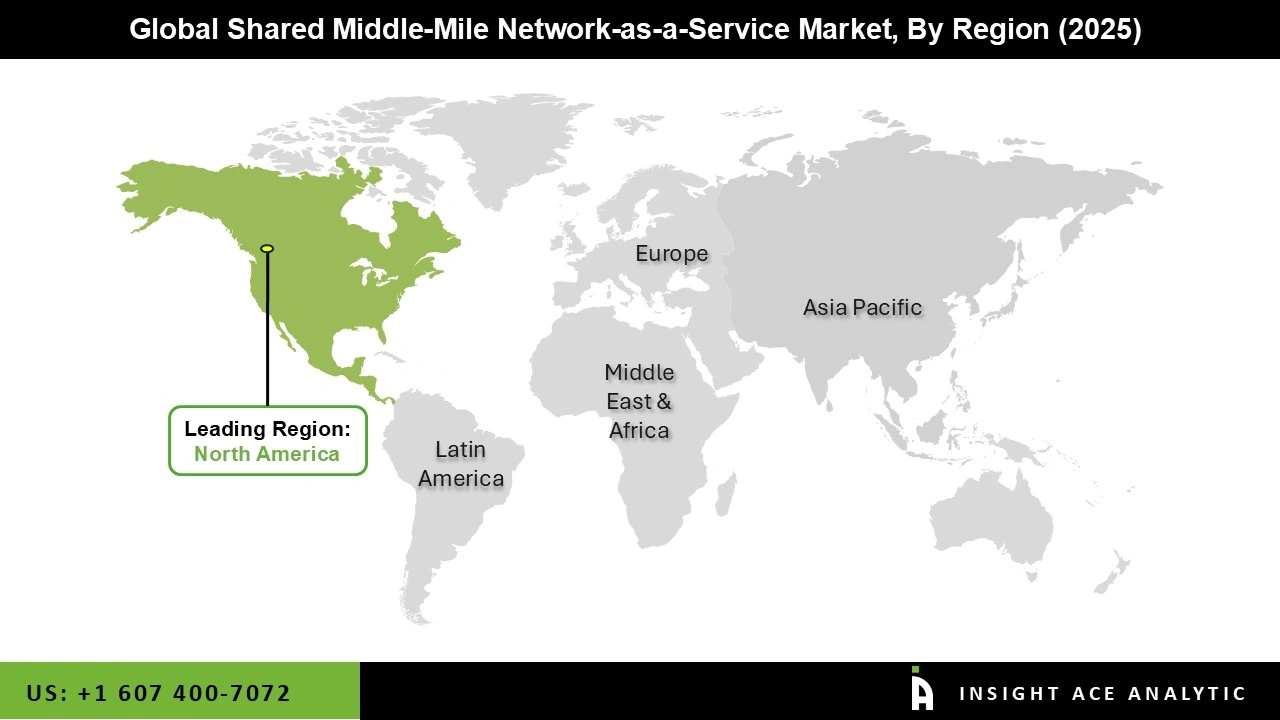
The Shared Middle-Mile Network-as-a-Service market was dominated by the North America region in 2025. The rapid adoption of shared middle-mile network-as-a-service in this region is being fueled by the need for more adaptable, scalable, and economical logistics solutions. Businesses are looking for ways to enhance their transportation networks as e-commerce grows and the need for quicker deliveries rises.
Additionally, by allowing several businesses to use a centralized, shared logistics infrastructure, shared middle-mile network services offer a solution that increases delivery speed and lowers expenses. Furthermore, the shared middle-mile network-as-a-service market is anticipated to increase gradually in North America due to the increasing emphasis on digitization in the logistics industry and the emergence of collaborative, tech-driven platforms.
Shared Middle-Mile Network-as-a-Service Market Report Scope :
| Report Attribute | Specifications |
| Market size value in 2025 | USD 1.10 Bn |
| Revenue forecast in 2035 | USD 3.63 Bn |
| Growth Rate CAGR | CAGR of 12.6% from 2026 to 2035 |
| Quantitative Units | Representation of revenue in US$ Bn and CAGR from 2026 to 2035 |
| Historic Year | 2022 to 2024 |
| Forecast Year | 2026-2035 |
| Report Coverage | The forecast of revenue, the position of the company, the competitive market structure, growth prospects, and trends |
| Segments Covered | Service Type, End-user, and By Region |
| Regional Scope | North America; Europe; Asia Pacific; Latin America; Middle East & Africa |
| Country Scope | U.S.; Canada; U.K.; Germany; China; India; Japan; Brazil; Mexico; The UK; France; Italy; Spain; China; Japan; India; South Korea; Southeast Asia; South Korea; Southeast Asia |
| Competitive Landscape | C.H. Robinson, Shopify Fulfillment Network (SFN), Project44, Flexport, and Convoy |
| Customization Scope | Free customization report with the procurement of the report, Modifications to the regional and segment scope. Geographic competitive landscape. |
| Pricing and Available Payment Methods | Explore pricing alternatives that are customized to your particular study requirements. |
Segmentation of Shared Middle-Mile Network-as-a-Service Market:
Shared Middle-Mile Network-as-a-Service Market by Service Type-
- Shared Fulfillment & Cross Docking Networks
- Platform Enabled Middle Mile Collaboration
- Managed Shared Carrier Networks
- Analytics & Optimization Services
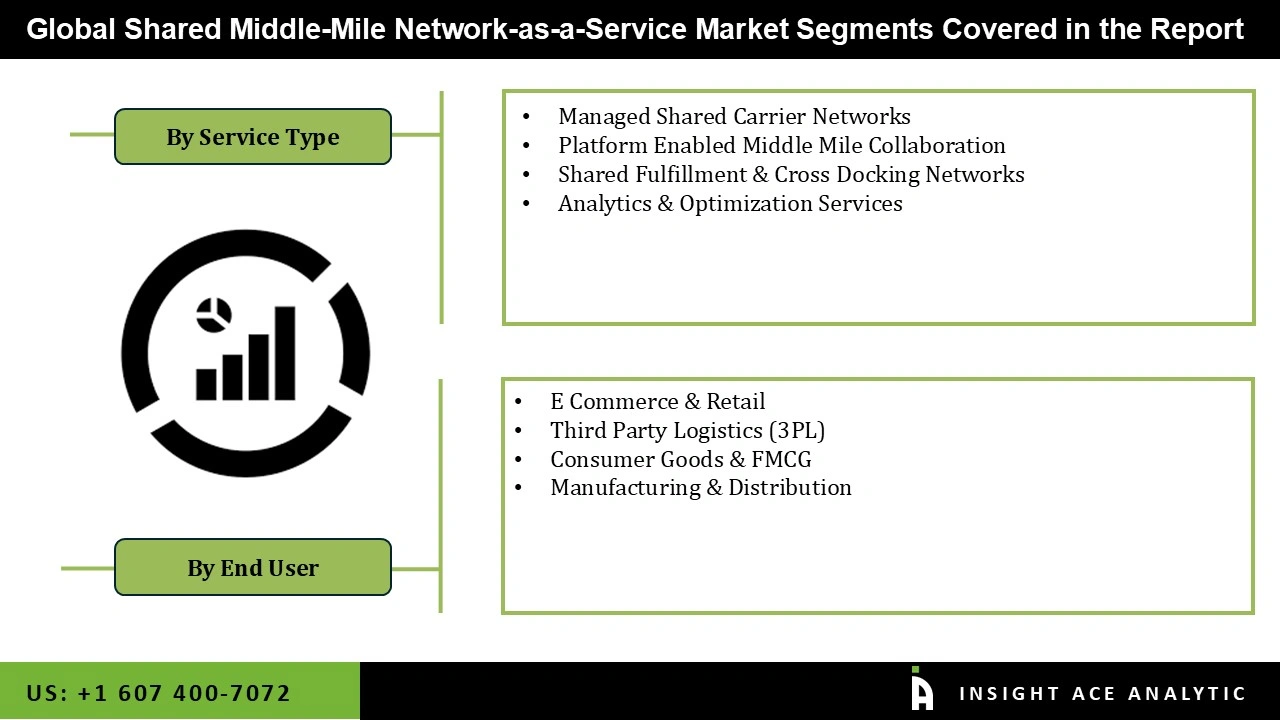
Shared Middle-Mile Network-as-a-Service Market by End-user-
- Third Party Logistics (3PL)
- E Commerce & Retail
- Manufacturing & Distribution
- Consumer Goods & FMCG
Shared Middle-Mile Network-as-a-Service Market Region-
- North America-
- The US
- Canada
- Europe-
- Germany
- The UK
- France
- Italy
- Spain
- Rest of Europe
- Asia-Pacific-
- China
- Japan
- India
- South Korea
- South East Asia
- Rest of Asia Pacific
- Latin America-
- Brazil
- Argentina
- Mexico
- Rest of Latin America
- Middle East & Africa-
- GCC Countries
- South Africa
- Rest of Middle East and Africa
Research Design and Approach
This study employed a multi-step, mixed-method research approach that integrates:
- Secondary research
- Primary research
- Data triangulation
- Hybrid top-down and bottom-up modelling
- Forecasting and scenario analysis
This approach ensures a balanced and validated understanding of both macro- and micro-level market factors influencing the market.
Secondary Research
Secondary research for this study involved the collection, review, and analysis of publicly available and paid data sources to build the initial fact base, understand historical market behaviour, identify data gaps, and refine the hypotheses for primary research.
Sources Consulted
Secondary data for the market study was gathered from multiple credible sources, including:
- Government databases, regulatory bodies, and public institutions
- International organizations (WHO, OECD, IMF, World Bank, etc.)
- Commercial and paid databases
- Industry associations, trade publications, and technical journals
- Company annual reports, investor presentations, press releases, and SEC filings
- Academic research papers, patents, and scientific literature
- Previous market research publications and syndicated reports
These sources were used to compile historical data, market volumes/prices, industry trends, technological developments, and competitive insights.

Primary Research
Primary research was conducted to validate secondary data, understand real-time market dynamics, capture price points and adoption trends, and verify the assumptions used in the market modelling.
Stakeholders Interviewed
Primary interviews for this study involved:
- Manufacturers and suppliers in the market value chain
- Distributors, channel partners, and integrators
- End-users / customers (e.g., hospitals, labs, enterprises, consumers, etc., depending on the market)
- Industry experts, technology specialists, consultants, and regulatory professionals
- Senior executives (CEOs, CTOs, VPs, Directors) and product managers
Interview Process
Interviews were conducted via:
- Structured and semi-structured questionnaires
- Telephonic and video interactions
- Email correspondences
- Expert consultation sessions
Primary insights were incorporated into demand modelling, pricing analysis, technology evaluation, and market share estimation.
Data Processing, Normalization, and Validation
All collected data were processed and normalized to ensure consistency and comparability across regions and time frames.
The data validation process included:
- Standardization of units (currency conversions, volume units, inflation adjustments)
- Cross-verification of data points across multiple secondary sources
- Normalization of inconsistent datasets
- Identification and resolution of data gaps
- Outlier detection and removal through algorithmic and manual checks
- Plausibility and coherence checks across segments and geographies
This ensured that the dataset used for modelling was clean, robust, and reliable.
Market Size Estimation and Data Triangulation
Bottom-Up Approach
The bottom-up approach involved aggregating segment-level data, such as:
- Company revenues
- Product-level sales
- Installed base/usage volumes
- Adoption and penetration rates
- Pricing analysis
This method was primarily used when detailed micro-level market data were available.

Top-Down Approach
The top-down approach used macro-level indicators:
- Parent market benchmarks
- Global/regional industry trends
- Economic indicators (GDP, demographics, spending patterns)
- Penetration and usage ratios
This approach was used for segments where granular data were limited or inconsistent.
Hybrid Triangulation Approach
To ensure accuracy, a triangulated hybrid model was used. This included:
- Reconciling top-down and bottom-up estimates
- Cross-checking revenues, volumes, and pricing assumptions
- Incorporating expert insights to validate segment splits and adoption rates
This multi-angle validation yielded the final market size.
Forecasting Framework and Scenario Modelling
Market forecasts were developed using a combination of time-series modelling, adoption curve analysis, and driver-based forecasting tools.
Forecasting Methods
- Time-series modelling
- S-curve and diffusion models (for emerging technologies)
- Driver-based forecasting (GDP, disposable income, adoption rates, regulatory changes)
- Price elasticity models
- Market maturity and lifecycle-based projections
Scenario Analysis
Given inherent uncertainties, three scenarios were constructed:
- Base-Case Scenario: Expected trajectory under current conditions
- Optimistic Scenario: High adoption, favourable regulation, strong economic tailwinds
- Conservative Scenario: Slow adoption, regulatory delays, economic constraints
Sensitivity testing was conducted on key variables, including pricing, demand elasticity, and regional adoption.
Request Customization
Add countries, segments, company profiles, or extend forecast — free 10% customization with purchase.
Customize This Report →Enquire Before Buying
Speak with our analyst team about scope, methodology, pricing, or deliverable formats.
Enquire Now →Frequently Asked Questions
Shared Middle-Mile Network-as-a-Service Market Size is valued at USD 1.16 Bn in 2025 and is predicted to reach USD 3.63 Bn by the year 2035
Shared Middle-Mile Network-as-a-Service Market is expected to grow at a 12.6% CAGR during the forecast period for 2026 to 2035
C.H. Robinson, Shopify Fulfillment Network (SFN), Project44, Flexport, Convoy and others.
Shared Middle-Mile Network-as-a-Service Market is Segmented in Distribution by Service Type (Shared Fulfillment & Cross Docking Networks, Platform Enabled Middle Mile Collaboration, Managed Shared Carrier Networks, and Analytics & Optimization Services), End-user (Third Party Logistics (3PL), E Commerce & Retail, Manufacturing & Distribution, and Consumer Goods & FMCG) and Other
North America region is leading the Shared Middle-Mile Network-as-a-Service Market