Port to Door Container Journey Orchestration Platforms Market Size, Share, Trend, Revenue Report 2026 to 2035
What is Port to Door Container Journey Orchestration Platforms Market Size?
Port to Door Container Journey Orchestration Platforms Market Size is valued at USD 0.68 Bn in 2025 and is predicted to reach USD 2.48 Bn by the year 2035 at a 14.7% CAGR during the forecast period for 2026 to 2035.
Port to Door Container Journey Orchestration Platforms Market Size, Share & Trends Analysis Distribution by Deployment Architecture (API-first Embedded Orchestration, Cloud-native SaaS, and Hybrid Deployments with Legacy TMS/ERP Links), Platform Function (Real-time Visibility and ETA Orchestration, Documentation and Workflow Collaboration, Exception Management and Alerting, Analytics and Carrier Performance Benchmarking, Demurrage and Detention Control), Journey Coverage (Port-to-port Container Visibility, Port-to-door Multimodal Orchestration, Port and Terminal-only Workflow Management, and Door-to-door Multimodal Visibility), Buyer Type (3PL and 4PL Providers, Large BCOs, Retailers, and Importers, Ocean-carrier and Terminal-linked Users, Freight Forwarders and NVOCCs), and Segment Forecasts, 2026 to 2035
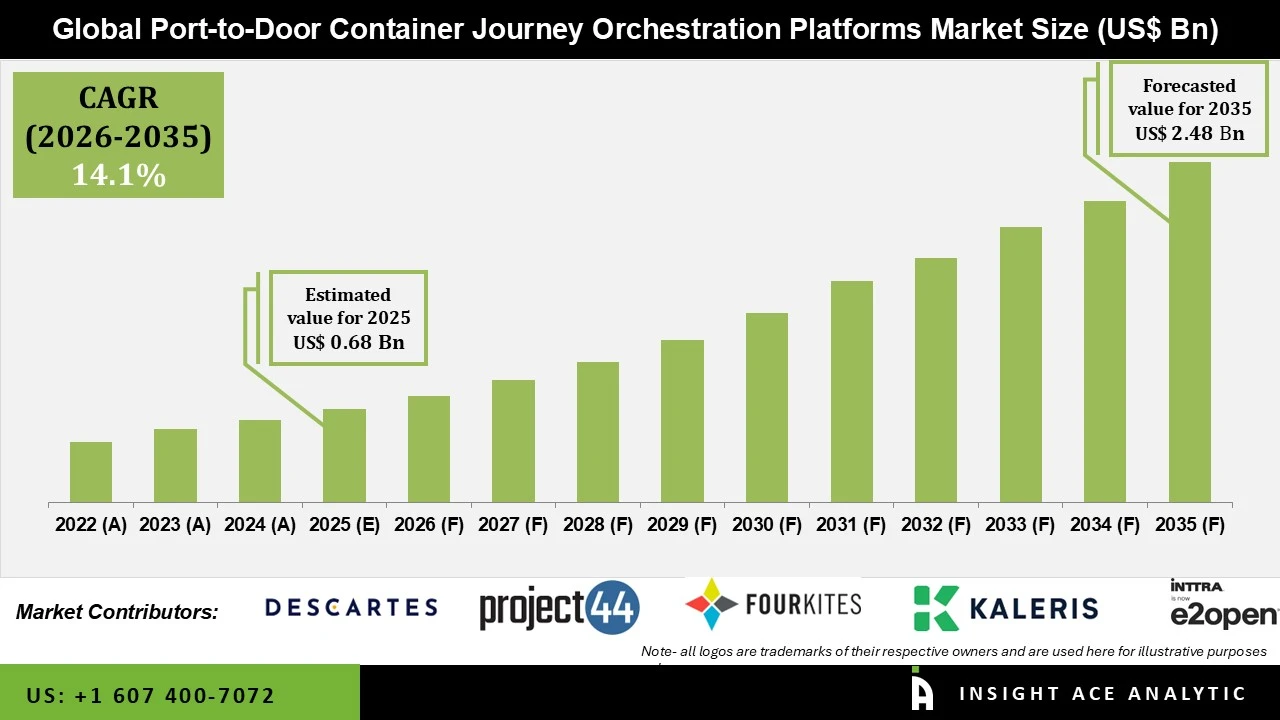
Digital solutions known as port-to-door container journey orchestration platforms oversee and plan the whole transportation of shipping containers from seaports to final delivery sites like warehouses, distribution centers, or customer facilities. These solutions provide real-time visibility, predictive analytics, and automated decision-making throughout the supply chain by integrating data from many stakeholders, such as rail operators, freight forwarders, trucking businesses, port authorities, customs agencies, and ocean carriers. They help minimize delays, optimize routing, and enhance asset utilization by coordinating tasks like port handling, customs clearance, interior transportation, and last-mile delivery. The adoption of IoT and AI technologies, the growing need for effective logistics solutions, and supply chain management's transition to digital transformation are some of the port-to-door container journey orchestration platforms market.
The port-to-door container journey orchestration platforms market is expanding rapidly because of the growing need for real-time visibility across container movements and the complexity of global supply chains. The logistics stakeholders are looking for integrated digital solutions that can easily coordinate operations from ports to inland destinations as global trade volumes continue to rise. By effectively coordinating port operations, customs clearance, multimodal transportation, and last-mile delivery, these platforms help to minimize delays and operational inefficiencies. Additionally, businesses are being forced to implement sophisticated orchestration technologies in order to guarantee quicker and more dependable container flows due to the quick expansion of e-commerce and just-in-time delivery models. This is anticipated to boost the port-to-door container journey orchestration platforms market growth over the forecast period.
In addition, it is anticipated that the port-to-door container journey orchestration platforms market will grow as a result of ongoing technical developments and an increasing focus on digital transformation in the transportation and logistics industries. Orchestration platform adoption is also being aided by regulatory actions that support digitization, data standards, and paperless trading. Moreover, there is a discernible trend toward platform-based ecosystems that facilitate improved data interchange and collaboration by connecting various stakeholders on a single interface. Vendors are concentrating on creating scalable and adaptable solutions to meet the needs of particular industries, such as manufacturing, healthcare, and retail. The port-to-door container journey orchestration platforms market growth is also being influenced by the growing significance of automation and predictive analytics in handling exceptions and reducing interruptions.
Competitive Landscape
Which are the Leading Players in Port-to-Door Container Journey Orchestration Platforms Market?
• FourKites
• project44
• Terminal49
• e2open / INTTRA
• Kaleris
• Descartes
• Vizion
Market Dynamics
Driver
Growing Demand for Efficient and Visible End-to-End Supply Chains
The growing need for real-time, end-to-end visibility throughout international supply chains is one of the main factors propelling the port-to-door container journey orchestration platforms market. Companies are having trouble controlling container movements and handling interruptions as logistics networks get increasingly complicated as a result of globalization, multi-modal transportation, and dispersed stakeholders. In order to improve coordination and transparency, orchestration platforms combine data from ports, carriers, customs, and inland transportation providers into a single system. Furthermore, the value proposition of these platforms is being strengthened by the increasing uptake of digital technologies such as AI, IoT, and predictive analytics, which make them crucial instruments for boosting operational effectiveness, cutting expenses, and guaranteeing on-time delivery in markets that are becoming more and more competitive.
Restrain/Challenge
High Implementation Costs and Difficulties with Data Integration
The port-to-door container journey orchestration platforms market is significantly constrained by the difficulty of integrating many data sources and the substantial upfront costs associated with deployment. These platforms depend on the smooth interchange of data between various parties, such as transport operators, shipping lines, port authorities, and customs agencies, many of whom use antiquated systems with poor interoperability. The port-to-door container journey orchestration platform’s efficacy may be diminished by data silos, inconsistencies, and integration delays brought on by this lack of standardization. Moreover, it can be difficult for small and medium-sized businesses to implement such sophisticated digital solutions since they sometimes call for large capital expenditures, qualified staff, and organizational change management.
Real-time Visibility and ETA Orchestration Segment is Expected to Drive the Port-to-Door Container Journey Orchestration Platforms Market
The Real-time Visibility and ETA Orchestration category held the largest share in the Port-to-Door Container Journey Orchestration Platforms market in 2025 driven by the growing demand for precise, dynamic tracking of container movements within intricate, multi-modal supply chains. In addition to predictive expected time of arrival (ETA) calculations that take into consideration factors such as port congestion, weather, customs delays, and interior transportation disruptions, businesses are giving priority to systems that offer continuous, real-time information on shipment progress. Additionally, the accuracy and dependability of ETA predictions are being improved by technological developments like IoT sensors, GPS monitoring, artificial intelligence, and machine learning, which are hastening the category's acceptance.
3PL and 4PL Providers Segment is Growing at the Highest Rate in the Port-to-Door Container Journey Orchestration Platforms Market
In 2025, the 3PL and 4PL Providers category dominated the Port-to-Door Container Journey Orchestration Platforms market fueled by the growing need for outsourced and integrated logistics solutions. By enhancing shipment visibility, streamlining route planning, and guaranteeing effective coordination across various transport modes, third-party logistics (3PL) providers are using these platforms to improve their service offerings. In the meantime, orchestration platforms are being used by fourth-party logistics (4PL) providers, who concentrate on end-to-end supply chain management, as a key enabler to handle intricate logistics networks on behalf of their customers. Through the integration of data from multiple stakeholders and the provision of seamless, data-driven logistics services, these platforms enable 3PLs and 4PLs to function as central coordinators.
Why Asia Pacific Led the Port-to-Door Container Journey Orchestration Platforms Market?
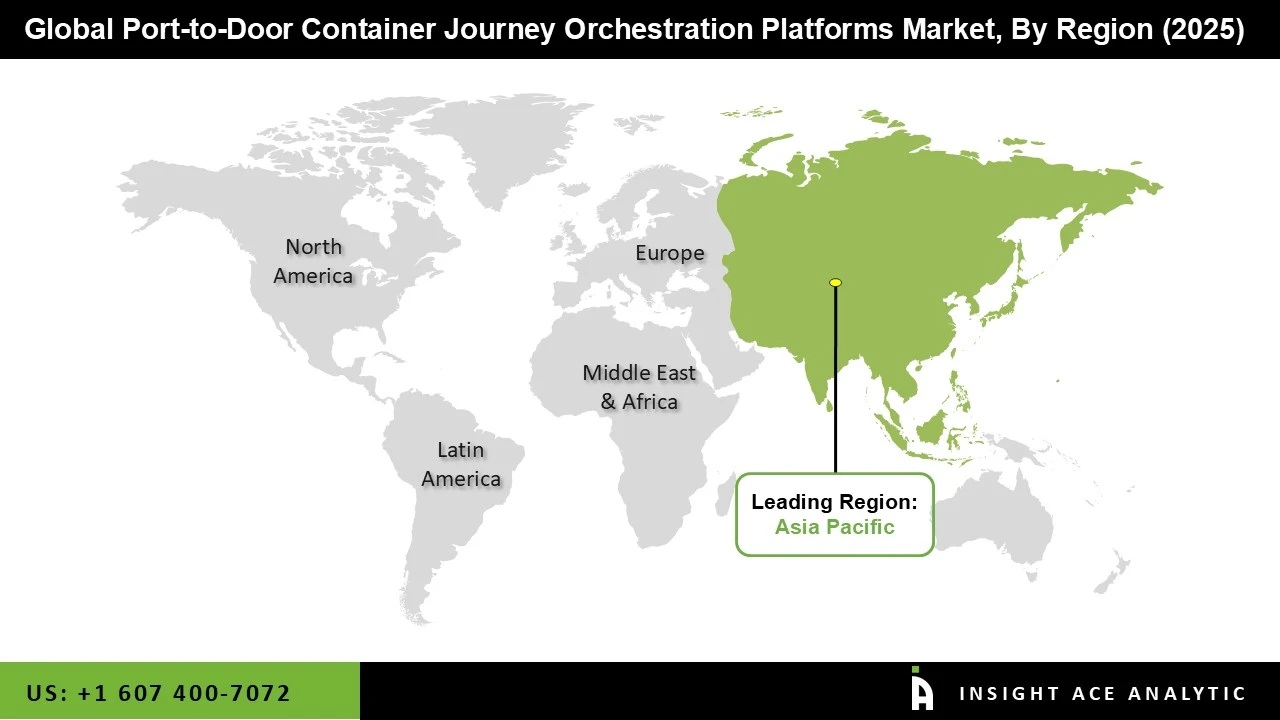
The Port-to-Door Container Journey Orchestration Platforms market was dominated by Asia-Pacific region in 2025 propelled by its high rate of digital adoption, sophisticated logistics infrastructure, and the presence of top technology suppliers. Because of its established supply chain ecosystem and growing demand for real-time visibility across intricate multimodal networks, China, Singapore, Japan, and South Korea, in particular, play a significant role. The extensive use of cloud-based platforms, AI-driven analytics, and IoT-enabled tracking systems—which facilitate smooth coordination between ports, carriers, and inland logistics providers—further propels the region's expansion. Additionally, shippers and logistics companies are being encouraged to use orchestration platforms for proactive decision-making and disruption control due to enduring issues, including port congestion, rail bottlenecks, and high demurrage charges.
Port-to-Door Container Journey Orchestration Platforms Market Report Scope:
| Report Attribute | Specifications |
| Market size value in 2025 | USD 0.68 Bn |
| Revenue forecast in 2035 | USD 2.48 Bn |
| Growth Rate CAGR | CAGR of 14.1% from 2026 to 2035 |
| Quantitative Units | Representation of revenue in US$ Bn and CAGR from 2026 to 2035 |
| Historic Year | 2022 to 2025 |
| Forecast Year | 2026-2035 |
| Report Coverage | The forecast of revenue, the position of the company, the competitive market structure, growth prospects, and trends |
| Segments Covered | Deployment Architecture, Platform Function, Journey Coverage, Buyer Type, and By Region |
| Regional Scope | North America; Europe; Asia Pacific; Latin America; Middle East & Africa |
| Country Scope | U.S.; Canada; U.K.; Germany; China; India; Japan; Brazil; Mexico; The UK; France; Italy; Spain; China; Japan; India; South Korea; Southeast Asia; South Korea; Southeast Asia |
| Competitive Landscape | FourKites, project44, Terminal49, e2open / INTTRA, Kaleris, Descartes, and Vizion. |
| Customization Scope | Free customization report with the procurement of the report, Modifications to the regional and segment scope. Geographic competitive landscape. |
| Pricing and Available Payment Methods | Explore pricing alternatives that are customized to your particular study requirements. |
Market Segmentation:
Port-to-Door Container Journey Orchestration Platforms Market by Deployment Architecture-
• API-first Embedded Orchestration
• Cloud-native SaaS
• Hybrid Deployments with Legacy TMS/ERP Links
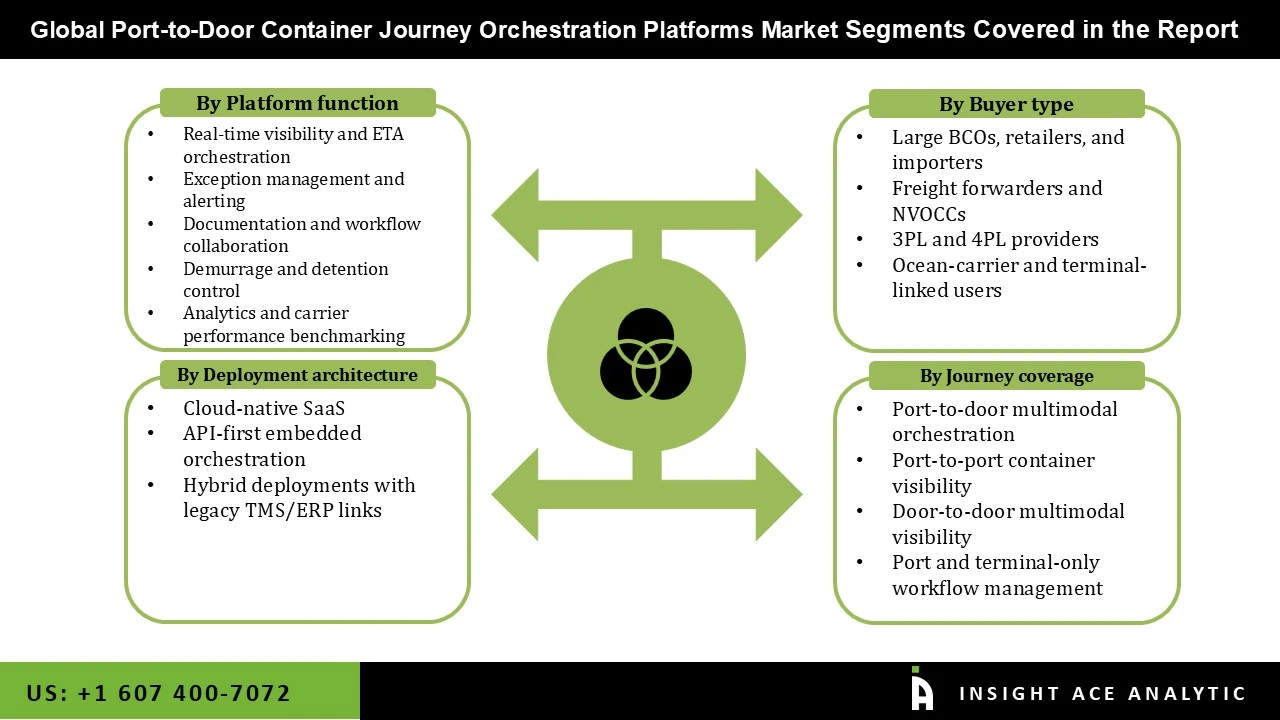
Port-to-Door Container Journey Orchestration Platforms Market by Platform Function-
• Real-time Visibility and ETA Orchestration
• Documentation and Workflow Collaboration
• Exception Management and Alerting
• Analytics and Carrier Performance Benchmarking
• Demurrage and Detention Control
Port-to-Door Container Journey Orchestration Platforms Market by Journey Coverage-
• Port-to-port Container Visibility
• Port-to-door Multimodal Orchestration
• Port and Terminal-only Workflow Management
• Door-to-door Multimodal Visibility
Port-to-Door Container Journey Orchestration Platforms Market by Buyer Type-
• 3PL and 4PL Providers
• Large BCOs, Retailers, and Importers
• Ocean-carrier and Terminal-linked Users
• Freight Forwarders and NVOCCs
Port-to-Door Container Journey Orchestration Platforms Market By Region-
North America-
• The US
• Canada
Europe-
• Germany
• The UK
• France
• Italy
• Spain
• Rest of Europe
Asia-Pacific-
• China
• Japan
• India
• South Korea
• South East Asia
• Rest of Asia Pacific
Latin America-
• Brazil
• Argentina
• Mexico
• Rest of Latin America
Middle East & Africa-
• GCC Countries
• South Africa
• Rest of Middle East and Africa
Research Design and Approach
This study employed a multi-step, mixed-method research approach that integrates:
- Secondary research
- Primary research
- Data triangulation
- Hybrid top-down and bottom-up modelling
- Forecasting and scenario analysis
This approach ensures a balanced and validated understanding of both macro- and micro-level market factors influencing the market.
Secondary Research
Secondary research for this study involved the collection, review, and analysis of publicly available and paid data sources to build the initial fact base, understand historical market behaviour, identify data gaps, and refine the hypotheses for primary research.
Sources Consulted
Secondary data for the market study was gathered from multiple credible sources, including:
- Government databases, regulatory bodies, and public institutions
- International organizations (WHO, OECD, IMF, World Bank, etc.)
- Commercial and paid databases
- Industry associations, trade publications, and technical journals
- Company annual reports, investor presentations, press releases, and SEC filings
- Academic research papers, patents, and scientific literature
- Previous market research publications and syndicated reports
These sources were used to compile historical data, market volumes/prices, industry trends, technological developments, and competitive insights.

Primary Research
Primary research was conducted to validate secondary data, understand real-time market dynamics, capture price points and adoption trends, and verify the assumptions used in the market modelling.
Stakeholders Interviewed
Primary interviews for this study involved:
- Manufacturers and suppliers in the market value chain
- Distributors, channel partners, and integrators
- End-users / customers (e.g., hospitals, labs, enterprises, consumers, etc., depending on the market)
- Industry experts, technology specialists, consultants, and regulatory professionals
- Senior executives (CEOs, CTOs, VPs, Directors) and product managers
Interview Process
Interviews were conducted via:
- Structured and semi-structured questionnaires
- Telephonic and video interactions
- Email correspondences
- Expert consultation sessions
Primary insights were incorporated into demand modelling, pricing analysis, technology evaluation, and market share estimation.
Data Processing, Normalization, and Validation
All collected data were processed and normalized to ensure consistency and comparability across regions and time frames.
The data validation process included:
- Standardization of units (currency conversions, volume units, inflation adjustments)
- Cross-verification of data points across multiple secondary sources
- Normalization of inconsistent datasets
- Identification and resolution of data gaps
- Outlier detection and removal through algorithmic and manual checks
- Plausibility and coherence checks across segments and geographies
This ensured that the dataset used for modelling was clean, robust, and reliable.
Market Size Estimation and Data Triangulation
Bottom-Up Approach
The bottom-up approach involved aggregating segment-level data, such as:
- Company revenues
- Product-level sales
- Installed base/usage volumes
- Adoption and penetration rates
- Pricing analysis
This method was primarily used when detailed micro-level market data were available.

Top-Down Approach
The top-down approach used macro-level indicators:
- Parent market benchmarks
- Global/regional industry trends
- Economic indicators (GDP, demographics, spending patterns)
- Penetration and usage ratios
This approach was used for segments where granular data were limited or inconsistent.
Hybrid Triangulation Approach
To ensure accuracy, a triangulated hybrid model was used. This included:
- Reconciling top-down and bottom-up estimates
- Cross-checking revenues, volumes, and pricing assumptions
- Incorporating expert insights to validate segment splits and adoption rates
This multi-angle validation yielded the final market size.
Forecasting Framework and Scenario Modelling
Market forecasts were developed using a combination of time-series modelling, adoption curve analysis, and driver-based forecasting tools.
Forecasting Methods
- Time-series modelling
- S-curve and diffusion models (for emerging technologies)
- Driver-based forecasting (GDP, disposable income, adoption rates, regulatory changes)
- Price elasticity models
- Market maturity and lifecycle-based projections
Scenario Analysis
Given inherent uncertainties, three scenarios were constructed:
- Base-Case Scenario: Expected trajectory under current conditions
- Optimistic Scenario: High adoption, favourable regulation, strong economic tailwinds
- Conservative Scenario: Slow adoption, regulatory delays, economic constraints
Sensitivity testing was conducted on key variables, including pricing, demand elasticity, and regional adoption.
Request Customization
Add countries, segments, company profiles, or extend forecast — free 10% customization with purchase.
Customize This Report →Enquire Before Buying
Speak with our analyst team about scope, methodology, pricing, or deliverable formats.
Enquire Now →Frequently Asked Questions
Port to Door Container Journey Orchestration Platforms Market Size is valued at USD 0.68 Bn in 2025 and is predicted to reach USD 2.48 Bn by the year 2035
Port to Door Container Journey Orchestration Platforms Market is expected to grow at a 14.7% CAGR during the forecast period for 2026 to 2035.
FourKites, project44, Terminal49, e2open / INTTRA, Kaleris, Descartes, and Vizion.
Port to Door Container Journey Orchestration Platforms Market is segmented into Deployment Architecture, Platform Function, Journey Coverage, Buyer Type, and By Region
Asia Pacific region is leading the Port to Door Container Journey Orchestration Platforms Market.