Human AI Collaboration Market Size, Trend, Revenue Report 2026 to 2035
What is Human AI Collaboration Market Size?
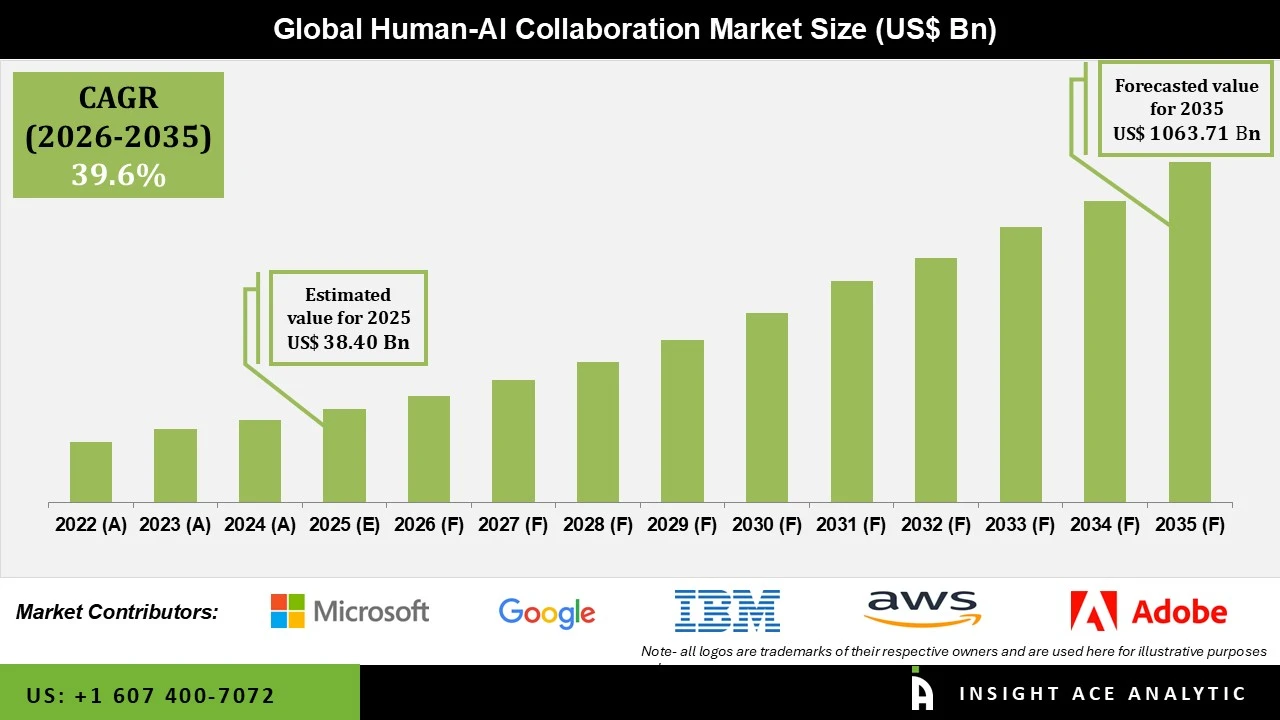
Human AI Collaboration Market Size is valued at USD 38.40 Bn in 2025 and is predicted to reach USD 1063.71 Bn by the year 2035 at a 39.60% CAGR during the forecast period for 2026 to 2035.
Human AI Collaboration Market Size, Share & Trends Analysis Distribution by Type (Conversational AI, AI Assistants, Augmented Intelligence Platforms, and Decision Support Systems), Offering (Services, Software & Platforms, Hardware & Embedded Systems, and Industry Specific Applications), Deployment Mode (On-premise, Cloud-based, and Hybrid), Collaboration Model (Human-in-the-Loop (HITL), Human-in-Command (HIC), and Human-on-the-Loop (HOTL)), Organization Size (Large Enterprises, Mid-sized Enterprises, and Small & Medium Businesses (SMBs)), End-user (Banking, Financial Services & Insurance (BFSI), Healthcare & Life Sciences, Manufacturing & Industrial, Media, Marketing & Creative, Retail & E-commerce, Transportation & Logistics, and Legal & Compliance), and Segment Forecasts, 2026 to 2035
Human-AI collaboration is a strategic alliance that combines human creativity, judgment, and contextual awareness with AI's speed, scalability, and data processing skills. When combined, this synergy allows for balanced innovation, increased efficiency, and more precise decision-making in a variety of industries. One of the most revolutionary advances in contemporary technology progress is human-AI collaboration. To improve results and operational efficiency, industries like healthcare, finance, and the creative sector are increasingly utilizing human–AI collaboration. The growing need to blend human judgment with AI-driven insights to produce more accurate and efficient results, especially in crucial areas such as BFSI and healthcare, is driving the human-AI collaboration market's expansion.
The human-AI collaboration market is expanding due to the growing need for increased productivity and efficiency across industries. Businesses are using AI to automate monotonous work so that people can concentrate on strategic and creative tasks. The use of AI-powered solutions for real-time analytics and decision-making is also being accelerated by the swift growth of digital transformation projects and the increasing amount of data produced across industries. As companies place a greater emphasis on data-driven operations and competitive advantage, the trend is anticipated to continue. Furthermore, human-AI collaboration is becoming more popular in industries like healthcare, banking, and retail, where AI helps with risk assessment, customer interaction, and diagnostics, improving overall results and operational efficacy.
Additionally, ongoing developments in cloud computing, machine learning, and natural language processing are influencing the market landscape by increasing the scalability and accessibility of AI systems. The market is growing as a result of investments in AI research and supportive government efforts. In order to increase trust and usability in human-AI interactions, corporations are also concentrating on creating explainable and moral AI systems. However, issues with data protection, moral ramifications, and the lack of qualified workers continue to hinder industry expansion. Widespread adoption may also be hampered by integration challenges with current systems and resistance to change, particularly in small and medium-sized businesses.
Competitive Landscape
Which are the Leading Players in Human-AI Collaboration Market?
• Adobe
• Microsoft
• Amazon Web Services
• Google
• IBM
• Salesforce
• SAP
• Others
Market Dynamics
Driver
Growing Need for Increased Efficiency and Productivity
The human-AI collaboration market is mostly driven by the growing need for increased operational efficiency and productivity. Businesses in all sectors are constantly under pressure to maximize resources, lower operating expenses, and increase output without sacrificing quality. This is made possible by human-AI collaboration, which enables AI systems to manage repetitive, time-consuming, and data-intensive tasks, including process optimization, data analysis, and customer service automation. This allows human workers to concentrate on higher-value tasks like decision-making, innovation, and strategic planning. Furthermore, AI-powered technologies also improve results by increasing accuracy and lowering human error. The use of collaborative AI solutions is anticipated to increase dramatically as companies continue to place a high priority on scalability and efficiency.
Restrain/Challenge
Integration Issues and a Shortage of Skilled Labor
The lack of qualified experts who can efficiently create, oversee, and incorporate AI systems into current processes is a major barrier to the human-AI collaboration market. Finding individuals with experience in AI, machine learning, and data science is a challenge for many firms, which hinders the full potential of collaborative systems and slows down deployment. Furthermore, integrating AI with legacy infrastructure can be difficult, expensive, and time-consuming. It frequently necessitates significant organizational reorganization and modifications. Moreover, the adoption is further hampered by staff resistance to change and inadequate training. All of these factors make it difficult for companies, especially small and medium-sized ones, to fully utilize human-AI cooperation solutions.
Software & Platforms Segment is Expected to Drive the Human-AI Collaboration Market
The Software & Platforms category held the largest share in the Human-AI Collaboration market in 2025. The market's core is the Software Platforms and Tools sector, which is driven by the demand for reliable, scalable, and occasionally industry-specific applications. This covers anything from specialist software for design collaboration or conversational AI to enterprise AI platforms and SKs provided by IT behemoths such as IBM and Microsoft. Additionally, the platform's ease of use, its ability to integrate with current enterprise systems (such as ERP and CRM), the complexity of its underlying Al models, and its capacity to deliver reliable and understandable results are all variables that define its dominance in this sub-segment.
Human-in-the-Loop (HITL) Segment is Growing at the Highest Rate in the Human-AI Collaboration Market
In 2025, the Human-in-the-Loop (HITL) category dominated the Human-AI Collaboration market driven by the growing demand for AI-powered systems to be accurate, dependable, and accountable. In high-stakes industries including healthcare, banking, and autonomous systems, HITL incorporates human judgment into AI workflows to guarantee that crucial judgments are verified and improved by human experience. The need for supervision procedures to lessen mistakes, bias, and unexpected consequences is growing as businesses use AI at scale. Additionally, HITL is essential for training and refining machine learning models via ongoing human input, which eventually improves system performance. The adoption of HITL frameworks is also being accelerated by legal restrictions and the increased focus on ethical AI, as companies need to ensure compliance and transparency.
Why North America Led the Human-AI Collaboration Market?
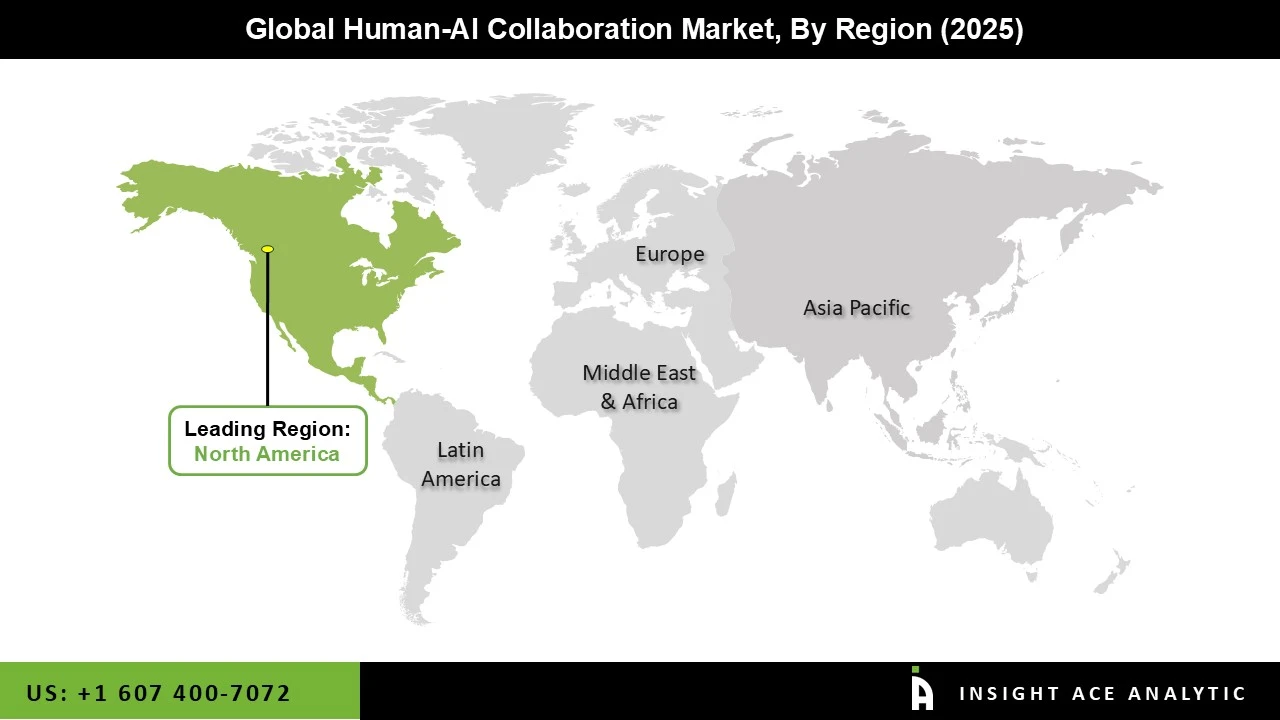
The Human-AI Collaboration market was dominated by North America region in 2025. North America has a highly qualified labor force that can implement and manage cutting-edge AI systems, which is essential for creating and managing human-AI collaboration. Its availability and ongoing technical developments allow companies to increase efficiency and keep a competitive edge in international marketplaces. Additionally, North American AI and robotics firms have seen an increase in venture capital funding, which has fueled growth and innovation. This funding helps businesses create cutting-edge solutions that improve human-AI collaboration, increasing workplace productivity and safety, and propelling market expansion. Furthermore, the human-AI collaboration market is growing due to the growing need for robots that can help, learn from, and work with humans in industries such as manufacturing, healthcare, and logistics.
Human-AI Collaboration Market Report Scope:
| Report Attribute | Specifications |
| Market size value in 2025 | USD 38.40 Bn |
| Revenue forecast in 2035 | USD 1063.71 Bn |
| Growth Rate CAGR | CAGR of 39.6% from 2026 to 2035 |
| Quantitative Units | Representation of revenue in US$ Bn and CAGR from 2026 to 2035 |
| Historic Year | 2022 to 2025 |
| Forecast Year | 2026-2035 |
| Report Coverage | The forecast of revenue, the position of the company, the competitive market structure, growth prospects, and trends |
| Segments Covered | Type, Offering, Deployment Mode, Collaboration Model, Organization Size, End-user, and By Region |
| Regional Scope | North America; Europe; Asia Pacific; Latin America; Middle East & Africa |
| Country Scope | U.S.; Canada; U.K.; Germany; China; India; Japan; Brazil; Mexico; The UK; France; Italy; Spain; China; Japan; India; South Korea; Southeast Asia; South Korea; Southeast Asia |
| Competitive Landscape | Adobe, Microsoft, Amazon Web Services, Google, IBM, Salesforce, SAP, and Others |
| Customization Scope | Free customization report with the procurement of the report, Modifications to the regional and segment scope. Geographic competitive landscape. |
| Pricing and Available Payment Methods | Explore pricing alternatives that are customized to your particular study requirements. |
Market Segmentation:
Human-AI Collaboration Market by Type-
• Conversational AI
• AI Assistants
• Augmented Intelligence Platforms
• Decision Support Systems
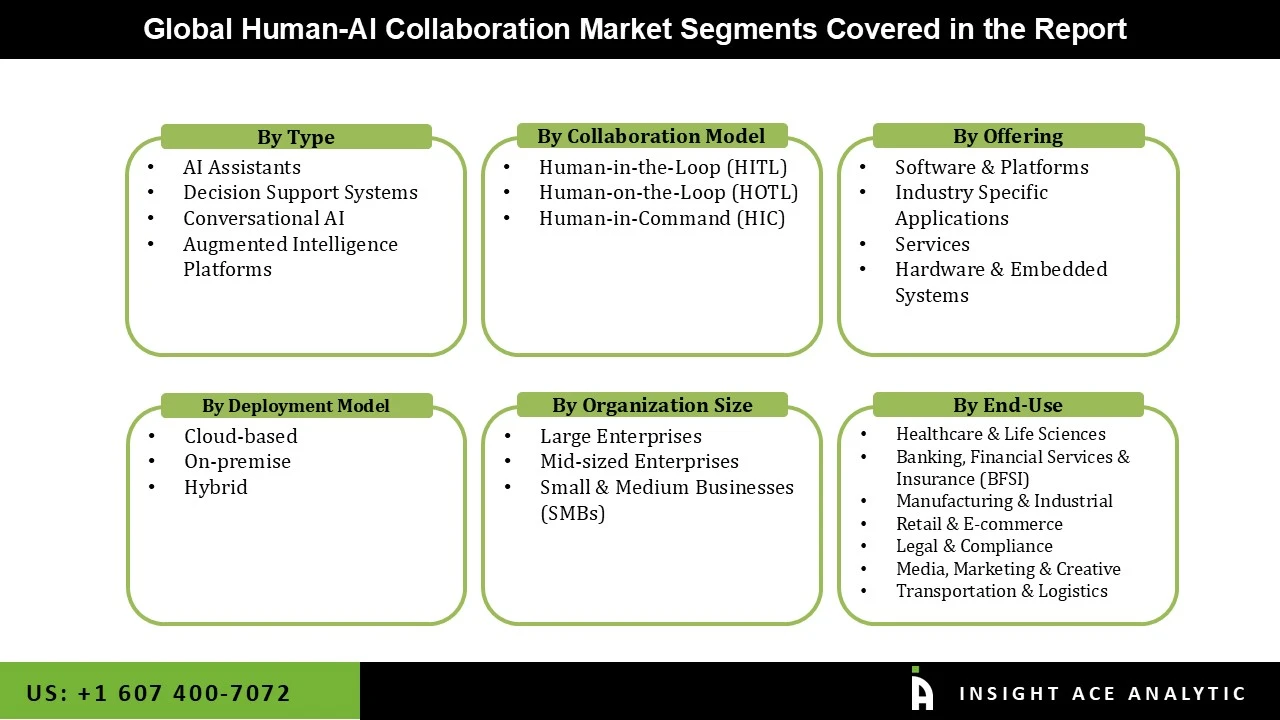
Human-AI Collaboration Market by Offering-
• Services
• Software & Platforms
• Hardware & Embedded Systems
• Industry Specific Applications
Human-AI Collaboration Market by Deployment Mode-
• On-premise
• Cloud-based
• Hybrid
Human-AI Collaboration Market by Collaboration Model-
• Human-in-the-Loop (HITL)
• Human-in-Command (HIC)
• Human-on-the-Loop (HOTL)
Human-AI Collaboration Market by Organization Size-
• Large Enterprises
• Mid-sized Enterprises
• Small & Medium Businesses (SMBs)
Human-AI Collaboration Market by End-user-
• Banking, Financial Services & Insurance (BFSI)
• Healthcare & Life Sciences
• Manufacturing & Industrial
• Media, Marketing & Creative
• Retail & E-commerce
• Transportation & Logistics
• Legal & Compliance
Research Design and Approach
This study employed a multi-step, mixed-method research approach that integrates:
- Secondary research
- Primary research
- Data triangulation
- Hybrid top-down and bottom-up modelling
- Forecasting and scenario analysis
This approach ensures a balanced and validated understanding of both macro- and micro-level market factors influencing the market.
Secondary Research
Secondary research for this study involved the collection, review, and analysis of publicly available and paid data sources to build the initial fact base, understand historical market behaviour, identify data gaps, and refine the hypotheses for primary research.
Sources Consulted
Secondary data for the market study was gathered from multiple credible sources, including:
- Government databases, regulatory bodies, and public institutions
- International organizations (WHO, OECD, IMF, World Bank, etc.)
- Commercial and paid databases
- Industry associations, trade publications, and technical journals
- Company annual reports, investor presentations, press releases, and SEC filings
- Academic research papers, patents, and scientific literature
- Previous market research publications and syndicated reports
These sources were used to compile historical data, market volumes/prices, industry trends, technological developments, and competitive insights.

Primary Research
Primary research was conducted to validate secondary data, understand real-time market dynamics, capture price points and adoption trends, and verify the assumptions used in the market modelling.
Stakeholders Interviewed
Primary interviews for this study involved:
- Manufacturers and suppliers in the market value chain
- Distributors, channel partners, and integrators
- End-users / customers (e.g., hospitals, labs, enterprises, consumers, etc., depending on the market)
- Industry experts, technology specialists, consultants, and regulatory professionals
- Senior executives (CEOs, CTOs, VPs, Directors) and product managers
Interview Process
Interviews were conducted via:
- Structured and semi-structured questionnaires
- Telephonic and video interactions
- Email correspondences
- Expert consultation sessions
Primary insights were incorporated into demand modelling, pricing analysis, technology evaluation, and market share estimation.
Data Processing, Normalization, and Validation
All collected data were processed and normalized to ensure consistency and comparability across regions and time frames.
The data validation process included:
- Standardization of units (currency conversions, volume units, inflation adjustments)
- Cross-verification of data points across multiple secondary sources
- Normalization of inconsistent datasets
- Identification and resolution of data gaps
- Outlier detection and removal through algorithmic and manual checks
- Plausibility and coherence checks across segments and geographies
This ensured that the dataset used for modelling was clean, robust, and reliable.
Market Size Estimation and Data Triangulation
Bottom-Up Approach
The bottom-up approach involved aggregating segment-level data, such as:
- Company revenues
- Product-level sales
- Installed base/usage volumes
- Adoption and penetration rates
- Pricing analysis
This method was primarily used when detailed micro-level market data were available.

Top-Down Approach
The top-down approach used macro-level indicators:
- Parent market benchmarks
- Global/regional industry trends
- Economic indicators (GDP, demographics, spending patterns)
- Penetration and usage ratios
This approach was used for segments where granular data were limited or inconsistent.
Hybrid Triangulation Approach
To ensure accuracy, a triangulated hybrid model was used. This included:
- Reconciling top-down and bottom-up estimates
- Cross-checking revenues, volumes, and pricing assumptions
- Incorporating expert insights to validate segment splits and adoption rates
This multi-angle validation yielded the final market size.
Forecasting Framework and Scenario Modelling
Market forecasts were developed using a combination of time-series modelling, adoption curve analysis, and driver-based forecasting tools.
Forecasting Methods
- Time-series modelling
- S-curve and diffusion models (for emerging technologies)
- Driver-based forecasting (GDP, disposable income, adoption rates, regulatory changes)
- Price elasticity models
- Market maturity and lifecycle-based projections
Scenario Analysis
Given inherent uncertainties, three scenarios were constructed:
- Base-Case Scenario: Expected trajectory under current conditions
- Optimistic Scenario: High adoption, favourable regulation, strong economic tailwinds
- Conservative Scenario: Slow adoption, regulatory delays, economic constraints
Sensitivity testing was conducted on key variables, including pricing, demand elasticity, and regional adoption.
Request Customization
Add countries, segments, company profiles, or extend forecast — free 10% customization with purchase.
Customize This Report →Enquire Before Buying
Speak with our analyst team about scope, methodology, pricing, or deliverable formats.
Enquire Now →Frequently Asked Questions
Human AI Collaboration Market Size is valued at USD 38.40 Bn in 2025 and is predicted to reach USD 1063.71 Bn by the year 2035
Human AI Collaboration Market Size is predicted to grow at a 39.60% CAGR during the forecast period for 2026 to 2035.
Adobe, Microsoft, Amazon Web Services, Google, IBM, Salesforce, SAP, and Others
Human AI Collaboration Market is segmented into Type, Offering, Deployment Mode, Collaboration Model, Organization Size, End-user, and By Region
North America region is leading the Human AI Collaboration Market.