Automatic Kjeldahl Nitrogen Analyzer Market Size, Share, Trend, Forecast Report 2026 to 2035
What is Automatic Kjeldahl Nitrogen Analyzer Market Size?
Automatic Kjeldahl Nitrogen Analyzer Market Size is valued at USD 368.32 Mn in 2025 and is predicted to reach USD 707.57 Mn by the year 2035 at a 6.9% CAGR during the forecast period for 2026 to 2035.
Automatic Kjeldahl Nitrogen Analyzer Market Size, Share & Trends Analysis Distribution by Component (Digestion Units, Titration Systems, Distillation Units, Sample Handling & Accessories, and Others), Product Type (Integrated Digestion-Distillation Systems, Fully Automatic Kjeldahl Analyzers, Semi-Automatic Kjeldahl Analyzers, and Others), Application (Agriculture & Fertilizer Analysis, Food & Beverage Testing, and Others), and Segment Forecasts, 2026 to 2035
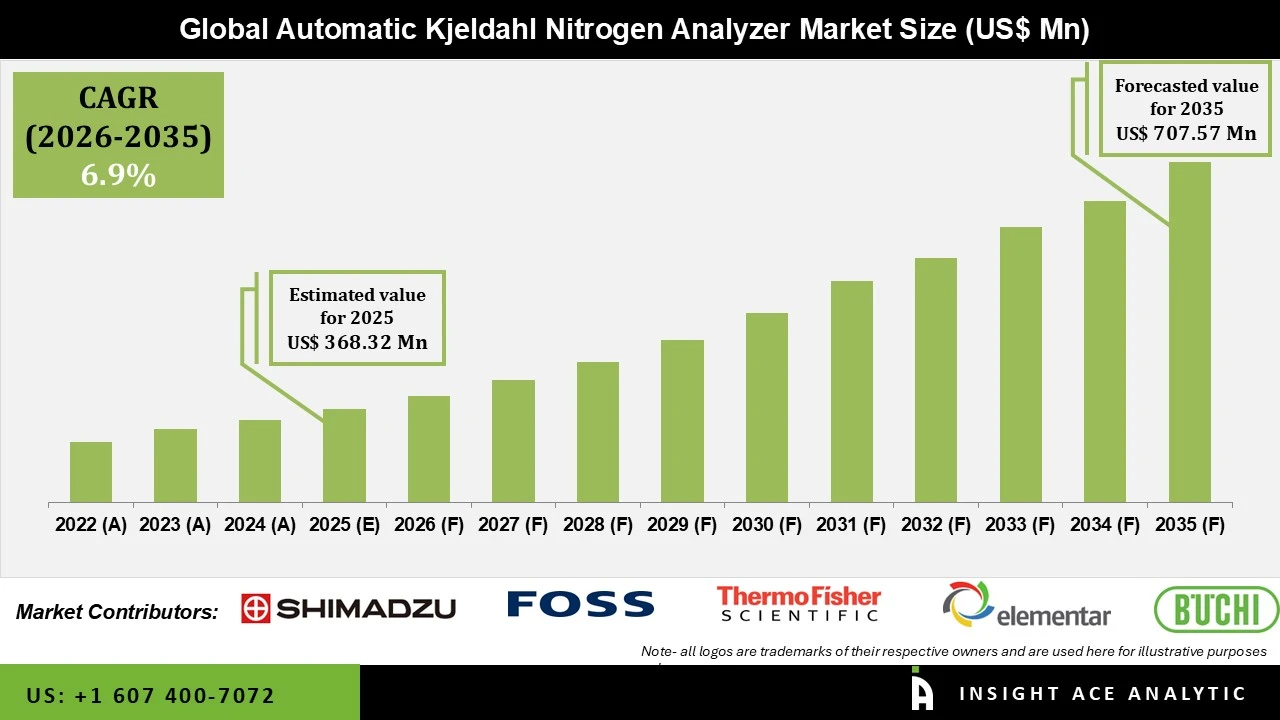
The Kjeldahl nitrogen analyzer is a device that uses the idea of constant nitrogen content in proteins to determine the protein content by measuring the nitrogen concentration in the sample. The nitrogen content in seeds, dairy products, drinks, feed, soil, and other agricultural byproducts can be found using this specialist tool. The agricultural sector makes extensive use of it. The Kjeldahl nitrogen analyzer is quickly evolving toward automatic detection as a result of technological advancements, significantly increasing its automation and detection accuracy. The automatic Kjeldahl nitrogen analyzer market has grown significantly in recent years due to the increasing need for precise and efficient protein analysis solutions in a variety of industries, such as environmental monitoring, food and agriculture, and pharmaceuticals.
The growing demand for accurate and trustworthy nitrogen determination in the food and beverage sector is one of the major drivers propelling the automatic Kjeldahl nitrogen analyzer market. The demand for food goods rises along with the world's population, necessitating precise protein content analysis to guarantee quality and adherence to nutritional guidelines. Additionally, the chemical and pharmaceutical sectors are vital to the growth of the automatic Kjeldahl nitrogen analyzer market. For quality control as well as research and development, these industries need careful nitrogen and protein content analysis. Furthermore, it is anticipated that these businesses' increasing focus on research and development would increase the growth of the automatic Kjeldahl nitrogen analyzer market over the forecast period.
In addition, the precise nitrogen analysis is required in a number of industries, including wastewater treatment and agriculture, due to strict environmental laws, especially with regard to water quality and fertilizer use. The automatic Kjeldahl nitrogen analyzer market's expansion is greatly accelerated by this regulatory push. Additionally, these analyzers are becoming more appealing to a wider range of end users due to technology improvements such as the creation of completely automated, user-friendly devices with improved precision and accuracy. The market is expanding due to the growing use of these sophisticated analyzers in emerging nations and the growing consciousness of environmental sustainability. Moreover, particularly in areas with strong agricultural output, the developing agricultural industry and the increasing demand for effective fertilizer management are important automatic Kjeldahl nitrogen analyzer market growth drivers.
Competitive Landscape
Which are the Leading Players in Automatic Kjeldahl Nitrogen Analyzer Market?
• Thermo Fisher Scientific
• Elementar Analysensysteme GmbH
• C. Gerhardt GmbH & Co. KG
• FOSS Analytical A/S
• Metrohm AG
• OPSIS AB
• VELP Scientifica Srl
• Hanon Instruments Co., Ltd.
• PerkinElmer Inc.
• BUCHI Labortechnik AG
• Shimadzu Corporation
• Yamato Scientific Co., Ltd.
• Skalar Analytical B.V.
• Bruker Corporation
• Others
Market Dynamics
Driver
Growing Demand for Precise Nitrogen Analysis in Food Safety
The automatic Kjeldahl nitrogen analyzer market is mostly driven by the need for precise nitrogen analysis in food safety. Food makers and laboratories must carry out thorough testing to guarantee compliance as food safety laws become more strict worldwide. When evaluating the quality of foods high in protein, like meat, dairy, and plant-based products, nitrogen content is an essential factor. For instance, the U.S. Food and Drug Administration (FDA) has set standards for the amount of nitrogen in food items, which calls for the application of trustworthy analytical techniques. The food industry's need for Kjeldahl nitrogen analyzers is being driven by the rising incidence of foodborne illnesses and the requirement for quality control. The Food Safety and Inspection Service (FSIS) estimates that 48 million Americans suffer from foodborne diseases annually, underscoring the significance of stringent testing procedures.
Restrain/Challenge
High Initial and Ongoing Costs of Equipment
The high initial and ongoing costs of the equipment are a major barrier to the automatic Kjeldahl nitrogen analyzer market. These analyzers are quite costly for small and medium-sized laboratories, particularly in emerging agricultural economies, because they require sophisticated automation, digestion, and distillation equipment, and integrated software systems. Additionally, the total cost of ownership is increased by ongoing costs like maintenance, calibration, specialist reagents (such as sulfuric acid and catalysts), and the need for qualified technicians. Moreover, widespread adoption among regional fertilizer quality control centers, educational institutions, and smaller soil testing labs is restricted by this financial burden. As a result, cost sensitivity continues to be a significant obstacle, impeding the automatic Kjeldahl nitrogen analyzer market penetration in price-sensitive areas despite the benefits of accuracy and efficiency.
Fully Automatic Kjeldahl Analyzers Segment is Expected to Drive the Automatic Kjeldahl Nitrogen Analyzer Market
The fully automatic Kjeldahl analyzers category held the largest share in the Automatic Kjeldahl Nitrogen Analyzer market in 2025. The entire Kjeldahl process, including sample digestion, distillation, and titration, can be carried out by fully automatic Kjeldahl nitrogen protein analyzers with little assistance from humans. High-throughput and reliable protein analysis with less reliance on manual labor is made possible by these sophisticated pieces of equipment's automated sample handling, integrated control systems, and sophisticated data processing capabilities. These analyzers reduce human mistakes with improved automation. Additionally, because fully automatic analyzers are perfect for high-throughput laboratories due to their efficiency, accuracy, and capacity to handle enormous sample volumes, they are in high demand.
Agriculture & Fertilizer Analysis Segment is Growing at the Highest Rate in the Automatic Kjeldahl Nitrogen Analyzer Market
In 2025, the Agriculture & Fertilizer Analysis category dominated the Automatic Kjeldahl Nitrogen Analyzer market due to the growing demand for accurate evaluation of soil, fertilizer, and nutrient quality. In order to maximize agricultural productivity and guarantee balanced nutrient application, these analyzers are frequently used to measure the amount of nitrogen present in soil, crops, and fertilizers. Automated Kjeldahl systems for precise and repeatable analysis are being adopted by agricultural laboratories and research organizations in response to the growing global emphasis on sustainable farming methods and effective fertilizer use. Furthermore, governments and agribusinesses are being forced to invest in cutting-edge analytical tools due to strict rules involving soil health monitoring and fertilizer composition.
Why North America Led the Automatic Kjeldahl Nitrogen Analyzer Market?
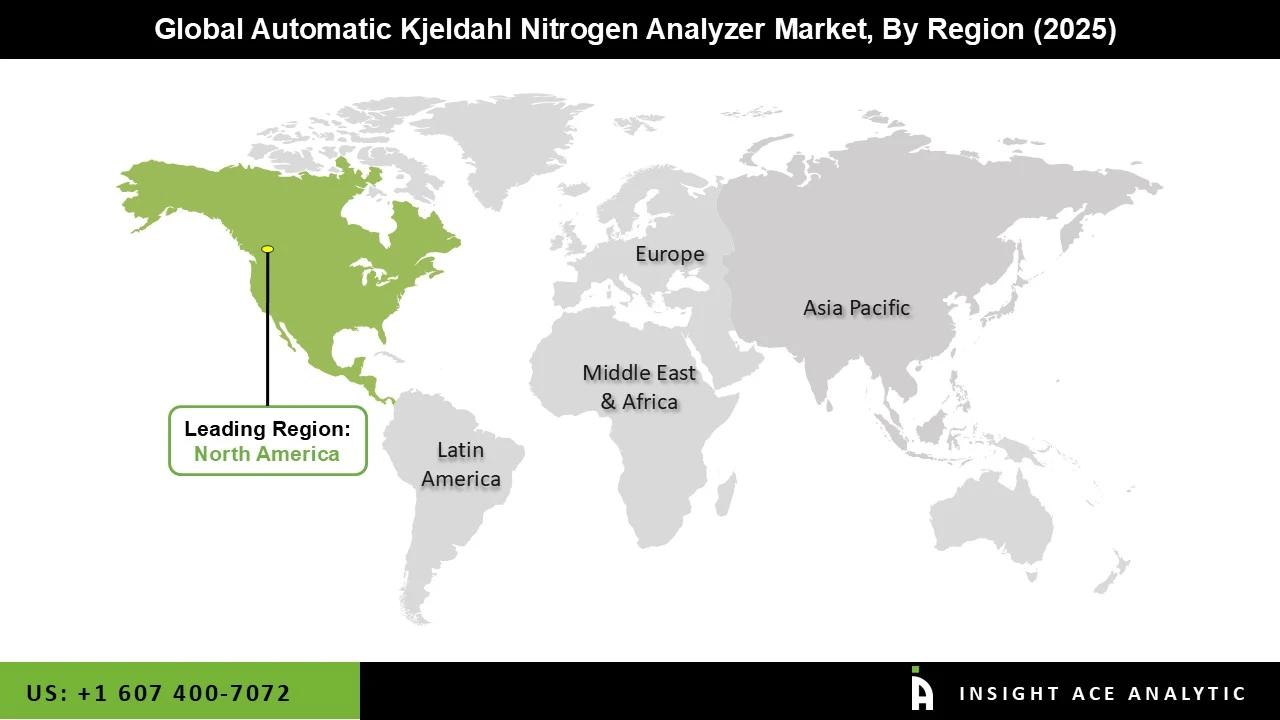
The Automatic Kjeldahl Nitrogen Analyzer market was dominated by North America region in 2025 propelled by the well-known pharmaceutical and food and beverage sectors. The significant demand for precise nitrogen analysis solutions is a result of the region's strict food safety laws and strong environmental monitoring systems. High testing volumes, sophisticated research facilities, knowledgeable laboratory personnel, and ongoing expenditures in analytical equipment, quality assurance, and regulatory compliance all contribute to the automatic Kjeldahl nitrogen analyzer market's growth in both commercial and industrial laboratories. Additionally, the existence of prominent industry participants and cutting-edge research facilities contributes to the automatic Kjeldahl nitrogen analyzer market's expansion in North America. Particularly important is the United States, where the FDA enforces strict food product testing regulations.
Key Development
June 2024: In order to create cutting-edge Kjeldahl nitrogen analysis systems suitable for sustainable farming methods, Elementar Analysensysteme GmbH announced a collaboration with a preeminent agricultural research organization. By improving the precision of nitrogen readings in soil and plant samples, this partnership hopes to promote ecologically friendly farming methods.
May 2023: The Vapodest 500, a sophisticated Kjeldahl nitrogen analyzer, was introduced by C. Gerhardt. With its high-quality parts, ceramic microdosing pump, parallel distillation, and online titration, and ability to handle continuous operation and large sample throughput, it is perfect for labs that need to determine nitrogen efficiently and reliably.
Automatic Kjeldahl Nitrogen Analyzer Market Report Scope:
| Report Attribute | Specifications |
| Market size value in 2025 | USD 368.32 Mn |
| Revenue forecast in 2035 | USD 707.57 Mn |
| Growth Rate CAGR | CAGR of 6.9% from 2026 to 2035 |
| Quantitative Units | Representation of revenue in US$ Mn and CAGR from 2026 to 2035 |
| Historic Year | 2022 to 2025 |
| Forecast Year | 2026-2035 |
| Report Coverage | The forecast of revenue, the position of the company, the competitive market structure, growth prospects, and trends |
| Segments Covered | Component, Product Type, Application, and By Region |
| Regional Scope | North America; Europe; Asia Pacific; Latin America; Middle East & Africa |
| Country Scope | U.S.; Canada; U.K.; Germany; China; India; Japan; Brazil; Mexico; The UK; France; Italy; Spain; China; Japan; India; South Korea; Southeast Asia; South Korea; Southeast Asia |
| Competitive Landscape | Thermo Fisher Scientific, Elementar Analysensysteme GmbH, C. Gerhardt GmbH & Co. KG, FOSS Analytical A/S, Metrohm AG, OPSIS AB, VELP Scientifica Srl, Hanon Instruments Co., Ltd., PerkinElmer Inc., BUCHI Labortechnik AG, Shimadzu Corporation, Yamato Scientific Co., Ltd., Skalar Analytical B.V., Bruker Corporation, and Others. |
| Customization Scope | Free customization report with the procurement of the report, Modifications to the regional and segment scope. Geographic competitive landscape. |
| Pricing and Available Payment Methods | Explore pricing alternatives that are customized to your particular study requirements. |
Market Segmentation:
Automatic Kjeldahl Nitrogen Analyzer Market by Component-
• Digestion Units
• Titration Systems
• Distillation Units
• Sample Handling & Accessories
• Others
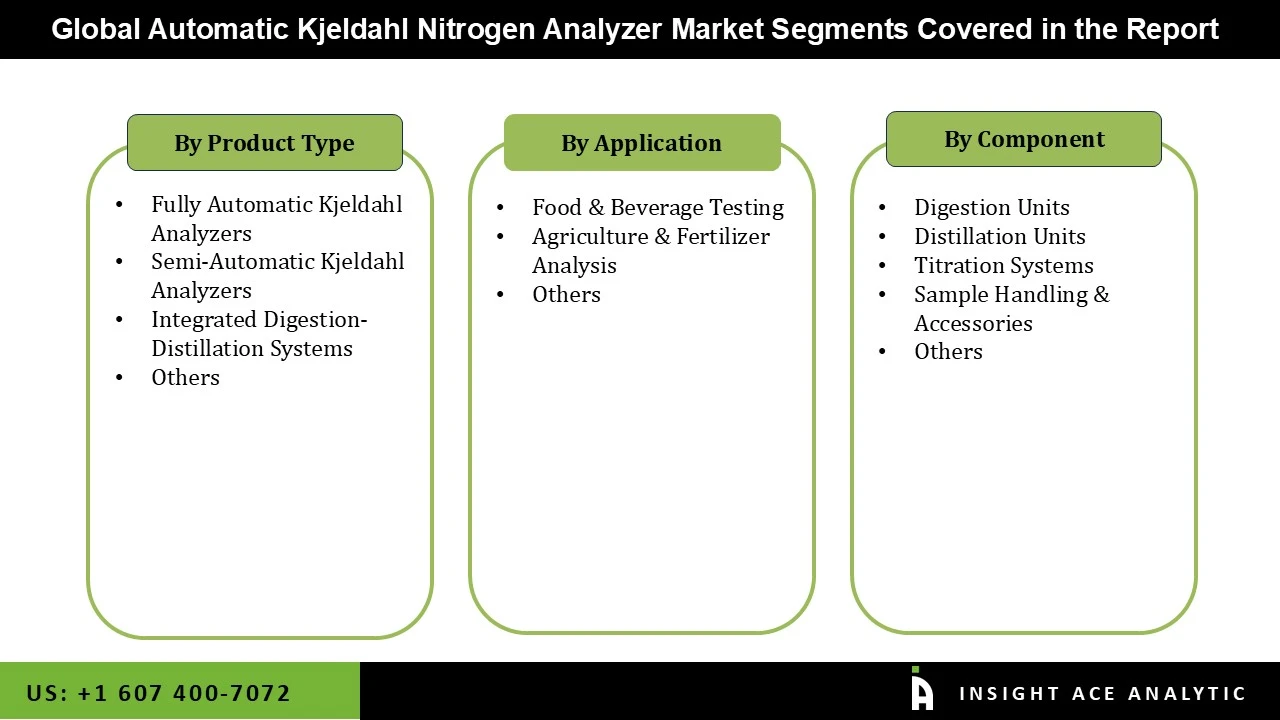
Automatic Kjeldahl Nitrogen Analyzer Market by Product Type-
• Integrated Digestion-Distillation Systems
• Fully Automatic Kjeldahl Analyzers
• Semi-Automatic Kjeldahl Analyzers
• Others
Automatic Kjeldahl Nitrogen Analyzer Market by Application-
• Agriculture & Fertilizer Analysis
• Food & Beverage Testing
• Others
By Region-
North America-
• The US
• Canada
Europe-
• Germany
• The UK
• France
• Italy
• Spain
• Rest of Europe
Asia-Pacific-
• China
• Japan
• India
• South Korea
• South East Asia
• Rest of Asia Pacific
Latin America-
• Brazil
• Argentina
• Mexico
• Rest of Latin America
Middle East & Africa-
• GCC Countries
• South Africa
• Rest of Middle East and Africa
Research Design and Approach
This study employed a multi-step, mixed-method research approach that integrates:
- Secondary research
- Primary research
- Data triangulation
- Hybrid top-down and bottom-up modelling
- Forecasting and scenario analysis
This approach ensures a balanced and validated understanding of both macro- and micro-level market factors influencing the market.
Secondary Research
Secondary research for this study involved the collection, review, and analysis of publicly available and paid data sources to build the initial fact base, understand historical market behaviour, identify data gaps, and refine the hypotheses for primary research.
Sources Consulted
Secondary data for the market study was gathered from multiple credible sources, including:
- Government databases, regulatory bodies, and public institutions
- International organizations (WHO, OECD, IMF, World Bank, etc.)
- Commercial and paid databases
- Industry associations, trade publications, and technical journals
- Company annual reports, investor presentations, press releases, and SEC filings
- Academic research papers, patents, and scientific literature
- Previous market research publications and syndicated reports
These sources were used to compile historical data, market volumes/prices, industry trends, technological developments, and competitive insights.

Primary Research
Primary research was conducted to validate secondary data, understand real-time market dynamics, capture price points and adoption trends, and verify the assumptions used in the market modelling.
Stakeholders Interviewed
Primary interviews for this study involved:
- Manufacturers and suppliers in the market value chain
- Distributors, channel partners, and integrators
- End-users / customers (e.g., hospitals, labs, enterprises, consumers, etc., depending on the market)
- Industry experts, technology specialists, consultants, and regulatory professionals
- Senior executives (CEOs, CTOs, VPs, Directors) and product managers
Interview Process
Interviews were conducted via:
- Structured and semi-structured questionnaires
- Telephonic and video interactions
- Email correspondences
- Expert consultation sessions
Primary insights were incorporated into demand modelling, pricing analysis, technology evaluation, and market share estimation.
Data Processing, Normalization, and Validation
All collected data were processed and normalized to ensure consistency and comparability across regions and time frames.
The data validation process included:
- Standardization of units (currency conversions, volume units, inflation adjustments)
- Cross-verification of data points across multiple secondary sources
- Normalization of inconsistent datasets
- Identification and resolution of data gaps
- Outlier detection and removal through algorithmic and manual checks
- Plausibility and coherence checks across segments and geographies
This ensured that the dataset used for modelling was clean, robust, and reliable.
Market Size Estimation and Data Triangulation
Bottom-Up Approach
The bottom-up approach involved aggregating segment-level data, such as:
- Company revenues
- Product-level sales
- Installed base/usage volumes
- Adoption and penetration rates
- Pricing analysis
This method was primarily used when detailed micro-level market data were available.

Top-Down Approach
The top-down approach used macro-level indicators:
- Parent market benchmarks
- Global/regional industry trends
- Economic indicators (GDP, demographics, spending patterns)
- Penetration and usage ratios
This approach was used for segments where granular data were limited or inconsistent.
Hybrid Triangulation Approach
To ensure accuracy, a triangulated hybrid model was used. This included:
- Reconciling top-down and bottom-up estimates
- Cross-checking revenues, volumes, and pricing assumptions
- Incorporating expert insights to validate segment splits and adoption rates
This multi-angle validation yielded the final market size.
Forecasting Framework and Scenario Modelling
Market forecasts were developed using a combination of time-series modelling, adoption curve analysis, and driver-based forecasting tools.
Forecasting Methods
- Time-series modelling
- S-curve and diffusion models (for emerging technologies)
- Driver-based forecasting (GDP, disposable income, adoption rates, regulatory changes)
- Price elasticity models
- Market maturity and lifecycle-based projections
Scenario Analysis
Given inherent uncertainties, three scenarios were constructed:
- Base-Case Scenario: Expected trajectory under current conditions
- Optimistic Scenario: High adoption, favourable regulation, strong economic tailwinds
- Conservative Scenario: Slow adoption, regulatory delays, economic constraints
Sensitivity testing was conducted on key variables, including pricing, demand elasticity, and regional adoption.
Request Customization
Add countries, segments, company profiles, or extend forecast — free 10% customization with purchase.
Customize This Report →Enquire Before Buying
Speak with our analyst team about scope, methodology, pricing, or deliverable formats.
Enquire Now →Frequently Asked Questions
Automatic Kjeldahl Nitrogen Analyzer Market Size is valued at USD 368.32 Mn in 2025 and is predicted to reach USD 707.57 Mn by the year 2035
Automatic Kjeldahl Nitrogen Analyzer Market Size is predicted to witness at a 6.9% CAGR during the forecast period for 2026 to 2035.
Thermo Fisher Scientific, Elementar Analysensysteme GmbH, C. Gerhardt GmbH & Co. KG, FOSS Analytical A/S, Metrohm AG, OPSIS AB, VELP Scientifica Srl, Hanon Instruments Co., Ltd., PerkinElmer Inc., BUCHI Labortechnik AG, Shimadzu Corporation, Yamato Scientific Co., Ltd., Skalar Analytical B.V., Bruker Corporation, and Others.
Automatic Kjeldahl Nitrogen Analyzer Market is segmented into Component, Product Type, Application, and By Region.
North America region is leading the Automatic Kjeldahl Nitrogen Analyzer Market.