Pet Biotics Market Size, Share and Forecast 2026 to 2035
Pet Biotics Market Size is valued at USD 847.21 Mn in 2025 and is predicted to reach USD 1,889.12 Mn by the year 2035 at a 8.8% CAGR during the forecast period for 2026 to 2035.
Pet Biotics Market Size, Share & Trends Analysis Distribution by Product Type (Probiotics, Prebiotics, Postbiotics), Application (Dry Food, Wet Food, Supplements, Snacks & Treats), by pets (Dogs, Cats, Other Pets (Birds, Equine, And Other Small Mammals)), by function (Digestive/Gut Health, Immune Modulation, Metabolic & Weight Management, Oral & Dental Health, Other Functions), by form(dry, wet), by Manufacturing Technology (Fermentation, Centrifugation & Filtration, Drying & Stabilization, Encapsulation & Protection, Inactivation & Cell Disruption, Formulation & Blending, Quality Control & Storage),and Segment Forecasts, 2026 to 2035
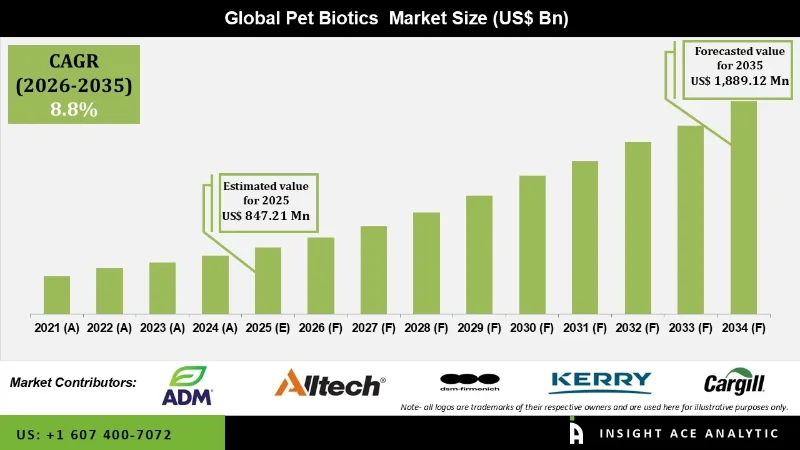
Pet biotics are natural health products designed to support pets' overall well-being, focusing on gut health, immunity, and digestion. These beneficial ingredients include probiotics, prebiotics, and postbiotics, which are added to pet food, treats, and supplements to support pets' health and activity. With growing awareness among pet owners about the importance of preventive care and proper nutrition, pet biotics are becoming an essential part of daily pet care. They offer a natural, safe, and effective way to enhance pets’ well-being and quality of life across dogs, cats, and other small animals. As more people understand how important gut health is for pets’ overall wellness, nutrition, and long-term health, the demand for pet biotics is increasing rapidly.
The pet biotics market is growing rapidly as more pet owners focus on their pets’ health and well-being. One of the main reasons behind this growth is the increasing awareness of gut health, with owners seeking probiotics, prebiotics, and postbiotics to support digestion and immunity. Pet humanization also plays a role, as pets are treated like family members, encouraging spending on premium health products. Preventive care and functional nutrition are gaining attention, with owners choosing products to avoid health issues. Veterinarian recommendations influence adoption, as professionals guide owners on the benefits of biotics. Additionally, innovation in product formulation and easier availability of foods, treats, and supplements are further fueling market growth.
The challenges in the pet biotics industry remain limited, with long-term research showing that certain biotic strains are effective for pets, which can make both veterinarians and pet owners hesitant. Another issue is maintaining product quality, as the beneficial bacteria can lose their strength during production, storage, or transport. Cost is also a concern, since high-quality pet biotic products are often more expensive and may not be affordable for everyone.
In addition, some pet owners are still not fully aware of how pet biotics work or how they benefit their pets, which can slow wider adoption. One major opportunity in the pet biotics market is the growing demand for personalized and condition-specific pet nutrition. Pet owners are increasingly looking for targeted solutions for issues such as sensitive digestion, allergies, weight management, and immune support. This creates strong potential for pet biotic products tailored to specific life stages, breeds, or health conditions, offered through cust
Competitive Landscape
Which are the Leading Players in the Pet Biotics Market?
• ADM (US)
• Alltech (US)
• dsm-firmenich (Netherlands)
• International Flavors & Fragrances Inc. (US)
• Kerry Group plc (Ireland)
• Cargill, Incorporated (US)
• Probi (Sweden)
• Kemin Industries, Inc. (US)
• BENEO GmbH (Germany)
• Ingredion (US)
• Lallemand Inc. (Canada)
• Sacco System (Italy)
• Phileo by Lesaffre (France)
• Sanzyme Biologics (India)
• Orffa (Netherlands)
Market Dynamics
Driver
Growing Awareness about gut health of pets.
The pet biotics market is mainly driven by the growing awareness about the importance of gut health is for pets. Pet owners are learning that a healthy gut supports better digestion, stronger immunity, and overall well-being. As a result, many are choosing products that contain probiotics, prebiotics, and postbiotics to help their pets stay healthy and comfortable. This shift in understanding has encouraged owners to be more proactive about their pets’ nutrition, making gut-health-focused products a regular part of daily pet care. This awareness is shaping buying decisions and playing a key role in the steady growth of the pet biotics market.
Restrain/Challenge
Limited Long-Term Clinical Evidence for Pet Biotics as a Major Hurdle.
One of the biggest challenges in the pet biotics market is the lack of strong, long-term scientific research proving the effectiveness of specific biotic strains in pets. While short-term benefits are often reported, limited clinical studies make some veterinarians cautious about regularly recommending these products. This uncertainty can also affect pet owners, who may hesitate to invest in biotic supplements without clear evidence of long-term results. As a result, trust and confidence in pet biotics can develop slowly. Additionally, inconsistent research findings across different products and strains make it harder to set clear guidelines. Until more validated studies and clinical data are available, this challenge is likely to continue affecting wider adoption and market growth.
Market Segmentation:
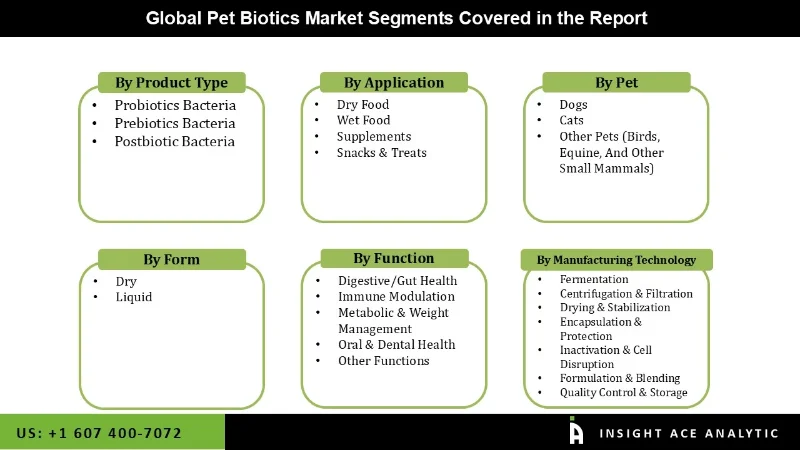
The Pet Biotics market is segmented across several key dimensions: product type, application, pet type, function, form, and manufacturing technology. By product type, the market includes probiotics, prebiotics, and yeast & fungi, catering to different nutritional and health needs. Segmentation by application covers major uses such as dry food, wet food, supplements, and snacks & treats.
The market is also analyzed by pet type, including dogs, cats, and other pets such as birds, equine, and other small mammals, reflecting the diverse target audience for these products. Functional segmentation focuses on digestive/gut health, immune modulation, metabolic & weight management, oral & dental health, and other specific health functions. By form, products are categorized into dry and wet formats to suit various feeding preferences. Finally, the market is defined by manufacturing technology, encompassing fermentation, centrifugation & filtration, drying & stabilization, encapsulation & protection, inactivation & cel
How Is The Postbiotics And Beneficial Microbes Segment Expected To Drive The Pet Biotics Market?
The postbiotics and beneficial microbes segment, including lactobacillus, bifidobacterium, and yeast strains such as Saccharomyces Boulardii and Saccharomyces Cerevisiae, held a significant share in the pet biotics market. This growth is driven by the increasing awareness of gut health and the role of beneficial microbes in supporting digestion, immunity, and overall wellness in pets. These strains are favored for their stability, safety, and effectiveness, making them suitable for inclusion in pet food, treats, and supplements. The demand for this segment is further boosted by veterinarians recommending these microbes to manage digestive issues, maintain gut balance, and promote preventive health in dogs, cats, and other small pets.
Is The Supplement Segment Growing At The Highest Rate In The Pet Biotics Market?
The Supplement segment is expected to grow at the fastest rate in the pet biotics market, and for better reasons. Pet supplements are an easy and effective way to deliver probiotics, prebiotics, and postbiotics directly to pets, helping support digestion, strengthen immunity, and improve overall health. Unlike functional foods, supplements allow for precise dosing and can be tailored to specific health needs, such as sensitive digestion, weight management, or immune support.
The convenience of capsules, powders, chewables, and soft treats makes them highly appealing to pet owners. Increasing awareness of preventive care, recommendations from veterinarians, and the trend of treating pets as family members are all driving the strong adoption and rapid growth of this segment.
What Factors Are Driving Asia Pacific To Be The Fastest-Growing Region In The Pet Biotics Market Development?
Asia Pacific is emerging as a leader in the pet biotics market due to several key factors. The region is seeing a rapid increase in pet ownership, with more households adopting dogs, cats, and other small pets. Pet owners are increasingly aware of the importance of digestive health, immunity, and overall wellness, driving demand for probiotics, prebiotics, and postbiotics.
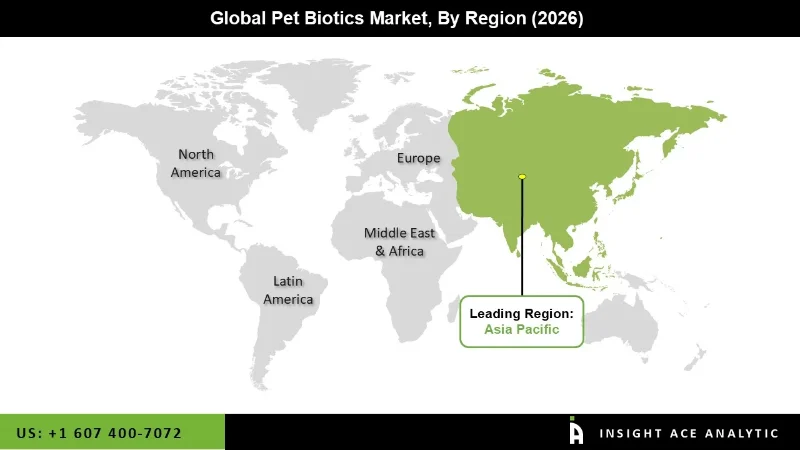
Rising disposable incomes and a growing middle class make premium pet nutrition products more accessible. Additionally, expanding retail and e-commerce channels, along with the introduction of innovative pet supplements and foods, are making biotic products easier to purchase. Together, these factors position Asia Pacific at the forefront of market growth.
Key Development
- October 2025: dsm firmenich opened a new automated pet-only premix facility in Tonganoxie, Kansas. The facility produce advanced pet nutrition ingredients and meet the growing demand for innovative pet products in North America.
- June 2025: ADM opened a new advanced R&D center at Lausanne’s biopôle campus in Switzerland, focused on microbiome research for pets, livestock, and aquaculture. This facility aims to enhance biotic ingredients that support gut health, immunity, and digestion for the pets.
Pet Biotics Market Report Scope:
| Report Attribute | Specifications |
| Market size value in 2025 | USD 847.21 Mn |
| Revenue forecast in 2035 | USD 1,889.12 Mn |
| Growth Rate CAGR | CAGR of 8.8 from 2026 to 2035 |
| Quantitative Units | Representation of revenue in US$ Mn and CAGR from 2026 to 2035 |
| Historic Year | 2022 to 2024 |
| Forecast Year | 2026-2035 |
| Report Coverage | The forecast of revenue, the position of the company, the competitive market structure, growth prospects, and trends |
| Segments Covered | By Product Type, Pet Type, Form, Function, Manufacturing technology and by Region. |
| Regional Scope | North America; Europe; Asia Pacific; Latin America; Middle East & Africa |
| Country Scope | U.S.; Canada; U.K.; Germany; China; India; Japan; Brazil; Mexico; The UK; France; Italy; Spain; China; Japan; India; South Korea; Southeast Asia; South Korea; Southeast Asia |
| Competitive Landscape | ADM(US), Alltech(US), dsm-firmenich(Netherlands), International Flavors & Fragrances Inc.(US), Kerry Group plc(Ireland), Cargill, Incorporated (US), Probi (Sweden), Kemin Industries, Inc.(US), BENEO GmbH(Germany), Ingredion(US), Lallemand Inc.(Canada), Sacco System(Italy), Phileo by Lesaffre(France), Sanzyme Biologics(India), Orffa(Netherlands) |
| Customization Scope | Free customization report with the procurement of the report, Modifications to the regional and segment scope. Geographic competitive landscape. |
| Pricing and Available Payment Methods | Explore pricing alternatives that are customized to your particular study requirements. |
Pet Biotics Market Segmentation:
Pet Biotics Market by Product Type-
- Probiotics Bacteria
-
- Lactobacillus
- Bifidobacterium
- Bacillus
- Enterococcus
- Streptococcus Thermophilus
- Yeast & Fungi
-
-
- Saccharomyces Boulardii
- Saccharomyces Cerevisiae
- Other Yeast & Fungi
-
- Prebiotics Bacteria
-
- Oligosaccharides
- Fructooligosaccharides (Fos)
- Galactooligosaccharides (Gos)
- Mannanoligosaccharides (Mos)
- Other Oligosaccharides
-
-
- Inulin
- Polydextrose
-
-
- Other Prebiotic Ingredient Types (Beta-Glucans, Resistant Starches, Pectin)
- Postbiotics Bacteria
-
- Lactobacillus
- Bifidobacterium
- Other Bacteria
- Yeast
-
-
- Saccharomyces Boulardii
- Saccharomyces Cerevisiae
-
Pet Biotics Market by Application-
- Dry Food
- Wet Food
- Supplements
- Snacks & Treats
Pet Biotics Market by Pet-
- Dogs
- Cats
- Other Pets (Birds, Equine, And Other Small Mammals)
Pet Biotics Market by Form-
- Dry
- Liquid
Pet Biotics Market by Function-
- Digestive/Gut Health
- Immune Modulation
- Metabolic & Weight Management
- Oral & Dental Health
- Other Functions
Pet Biotics Market by Manufacturing Technology-
- Fermentation
- Centrifugation & Filtration
- Drying & Stabilization
- Encapsulation & Protection
- Inactivation & Cell Disruption
- Formulation & Blending
- Quality Control & Storage
Pet Biotics Market By Region-
- North America-
• The US
• Canada
- Europe-
• Germany
• The UK
• France
• Italy
• Spain
• Rest of Europe
- Asia-Pacific-
• China
• Japan
• India
• South Korea
• South East Asia
• Rest of Asia Pacific
- Latin America-
• Brazil
• Argentina
• Mexico
• Rest of Latin America
- Middle East & Africa-
• GCC Countries
• South Africa
• Rest of Middle East and Africa
Research Design and Approach
This study employed a multi-step, mixed-method research approach that integrates:
- Secondary research
- Primary research
- Data triangulation
- Hybrid top-down and bottom-up modelling
- Forecasting and scenario analysis
This approach ensures a balanced and validated understanding of both macro- and micro-level market factors influencing the market.
Secondary Research
Secondary research for this study involved the collection, review, and analysis of publicly available and paid data sources to build the initial fact base, understand historical market behaviour, identify data gaps, and refine the hypotheses for primary research.
Sources Consulted
Secondary data for the market study was gathered from multiple credible sources, including:
- Government databases, regulatory bodies, and public institutions
- International organizations (WHO, OECD, IMF, World Bank, etc.)
- Commercial and paid databases
- Industry associations, trade publications, and technical journals
- Company annual reports, investor presentations, press releases, and SEC filings
- Academic research papers, patents, and scientific literature
- Previous market research publications and syndicated reports
These sources were used to compile historical data, market volumes/prices, industry trends, technological developments, and competitive insights.

Primary Research
Primary research was conducted to validate secondary data, understand real-time market dynamics, capture price points and adoption trends, and verify the assumptions used in the market modelling.
Stakeholders Interviewed
Primary interviews for this study involved:
- Manufacturers and suppliers in the market value chain
- Distributors, channel partners, and integrators
- End-users / customers (e.g., hospitals, labs, enterprises, consumers, etc., depending on the market)
- Industry experts, technology specialists, consultants, and regulatory professionals
- Senior executives (CEOs, CTOs, VPs, Directors) and product managers
Interview Process
Interviews were conducted via:
- Structured and semi-structured questionnaires
- Telephonic and video interactions
- Email correspondences
- Expert consultation sessions
Primary insights were incorporated into demand modelling, pricing analysis, technology evaluation, and market share estimation.
Data Processing, Normalization, and Validation
All collected data were processed and normalized to ensure consistency and comparability across regions and time frames.
The data validation process included:
- Standardization of units (currency conversions, volume units, inflation adjustments)
- Cross-verification of data points across multiple secondary sources
- Normalization of inconsistent datasets
- Identification and resolution of data gaps
- Outlier detection and removal through algorithmic and manual checks
- Plausibility and coherence checks across segments and geographies
This ensured that the dataset used for modelling was clean, robust, and reliable.
Market Size Estimation and Data Triangulation
Bottom-Up Approach
The bottom-up approach involved aggregating segment-level data, such as:
- Company revenues
- Product-level sales
- Installed base/usage volumes
- Adoption and penetration rates
- Pricing analysis
This method was primarily used when detailed micro-level market data were available.

Top-Down Approach
The top-down approach used macro-level indicators:
- Parent market benchmarks
- Global/regional industry trends
- Economic indicators (GDP, demographics, spending patterns)
- Penetration and usage ratios
This approach was used for segments where granular data were limited or inconsistent.
Hybrid Triangulation Approach
To ensure accuracy, a triangulated hybrid model was used. This included:
- Reconciling top-down and bottom-up estimates
- Cross-checking revenues, volumes, and pricing assumptions
- Incorporating expert insights to validate segment splits and adoption rates
This multi-angle validation yielded the final market size.
Forecasting Framework and Scenario Modelling
Market forecasts were developed using a combination of time-series modelling, adoption curve analysis, and driver-based forecasting tools.
Forecasting Methods
- Time-series modelling
- S-curve and diffusion models (for emerging technologies)
- Driver-based forecasting (GDP, disposable income, adoption rates, regulatory changes)
- Price elasticity models
- Market maturity and lifecycle-based projections
Scenario Analysis
Given inherent uncertainties, three scenarios were constructed:
- Base-Case Scenario: Expected trajectory under current conditions
- Optimistic Scenario: High adoption, favourable regulation, strong economic tailwinds
- Conservative Scenario: Slow adoption, regulatory delays, economic constraints
Sensitivity testing was conducted on key variables, including pricing, demand elasticity, and regional adoption.
Request Customization
Add countries, segments, company profiles, or extend forecast — free 10% customization with purchase.
Customize This Report →Enquire Before Buying
Speak with our analyst team about scope, methodology, pricing, or deliverable formats.
Enquire Now →Frequently Asked Questions
Pet Biotics Market Size is valued at USD 847.21 Mn in 2025 and is predicted to reach USD 1,889.12 Mn by the year 2035.
Pet Biotics Market is expected to grow at a 8.8% CAGR during the forecast period for 2026 to 2035.
ADM(US), Alltech(US), dsm-firmenich(Netherlands), International Flavors & Fragrances Inc.(US), Kerry Group plc(Ireland), Cargill, Incorporated (US), Probi (Sweden), Kemin Industries, Inc.(US), BENEO GmbH(Germany), Ingredion(US), Lallemand Inc.(Canada), Sacco System(Italy), Phileo by Lesaffre(France), Sanzyme Biologics(India), Orffa(Netherlands)
By Product Type, Pet Type, Form, Function, Manufacturing technology and by Region are the key segments of the Pet Biotics Market.
Asia Pacific region is leading the Pet Biotics Market.