Probiotics, Prebiotics and Immunostimulants for Aquaculture Market Size and Scope 2026 to 2035
Warning: Trying to access array offset on value of type null in /home/z8nbkwptb7pj/public_html/report-details.php on line 219
Global Probiotics, Prebiotics and Immunostimulants for Aquaculture Market is likely to witness a 9.2% CAGR during the forecast period for 2026 to 2035.
Probiotics, Prebiotics and Immunostimulants for Aquaculture Market Size, Share & Trends Analysis Distribution By Product Type (Probiotics, Prebiotics, and Immunostimulants), By Form( Dry / Powder, Liquid, Micro-Encapsulated), By Application (Feed Additives, Water Treatment, Hatchery Applications, Disease Prevention / Functional Health, Others), By Species (Warm-Water Fish, Cold-Water Fish, Crustaceans, Mollusks), By Region and Segment Forecasts, 2026 to 2035.
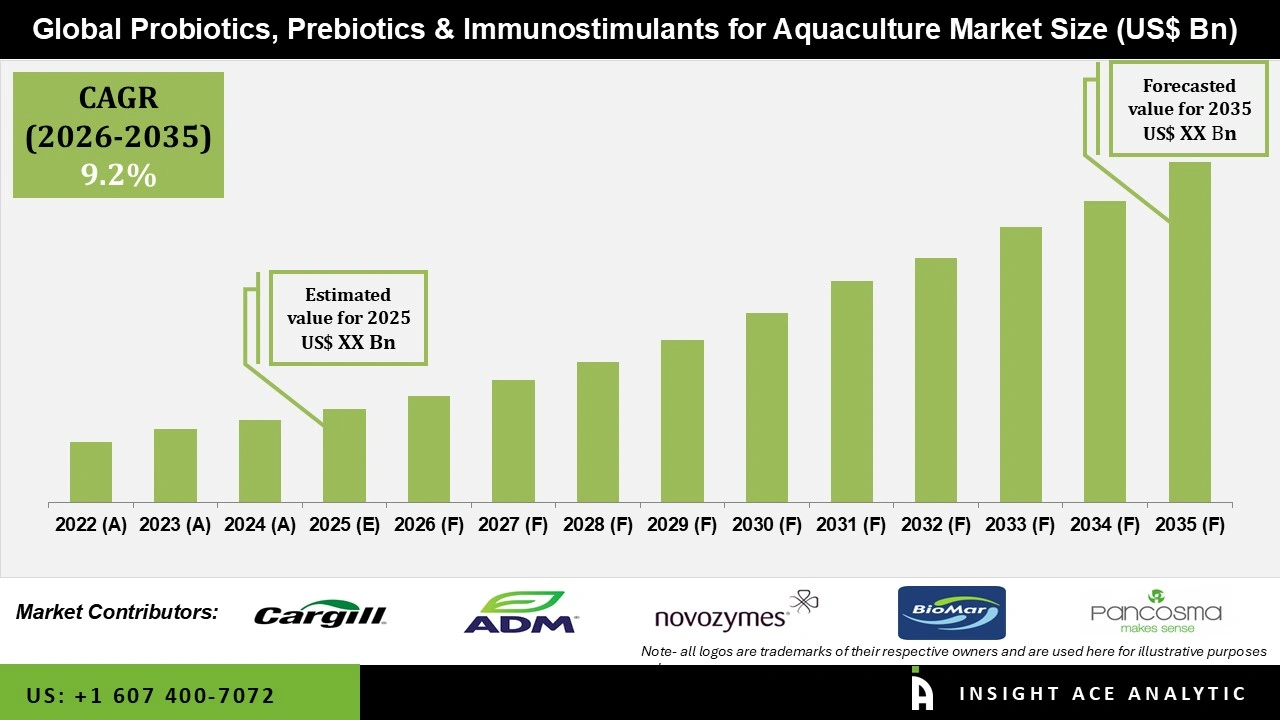
Probiotics, prebiotics, and immunostimulants are widely used in aquaculture to improve the health, growth, and disease resistance of fish and shrimp. These products support gut health, enhance nutrient absorption, and strengthen the immune system, helping aquatic species better withstand stress and infections. Probiotics contain beneficial microorganisms, prebiotics promote the growth of these microorganisms, and immunostimulants activate natural defense mechanisms. They are commonly applied in fish and shrimp farming to reduce disease outbreaks and limit the use of antibiotics. With the rising demand for sustainable seafood production, increasing disease challenges, and growing awareness of eco-friendly farming practices, the global probiotics, prebiotics, and immunostimulants for aquaculture market is expected to grow at a steady and significant pace.
The probiotics, prebiotics, and immunostimulants for aquaculture market is primarily driven by the increasing occurrence of diseases in fish and shrimp farming, which has created a strong need for solutions that improve animal health and reduce mortality. At the same time, growing consumer demand for antibiotic-free and safe seafood, along with stricter regulations on antibiotic usage, is encouraging farmers to shift toward natural and sustainable health-enhancing products. The rapid expansion of global aquaculture production to meet rising seafood consumption is further boosting demand for effective feed additives that support better growth and feed efficiency. Additionally, the industry’s increasing focus on eco-friendly farming practices and continuous advancements in aquaculture nutrition and feed technology are accelerating the adoption of probiotics, prebiotics, and immunostimulants worldwide.
Furthermore, The probiotics, prebiotics, and immunostimulants for aquaculture market faces several challenges that can affect its growth and adoption. High product costs often limit usage among small and medium-scale farmers who are highly price sensitive. In addition, a lack of awareness and technical understanding about proper application and dosage can reduce product effectiveness. The results of these products may also vary depending on species, water conditions, and farming practices, creating uncertainty for farmers. Moreover, complex and varying regulatory frameworks across regions can slow market entry. However, the rising global focus on sustainable and antibiotic-free aquaculture presents a strong opportunity, as producers increasingly seek natural, eco-friendly solutions to improve animal health and meet regulatory and consumer expectations.
Competitive Landscape
Which are the Leading Players in the Probiotics, Prebiotics & Immunostimulants for Aquaculture Market?
- Cargill, Incorporated
- Archer Daniels Midland Company (ADM)
- DSM-Firmenich AG
- Evonik Industries AG
- BASF SE
- Kemin Industries, Inc.
- Alltech, Inc.
- Novozymes A/S
- Skretting (Nutreco N.V.)
- BioMar Group A/S
- Aller Aqua Group A/S
- Ridley Corporation Limited
- Zeigler Bros., Inc.
- Grobest Holdings Limited
- Lallemand Inc.
- Biorigin (Zilor Group)
- Pancosma SA
- Norel S.A.
- Chr. Hansen Holding A/S
- Bluestar Adisseo Company
- ICC Brazil
- Synbio Tech Inc.
- Vinnbio India Pvt. Ltd.
- Biostadt India Limited
- Zeal Aqua Limited
- Avanti Feeds Limited
- BernAqua NV
- AquaBio Technology Group
- Inve Aquaculture NV
- Angel Yeast Co., Ltd.
- Lesaffre Group
- Ohly GmbH
- AB Vista
- Olmix Group
- BioMarin Energy Inc.
- PhytoBiotics Futterzusatzstoffe GmbH
- AquaInTech Inc.
- Huvepharma EOOD
Market Dynamics
Driver
Rising Disease Challenges Driving the Demand for Probiotics, Prebiotics & Immunostimulants for Aquaculture Market
The growing incidence of diseases in aquaculture is one of the key factors driving the demand for probiotics, prebiotics, and immunostimulants. Fish and shrimp farms often face challenges such as bacterial infections, poor water quality, and stress-related illnesses, which can lead to significant losses for farmers. To combat these issues, aquaculture producers are increasingly adopting natural solutions that improve gut health, enhance immunity, and promote overall survival and growth of aquatic species. These products not only help reduce dependency on antibiotics but also support sustainable and eco-friendly farming practices, making them essential for modern aquaculture operations.
Restrain/Challenge
High Cost Associated with Probiotics, Prebiotics & Immunostimulants for Aquaculture Market
The high cost of probiotics, prebiotics, and immunostimulants is one of the main challenges facing the aquaculture market. Small and medium-scale farmers, who form a large part of the industry, often find it difficult to afford these products, even though they offer significant benefits for fish and shrimp health. This price sensitivity can limit widespread adoption and slow market growth. While these solutions improve immunity, gut health, and overall survival of aquatic species, the upfront investment may seem high for farmers with tight budgets. Reducing costs, offering affordable formulations, and educating farmers on long-term benefits can help overcome this challenge and boost adoption.
Market Segmentation
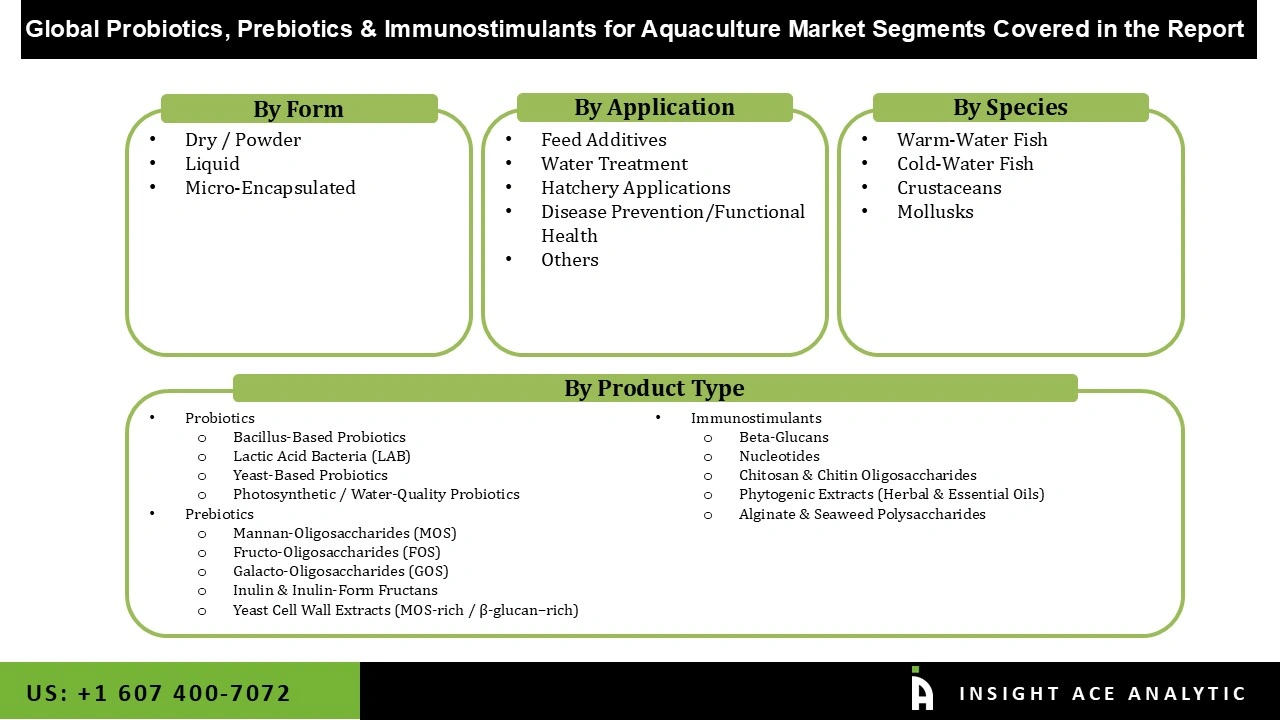
The Probiotics, Prebiotics & Immunostimulants for Aquaculture market is segmented across key dimensions including product type, form, application, and species. By product type, the market includes probiotics, prebiotics, and immunostimulants. Probiotics are further classified into Bacillus-based, lactic acid bacteria (LAB), yeast-based, and photosynthetic or water-quality probiotics, each supporting gut health and water stability. Prebiotics include mannan-oligosaccharides (MOS), fructo-oligosaccharides (FOS), galacto-oligosaccharides (GOS), inulin and inulin-form fructans, and yeast cell wall extracts, which promote beneficial microbial growth. Immunostimulants such as beta-glucans, nucleotides, chitosan derivatives, phytogenic extracts, and seaweed-based polysaccharides enhance immune response. By form, products are available as dry, liquid, or micro-encapsulated formulations. Based on application, the market covers feed additives, water treatment, hatchery use, disease prevention, and other functional health applications. By species, these solutions are used across warm-water fish, cold-water fish, crustaceans, and mollusks.
Micro-encapsulated Segment is Expected to Drive the Probiotics, Prebiotics & Immunostimulants for Aquaculture Market.
The micro-encapsulated segment is expected to experience strong growth in the probiotics, prebiotics, and immunostimulants for aquaculture market. This growth is driven by its ability to protect active ingredients from heat, moisture, and harsh processing conditions during feed manufacturing. Micro-encapsulation ensures better stability, controlled release, and higher absorption of beneficial compounds in fish and shrimp, resulting in improved effectiveness. Farmers are increasingly preferring these formulations because they deliver more consistent results, reduce nutrient loss, and offer better value over time. As aquaculture operations become more technology-driven and focused on efficiency and performance, the demand for advanced and reliable solutions such as micro-encapsulated products is expected to rise steadily.
Probiotics Segment is Growing at the Highest Rate in the Probiotics, Prebiotics & Immunostimulants for Aquaculture Market.
The probiotics segment is expected to witness strong growth in the probiotics, prebiotics, and immunostimulants for aquaculture market. This growth is mainly driven by the rising need to control diseases and improve overall fish and shrimp health in farming operations. Probiotics help maintain a healthy gut balance, improve digestion, enhance immunity, and reduce the presence of harmful pathogens in both the animal and the farming environment. Farmers increasingly prefer probiotics because they offer visible results, are easy to use through feed or water, and support antibiotic-free production. With growing awareness about sustainable aquaculture and the long-term benefits of preventive health management, the probiotics segment is likely to remain a key growth contributor in the market
Why Asia Pacific Led the Probiotics, Prebiotics & Immunostimulants for Aquaculture Market?
Asia Pacific led the probiotics, prebiotics, and immunostimulants for aquaculture market due to its strong dominance in global aquaculture production and high consumption of seafood. Countries such as China, India, Vietnam, Indonesia, and Thailand are major producers of fish and shrimp, creating a large and consistent demand for solutions that improve animal health and farm productivity.
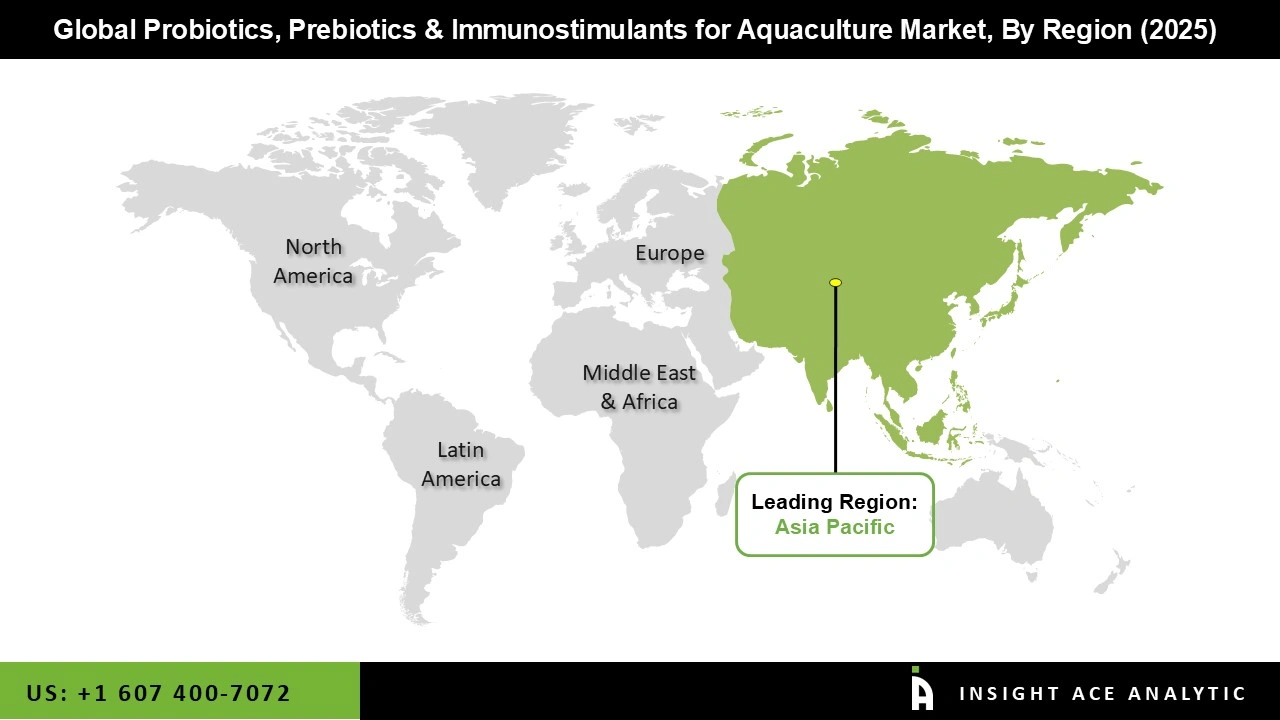
The region also faces frequent disease outbreaks and water quality challenges, which has increased the adoption of probiotics and immunostimulants as effective alternatives to antibiotics. In addition, growing awareness among farmers about sustainable farming practices, supportive government initiatives, and the presence of a large number of aquafeed manufacturers have further strengthened market growth. Rising exports of seafood and increasing focus on quality, safety, and yield efficiency continue to position Asia Pacific as the leading regional market.
Key Development:
- January 2025: Aquaintech, Inc. has launched PRO4000X, a tableted probiotic combining Bacillus subtilis and B. licheniformis, which reached nearly 1 million kg in global sales and was widely adopted by shrimp and fish farmers in 2025 which improve the health and performance of fish and shrimp in aquaculture systems.
- March 2024: Novozymes A/S has Introduced a new yeast-based prebiotic for tropical shrimp farming in designed to improve immunity and stress resistance in commercial operations.
Probiotics, Prebiotics anc Immunostimulants for Aquaculture Market Report Scope :
| Report Attribute | Specifications |
| Growth Rate CAGR | CAGR of 9.2% from 2026 to 2035 |
| Quantitative Units | Representation of revenue in US$ Bn and CAGR from 2025 to 2035 |
| Historic Year | 2022 to 2024 |
| Forecast Year | 2026-2035 |
| Report Coverage | The forecast of revenue, the position of the company, the competitive market structure, growth prospects, and trends |
| Segments Covered | Product Type, Form, Application,Species, and By Region |
| Regional Scope | North America; Europe; Asia Pacific; Latin America; Middle East & Africa |
| Country Scope | U.S.; Canada; U.K.; Germany; China; India; Japan; Brazil; Mexico; The UK; France; Italy; Spain; China; Japan; India; South Korea; Southeast Asia; South Korea; Southeast Asia |
| Competitive Landscape | Cargill, Incorporated, Archer Daniels Midland Company (ADM), DSM-Firmenich AG, Evonik Industries AG, BASF SE, Kemin Industries, Inc., Alltech, Inc., Novozymes A/S, Skretting (Nutreco N.V.), BioMar Group A/S, Aller Aqua Group A/S, Ridley Corporation Limited, Zeigler Bros., Inc., Grobest Holdings Limited, Lallemand Inc., Biorigin (Zilor Group), Pancosma SA, Norel S.A., Chr. Hansen Holding A/S, Bluestar Adisseo Company, ICC Brazil, Synbio Tech Inc., Vinnbio India Pvt. Ltd., Biostadt India Limited, Zeal Aqua Limited, Avanti Feeds Limited, BernAqua NV, AquaBio Technology Group, Inve Aquaculture NV, Angel Yeast Co., Ltd., Lesaffre Group, Ohly GmbH, AB Vista, Olmix Group, BioMarin Energy Inc., PhytoBiotics Futterzusatzstoffe GmbH, AquaInTech Inc., Huvepharma EOOD |
| Customization Scope | Free customization report with the procurement of the report, Modifications to the regional and segment scope. Geographic competitive landscape. |
| Pricing and Available Payment Methods | Explore pricing alternatives that are customized to your particular study requirements. |
Segmentations of Probiotics, Prebiotics and Immunostimulants for Aquaculture Market :
Probiotics, Prebiotics and Immunostimulants for Aquaculture Market by Product Type –
- Probiotics
- Bacillus-Based Probiotics
- Lactic Acid Bacteria (LAB)
- Yeast-Based Probiotics
- Photosynthetic / Water-Quality Probiotics
- Prebiotics
- Mannan-Oligosaccharides (MOS)
- Fructo-Oligosaccharides (FOS)
- Galacto-Oligosaccharides (GOS)
- Inulin & Inulin-Form Fructans
- Yeast Cell Wall Extracts (MOS-rich / β-glucan–rich)
- Immunostimulants
- Beta-Glucans
- Nucleotides
- Chitosan & Chitin Oligosaccharides
- Phytogenic Extracts (Herbal & Essential Oils)
- Alginate & Seaweed Polysaccharides
Probiotics, Prebiotics and Immunostimulants for Aquaculture Market by Form –
- Dry / Powder
- Liquid
- Micro-Encapsulated
Probiotics, Prebiotics and Immunostimulants for Aquaculture Market by Application –
- Feed Additives
- Water Treatment
- Hatchery Applications
- Disease Prevention / Functional Health
- Others
Probiotics, Prebiotics and Immunostimulants for Aquaculture Market by Species –
- Warm-Water Fish
- Cold-Water Fish
- Crustaceans
- Mollusks
Probiotics, Prebiotics and Immunostimulants for Aquaculture Market By Region-
- North America-
- The US
- Canada
- Europe-
- Germany
- The UK
- France
- Italy
- Spain
- Rest of Europe
- Asia-Pacific-
- China
- Japan
- India
- South Korea
- South East Asia
- Rest of Asia Pacific
- Latin America-
- Brazil
- Argentina
- Mexico
- Rest of Latin America
- Middle East & Africa-
- GCC Countries
- South Africa
- Rest of Middle East and Africa
Research Design and Approach
This study employed a multi-step, mixed-method research approach that integrates:
- Secondary research
- Primary research
- Data triangulation
- Hybrid top-down and bottom-up modelling
- Forecasting and scenario analysis
This approach ensures a balanced and validated understanding of both macro- and micro-level market factors influencing the market.
Secondary Research
Secondary research for this study involved the collection, review, and analysis of publicly available and paid data sources to build the initial fact base, understand historical market behaviour, identify data gaps, and refine the hypotheses for primary research.
Sources Consulted
Secondary data for the market study was gathered from multiple credible sources, including:
- Government databases, regulatory bodies, and public institutions
- International organizations (WHO, OECD, IMF, World Bank, etc.)
- Commercial and paid databases
- Industry associations, trade publications, and technical journals
- Company annual reports, investor presentations, press releases, and SEC filings
- Academic research papers, patents, and scientific literature
- Previous market research publications and syndicated reports
These sources were used to compile historical data, market volumes/prices, industry trends, technological developments, and competitive insights.

Primary Research
Primary research was conducted to validate secondary data, understand real-time market dynamics, capture price points and adoption trends, and verify the assumptions used in the market modelling.
Stakeholders Interviewed
Primary interviews for this study involved:
- Manufacturers and suppliers in the market value chain
- Distributors, channel partners, and integrators
- End-users / customers (e.g., hospitals, labs, enterprises, consumers, etc., depending on the market)
- Industry experts, technology specialists, consultants, and regulatory professionals
- Senior executives (CEOs, CTOs, VPs, Directors) and product managers
Interview Process
Interviews were conducted via:
- Structured and semi-structured questionnaires
- Telephonic and video interactions
- Email correspondences
- Expert consultation sessions
Primary insights were incorporated into demand modelling, pricing analysis, technology evaluation, and market share estimation.
Data Processing, Normalization, and Validation
All collected data were processed and normalized to ensure consistency and comparability across regions and time frames.
The data validation process included:
- Standardization of units (currency conversions, volume units, inflation adjustments)
- Cross-verification of data points across multiple secondary sources
- Normalization of inconsistent datasets
- Identification and resolution of data gaps
- Outlier detection and removal through algorithmic and manual checks
- Plausibility and coherence checks across segments and geographies
This ensured that the dataset used for modelling was clean, robust, and reliable.
Market Size Estimation and Data Triangulation
Bottom-Up Approach
The bottom-up approach involved aggregating segment-level data, such as:
- Company revenues
- Product-level sales
- Installed base/usage volumes
- Adoption and penetration rates
- Pricing analysis
This method was primarily used when detailed micro-level market data were available.

Top-Down Approach
The top-down approach used macro-level indicators:
- Parent market benchmarks
- Global/regional industry trends
- Economic indicators (GDP, demographics, spending patterns)
- Penetration and usage ratios
This approach was used for segments where granular data were limited or inconsistent.
Hybrid Triangulation Approach
To ensure accuracy, a triangulated hybrid model was used. This included:
- Reconciling top-down and bottom-up estimates
- Cross-checking revenues, volumes, and pricing assumptions
- Incorporating expert insights to validate segment splits and adoption rates
This multi-angle validation yielded the final market size.
Forecasting Framework and Scenario Modelling
Market forecasts were developed using a combination of time-series modelling, adoption curve analysis, and driver-based forecasting tools.
Forecasting Methods
- Time-series modelling
- S-curve and diffusion models (for emerging technologies)
- Driver-based forecasting (GDP, disposable income, adoption rates, regulatory changes)
- Price elasticity models
- Market maturity and lifecycle-based projections
Scenario Analysis
Given inherent uncertainties, three scenarios were constructed:
- Base-Case Scenario: Expected trajectory under current conditions
- Optimistic Scenario: High adoption, favourable regulation, strong economic tailwinds
- Conservative Scenario: Slow adoption, regulatory delays, economic constraints
Sensitivity testing was conducted on key variables, including pricing, demand elasticity, and regional adoption.
Request Customization
Add countries, segments, company profiles, or extend forecast — free 10% customization with purchase.
Customize This Report →Enquire Before Buying
Speak with our analyst team about scope, methodology, pricing, or deliverable formats.
Enquire Now →Frequently Asked Questions
Probiotics, Prebiotics and Immunostimulants for Aquaculture Market is likely to witness a 9.2% CAGR during the forecast period for 2026 to 2035.
Cargill, Incorporated, Archer Daniels Midland Company (ADM), DSM-Firmenich AG, Evonik Industries AG, BASF SE, Kemin Industries, Inc., Alltech, Inc., Novozymes A/S, Skretting (Nutreco N.V.), BioMar Group A/S, Aller Aqua Group A/S, Ridley Corporation Limited, Zeigler Bros., Inc., Grobest Holdings Limited, Lallemand Inc., Biorigin (Zilor Group), Pancosma SA, Norel S.A., Chr. Hansen Holding A/S, Bluestar Adisseo Company, ICC Brazil, Synbio Tech Inc. and Others
Probiotics, Prebiotics and Immunostimulants for Aquaculture Market is Segmented in Distribution By Product Type (Probiotics, Prebiotics, and Immunostimulants), By Form( Dry / Powder, Liquid, Micro-Encapsulated), By Application (Feed Additives, Water Treatment, Hatchery Applications, Disease Prevention / Functional Health, Others), By Species (Warm-Water Fish, Cold-Water Fish, Crustaceans, Mollusks) and Other.
North America region is leading the Probiotics, Prebiotics and Immunostimulants for Aquaculture Market.