Nicotine-Free Smoking Device Market Size, Scope, Forecast Report 2026 to 2035
What is Nicotine-Free Smoking Device Market Size?
Global Nicotine-Free Smoking Device Market Size is valued at USD 2.86 Bn in 2025 and is predicted to reach USD 13.11 Bn by the year 2035 at a 16.6% CAGR during the forecast period for 2026 to 2035.
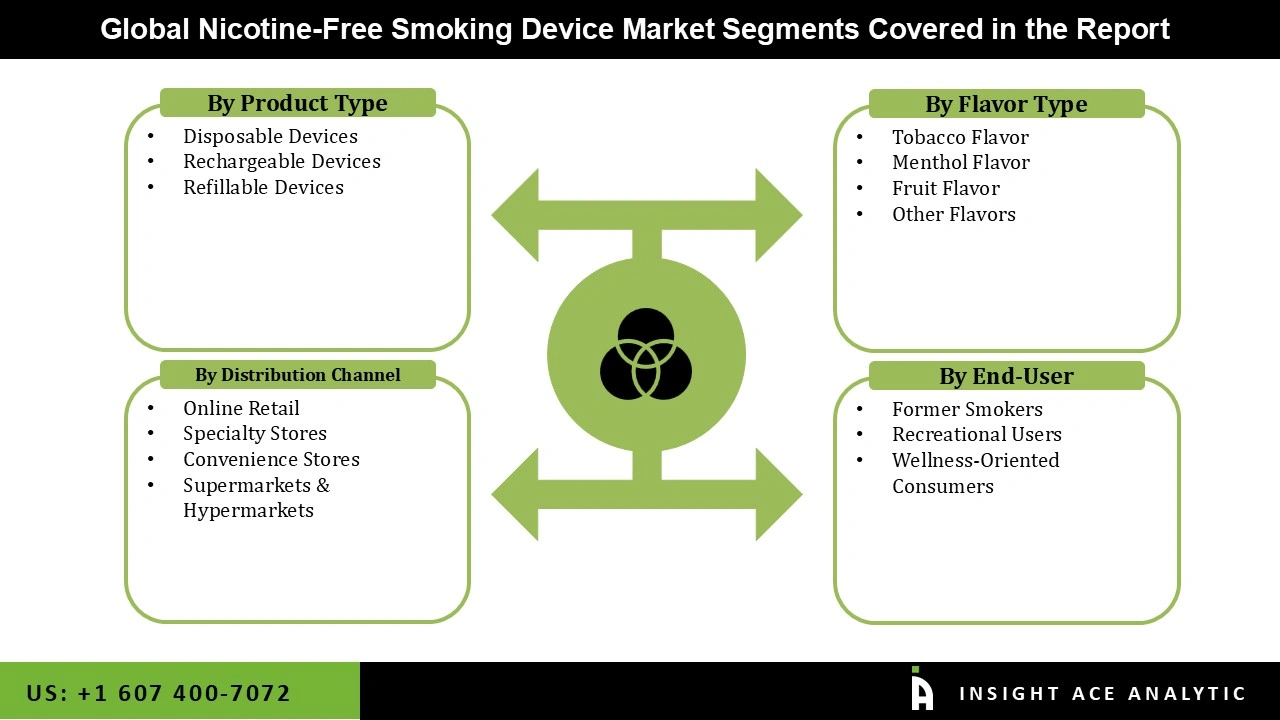
Nicotine-Free Smoking Device Market Size, Share & Trends Analysis By Product Type (Disposable Devices, Rechargeable Devices, and Refillable Devices), Flavor Type (Tobacco Flavor, Menthol Flavor, Fruit Flavor, and Other Flavor), Distribution Channel (Online Retail, Specialty Stores, Convenience Stores, and Supermarkets & Hypermarkets), End-User (Former Smokers, Recreational Users, and Wellness-Oriented Consumers), and Segment Forecasts, 2026 to 2035.
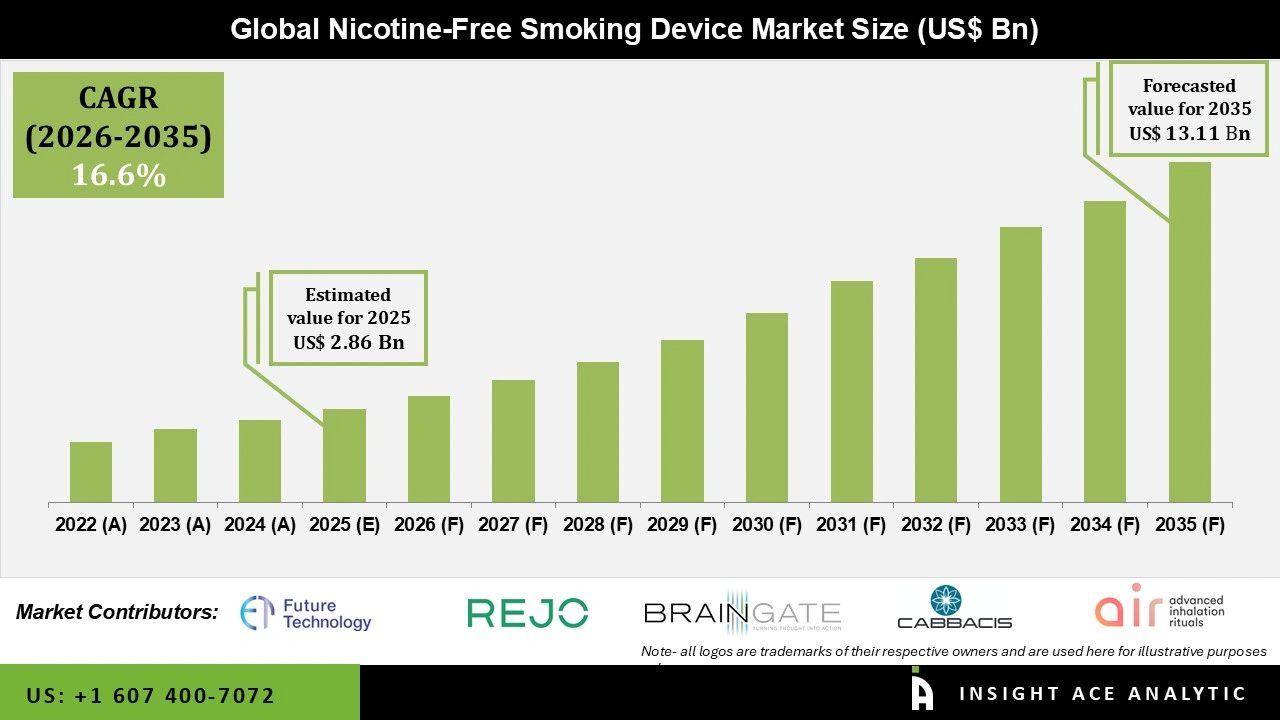
Nicotine-free smoking products are smoking devices that allow users to simulate smoking habits but do not deliver any nicotine or tobacco to the body. Such devices may be based on various formulas including herbs, essential oils, flavored air, or heat technology that creates a vapor or aroma and become popular for consumers who want to decrease their nicotine intake. In addition, the market includes reusable and disposable devices that are getting more popular due to healthy lifestyle trends and participants of smoking cessation programs.
The awareness about harmful effects of tobacco usage, the increasing consumer demands for nicotine-free health products, and the growing number of government initiatives encouraging smoking cessation are key factors driving market development. Nowadays, consumers seek new nicotine-free smoking products that will help them to replicate the behavior associated with smoking without nicotine dependence. The introduction of such products by manufacturers allows them to create customizable products with adjustable temperature. Moreover, the growing popularity of herbal inhalers and aromatherapy devices among young consumers promotes market development.
The development of e-commerce websites has brought a lot of advantages in terms of increased availability of the products to customers around the world. Moreover, innovations in the products, increased investments in smokeless products, and partnerships of wellness brands with healthcare firms will present many opportunities to market players. On the other hand, the absence of uniform regulations, different views of consumers about the safety of the products, and rivalry of nicotine vapes will act as major factors inhibiting market growth.
Competitive Landscape
Which are the Leading Players in Nicotine-Free Smoking Device Market?
- CAPNOS
- Ripple+
- MONQ
- HealthVape
- FÜM
- Vitaminvape
- Inhale Health
- Eagle Energy
- VitaStik
- NutroVape
- Breathesmart
- Komuso Design
- Breathe EV
- Puff Herbals
- MOKSHA Lifestyle Products
- Air Bar Wellness
- LUVV Air
- VITASTIK Ltd.
- Ripple Co.
- Breathe Naturally
Market Dynamics
Driver
Growing Consumer Preference for Tobacco-Free and Nicotine-Free Alternatives
The rising knowledge about the dangers of smoking and nicotine usage on one’s health is the major factor that influences the growth of the Nicotine-Free Smoking Devices market. People all around the world are actively encouraged by governments and other authorities to quit smoking, and the need for healthy alternatives to cigarettes arises. New technologies are used to make smoking devices without nicotine more attractive to customers. Herbal components, essential oils, plant elements, and aromatherapy technologies are used in order to create an enjoyable smoking experience without addicting substances. Growing interest towards a healthier lifestyle is another factor influencing the rise of nicotine-free smoking devices market.
Continuous product innovation such as rechargeable devices, flavored cartridge customization options, advanced heating systems, and sustainable product design is another advantage that this market is enjoying. Manufacturers are also increasing their efforts in developing new products through investing in research and development for making safer and more user-friendly products. Furthermore, the fast pace of adoption of online sales platforms and direct-to-customer sales business models is helping in increasing product accessibility in both developed and emerging countries. With the increased demand for smoke-free and nicotine-free lifestyle products, the Nicotine-Free Smoking Device Market will grow at a steady pace during the forecast period.
Restrain/Challenge
Regulatory Uncertainty and Consumer Awareness Remain Key Challenges
One of the key issues facing the global Nicotine Free Smoking Device market is that of a lack of regulation regarding inhalation products without nicotine. Regulations vary greatly from one country to another, making approval, labeling, ingredient information and marketing of such products rather difficult for companies manufacturing the products across regions. In addition to delays in product introduction to market, such regulatory issues also lead to increased expenses on the part of producers.
Yet another issue facing the market is the lack of consumer awareness about the advantages and safety of such devices without nicotine. Consumers generally tend to relate the product with the regular e-cigarette or vaping device containing nicotine. In addition to that, there could be stiff competition from nicotine replacement therapies and herbal supplements. The availability of cheap substitutes is another challenge that needs to be addressed by manufacturers.
Smoking Cessation Users Segment is Expected to Drive the Nicotine-Free Smoking Device Market
The segment of smokers using nicotine cessation solutions was the largest revenue-generating segment in the Nicotine-Free Smoking Device Market in 2025. Awareness about the dangers of nicotine addiction along with the increase in engagement in smoking cessation programs is promoting adoption of nicotine-free products by consumers. The devices allow for a mouth-to-hand experience without the consumption of nicotine and can be used by those who are quitting smoking and vaping. The healthcare industry, as well as wellness providers, is increasingly promoting alternative behavioral measures alongside smoking cessation solutions, thus driving market demand. With the introduction of tobacco control measures by governments around the world, the smoking cessation segment is likely to stay dominant through the forecast period.
Heat-Not-Burn and Smart Inhalation Devices Segment is Growing at the Highest Rate in the Nicotine-Free Smoking Device Market
Heat not burn and smart inhalers category is anticipated to be the fastest growing category during the forecast period. This is because these products provide better user experience through superior technology of heating, temperature control, battery-powered, flavor delivery without involving nicotine and burning of tobacco. These devices incorporate smart technology in the form of Bluetooth facility and applications for smartphones. The increasing popularity of premium wellness products, environment-friendly and reusable products, and unique inhalation technology is likely to drive this market going forward.
Why North America Led the Nicotine-Free Smoking Device Market?
In the year 2025, North America was expected to be the largest regional market for Nicotine-Free Smoking Devices because of higher health awareness, high buying power of the consumers, and increased popularity of smoke-free products. Higher investments in smoking cessation programs, favorable public health policies, and the presence of wellness and inhalation technology firms in the region have played an instrumental role in shaping the regional market's growth. The region has the advantage of well-developed retail facilities and wide distribution networks through online e-commerce websites, specialty wellness stores, and pharmacies.
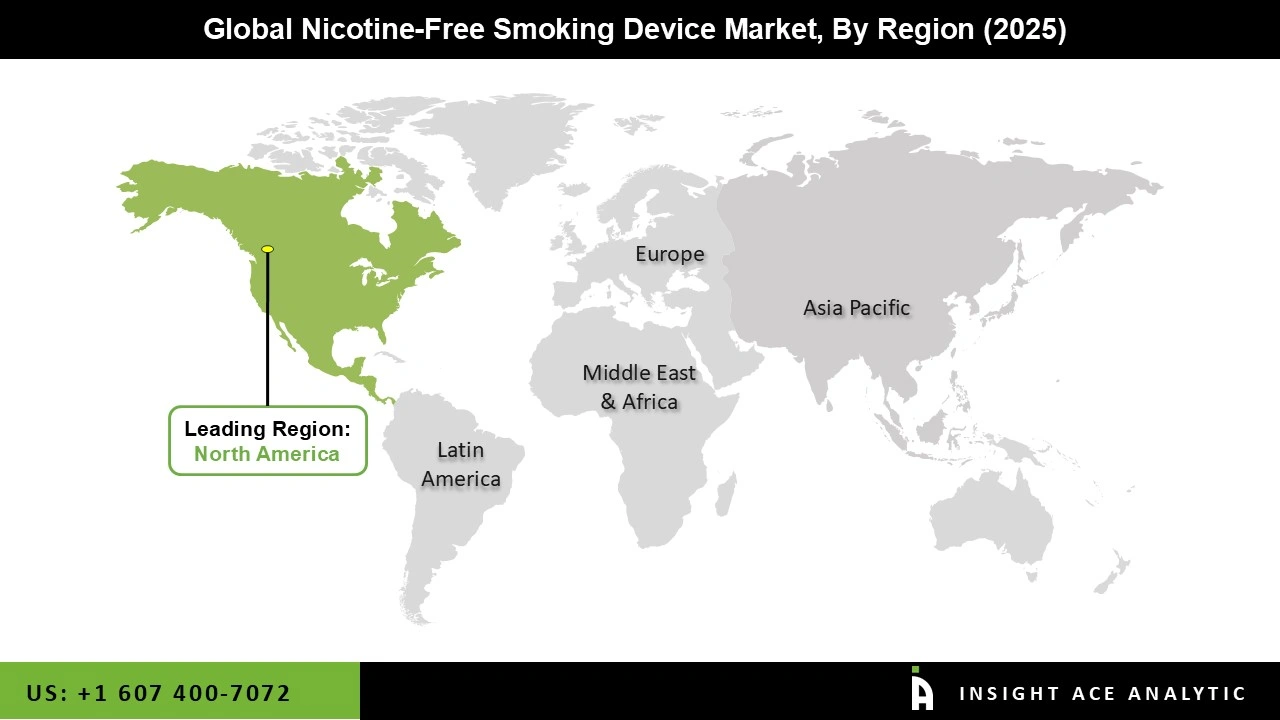
Growing health consciousness among the people is pushing consumers towards nicotine-free products, thereby driving innovation among products. Moreover, increasing awareness about mental wellness products and aromatherapy products has broadened the customer base of the product category.
Asia Pacific is forecasted to grow at the highest rate throughout the forecast period on account of growing urbanization, increasing disposable incomes, rising health awareness, and increasing e-commerce presence. Countries like Japan, South Korea, China, India, and Australia are showing rising demand for alternative wellness products.
Key Development
- April 2025: Ripple+ added to its product portfolio a new range of wellness inhalers powered by herbs with improved herbal formulas and sustainable packaging, enhancing its position in the wellness and nicotine-free inhalation segment.
Nicotine-Free Smoking Device Market Report Scope:
| Report Attribute | Specifications |
| Market size value in 2025 | USD 2.86 Bn |
| Revenue forecast in 2035 | USD 13.11 Bn |
| Growth Rate CAGR | CAGR of 16.6% from 2026 to 2035 |
| Quantitative Units | Representation of revenue in US$ Bn and CAGR from 2026 to 2035 |
| Historic Year | 2022 to 2025 |
| Forecast Year | 2026-2035 |
| Report Coverage | The forecast of revenue, the position of the company, the competitive market structure, growth prospects, and trends |
| Segments Covered | Product Type, Flavor Type, Distribution Channel, End- User and By Region |
| Regional Scope | North America; Europe; Asia Pacific; Latin America; Middle East & Africa |
| Country Scope | U.S.; Canada; U.K.; Germany; China; India; Japan; Brazil; Mexico; The UK; France; Italy; Spain; China; Japan; India; South Korea; Southeast Asia; South Korea; Southeast Asia |
| Competitive Landscape | CAPNOS, Ripple+, MONQ, HealthVape, FÜM, Vitaminvape, Inhale Health, Eagle Energy, VitaStik, NutroVape, Breathesmart, Komuso Design, Breathe EV, Puff Herbals, MOKSHA Lifestyle Products, Air Bar Wellness, LUVV Air, VITASTIK Ltd., Ripple Co., and Breathe Naturally. |
| Customization Scope | Free customization report with the procurement of the report, Modifications to the regional and segment scope. Geographic competitive landscape. |
| Pricing and Available Payment Methods | Explore pricing alternatives that are customized to your particular study requirements. |
Segmentations Nicotine-Free Smoking Device Market:
Nicotine-Free Smoking Device Market by Product Type -
- Disposable Devices
- Rechargeable Devices
- Refillable Devices
Nicotine-Free Smoking Device Market by Flavor Type-
- Tobacco Flavor
- Menthol Flavor
- Fruit Flavor
- Other Flavor
Nicotine-Free Smoking Device Market by Distribution Channel -
- Online Retail
- Specialty Stores
- Convenience Stores
- Supermarkets & Hypermarkets
Nicotine-Free Smoking Device Market by End-User-
- Former Smokers
- Recreational Users
- Wellness-Oriented Consumers
Nicotine-Free Smoking Device Market By Region-
- North America-
- The US
- Canada
- Europe-
- Germany
- The UK
- France
- Italy
- Spain
- Rest of Europe
- Asia-Pacific-
- China
- Japan
- India
- South Korea
- South East Asia
- Rest of Asia Pacific
- Latin America-
- Brazil
- Argentina
- Mexico
- Rest of Latin America
- Middle East and Africa-
- GCC Countries
- South Africa
- Rest of Middle East and Africa
Research Design and Approach
This study employed a multi-step, mixed-method research approach that integrates:
- Secondary research
- Primary research
- Data triangulation
- Hybrid top-down and bottom-up modelling
- Forecasting and scenario analysis
This approach ensures a balanced and validated understanding of both macro- and micro-level market factors influencing the market.
Secondary Research
Secondary research for this study involved the collection, review, and analysis of publicly available and paid data sources to build the initial fact base, understand historical market behaviour, identify data gaps, and refine the hypotheses for primary research.
Sources Consulted
Secondary data for the market study was gathered from multiple credible sources, including:
- Government databases, regulatory bodies, and public institutions
- International organizations (WHO, OECD, IMF, World Bank, etc.)
- Commercial and paid databases
- Industry associations, trade publications, and technical journals
- Company annual reports, investor presentations, press releases, and SEC filings
- Academic research papers, patents, and scientific literature
- Previous market research publications and syndicated reports
These sources were used to compile historical data, market volumes/prices, industry trends, technological developments, and competitive insights.

Primary Research
Primary research was conducted to validate secondary data, understand real-time market dynamics, capture price points and adoption trends, and verify the assumptions used in the market modelling.
Stakeholders Interviewed
Primary interviews for this study involved:
- Manufacturers and suppliers in the market value chain
- Distributors, channel partners, and integrators
- End-users / customers (e.g., hospitals, labs, enterprises, consumers, etc., depending on the market)
- Industry experts, technology specialists, consultants, and regulatory professionals
- Senior executives (CEOs, CTOs, VPs, Directors) and product managers
Interview Process
Interviews were conducted via:
- Structured and semi-structured questionnaires
- Telephonic and video interactions
- Email correspondences
- Expert consultation sessions
Primary insights were incorporated into demand modelling, pricing analysis, technology evaluation, and market share estimation.
Data Processing, Normalization, and Validation
All collected data were processed and normalized to ensure consistency and comparability across regions and time frames.
The data validation process included:
- Standardization of units (currency conversions, volume units, inflation adjustments)
- Cross-verification of data points across multiple secondary sources
- Normalization of inconsistent datasets
- Identification and resolution of data gaps
- Outlier detection and removal through algorithmic and manual checks
- Plausibility and coherence checks across segments and geographies
This ensured that the dataset used for modelling was clean, robust, and reliable.
Market Size Estimation and Data Triangulation
Bottom-Up Approach
The bottom-up approach involved aggregating segment-level data, such as:
- Company revenues
- Product-level sales
- Installed base/usage volumes
- Adoption and penetration rates
- Pricing analysis
This method was primarily used when detailed micro-level market data were available.

Top-Down Approach
The top-down approach used macro-level indicators:
- Parent market benchmarks
- Global/regional industry trends
- Economic indicators (GDP, demographics, spending patterns)
- Penetration and usage ratios
This approach was used for segments where granular data were limited or inconsistent.
Hybrid Triangulation Approach
To ensure accuracy, a triangulated hybrid model was used. This included:
- Reconciling top-down and bottom-up estimates
- Cross-checking revenues, volumes, and pricing assumptions
- Incorporating expert insights to validate segment splits and adoption rates
This multi-angle validation yielded the final market size.
Forecasting Framework and Scenario Modelling
Market forecasts were developed using a combination of time-series modelling, adoption curve analysis, and driver-based forecasting tools.
Forecasting Methods
- Time-series modelling
- S-curve and diffusion models (for emerging technologies)
- Driver-based forecasting (GDP, disposable income, adoption rates, regulatory changes)
- Price elasticity models
- Market maturity and lifecycle-based projections
Scenario Analysis
Given inherent uncertainties, three scenarios were constructed:
- Base-Case Scenario: Expected trajectory under current conditions
- Optimistic Scenario: High adoption, favourable regulation, strong economic tailwinds
- Conservative Scenario: Slow adoption, regulatory delays, economic constraints
Sensitivity testing was conducted on key variables, including pricing, demand elasticity, and regional adoption.
Request Customization
Add countries, segments, company profiles, or extend forecast — free 10% customization with purchase.
Customize This Report →Enquire Before Buying
Speak with our analyst team about scope, methodology, pricing, or deliverable formats.
Enquire Now →Frequently Asked Questions
Nicotine-Free Smoking Device Market Size is valued at USD 2.86 Bn in 2025 and is predicted to reach USD 13.11 Bn by the year 2035
The Nicotine-Free Smoking Device Market is expected to grow at a 16.6% CAGR during the forecast period for 2026 to 2035
CAPNOS, Ripple+, MONQ, HealthVape, FÜM, Vitaminvape, Inhale Health, Eagle Energy, VitaStik, NutroVape, Breathesmart, Komuso Design, Breathe EV, Puff Herbals, MOKSHA Lifestyle Products, Air Bar Wellness, LUVV Air, VITASTIK Ltd., Ripple Co., Breathe Naturally and Others.
Nicotine-Free Smoking Device Market is segmented into Product Type, Flavor Type, Distribution Channel, End- User and Other.
North America region is leading the Nicotine-Free Smoking Device Market.