AI Powered Angiogram Physiology Software Market Current Trends Analysis 2026 to 2035
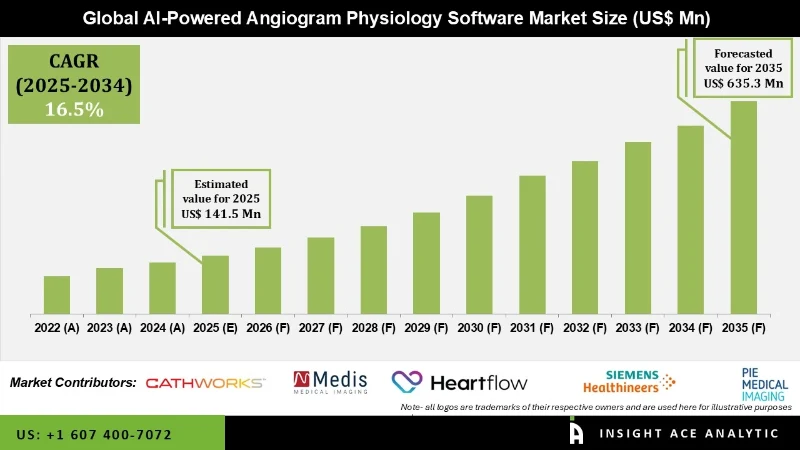
AI-Powered Angiogram Physiology Software Market Size is valued at USD 141.5 Mn in 2025 and is predicted to reach USD 635.3 Mn by the year 2035 at a 16.5% CAGR during the forecast period for 2026 to 2035.
AI-Powered Angiogram Physiology Software Market Size, Share & Trends Analysis Distribution by Type (Cloud/Edge-Integrated AI Diagnostic Modules, AI-Based FFR/IFR Computation Platforms, AI-Based Flow & Perfusion Quantification, and Hybrid Visualization & Decision-Support Suites), Application (CAD Diagnosis, Research & Clinical Workflow Integration, and Lesion Assessment & Stent Optimization), End-user (Hospitals & Cath Labs, Cardiology Diagnostic Centers, and Academic/Research Institutions), and Segment Forecasts, 2026 to 2035
AI-powered angiogram physiology software is a cutting-edge clinical decision-support tool that evaluates the physiological relevance of coronary artery disease by analyzing coronary angiography images using machine learning algorithms and artificial intelligence. This software extracts functional parameters, like fractional flow reserve (FFR) or comparable indices, directly from routine angiographic images, frequently without the use of pressure wires or pharmaceutical agents, in contrast to traditional angiograms, which primarily provide anatomical visualization of blood vessels.
During cardiac catheterization operations, it facilitates more precise diagnosis, supports evidence-based treatment planning, and lowers procedure time, cost, and patient pain. The increased incidence of cardiovascular illnesses, improvements in imaging technology, and an increase in the need for minimally invasive diagnostic treatments are the main factors driving the AI-powered angiogram physiology software market's expansion.
The rising prevalence of cardiovascular disorder worldwide is one of the main factors driving the AI-powered angiogram physiology software market. Cardiovascular diseases, including coronary artery disease & stroke, have become more common due to an ageing population and lifestyle changes, requiring sophisticated diagnostic techniques for early identification and treatment. The need for AI-powered angiogram physiology software that can produce precise and detailed images of blood vessels has increased as a result, helping to improve diagnosis and treatment planning.
Additionally, this expansion is being further fueled by government programs encouraging the use of AI in healthcare, as well as more R&D expenditures from the public and private sectors. The potential of AI-powered angiogram physiology software to enhance patient outcomes, increase productivity, and save healthcare expenses makes it even more alluring. As a result, there is a positive feedback loop that encourages more innovation and market growth.
Furthermore, another important factor driving the AI-powered angiogram physiology software market expansion is the growing inclination towards minimally invasive procedures. The dangers of traditional invasive techniques, such as infection and lengthier recovery times, are decreased by these procedures. Since this software makes these operations easier by offering real-time data and high-quality images, it has been more widely used.
The market is expanding as a result of the preference for these safer and more effective diagnostic choices among both patients and healthcare professionals. However, there are still a number of obstacles in the AI-powered angiogram physiology software market, such as legal restrictions on the use of AI in healthcare, the requirement for large data sets for algorithm training, and worries about data security and privacy.
Competitive Landscape
Which are the Leading Players in AI-Powered Angiogram Physiology Software Market?
• Siemens Healthineers (I modules)
• CathWorks (FFRangio)
• HeartFlow (AI-FFR/ Angio)
• Artrya
• Opsens AI
• Pie Medical Imaging
• Medis Medical Imaging (QFR)
• Keya Medical
• DeepCath Analytics
Market Dynamics
Driver
High Prevalence of Cardiovascular Disease
The AI-powered angiogram physiology software market is anticipated to grow in the future due to the high prevalence of cardiovascular disease. AI-powered angiogram physiology software is used to identify cardiovascular conditions by assisting with the interpretation of electrocardiograms (ECGs). AI is also capable of analyzing enormous volumes of data from imaging data, mobile health devices, and electronic health records. For instance, the American Heart Association, a US-based nonprofit organization dedicated to cardiovascular medical research, said in January 2022 that cardiovascular disease was responsible for over 19.1 million deaths worldwide.
Restrain/Challenge
High Initial Cost of Purchasing and Maintaining
The high initial cost of purchasing and maintaining sophisticated equipment is one of the main issues facing the AI-powered angiogram physiology software market. Angiography systems can cost a lot of money, especially those that incorporate the newest technology developments in artificial intelligence. The adoption among healthcare organizations with limited funding is further hampered by the high maintenance and operating costs of these devices. Because of this, many healthcare facilities are forced to prioritize necessary equipment or search for less expensive options, which might impede the AI-powered angiogram physiology software market's expansion, particularly in emerging markets where healthcare budgets are frequently constrained.
AI-Based FFR/IFR Computation Platforms Segment is Expected to Drive the AI-Powered Angiogram Physiology Software Market
The AI-Based FFR/IFR Computation Platforms category held the largest share in the AI-Powered Angiogram Physiology Software market in 2025, driven by the growing need for real-time, precise, non-invasive coronary artery disease (CAD) assessment. These platforms do away with the need for pressure wires and pharmaceuticals like adenosine by using sophisticated AI and machine learning algorithms to calculate Fractional Flow Reserve (FFR) & Instantaneous Wave-Free Ratio (iFR) straight from normal angiographic pictures. Interventional cardiologists find AI-based FFR/IFR solutions very appealing because they drastically cut down on procedural time, reduce the risk of complications as well as improve patient comfort. The uptake of these platforms is being accelerated by the rising incidence of cardiovascular disorders as well as the expanding use of precision cardiology and value-based care.
Cardiology Diagnostic Centers Segment is Growing at the Highest Rate in the AI-Powered Angiogram Physiology Software Market
In 2025, the Cardiology Diagnostic Centers category dominated the AI-Powered Angiogram Physiology Software market driven by the growing global burden of coronary artery disease and the increasing need for sophisticated, non-invasive cardiovascular diagnostics. In order to provide quick, precise, and repeatable results without the use of invasive pressure wires, these centers are depending more and more on AI-enabled angiography physiology tools, including flow-based lesion assessment and AI-derived fractional flow reserve (FFR). These solutions are especially appealing for high-volume diagnostic facilities because AI algorithms can automatically assess angiographic pictures, lower inter-observer variability, and promote evidence-based clinical decision-making.
Why North America Led the AI-Powered Angiogram Physiology Software Market?
The AI-Powered Angiogram Physiology Software market was dominated by North America region in 2025 because of the early adoption of cutting-edge medical technologies, large healthcare spending, and well-established healthcare infrastructure. The United States, characterized by a high prevalence of cardiovascular illnesses and substantial government healthcare investments, is the leading contributor to this regional dominance.
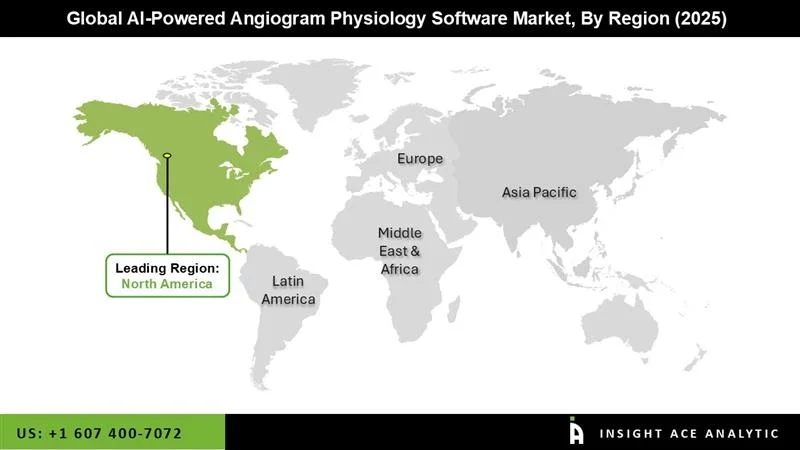
The region's implementation of AI-driven angiogram physiology software is being propelled by the aging demographic and the increasing demand for minimally invasive procedures. Moreover, North America's preeminent status is assured by the presence of substantial market players and continuous advancements in imaging technologies.
AI-Powered Angiogram Physiology Software Market Report Scope:
| Report Attribute | Specifications |
| Market size value in 2025 | USD 141.5 Mn |
| Revenue forecast in 2035 | USD 635.3 Mn |
| Growth Rate CAGR | CAGR of xx% from 2026 to 2035 |
| Quantitative Units | Representation of revenue in US$ Bn and CAGR from 2026 to 2035 |
| Historic Year | 2022 to 2024 |
| Forecast Year | 2026-2035 |
| Report Coverage | The forecast of revenue, the position of the company, the competitive market structure, growth prospects, and trends |
| Segments Covered | Type, Application, End-user, and By Region |
| Regional Scope | North America; Europe; Asia Pacific; Latin America; Middle East & Africa |
| Country Scope | U.S.; Canada; U.K.; Germany; China; India; Japan; Brazil; Mexico; The UK; France; Italy; Spain; China; Japan; India; South Korea; Southeast Asia; South Korea; Southeast Asia |
| Competitive Landscape | Siemens Healthineers (I modules), CathWorks (FFRangio), HeartFlow (AI-FFR/ Angio), Artrya, Opsens AI, Pie Medical Imaging, Medis Medical Imaging (QFR), Keya Medical, and DeepCath Analytics. |
| Customization Scope | Free customization report with the procurement of the report, Modifications to the regional and segment scope. Geographic competitive landscape. |
| Pricing and Available Payment Methods | Explore pricing alternatives that are customized to your particular study requirements. |
Market Segmentation:
AI-Powered Angiogram Physiology Software Market by Type-
- Cloud/Edge-Integrated AI Diagnostic Modules
- AI-Based FFR/IFR Computation Platforms
- AI-Based Flow & Perfusion Quantification
- Hybrid Visualization & Decision-Support Suites
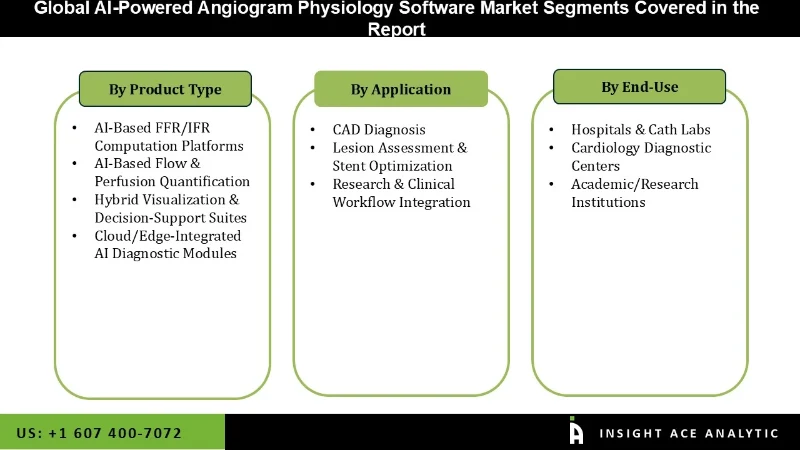
AI-Powered Angiogram Physiology Software Market by Application-
- CAD Diagnosis
- Research & Clinical Workflow Integration
- Lesion Assessment & Stent Optimization
AI-Powered Angiogram Physiology Software Market by End-user-
- Hospitals & Cath Labs
- Cardiology Diagnostic Centers
- Academic/Research Institutions
- AI-Powered Angiogram Physiology Software Market By Region-
North America-
- The US
- Canada
Europe-
- Germany
- The UK
- France
- Italy
- Spain
- Rest of Europe
Asia-Pacific-
- China
- Japan
- India
- South Korea
- South East Asia
- Rest of Asia Pacific
Latin America-
- Brazil
- Argentina
- Mexico
- Rest of Latin America
Middle East & Africa-
- GCC Countries
- South Africa
- Rest of Middle East and Africa
Research Design and Approach
This study employed a multi-step, mixed-method research approach that integrates:
- Secondary research
- Primary research
- Data triangulation
- Hybrid top-down and bottom-up modelling
- Forecasting and scenario analysis
This approach ensures a balanced and validated understanding of both macro- and micro-level market factors influencing the market.
Secondary Research
Secondary research for this study involved the collection, review, and analysis of publicly available and paid data sources to build the initial fact base, understand historical market behaviour, identify data gaps, and refine the hypotheses for primary research.
Sources Consulted
Secondary data for the market study was gathered from multiple credible sources, including:
- Government databases, regulatory bodies, and public institutions
- International organizations (WHO, OECD, IMF, World Bank, etc.)
- Commercial and paid databases
- Industry associations, trade publications, and technical journals
- Company annual reports, investor presentations, press releases, and SEC filings
- Academic research papers, patents, and scientific literature
- Previous market research publications and syndicated reports
These sources were used to compile historical data, market volumes/prices, industry trends, technological developments, and competitive insights.

Primary Research
Primary research was conducted to validate secondary data, understand real-time market dynamics, capture price points and adoption trends, and verify the assumptions used in the market modelling.
Stakeholders Interviewed
Primary interviews for this study involved:
- Manufacturers and suppliers in the market value chain
- Distributors, channel partners, and integrators
- End-users / customers (e.g., hospitals, labs, enterprises, consumers, etc., depending on the market)
- Industry experts, technology specialists, consultants, and regulatory professionals
- Senior executives (CEOs, CTOs, VPs, Directors) and product managers
Interview Process
Interviews were conducted via:
- Structured and semi-structured questionnaires
- Telephonic and video interactions
- Email correspondences
- Expert consultation sessions
Primary insights were incorporated into demand modelling, pricing analysis, technology evaluation, and market share estimation.
Data Processing, Normalization, and Validation
All collected data were processed and normalized to ensure consistency and comparability across regions and time frames.
The data validation process included:
- Standardization of units (currency conversions, volume units, inflation adjustments)
- Cross-verification of data points across multiple secondary sources
- Normalization of inconsistent datasets
- Identification and resolution of data gaps
- Outlier detection and removal through algorithmic and manual checks
- Plausibility and coherence checks across segments and geographies
This ensured that the dataset used for modelling was clean, robust, and reliable.
Market Size Estimation and Data Triangulation
Bottom-Up Approach
The bottom-up approach involved aggregating segment-level data, such as:
- Company revenues
- Product-level sales
- Installed base/usage volumes
- Adoption and penetration rates
- Pricing analysis
This method was primarily used when detailed micro-level market data were available.

Top-Down Approach
The top-down approach used macro-level indicators:
- Parent market benchmarks
- Global/regional industry trends
- Economic indicators (GDP, demographics, spending patterns)
- Penetration and usage ratios
This approach was used for segments where granular data were limited or inconsistent.
Hybrid Triangulation Approach
To ensure accuracy, a triangulated hybrid model was used. This included:
- Reconciling top-down and bottom-up estimates
- Cross-checking revenues, volumes, and pricing assumptions
- Incorporating expert insights to validate segment splits and adoption rates
This multi-angle validation yielded the final market size.
Forecasting Framework and Scenario Modelling
Market forecasts were developed using a combination of time-series modelling, adoption curve analysis, and driver-based forecasting tools.
Forecasting Methods
- Time-series modelling
- S-curve and diffusion models (for emerging technologies)
- Driver-based forecasting (GDP, disposable income, adoption rates, regulatory changes)
- Price elasticity models
- Market maturity and lifecycle-based projections
Scenario Analysis
Given inherent uncertainties, three scenarios were constructed:
- Base-Case Scenario: Expected trajectory under current conditions
- Optimistic Scenario: High adoption, favourable regulation, strong economic tailwinds
- Conservative Scenario: Slow adoption, regulatory delays, economic constraints
Sensitivity testing was conducted on key variables, including pricing, demand elasticity, and regional adoption.
Request Customization
Add countries, segments, company profiles, or extend forecast — free 10% customization with purchase.
Customize This Report →Enquire Before Buying
Speak with our analyst team about scope, methodology, pricing, or deliverable formats.
Enquire Now →Frequently Asked Questions
AI-Powered Angiogram Physiology Software Market Size is valued at USD 141.5 Mn in 2025 and is predicted to reach USD 635.3 Mn by the year 2035
AI-Powered Angiogram Physiology Software Market is expected to grow at a 16.5% CAGR during the forecast period for 2026 to 2035.
Siemens Healthineers (I modules), CathWorks (FFRangio), HeartFlow (AI-FFR/ Angio), Artrya, Opsens AI, Pie Medical Imaging, Medis Medical Imaging (QFR), Keya Medical, and DeepCath Analytics.
Type, Application, End-user, and By Region are the key segments of the AI-Powered Angiogram Physiology Software Market.
North America region is leading the AI-Powered Angiogram Physiology Software Market.