Automated Blood Culture Systems Market Size, Share, Revenue Report 2026 to 2035
What is Automated Blood Culture Systems Market Size?
Automated Blood Culture Systems Market is estimated to grow at a 8.5% CAGR during the forecast period for 2026 to 2035.
Automated Blood Culture Systems Market Size, Share & Trends Analysis Distribution by Product / Offering (Instruments / Systems, Consumables, Software & Informatics, Services), By Detection Technology (Colorimetric / Chromogenic Detection, Fluorescence-Based Detection, Gas-Pressure / Headspace Detection, Other Optical & Proprietary Detection), By Application (Bacteremia, Fungemia, Mycobacterial & Other Sterile-Body-Fluid Detection), By End-User (Hospital & Clinical Laboratories, Independent / Reference Diagnostic LaboratoriesAcademic & Research Institutes, Other End Users) and Segment Forecasts, 2026 to 2035
Automated blood culture systems are specialised diagnostic platforms used to detect and identify microorganisms—primarily bacteria and fungi—in blood samples. They play a critical role in the diagnosis of bacteraemia, fungaemia and other serious bloodstream infections. These systems continuously monitor culture bottles for signs of microbial growth by detecting changes in carbon dioxide production, fluorescence, colourimetric reactions or internal gas pressure, enabling earlier detection than traditional manual culture methods.
By providing more rapid and reliable results, automated systems help clinicians initiate appropriate antimicrobial therapy sooner and support better management of patients with suspected sepsis or other systemic infections. They are routinely used in hospital laboratories, diagnostic centres, reference laboratories and research settings, and form a core element of modern clinical microbiology workflows.
The automated blood culture systems market includes the instruments, specialised culture media bottles, detection technologies, software platforms and associated services required for continuous microbial monitoring. The market is evolving toward greater integration with laboratory automation, improved digital connectivity and more advanced data management capabilities. Solutions range from continuous-monitoring incubators and modular systems to fully integrated platforms that link detection with downstream identification and susceptibility testing.
The sector is served by established diagnostic technology companies as well as newer entrants developing advanced monitoring platforms and consumables. Overall, automated blood culture systems remain a foundational part of clinical microbiology and infectious disease diagnostics, supporting the timely detection of bacterial, fungal and other bloodstream pathogens.
Competitive Landscape
Which are the Leading Players in the Automated Blood Culture Systems Market?
• bioMérieux SA
• Waters Corporation (BD BACTEC)
• Thermo Fisher Scientific Inc.
• Shenzhen Mindray Bio-Medical Electronics Co., Ltd.
• Autobio Diagnostics Co., Ltd.
• Zybio Inc.
• Scenker Biological Technology Co., Ltd.
• Zhuhai DL Biotech Co., Ltd. (Deer Bioengineering)
• Bruker Corporation
• QIAGEN N.V.
• T2 Biosystems, Inc.
• Accelerate Diagnostics, Inc.
• F. Hoffmann-La Roche Ltd
• Danaher Corporation (Cepheid)
• Bio-Rad Laboratories, Inc.
• DiaSorin S.p.A.
Market Dynamics
Driver
Increasing Prevalence of Bloodstream Infections and Rising Demand for Early Diagnosis
Increasing prevalence of bloodstream infections and the consequent rising demand for early diagnosis is a key driver of the automated blood culture systems market. The increasing burden of bacteremia, sepsis and fungemia is driving the need for faster and more reliable detection of the causative microorganism. Automated blood culture systems provide for the continuous monitoring of blood cultures, which in turn facilitates earlier detection of microbial growth and enables timely clinical intervention. The ability of these systems to improve laboratory efficiency, provide a standardised testing process and support infection management is a further key reason for their uptake in both hospital and diagnostic laboratory settings.
Restrain/Challenge
High Equipment Costs and Recurring Consumable Expenses
The high cost of automated blood culture systems and associated consumables is a major barrier to market uptake. The cost of the instruments themselves is considerable, not to mention the cost of the culture bottles, reagents, maintenance and the laboratory infrastructure required to run them. The ongoing cost of consumables and equipment servicing can add significantly to the overall cost of testing, which is a major impediment to adoption in smaller hospitals and diagnostic labs, particularly in cost constrained and resource poor healthcare environments.
Consumables (Culture Bottles & Media) segment Segment is Expected to Drive the Automated Blood Culture Systems Market
The consumables (culture bottles & media) segment is expected to be the largest in the automated blood culture systems market, again driven by the ongoing need for the specific type of bottles required for routine testing. Unlike the instruments which are bought on a periodic basis, the bottles are required for every blood culture test and therefore there is a constant demand for replacement. Aerobic and anaerobic bottles are used for the detection of different types of bacterial infection, paediatric bottles are used for blood culture testing in the paediatric population and there are also a range of fungal and mycobacterial bottles to meet specific diagnostic needs. The size of the segment is underpinned by the increasing volume of blood culture testing, the drive to identify bloodstream infection as early as possible and the fact that the bottles are used in every blood culture test in the laboratory.
Fluorescence-Based Detection Segment is Growing at the Highest Rate in the Automated Blood Culture Systems Market
Fluorescence based detection is expected to be the fastest growing segment in the automated blood culture systems market, driven by the ongoing advancements in optical sensing technologies and the increasing demand for sensitive and reliable detection of microbes. Fluorescence-based systems detect microbial growth by monitoring changes in the fluorescence signal as a result of metabolic activity, thus allowing for continuous monitoring and automated result interpretation. The growth of the segment is expected to be underpinned by the increasing adoption of more sophisticated diagnostic platforms and by the continued drive towards improved detection accuracy and laboratory automation.
Why North America Led the Automated Blood Culture Systems Market?
North America is the largest market for automated blood culture systems supported by its mature healthcare infrastructure, high uptake of advanced diagnostic technologies and the presence of a number of key players. The U.S. is a major contributor to regional demand thanks to its large number of hospitals, clinical labs and reference diagnostic centres. The increasing burden of sepsis and bacteraemia is driving demand for automated systems that can provide continuous monitoring of the blood and enable rapid diagnosis. Additionally, strong investments in laboratory automation, established diagnostic capabilities, and the presence of key manufacturers such as bioMérieux, Thermo Fisher Scientific, and BD are strengthening the region's market position.
Key Development
June 2026: Waters Corporation received U.S. FDA 510(k) clearance for its BD BACTEC FXI Culture System, enabling commercialization in the U.S. The automated system demonstrated approximately three hours faster microbial detection compared with its previous-generation platform, supporting earlier diagnosis of bloodstream infections and sepsis.
Automated Blood Culture Systems Market Report Scope:
| Report Attribute | Specifications |
| Growth Rate CAGR | CAGR of 8.5% from 2026 to 2035 |
| Quantitative Units | Representation of revenue in US$ Bn and CAGR from 2026 to 2035 |
| Historic Year | 2022 to 2025 |
| Forecast Year | 2026-2035 |
| Report Coverage | The forecast of revenue, the position of the company, the competitive market structure, growth prospects, and trends |
| Segments Covered | Product / Offering, Detection Technology, Application, End-User and By Region |
| Regional Scope | North America; Europe; Asia Pacific; Latin America; Middle East & Africa |
| Country Scope | U.S.; Canada; U.K.; Germany; China; India; Japan; Brazil; Mexico; France; Italy; Spain; South Korea; Southeast Asia |
| Competitive Landscape | bioMérieux SA, Waters Corporation (BD BACTEC), Thermo Fisher Scientific Inc., Shenzhen Mindray Bio-Medical Electronics Co., Ltd., Autobio Diagnostics Co., Ltd., Zybio Inc., Scenker Biological Technology Co., Ltd., Zhuhai DL Biotech Co., Ltd. (Deer Bioengineering), Bruker Corporation, QIAGEN N.V. |
| Customization Scope | Free customization report with the procurement of the report, Modifications to the regional and segment scope. Geographic competitive landscape. |
| Pricing and Available Payment Methods | Explore pricing alternatives that are customized to your particular study requirements. |
Market Segmentation:
Automated Blood Culture Systems Market by Product / Offering -
• Instruments / Systems
o Automated Continuous-Monitoring Blood Culture Instruments
o Satellite / Distributed Blood Culture Modules
• Consumables (Culture Bottles & Media)
o Aerobic Bottles
o Anaerobic Bottles
o Pediatric Bottles
o Mycobacterial / Fungal Bottles
o Other / Specialty Bottles
• Software & Informatics
o Middleware, Data Management & Connectivity
• Services
o Installation, Maintenance & Support Contracts
Automated Blood Culture Systems Market by Detection Technology -
• Colorimetric / Chromogenic Detection
• Fluorescence-Based Detection
• Gas-Pressure / Headspace Detection
• Other Optical & Proprietary Detection
Automated Blood Culture Systems Market by Application -
• Bacteremia (Bacterial Bloodstream Infection)
• Fungemia (Fungal Bloodstream Infection)
• Mycobacterial & Other Sterile-Body-Fluid Detection
Automated Blood Culture Systems Market by End User -
• Hospital & Clinical Laboratories
• Independent / Reference Diagnostic LaboratoriesAcademic & Research Institutes
• Other End Users (Public-Health, Blood-Bank & Contract Laboratories)
Automated Blood Culture Systems Market by Region-
North America-
• The US
• Canada
• Mexico
Europe-
• Germany
• The UK
• France
• Italy
• Spain
• Rest of Europe
Asia-Pacific-
• China
• Japan
• India
• South Korea
• South East Asia
• Rest of Asia Pacific
Latin America-
• Brazil
• Argentina
• Rest of Latin America
Middle East & Africa-
• GCC Countries
• South Africa
• Rest of Middle East and Africa
Research Design and Approach
This study employed a multi-step, mixed-method research approach that integrates:
- Secondary research
- Primary research
- Data triangulation
- Hybrid top-down and bottom-up modelling
- Forecasting and scenario analysis
This approach ensures a balanced and validated understanding of both macro- and micro-level market factors influencing the market.
Secondary Research
Secondary research for this study involved the collection, review, and analysis of publicly available and paid data sources to build the initial fact base, understand historical market behaviour, identify data gaps, and refine the hypotheses for primary research.
Sources Consulted
Secondary data for the market study was gathered from multiple credible sources, including:
- Government databases, regulatory bodies, and public institutions
- International organizations (WHO, OECD, IMF, World Bank, etc.)
- Commercial and paid databases
- Industry associations, trade publications, and technical journals
- Company annual reports, investor presentations, press releases, and SEC filings
- Academic research papers, patents, and scientific literature
- Previous market research publications and syndicated reports
These sources were used to compile historical data, market volumes/prices, industry trends, technological developments, and competitive insights.
Primary Research
Primary research was conducted to validate secondary data, understand real-time market dynamics, capture price points and adoption trends, and verify the assumptions used in the market modelling.
Stakeholders Interviewed
Primary interviews for this study involved:
- Manufacturers and suppliers in the market value chain
- Distributors, channel partners, and integrators
- End-users / customers (e.g., hospitals, labs, enterprises, consumers, etc., depending on the market)
- Industry experts, technology specialists, consultants, and regulatory professionals
- Senior executives (CEOs, CTOs, VPs, Directors) and product managers
Interview Process
Interviews were conducted via:
- Structured and semi-structured questionnaires
- Telephonic and video interactions
- Email correspondences
- Expert consultation sessions
Primary insights were incorporated into demand modelling, pricing analysis, technology evaluation, and market share estimation.
Data Processing, Normalization, and Validation
All collected data were processed and normalized to ensure consistency and comparability across regions and time frames.
The data validation process included:
- Standardization of units (currency conversions, volume units, inflation adjustments)
- Cross-verification of data points across multiple secondary sources
- Normalization of inconsistent datasets
- Identification and resolution of data gaps
- Outlier detection and removal through algorithmic and manual checks
- Plausibility and coherence checks across segments and geographies
This ensured that the dataset used for modelling was clean, robust, and reliable.
Market Size Estimation and Data Triangulation
Bottom-Up Approach
The bottom-up approach involved aggregating segment-level data, such as:
- Company revenues
- Product-level sales
- Installed base/usage volumes
- Adoption and penetration rates
- Pricing analysis
This method was primarily used when detailed micro-level market data were available.
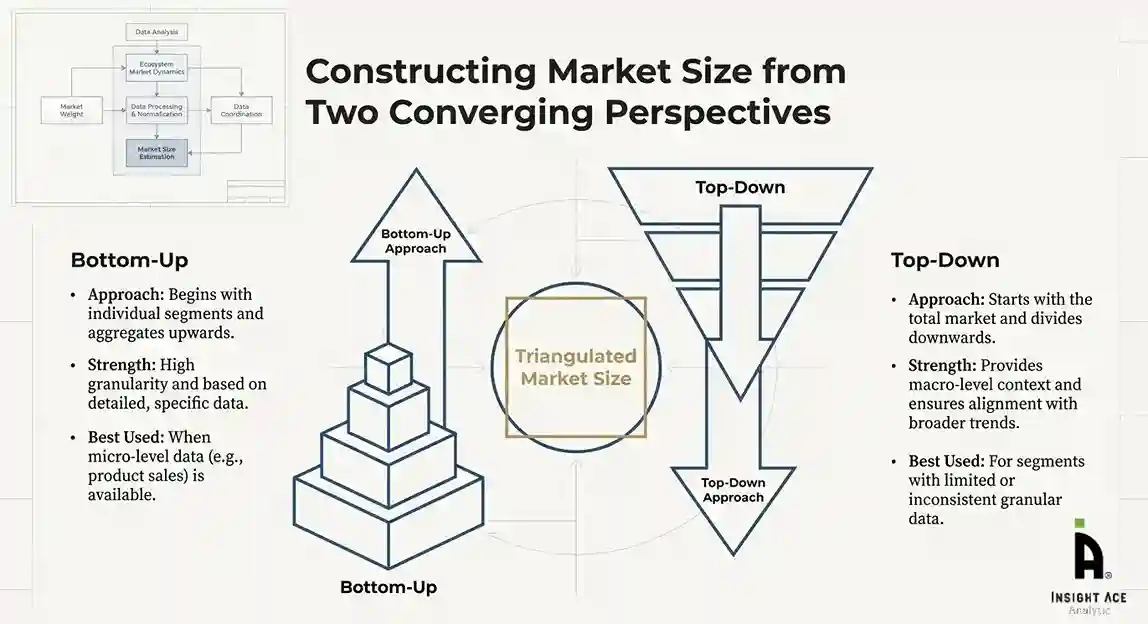
Top-Down Approach
The top-down approach used macro-level indicators:
- Parent market benchmarks
- Global/regional industry trends
- Economic indicators (GDP, demographics, spending patterns)
- Penetration and usage ratios
This approach was used for segments where granular data were limited or inconsistent.
Hybrid Triangulation Approach
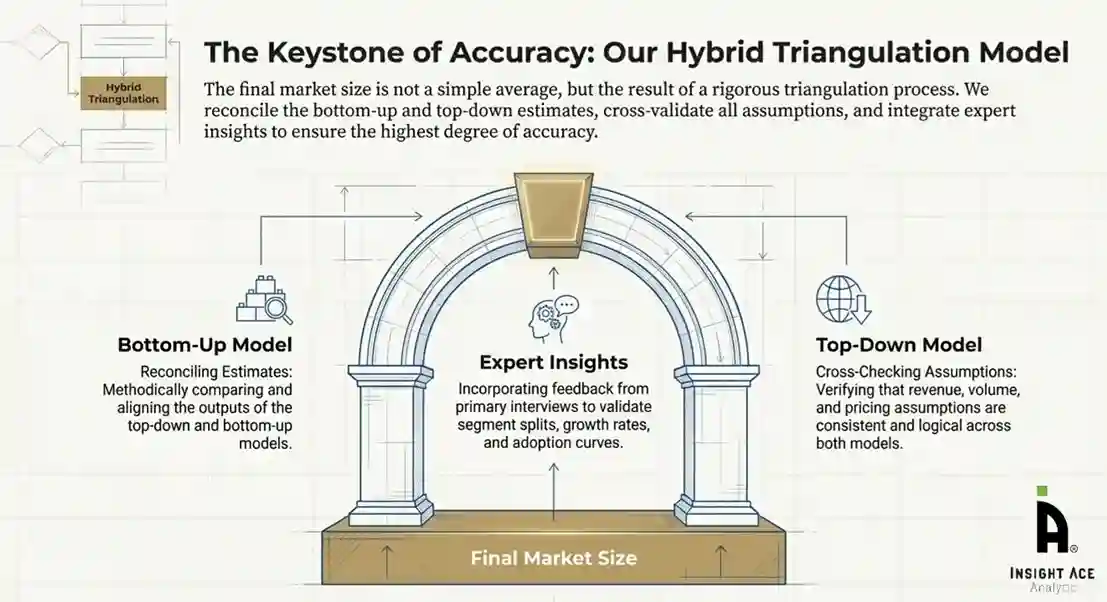
To ensure accuracy, a triangulated hybrid model was used. This included:
- Reconciling top-down and bottom-up estimates
- Cross-checking revenues, volumes, and pricing assumptions
- Incorporating expert insights to validate segment splits and adoption rates
This multi-angle validation yielded the final market size.
Forecasting Framework and Scenario Modelling
Market forecasts were developed using a combination of time-series modelling, adoption curve analysis, and driver-based forecasting tools.
Forecasting Methods
- Time-series modelling
- S-curve and diffusion models (for emerging technologies)
- Driver-based forecasting (GDP, disposable income, adoption rates, regulatory changes)
- Price elasticity models
- Market maturity and lifecycle-based projections
Scenario Analysis
Given inherent uncertainties, three scenarios were constructed:
- Base-Case Scenario: Expected trajectory under current conditions
- Optimistic Scenario: High adoption, favourable regulation, strong economic tailwinds
- Conservative Scenario: Slow adoption, regulatory delays, economic constraints
Sensitivity testing was conducted on key variables, including pricing, demand elasticity, and regional adoption.
Request Customization
Add countries, segments, company profiles, or extend forecast — free 10% customization with purchase.
Customize This Report →Enquire Before Buying
Speak with our analyst team about scope, methodology, pricing, or deliverable formats.
Enquire Now →Frequently Asked Questions
Automated Blood Culture Systems Market is estimated to grow at a 8.5% CAGR during the forecast period for 2026 to 2035.
Octane Medical Group, Miltenyi Biotec, Cellares, Ori Biotech, Cytiva, Terumo BCT, Thermo Fisher Scientific, Sartorius, Wilson Wolf / ScaleReady, Adva Biotechnology, Multiply Labs, Fresenius Kabi, Cellular Origins, MaxCyte, Cellino Biotech
Automated Blood Culture Systems Market is segmented into Offering, Platform Architecture, Manufacturing Unit Operation, Therapy Modality, Therapy Sourcing Model and By Region
North America region is leading the Automated Blood Culture Systems Market.