Anti-Fingerprint Coating Manufacturers Market Size, Share, Revenue Report 2026 to 2035
What is Anti-Fingerprint Coating Manufacturers Market Size?
Global Anti-Fingerprint Coating Manufacturers Market is estimated to grow with at 7.1% CAGR during the forecast period for 2026 to 2035.
Anti-Fingerprint Coating Manufacturers Market Size, Share & Trends Analysis Distribution by Application (Consumer Goods (Smartphones, Television and Monitors, Laptops and Tablets, Wearables, Others), Building and Construction (Architectural Glass, Ceramic Sanitaryware, Others), Automotive, Stainless Steel, Others), by Material Type (Silicon, Titanium, Fluorine, Others), by Technology (Vacuum Deposition, Sol-Gel, Others) and Segment Forecasts, 2026 to 2035.
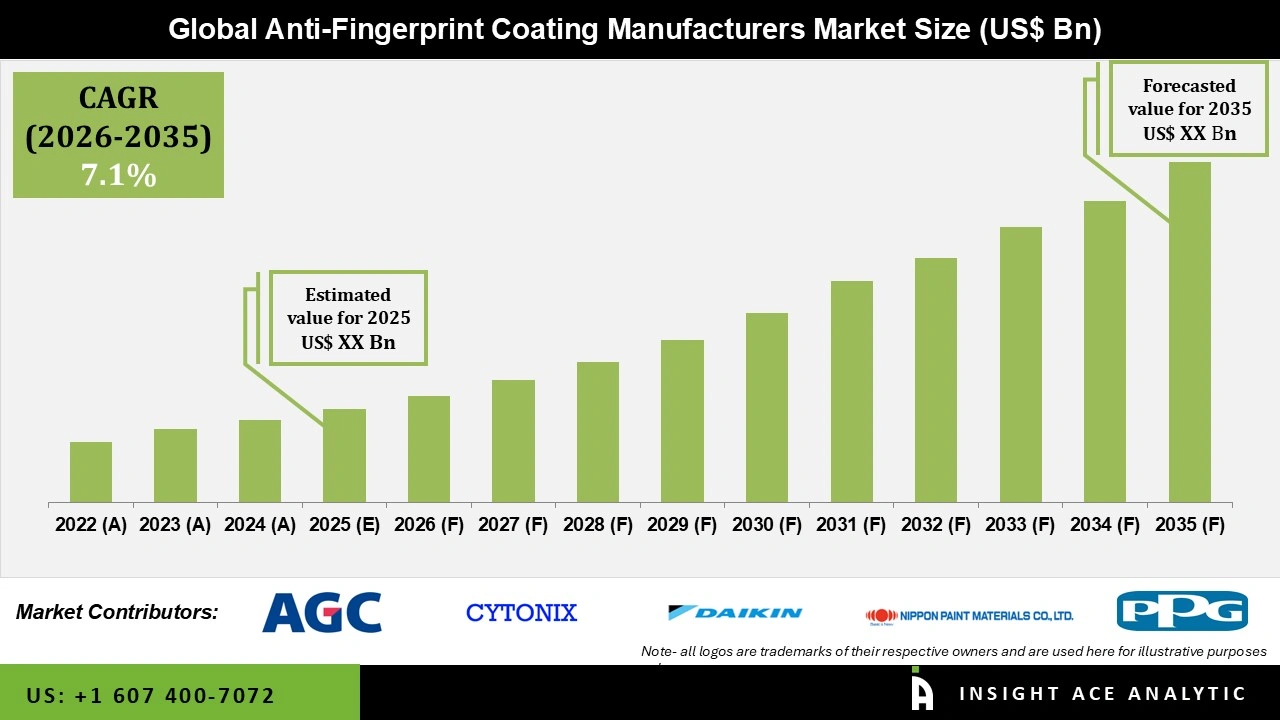
The anti-fingerprint coating manufacturers covers coatings and treatments that help reduce fingerprints, smudges, oil marks, and stains on many types of products. These coatings make surfaces cleaner, look better, last longer, and are easier to maintain. They are commonly used on smartphones, laptops, tablets, TVs, wearable devices, architectural glass, ceramic sanitaryware, car parts, stainless steel, and other consumer and industrial goods. Manufacturers use materials like silicon, titanium, and fluorine-based compounds, along with methods such as vacuum deposition and sol-gel processes, to create coatings that are clear, scratch-resistant, water-repellent, and durable. As more people and businesses want products with high-quality finishes that are easy to care for, anti-fingerprint coatings have become a key part of modern surface engineering.
The market is growing because electronics makers are releasing more devices with large touchscreens, glass panels, and shiny metal finishes that easily show fingerprints and smudges. Smartphones, tablets, laptops, smartwatches, and display screens are the main products that use these coatings, as companies aim to improve both aesthetics and the user experience. Demand is also rising in the automotive, construction, and home appliance industries, where coated surfaces help keep things looking clean and reduce the need for frequent cleaning. More people living in cities, higher incomes, and a preference for premium products are driving manufacturers to incorporate advanced coatings into their designs. As customers care more about quality, durability, and appearance, anti-fingerprint coatings are being used in more industries.
New technologies are having a big impact on the market. Manufacturers are investing in nanotechnology, fluoropolymer coatings, hybrid materials, and eco-friendly formulas that resist fingerprints, scratches, chemicals, and moisture while remaining clear. Improved vacuum deposition and sol-gel methods are helping companies produce thinner, more uniform, and more durable coatings for large-scale use. There is also a stronger focus on sustainable manufacturing, leading to the development of low-VOC, PFAS-free coatings that comply with new environmental regulations.
Competitive Landscape
Which are the Leading Players in the Anti-Fingerprint Coating Manufacturers Market?
- AGC Inc.
- Cytonix LLC
- Daikin Industries, Ltd.
- Nippon Paint Surf Chemicals Co., Ltd.
- PPG Industries, Inc.
- Taiwan Fluoro Technology
- NAGASE & CO., LTD.
- 3M
- Dow Inc.
- Essilor International
- Shin-Etsu Chemical Co., Ltd.
- Solvay S.A.
- Henkel AG & Co. KGaA
- Aculon
- KNW Co., Ltd.
Market Dynamics
Driver
Growing Demand for Premium Consumer Electronics and High-Performance Surface Protection
The anti-fingerprint coating manufacturers market is expanding as companies in electronics, automotive, construction, and other industries look to improve how their products look, last, and feel for users. More people are using smartphones, tablets, laptops, wearables, TVs, and touchscreens, which has increased the need for coatings that keep surfaces free from fingerprints, smudges, oil, and dirt. Consumers want products that stay clean, look clear, and are easy to maintain, so manufacturers are adding anti-fingerprint coatings to their designs. The use of premium glass, stainless steel, and decorative surfaces in buildings, cars, and home products is also boosting demand for advanced coatings. Ongoing progress in nanotechnology, surface engineering, and eco-friendly coatings is helping the market grow.
Restrain/Challenge
High Production Costs and Performance Requirements
Even though the market is growing, manufacturers still face challenges in making high-quality anti-fingerprint coatings. Creating coatings that resist fingerprints and also stay clear, scratch-resistant, durable, and long-lasting needs advanced materials and complex production methods, which raises costs. Companies also have to make sure their coatings work well on different surfaces like glass, metal, ceramics, and plastics, and keep quality high when producing large quantities. Stricter environmental regulations on certain chemicals are pushing companies to find safer, more sustainable alternatives, requiring ongoing investment in research and development. Finding the right balance between performance, meeting regulations, and keeping costs down is still a major challenge.
Consumer Goods Segment is Expected to Drive the Anti-Fingerprint Coating Manufacturers Market
The Consumer Goods segment is likely to account for a large share of the anti-fingerprint coating manufacturers' market in the coming years. As more smartphones, laptops, tablets, TVs, wearables, and other touchscreen devices are made, the need for high-quality anti-fingerprint coatings keeps rising. Manufacturers are working to make their products look better, have clearer displays, resist scratches, and offer a better user experience, so these coatings are becoming key for premium electronics. More people want durable, easy-to-clean devices, which should help this segment keep growing.
Fluorine Segment is Expected to Drive the Anti-Fingerprint Coating Manufacturers Market
The Fluorine segment is set to lead the market for material types because it repels water, oil, and smudges very well. Fluorine-based coatings protect surfaces while remaining clear and long-lasting, so they are widely used in electronics, automotive displays, architectural glass, and other high-end applications. While companies are looking into greener options, fluorine-based materials remain the top choice for high performance and long-lasting protection.
Why North America Leads the Anti-Fingerprint Coating Manufacturers Market?
North America leads the anti-fingerprint coating manufacturers market because it has many electronics makers, advanced materials companies, and strong research and development. The United States is home to many tech firms, coating providers, and chemical manufacturers who keep investing in new surface engineering and nanotechnology. High demand for top-quality electronics, luxury cars, and premium building materials also helps drive the use of anti-fingerprint coatings in many industries.
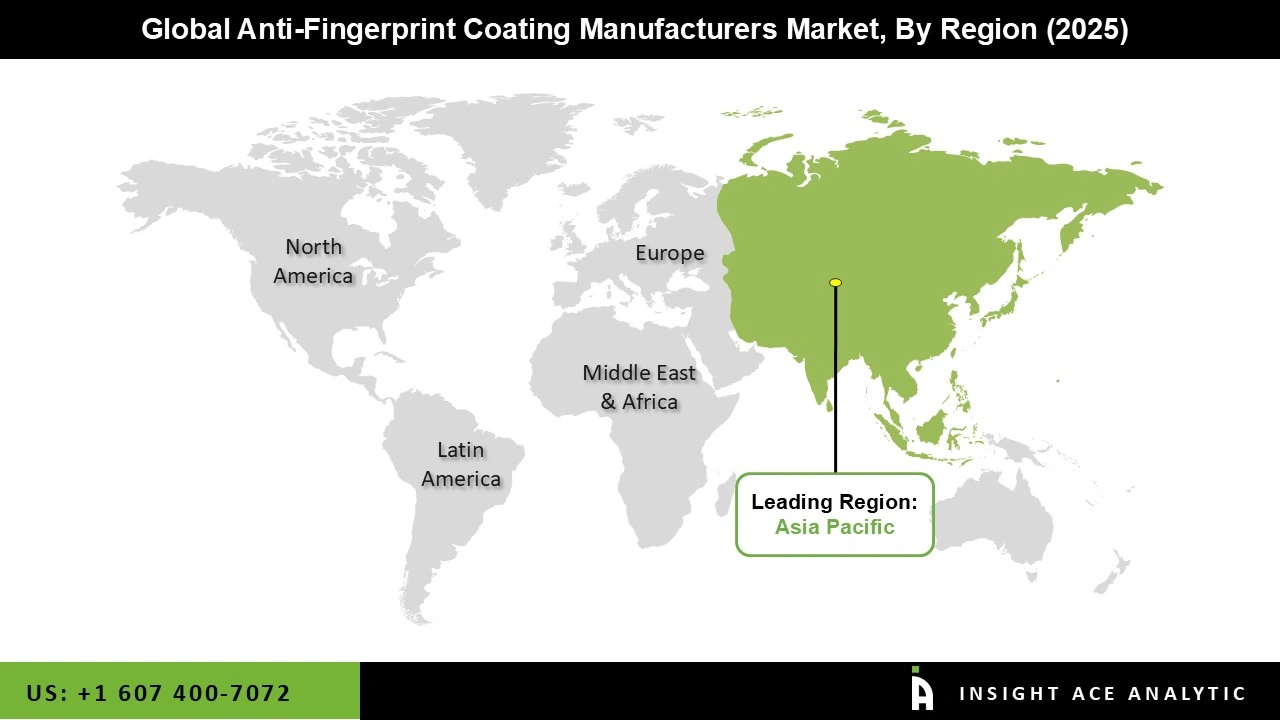
The region benefits from steady investment in new products, advanced manufacturing, and eco-friendly coatings that meet changing environmental rules. While North America is a major market, Asia Pacific is expected to grow the fastest, driven by increased electronics production, rapid industrial growth, rising car manufacturing, and rising demand for smartphones, appliances, and high-end building materials in countries like China, Japan, South Korea, and India.
Key Developments-
• In February 2025, PPG Industries, Inc. strengthened its speciality coatings business by advancing innovative surface coating technologies designed to provide improved fingerprint resistance, stain repellency, and easy-to-clean properties for automotive, consumer electronics, and industrial applications, while supporting environmentally responsible coating formulations.
Anti-Fingerprint Coating Manufacturers Market Report Scope:
| Report Attribute | Specifications |
| Growth Rate CAGR | CAGR of 7.1% from 2026 to 2035 |
| Quantitative Units | Representation of revenue in US$ Bn and CAGR from 2026 to 2035 |
| Historic Year | 2021 to 2025 |
| Forecast Year | 2026-2035 |
| Report Coverage | The forecast of revenue, the position of the company, the competitive market structure, growth prospects, and trends |
| Segments Covered | By Application, Technology, Material Type, and By Region |
| Regional Scope | North America; Europe; Asia Pacific; Latin America; Middle East & Africa |
| Country Scope | U.S.; Canada; U.K.; Germany; China; India; Japan; Brazil; Mexico; The UK; France; Italy; Spain; China; Japan; India; South Korea; Southeast Asia; South Korea; Southeast Asia |
| Competitive Landscape | AGC Inc., Cytonix LLC, Daikin Industries, Ltd., Nippon Paint Surf Chemicals Co., Ltd., PPG Industries, Inc., Taiwan Fluoro Technology, NAGASE & CO., LTD., 3M, Dow Inc., Essilor International, Shin-Etsu Chemical Co., Ltd., Solvay S.A., Henkel AG & Co. KGaA, Aculon, KNW Co., Ltd. |
| Customization Scope | Free customisation report with the procurement of the report, Modifications to the regional and segment scope. Geographic competitive landscape. |
| Pricing and Available Payment Methods | Explore pricing alternatives that are customized to your particular study requirements. |
Segmentations of Anti-Fingerprint Coating Manufacturers Market?
Anti-Fingerprint Coating Manufacturers Market by Material Type-
- Silicon
- Titanium
- Fluorine
- Others
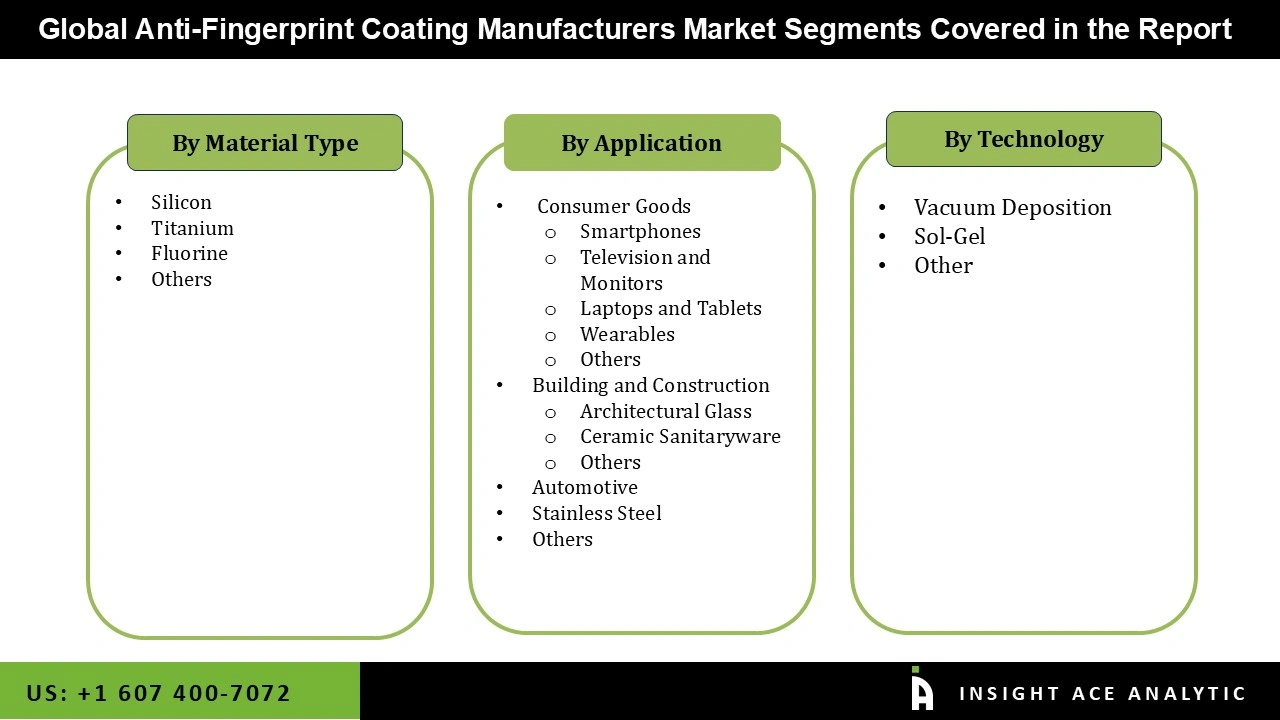
Anti-Fingerprint Coating Manufacturers Market by Application-
- Consumer Goods
- Smartphones
- Television and Monitors
- Laptops and Tablets
- Wearables
- Others
- Building and Construction
- Architectural Glass
- Ceramic Sanitaryware
- Others
- Automotive
- Stainless Steel
- Others
Anti-Fingerprint Coating Manufacturers Market by Technology-
- Vacuum Deposition
- Sol-Gel
- Other
Anti-Fingerprint Coating Manufacturers Market by Region-
- North America-
- The US
- Canada
- Europe-
- Germany
- The UK
- France
- Italy
- Spain
- Rest of Europe
- Asia-Pacific-
- China
- Japan
- India
- South Korea
- South East Asia
- Rest of Asia Pacific
- Latin America-
- Brazil
- Argentina
- Mexico
- Rest of Latin America
- Middle East and Africa-
- GCC Countries
- South Africa
- Rest of Middle East and Africa
Research Design and Approach
This study employed a multi-step, mixed-method research approach that integrates:
- Secondary research
- Primary research
- Data triangulation
- Hybrid top-down and bottom-up modelling
- Forecasting and scenario analysis
This approach ensures a balanced and validated understanding of both macro- and micro-level market factors influencing the market.
Secondary Research
Secondary research for this study involved the collection, review, and analysis of publicly available and paid data sources to build the initial fact base, understand historical market behaviour, identify data gaps, and refine the hypotheses for primary research.
Sources Consulted
Secondary data for the market study was gathered from multiple credible sources, including:
- Government databases, regulatory bodies, and public institutions
- International organizations (WHO, OECD, IMF, World Bank, etc.)
- Commercial and paid databases
- Industry associations, trade publications, and technical journals
- Company annual reports, investor presentations, press releases, and SEC filings
- Academic research papers, patents, and scientific literature
- Previous market research publications and syndicated reports
These sources were used to compile historical data, market volumes/prices, industry trends, technological developments, and competitive insights.

Primary Research
Primary research was conducted to validate secondary data, understand real-time market dynamics, capture price points and adoption trends, and verify the assumptions used in the market modelling.
Stakeholders Interviewed
Primary interviews for this study involved:
- Manufacturers and suppliers in the market value chain
- Distributors, channel partners, and integrators
- End-users / customers (e.g., hospitals, labs, enterprises, consumers, etc., depending on the market)
- Industry experts, technology specialists, consultants, and regulatory professionals
- Senior executives (CEOs, CTOs, VPs, Directors) and product managers
Interview Process
Interviews were conducted via:
- Structured and semi-structured questionnaires
- Telephonic and video interactions
- Email correspondences
- Expert consultation sessions
Primary insights were incorporated into demand modelling, pricing analysis, technology evaluation, and market share estimation.
Data Processing, Normalization, and Validation
All collected data were processed and normalized to ensure consistency and comparability across regions and time frames.
The data validation process included:
- Standardization of units (currency conversions, volume units, inflation adjustments)
- Cross-verification of data points across multiple secondary sources
- Normalization of inconsistent datasets
- Identification and resolution of data gaps
- Outlier detection and removal through algorithmic and manual checks
- Plausibility and coherence checks across segments and geographies
This ensured that the dataset used for modelling was clean, robust, and reliable.
Market Size Estimation and Data Triangulation
Bottom-Up Approach
The bottom-up approach involved aggregating segment-level data, such as:
- Company revenues
- Product-level sales
- Installed base/usage volumes
- Adoption and penetration rates
- Pricing analysis
This method was primarily used when detailed micro-level market data were available.

Top-Down Approach
The top-down approach used macro-level indicators:
- Parent market benchmarks
- Global/regional industry trends
- Economic indicators (GDP, demographics, spending patterns)
- Penetration and usage ratios
This approach was used for segments where granular data were limited or inconsistent.
Hybrid Triangulation Approach
To ensure accuracy, a triangulated hybrid model was used. This included:
- Reconciling top-down and bottom-up estimates
- Cross-checking revenues, volumes, and pricing assumptions
- Incorporating expert insights to validate segment splits and adoption rates
This multi-angle validation yielded the final market size.
Forecasting Framework and Scenario Modelling
Market forecasts were developed using a combination of time-series modelling, adoption curve analysis, and driver-based forecasting tools.
Forecasting Methods
- Time-series modelling
- S-curve and diffusion models (for emerging technologies)
- Driver-based forecasting (GDP, disposable income, adoption rates, regulatory changes)
- Price elasticity models
- Market maturity and lifecycle-based projections
Scenario Analysis
Given inherent uncertainties, three scenarios were constructed:
- Base-Case Scenario: Expected trajectory under current conditions
- Optimistic Scenario: High adoption, favourable regulation, strong economic tailwinds
- Conservative Scenario: Slow adoption, regulatory delays, economic constraints
Sensitivity testing was conducted on key variables, including pricing, demand elasticity, and regional adoption.
Request Customization
Add countries, segments, company profiles, or extend forecast — free 10% customization with purchase.
Customize This Report →Enquire Before Buying
Speak with our analyst team about scope, methodology, pricing, or deliverable formats.
Enquire Now →Frequently Asked Questions
The Anti-Fingerprint Coating Manufacturers Market is expected to grow at a 7.1% CAGR during the forecast period for 2026 to 2035
AGC Inc., Cytonix LLC, Daikin Industries, Ltd., Nippon Paint Surf Chemicals Co., Ltd., PPG Industries, Inc., Taiwan Fluoro Technology, NAGASE & CO., LTD., 3M, Dow Inc., Essilor International, Shin-Etsu Chemical Co., Ltd., Solvay S.A., Henkel AG & Co. KGaA, Aculon, KNW Co., Ltd. and Others.
Anti-Fingerprint Coating Manufacturers Market is segmented into Application, Technology, Material Type, and Other.
Asia Pacific region is leading the Anti-Fingerprint Coating Manufacturers Market.