Sustainable Primary Packaging for Injectable Drugs Market Key Players Analysis 2026 to 2035
Global Sustainable Primary Packaging for Injectable Drugs Market is estimated to grow with the 14.7% CAGR during the forecast period for 2026 to 2035.
Sustainable Primary Packaging for Injectable Drugs Market (Value and Volume) Size, Share & Trends Analysis Distribution By Product Type (Sustainable Vials, Sustainable Prefilled Syringes, Sustainable Cartridges, Sustainable IV Containers, Sustainable Components), Application type (Biologics and Biosimilars, Small-Molecule Injectables, Lyophilized Drugs, Vaccines, High-Viscosity Biologics), By End User (Pharmaceutical Companies, Biopharmaceutical Companies, CDMOs, Vaccine Manufacturers, Hospitals and Healthcare Providers) and Segment Forecasts, 2026 to 2035
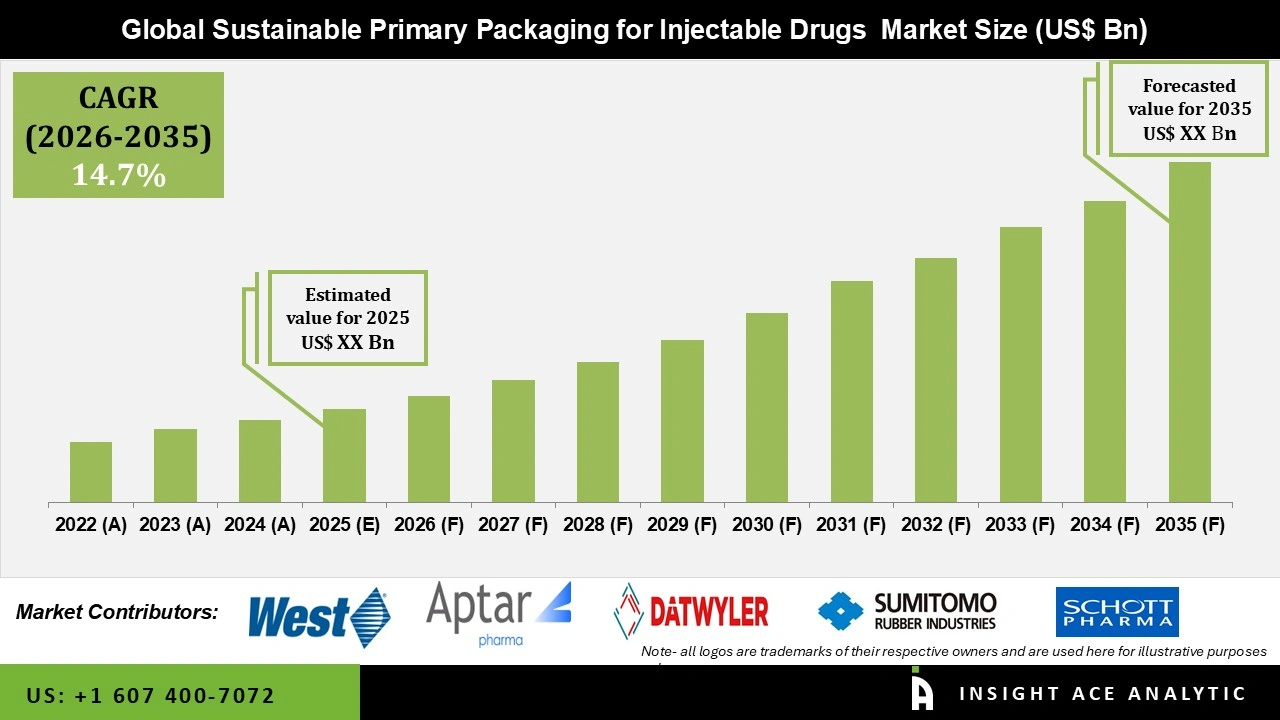
Sustainable primary packaging for injectable drugs is designed to safely hold and deliver medicines while also being better for the environment. Instead of relying only on traditional plastics, companies are turning to eco-friendly materials, recyclable parts, and energy-efficient production methods. The aim is to keep medicine safe for patients, reduce waste, lower carbon emissions, and promote a more responsible healthcare system. This move also helps pharmaceutical companies meet global sustainability standards and respond to the growing demand for greener medical solutions.
Environmental awareness is growing, and the pressure to cut medical waste and reduce carbon emissions is accelerating across the industry. Healthcare providers and patients are also showing a stronger preference for packaging that is eco-friendly and responsible. At the same time, new sustainable materials and technologies are making it easier for companies to adopt greener solutions without affecting safety. Along with this, tighter global regulations are accelerating the shift toward packaging that supports sustainability while meeting all required standards.
One of the main challenges in sustainable packaging for injectable drugs is the higher production cost, as eco-friendly materials and new technologies can be expensive for companies to adopt quickly. Another hurdle is the limited recycling infrastructure, since many regions still lack proper facilities to handle medical packaging waste. Moreover, material compatibility is a concern because injectable drugs are sensitive, and not all green materials are fully tested or safe. There is an opportunity to combine eco-friendly materials with smart packaging technologies, making solutions safer, more efficient, and giving companies a competitive edge.
Competitive Landscape
Which are the Leading Players in Sustainable Primary Packaging for Injectable Drugs Market?
- West Pharmaceutical Services
- Aptar Pharma
- Datwyler
- Daikyo Seiko
- Helvoet Rubber & Plastic Technologies
- Sumitomo Rubber Industries
- Jiangsu Hualan New Pharmaceutical Material
- Hebei First Rubber Medical
- Schott Pharma
- Gerresheimer
- Stevanato Group
- Bormioli Pharma
- SGD Pharma
- Nipro PharmaPackaging
- Corning
- Baxter
- Fresenius Kabi
- B. Braun
- RENOLIT Healthcare
- PolyCine GmbH
- ICU Medical
Market Dynamics
Driver
Environmental Awareness Driving Sustainable Packaging for Injectable Drugs.
Environmental awareness is driving the growth of sustainable packaging for injectable drugs. Companies are feeling more pressure to reduce medical waste and lower carbon emissions. Patients, hospitals, and healthcare providers increasingly prefer eco-friendly packaging, which is creating strong demand in the market. This growing concern for the environment is encouraging pharmaceutical companies to adopt greener solutions. Patients are more informed and prefer medicines from companies that care about the environment. At the same time, adopting eco-friendly packaging helps companies improve their brand image and reputation.
Restrain/Challenge
High Costs Limiting Sustainable Packaging for injectable drugs
One of the biggest challenges for sustainable packaging in injectable drugs is the high production cost. Eco-friendly materials and new technologies can be expensive, making it harder for companies to adopt them quickly. Even if the demand for greener solutions is strong, the high cost slows down widespread adoption and limits how fast the market can grow.
Sustainable Vials Leading the Injectable Drug Packaging Market
Sustainable vials, especially Low-Carbon Glass Vials and Polymer Vials (COP/COC), hold the largest market share in sustainable primary packaging for injectable drugs. Vials are widely used to store many types of injectable medicines, including biologics, vaccines, and small-molecule drugs, because they keep the medicine safe, stable, and sterile. Even though prefilled syringes and cartridges are becoming more popular, vials are still the most used and trusted option for pharmaceutical and biopharmaceutical companies around the world. Their essential role in protecting sensitive medicines makes them the leading product type in the market.
Biologics & Biosimilars Boosts Sustainable Packaging for injectable drugs
The biologics and biosimilars segment are a major driver of sustainable packaging for injectable drugs. Biologics are medicines made from living cells, and biosimilars are nearly identical, lower-cost copies. These medicines are delicate and need special packaging to stay safe and stable. Eco-friendly vials and prefilled syringes are increasingly used, helping pharmaceutical companies protect both patients and the environment
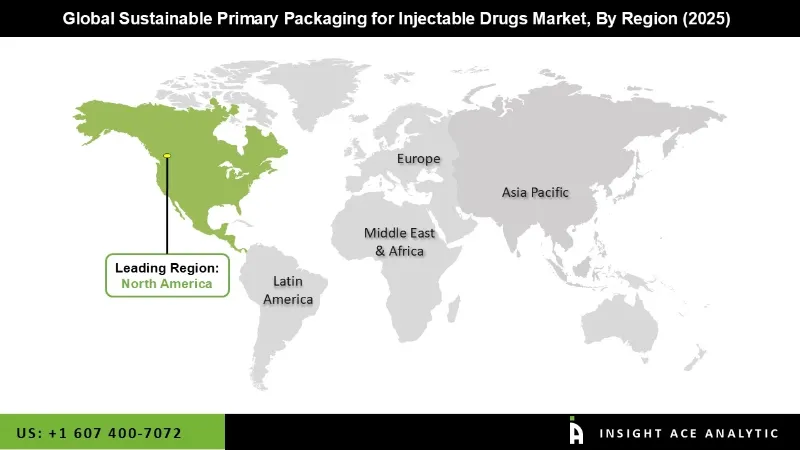
Why North America Led the sustainable packaging market for injectable drugs?
North America leads the sustainable packaging market for injectable drugs due to strong environmental awareness, strict regulations, and high use of advanced technologies. The presence of major pharma companies and growing demand from hospitals, healthcare providers, and patients for safe, reliable, and eco-friendly packaging further drives market growth.
Sustainable Primary Packaging for Injectable Drugs Market Report Scope:
| Report Attribute | Specifications |
| Growth Rate CAGR | CAGR of 14.7 from 2026 to 2035 |
| Quantitative Units | Representation of revenue in US$ Bn and CAGR from 2026 to 2035 |
| Historic Year | 2022 to 2024 |
| Forecast Year | 2026 to 2035 |
| Report Coverage | The forecast of revenue, the position of the company, the competitive market structure, growth prospects, and trends |
| Segments Covered | By Application Type, Product Type, End User, |
| Regional Scope | North America; Europe; Asia Pacific; Latin America; Middle East & Africa |
| Country Scope | United States, Canada, Mexico, Germany, United Kingdom, France, Italy, Spain, Rest of Europe, China, India, Japan, South Korea, Australia, Rest of Asia Pacific, Brazil, Argentina, Rest of Latin America, GCC Countries, South Africa, Rest of Middle East & Africa |
| Competitive Landscape | West Pharmaceutical Services, Aptar Pharma, Datwyler, Daikyo Seiko, Helvoet Rubber & Plastic Technologies, Sumitomo Rubber Industries, Jiangsu Hualan New Pharmaceutical Material, Hebei First Rubber Medical, Schott Pharma, Gerresheimer, Stevanato Group, Bormioli Pharma, SGD Pharma, Nipro Pharma Packaging, Corning, Baxter, Fresenius Kabi, B. Braun, RENOLIT Healthcare, PolyCine GmbH, ICU Medical, Other Prominent Players. |
| Customization Scope | Free customization report with the procurement of the report, Modifications to the regional and segment scope. Geographic competitive landscape. |
| Pricing and Available Payment Methods | Explore pricing alternatives that are customized to your particular study requirements. |
Market Segmentation:
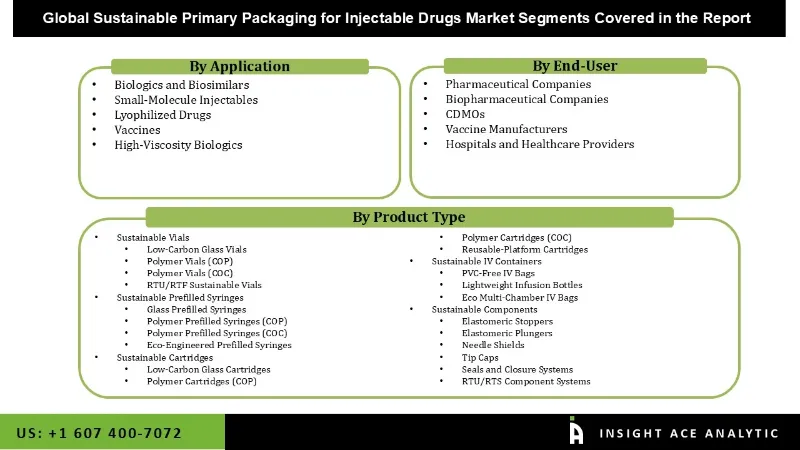
Sustainable Primary Packaging for Injectable Drugs Market by Product Type-
- Sustainable Vials
-
- Low-Carbon Glass Vials
- Polymer Vials (COP)
- Polymer Vials (COC)
- RTU/RTF Sustainable Vials
- Sustainable Prefilled Syringes
-
- Glass Prefilled Syringes
- Polymer Prefilled Syringes (COP)
- Polymer Prefilled Syringes (COC)
- Eco-Engineered Prefilled Syringes
- Sustainable Cartridges
-
- Low-Carbon Glass Cartridges
- Polymer Cartridges (COP)
- Polymer Cartridges (COC)
- Reusable-Platform Cartridges
- Sustainable IV Containers
-
- PVC-Free IV Bags
- Lightweight Infusion Bottles
- Eco Multi-Chamber IV Bags
- Sustainable Components
-
- Elastomeric Stoppers
- Elastomeric Plungers
- Needle Shields
- Tip Caps
- Seals and Closure Systems
- RTU/RTS Component Systems
Sustainable Primary Packaging for Injectable Drugs Market by Application-
- Biologics and Biosimilars
- Small-Molecule Injectables
- Lyophilized Drugs
- Vaccines
- High-Viscosity Biologics
Sustainable Primary Packaging for Injectable Drugs Market by End Users-
- Pharmaceutical Companies
- Biopharmaceutical Companies
- CDMOs
- Vaccine Manufacturers
- Hospitals and Healthcare Providers
Research Design and Approach
This study employed a multi-step, mixed-method research approach that integrates:
- Secondary research
- Primary research
- Data triangulation
- Hybrid top-down and bottom-up modelling
- Forecasting and scenario analysis
This approach ensures a balanced and validated understanding of both macro- and micro-level market factors influencing the market.
Secondary Research
Secondary research for this study involved the collection, review, and analysis of publicly available and paid data sources to build the initial fact base, understand historical market behaviour, identify data gaps, and refine the hypotheses for primary research.
Sources Consulted
Secondary data for the market study was gathered from multiple credible sources, including:
- Government databases, regulatory bodies, and public institutions
- International organizations (WHO, OECD, IMF, World Bank, etc.)
- Commercial and paid databases
- Industry associations, trade publications, and technical journals
- Company annual reports, investor presentations, press releases, and SEC filings
- Academic research papers, patents, and scientific literature
- Previous market research publications and syndicated reports
These sources were used to compile historical data, market volumes/prices, industry trends, technological developments, and competitive insights.

Primary Research
Primary research was conducted to validate secondary data, understand real-time market dynamics, capture price points and adoption trends, and verify the assumptions used in the market modelling.
Stakeholders Interviewed
Primary interviews for this study involved:
- Manufacturers and suppliers in the market value chain
- Distributors, channel partners, and integrators
- End-users / customers (e.g., hospitals, labs, enterprises, consumers, etc., depending on the market)
- Industry experts, technology specialists, consultants, and regulatory professionals
- Senior executives (CEOs, CTOs, VPs, Directors) and product managers
Interview Process
Interviews were conducted via:
- Structured and semi-structured questionnaires
- Telephonic and video interactions
- Email correspondences
- Expert consultation sessions
Primary insights were incorporated into demand modelling, pricing analysis, technology evaluation, and market share estimation.
Data Processing, Normalization, and Validation
All collected data were processed and normalized to ensure consistency and comparability across regions and time frames.
The data validation process included:
- Standardization of units (currency conversions, volume units, inflation adjustments)
- Cross-verification of data points across multiple secondary sources
- Normalization of inconsistent datasets
- Identification and resolution of data gaps
- Outlier detection and removal through algorithmic and manual checks
- Plausibility and coherence checks across segments and geographies
This ensured that the dataset used for modelling was clean, robust, and reliable.
Market Size Estimation and Data Triangulation
Bottom-Up Approach
The bottom-up approach involved aggregating segment-level data, such as:
- Company revenues
- Product-level sales
- Installed base/usage volumes
- Adoption and penetration rates
- Pricing analysis
This method was primarily used when detailed micro-level market data were available.

Top-Down Approach
The top-down approach used macro-level indicators:
- Parent market benchmarks
- Global/regional industry trends
- Economic indicators (GDP, demographics, spending patterns)
- Penetration and usage ratios
This approach was used for segments where granular data were limited or inconsistent.
Hybrid Triangulation Approach
To ensure accuracy, a triangulated hybrid model was used. This included:
- Reconciling top-down and bottom-up estimates
- Cross-checking revenues, volumes, and pricing assumptions
- Incorporating expert insights to validate segment splits and adoption rates
This multi-angle validation yielded the final market size.
Forecasting Framework and Scenario Modelling
Market forecasts were developed using a combination of time-series modelling, adoption curve analysis, and driver-based forecasting tools.
Forecasting Methods
- Time-series modelling
- S-curve and diffusion models (for emerging technologies)
- Driver-based forecasting (GDP, disposable income, adoption rates, regulatory changes)
- Price elasticity models
- Market maturity and lifecycle-based projections
Scenario Analysis
Given inherent uncertainties, three scenarios were constructed:
- Base-Case Scenario: Expected trajectory under current conditions
- Optimistic Scenario: High adoption, favourable regulation, strong economic tailwinds
- Conservative Scenario: Slow adoption, regulatory delays, economic constraints
Sensitivity testing was conducted on key variables, including pricing, demand elasticity, and regional adoption.
Request Customization
Add countries, segments, company profiles, or extend forecast — free 10% customization with purchase.
Customize This Report →Enquire Before Buying
Speak with our analyst team about scope, methodology, pricing, or deliverable formats.
Enquire Now →Frequently Asked Questions
Sustainable Primary Packaging for Injectable Drugs Market is estimated to grow with the 14.7% CAGR during the forecast period for 2026 to 2035.
West Pharmaceutical Services, Aptar Pharma, Datwyler, Daikyo Seiko, Helvoet Rubber & Plastic Technologies, Sumitomo Rubber Industries, Jiangsu Hualan New Pharmaceutical Material, Hebei First Rubber Medical, Schott Pharma, Gerresheimer, Stevanato Group, Bormioli Pharma, SGD Pharma, Nipro Pharma Packaging, Corning, Baxter, Fresenius Kabi, B. Braun, RENOLIT Healthcare, PolyCine GmbH, ICU Medical, Other Prominent Players.
By Application Type, Product Type, End User are the key segments of the Sustainable Primary Packaging for Injectable Drugs Market.
North America region is leading the Sustainable Primary Packaging for Injectable Drugs Market.