Sustainable Home Decor Market Size, Share Detailed Report 2025 to 2034
Global Sustainable Home Decor Market Size is valued at USD 4.5 Bn in 2024 and is predicted to reach USD 9.4 Bn by the year 2034 at a 7.9% CAGR during the forecast period for 2025-2034.
Sustainable Home Decor Market Size, Share & Trends Analysis Report By Type (Furniture, Textiles, Lighting, Wall Decor, Flooring, Kitchenware, Bedding, Bathroom Accessories, Decorative Accessories), By Product (Reclaimed Wood Furniture, Organic Cotton Textiles, LED Lighting, Recycled Metal Art, Natural Fiber Rugs, Eco-friendly Paints, Biodegradable Kitchenware, Bamboo Bedding, Recycled Glass D�cor), By Material, By Application, By End User, By Technology , By Service, By Form, By Region, And By Segment Forecasts, 2025-2034.

Sustainable home decor is the process of creating visually beautiful and functional settings for occupants, both indoors and outside. Sustainable home decor alternatives include anything from furniture to floor coverings such as wood and laminate, vinyl and rubber, carpets and rugs, and tiles. Additionally, they include textiles for the home, including rugs, bedding, bathrooms, kitchens, and dining rooms, as well as textiles for the living room. The growing demand for eco-friendly items among consumers is driving the market for sustainable home decor. The demand for healthier living surroundings and more environmental awareness are the primary drivers of this movement.
In order to reduce their ecological impact, consumers are looking for decor products made of sustainable resources like bamboo, repurposed metals, and organic fabrics. Another important factor is the growing trend in home design toward utility and minimalism, which is consistent with sustainability ideals. This change is pushing producers to come up with new and creative ways to make items that are functional, long-lasting, and visually appealing.
Furthermore, businesses are encouraged to use environmentally friendly production techniques through regulatory frameworks that support sustainable practices. Additionally, the growth of e-commerce platforms is broadening the market and making sustainable products more accessible to customers. These platforms let brands successfully convey their sustainability credentials, which builds customer loyalty and trust. Because of these changing trends and customer preferences, the market for sustainable home decor is expected to grow further.
Competitive Landscape
Some Major Key Players In The Sustainable Home Decor Market:
- Made Trade LLC
- VivaTerra
- The Citizenry, Inc.
- Parachute Home, Inc.
- West Elm, Inc. (a subsidiary of Williams-Sonoma, Inc.)
- Coyuchi, Inc.
- Avocado Green Brands, LLC (formerly Brentwood Home Holdings, LLC)
- Etsy, Inc.
- Burrow, Inc.
- Branch Furniture, Inc.
- Medley LLC
- Thuma Inc.
- Canada Inc. (operating as Goodee)
- Sabai Design, Inc.
- EcoVibe OÜ
- Joybird
- Other Market Players
Market Segmentation:
The Sustainable Home Decor market is segmented by material, type, application, service, form. Based on type, the market is segmented into furniture, textiles, lighting, wall decor, flooring, kitchenware, bedding, bathroom accessories, and decorative accessories. By product, it is classified into reclaimed wood furniture, organic cotton textiles, LED lighting, recycled metal art, natural fiber rugs, eco-friendly paints, biodegradable kitchenware, bamboo bedding, and recycled glass decor. Based on material type, the market is categorized into bamboo, recycled metal, reclaimed wood, organic cotton, natural rubber, recycled glass, hemp, jute, and cork. By application, the segment comprises residential, commercial, hospitality, retail, office spaces, educational institutions, healthcare facilities, and public spaces. By end users, this market is classified into homeowners, interior designers, architects, real estate developers, the hospitality industry, corporate offices, educational institutions, healthcare providers, and retailers. As per the technology, the market includes 3D printing, smart home integration, sustainable manufacturing processes, and energy-efficient technology. The service segment includes consultation services, custom design services, installation services, and maintenance services. By Form, the market is divided into ready-to-assemble, pre-assembled, customizable, and modular.
Based On Type, The Furniture Segment Is Accounted As A Major Contributor To The Sustainable Home Decor Market
In 2024, the market for sustainable home decor witnessed a significant revenue share from the furniture segment. Many sustainable furniture makers avoid using synthetic materials and only employ natural ones because of environmental concerns. Renewable natural materials, including bamboo that grows quickly and products made from salvaged wood, are also highly valued by them. The Forest Stewardship Council (FSC) mostly certifies these kinds of furniture. Additionally, consumers are looking more and more for furniture that reflects their ethical and sustainable purchasing beliefs. The desire for items that use natural and non-toxic materials, which promote a healthy living environment, is one area where this trend is very noticeable. Furthermore, customers seeking durable and adaptable items are drawn to sustainable furniture since it frequently has classic designs and excellent craftsmanship.
Reclaimed Wood Furniture Segment Witnessed Growth At A Rapid Rate
The market for sustainable home decor is seeing tremendous growth in the reclaimed wood furniture area due to continuously rising awareness of environmental issues and their demand for eco-friendly interior design options. Environmentally concerned buyers looking for distinctive, character-rich items that lessen deforestation and carbon emissions are drawn to reclaimed wood furniture as sustainability emerges as a major element in home furnishings trends. This category gains from the growing appeal of industrial, vintage, and rustic styles, which complement the inherent flaws and history of repurposed materials. Government laws encouraging recycling and sustainable sourcing, as well as the expanding number of green certifications, are further driving up demand in the market.
In The Region, The North America Sustainable Home Decor Market Holds A Significant Revenue Share.
The market for sustainable home decor in North America is expected to grow significantly in terms of revenue attributed to improved product accessibility and a stronger presence of both online and offline channels for home decor. Decor items that are most common in the region with the most market participants include furniture, lighting, decorative flooring, and textile use. The US leads the global market for outdoor furniture, in part due to consumers' growing willingness to spend money on home decor. Furthermore, the abundance of possible suppliers in this area promotes market expansion even further. As a result, there is an increased demand in North America for eco-friendly home furnishings. Additionally, over the projection period, Europe is expected to increase significantly. Growing customer demand for aesthetically sophisticated furnishings and more innovation are driving the growth of the Euroe sustainable home decor market. Due to advancements in technology, manufacturers can now choose from an unparalleled array of construction and design possibilities. In the past, major furniture manufacturers entering the Europe market have also increased the overall demand for furniture.
Recent Development-
- In March 2025, Global design firm West Elm collaborated with the esteemed interior design pair Pierce & Ward. Co-founders Louisa Pierce and Emily Ward have collaborated with the West Elm team to create a new collection that highlights the renowned design duo's unique, award-winning style, which fuses vintage allure with contemporary sophistication.
Sustainable Home Decor Market Report Scope
| Report Attribute | Specifications |
| Market Size Value In 2024 | USD 4.5 Bn |
| Revenue Forecast In 2034 | USD 9.4 Bn |
| Growth Rate CAGR | CAGR of 7.9% from 2025 to 2034 |
| Quantitative Units | Representation of revenue in US$ Bn and CAGR from 2025 to 2034 |
| Historic Year | 2021 to 2024 |
| Forecast Year | 2025-2034 |
| Report Coverage | The forecast of revenue, the position of the company, the competitive market structure, growth prospects, and trends |
| Segments Covered | By Component, Application, And End-user. |
| Regional Scope | North America; Europe; Asia Pacific; Latin America; Middle East & Africa |
| Country Scope | U.S.; Canada; U.K.; Germany; China; India; Japan; Brazil; Mexico; France; Italy; Spain; South East Asia; South Korea |
| Competitive Landscape | Made Trade, Viva Terra, The Citizenry, Parachute Home, West Elm, Coyuchi, Avocado Green Brands, Etsy, Burrow, Branch Furniture, Medley Home, Thuma, Goodee, Sabai, Eco Vibe, and Joybird. |
| Customization Scope | Free customization report with the procurement of the report and modifications to the regional and segment scope. Particular Geographic competitive landscape. |
| Pricing And Available Payment Methods | Explore pricing alternatives that are customized to your particular study requirements. |
Segmentation of Sustainable Home Decor Market-
Sustainable Home Decor Market By Type-
- Furniture
- Textiles
- Lighting
- Wall Decor
- Flooring
- Kitchenware
- Bedding
- Bathroom Accessories
- Decorative Accessories

Sustainable Home Decor Market By Product-
- Reclaimed Wood Furniture
- Organic Cotton Textiles
- LED Lighting
- Recycled Metal Art
- Natural Fiber Rugs
- Eco-friendly Paints
- Biodegradable Kitchenware
- Bamboo Bedding
- Recycled Glass Decor
Sustainable Home Decor Market By Material Type-
- Bamboo
- Recycled Metal
- Reclaimed Wood
- Organic Cotton
- Natural Rubber
- Recycled Glass
- Hemp
- Jute
- Cork
Sustainable Home Decor Market By Application-
- Residential
- Commercial
- Hospitality
- Retail
- Office Spaces
- Educational Institutions
- Healthcare Facilities
- Public Spaces
Sustainable Home Decor Market By End User
- Homeowners
- Interior Designers
- Architects
- Real Estate Developers
- Hospitality Industry
- Corporate Offices
- Educational Institutions
- Healthcare Providers
- Retailers
Sustainable Home Decor Market By Technology-
- 3D Printing
- Smart Home Integration
- Sustainable Manufacturing Processes
- Energy-efficient Technology
Sustainable Home Decor Market By Service-
- Consultation Services
- Custom Design Services
- Installation Services
- Maintenance Services
Sustainable Home Decor Market By Form-
- Ready-to-Assemble
- Pre-assembled
- Customizable
- Modular
Sustainable Home Decor Market By Region-
North America-
- The US
- Canada
Europe-
- Germany
- The UK
- France
- Italy
- Spain
- Rest of Europe
Asia-Pacific-
- China
- Japan
- India
- South Korea
- South East Asia
- Rest of Asia Pacific
Latin America-
- Brazil
- Argentina
- Mexico
- Rest of Latin America
Middle East & Africa-
- GCC Countries
- South Africa
- Rest of Middle East and Africa
Research Design and Approach
This study employed a multi-step, mixed-method research approach that integrates:
- Secondary research
- Primary research
- Data triangulation
- Hybrid top-down and bottom-up modelling
- Forecasting and scenario analysis
This approach ensures a balanced and validated understanding of both macro- and micro-level market factors influencing the market.
Secondary Research
Secondary research for this study involved the collection, review, and analysis of publicly available and paid data sources to build the initial fact base, understand historical market behaviour, identify data gaps, and refine the hypotheses for primary research.
Sources Consulted
Secondary data for the market study was gathered from multiple credible sources, including:
- Government databases, regulatory bodies, and public institutions
- International organizations (WHO, OECD, IMF, World Bank, etc.)
- Commercial and paid databases
- Industry associations, trade publications, and technical journals
- Company annual reports, investor presentations, press releases, and SEC filings
- Academic research papers, patents, and scientific literature
- Previous market research publications and syndicated reports
These sources were used to compile historical data, market volumes/prices, industry trends, technological developments, and competitive insights.

Primary Research
Primary research was conducted to validate secondary data, understand real-time market dynamics, capture price points and adoption trends, and verify the assumptions used in the market modelling.
Stakeholders Interviewed
Primary interviews for this study involved:
- Manufacturers and suppliers in the market value chain
- Distributors, channel partners, and integrators
- End-users / customers (e.g., hospitals, labs, enterprises, consumers, etc., depending on the market)
- Industry experts, technology specialists, consultants, and regulatory professionals
- Senior executives (CEOs, CTOs, VPs, Directors) and product managers
Interview Process
Interviews were conducted via:
- Structured and semi-structured questionnaires
- Telephonic and video interactions
- Email correspondences
- Expert consultation sessions
Primary insights were incorporated into demand modelling, pricing analysis, technology evaluation, and market share estimation.
Data Processing, Normalization, and Validation
All collected data were processed and normalized to ensure consistency and comparability across regions and time frames.
The data validation process included:
- Standardization of units (currency conversions, volume units, inflation adjustments)
- Cross-verification of data points across multiple secondary sources
- Normalization of inconsistent datasets
- Identification and resolution of data gaps
- Outlier detection and removal through algorithmic and manual checks
- Plausibility and coherence checks across segments and geographies
This ensured that the dataset used for modelling was clean, robust, and reliable.
Market Size Estimation and Data Triangulation
Bottom-Up Approach
The bottom-up approach involved aggregating segment-level data, such as:
- Company revenues
- Product-level sales
- Installed base/usage volumes
- Adoption and penetration rates
- Pricing analysis
This method was primarily used when detailed micro-level market data were available.
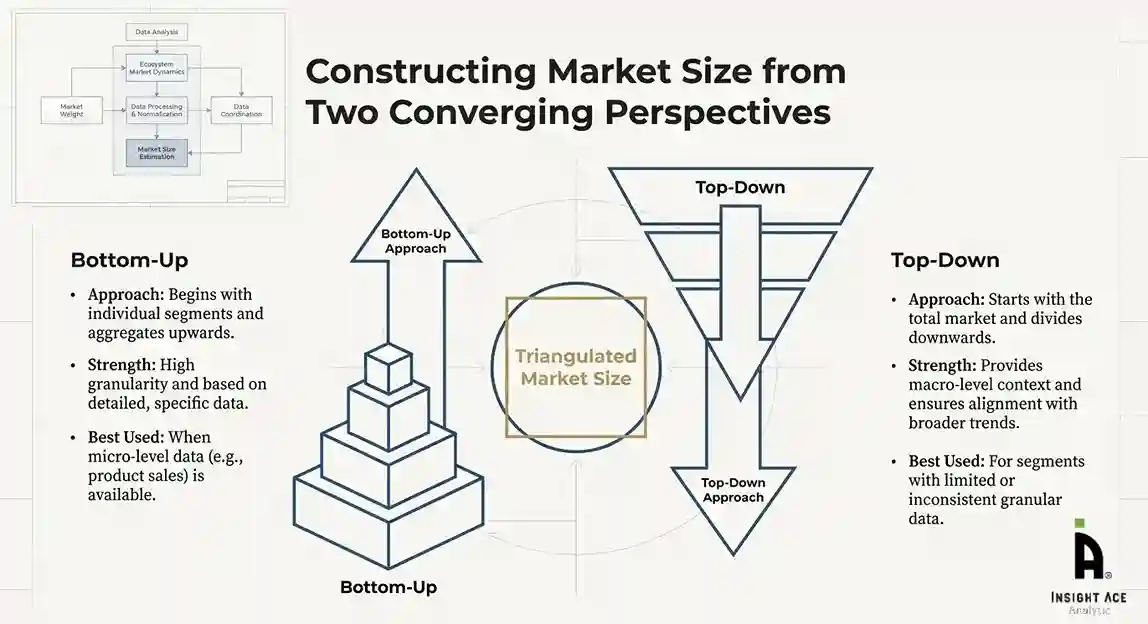
Top-Down Approach
The top-down approach used macro-level indicators:
- Parent market benchmarks
- Global/regional industry trends
- Economic indicators (GDP, demographics, spending patterns)
- Penetration and usage ratios
This approach was used for segments where granular data were limited or inconsistent.
Hybrid Triangulation Approach
To ensure accuracy, a triangulated hybrid model was used. This included:
- Reconciling top-down and bottom-up estimates
- Cross-checking revenues, volumes, and pricing assumptions
- Incorporating expert insights to validate segment splits and adoption rates
This multi-angle validation yielded the final market size.
Forecasting Framework and Scenario Modelling
Market forecasts were developed using a combination of time-series modelling, adoption curve analysis, and driver-based forecasting tools.
Forecasting Methods
- Time-series modelling
- S-curve and diffusion models (for emerging technologies)
- Driver-based forecasting (GDP, disposable income, adoption rates, regulatory changes)
- Price elasticity models
- Market maturity and lifecycle-based projections
Scenario Analysis
Given inherent uncertainties, three scenarios were constructed:
- Base-Case Scenario: Expected trajectory under current conditions
- Optimistic Scenario: High adoption, favourable regulation, strong economic tailwinds
- Conservative Scenario: Slow adoption, regulatory delays, economic constraints
Sensitivity testing was conducted on key variables, including pricing, demand elasticity, and regional adoption.
Request Customization
Add countries, segments, company profiles, or extend forecast — free 10% customization with purchase.
Customize This Report →Enquire Before Buying
Speak with our analyst team about scope, methodology, pricing, or deliverable formats.
Enquire Now →Frequently Asked Questions
Sustainable Home Decor Market Size is valued at USD 4.5 Bn in 2024 and is predicted to reach USD 9.4 Bn by the year 2034
Sustainable Home Decor Market is expected to grow at a 7.9% CAGR during the forecast period for 2025-2034.
Made Trade, Viva Terra, The Citizenry, Parachute Home, West Elm, Coyuchi, Avocado Green Brands, Etsy, Burrow, Branch Furniture, Medley Home,
Component, Application, and End-user. are the key segments of the Sustainable Home Decor Market
North America region is leading the Sustainable Home Decor Market.