Robot Charging Station Market Size, Share, Revenue Report 2026 to 2035
What is Robot Charging Station Market Size?
Robot Charging Station Market Size is valued at USD 783.80 Mn in 2025 and is predicted to reach USD 3,169.32 Mn by the year 2035 at a 15.2 CAGR during the forecast period for 2026 to 2035.
Robot Charging Station Market Size, Share & Trends Analysis Distribution by Station Type (Fixed, Mobile), By Level of Charging (Level 1, Level 2, Level 3), By Commercial Application (Parking Facilities, Airports, Retail Centers & Malls, Others) and Segment Forecasts, 2026 to 2035
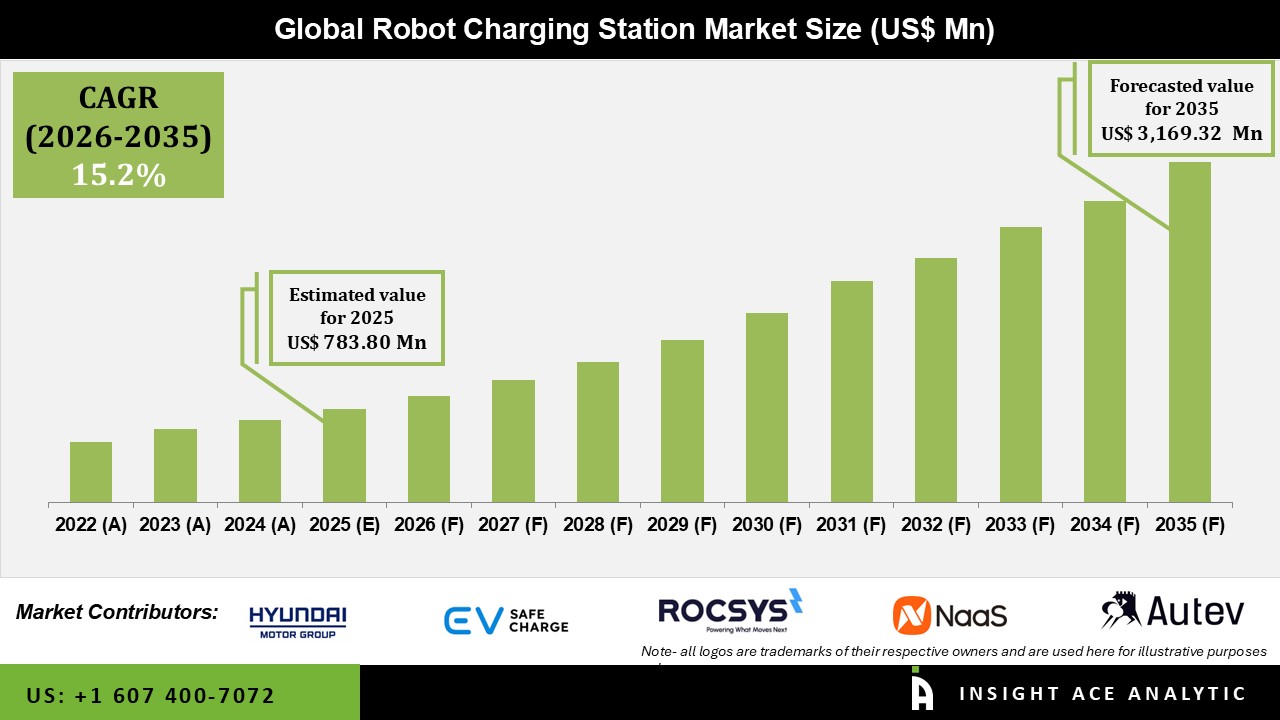
Robot charging stations are automated electric vehicle charging systems designed to deliver charging services with minimal or no human intervention. These systems utilize technologies such as robotic arms, automated charging connectors, autonomous positioning mechanisms, and mobile robotic charging units to establish a connection between the vehicle and the charging infrastructure. Depending on the system configuration, vehicles can automatically position themselves for charging, while mobile robotic chargers can be deployed to deliver charging services to parked vehicles without requiring a dedicated fixed charging point for every parking space.The technology is particularly relevant to environments where automated and flexible charging can improve operational efficiency, space utilization, and user convenience.
Robot charging stations can be deployed across public parking facilities, commercial and residential buildings, fleet depots, logistics and distribution centres, workplaces, and other high-utilization vehicle environments. By reducing the need for manual plug-in operations and enabling charging infrastructure to serve multiple vehicles, robotic charging systems are emerging as an important technology within the evolving electric vehicle charging ecosystem.
The market for robot charging stations involves the development and implementation of robotic systems which automate the physical linking and supply of electrical power to electric vehicles. It covers fixed robotic charging units, mobile charging robots, and automated conductive charging systems that are designed for use with passenger cars and commercial fleets. Since vehicle electrification and the automation of charging are progressing, the market is becoming an emerging area where robotics, electric vehicle infrastructure, and autonomous mobility come together, with available solutions ranging from prototype systems and pilot projects to commercially available charging platforms.
Competitive Landscape
Which are the Leading Players in the Robot Charging Station Market?
• Hyundai Motor Group
• EV Safe Charge Inc.
• Mob-Energy S.A.S
• VOLTERIO GmbH
• ROCSYS
• NaaS Technology, Inc
• Volkswagen Group
• Autev
• EVAR Inc.
• ALVERI GmbH
Market Dynamics
Driver
Growing Electric Vehicle Adoption and Demand for Automated Charging Solutions
The main factor behind the growth of the robot charging station market is the rising number of electric vehicles (EVs) and the growing demand for automated charging options. With the number of electric vehicles increasing in both passenger car and commercial fleet sectors, there is a greater need for convenient, efficient, and scalable charging facilities. Robotic charging systems carry out the physical connection between the vehicles and the chargers, cutting down on the requirement for manual handling and enabling charging activities at fleet depots, parking sites, and other commercial locations. This ability is especially useful for fleet operators who have to look after a number of vehicles, since charging automation can make their operations simpler and increase the availability of their vehicles.
Restrain/Challenge
High installation Costs and Integration Complexity of Robotic Charging Systems
The main challenge for the robot charging station market is the high initial investment and complexity of integrating robotic charging systems with existing EV infrastructure. Since such systems need specialized robotic hardware, sensors, control software, and vehicle-to-charger alignment technologies, the costs of installation and maintenance end up being higher than those of ordinary charging stations. Moreover, ensuring compatibility with various vehicle designs, charging connectors, and parking arrangements adds to the difficulty of putting the systems into use, especially when operators want to introduce automated charging across large and varied fleets of vehicles.
Fixed segment Segment is Expected to Drive the Robot Charging Station Market
The fixed segment is expected to drive the robot charging station market, supported by the deployment of automated charging systems at fleet depots, commercial parking facilities, logistics hubs, and other designated charging locations. Fixed robotic charging stations offer a dedicated charging arrangement that allows vehicles to connect automatically, facilitating regular charging operations and enabling integration with current EV infrastructure. Because they are well suited to high-frequency charging and to the predictable patterns of vehicle parking, they are important to fleet operators and commercial facilities that want to automate their charging processes.
Level 3 Segment is Growing at the Highest Rate in the Robot Charging Station Market
The Level 3 segment is anticipated to show the fastest rate of growth in the robot charging station market due to the rising demand for faster charging and less vehicle downtime in commercial fleets and in charging facilities that are used a lot. Since Level 3 charging, which is referred to as DC fast charging, can recharge EV batteries more rapidly than either Level 1 or Level 2 charging, it is well suited for use in fleet depots, public charging hubs, and other sites where it is necessary for vehicles to get back into service quickly. The way it can be incorporated with automated charging systems helps to improve the efficiency of fleet operations, although attention must still be given to its compatibility with robotic connectors and vehicle charging interfaces.
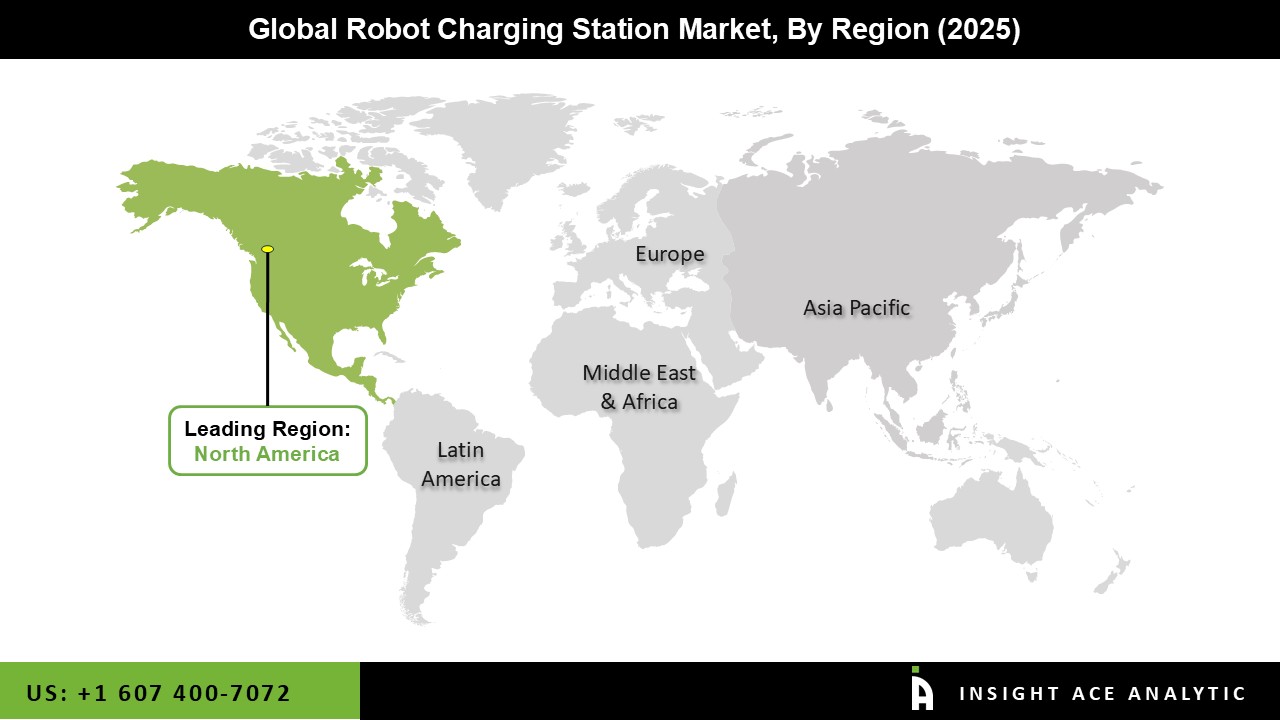
Why Asia-Pacific Led the Robot Charging Station Market?
The Asia-Pacific region is leading the robot charging station market, supported by rapid industrialization, expanding manufacturing and logistics operations, and increasing adoption of autonomous mobile robots (AMRs) and automated guided vehicles (AGVs). In China, Japan, South Korea and India, investment is being made in industrial automation, smart factories, and robotics technologies, which in turn raises the demand for automated charging infrastructure designed to reduce robot downtime and enable continuous operations in warehouses, automotive plants, and e-commerce facilities.
Key Development
May 2025: Hyundai Motor Group signed an MoU with Incheon International Airport Corporation to demonstrate AI-powered automatic EV charging robots at the airport, combining its robotics and AI capabilities with the airport operator’s expertise to validate automated charging solutions.
Robot Charging Station Market Report Scope:
| Report Attribute | Specifications |
| Market size value in 2025 | USD 783.80 Mn |
| Revenue forecast in 2035 | USD 3,169.32 Mn |
| Growth Rate CAGR | CAGR of 15.2% from 2026 to 2035 |
| Quantitative Units | Representation of revenue in US$ Mn and CAGR from 2026 to 2035 |
| Historic Year | 2022 to 2025 |
| Forecast Year | 2026-2035 |
| Report Coverage | The forecast of revenue, the position of the company, the competitive market structure, growth prospects, and trends |
| Segments Covered | Station Type, Level of Charging, Commercial Application, and By Region |
| Regional Scope | North America; Europe; Asia Pacific; Latin America; Middle East & Africa |
| Country Scope | U.S.; Canada; U.K.; Germany; China; India; Japan; Brazil; Mexico; France; Italy; Spain; South Korea; Southeast Asia |
| Competitive Landscape | Hyundai Motor Group, EV Safe Charge Inc., Mob-Energy S.A.S, VOLTERIO GmbH, ROCSYS, NaaS Technology, Inc, Volkswagen Group, Autev, EVAR Inc., ALVERI GmbH |
| Customization Scope | Free customization report with the procurement of the report, Modifications to the regional and segment scope. Geographic competitive landscape. |
| Pricing and Available Payment Methods | Explore pricing alternatives that are customized to your particular study requirements. |
Market Segmentation:
Robot Charging Station Market by Station Type -
• Fixed
• Mobile
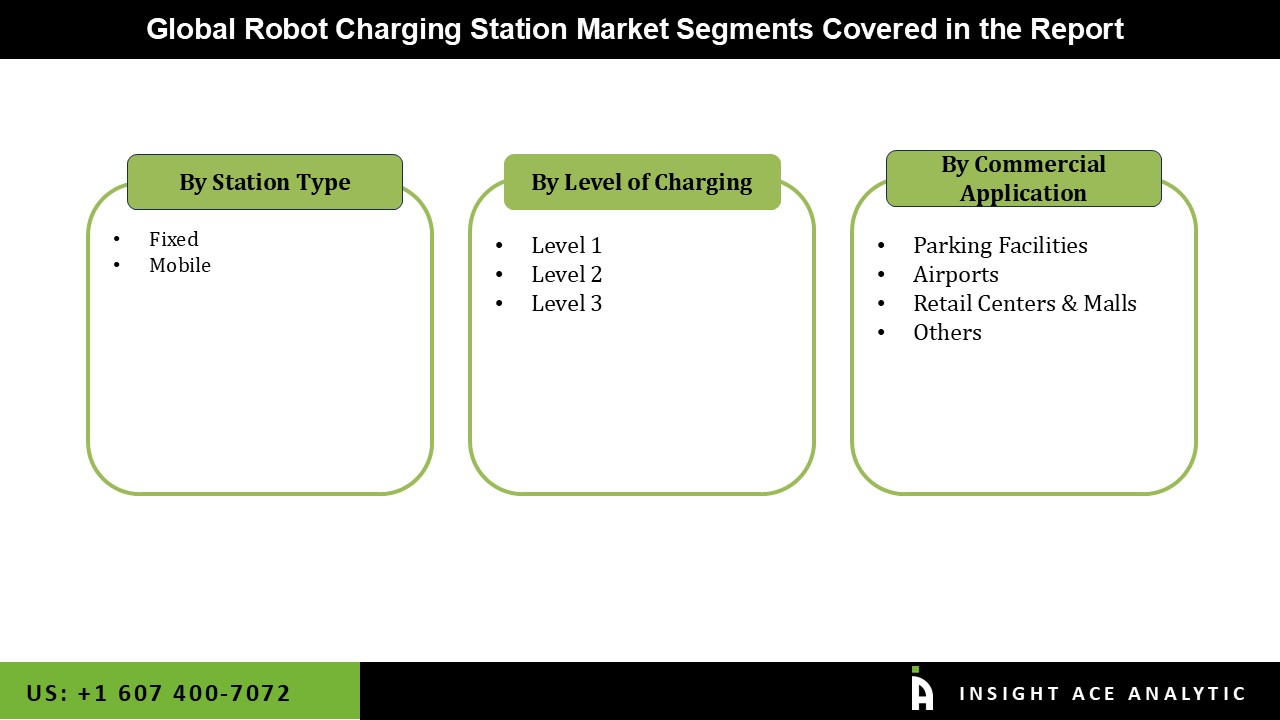
Robot Charging Station Market by Level of Charging -
• Level 1
• Level 2
• Level 3
Robot Charging Station Market by Commercial Application -
• Parking Facilities
• Airports
• Retail Centers & Malls
• Others
Robot Charging Station Market by Region-
North America-
• The US
• Canada
• Mexico
Europe-
• Germany
• The UK
• France
• Italy
• Spain
• Rest of Europe
Asia-Pacific-
• China
• Japan
• India
• South Korea
• South East Asia
• Rest of Asia Pacific
Latin America-
• Brazil
• Argentina
• Rest of Latin America
Middle East & Africa-
• GCC Countries
• South Africa
• Rest of Middle East and Africa
Research Design and Approach
This study employed a multi-step, mixed-method research approach that integrates:
- Secondary research
- Primary research
- Data triangulation
- Hybrid top-down and bottom-up modelling
- Forecasting and scenario analysis
This approach ensures a balanced and validated understanding of both macro- and micro-level market factors influencing the market.
Secondary Research
Secondary research for this study involved the collection, review, and analysis of publicly available and paid data sources to build the initial fact base, understand historical market behaviour, identify data gaps, and refine the hypotheses for primary research.
Sources Consulted
Secondary data for the market study was gathered from multiple credible sources, including:
- Government databases, regulatory bodies, and public institutions
- International organizations (WHO, OECD, IMF, World Bank, etc.)
- Commercial and paid databases
- Industry associations, trade publications, and technical journals
- Company annual reports, investor presentations, press releases, and SEC filings
- Academic research papers, patents, and scientific literature
- Previous market research publications and syndicated reports
These sources were used to compile historical data, market volumes/prices, industry trends, technological developments, and competitive insights.
Primary Research
Primary research was conducted to validate secondary data, understand real-time market dynamics, capture price points and adoption trends, and verify the assumptions used in the market modelling.
Stakeholders Interviewed
Primary interviews for this study involved:
- Manufacturers and suppliers in the market value chain
- Distributors, channel partners, and integrators
- End-users / customers (e.g., hospitals, labs, enterprises, consumers, etc., depending on the market)
- Industry experts, technology specialists, consultants, and regulatory professionals
- Senior executives (CEOs, CTOs, VPs, Directors) and product managers
Interview Process
Interviews were conducted via:
- Structured and semi-structured questionnaires
- Telephonic and video interactions
- Email correspondences
- Expert consultation sessions
Primary insights were incorporated into demand modelling, pricing analysis, technology evaluation, and market share estimation.
Data Processing, Normalization, and Validation
All collected data were processed and normalized to ensure consistency and comparability across regions and time frames.
The data validation process included:
- Standardization of units (currency conversions, volume units, inflation adjustments)
- Cross-verification of data points across multiple secondary sources
- Normalization of inconsistent datasets
- Identification and resolution of data gaps
- Outlier detection and removal through algorithmic and manual checks
- Plausibility and coherence checks across segments and geographies
This ensured that the dataset used for modelling was clean, robust, and reliable.
Market Size Estimation and Data Triangulation
Bottom-Up Approach
The bottom-up approach involved aggregating segment-level data, such as:
- Company revenues
- Product-level sales
- Installed base/usage volumes
- Adoption and penetration rates
- Pricing analysis
This method was primarily used when detailed micro-level market data were available.
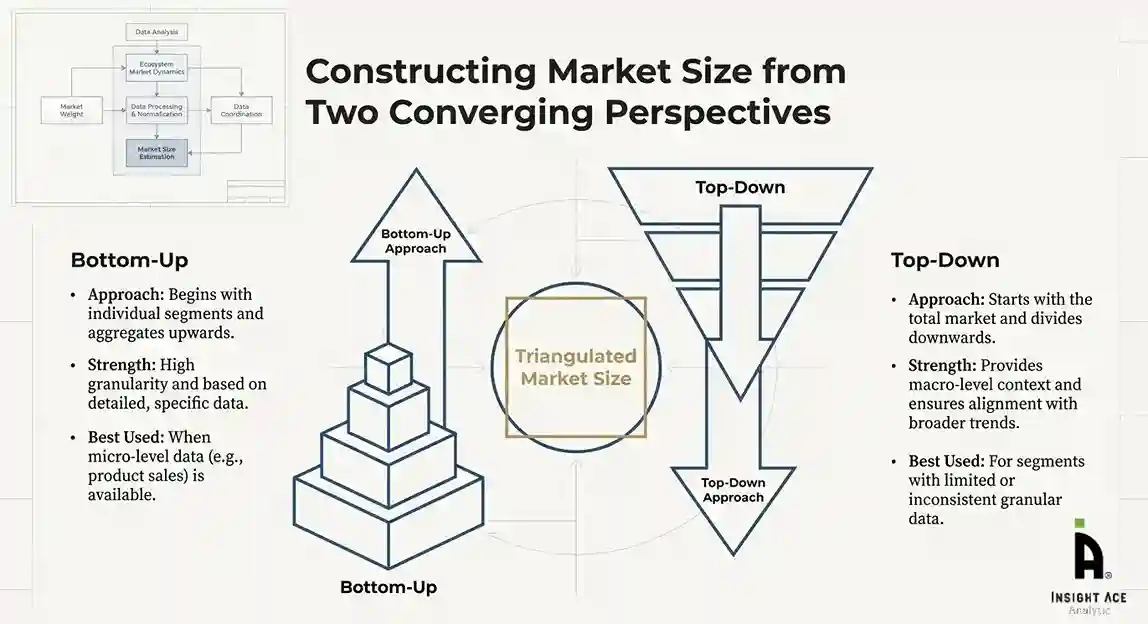
Top-Down Approach
The top-down approach used macro-level indicators:
- Parent market benchmarks
- Global/regional industry trends
- Economic indicators (GDP, demographics, spending patterns)
- Penetration and usage ratios
This approach was used for segments where granular data were limited or inconsistent.
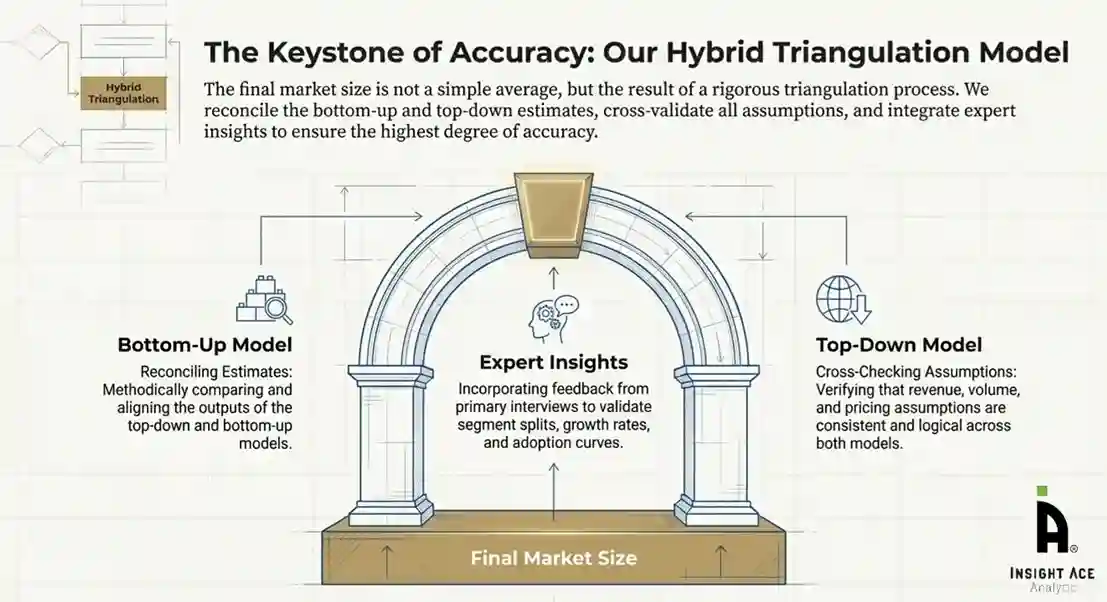
Hybrid Triangulation Approach
To ensure accuracy, a triangulated hybrid model was used. This included:
- Reconciling top-down and bottom-up estimates
- Cross-checking revenues, volumes, and pricing assumptions
- Incorporating expert insights to validate segment splits and adoption rates
This multi-angle validation yielded the final market size.
Forecasting Framework and Scenario Modelling
Market forecasts were developed using a combination of time-series modelling, adoption curve analysis, and driver-based forecasting tools.
Forecasting Methods
- Time-series modelling
- S-curve and diffusion models (for emerging technologies)
- Driver-based forecasting (GDP, disposable income, adoption rates, regulatory changes)
- Price elasticity models
- Market maturity and lifecycle-based projections
Scenario Analysis
Given inherent uncertainties, three scenarios were constructed:
- Base-Case Scenario: Expected trajectory under current conditions
- Optimistic Scenario: High adoption, favourable regulation, strong economic tailwinds
- Conservative Scenario: Slow adoption, regulatory delays, economic constraints
Sensitivity testing was conducted on key variables, including pricing, demand elasticity, and regional adoption.
Request Customization
Add countries, segments, company profiles, or extend forecast — free 10% customization with purchase.
Customize This Report →Enquire Before Buying
Speak with our analyst team about scope, methodology, pricing, or deliverable formats.
Enquire Now →Frequently Asked Questions
Robot Charging Station Market Size is valued at USD 783.80 Mn in 2025 and is predicted to reach USD 3,169.32 Mn by the year 2035
Robot Charging Station Market is expected to grow at a 15.2 CAGR during the forecast period for 2026 to 2035.
Hyundai Motor Group, EV Safe Charge Inc., Mob-Energy S.A.S, VOLTERIO GmbH, ROCSYS, NaaS Technology, Inc, Volkswagen Group, Autev, EVAR Inc., ALVERI GmbH
Robot Charging Station Market is segmented into Station Type, Level of Charging, Commercial Application, and By Region.
Asia Pacific region is leading the Robot Charging Station Market.